OTP vs. Silent Network: Choosing a Phone Verification Method
Use OTP where users can receive a code. Use silent verification where a live route is confirmed. Didit charges the carrier rate plus $0.02 per OTP code. The public price feed omits silent verification pricing.
 Alberto RosasCo-founder and CEO
Contents
In this guide
Jump to the part you need.
OTP fits when the destination and the device can receive one of the available channels. Silent network verification fits where a live route is confirmed and you want to remove the code step. At Didit a code costs the carrier price for the country and channel plus a $0.02 fee. We document coverage, per-number eligibility, country registration and approval status, so confirm the requirements for your route before relying on it. Didit's public price feed does not list a silent verification price.
Last updated: November 26, 2026. Prices checked against the live Didit price feed on November 26, 2026.
| Method | What the check establishes | Best fit | Main limit | Didit price unit |
|---|---|---|---|---|
| Silent network verification | Where supported, the mobile network is used to check whether the device's mobile connection matches the supplied number | Returning users and low-value sign-ups where a live route is confirmed | Coverage depends on country and operator; it removes the code-entry step, and SIM-swap risk needs a separate assessment | Didit's public price feed does not list a silent verification price |
| OTP over SMS, WhatsApp, Telegram, voice or Viber | The user types a time-limited code back into your flow | Any destination and device that can receive an available channel | Delivery failures, SIM swap, code phishing, users who abandon the step | Carrier price plus a $0.02 fee per code |
| Phone risk lookup | Carrier, line type, porting and fraud signals scored without sending a code | Screening a number before you contact it | A signal, not proof of ownership | Phone risk lookups are billed separately from verification codes |
| Silent-first with OTP fallback | A silent check where a route and an execution method are confirmed, then a code when there is none | A design option for mixed audiences, after a live route is confirmed | Two paths to build, monitor and reconcile | Didit's public price feed does not list a silent verification price; codes are carrier price plus a $0.02 fee |
Start free in the sandbox at business.didit.me with no sales call. Developers can connect Didit to an AI assistant through the MCP server. The phone step is documented in the Phone Verification overview, per-country code prices are on the phone price list, and every other unit price is on Pricing.
How OTP verification works
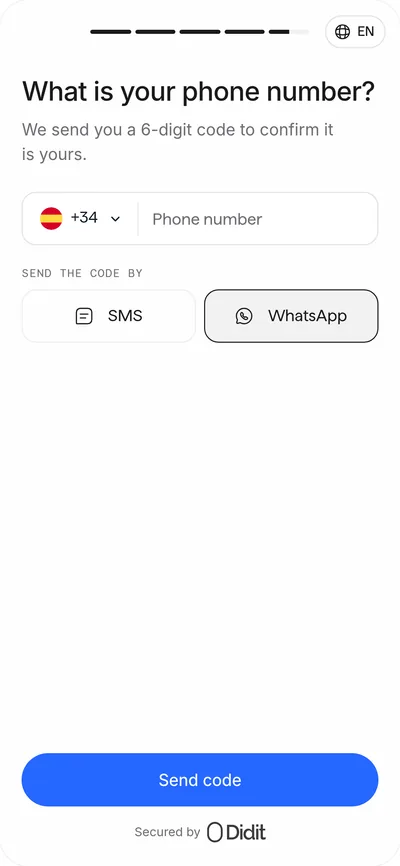
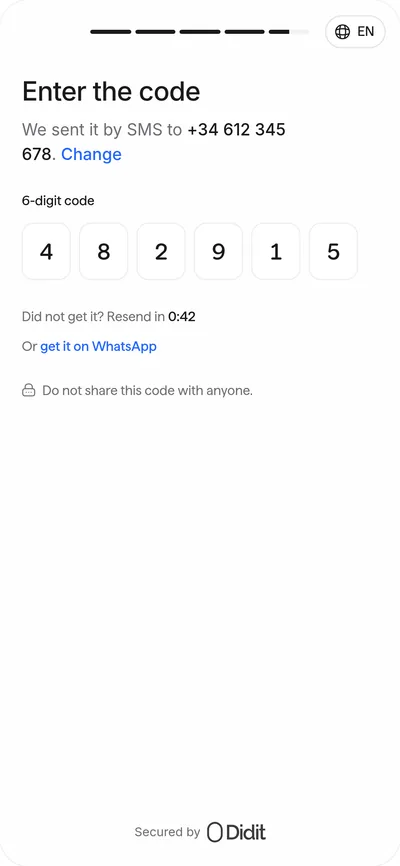
An OTP is a short code the user types back. The Didit Phone Verification product page introduces the product, the Phone Verification overview documents the phone step end to end, covering OTP, channels, risk signals and the decision payload, and the phone price list lists the price per code for each country and channel. We support SMS, WhatsApp, Telegram, voice and Viber, depending on country availability. The documented standalone send options list WhatsApp as the default, plus SMS, Telegram and voice. If a preferred channel is unavailable, the send can fall back to SMS. The default code window is 5 minutes from the first send, and a retry inside the same window keeps that deadline. A standalone verification allows 5 wrong entries by default before it ends.
SMS codes carry your sender name at no extra cost, for example "123456 is your verification code for Acme Bank". You set it in the Business Console or pass options.sms_sender_name on a single send. WhatsApp codes use a fixed message. Connect your own WhatsApp Business number in the Business Console to send them under your business name.
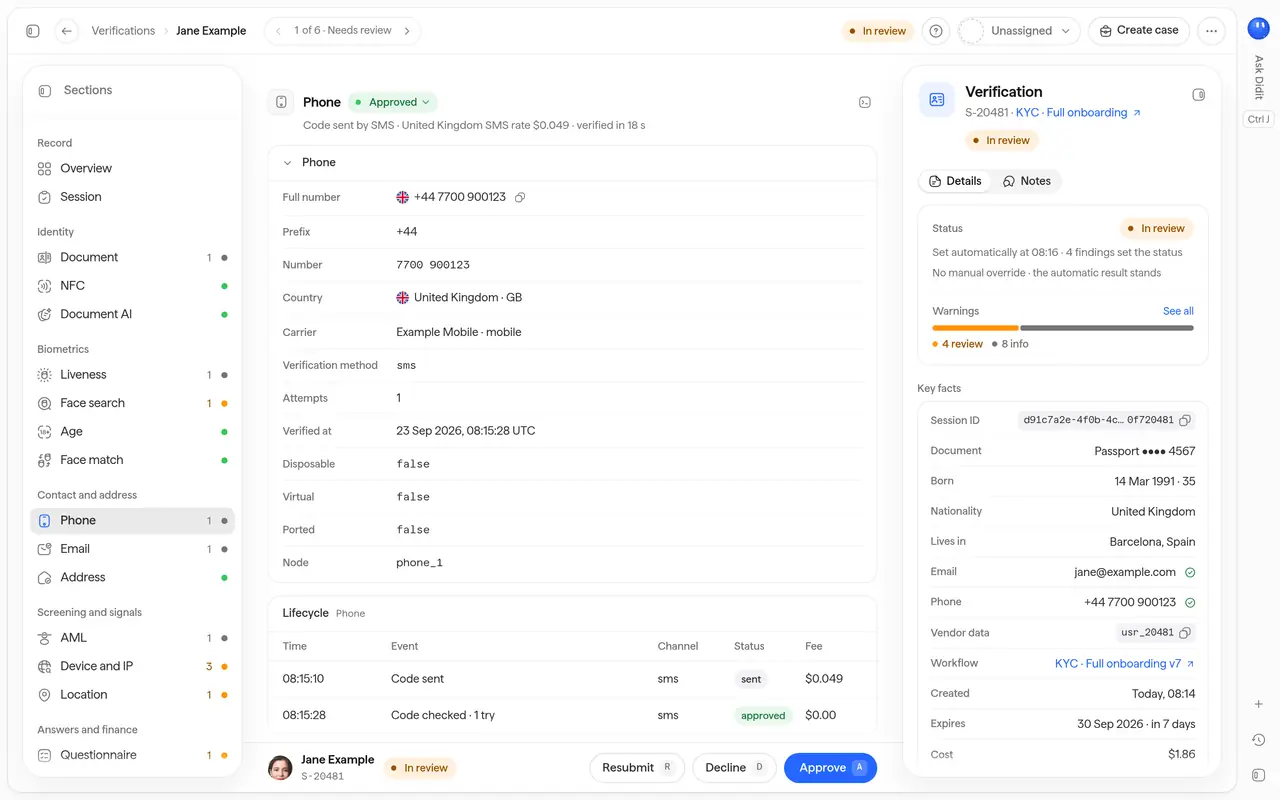
What comes back with the check matters as much as the code itself: carrier, line type, whether the number is disposable or virtual, and whether it was ported. We return those as risk signals and raise warnings such as DUPLICATED_PHONE_NUMBER, DISPOSABLE_NUMBER, VOIP_NUMBER, OTP_DELIVERY_FAILED, OTP_MAX_ATTEMPTS_REACHED and PHONE_NUMBER_BLOCKED. In a hosted workflow, we let you configure actions for duplicate, disposable and VoIP numbers. The standalone check accepts voip_number_action, for example set to DECLINE.
The trade-offs are concrete: users leave the flow to find the message and abandon the step, delivery fails on some international routes and through spam filters, a SIM swap moves the number to a fraudster's handset, and code phishing talks a user into reading the code aloud. Removing the typed code removes the code-phishing opportunity. The other three still need their own controls.
How silent network verification works
Where supported, silent network verification uses the mobile network to check whether the device's mobile connection matches the supplied number. It removes the code-entry step. SIM-swap risk requires a separate assessment.
Eligibility is a different question from matching. The eligibility call tells you whether a route may be available for a specific number. It does not prove that the person in your flow holds the phone. Coverage is arranged country by country, so we expose four calls you can test: check coverage, check a number, register a country and track approval. Check coverage for your target countries and eligibility for representative numbers. If your rollout requires a country registration, submit it and track its approval separately.
Our public docs describe coverage, per-number eligibility, country registration and approval status. They do not describe a production endpoint that executes a silent check, so confirm the execution method before you commit engineering time. Didit's public price feed does not list a silent verification price either, so do not put a per-check number in a budget until the route and its price are confirmed in writing.
Alternatives to SMS OTP and what each proves
You can combine these options based on what your flow needs to verify. Choose by channel availability, by what each method proves, and by cost per completed verification, not by a single headline price.
- Silent network verification, where a live route is confirmed: the mobile network is used to check whether the device's mobile connection matches the supplied number, and the code-entry step disappears.
- A phone risk lookup before you send anything:
POST /v3/phone/risk/scores carrier, line type, porting and fraud without delivering a code. It adds screening signals to your decision. It is not proof that the user holds the phone. - An app or voice channel instead of SMS: WhatsApp, Telegram, Viber, or a voice call that reads the code aloud twice. These still deliver a code, so the user still types it, and they need access to the corresponding service.
- An enrolled authentication factor: a time-based one-time password factor uses a time-based code from the user's own app, with no SMS at all. We enroll, list, read, update and delete factors through the authentication factor endpoints.
Before you send, check which channels a number can receive with message capabilities. That one call answers the availability question without a guessed country list.
Spain and feature phones: what still works
Use SMS on compatible feature phones, or select voice where it is available. An unanswered voice call falls back to SMS. An eligible first SMS request to a fixed line may route to voice and is charged as voice. App channels such as WhatsApp, Telegram and Viber require access to the corresponding service, while voice requires a line that can receive the call, so qualify support per user rather than by country.
| Channel | Price per code (USD) | Device support |
|---|---|---|
| SMS | $0.0685 | Compatible feature phones |
| $0.0582 | Access to WhatsApp | |
| Telegram | $0.05 | Access to Telegram |
| Viber | $0.0477 | Access to Viber |
The list price is the carrier charge for the route plus Didit's $0.02 fee, and only the fee takes the plan discount: on Scale the fee falls to $0.018 while the carrier charge passes through at cost. Billing uses the higher of the listed carrier price and the price the route reports. A cheaper channel is only cheaper if your users are on it, which is exactly where the feature-phone audience changes the answer.
Comparing vendors on Spain is short. We publish these routes per channel. Prove home page, read November 26, 2026, does not publish prices and does not state country coverage, so a Spanish price comparison against Prove is a quote, not a table.
Returning users: what replaces passwords and SMS codes
For a returning user the question changes. You are not learning the number, you are deciding whether to let this person back in.
An enrolled factor is the sign-in method. A time-based one-time password factor generates a code in the user's own app without an SMS, and biometric authentication takes the place of a code at $0.10 per authentication. The first 50,000 Authentication active users each month are free on every plan. Those are two separate facts with two billing units: an active user month and a completed authentication, neither of which is a verification code.
Phone and device signals are inputs to a step-up decision, not a sign-in method on their own: the number already on file, whether the device or IP changed, and what a risk lookup says about the line. A sequence worth evaluating is a silent check where a live route is confirmed, a risk lookup when the device changed, then a factor or a code when the signals justify it. Confirm the route and the execution method before you build it.
Evidence table: Didit vs Prove for phone verification
Didit publishes this ranking; we explain the criteria so you can check them. Didit is listed first. Prove's column reports only what Prove home page, read November 26, 2026, publishes, and marks the rest as unreported rather than scoring it.
| Criterion | Didit | Prove (Prove home page, read November 26, 2026) |
|---|---|---|
| Methods | OTP over SMS, WhatsApp, Telegram, voice and Viber; documented silent coverage and eligibility checks; phone risk scoring | Names Prove Identity Platform and Prove Solutions. Phone-specific methods are not published on the page. |
| Published pricing | A price per code for each country and channel on the public phone price list, plus Didit's $0.02 fee. Phone risk lookups are billed separately from verification codes. | Pricing is not published on Prove's home page; quote required. |
| Coverage | The public phone price list shows which channels are offered per country, and the documented capability check tells you what a specific number can receive. We document coverage, per-number eligibility, country registration and approval status. Confirm the requirements for your route before relying on it. | Not stated on the page we read. |
| Product breadth (KYC, KYB, AML, monitoring) | Full ID check at $0.33, KYB from $2.00 per company, AML screening at $0.20 and transaction monitoring at $0.001 per transaction beyond the plan's monthly allowance, all on one credit balance | Names Prove Identity Platform and Prove Solutions. It does not publish phone-specific methods, pricing, coverage, certifications or developer access. |
| Developer access | Free MCP server at didit.me/developers/mcp, REST API, SDKs and a sandbox that needs no sales call | Developer access is not described on the page, which shows a "Let's Talk" contact CTA. |
| Live test requirements | Sending verification codes is unlocked by a paid Growth or Scale plan or by the organization's first top-up. A limited live OTP pilot shows real carrier delivery, completion and billed cost, which a mocked sandbox cannot. | Not stated on the page we read. |
| Certifications | SOC 2 Type 2 report and ISO/IEC 27001:2022 certification, certificate ES144068. iBeta Level 1 PAD is separate biometric testing. | Not stated on the page we read. |
| Implementation | Two calls for standalone OTP (/v3/phone/send/ then /v3/phone/check/), or the phone step inside a session with a hosted flow or SDK | Not described on the page we read. |
| Price units | Carrier price plus a $0.02 fee per code, phone risk lookups billed separately from verification codes, $0.33 per full ID check | Not published; quote required. |
| Records | Every attempt kept on one verification record, filters and CSV export through GET /v3/phone/verifications/, and hosted session webhooks | Not described on the page we read. |
Matched volume price scenarios: 1,000, 10,000 and 100,000 codes
These scenarios compare one SMS code per user in the US and Spain. The table uses published list rates. Billing uses the higher of the listed carrier price and the price the route reports. Prove is listed as quote required at every volume: Prove home page, read November 26, 2026, publishes no price.
| Codes | Didit, US SMS at $0.0473 | Didit, Spain SMS at $0.0685 | Prove |
|---|---|---|---|
| 1,000 | $47.30 (1,000 x $0.0473) | $68.50 (1,000 x $0.0685) | Quote required |
| 10,000 | $473.00 (10,000 x $0.0473) | $685.00 (10,000 x $0.0685) | Quote required |
| 100,000 | $4,730.00 (100,000 x $0.0473) | $6,850.00 (100,000 x $0.0685) | Quote required |
On Scale the Didit fee drops to $0.018 while the carrier charge stays at cost, so a US SMS code becomes $0.0453 and 100,000 codes cost $4,530.00 (100,000 x $0.0453). On Growth the fee is $0.0192, which makes the same code $0.0465 and the same volume $4,650.00. The Growth and Scale figures apply their plan discounts to the Didit fee; subscription fees and credits are excluded.
Worked cost example: 10,000 Spanish sign-ups with a completed ID check
Take 10,000 sign-ups in Spain, each with a completed full ID check, and 8,000 SMS codes sent to Spanish numbers. The example uses only published unit prices, excludes lookup fees, and every figure is usage at published list rates with subscription fees and credits left out.
- Full ID check: 10,000 x $0.33 = $3,300.00
- Spanish SMS codes: 8,000 x $0.0685 = $548.00
- Total: $3,300.00 + $548.00 = $3,848.00
- Cost per sign-up: $3,848.00 / 10,000 = $0.3848
The example does not supply a count of successful phone verifications, so we do not report a cost per successful phone verification here. Track that number in a limited live pilot and divide the phone spend by it.
Two levers move the figure without changing the flow. Moving the 8,000 codes from SMS to WhatsApp in Spain takes the per-code price from $0.0685 to $0.0582 and saves 8,000 x $0.0103 = $82.40. On a Scale plan the fee on each code falls from $0.02 to $0.018, saving 8,000 x $0.002 = $16.00, and the $0.33 ID check becomes $0.297, a further $330.00. The channel change is a list-rate comparison; the Scale savings are a separate plan-rate comparison. Billing uses the higher of the listed carrier price and the price the route reports.
Strengths and limitations
Didit limitations
- Silent coverage depends on carrier arrangements per country. We document coverage, per-number eligibility, country registration and approval status; confirm the requirements for your route before relying on it. Our public docs describe those checks rather than a production endpoint that executes a silent check.
- The public list shows a price per code for each channel; a voice-only route is priced from the pricing endpoint for that route.
- OTP pricing is per code. Track billed codes separately from send requests when modeling retries. Didit does not charge when anti-abuse protection blocks a request before sending a code.
- Free plan credit does not cover phone codes, so a Free organization subscribes or tops up before its first live code.
Prove contact route
- Prove home page, read November 26, 2026, positions Prove as "Trust Infrastructure for an Agentic World" and describes identity as a persistent foundation of trust across people, businesses and AI agents.
- The page offers a "Let's Talk" contact route, which suits buyers who want a guided evaluation.
Prove gaps on the page we read
- Prove home page, read November 26, 2026, publishes no pricing, so every cost question becomes a quote.
- No country coverage is stated on that page, which makes a Spain or feature-phone decision hard to validate from the outside.
- No certifications or audit evidence is stated on that page.
- Developer access is not described: no sandbox, API reference or MCP path appears on the page.
When Prove is the better fit
Prove is the better fit when you want to start with the contact route on Prove home page, read November 26, 2026, a "Let's Talk" conversation, and evaluate the identity offering that page describes before you look at per-code economics. That suits organizations that buy through a guided evaluation and treat the phone step as one part of a wider identity agreement.
Before you sign, ask for country coverage, the per-check price, the certification reports and a test plan in writing, because none of those appear on the page we read. Ask specifically how a Spanish number and a feature-phone user are handled.
Didit is the better fit when you need to model cost before you commit and want OTP, risk signals and the documented silent capability calls on one API. It fits teams that need published OTP prices, standalone risk lookups or phone results in a hosted verification decision. We use one credit balance across products.
Migration plan: parallel test, webhooks, records
- Write down what your current flow collects and stores: the number format, who sends the code, what you keep about the attempt, and how your app reacts to a failed check.
- Validate the Didit flow in a sandbox application with the documented sandbox test data: decisions, scenario outcomes and webhook handling. The sandbox mocks external providers and never bills. It cannot validate real carrier delivery, silent coverage or actual billed costs.
- Run a limited live pilot for the things the sandbox cannot show: carrier coverage, delivery, completion and billed cost, in parallel with your current vendor.
- Decide the rule before you cut over: a code on the channel the number can receive, a risk lookup when the number is new or the device changed, and the action for each warning.
- Wire reporting to the right scope. For a hosted session, subscribe to
status.updatedand read the decision body, where phone results arrive inphone_verifications[]; verifyX-Signature-V2and check thatX-Timestampis within 5 minutes. For standalone calls, keep theverification_idfrom the send response and pass it to the check call to check and reconcile that specific verification. - Keep the records reconcilable. A retry stays on the same record, and
GET /v3/phone/verifications/filters by status, channel, phone number, reference, tag and creation time, and exports the matching rows withformat=csv. The CSV columns areverification_id,status,phone_number,country,created_atandverified_at. A risk lookup is not a verification and is read fromGET /v3/phone/lookups/.
curl -X POST 'https://verification.didit.me/v3/phone/send/' \
-H "x-api-key: $DIDIT_API_KEY" \
-H "Content-Type: application/json" \
-d '{
"phone_number": "+14155552671",
"options": {
  "code_size": 6,
  "preferred_channel": "whatsapp",
  "locale": "en-US"
},
"vendor_data": "user-1234"
}'

curl -X POST 'https://verification.didit.me/v3/phone/check/' \
-H "x-api-key: $DIDIT_API_KEY" \
-H "Content-Type: application/json" \
-d '{
"phone_number": "+14155552671",
"code": "123456",
"voip_number_action": "DECLINE"
}'
In the check call, 123456 represents the code the user received. Keep the verification_id that the send response returns and pass it to the check call to check that specific verification, as the standalone guide describes.
The switch page summarises what moves and what stays, and the webhook docs list every event type that can carry a phone result.
Sources
- Didit pricing: didit.me/pricing
- Didit phone price list by country and channel: didit.me/pricing/phone
- Didit pricing as JSON: didit.me/pricing.json
- Didit pricing in the docs: docs.didit.me/getting-started/pricing
- Didit phone verification product page: didit.me/products/phone-verification
- Didit phone verification overview: docs.didit.me/core-technology/phone-verification/overview
- Didit phone verification standalone API: docs.didit.me/standalone-apis/phone-verification
- Didit phone verification records: docs.didit.me/standalone-apis/phone-verifications-list
- Didit silent coverage, eligibility, registration and approval: coverage, eligibility, registration, approval status
- Didit message capabilities: docs.didit.me/standalone-apis/messages-capabilities
- Didit webhooks: docs.didit.me/integration/webhooks
- Didit sandbox testing: docs.didit.me/integration/sandbox-testing
- Didit MCP server: didit.me/developers/mcp
- Didit switch page: didit.me/switch
- Prove home page, prove.com, read November 26, 2026 (plain text, no link).
The next step is a sandbox application at business.didit.me: create one, run the phone step with the documented sandbox test data, and check the decisions and webhook handling before you compare carriers, delivery and billed costs in a limited live pilot. No sales call is involved.
Try it
Try this in the sandbox
Run the check this guide describes, free.
The product this post is about, taken from its topic. Run it free in the sandbox.
Author
Alberto Rosas
Co-founder and CEO

Keep reading
Other guides in the same topic.
 What Is the Purpose of FICA in South Africa? 2026 Guide
FICA is South Africa's anti-money laundering law. It creates the Financial Intelligence Centre and requires accountable institutions to identify and verify clients, screen for PEP and sanctions risk and report suspicious.
Alberto RosasNov 26, 2026 Sixth Money Laundering Directive (6AMLD): What Changed and Which Rules Apply
6AMLD is Directive (EU) 2018/1673: Member States must criminalise laundering, widen predicate offences and set a four-year penalty floor. It adds no new due diligence duties for firms.
Alberto RosasNov 26, 2026 Automated Sanctions Screening: Canada, the Entity List and Embargoes
Automated sanctions screening matches people and companies against lists such as Canada's autonomous sanctions made under SEMA and JVCFOA and the OFAC SDN List, and returns candidate hits scored for identity confidence and.
Alberto RosasNov 26, 2026Questions
Frequently asked questions
What are the alternatives to SMS OTP for verifying users silently?
The main one is silent network verification. Where supported, it uses the mobile network to check whether the device's mobile connection matches the supplied number, so there is no code for the user to type, and SIM-swap risk needs a separate assessment. Didit documents a coverage call and a per-number eligibility check, so you can confirm whether a route may be available before you route traffic to it. A phone risk lookup with POST /v3/phone/risk/ adds screening signals before you send anything, but it is not proof of ownership.
Is there an alternative to SMS OTP for Spain that still works on feature phones?
SMS works on compatible feature phones, and you can select voice where it is available: an unanswered voice call falls back to SMS, and an eligible first SMS request to a fixed line may route to voice and is charged as voice. On Didit a Spanish code costs $0.0685 by SMS, $0.0582 by WhatsApp, $0.05 by Telegram and $0.0477 by Viber at published list rates. WhatsApp, Telegram and Viber require access to the corresponding service, while voice needs a line that can receive the call.
What replaces passwords and SMS codes for verifying returning users?
Two different replacements. To replace an SMS code, enroll a time-based one-time password factor: it generates a code in the user's own app with no SMS. To replace a password in a sign-in flow, use an enrolled factor or biometric authentication, which costs $0.10 per authentication. The first 50,000 Authentication active users each month are free on every plan, an active-user month billed separately from a completed authentication. Phone and device signals, such as the number on file and a changed device, are inputs to a step-up decision rather than a sign-in method on their own.
Are there alternatives to verifying a real phone number at all?
If the phone step is not pulling its weight, you can identify the person with a document and biometrics instead: a full ID check on Didit is $0.33 and includes the ID document, passive liveness, face match and device and IP analysis. Email verification at $0.02 per check can carry contactability for flows that do not need a phone. What you lose is a verified phone contact channel and phone-number duplicate detection, which a hosted workflow reports as DUPLICATED_PHONE_NUMBER.
How much does Didit charge per OTP code?
Per code you pay the carrier price for the country and channel plus a $0.02 Didit fee, so a US SMS code is $0.0473 and a Spanish SMS code is $0.0685 at published list rates. On Growth the fee is $0.0192 and on Scale it is $0.018, while the carrier charge passes through at cost. Billing uses the higher of the listed carrier price and the price the route reports. Phone risk lookups are billed separately from verification codes.
Does Didit support silent network verification?
We document four capabilities: coverage, a per-number eligibility check, a country registration and an approval status call, all separate from the OTP send and check endpoints. Those calls tell you whether a route may be available and whether a country is approved. Our public docs do not describe a production endpoint that executes a silent check, so confirm the execution method with us before you build on it, and keep OTP as the fallback.
Which is more secure, OTP or silent network verification?
Where supported, silent network verification uses the mobile network to check whether the device's mobile connection matches the supplied number, and it removes the code-entry step, so there is no code to phish. SIM-swap risk requires a separate assessment rather than being solved by the method itself. A successful OTP check shows that the person in the flow could supply the code sent to that number. For high-value actions, pair a silent check with a step-up factor instead of relying on one method alone.
Can I run OTP and silent network verification in the same flow?
Silent-first with OTP fallback is a design option, not a ready-to-deploy default: confirm a live route and the execution method first, then keep a code as the fallback when there is no route or the risk signals are high. For OTP, a hosted session returns phone results in phone_verifications[]. For standalone OTP, pass the verification_id returned by the send call to check that specific verification. Confirm how silent execution returns its result before combining the paths.
How long does switching phone verification vendors take?
The technical move is short: two calls for standalone OTP, or the phone step inside a session if you use the hosted flow or an SDK. A Didit sandbox application takes minutes, never bills, and lets you validate decisions and webhook handling with documented test data. We do not publish a fixed migration time because the variable is your own review, webhook handling and parallel run, plus the limited live pilot that shows real delivery and billed costs.
What does Prove charge for phone verification?
Prove home page, read November 26, 2026, does not publish pricing, so the answer is quote required. The same page does not state country coverage, developer tools, onboarding time or certifications, and it points to a "Let's Talk" contact route rather than a self-serve sandbox. Ask for the per-check price, coverage list and audit reports in writing before you compare it with a published price list.
Compliance built in
Audited, certified and attested.
We hold the certifications and build each country's rules into your flows, so you can launch anywhere without worrying. Security and Compliance center
- Regulation encoded into your flows
Tell us what you do and where. Didit lists the rules that apply to you, with sources, and builds the checks each country needs into one workflow.
- Ready for AMLR
Every requirement of the new EU anti-money laundering rules, from checking customers to human review, is already covered by a Didit check.
- Tested in Spain's Treasury sandbox
Spain's Treasury published its supervised sandbox report on Didit's NFC plus active liveness onboarding; SEPBLAC took part and valued the added measures positively.
- Audited, not self-declared
iBeta Level 1 and Level 2. Liveness tested under ISO/IEC 30107-3.
Your obligations · 3 regions
 SOC 2 Type 2
 ISO 27001
 iBeta Level 1 and Level 2
 EU regulator attestation
 FSM youth protection
 GDPR
 EBA remote onboarding
 MiCA compatible
 FIDO Alliance member
- AMLREU AML Regulation ready
Integration · Didit MCP
Run Didit from your own AI agent
Connect Didit to Claude, Cursor, VS Code or ChatGPT and just ask in plain words. Your agent can do anything you can do in the console, with the same permissions you have.
 Add to Claude
 ChatGPT
 Cursor
- Build workflowsDescribe the checks you need. The agent creates and publishes the flow.
- Run investigationsAsk why a session was declined, review cases, search people and companies.
- Change rulesCreate payment rules, test them on past data and switch them on.
- Pull reportsAsk for numbers, exports or the audit log.
Didit Academy


