Panama cédula verification API: government database lookup
Didit verifies a Panama cédula through Database Validation against the source its docs name as the Tribunal Electoral biometric service (SIB, SIB Plus).
 Alberto RosasCo-founder and CEO
Contents
In this guide
Jump to the part you need.
This page is for teams onboarding Panamanian users who need to confirm a cédula number exists in the registry and belongs to the person on camera. Didit checks it through Database Validation, a non-document lookup. Database Validation is priced per service and listed as variable, from $0.05 per check, so read the per-service table for Panama. Caveat: the Panama source returns its own biometric verdict, not a portrait, and Didit Liveness and Face Match steps are billed separately.
Last updated: November 26, 2026. Prices checked against the live Didit price feed on November 26, 2026.
| Item | Detail |
|---|---|
| Method | Non-document lookup (Database Validation) with the source's biometric comparison |
| Source named in Didit docs | Tribunal Electoral biometric service, written as SIB and SIB Plus |
| Service id | pan_sib |
| Identifier | The cédula number, sent in identification_number |
| Extra inputs | selfie (JPG, PNG or WebP, up to 2 MB) and gender |
| Assurance tier | data_match |
| Price | Database Validation is variable per service; the Panama rate is on the per-service pricing table. |
| Fallback | Document capture, if you switch it on for Panama |
| Docs | Database Validation API and Non-document lookup |
Start free in the sandbox at https://business.didit.me/ with no sales call. Developers can connect Didit to an AI assistant through https://didit.me/developers/mcp/. The matching Database Validation product page is Database Validation API, and plans and discounts are on https://didit.me/pricing/.
What a Panama cédula check actually queries
Didit's Database Validation verifies a person's identity data against the authoritative source for that country: the national civil registry, tax authority, electoral roll, credit bureau or biometric registry that issued the document in the first place. For Panama the docs name the source exactly: the Tribunal Electoral biometric service, written as SIB and SIB Plus. The catalog id you send is pan_sib.
We do not generalise that mapping, because the source determines what the match proves, which consent regime the query runs under, and what you can tell a regulator about provenance. The docs put it this way:
The Source queried column below names the exact source for every country, and it is the only statement of provenance to rely on.
Two practical consequences. First, the lookup proves the details the user typed matched a record the source holds. No document was inspected, so the assurance tier is data_match and nothing about a document's authenticity is being claimed. Second, the end user never sees the source name or the tier. The flow you run decides where the source is recorded. On an ID Verification non-document lookup it is on the session payload as id_lookup.source. On Database Validation it is in the database_validations[] array, on services_used and in each entry of validations[], and in both flows it appears in the Didit Business Console and in your exports, for you and your auditors.
Where Panama differs from a plain data lookup is the selfie. The Tribunal Electoral biometric service runs its own comparison and returns a verdict rather than a portrait. That comparison is part of the lookup service. It is not a liveness check in Didit's sense, so the country's skip_liveness_and_face_match switch is normalised off on save and any Liveness and Face Match steps in your workflow still run. On a match, Face Match compares your live capture with the selfie the lookup verified. Those separately configured steps are additional charges.
What Panama's official sources establish
The Tribunal Electoral page for the Trámite de renovación de cédula (Tribunal Electoral, read November 26, 2026) describes the renewal as an in-person act. The applicant books an appointment through tribunalcontigo.te.gob.pa, presents themselves at a regional or district office that has the triada (photography) service, and provides their cédula number. The page is a procedure guide, not a KYC or identity-verification mandate, and it does not establish the technical provenance of any lookup. The Didit docs separately name the Tribunal Electoral's biometric service as the Panama source.
The data-protection framework comes from the Gaceta Oficial Digital No. 30661, published Thursday 26 November 2026 (read November 26, 2026). It carries MIDES Resolución N° 409 of 22 October 2026, which adopts the Ficha Básica de Emergencia Social (FIBES). The text states that the information collected is confidential and handled under Ley 81 of 26 March 2019 on Protection of Personal Data, that access is limited to authorized personnel, that use for political, electoral or commercial purposes is prohibited, and that sensitive questions are skipped when the person does not authorize them (question 10). The resolution governs an emergency social form, not identity checks, so read it as the framework in force: purpose limitation, authorization and restricted access. It is not an identity-verification mandate.
One source card is not usable as evidence about Panama. The SINE page from the Tribunal Electoral (read November 26, 2026) republishes a Noticias Caracol article about Colombia's Registraduría Nacional and its 2023 biometric voter authentication. It contains nothing about Panamanian registers or databases. We list it in Sources so nobody treats it as a Panama register reference.
Identifiers and fields
Didit's docs do not publish a mask or check-digit rule for the Panamanian cédula, so pass the number as printed on the card and let the source answer. Everything else in the table is documented.
| Item | What it carries | Where it appears |
|---|---|---|
| Source register | Tribunal Electoral biometric service, SIB and SIB Plus, as named in Didit docs | Docs, console country row, id_lookup.source |
| Service id | pan_sib | services on the API call |
| Identifier | The cédula number, as printed | identification_number |
| Country | ISO 3166-1 alpha-3 code PAN | issuing_state |
| Name | Given and family name | first_name, last_name |
| Date of birth | YYYY-MM-DD | date_of_birth |
| Gender | Required by pan_sib alongside the selfie; the console's expected request panel shows what the source expects | gender |
| Selfie | JPG, PNG or WebP, up to 2 MB | selfie |
| Consent | Required when the service is flagged requires_consent, otherwise HTTP 400 | consent=true |
| Assurance tier | The result is a data match, not a document inspection | data_match |
What Didit returns for Panama
The decision carries a database_validations[] array, one entry per call. Each entry returns match_type, which is full_match, partial_match or no_match, plus validation_type, services_used, match_score and a validations[] list. Inside each validation you get the service, its status, the fields that matched (matched_fields) and record_details when the source returns them, so you can see that the cédula and date of birth matched while a surname did not.
Warnings use the DATABASE_VALIDATION codes: DATABASE_VALIDATION_NO_MATCH, DATABASE_VALIDATION_PARTIAL_MATCH and COULD_NOT_PERFORM_DATABASE_VALIDATION. Biometric outcomes surface through the per-service outcome_code, for example BIOMETRIC_NO_MATCH. If a configured validation produced no result at all, the decision explains why in database_validation_not_performed_reason. The decision also carries biometric_retention with jurisdictions and deletes_at, which tells you when live biometric data is deleted.

Run it in the Business Console
The console and the Management API are two views of the same workflow object, so a click writes the config you could also send as JSON.
- Open Workflows, choose the workflow and add the
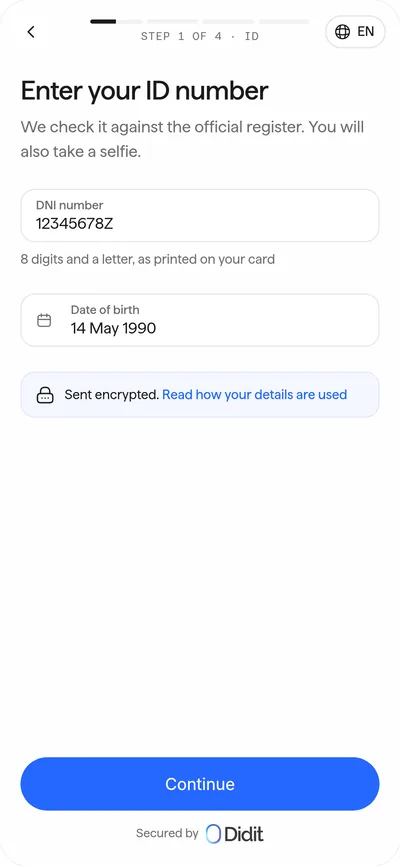
DATABASE_VALIDATIONfeature. Optionally pin the services each country may use. - Select the ID Verification node, open the Countries tab and open Panama.
- Turn on Non-doc lookup and set
id_lookup.max_attemptsto the number of answered attempts a user gets. - Turn on Document capture if you want a fallback, then set the switches
on_partial_match,on_no_matchandon_provider_errortofallback_to_document. Those switches are unavailable when document capture is off, because there is nowhere to fall back to. - Leave Liveness and Face Match steps in the workflow. For Panama,
skip_liveness_and_face_matchis normalised off on save, so any Liveness and Face Match steps in the workflow still run. - Use See details on the Panama source to read the expected request and response in plain language.
- Save, publish, run a session, then read the completed session's detail page for the method actually used and the source name.
Run it through the API
There are two modes and the choice is about where the data comes from, not about price.
Mode A: the lookup as a step in a hosted flow
Create a session with the workflow that has Database Validation enabled, send the user to the returned URL, then read the decision. Fields are fed into the registry lookup from the steps in front of it, so no separate parameter push is needed.
curl -X POST 'https://verification.didit.me/v3/session/' -H "x-api-key: $DIDIT_API_KEY" -H "Content-Type: application/json" -d '{"workflow_id":"WORKFLOW_UUID","vendor_data":"user-1234","callback":"https://app.example.com/done"}'curl https://verification.didit.me/v3/session/<SESSION_ID>/decision/ -H "x-api-key: $DIDIT_API_KEY"Branch on session_kind first, then read database_validations. You can also subscribe to session.status.updated instead of polling. See Create Session and Retrieve Session.
Mode B: a standalone server-to-server check
Use this when your own system already holds the cédula data and you want one call that returns the registry verdict.
curl -X POST 'https://verification.didit.me/v3/database-validation/' -H "x-api-key: $DIDIT_API_KEY" -F "issuing_state=PAN" -F "identification_number=CEDULA_NUMBER" -F "first_name=Jane" -F "last_name=Doe" -F "date_of_birth=1990-01-15" -F "gender=GENDER_VALUE" -F "selfie=@selfie.jpg" -F "vendor_data=user-1234"Omit services to run the country's default service, or pass services=["pan_sib"] to choose the Panama service explicitly. Billing is per successful service hit, so a multi-service request can produce more than one usage event. The response is { request_id, database_validation: { match_type, validation_type, services_used, match_score, validations, warnings } }.
Worked cost example
The public price feed lists Database Validation as Variable, so write the Panama rate as P; the per-service pricing table gives the exact figure. The Panama lookup includes the source's own selfie comparison. The Liveness, Face Match and Device and IP Analysis steps below are configured in the workflow and billed separately.
A Panama lookup that matches the registry, with the Liveness, Face Match and Device and IP Analysis steps configured in the workflow:
- Panama lookup (
pan_sib): P, variable per service; includes the source's own selfie comparison. - Passive Liveness step: $0.10.
- Face Match 1:1 step: $0.05.
- Device and IP analysis: $0.03.
- Fixed add-on per completed check: 0.10 + 0.05 + 0.03 = $0.18.
A user who falls back to document capture instead:
- ID document verification: $0.15.
- Passive Liveness: $0.10.
- Face Match 1:1: $0.05.
- Device and IP analysis: $0.03.
- Total: 0.15 + 0.10 + 0.05 + 0.03 = $0.33 per completed check.
Now take 1,000 Panama sessions where 850 match the registry and 150 fall back to a document. The lookup group costs 850 x (P + 0.18) = 850P + 153.00. The fallback group costs 150 x 0.33 = 49.50. Add them: 850P + 153.00 + 49.50 = 850P + 202.50. On the Scale plan the same fallback path prices at 0.135 + 0.09 + 0.045 + 0.027 = $0.297 per check, and 150 x 0.297 = 44.55. The 10% discount applies to Didit prices, including the per-service lookup rate. The sandbox is free on every plan.
Fallbacks when the source is down or has no match
Panama's registry is a remote system you do not control. Route each documented response: HTTP 400 means fix the request, HTTP 502 means the upstream services failed and the request is not billed, and each match_type maps to an action you configure.
- HTTP 502 with
validation_errors[]: every selected upstream service failed. The request is not billed and aCOULD_NOT_PERFORM_DATABASE_VALIDATIONlog is written. Retry later or fall back to document capture. match_typeofno_match: the submitted details were not found in the registry. Apply your policy or route the user to document capture ifon_no_matchis set tofallback_to_document.match_typeofpartial_match: some fields matched and others did not, for example the cédula matched and the surname did not. Route to review, or fall back to a document.BIOMETRIC_NO_MATCH: a documented per-service outcome code for the biometric comparison. The workflow branch you configured controls the next step.- HTTP 400: the service id is not eligible for
issuing_state, a required field is missing, or consent is missing on a service flaggedrequires_consent.

Sources
- Didit docs: Database Validation API, government-registry KYC
- Didit docs: Non-document ID verification, authoritative source lookup
- Didit docs: ID verification methods and assurance tiers
- Didit docs: Configure ID verification methods in the console
- Didit docs: Create Session API
- Didit docs: Retrieve Session API
- Didit pricing and pricing as JSON
- Tribunal Electoral, Trámite de renovación de cédula, read November 26, 2026. Official page
- Gaceta Oficial Digital No. 30661, Thursday 26 November 2026, MIDES Resolución N° 409, read November 26, 2026. Official gazette PDF
- SINE, Tribunal Electoral de Panamá, Biometría en elecciones regionales 2023, read November 26, 2026. The page republishes a Noticias Caracol article about Colombia's Registraduría Nacional and contains no information about Panamanian registers. SINE article 73817
Start free in the sandbox at https://business.didit.me/, no sales call. Developers can wire the Panama lookup through an assistant with the MCP server at https://didit.me/developers/mcp/, and teams replacing another provider can start from https://didit.me/switch/.
Try it
Try this in the sandbox
Run the check this guide describes, free.
The product this post is about, taken from its topic. Run it free in the sandbox.
Author
Alberto Rosas
Co-founder and CEO

Keep reading
Other guides in the same topic.
 USA PATRIOT Act Section 314: AML Information Sharing Explained
Section 314(a) lets law enforcement request account data through FinCEN. Section 314(b) gives financial institutions a voluntary, registered safe harbor to share risk information with each other.
Alberto RosasNov 26, 2026 Driver's License Number, ISS and DD: Document Fields Explained
A driver's license number identifies the driving record. ISS is the card's issue date. DD is the document discriminator for that one card, not for the person.
Alberto RosasNov 26, 2026 SAR vs UAR: AML Case Management That Ends in a Filing
A SAR is the suspicious activity report filed with the FIU. A UAR is the unusual activity report that records why activity looked odd. One case holds the evidence, the decision and the filing.
Alberto RosasNov 26, 2026Questions
Frequently asked questions
Does Didit verify Panama cédula numbers against a government database?
Yes. Didit Database Validation checks the identity data against the source named in its docs. For Panama the docs name the Tribunal Electoral biometric service, written as SIB and SIB Plus, with the service id pan_sib. It returns a per-field match, an aggregated match_type and the underlying record details when the source provides them.
What is the difference between SIB and SIB Plus for a Panama check?
The Didit docs expose one service id, pan_sib, and do not document separate API behavior for SIB versus SIB Plus. They name both as the Tribunal Electoral biometric service used for Panama.
How much does a Panama cédula check cost?
The Panama lookup rate is P on the per-service pricing table. Separately configured steps are public: Passive Liveness at $0.10, Face Match 1:1 at $0.05 and device and IP analysis at $0.03, so $0.18 on top of the lookup price. Document Verification alone is $0.15 per check. If the fallback workflow also runs Passive Liveness, Face Match 1:1 and Device and IP Analysis, the completed fallback path totals $0.33.
Is a selfie required for a Panama cédula lookup?
Yes. The pan_sib service takes an extra selfie, as JPG, PNG or WebP up to 2 MB, plus gender. The source runs the face comparison itself and returns a verdict, so Didit asks the user for the selfie inside the lookup step.
Does the Panama lookup let me skip Liveness and Face Match?
No. Panama's source checks the selfie itself and returns a verdict rather than a portrait, so the skip_liveness_and_face_match switch is normalised off on save. Any Liveness and Face Match steps in your workflow still run. On a match, Face Match compares the live capture with the selfie the lookup verified.
What does match_type no_match mean for a Panamanian user?
It means the submitted details were not found in the registry. Apply your policy or set on_no_match to fallback_to_document so the person can still verify with a photographed document.
Which API endpoint checks a Panama cédula server to server?
Call POST https://verification.didit.me/v3/database-validation/ with issuing_state=PAN, the cédula number in identification_number, name, date of birth, gender and a selfie, authenticated with the x-api-key header. It returns a database_validation object with match_type and a validations[] list.
What happens if the Tribunal Electoral source is down?
You get an HTTP 502 with validation_errors[]. The request is not billed and a COULD_NOT_PERFORM_DATABASE_VALIDATION log is written, so retry later or let the workflow fall back to document capture. If a configured validation produced no result for another reason, the decision states why in database_validation_not_performed_reason.
Which assurance tier does a Panama cédula lookup produce?
The result carries the data_match tier, which means the details the user gave matched a record the source holds. No document was inspected, so the tier does not claim anything about a document's authenticity. Add document capture if your policy needs the documentary tier as well.
Can I test Didit flows in the sandbox for free?
Yes. Sandbox testing is free and unlimited on every plan, and you can create an account at business.didit.me without a sales call. Production country and method availability is a separate question, so check the docs for the countries and methods you plan to use before launch.
Compliance built in
Audited, certified and attested.
We hold the certifications and build each country's rules into your flows, so you can launch anywhere without worrying. Security and Compliance center
- Regulation encoded into your flows
Tell us what you do and where. Didit lists the rules that apply to you, with sources, and builds the checks each country needs into one workflow.
- Ready for AMLR
Every requirement of the new EU anti-money laundering rules, from checking customers to human review, is already covered by a Didit check.
- Tested in Spain's Treasury sandbox
Spain's Treasury published its supervised sandbox report on Didit's NFC plus active liveness onboarding; SEPBLAC took part and valued the added measures positively.
- Audited, not self-declared
iBeta Level 1 and Level 2. Liveness tested under ISO/IEC 30107-3.
Your obligations · 3 regions
 SOC 2 Type 2
 ISO 27001
 iBeta Level 1 and Level 2
 EU regulator attestation
 FSM youth protection
 GDPR
 EBA remote onboarding
 MiCA compatible
 FIDO Alliance member
- AMLREU AML Regulation ready
Integration · Didit MCP
Run Didit from your own AI agent
Connect Didit to Claude, Cursor, VS Code or ChatGPT and just ask in plain words. Your agent can do anything you can do in the console, with the same permissions you have.
 Add to Claude
 ChatGPT
 Cursor
- Build workflowsDescribe the checks you need. The agent creates and publishes the flow.
- Run investigationsAsk why a session was declined, review cases, search people and companies.
- Change rulesCreate payment rules, test them on past data and switch them on.
- Pull reportsAsk for numbers, exports or the audit log.
Didit Academy


