Passive Liveness Detection in 9 Steps: Stop Deepfakes (2026)
Passive liveness detects deepfakes, printed photos and screen replays from one selfie. We charge $0.10 per Passive Liveness check, in a session or on the standalone API, with a free sandbox.
 Alejandro RosasCo-founder and CTO
Contents
In this guide
Jump to the part you need.
Use our passive liveness check when you need to catch a printed photo, a screen replay, a mask or a deepfake from one selfie, with no head turn and no blinking on cue. It fits sign-up, account recovery and step-up checks before a payment. Passive Liveness costs $0.10 per check. The caveat: passive is our standard security tier, so put 3D Flash or 3D Action in front of high-value accounts.
Last updated: November 26, 2026. Prices checked against the live Didit price feed on November 26, 2026.
| Item | Detail |
|---|---|
| What it answers | Is a real person in front of the camera, or a print, a screen, a mask or a deepfake? |
| Input | One front-facing face image: jpg, jpeg, png, tiff or webp, up to 5 MB, no PDFs |
| Output | status, score from 0 to 100, warnings[], face_quality, face_luminance |
| Price in a session | $0.10 per check |
| Price, standalone API | $0.10 per call, billed as one Passive Liveness credit per 200 response |
| Speed | Sub-2-second p99 inference |
| Accuracy | 99.9%, with a false acceptance rate under 0.1% |
| Default decline threshold | face_liveness_score_decline_threshold = 30 |
| Sandbox | Free on every plan; a sandbox key returns a static Approved mock and spends no credit |
| Best for | Sign-up, account recovery and step-up checks before a payment |
Start free in the sandbox at business.didit.me, with no sales call. If you build with an AI assistant, connect Didit to it through our MCP server.
What passive liveness detection is
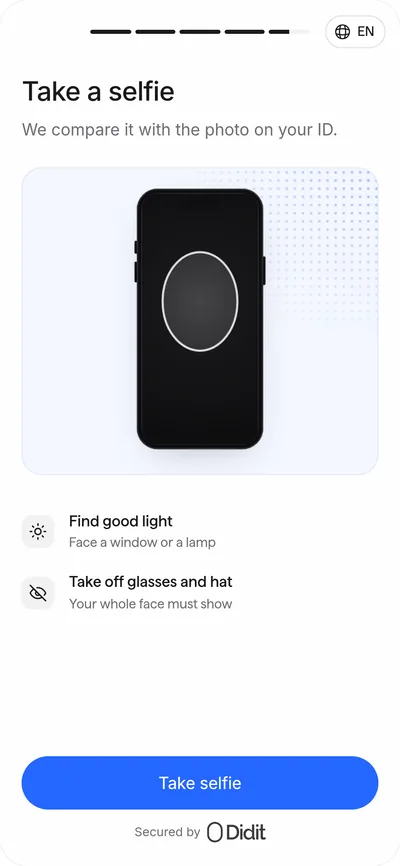
Passive liveness asks one question: is there a live person in front of the camera? It answers from a single frame. The user takes a selfie, nothing else. No motion or user interaction is required. That matters for two audiences at once. Your users get a one-tap step at sign-up, and fraud teams get a check that a replayed video or a printed photo has to survive.
Our passive model runs a convolutional neural network over the largest face it detects in the image. It looks at artifacts, texture patterns and other subtle indicators that separate a real face from a spoof, including the anomalies that printed photos and digital screens leave behind. The result is a liveness score from 0 to 100, a status, and a list of named warnings you can branch on. Passive Liveness is one component of the $0.33 full ID check, next to ID document verification, face match 1:1 and device and IP analysis.
A standalone passive check also suits checks you run later: an account recovery, a step-up before a high-value payment, a second look at a suspicious session. You send the image you already hold and read the result in the response, without asking the person for a new interaction pattern.
Two ways to run the check
- Inside a session. The user goes through a hosted Didit flow, or your app mounts the SDK, and the workflow's liveness node runs. Set
face_liveness_methodto"PASSIVE","ACTIVE_3D"or"FLASHING"in the Business Console or withPOST /v3/workflows/, then read theliveness_checks[]array from the decision. - Standalone API. You already hold the selfie and want one server-to-server answer.
POST /v3/passive-liveness/returns the liveness object in the response and the user never opens a session URL; withsave_api_requestset to true the call is still persisted as an API-type session you can fetch later. Passive only.
Recommended split: use the session for onboarding, where the user is present and you control the flow, and call the standalone endpoint for later step-ups when your backend already holds the image. Our liveness documentation covers both modes, and the pricing page lists the line items separately.
Choosing between passive, 3D Flash and 3D Action
| Method | What the user does | Security tier | Best for |
|---|---|---|---|
| Passive Liveness | Takes a selfie. Single-frame analysis, no interaction. | Standard | Sign-up, low-risk step-ups, markets where drop-off is expensive |
| 3D Flash | Holds still while a light pattern is projected and read at over 30 frames per second to build a depth map. | High | Financial services, account access, identity verification |
| 3D Action and Flash | Performs one randomized action while the light pattern is analyzed. | Highest | Banking, healthcare, government applications |
All three methods report through the same decision surface: one entry per liveness node in liveness_checks[] on the decision payload, so switching method changes the workflow setting, not the field you read. Prices for each module are on didit.me/pricing.
Prerequisites
- A Didit organization and application, with an API key from the Business Console.
- A server that can send multipart form data, or a workflow you can publish in the console if you prefer the hosted flow.
- A captured selfie: one face, front-facing, reasonably lit, jpg, jpeg, png, tiff or webp, at most 5 MB. PDFs are rejected.
- Credit on a live key. Sandbox keys skip processing and billing, so they cost nothing while you build.
- A written policy for three outcomes: pass, resubmit once, or send to a human reviewer.
How to add passive liveness detection in 9 steps
- Create the application and copy the API key. Sandbox and live keys are separate; start with the sandbox key so every call returns a static Approved mock and no credit is spent.
- Pick the route. Use a session when the user is present and you control the flow. Use the standalone API when your backend already has the image.
- For a session, set the liveness method, then create the session. Set
face_liveness_methodto"PASSIVE"in the workflow, create it withPOST /v3/session/usingworkflow_id,vendor_dataandcallback, and opensession.urlfor the user or mount the SDK. - For the standalone check, send the selfie. One POST, multipart form data, API key in the
x-api-keyheader.vendor_datais your own user identifier; reuse the same value for the same person so a retry does not look like a duplicate.curl -X POST 'https://verification.didit.me/v3/passive-liveness/' \ -H 'x-api-key: YOUR_API_KEY' \ -F 'user_image=@./selfie.jpg' \ -F 'save_api_request=true' \ -F 'vendor_data=user-123' - Read the score and the status together.
statuscomes back as Approved, Declined or In Review.scoreruns from 0 to 100 and the check declines at or belowface_liveness_score_decline_threshold, which defaults to 30. - Branch on the warnings, not only on the status.
NO_FACE_DETECTEDandMULTIPLE_FACES_DETECTEDmean a bad capture, so ask for one retry.LIVENESS_FACE_ATTACKandLOW_LIVENESS_SCOREdecline the check and must not be approved.FACE_IN_BLOCKLISTis a block.DUPLICATED_FACEis information, never a decline, so your policy decides whether it goes to review. - Keep the identifier. Store
request_idfrom the standalone response and fetch the full record withGET /v3/session/{sessionId}/decision/whenever you need the complete decision. - Subscribe to the webhook. Register
status.updatedon a destination, read the raw body first, verifyX-Signature-V2with your destination secret, reject a timestamp older than 300 seconds, then process the event. Webhook statuses are exact, case-sensitive strings. - Test, tune, then go live. Run real traffic shapes in the sandbox, tune the threshold against your own decline rate, then swap in the live key. Nothing else in the call changes. If you want a coding agent to do the wiring, hand it the integration prompt.

Expected output
The standalone call returns the request_id and a liveness object. The fields are these, with the values your capture and your thresholds produce:
{
  "request_id": "uuid",
  "liveness": {
    "status": "Approved | Declined | In Review",
    "method": "PASSIVE",
    "score": 0,
    "user_image": { "entities": [...], "best_angle": "..." },
    "warnings": [],
    "face_quality": 0,
    "face_luminance": 0
  }
}score, face_quality and face_luminance are 0 to 100, and the last two are nullable, so treat a missing value as unknown rather than as a failure. Inside a workflow the same object appears as one entry in liveness_checks[] on the decision payload, one entry per liveness node. The canonical schema is in the data models reference.

Failure cases and how to recover
| Signal | What happened | Recovery |
|---|---|---|
| HTTP 403 | Missing or invalid API key, or the balance cannot cover the call. This API never returns 401. | Check the API key and available credit, then top up if the balance is insufficient. A 403 on balance arrives before any image processing. |
| HTTP 400 | Missing user_image, a file over 5 MB, an unsupported extension, or a PDF. | Convert to jpeg or png and resize. Images are compressed to about 0.5 MB before processing anyway. |
| HTTP 429 | The shared write budget of 300 requests per minute per API key is exhausted. | Slow down and retry after the window. The budget is shared across all POST, PATCH and DELETE endpoints. |
NO_FACE_DETECTED | The liveness model found no face in the frame. | Ask for one new selfie, single face, better light. |
MULTIPLE_FACES_DETECTED | Warning severity. It does not decline on its own. | Re-capture with one person in frame, or route to review if your policy says so. |
LOW_LIVENESS_SCORE | The score sat at or below the decline threshold. | Do not approve. Allow one retry, then send to a person. |
LIVENESS_FACE_ATTACK | The model detected a presentation attack. | Decline the session and log it. Apply your retry policy and do not approve a session flagged with LIVENESS_FACE_ATTACK. |
FACE_IN_BLOCKLIST, POSSIBLE_FACE_IN_BLOCKLIST | The face matches an entry on your face blocklist. | Block per your policy. Faces from your own vendor_data are excluded from this screening. |
DUPLICATED_FACE, POSSIBLE_DUPLICATED_FACE | Information severity: the same face already appeared in another approved session. Never declines. | Route to review when the account is a duplicate risk. |
The full risk catalogue with every code is in the liveness warnings documentation.
Inputs and outputs
| Field | Direction | Notes |
|---|---|---|
user_image | Input, required | Binary face image, one subject, 5 MB maximum |
save_api_request | Input | Defaults to true: the call is persisted, the image and face crop are stored, and the face is enrolled in your face search index. False makes it one-shot. |
vendor_data | Input | Your internal user id. Prior faces with the same value are excluded from duplicate and blocklist search. |
request_id | Output | The session id you use with GET /v3/session/{sessionId}/decision/ |
liveness.status | Output | Approved, Declined or In Review |
liveness.score | Output | 0 to 100, compared against your decline threshold |
liveness.warnings[] | Output | Named signals with severity: error, warning or information |
face_quality, face_luminance | Output | 0 to 100 and nullable, describing capture quality |
What you pay for and where review begins
- Each 200 response consumes one Passive Liveness credit, paid from your plan credit first and then from top-ups. A shortfall returns 403 before the image is touched, so a failed billing call costs nothing. You pay for a check only when it finishes with a result.
- Inside a session the $0.10 step is billed as part of that check; the standalone endpoint is its own per-call line. Both are read from the same live price feed.
- Sandbox keys skip processing and billing entirely, and the sandbox is free on every plan.
- Blocklist and duplicate screening run on every call, with or without
save_api_request. - A status of In Review is the boundary: automated checks flagged something a person has to settle. A reviewer approves, declines or requests a resubmission in the console, and the session moves through the states documented in verification statuses.
- Threshold tuning is your call, not ours.
face_liveness_score_decline_thresholdstarts at 30. Raising it catches more spoofs and declines more real users, and only your traffic can tell you where that line belongs.
Worked cost example
Take 10,000 new users a month, each going through a full ID check, plus 2,000 step-up selfie checks for high-value actions through the standalone API.
- Full ID checks at list price: 10,000 x $0.33 = $3,300.00. The passive liveness part inside each check is 10,000 x $0.10 = $1,000.00, already included in the $0.33 and not added again.
- Standalone passive liveness calls at list price: 2,000 x $0.10 = $200.00.
- Monthly total at list price: $3,300.00 + $200.00 = $3,500.00.
- On the Scale plan every Didit price is 10% lower, so the full ID checks cost 10,000 x $0.297 = $2,970.00 and the standalone calls cost 2,000 x $0.09 = $180.00, for a monthly total of $2,970.00 + $180.00 = $3,150.00.
Read the exact numbers from the live feed at pricing.json before you commit to a budget, and see the pricing documentation for how credit and top-ups are consumed.
Sources
- Didit docs: Passive Liveness API, deepfake detection
- Didit docs: Liveness detection overview
- Didit docs: Liveness warnings catalogue
- Didit docs: Data models, liveness check schema
- Didit docs: Workflow builder
- Didit docs: Webhooks and signature verification
- Didit docs: Verification statuses
- Didit docs: Pricing and billing
- Didit pricing page and pricing.json, read November 26, 2026
- Didit integration prompt and Didit MCP server
Next step: create a free sandbox application at business.didit.me, paste the curl call above with your sandbox key, and see the response before you talk to anyone. No sales call, no credit spent.
Try it
Try this in the sandbox
Run the check this guide describes, free.
The product this post is about, taken from its topic. Run it free in the sandbox.
Author
Alejandro Rosas
Co-founder and CTO

Keep reading
Other guides in the same topic.
 What Is the Purpose of FICA in South Africa? 2026 Guide
FICA is South Africa's anti-money laundering law. It creates the Financial Intelligence Centre and requires accountable institutions to identify and verify clients, screen for PEP and sanctions risk and report suspicious.
Alberto RosasNov 26, 2026 Sixth Money Laundering Directive (6AMLD): What Changed and Which Rules Apply
6AMLD is Directive (EU) 2018/1673: Member States must criminalise laundering, widen predicate offences and set a four-year penalty floor. It adds no new due diligence duties for firms.
Alberto RosasNov 26, 2026 Automated Sanctions Screening: Canada, the Entity List and Embargoes
Automated sanctions screening matches people and companies against lists such as Canada's autonomous sanctions made under SEMA and JVCFOA and the OFAC SDN List, and returns candidate hits scored for identity confidence and.
Alberto RosasNov 26, 2026Questions
Frequently asked questions
What is passive liveness detection?
Passive liveness detection decides whether a real person is in front of the camera by analyzing one image, with no blinking, head turn or spoken phrase required. We evaluate the largest detected face with a biometric model and return a liveness score from 0 to 100 plus named warnings. Passive Liveness costs $0.10 per check, in a verification session or on the standalone API.
How do you detect deepfakes and advanced presentation attacks?
Our passive model reads a single frame for artifacts and texture patterns associated with presentation attacks such as printed photos and screen replays. The result comes back as a score with named signals, so an attack surfaces as LIVENESS_FACE_ATTACK or LOW_LIVENESS_SCORE instead of a silent pass. When the account is worth attacking, run 3D Flash or 3D Action as well: the projected light pattern builds a depth map that a flat screen cannot reproduce.
Is passive liveness enough for high-risk onboarding?
Passive liveness is our standard security tier: fast, no user interaction, and priced at $0.10 per check. For banking, healthcare or government flows, add 3D Flash (high) or 3D Action and Flash (highest) in the same workflow, since a randomized action plus a light pattern is harder to spoof than a still frame. One way to split it, as an implementation recommendation rather than a documented Didit behaviour: passive on sign-up, then a stronger method when your own risk signals fire.
How much does passive liveness detection cost?
$0.10 per check, in a verification session or on the standalone Passive Liveness API, paid from prepaid credit. Each 200 response consumes one Passive Liveness credit, taken from your plan credit first and then from top-ups. It is one of the four parts of the $0.33 full ID check, next to ID document verification at $0.15, face match at $0.05 and device and IP analysis at $0.03. The sandbox is free on every plan and a sandbox key spends no credit.
How is Passive Liveness billed in a session versus the standalone API?
Inside a verification session the check runs as one step of that session and is paid when the step finishes with a result. On the standalone endpoint each 200 response consumes one Passive Liveness credit, taken from your plan credit first and then from top-ups. A shortfall returns 403 before any image processing, and sandbox keys skip billing entirely.
What image should I send to the passive liveness API?
One front-facing face image as jpg, jpeg, png, tiff or webp, up to 5 MB, with a single person in the frame. PDFs are not accepted, and images are compressed to about 0.5 MB before processing, so a higher resolution does not buy accuracy. Good light matters more than megapixels: check face_quality and face_luminance in the response.
What does the liveness score mean and what threshold should I use?
The score runs from 0 to 100, and the check is declined when it sits at or below face_liveness_score_decline_threshold, which defaults to 30. Raising the threshold blocks more spoofs and declines more genuine users, so tune it against your own traffic in the sandbox before going live. The score is one input; the warnings carry the reason.
What happens when the check comes back Declined?
A decline with LIVENESS_FACE_ATTACK means the model detected a presentation attack, and that session should not be approved. A decline with LOW_LIVENESS_SCORE is often a poor capture, so allow one retry and then send it to a person. A face matching your own blocklist returns FACE_IN_BLOCKLIST or POSSIBLE_FACE_IN_BLOCKLIST.
Can I run passive liveness without a full KYC session?
Yes. POST https://verification.didit.me/v3/passive-liveness/ takes a selfie server to server and returns the result in one call, which suits a step-up check before a payment or a password reset. The call is billed at $0.10 and, with save_api_request set to false, nothing is stored and the face is not enrolled in your face search index. Blocklist and duplicate screening still run.
Does Didit store the selfie I send?
With save_api_request at its default of true, the call is saved as an API session, the reference image and face crop are stored, and the face is enrolled in your face search index for later duplicate and blocklist checks. Set it to false for a one-shot call that stores nothing. Retention follows your plan, from one year on Free up to ten years on Scale.
How fast is the passive liveness check?
Our inference runs at sub-2-second p99, and the standalone endpoint returns the liveness object in its own HTTP response, so you read the result from that call. The shared write budget is 300 requests per minute per API key across all POST, PATCH and DELETE endpoints, and exceeding it returns HTTP 429. Pace calls inside that budget.
Which certifications cover Didit liveness detection?
We hold iBeta Level 1 PAD for presentation attack detection, SOC 2 Type 2 and ISO/IEC 27001:2022, certificate ES144068. We publish 99.9% accuracy with a false acceptance rate under 0.1% for liveness. 4,000+ companies run Didit in production across 220+ countries.
What is the difference between passive and active liveness?
Active liveness asks the user to do something, such as a randomized action or a light-pattern challenge, then checks the response. Passive liveness asks for nothing and analyzes the frame it receives. Active is harder to spoof and costs $0.15 per check; passive is faster and costs $0.10 per check, and both return results through the same decision payload.
Can a photo held up to the camera or a replayed video get through?
That is the attack the check exists for: printed photos, screen replays, masks and deepfakes are presentation attacks, and the model returns LIVENESS_FACE_ATTACK when it detects one. Printed photos, screen replays, masks and deepfakes are presentation attacks the model is designed to detect. It is a probability rather than a guarantee, so pair the score with your warnings policy and your review rules.
Compliance built in
Audited, certified and attested.
We hold the certifications and build each country's rules into your flows, so you can launch anywhere without worrying. Security and Compliance center
- Regulation encoded into your flows
Tell us what you do and where. Didit lists the rules that apply to you, with sources, and builds the checks each country needs into one workflow.
- Ready for AMLR
Every requirement of the new EU anti-money laundering rules, from checking customers to human review, is already covered by a Didit check.
- Tested in Spain's Treasury sandbox
Spain's Treasury published its supervised sandbox report on Didit's NFC plus active liveness onboarding; SEPBLAC took part and valued the added measures positively.
- Audited, not self-declared
iBeta Level 1 and Level 2. Liveness tested under ISO/IEC 30107-3.
Your obligations · 3 regions
 SOC 2 Type 2
 ISO 27001
 iBeta Level 1 and Level 2
 EU regulator attestation
 FSM youth protection
 GDPR
 EBA remote onboarding
 MiCA compatible
 FIDO Alliance member
- AMLREU AML Regulation ready
Integration · Didit MCP
Run Didit from your own AI agent
Connect Didit to Claude, Cursor, VS Code or ChatGPT and just ask in plain words. Your agent can do anything you can do in the console, with the same permissions you have.
 Add to Claude
 ChatGPT
 Cursor
- Build workflowsDescribe the checks you need. The agent creates and publishes the flow.
- Run investigationsAsk why a session was declined, review cases, search people and companies.
- Change rulesCreate payment rules, test them on past data and switch them on.
- Pull reportsAsk for numbers, exports or the audit log.
Didit Academy


