Programmatic Adverse Media Screening: Didit API How-To
POST /v3/aml/ with include_adverse_media true screens a person against sanctions, PEP, warning and watchlist data from 1,300+ global watchlists, with adverse-media enrichment in the same call, for $0.20.
 Alejandro RosasCo-founder and CTO
Contents
In this guide
Jump to the part you need.
Programmatic adverse media screening fits teams that need a repeatable adverse media check inside their own system rather than in a console: fintechs, payment providers, crypto businesses and lenders onboarding at volume. We charge $0.20 per completed AML screening, and adverse media is available in that same call when you set include_adverse_media to true. The caveat is latency. With adverse media switched on, the request waits for enrichment, so set a client timeout of at least 60 seconds.
Last updated: November 26, 2026. Prices checked against the live Didit price feed on November 26, 2026.
| Item | Detail |
|---|---|
| Endpoint | POST https://verification.didit.me/v3/aml/ |
| Authentication | x-api-key header, held server side only |
| Price | $0.20 per completed AML screening; taxes are added where they apply |
| Datasets in the call | Sanctions, PEP, warning and watchlist screening against 1,300+ global watchlists, with adverse-media enrichment in the same call |
| Adverse media switch | include_adverse_media: true |
| Latency | A few seconds plain; with adverse media, about 5 seconds initial pause plus up to about 25 seconds polling |
| Stored result | save_api_request defaults to true, then GET /v3/session/{sessionId}/decision/ |
| Retry safety | Idempotency-Key header; a replayed answer is not billed again |
| Sandbox | Free on every plan, mocked result unless you pass sandbox_scenario |
Start free in the sandbox at business.didit.me, no sales call needed. If you build with an AI assistant, connect Didit through the Didit MCP server. The matching product page is AML Screening, and every unit price is on the pricing page.
What adverse media screening means
Adverse media, also called negative news, is unfavorable reporting about a person or a company that may point to financial crime risk: allegations, investigations, indictments, convictions or regulatory action. It is not a legal prohibition and it is not a position of influence. That is the difference from the two datasets next to it. A sanctions listing is a legal restriction. A PEP record marks someone with a prominent public function. An adverse media hit is a reported fact or allegation that changes how much scrutiny the customer deserves.
In an AML program the three are read together, which is why we run them in a single call. Splitting adverse media into its own separate vendor means one more contract, one more key and one more place where a decision can drift out of the audit trail.
Treat an adverse media result as enrichment data: it adds context to a decision, and your compliance policy decides what that context means for the customer. A plain adverse media search on a search engine returns links. A screening API returns records with identity confidence and entity risk attached, plus a warning code your system can branch on. For compliance work, that difference is the whole product.
The outcome you should design for
The call is done when three things are true: you know whether the person matched an adverse media record, you know how confident the match is, and you know which of your thresholds decided the case. Didit answers with a two-score model.
- Match score (0 to 100): how likely the listed entity is the same person you sent. It is built from the weights you set for name, date of birth and country, and a matching
document_numberacts as a golden key that overrides the match score to 100. - Risk score (0 to 100): how risky the listed entity is, independent of who you are screening.
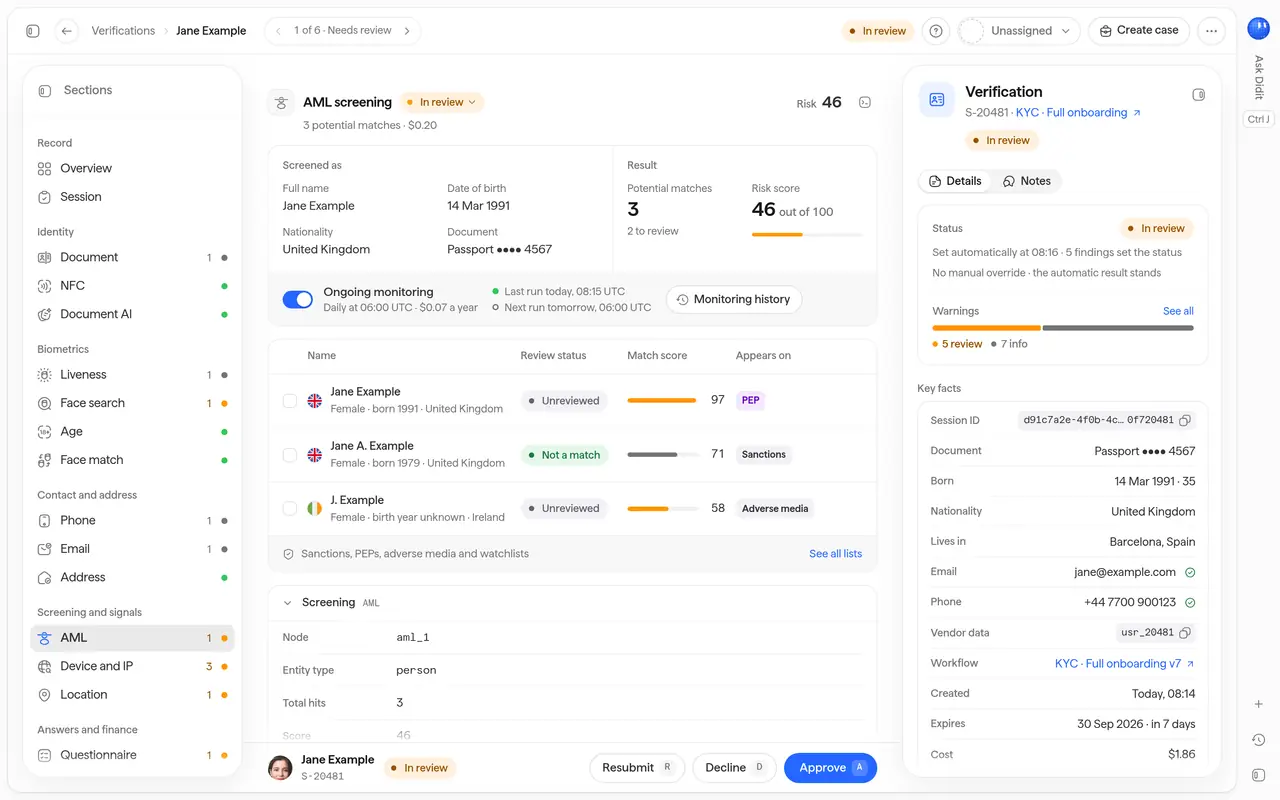
Hits whose match score falls below aml_match_score_threshold (default 93) are tagged review_status as a false positive and ignored for risk purposes. The highest risk score among the remaining hits becomes aml.score, and that single number drives the status: above aml_score_review_threshold (default 100) the status is Declined, above aml_score_approve_threshold (default 80) it is In Review, otherwise Approved. The recommended method is therefore not to read headlines in code. Read two numbers, apply your policy, and route the middle band to a human.

Prerequisites
- A Didit application and its API key. In the Business Console open Developers, then API keys, or create the key through the programmatic register and verify-email flow. Sandbox keys start with
sk_test_, live keys withsk_live_. - Server-side code. The key is a secret with full access to your application, so never ship it to a browser or a mobile bundle.
- The data you actually hold: at minimum
full_name. Date of birth and nationality raise match quality, because they are the other two weighted components. - Three threshold decisions before you go live:
aml_match_score_threshold,aml_score_approve_thresholdandaml_score_review_threshold. If you also send custom weights,aml_name_weightplusaml_dob_weightplusaml_country_weightmust sum to exactly 100. - A client timeout of at least 60 seconds, because adverse media enrichment is the slow part of the call.
Steps to run a programmatic adverse media check
- Start in the sandbox. Sandbox keys skip screening and billing entirely and return a mocked
Approvedresult with zero hits unless you passsandbox_scenario. That lets you build the parsing, the thresholds and the routing for free before any live record is touched. - Pick the route that matches the job. Use
POST /v3/aml/when you want a one-shot screen decoupled from a hosted flow. Use a workflow with the AML feature when the screen belongs inside a verification session; the decision then carriesaml_screenings[]. For adverse media only, the standalone route is the shorter path. - Send the request with adverse media switched on. The documented example:
curl -X POST 'https://verification.didit.me/v3/aml/' -H "x-api-key: $DIDIT_API_KEY" -H "Content-Type: application/json" -d '{"full_name": "Javier Ejemplo Modelo", "entity_type": "person", "date_of_birth": "1974-01-01", "nationality": "ES", "include_adverse_media": true, "vendor_data": "user-1234"}'- Read the scores and the warnings. Do not branch on the presence of hits alone. Branch on
aml.scoreagainst your thresholds, and log thewarnings[]risk codes that came with it:ADVERSE_MEDIA_HIT,POSSIBLE_MATCH_FOUND,MATCH_FOUND,SANCTIONED_ENTITY,PEP_MATCH,HIGH_RISK_COUNTRY,ONGOING_MONITORING_ENABLED. APOSSIBLE_MATCH_FOUNDwarning is added whenever the score is non-zero and at or above the approve threshold; a score of exactly 0 never warns. - Keep the record.
save_api_requestdefaults to true, so the screening is stored as a session, appears in the console, fires astatus.updatedwebhook, and stays open to later hit review status updates. Retrieve it withGET /v3/session/{sessionId}/decision/. If you setsave_api_requestto false, nothing is stored andrequest_idis only a transient correlation id.
Expected output
The documented response shape is a request id and an aml object holding the status, the screening id, the hits and the warnings:
{
  "request_id": "...",
  "aml": {
    "status": "Approved",
    "screening_id": "...",
    "hits": [ ... ],
    "warnings": [ ... ]
  }
}
On a sandbox key, that is literally what you get back: Approved with zero hits. On a live key, each hit carries its own match_score and risk_score, and a hit below the match threshold is tagged as a false positive rather than removed, so you can still see what was discarded and why. The AML status field uses this enum: Not Started, In Progress, Approved, In Review, Declined, Abandoned or Kyc Expired.

Failure cases and how to recover
| Failure | What it means | Recovery |
|---|---|---|
400 on weights | Name, DOB and country weights do not sum to exactly 100 | Fix the three numbers; missing components are re-normalized away |
400 on monitoring | include_ongoing_monitoring=true without save_api_request=true | Turn persistence back on, monitoring needs a stored profile |
401 | The x-api-key header is wrong, malformed, revoked or expired | Re-fetch the key from Developers, then API keys in the console |
403 | No key, a scoped key without access, or an insufficient balance | Top up or use a key with the right scope. The refusal happens before any new screening |
409 | The same Idempotency-Key was reused with a different body | Send a new key for a new request body |
429 | Rate limit reached | The response carries a wait field in seconds; back off, then retry |
| Adverse media timeout | The upstream enrichment was slow; the result comes back without the adverse media hits | It is still actionable. If you need the news layer, run a new screening with a new Idempotency-Key; reusing the key replays the stored answer |
Declined | The score is above aml_score_review_threshold (default 100) | Stop the flow or route to enhanced due diligence, following your own policy |
In Review | The score is above the approve threshold and not above the review threshold | Send it to your manual queue. This is the band the API deliberately does not decide |
Design around the timeout: send an Idempotency-Key on the first attempt, so a retry returns the stored answer without a second charge.
Inputs and outputs
| Field | Required | Notes |
|---|---|---|
full_name | Yes | Person or company being screened, minimum 2 characters |
entity_type | No | person or a company entity |
date_of_birth | No | Feeds the DOB weight in the match score |
nationality | No | Feeds the country weight |
include_adverse_media | No | Set to true for the adverse media layer; this is what adds the long poll |
vendor_data | No | Your own identifier, echoed back |
save_api_request | No | Defaults to true, which stores the session and the report |
include_ongoing_monitoring | No | Keeps the profile under provider-driven monitoring; requires save_api_request=true |
aml_match_score_threshold, aml_score_approve_threshold, aml_score_review_threshold | No | Defaults 93, 80 and 100 |
Idempotency-Key header | No | Up to 255 characters, scoped to your application and the exact request body |
| Output | What it tells you |
|---|---|
request_id | Correlation id; with persistence on it works with the decision endpoint |
aml.status | Approved, In Review, Declined or another enum value |
aml.screening_id | Identifier of the screening that produced the report |
aml.hits[] | Every potential match with match_score, risk_score and its review_status |
aml.score | The highest risk score among hits that survived the match threshold |
aml.warnings[] | Risk codes for automation, including ADVERSE_MEDIA_HIT |
Paid steps and review boundaries
One AML API credit is charged after the first successful screening, at $0.20. The published $0.20 is for a completed AML screening; taxes are added where they apply. Replayed idempotent responses are not charged again, and an insufficient balance returns 403 before any new screening runs. The sandbox is free on every plan, so parsing and threshold testing cost nothing. If a saved screening needs a PDF for a file or a partner, that report is retrieved from the same session.
Ongoing monitoring is a separate line at $0.07 per screened person per year, and it requires save_api_request=true. You can switch it off from the Business Console.
The review boundary sits inside the two-score model, not inside your code. Below the match threshold, hits are set aside as false positives. Above it, the risk score decides whether the case is approved, sent to review or declined. Anything the API marks In Review is, by design, a human decision, and that is where a review queue earns its keep.
Worked cost example
Take a lender that onboards 5,000 new customers a month and runs one adverse media screening plus a full ID check on each of them, at list prices.
- AML screening with adverse media: 5,000 x $0.20 = $1,000.00
- Full ID check: 5,000 x $0.33 = $1,650.00
- Total per month: $1,000.00 + $1,650.00 = $2,650.00
- Ongoing monitoring for that month's cohort: 5,000 x $0.07 = $350.00 per year
The same volume on the Growth plan takes 4% off every Didit price: AML becomes $0.192 per screen (5,000 x $0.192 = $960.00) and the full ID check becomes $0.3168 (5,000 x $0.3168 = $1,584.00), so $960.00 + $1,584.00 = $2,544.00 a month. Retried idempotent calls add nothing to either figure. The two figures above are the compliance bundle arithmetic at list price, $0.53 x 5,000 = $2,650.00, which is the same total from the other direction.
Why an adverse media check with a Google search from C# is not a screen
People search for how to run an adverse media check with a Google search from C#, usually after a scrape stopped working. We understand the temptation and we do not recommend it. A search result gives you a link, not a record. It gives you no match score, so you cannot separate a namesake from your customer. It gives you no risk score, so every result looks equally alarming. It gives you no stable coverage, because results depend on the query, the region and the day. And it gives you nothing to show a regulator when they ask what you screened and what you decided.
If you already have a C# service, the API is one HTTP call. Send the same person fields you would put in the search box, set include_adverse_media to true, and store the returned decision next to the customer record.
Automating adverse media screening after onboarding
Adverse media changes after the customer is approved, which is why the monitoring line exists. Set include_ongoing_monitoring=true together with save_api_request=true and the profile stays under provider-driven monitoring, with the provider's updates reaching the report. You get the ONGOING_MONITORING_ENABLED warning on the record, and you can disable it from the console when a relationship ends. For teams handling wallets and transactions, AML screening sits alongside our Transaction Monitoring line, so a single credit balance pays for the whole flow.
Sources
- Didit docs: AML Screening API (standalone)
- Didit docs: AML Screening overview
- Didit docs: AML warning codes
- Didit docs: continuous monitoring
- Didit docs: data models
- Didit docs: webhooks and signatures
- Didit docs: API authentication
- Didit docs: pricing and billing rules
- Didit pricing page and price feed, read November 26, 2026
- Didit AML Screening product page
- Didit MCP server setup
- FATF, the global AML standard setter
Next step: create a sandbox application at business.didit.me, send one adverse media screening with a test key, and read the scores before you touch a live record. No sales call is involved.
Try it
Try this in the sandbox
Run the check this guide describes, free.
The product this post is about, taken from its topic. Run it free in the sandbox.
Author
Alejandro Rosas
Co-founder and CTO

Keep reading
Other guides in the same topic.
 What Is the Purpose of FICA in South Africa? 2026 Guide
FICA is South Africa's anti-money laundering law. It creates the Financial Intelligence Centre and requires accountable institutions to identify and verify clients, screen for PEP and sanctions risk and report suspicious.
Alberto RosasNov 26, 2026 Sixth Money Laundering Directive (6AMLD): What Changed and Which Rules Apply
6AMLD is Directive (EU) 2018/1673: Member States must criminalise laundering, widen predicate offences and set a four-year penalty floor. It adds no new due diligence duties for firms.
Alberto RosasNov 26, 2026 Automated Sanctions Screening: Canada, the Entity List and Embargoes
Automated sanctions screening matches people and companies against lists such as Canada's autonomous sanctions made under SEMA and JVCFOA and the OFAC SDN List, and returns candidate hits scored for identity confidence and.
Alberto RosasNov 26, 2026Questions
Frequently asked questions
What is adverse media screening in simple terms?
Adverse media screening checks whether a person or company appears in negative news or public reporting that suggests financial crime risk, such as an investigation, an indictment or a conviction. It is not a sanctions listing and not a PEP record, though all three are usually run together. The output is a set of potential matches, each scored for identity confidence and for entity risk.
What is the adverse media API endpoint and what does it cost?
The endpoint is POST https://verification.didit.me/v3/aml/ on verification.didit.me, authenticated with an x-api-key header. You add adverse media to the call with include_adverse_media: true. The price is $0.20 per completed AML screening; taxes are added where they apply. The same call covers sanctions, PEP, warning and watchlist screening against 1,300+ global watchlists, with adverse-media enrichment when the switch is on, and sandbox calls are free.
What does an adverse media screening example request look like?
A minimal call sends full_name, optionally entity_type, date_of_birth and nationality, plus include_adverse_media: true and your own vendor_data. In curl it is a single POST with the API key header and a JSON body, exactly as shown in our docs. The response returns a request_id and an aml object with status, hits and warnings.
Can I run an adverse media check with a Google search from C# instead of an API?
You can write the code, but it is not a screening control. A search gives no match score, no risk score, no stable list coverage and no audit record of what was screened. Regulated programs need a reproducible result per customer, which is what an API response and a stored decision give you. The better use of C# is a single POST to the AML endpoint.
How does Didit decide whether a hit is a true match or a false positive?
Each hit gets a match score from 0 to 100, built from the weights you set for name, date of birth and country, with a matching document number forcing the score to 100. Hits below aml_match_score_threshold, default 93, are tagged as false positives and excluded from risk. The highest risk score among the surviving hits becomes the screening score that drives the status.
What is an adverse media report and can I get one per person?
A report is the stored record of one screening: the input, the hits, both scores, the warnings and the status. Because save_api_request defaults to true, every screening becomes a session you can retrieve with GET /v3/session/{sessionId}/decision/ or export as a PDF, and it is also visible in the Business Console. Reviewers can update hit review statuses later without re-running the screen.
What makes adverse media screening advanced rather than a name search?
Advanced screening separates two questions that a name search confuses: is this the same person, and how risky is that person. Didit answers both with separate scores, exposes the thresholds and weights so you can tune them, returns warning codes your code can branch on, and keeps the profile under monitoring after onboarding. That is the difference between a list of links and a decision you can defend.
Where does the adverse media database come from?
Didit screens against sanctions, PEP, warning and watchlist data from 1,300+ global watchlists, with adverse-media enrichment in the same call. That means one request returns the identity matches, the risk scores and the adverse-media layer instead of you stitching together separate feeds. Coverage and list content are documented on our side and applied at request time. Treat an adverse media result as enrichment data and review it under your own compliance policy.
How long does an adverse media check take?
A plain screening typically completes in a few seconds. With include_adverse_media=true the API waits for enrichment, an initial pause of about 5 seconds plus up to about 25 seconds of polling. Configure your client timeout to at least 60 seconds and treat a slow adverse media layer as a known condition, not an error.
How do I automate adverse media screening and monitor people afterwards?
Call the AML endpoint as part of your onboarding flow, branch on the returned status against your thresholds, and send the In Review band to a queue. For monitoring, add include_ongoing_monitoring=true with save_api_request=true and the profile stays under provider-driven monitoring at $0.07 per screened person per year. Subscribe to the status.updated webhook so updates reach your system without polling.
What happens if my client times out while adverse media is still loading?
Send an Idempotency-Key header on the first attempt, then retry with the same key. The first completed request stores its response, and later identical retries return that same response without running or billing another screening. If the original request is still running, retry later with the same key. If the completed response came back without adverse-media hits because the upstream was slow, run a new screening with a new key to request the news layer again.
Does an adverse media hit block the customer automatically?
Only if your thresholds say so. The API returns Declined when the score is above aml_score_review_threshold (default 100), In Review when it is above aml_score_approve_threshold (default 80) and not above the review threshold, and Approved otherwise. The middle band is deliberately left for a human, because a namesake match and a confirmed conviction should not end in the same automated action.
Compliance built in
Audited, certified and attested.
We hold the certifications and build each country's rules into your flows, so you can launch anywhere without worrying. Security and Compliance center
- Regulation encoded into your flows
Tell us what you do and where. Didit lists the rules that apply to you, with sources, and builds the checks each country needs into one workflow.
- Ready for AMLR
Every requirement of the new EU anti-money laundering rules, from checking customers to human review, is already covered by a Didit check.
- Tested in Spain's Treasury sandbox
Spain's Treasury published its supervised sandbox report on Didit's NFC plus active liveness onboarding; SEPBLAC took part and valued the added measures positively.
- Audited, not self-declared
iBeta Level 1 and Level 2. Liveness tested under ISO/IEC 30107-3.
Your obligations · 3 regions
 SOC 2 Type 2
 ISO 27001
 iBeta Level 1 and Level 2
 EU regulator attestation
 FSM youth protection
 GDPR
 EBA remote onboarding
 MiCA compatible
 FIDO Alliance member
- AMLREU AML Regulation ready
Integration · Didit MCP
Run Didit from your own AI agent
Connect Didit to Claude, Cursor, VS Code or ChatGPT and just ask in plain words. Your agent can do anything you can do in the console, with the same permissions you have.
 Add to Claude
 ChatGPT
 Cursor
- Build workflowsDescribe the checks you need. The agent creates and publishes the flow.
- Run investigationsAsk why a session was declined, review cases, search people and companies.
- Change rulesCreate payment rules, test them on past data and switch them on.
- Pull reportsAsk for numbers, exports or the audit log.
Didit Academy


