Proof of Address for Digital Nomads and Remote Workers
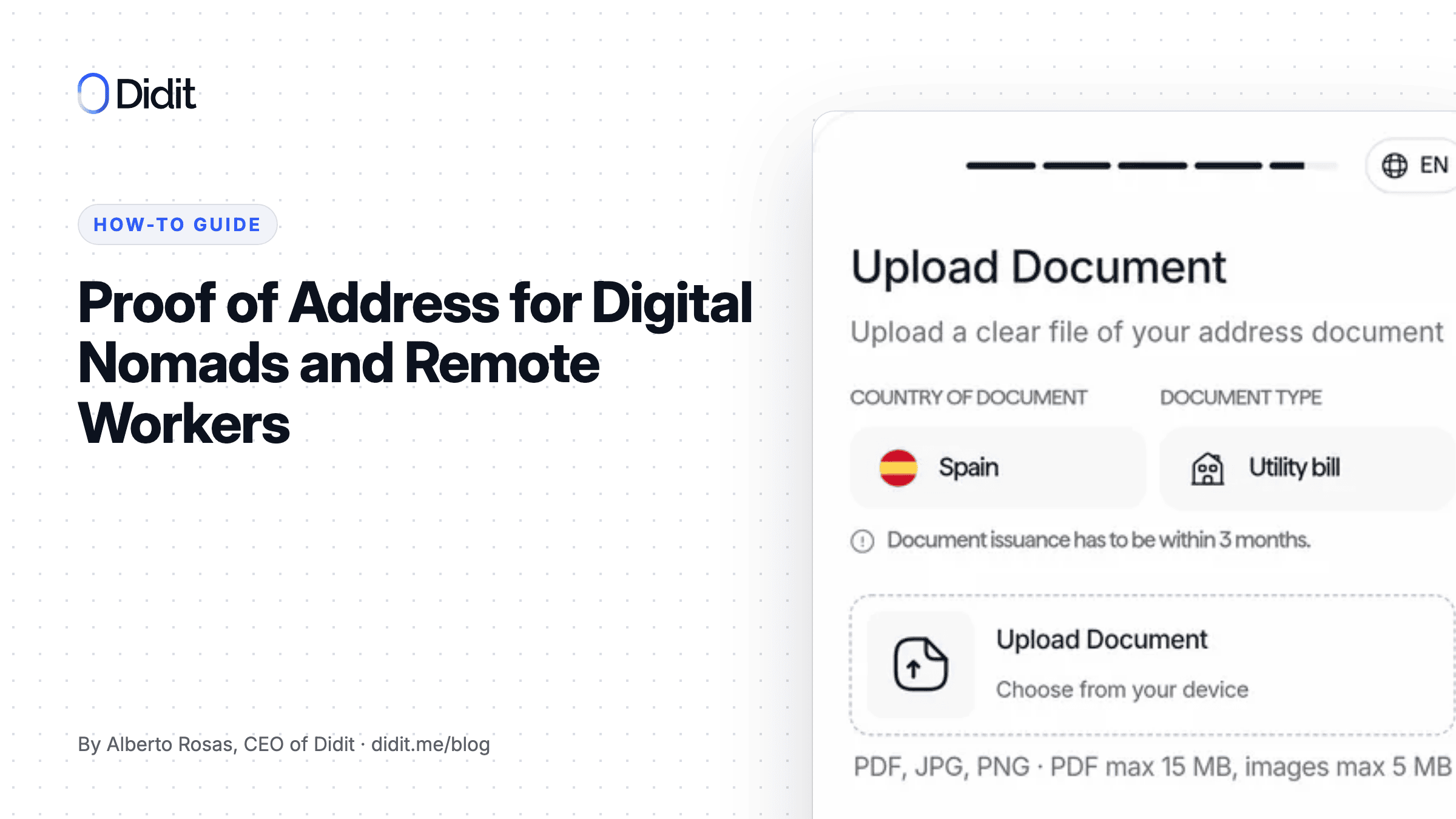
Learn what to submit when a utility bill is in someone else’s name. See how to run Didit Proof of Address in a hosted workflow or via API at a $0.20 list price per completed check.
 Alberto RosasCo-founder and CEO
Contents
In this guide
Jump to the part you need.
Didit's proof of address check fits two readers. The first is a bank, fintech, exchange, employer or landlord that has to confirm where a remote worker lives. The second is the applicant choosing a document the requester accepts. Each completed check lists at $0.20, and the standalone API consumes a credit per live HTTP 200 response. We check the submitted document. Your organization decides which documents meet its policy.
Last updated: November 26, 2026. Prices checked against the live Didit price feed on November 26, 2026.
| Item | Answer |
|---|---|
| What a check returns | Document type and subtype, issuer, issue and expiry dates, holder name, raw and parsed address with coordinates, and a warnings list. On the standalone API the readable result is Approved or Declined. |
| Price | The Proof of Address workflow step lists at $0.20 per completed check. The standalone API consumes one credit at the $0.20 list price per live HTTP 200 response, including Declined results. |
| Address validation add-on | $0.10 per validated address on the documented price |
| Accepted files (standalone API) | PDF, JPG, PNG, TIFF or WebP, up to 15 MB, multi-page PDFs included |
| Typical latency (standalone API) | 5 to 15 seconds, up to about 30 seconds for a multi-page PDF. Set client timeouts to 45 seconds or more |
| Two ways to run it | A workflow session with the proof of address step, or a one-shot call to POST /v3/poa/ |
| Standalone results | Approved or Declined for a readable document. A document that cannot be processed at all returns 400. |
| Sandbox | Free on every plan. The free standalone sandbox returns a fixed mock response for testing request and response handling. It does not evaluate the sample bill. |
Start free in the sandbox at business.didit.me, no sales call. Developers who want an AI assistant to drive the integration can connect Didit through the Didit MCP server. The Proof of Address API page is the product page for the standalone check: the endpoint, its fields and its response. The Proof of Address overview describes the workflow step and how to configure it. The pricing page has unit prices and plan credit.
The outcome, and the method we recommend
Aim for a decision you can defend later: the document type is recognised, the issuer is identified, the dates are read, the holder name is compared, the address is parsed and geocoded, the file survives the forensic checks, and the status arrives with the warnings that produced it. That is a better audit trail than a scanned bill sitting in a support inbox.
We recommend one session-based workflow that runs ID Verification first and Proof of Address second. Switch on address validation only if you need to confirm that the postal address exists: turn on address_validation_enabled for the address step, and read the result in the address_validation object of that step's entry in poa_verifications[]. Three things follow. The name on the document is compared against a document you already verified, not against a typed field. Both results arrive in one decision payload. And each part is billed on its own line, so you can see what the address step costs by itself.
| Method | Use it when | What you read | Documentation |
|---|---|---|---|
| Hosted upload in a workflow | The applicant uploads inside a Didit flow or your app, and you want the document matched against a verified ID | poa_verifications[] on GET /v3/session/{sessionId}/decision/ | Proof of Address overview |
| Standalone document check | You already hold the file, for example during a migration or from a partner sending documents server to server | The response body of that one call | Proof of Address API |
| Address-only validation | You have an address and need to know whether it exists and how it normalises, without linking it to a person | address_validation.status and the normalised address | Address Validation API |
What applicants can submit
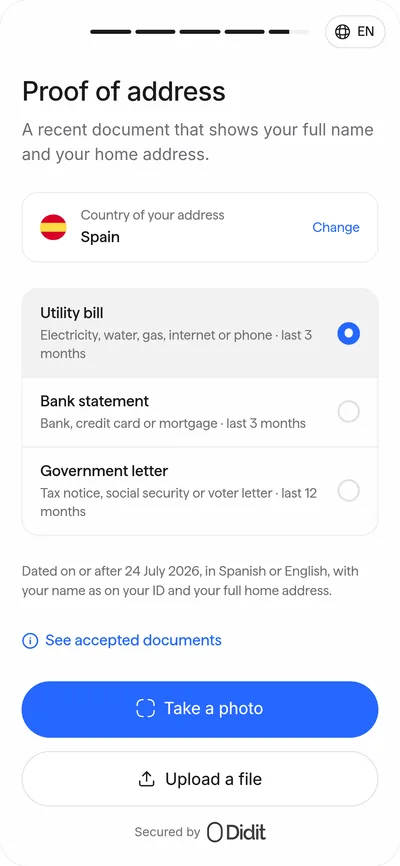
This section is for the applicant. The requester sets policy, so treat every row below as a candidate document, subject to the requester's policy. The acceptable age is inside the Didit age setting you configured, and inside any shorter age the requester sets.
| Address requested | Candidate document | Who issues it | Whose name appears | Acceptable age | If unavailable |
|---|---|---|---|---|---|
| Residential address | Utility bill | The utility provider | The applicant | Inside your poa_document_age_months setting and any shorter requester limit | Ask the requester which alternatives it accepts, such as a bank statement or government letter |
| Residential address | Bank statement | The bank | The applicant | Inside your configured age setting and any shorter requester limit | Ask the requester before submitting an older statement or another document type |
| Residential address | Government letter | A tax, benefit, residence or municipal authority | The applicant | Inside your configured age setting and any shorter requester limit | Ask the issuing office for a current copy, or ask the requester what it accepts |
| Residential address | Long-term lease or tenancy contract | The landlord or letting agent | The applicant, or the applicant and landlord | Inside your configured age setting and any shorter requester limit | Ask the landlord for a tenancy confirmation that shows the applicant's name and the address |
| Residential address | Booking confirmation, hotel invoice or permission letter | The hotel, operator or host | The applicant, the operator or the host | Ask the requester, because the type and dates may not meet its policy | Ask whether the requester accepts it before submitting it |
| Mailing or business address | Virtual mailbox statement | The mailbox provider | The applicant | Inside your configured age setting and any shorter requester limit | Confirm the requester accepts a mailing address before paying for a mailbox |
Hypothetical example: a nomad rents a serviced apartment and the operator receives the utility bill. The applicant should not submit the operator's bill as their own. If a bank statement shows the apartment address and the requester accepts bank statements, that is one route. If not, ask the requester whether a dated invoice or tenancy confirmation from the operator, showing the applicant's name and unit address, is accepted.
Prerequisites
- A Didit organization and application. Sandbox testing is free on every plan.
- Use your application’s API key in the
x-api-keyheader. The key used to fetchGET /v3/session/{session_id}/decision/must haveread:sessions. - For the workflow route, a workflow containing the proof of address step, built in the Business Console or created with
POST /v3/workflows/. - Two policy settings decided before launch:
poa_document_age_months(how old a document may be) andpoa_languages_allowed(which languages you accept). - Write down the document types your organization accepts. We classify the submitted document and apply the documented check settings. Apply your accepted-document list separately when reading a standalone result.
POA_DOCUMENT_NOT_SUPPORTED_FOR_APPLICATIONis informational on that endpoint. - For the applicant, a document in their own name if the requester's policy requires a name match. A bill in another person's name can trigger a mismatch when the check compares it with the applicant's name.
- A client timeout of at least 45 seconds on any server that calls the standalone endpoint.
Step by step: the session workflow
- Open your workflow and add the proof of address step. Configure
poa_languages_allowed,poa_document_age_monthsand the per-risk action settings listed in the Proof of Address overview. - Create a session. Send
vendor_dataas the stable applicant identifier you use when creating the session.
curl -X POST 'https://verification.didit.me/v3/session/' -H "x-api-key: $DIDIT_API_KEY" -H "Content-Type: application/json" -d '{"workflow_id": "WORKFLOW_UUID", "vendor_data": "nomad-1234", "callback": "https://app.example.com/onboarding/done"}'- Send the person to
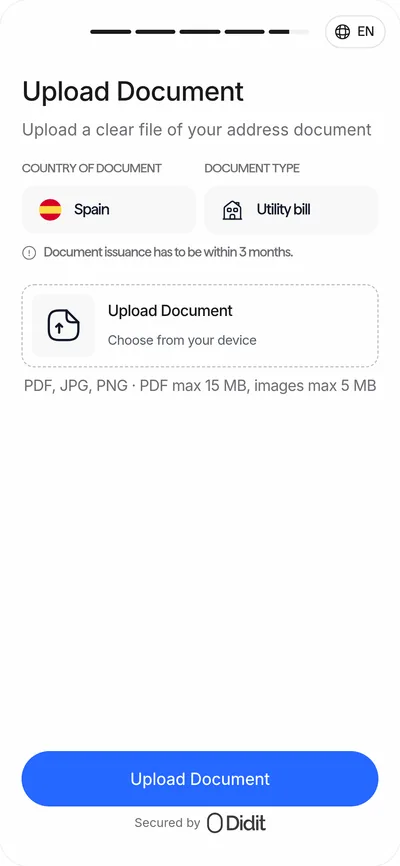
session.url, or mount the Web or Mobile SDK. They choose the document and photograph or upload it, and the UI handles capture quality. - Fetch the decision with
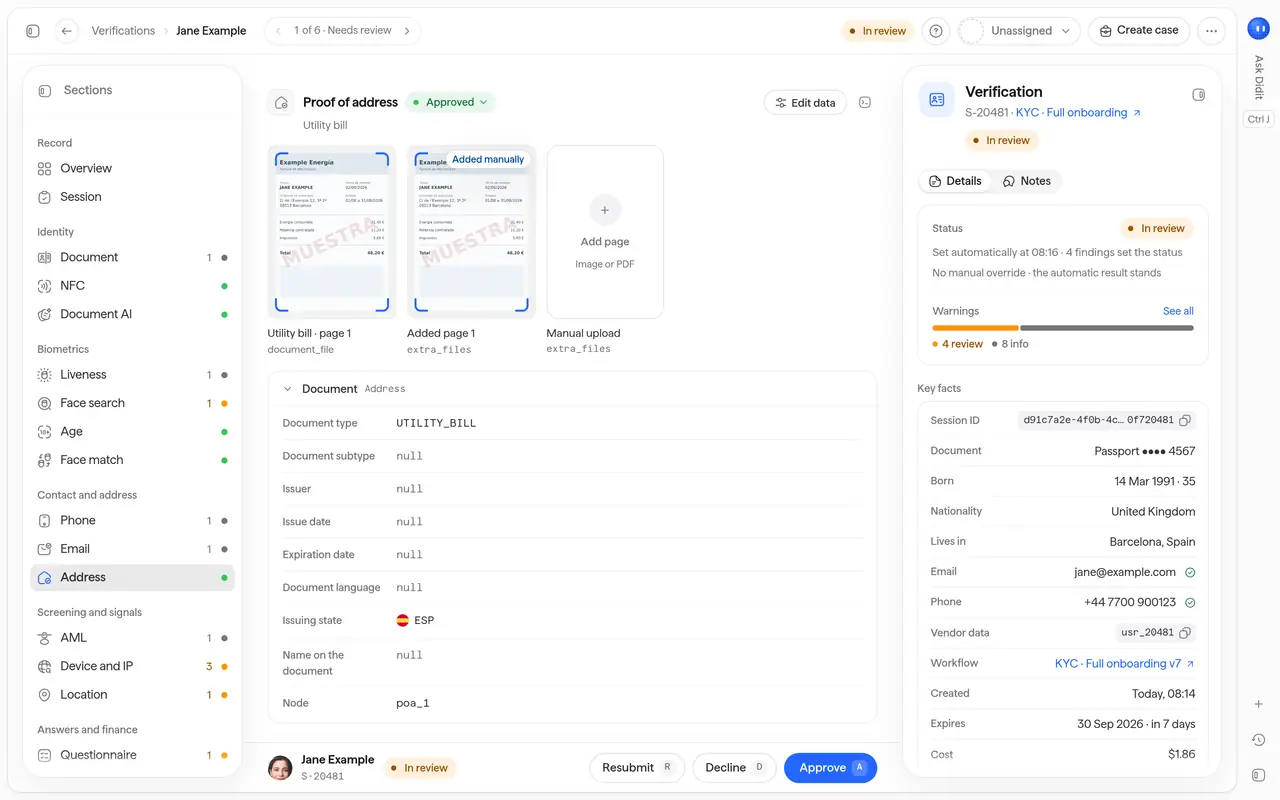
GET /v3/session/{sessionId}/decision/and read thepoa_verifications[]array. Feature arrays are always plural arrays, and an absent or null array means the step did not run. - Read each entry in
poa_verifications[]and use its status and warnings to decide whether to proceed, request another document, or review the result. Keep thesession_idreturned when you create the session. Retrieve the decision or subscribe tosession.status.updated.
Step by step: the standalone API, with a runnable example
This is the documented call. Send the file as multipart form data, and send the expected_* fields only when you have a source your policy accepts. Encrypted PDFs need document_password, or the call returns HTTP 400 with code: encrypted_pdf.
curl -X POST 'https://verification.didit.me/v3/poa/' -H "x-api-key: $DIDIT_API_KEY" -F "document=@./utility-bill.pdf" -F "expected_address=Av. Monseñor Tavella 3396, Salta" -F "expected_country=ARG" -F "expected_first_name=Sophia" -F "expected_last_name=Martinez" -F "poa_languages_allowed=en,es" -F "vendor_data=user-1234"Pass expected values from a source your policy accepts for comparison. An address entered at signup is the applicant's declared address. If it differs from the document, check both before deciding what to do.
By default save_api_request is true: the call is stored as an API-type session, the document is kept, the returned request_id is a real session id you can pass to the decision endpoint, and a status.updated webhook fires. Set it to false when you want nothing stored, and accept that the request_id then cannot be looked up later.
What a standalone response looks like
The standalone sample focuses on request_id, poa.status and poa.warnings. The keys are documented, with the values shortened.
{
  "request_id": "...",
  "poa": {
    "status": "Approved",
    "warnings": []
  }
}
The response also carries the issuer, issue date, holder name, language, document type and subtype, and the raw and parsed/geocoded address. For a persisted call, the session decision exposes document_file and document_metadata. The standalone response omits document_metadata.
A live HTTP 200 response can contain a Declined result with a name mismatch warning. Read the status and warnings, then compare the submitted name with the expected name. Each live HTTP 200 response consumes one credit, including Declined results.
Statuses on a hosted Proof of Address result in poa_verifications[].status are Not Started, In Progress, Approved, In Review, Declined, Abandoned and Kyc Expired. On standalone POST /v3/poa/, a readable document returns HTTP 200 with status Approved or Declined. A document that cannot be processed at all returns 400. The top-level session status has additional values.
Failure cases and how to recover
| Signal | What happened | Recovery |
|---|---|---|
HTTP 400, code: encrypted_pdf | The PDF is password protected, or the password sent is wrong | Resend with the right document_password, or ask for a decrypted copy |
HTTP 400, code: document_unreadable | The file is corrupt or cannot be opened | Ask for a different file. Branch on code, never on the message text |
HTTP 503, code: document_processing_busy | Too many documents in flight, so this upload was not processed | Resend the same file after the seconds in Retry-After |
| HTTP 403 | HTTP 403 can mean insufficient credit or missing or invalid credentials. Read the response before acting. | Check the x-api-key header for a permission error, and top up or wait for plan credit if the response reports insufficient credit. |
| Client timeout | The call may still be extracting, especially on a multi-page PDF | Use a client timeout of at least 45 seconds and avoid retrying while the original call may still be processing. If both live requests complete with HTTP 200, each consumes a credit. |
NAME_MISMATCH or ADDRESS_MISMATCH | Extracted fields differ from the expected_* values you sent | Check your own expected values first, then the document |
OVERLAY_MANIPULATION_DETECTED | The check flagged possible overlay text manipulation. | For OVERLAY_MANIPULATION_DETECTED, reject the submitted document and ask for a fresh copy. Keep POA_DOCUMENT_UNPROVEN_TEXT_REPLACEMENT as a separate risk signal. |
POA_DOCUMENT_UNPROVEN_TEXT_REPLACEMENT | A field was blanked and retyped in another font, and the file holds no proof either way | Treat as a risk signal, not a clear forgery, and decide in your policy |
POA_DOCUMENT_EXPIRED, INVALID_DOCUMENT_TYPE, MISSING_ADDRESS_INFORMATION, UNABLE_TO_VALIDATE_DOCUMENT_AGE, UNABLE_TO_EXTRACT_ISSUE_DATE, POA_NAME_NOT_DETECTED | Hard failures. These always decline and are not configurable on this endpoint | The document cannot carry the decision. Ask for a different one |
POA_DOCUMENT_NOT_SUPPORTED_FOR_APPLICATION, UNPARSABLE_OR_INVALID_ADDRESS | Informational on the standalone endpoint. These warnings never cause a standalone decline. Apply your acceptance policy when reviewing the result. | Review the result under your own policy |
Inputs and outputs
| Field | Direction | Notes |
|---|---|---|
document | Input | PDF, JPG, PNG, TIFF or WebP, up to 15 MB |
document_password | Input | Only for encrypted PDFs |
expected_address, expected_country | Input | Comparison inputs for the extracted address and country |
expected_first_name, expected_last_name | Input | Comparison inputs for the extracted holder name |
poa_languages_allowed | Input | Comma separated language codes, for example en,es |
poa_document_age_months | Input or step setting | How old the document may be before it can decline |
poa_*_action | Standalone API input | The five configurable risk groups and their action values. In a workflow, the equivalent settings are configured on the step. |
vendor_data | Input | Your reference for the submitted check. |
save_api_request | Input | Default true. false stores nothing and makes request_id a one-off UUID |
request_id | Output | A session id when the call is persisted, otherwise a correlation UUID |
poa.status | Output | Approved or Declined on this endpoint |
| Document type | Output | The extracted type, for example UTILITY_BILL |
| Document subtype | Output | The extracted subtype, for example WATER_BILL |
poa.issuer, poa.issue_date, poa.language | Output | The issuer, issue date and detected language |
| Address output | Output | The raw address and the parsed/geocoded address |
poa.warnings | Output | Issue codes for every issue found |
Address verification is not the same as identity verification
Address Validation confirms a postal address and can match a building, flat or PO box. Proof of Address checks a submitted document for evidence linking a named person to the address. Use the evidence required by the requester and any applicable rules. Address Validation returns address_type for United States and Canadian addresses when the type is on record, and is_residential for the United States, Great Britain, the Netherlands and Ireland, which can be null when unknown.
Worked cost example
The example assumes that each applicant completes a full ID check covering ID document verification, passive liveness, face match and device and IP analysis, plus Proof of Address and a billable Address Validation result.
- Proof of address: 1,200 x $0.20 = $240.00
- Address validation: 1,200 x $0.10 = $120.00
- Full ID check: 1,200 x $0.33 = $396.00
- Monthly total at list price: $240.00 + $120.00 + $396.00 = $756.00
On the Growth plan ($99 a month, 4% off every Didit price) the same month is $240.00 x 0.96 = $230.40 for proof of address, $120.00 x 0.96 = $115.20 for address validation and $396.00 x 0.96 = $380.16 for ID checks, so $230.40 + $115.20 + $380.16 = $725.76. The plan adds $115.00 of credit, which covers the first $115.00 of that usage. The remaining $725.76 minus $115.00 = $610.76 is drawn from prepaid top-up credit, separate from the $99 monthly subscription fee.
If only half of the applicants need an address check, the arithmetic changes to 600 x $0.20 = $120.00 for proof of address, 600 x $0.10 = $60.00 for address validation and 1,200 x $0.33 = $396.00 for ID checks, which is $120.00 + $60.00 + $396.00 = $576.00 a month at list price.
Paid steps and review boundaries
- The standalone API consumes one credit at the $0.20 list price per live HTTP 200 response, including Declined results. A 400 that never reaches processing does not.
- A 403 for insufficient balance arrives before any document processing, so a blocked call costs nothing.
- Address validation is charged at $0.10 per validated address, and an
unavailableresult is not charged. - The standalone sandbox validates the request and returns HTTP 400 for malformed input. Valid requests return a fixed
Approvedmock response without document processing, session persistence or credit use. - When a reviewer changes a status by hand, the decision records
status_overridewith the automatic status kept beside it.
The Proof of Address result reflects the document warnings and configured actions. Apply your onboarding policy to the applicant’s case. The endpoint returns Approved or Declined from the warnings, with five risk groups you set per request on the standalone API and two warnings that stay informational. Everything above that is policy: whether a virtual mailbox is acceptable, whether a document from four months ago is too old, whether a declined applicant may resubmit with a different document.
Sources
- Didit docs: Proof of Address API product page,
POST /v3/poa/ - Didit docs: Proof of Address overview
- Didit docs: proof of address warnings catalogue
- Didit docs: Address Validation API
- Didit docs: Create Session API
- Didit docs: Retrieve Session API
- Didit docs: webhooks
- Didit docs: pricing and billing rules
- Didit pricing page and cost estimator
- Didit pricing feed as JSON
- Didit MCP server setup
The next step is a sandbox application. Create one at business.didit.me, no sales call. Run the standalone call with a sample bill and read the fixed mock response. The sandbox tests request and response handling; it does not evaluate the sample bill.
Try it
Try this in the sandbox
Run the check this guide describes, free.
The product this post is about, taken from its topic. Run it free in the sandbox.
Author
Alberto Rosas
Co-founder and CEO

Keep reading
Other guides in the same topic.
 What Is the Purpose of FICA in South Africa? 2026 Guide
FICA is South Africa's anti-money laundering law. It creates the Financial Intelligence Centre and requires accountable institutions to identify and verify clients, screen for PEP and sanctions risk and report suspicious.
Alberto RosasNov 26, 2026 Sixth Money Laundering Directive (6AMLD): What Changed and Which Rules Apply
6AMLD is Directive (EU) 2018/1673: Member States must criminalise laundering, widen predicate offences and set a four-year penalty floor. It adds no new due diligence duties for firms.
Alberto RosasNov 26, 2026 Automated Sanctions Screening: Canada, the Entity List and Embargoes
Automated sanctions screening matches people and companies against lists such as Canada's autonomous sanctions made under SEMA and JVCFOA and the OFAC SDN List, and returns candidate hits scored for identity confidence and.
Alberto RosasNov 26, 2026Questions
Frequently asked questions
What counts as proof of address for a digital nomad?
Choose a recent document that shows your name and the address the requester asked you to verify. An official PDF can supply that evidence when the requester accepts it. The document must be one the requester accepts, in a language your policy allows and inside the age window you configured. For a booking confirmation, a hotel invoice or a permission letter, ask the requester whether it accepts that document before submitting it.
How much does a Didit proof of address check cost?
The Proof of Address workflow step lists at $0.20 per completed check. The standalone API consumes one credit at the $0.20 list price per live HTTP 200 response, including Declined results. Address validation, if you switch it on, is $0.10 per validated address. Sandbox calls are free and consume no credit.
What is the process for registering my address after moving in?
Requirements depend on the jurisdiction. Ask the official local authority for the deadline, the documents and any landlord confirmation it requires. The registration record may serve as address evidence, but ask the requester whether it accepts that record. Didit does not register addresses; it checks the document you provide.
How does billing work for utilities in a long-term serviced apartment?
Read the lease or the operator's billing terms. Check who receives the bill. If utilities are bundled, ask the operator for a dated invoice or tenancy confirmation showing your name and unit address, and confirm that the requester accepts that document.
Are utilities like water and gas metered or a flat rate?
Read the lease or the operator's billing terms to see whether the utility is metered to your unit or billed at a flat rate, and who receives the bill. If utilities are included in rent, ask for a dated invoice or tenancy confirmation showing your name and unit address. Confirm that the requester accepts that document before you submit it.
Can I use a virtual mailbox as my proof of address?
The requester must accept both a mailing address and the evidence the mailbox provider issues. A virtual mailbox statement can be candidate evidence only when the requester accepts that address type and that document. Ask the requester before paying for a mailbox.
Can I use a co-working registered address as proof of address?
For a business or registered address, the requester must accept that address type and the evidence the coworking provider issues. A coworking agreement or invoice can be candidate evidence only when the requester accepts both. Ask the requester before you submit it.
Can I use a friend's or a family member's address?
The document has to be in your name for the name match to pass. A bill in another person's name can trigger a mismatch when the check compares it with the applicant's name. Some requesters accept a permission letter alongside a bill, so ask the organization whether it accepts that combination before submitting it.
What is AML proof of address and why do banks keep asking for it?
Anti-money-laundering rules can require regulated firms to identify their customers and hold address evidence under applicable rules. An organization may request address evidence during onboarding or a later review, depending on applicable rules and policy. Ask the requester which address evidence it accepts for the account and jurisdiction. Regulated firms must apply their policy within the applicable legal requirements. Didit charges $0.20 for the address check and $0.20 for an AML screening.
What happens if the address document is declined?
Read poa.warnings, not just the status. A mismatch warning can mean the expected values you sent were wrong or the document is in another name. For OVERLAY_MANIPULATION_DETECTED, reject the submitted document and ask for a fresh copy. Keep POA_DOCUMENT_UNPROVEN_TEXT_REPLACEMENT as a separate risk signal. Check the issue date, any expiry date and the configured age limit. Ask for a current document that meets the requester's policy.
How long does a proof of address check take?
Extraction is LLM-based and typically takes 5 to 15 seconds, with multi-page PDFs reaching about 30 seconds. Use a client timeout of at least 45 seconds and avoid retrying while the original call may still be processing. If both live requests complete with HTTP 200, each consumes a credit.
Can I verify an address without a document?
Address Validation can check whether a postal address exists without a document. The list price is $0.10 per validated address, and an unavailable result is free. To link a person to the address, ask the requester which evidence it accepts under any applicable rules.
Does Didit work for remote workers outside Europe and North America?
Didit's overall coverage spans 220+ countries and territories. Check whether your flow supports the applicant's document type and language, then set poa_languages_allowed to match your policy. A language mismatch can raise LANGUAGE_NOT_ALLOWED, and the configured risk action determines whether it causes a decline.
Compliance built in
Audited, certified and attested.
We hold the certifications and build each country's rules into your flows, so you can launch anywhere without worrying. Security and Compliance center
- Regulation encoded into your flows
Tell us what you do and where. Didit lists the rules that apply to you, with sources, and builds the checks each country needs into one workflow.
- Ready for AMLR
Every requirement of the new EU anti-money laundering rules, from checking customers to human review, is already covered by a Didit check.
- Tested in Spain's Treasury sandbox
Spain's Treasury published its supervised sandbox report on Didit's NFC plus active liveness onboarding; SEPBLAC took part and valued the added measures positively.
- Audited, not self-declared
iBeta Level 1 and Level 2. Liveness tested under ISO/IEC 30107-3.
Your obligations · 3 regions
 SOC 2 Type 2
 ISO 27001
 iBeta Level 1 and Level 2
 EU regulator attestation
 FSM youth protection
 GDPR
 EBA remote onboarding
 MiCA compatible
 FIDO Alliance member
- AMLREU AML Regulation ready
Integration · Didit MCP
Run Didit from your own AI agent
Connect Didit to Claude, Cursor, VS Code or ChatGPT and just ask in plain words. Your agent can do anything you can do in the console, with the same permissions you have.
 Add to Claude
 ChatGPT
 Cursor
- Build workflowsDescribe the checks you need. The agent creates and publishes the flow.
- Run investigationsAsk why a session was declined, review cases, search people and companies.
- Change rulesCreate payment rules, test them on past data and switch them on.
- Pull reportsAsk for numbers, exports or the audit log.
Didit Academy


