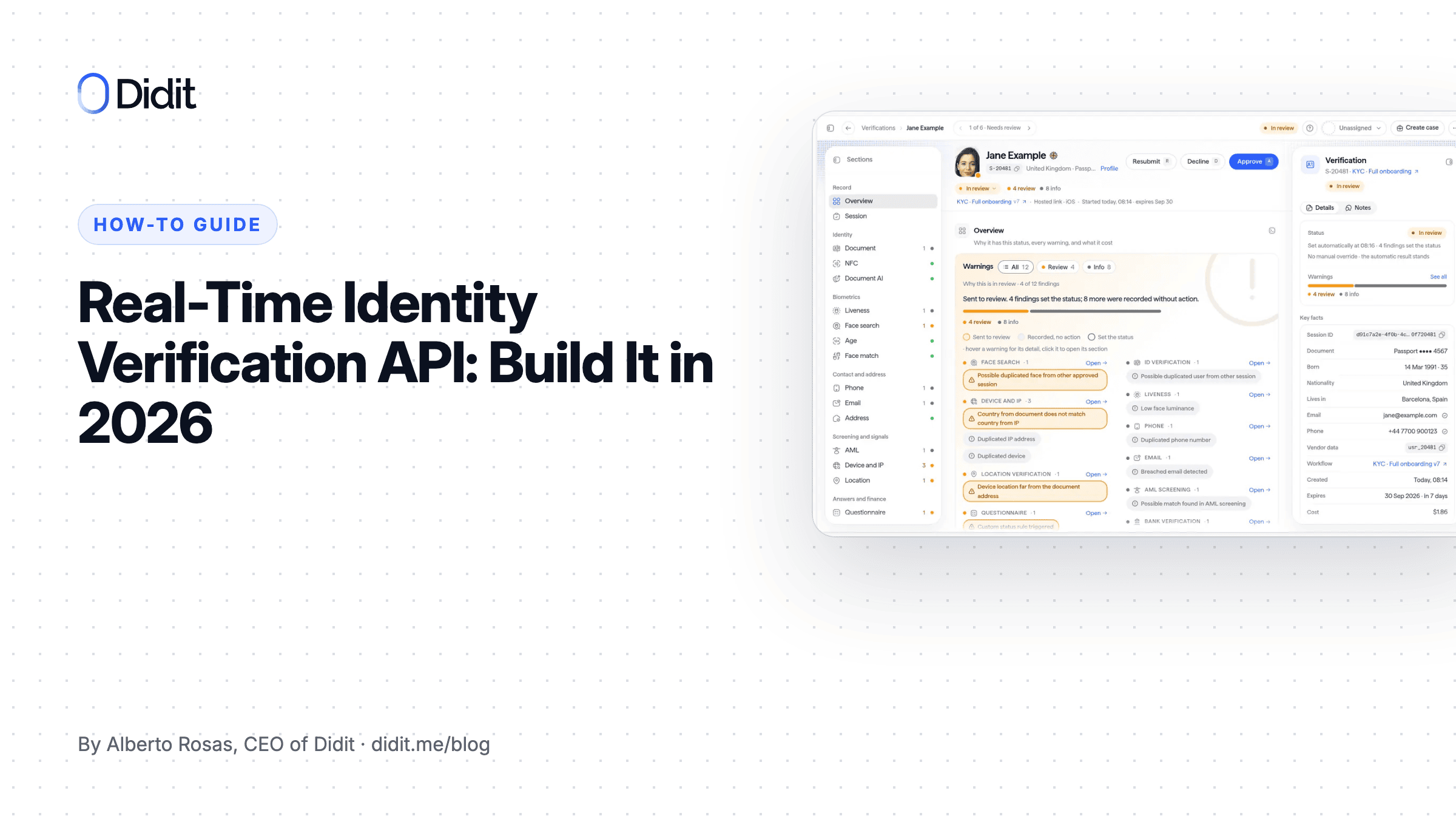
Real-Time Identity Verification API: Build It in 2026
A real-time identity verification API returns a decision while the user waits. On Didit a full KYC check is $0.33 list, $0.297 on Scale, and sandbox testing is free and unlimited on every plan.
 Alberto RosasCo-founder and CEO
Contents
In this guide
Jump to the part you need.
A real-time identity verification API fits teams that need a decision in the same flow as signup, not in a review queue. On Didit a full KYC check costs $0.33 at list price, $0.297 on Scale. The caveat is honest: the decision is only as fast as the last configured step, so step order, webhook handling and rate limits set your real speed.
Last updated: November 26, 2026. Prices checked against the live Didit price feed on November 26, 2026.
| Item | Value |
|---|---|
| Create a session | POST https://verification.didit.me/v3/session/ |
| Fetch the decision | GET https://verification.didit.me/v3/session/{session_id}/decision/ |
| Authentication | x-api-key header |
| Inference latency | sub-2-second p99 |
| Full KYC check | $0.33 list, $0.3168 on Growth, $0.297 on Scale |
| AML screening add-on | $0.20 per check |
| Session statuses | Approved, Declined, In Review, In Progress, Not Started, Expired, Abandoned, Kyc Expired, Resubmitted, Awaiting User |
| Webhook events | status.updated, data.updated, user.status.updated, user.data.updated, plus business and transaction events |
| Sandbox | Free and unlimited test sessions on every plan |
| Plans | Free at $0 with $10 of monthly credit, Growth $99 a month, Scale $299 a month, Enterprise from $15,000 a year |
Start free in the sandbox at business.didit.me with no sales call, and sandbox testing is free and unlimited on every plan. Developers who want an assistant to drive the calls can connect Didit to an AI assistant through the Didit MCP server. The product detail sits on AML Screening and Business Verification, and every number is on the pricing page.
What real time means in this build
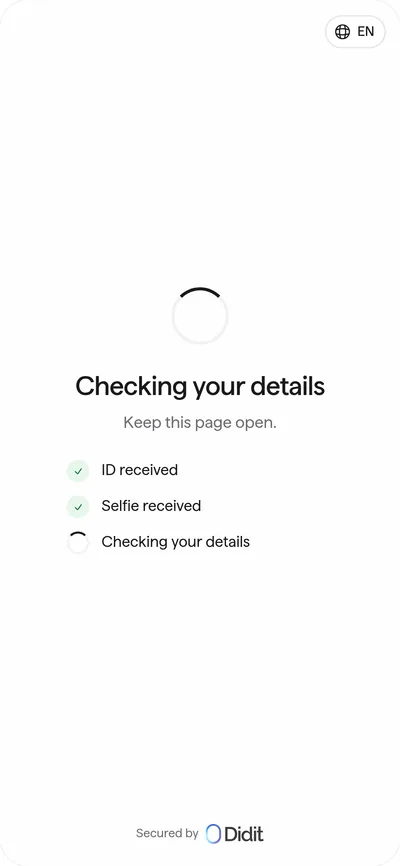
Real time has two halves and teams usually conflate them. The first half is inference: Didit returns a verification result at sub-2-second p99, so the document check, the passive liveness check and the face match finish while the person is still on the screen. The second half is delivery: the decision reaches your backend as a signed webhook the moment the status changes, and it stays readable at the decision endpoint afterwards.
The recommended method is therefore not a raw document upload. You create a session from a published workflow, hand the user the hosted URL, and listen for status.updated. The workflow decides which checks run and in which order, so the same code path carries a three-step KYC flow or a KYB flow with a registry lookup. That orchestration layer has no line item on the price list.
Numbers worth sizing against: 220+ countries and territories, 14,000+ document types, 200+ fraud signals on every session, and 4,000+ companies running on the platform. The Workflow Orchestrator, the SDKs, the MCP server and reusable KYC are all free to use; you pay per completed check.
Prerequisites
- A Didit organization. Sign up with a work email and the Free plan carries $10 of monthly credit, for the first organization created with an eligible work email for a company domain; an organization created through the API starts at $0. Read the billing rules in the pricing docs.
- An API key. Copy it from the console, or register programmatically with
POST https://apx.didit.me/auth/v2/programmatic/register/followed byPOST https://apx.didit.me/auth/v2/programmatic/verify-email/and the 6-character code. The response carries a sandbox key and a live key; build with the sandbox key. - A persisted
workflow.idfrom a published workflow, stored somewhere your backend reads at runtime. - A persisted
session_idfor every session you create: it is the field that matches the create response, every webhook and the decision call for that person, andvendor_datais the documented field that binds the session to your own stable identifier for the same entity. - An HTTPS endpoint for webhooks that reads the raw body and answers 2xx in under 5 seconds.
- A callback URL whose origin is on the application's allowed domains, or a custom URL scheme for a mobile deep link.
Step-by-step: from zero to a live decision
- Create the organization and copy two keys. Sign up at business.didit.me, create the organization, and open the API keys section. Keep the sandbox key in one environment variable and the live key in another, and never let a sandbox key reach production.
- Create a workflow and publish it. In the console open Workflows, click New workflow, choose Verifying users, and start from the KYC template, or create it with the API call below. A simple workflow runs its steps in a fixed order; a node-based workflow branches on results. Persist
workflow.id. - Create a session. Call
POST https://verification.didit.me/v3/session/with the workflow id and your ownvendor_data. Passexpected_detailswhen you already know the name, date of birth or document type: a mismatch then comes back as a decision warning instead of blocking the person. - Send the user to the returned
url. Hosted page, SDK or iframe, your choice. The link stays valid untilexpires_atunless you overridesession_expiration_time, which accepts 3600 to 2419200 seconds. - Register a webhook destination. Call
POST https://verification.didit.me/v3/webhook/destinations/with a label, an HTTPS URL,webhook_versionset to v3 and the events you want, then save the returnedsecret_shared_key.GET /v3/webhook/destinations/{destination_uuid}/returns the secret again if you lose it. - Handle the event correctly. Read the raw body, check that
X-Timestampis within 300 seconds, recompute the HMAC-SHA256 with your secret, and compare in constant time, accepting the-Previousheader while a rotated secret is in flight. De-duplicate onevent_id, answer 2xx inside 5 seconds, and only then write the status to your own record. - Read the decision when you need the detail.
GET https://verification.didit.me/v3/session/{session_id}/decision/returns the whole data set. Branch onsession_kindbefore touching any feature array. - Repeat in the sandbox, then switch keys. Sandbox testing is free and unlimited, and you can arm a scenario slug from
GET /v1/sandbox/scenarios/to reproduce a decline or an AML hit without waiting for a real one. Move to the live key once the organization holds credit.
These three calls are the whole loop, and they are copied from the quick start:
curl -X POST https://verification.didit.me/v3/workflows/ \
-H "x-api-key: $DIDIT_API_KEY" \
-H "Content-Type: application/json" \
-d '{
  "workflow_label": "Standard KYC",
  "workflow_type": "kyc",
  "features": [
    {"feature": "OCR"},
    {"feature": "LIVENESS", "config": {"face_liveness_method": "PASSIVE"}},
    {"feature": "FACE_MATCH"},
    {"feature": "AML"}
  ]
}'

curl -X POST https://verification.didit.me/v3/session/ \
-H "x-api-key: $DIDIT_API_KEY" \
-H "Content-Type: application/json" \
-d '{"workflow_id": "$WORKFLOW_ID", "vendor_data": "user-42", "callback": "https://myapp.com/kyc/return"}'

curl https://verification.didit.me/v3/session/$SESSION_ID/decision/ \
-H "x-api-key: $DIDIT_API_KEY"
Expected output
The session call returns session_id, url and session_token. Store session_id: it is the key that matches every webhook and the decision call for that person.
The decision call returns one object with session_id, session_kind, session_number, session_url, status, vendor_data, metadata, callback, features, expected_details, created_at, expires_at, reviews, status_override, decision_trace, linked_records and biometric_retention. Feature data arrives in plural arrays such as id_verifications[], liveness_checks[], face_matches[] and aml_screenings[]. If a feature did not run on the session, its array is absent or null, never a placeholder.
The webhook envelope is smaller and points at the same data:
{
  "event_id": "uuid",
  "session_id": "uuid",
  "status": "Approved",
  "webhook_type": "status.updated",
  "environment": "live",
  "vendor_data": "user-42",
  "decision": { }
}
decision is only present when the status is Approved, Declined, In Review or Abandoned. Status strings are case-sensitive, and "Kyc Expired" uses a single capital K.

Inputs and outputs
| Field | Direction | Required | What it does |
|---|---|---|---|
workflow_id | Input | Yes | UUID of a published workflow. A KYC workflow creates a user session and a KYB workflow creates a business session from the same endpoint. |
vendor_data | Input | Recommended | Your stable identifier for the person or business. Binds the session to an entity and feeds duplicate detection. |
callback | Input | No | Where the hosted flow returns the user. Must sit on an allowed domain, otherwise creation fails with 400 on callback. |
expected_details | Input | No | Name, date of birth, nationality, document types. Mismatches surface as decision warnings. |
metadata and tags | Input | No | Arbitrary JSON echoed back in responses and webhooks, plus up to 10 tags for filtering in the console. |
session_expiration_time | Input | No | Seconds the link stays valid, 3600 to 2419200, overriding the workflow setting for this session only. |
session_id | Output | Always | UUID used for the decision call and to match webhooks. |
url | Output | Always | Hosted verification link. Redirect the user or open it in the SDK. |
session_kind | Output | Always | user or business. Branch on it before reading feature arrays. |
status | Output | Always | Current state of the session, from Not Started to a terminal Approved, Declined or Expired. |
id_verifications[], liveness_checks[], face_matches[], aml_screenings[] | Output | Per feature | One entry per configured step that ran. Absent or null when the workflow skipped the feature. |
Failure cases and recovery
| Symptom | Cause | Recovery |
|---|---|---|
| 401 | Invalid, revoked or expired API key | Copy the key again from the console and redeploy the environment variable. |
| 403 with detail "You do not have permission to perform this action." | The key lacks a privilege, for example read:sessions on the decision call | Issue a key that holds the needed scope, or use the application that owns the session. |
400 on workflow_id | Unknown or unpublished workflow UUID | Publish the draft, re-read workflow.id, retry. |
400 on callback | The callback origin is not on the application's allowed domains | Add the origin with PATCH /v3/webhook/, or send a custom URL scheme. |
| 404 on the decision call | The session does not exist or belongs to a different application | Check the session_id against the key pair that created it. |
429 with Retry-After | A request budget was exceeded on one scope | Wait the given seconds, then back off with jitter, 5s to 40s, and stop after about 5 attempts. |
| Webhook never arrives | Handler slower than 5 seconds, or answered 5xx or 404, so delivery stopped after two retries at about 1 and 4 minutes | Resend from the destination's delivery log and keep a decision fetch as the fallback. |
| Signature check fails | Body re-encoded before hashing, or a timestamp older than 300 seconds | Hash the raw bytes for X-Signature or the canonical JSON for X-Signature-V2; accept the -Previous header during rotation. |
Rate limits deserve their own line because they shape a burst. Session creation allows 600 requests per minute per API key. The v3 decision path is governed by the generic GET ceiling of 600 per minute, not by the 100 per minute throttle that applies to the v1 and v2 decision paths. On Enterprise the global limits and the session limits can be raised on request; the details are in the rate limiting docs.

Paid steps and where human review starts
Every price below is a list price from the live feed, and you are billed only when a check finishes with a result. Some no-match database lookups and retries are billable, and the docs list them.
- Full KYC check $0.33: ID document verification $0.15, passive liveness $0.10, face match 1:1 $0.05, device and IP analysis $0.03.
- AML screening $0.20 per check across 1,300+ lists, plus ongoing monitoring at $0.07 per person per year.
- Optional steps: active liveness $0.15, NFC chip reading $0.15, proof of address $0.20, age estimation $0.10, custom questionnaires $0.10, Document AI $0.20.
- Business verification starts at $2.00 per company, and owners and officers take a linked full ID check plus person AML billed per person at $0.20.
- Wallet screening is $0.15 per screening inside Transaction Monitoring, and you can also bring your own screening provider and run it inside Didit.
The review boundary is a status, not a separate product. When a rule sends a session to a person, the status becomes In Review and the decision carries assignee, waiting_since and sla_due_at. A reviewer's manual change appears as status_override with automatic_status kept beside it, and decision_trace records whether the final status was automatic, manual or an investigator's. The Investigator agent, which writes reviews and follows up on cases, is included on the Growth plan and above. Build your integration so In Review and Awaiting User are pending states that a person can resolve, not failures. Sandbox testing is free and unlimited, so you can rehearse those states before a live session depends on them.

Worked cost example
Take 10,000 completed full KYC checks in a month, 2,000 of which also need AML screening, on the Scale plan. The figures below are usage spend; the plan fee is quoted separately at the end.
- Full KYC at list is $0.33. Scale takes 10% off: $0.33 minus $0.033 = $0.297 per check.
- KYC only: 8,000 multiplied by $0.297 = $2,376.00.
- KYC plus AML at list is $0.33 plus $0.20 = $0.53. On Scale: $0.53 multiplied by 0.90 = $0.477 per check.
- KYC plus AML: 2,000 multiplied by $0.477 = $954.00.
- Total usage spend: $2,376.00 plus $954.00 = $3,330.00.
- Usage is paid from credit first. The Scale credit of $350.00 covers the first $350.00, so top-ups cover $3,330.00 minus $350.00 = $2,980.00. Top-ups are added at face value and last 12 months.
- Total monthly out-of-pocket on Scale, plan fee included: $299.00 plan fee plus $2,980.00 of top-ups = $3,279.00. The plan fee is not usage; the $350.00 of credit it carries is already subtracted above.
For comparison, Growth takes 4% off: $0.33 multiplied by 0.96 = $0.3168 per check. On the Free plan the $10 of monthly credit buys about 30 full checks at $0.33.
Sources
- Didit docs: Quick Start
- Didit docs: Create Session API
- Didit docs: Retrieve Session Decision API
- Didit docs: Webhooks, HMAC signing and event types
- Didit docs: API Rate Limiting
- Didit docs: Pricing and billing rules
- Didit docs: Security and Compliance
- Didit pricing page and the live price feed, read November 26, 2026
- Didit AML Screening
- Didit Business Verification
- Didit MCP server
- FATF, for the customer due diligence baseline in Recommendation 10
The fastest way to judge the latency is to run it yourself. Create a free organization at business.didit.me, build the KYC template, and create your first session with the sandbox key. No sales call is needed, and sandbox testing is free and unlimited on every plan.
Try it
Try this in the sandbox
Run the check this guide describes, free.
The product this post is about, taken from its topic. Run it free in the sandbox.
Author
Alberto Rosas
Co-founder and CEO

Keep reading
Other guides in the same topic.
 What Is the Purpose of FICA in South Africa? 2026 Guide
FICA is South Africa's anti-money laundering law. It creates the Financial Intelligence Centre and requires accountable institutions to identify and verify clients, screen for PEP and sanctions risk and report suspicious.
Alberto RosasNov 26, 2026 Sixth Money Laundering Directive (6AMLD): What Changed and Which Rules Apply
6AMLD is Directive (EU) 2018/1673: Member States must criminalise laundering, widen predicate offences and set a four-year penalty floor. It adds no new due diligence duties for firms.
Alberto RosasNov 26, 2026 Automated Sanctions Screening: Canada, the Entity List and Embargoes
Automated sanctions screening matches people and companies against lists such as Canada's autonomous sanctions made under SEMA and JVCFOA and the OFAC SDN List, and returns candidate hits scored for identity confidence and.
Alberto RosasNov 26, 2026Questions
Frequently asked questions
What is a real-time identity verification API?
A real-time identity verification API is an HTTP endpoint that starts a verification and returns a decision inside the same user interaction instead of queueing it for manual work. On Didit you call POST https://verification.didit.me/v3/session/ with a workflow id, send the user to the returned URL, and read the outcome from a signed webhook or from GET /v3/session/{session_id}/decision/.
How fast is Didit's identity verification API?
Didit returns verification results at sub-2-second p99 inference latency, so the document, liveness and face match checks finish while the person is still in the flow. Total wall-clock time also depends on how long the person takes to capture a document and a selfie. Each status change is pushed as a webhook as soon as it happens.
How much does one real-time KYC check cost?
A full KYC check is $0.33 at list price: ID document verification $0.15, passive liveness $0.10, face match 1:1 $0.05 and device and IP analysis $0.03. Growth takes 4% off, so $0.3168 per check, and Scale takes 10% off, so $0.297. Adding AML screening costs another $0.20 per check, and you pay only when a check finishes with a result.
Do I need webhooks if I can fetch the decision?
You can ship with the decision call alone. Webhooks deliver each status change to your backend as a signed event when it happens, and the decision endpoint stays as the fallback when a delivery is missed. Register a destination and subscribe to status.updated and data.updated; if you verify only with X-Signature-Simple, re-fetch the decision rather than trusting the payload.
What status values can a session return?
The exact strings are Approved, Declined, In Review, In Progress, Not Started, Expired, Abandoned, Kyc Expired, Resubmitted and Awaiting User. They are case-sensitive, and Kyc Expired uses a single capital K. Treat In Review and Awaiting User as pending states, never as declines.
What happens if my webhook handler is slow or returns an error?
Didit expects an answer within 5 seconds. If the handler is slower, or answers 5xx or 404, the delivery is retried twice, after about 1 minute and about 4 minutes, and then dropped. Resend it from the destination's delivery log and keep the decision endpoint as a fallback so a dropped event never leaves a customer stuck.
Can I test the API without paying?
Yes. Sandbox testing is free and unlimited on every plan. Organizations that sign up with a work email also get $10 of monthly credit for the first organization created with an eligible work email for a company domain, and that credit pays for live checks. Sandbox sessions can reproduce outcomes through sandbox_scenario, which is rejected on live applications.
What are the rate limits?
Session creation allows 600 requests per minute per API key, and the v3 decision call falls under the 600 per minute GET ceiling rather than the 100 per minute throttle on the v1 and v2 decision paths. A throttle returns 429 with Retry-After and X-RateLimit headers. Wait the given seconds, then back off with jitter and stop after about 5 attempts.
Can the same endpoint verify a business?
Yes. POST /v3/session/ is the unified endpoint and the workflow type decides the kind of session. A KYC workflow creates a user session and a KYB workflow creates a business session, and the decision response says which one in session_kind. Branch on that field before reading any feature array.
Is Didit secure enough for regulated onboarding?
Didit holds SOC 2 Type 2 and ISO/IEC 27001:2022 certification, operates under GDPR, and completes iBeta Level 1 PAD presentation attack testing. Spain's Tesoro, Banco de España and SEPBLAC reviewed the flow and rated it safer than in-person verification. See the security and compliance docs for the full posture.
Do I need a sales call to start?
No. You can create an organization and run the sandbox at business.didit.me without talking to anyone, and the API keys are self-serve. Sales enters only for Enterprise contracts, which start at $15,000 a year.
Compliance built in
Audited, certified and attested.
We hold the certifications and build each country's rules into your flows, so you can launch anywhere without worrying. Security and Compliance center
- Regulation encoded into your flows
Tell us what you do and where. Didit lists the rules that apply to you, with sources, and builds the checks each country needs into one workflow.
- Ready for AMLR
Every requirement of the new EU anti-money laundering rules, from checking customers to human review, is already covered by a Didit check.
- Tested in Spain's Treasury sandbox
Spain's Treasury published its supervised sandbox report on Didit's NFC plus active liveness onboarding; SEPBLAC took part and valued the added measures positively.
- Audited, not self-declared
iBeta Level 1 and Level 2. Liveness tested under ISO/IEC 30107-3.
Your obligations · 3 regions
 SOC 2 Type 2
 ISO 27001
 iBeta Level 1 and Level 2
 EU regulator attestation
 FSM youth protection
 GDPR
 EBA remote onboarding
 MiCA compatible
 FIDO Alliance member
- AMLREU AML Regulation ready
Integration · Didit MCP
Run Didit from your own AI agent
Connect Didit to Claude, Cursor, VS Code or ChatGPT and just ask in plain words. Your agent can do anything you can do in the console, with the same permissions you have.
 Add to Claude
 ChatGPT
 Cursor
- Build workflowsDescribe the checks you need. The agent creates and publishes the flow.
- Run investigationsAsk why a session was declined, review cases, search people and companies.
- Change rulesCreate payment rules, test them on past data and switch them on.
- Pull reportsAsk for numbers, exports or the audit log.
Didit Academy


