Face Match With Didit Verification Links: Step-by-Step
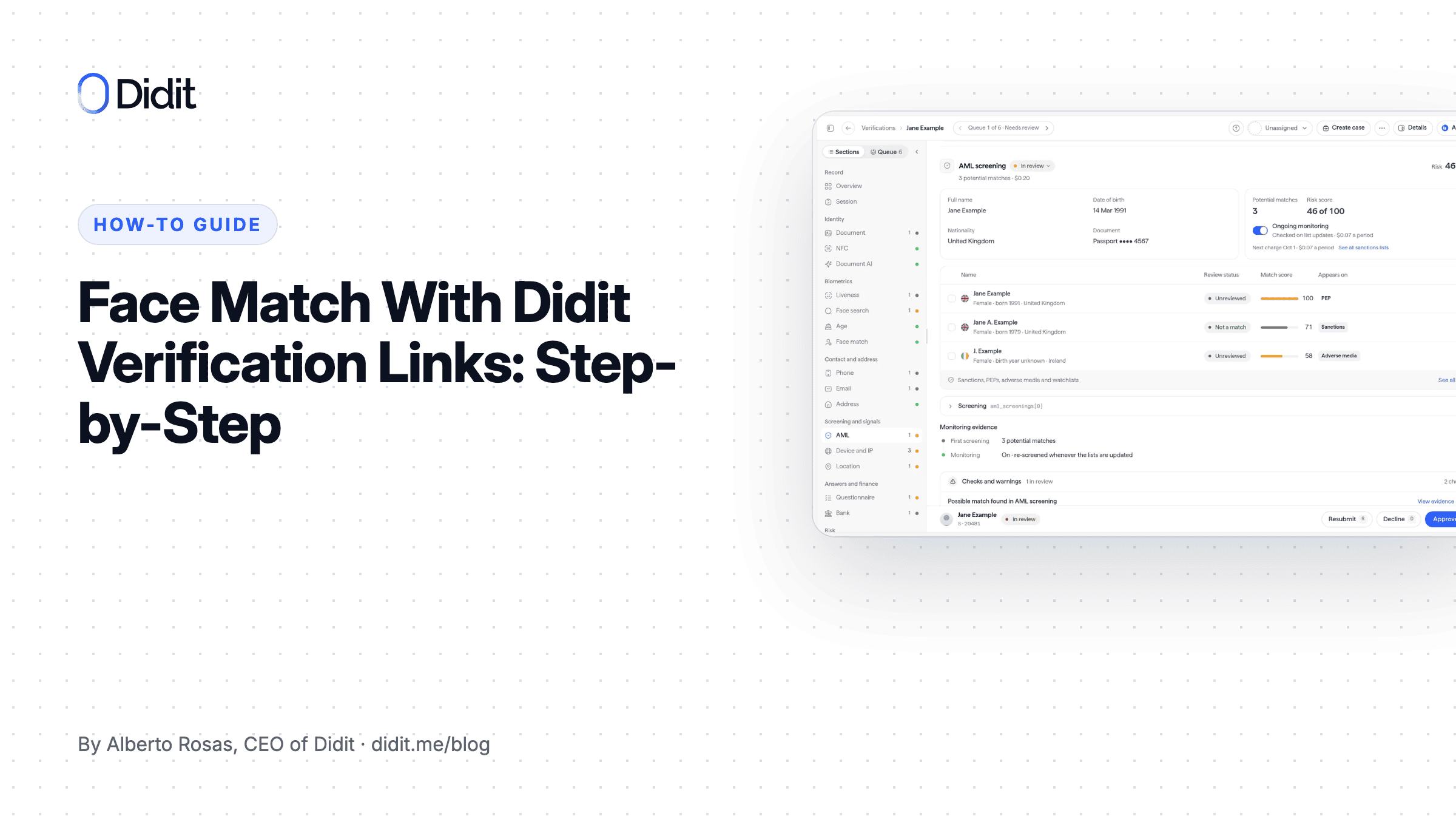
Create a Didit workflow with ID document, liveness and Face Match, create a session, send the returned URL, then read the Face Match entries from the decision. Face Match costs $0.05 per check; the full ID check is $0.33.
 Alberto RosasCo-founder and CEO
Contents
In this guide
Jump to the part you need.
Face Match with a Didit verification link fits teams that need a selfie compared against the portrait on an ID document without building capture screens. You define a workflow, create a session, and send the user the returned URL. Didit hosts the flow and returns a similarity score from 0 to 100. Face Match costs $0.05 per check. The caveat: the document portrait must be extractable, and the link works only while the session is valid.
Last updated: November 26, 2026. Prices checked against the live Didit price feed on November 26, 2026.
| Item | Detail |
|---|---|
| Outcome | A Didit-hosted flow that captures an ID document, runs a liveness check and compares the live face to the document portrait 1:1 |
| Recommended method | A workflow that contains ID document, liveness and Face Match, started with POST /v3/session/ or from the Business Console |
| Face Match price | $0.05 per check |
| Full ID check price | $0.33 per completed check: ID $0.15 + passive liveness $0.10 + face match $0.05 + device and IP $0.03 |
| Similarity score | 0 to 100; the thresholds in your workflow decide pass, review or decline |
| Default decline threshold on the standalone API | 30, so a score of 30 or less is Declined |
| Retries inside a session | face_match_max_attempts, default 3, range 1 to 3 |
| Result delivery | Webhook on status change, or GET /v3/session/{sessionId}/decision/ |
| Link validity | The workflow default, or session_expiration_time from 3600 to 2419200 seconds |
Start free in the sandbox at business.didit.me: no sales call, and sandbox sessions skip processing and billing. Developers who want an AI assistant to drive the setup can connect Didit through the Didit MCP server. Every module price is listed on the Didit pricing page.
What the verification link adds to Face Match
A verification link is a unique, secure URL that sends the user to a flow hosted entirely by Didit. You design the steps in the Business Console and Didit handles the interface, the document capture, the selfie capture and the security around them. That is the Orchestrated Workflows path: the workflow engine does the sequencing, and you never build a camera screen.
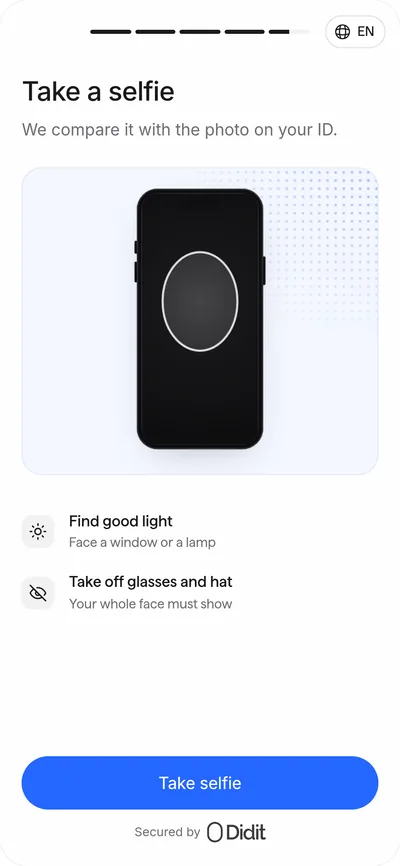
Face Match is one node in that flow. On its own it is a 1:1 biometric comparison: two faces in, one similarity score out. Inside a session it gets its two images from the steps before it. ID Verification produces the document portrait, which becomes the reference image, and a liveness check produces the live selfie, which becomes the user image. The comparison confirms that the person holding the document matches the portrait on it.
Delivery is up to you. The same link can go out by email, SMS, in-app message or support chat, and the console also returns a QR code for in-person onboarding where the user finishes on their own phone. The hosted flow runs in 54 capture and interface languages and accepts 14,000+ document types from 220+ countries and territories.
Prerequisites
- A Didit organization. Sign up at business.didit.me with a work email; eligible free organizations get $10 of monthly credit, and the sandbox is free on every plan.
- A workflow that includes the ID document step, a liveness step and Face Match. It has its own
workflow_id. - An API key from the console if you create sessions by API. Send it in the
x-api-keyheader. - An HTTPS endpoint that can accept webhooks, or a plan to poll the decision endpoint. The quick start at docs.didit.me covers webhook registration.
- A place to store the returned
session_idnext to your own user ID, so the decision can be matched back to the right account.
How to run Face Match with a verification link in 6 steps
- Build the workflow. In the Business Console open Workflows, click New workflow, choose Verifying users, then start from a template or from empty. Add the ID document step, a liveness step and Face Match. The liveness method is set with
face_liveness_method:PASSIVE,ACTIVE_3DorFLASHING. The same workflow can be created by API:POST /v3/workflows/withworkflow_label,workflow_typeand afeaturesarray listingOCR,LIVENESSandFACE_MATCH. - Copy the
workflow_id. It is a UUID and stays stable, so you create it once and reuse it for every session. - Create a session. One call returns the URL. Replace the key, the workflow UUID and the callback with your own values:
curl --request POST \
     --url https://verification.didit.me/v3/session/ \
     --header 'x-api-key: YOUR_API_KEY' \
     --header 'Content-Type: application/json' \
     --data '{
       "workflow_id": "550e8400-e29b-41d4-a716-446655440000",
       "vendor_data": "your_internal_user_id_123",
       "callback": "https://yourapp.com/kyc/return"
}'- Send the user the
urlfrom the response. Paste it into an email, an SMS, an in-app message or a QR code. If you prefer no code at all, do the same thing in the console: open Verifications, click + Create Verification, pick theworkflow_id, optionally addvendor_data, and copy the URL or QR code that appears. - Register a webhook destination and receive the status changes. The
callbackin the session is only the return URL that redirects the user when the hosted flow ends. Status events go to a webhook destination you register separately withPOST /v3/webhook/destinations/, passing alabeland the destinationurlwith the events you want. Save the returnedsecret_shared_key, verify theX-Signature-V2header, de-duplicate onevent_idand answer within 5 seconds. If you would rather pull, callGET /v3/session/{sessionId}/decision/. - Read the Face Match result. The decision payload carries a
face_matches[]array, one entry per Face Match node, with a status, a score from 0 to 100 and any warnings. That entry is where the automated result stops: it gives you the score, the status and the warning codes, and your own rules decide what your system does with them.

Expected output
The create call returns the session and the link. This is the documented response shape:
{
  "session_id": "11111111-2222-3333-4444-555555555555",
  "session_number": 1234,
  "vendor_data": "your_internal_user_id_123",
  "status": "Not Started",
  "workflow_id": "550e8400-e29b-41d4-a716-446655440000",
  "callback": "https://yourapp.com/kyc/return",
  "url": "https://verify.didit.me/session/abcdef123456"
}
Store session_id and url. The session status starts at Not Started and moves through In Progress to Approved, In Review or Declined, with Expired, Abandoned and Kyc Expired as the timeout and document-expiry outcomes. Status strings are case-sensitive and include spaces, so match on the exact value. The full enum is in the verification statuses reference.
Inputs and outputs
| Field | Direction | What it does |
|---|---|---|
x-api-key | Input header | Your application key. A missing key returns 403. A wrong, revoked or expired key returns 401. |
workflow_id | Input, required | UUID of the workflow that contains the ID document, liveness and Face Match nodes. |
vendor_data | Input, recommended | Your stable identifier for the person. It binds the session to your user and feeds duplicate detection across sessions. |
callback | Input, optional | Return URL only: where the hosted flow redirects the user at the end. Didit appends the session id and status. It must sit on one of the application's allowed domains, otherwise creation fails with 400. Status events are not sent here; they go to a registered webhook destination. |
session_expiration_time | Input, optional | Seconds the link stays valid, 3600 to 2419200, overriding the workflow setting for this session. |
language | Input, optional | ISO 639-1 code for the hosted interface, for example en, es or de. Defaults to browser detection. |
session_id | Output | The identifier you pass to the decision endpoint. |
url | Output | The verification link you send to the user. |
status | Output | Session status string. |
face_matches[].status | Output in the decision | Not Started, In Progress, Approved, In Review, Declined, Abandoned or Kyc Expired. |
face_matches[].score | Output in the decision | Similarity score from 0 to 100. |
face_matches[].warnings[] | Output in the decision | Risk codes such as LOW_FACE_MATCH_SIMILARITY or NO_REFERENCE_IMAGE. |
Reading the Face Match result: scores, thresholds and retries
The score is a number from 0 to 100, and it is not a verdict by itself. The thresholds you set in the workflow decide what happens to it, so there is no universal middle band that applies to every account: you configure the passing and review rules for your own risk appetite. On the standalone API the default decline threshold is 30: a score strictly above it returns Approved, and a score at or below it returns Declined with a LOW_FACE_MATCH_SIMILARITY warning.
Inside a session, a failure that the user can fix does not decline immediately. If the selfie is too dark, blurry or off-center, or the similarity is borderline, the user is asked to retry with guidance, the same model used for liveness. The attempt budget is face_match_max_attempts, default 3 and configurable between 1 and 3 per workflow node. While attempts remain, the step returns feedback codes such as this:
{
  "detail": "Make sure your face matches your document photo, improve lighting and try again.",
  "error": "LOW_FACE_MATCH_SIMILARITY",
  "feedback_codes": ["LOW_FACE_MATCH_SIMILARITY"],
  "attempts_used": 1,
  "max_attempts": 3
}
When the budget runs out, the computed status is applied: Declined or In Review, depending on how you configured the thresholds. Retries exist in the session flow only. The standalone endpoint is single-shot with no retry budget. With save_api_request=true, the call is persisted as an API-type session and can be queried later. With save_api_request=false, nothing is stored. The full warning catalogue sits in the Face Match warnings reference.

Failure cases and recovery
| Symptom | Cause | Recovery |
|---|---|---|
| 403 with "You do not have permission to perform this action." | A missing API key on verification.didit.me | Send the key in the x-api-key header. A wrong, revoked or expired key returns 401. |
| 400 on session creation | Invalid workflow_id, or a callback outside the application's allowed domains | Re-copy the UUID from the console; move the callback onto an allowed origin or use an app deep link. |
| 403 not enough credits | The organization balance cannot cover the call | Top up or move to a plan with credit. On the standalone API the refusal comes before any image processing. |
NO_REFERENCE_IMAGE | The document portrait could not be extracted | Ask for a sharper document photo or a different document type, then let the user retry. |
NO_FACE_DETECTED or MULTIPLE_FACES_DETECTED | The image is unusable: no face, or more than one person in frame | Send the user back to the face step with the standard guidance. The session flow allows the retry. |
LOW_FACE_MATCH_SIMILARITY | The two faces do not match, or the score is borderline | Do not approve. Let the retry budget run, then route to In Review or Declined according to your thresholds. |
| No webhook arrived | The handler took longer than 5 seconds, or answered 5xx or 404 | Didit retries twice, after about 1 and 4 minutes, then drops the delivery. Resend from the destination's delivery log or poll the decision endpoint. |
| 429 | The shared write budget of 300 requests per minute per API key was exceeded | Spread the writes out. The budget covers every POST, PATCH and DELETE call on the key. |

What you pay and where human review starts
Didit bills per completed check from prepaid credit. Inside a verification link each step keeps its own published price: ID document $0.15, passive liveness $0.10, Face Match $0.05 and device and IP analysis $0.03. Those four lines are what makes the $0.33 full ID check, and that figure assumes passive liveness plus device and IP analysis; if you choose active liveness instead, that step is $0.15. Sandbox testing is free. Completed live checks are billed from prepaid credit. The pricing documentation lists the billing rules, including which retries and no-match lookups are billable.
Automated checks return Approved or Declined when the result is clear, and In Review when a warning needs a person. We give you the score, the status and the warning codes; the thresholds that turn them into a business decision are yours.
Worked cost example
Take 10,000 completed ID checks in a month on a workflow that includes Face Match, with passive liveness and device and IP analysis. Every check contains the same four parts:
- ID document: 10,000 x $0.15 = $1,500.00
- Passive liveness: 10,000 x $0.10 = $1,000.00
- Face Match 1:1: 10,000 x $0.05 = $500.00
- Device and IP analysis: 10,000 x $0.03 = $300.00
- Total at list price: $1,500.00 + $1,000.00 + $500.00 + $300.00 = $3,300.00, which is 10,000 x $0.33
On Growth: $3,300.00 x 0.96 = $3,168.00 usage - $115.00 included credit + $99.00 fee = $3,152.00 additional monthly cost. On Scale: $3,300.00 x 0.90 = $2,970.00 usage - $350.00 included credit + $299.00 fee = $2,919.00 additional monthly cost.
Three different things are in that arithmetic and they do not behave the same way. The percentage is the usage discount, 4% on Growth and 10% on Scale, applied to every Didit price. The included credit is part of the plan and is added to the balance each month; it is spent first and unused credit expires at the end of the plan month. A top-up is cash you add at face value, it lasts 12 months, and it only covers usage the monthly credit does not. So your cash out each month is the fee plus whatever top-up you need, and only the fee part is fixed.
If you already hold both images, 2,000 standalone Face Match calls cost 2,000 x $0.05 = $100.00. Each completed call consumes one Face Match credit, including a call that returns Declined with HTTP 200.
Standalone Face Match when you already have two images
Not every Face Match needs a hosted flow. If your own app already captured a selfie and a document portrait, call POST /v3/face-match/ with multipart form data: user_image is the live capture and ref_image is the reference portrait. JPEG, PNG, WebP and TIFF up to 5 MB each. The call returns a request_id and a face_match object with a status, a score and warnings, and it costs $0.05 per completed API call, including declined 200 responses. The endpoint is single-shot with no retry budget. It never enrolls faces into a face search index and never runs blocklist or duplicate screening. With save_api_request at its default of true, the call is persisted as an API-type session: it appears in the Console, the returned request_id is a real session id you can pass to GET /v3/session/{sessionId}/decision/, and a status.updated webhook is emitted. With save_api_request=false, nothing is stored and request_id is a one-off correlation UUID that cannot be looked up later. Details are in the Face Match API reference.
Sources
- Didit documentation: Verification Links, hosted KYC URLs and QR codes
- Didit documentation: Face Match 1:1 overview
- Didit documentation: Face Match API reference
- Didit documentation: Face Match warnings
- Didit documentation: Create Session API
- Didit documentation: Verification statuses
- Didit documentation: Handling webhooks
- Didit documentation: Liveness detection overview
- Didit documentation: Quick start
- Didit documentation: Pricing and billing rules
- Didit pricing page and cost estimator (read November 26, 2026)
- Didit MCP server setup
Next step: open business.didit.me, create a sandbox organization and build the workflow with ID document, liveness and Face Match. You can send yourself a verification link in the first few minutes, with no sales call and nothing charged until you switch to a live key.
Try it
Try this in the sandbox
Run the check this guide describes, free.
The product this post is about, taken from its topic. Run it free in the sandbox.
Author
Alberto Rosas
Co-founder and CEO

Keep reading
Other guides in the same topic.
 What Is the Purpose of FICA in South Africa? 2026 Guide
FICA is South Africa's anti-money laundering law. It creates the Financial Intelligence Centre and requires accountable institutions to identify and verify clients, screen for PEP and sanctions risk and report suspicious.
Alberto RosasNov 26, 2026 Sixth Money Laundering Directive (6AMLD): What Changed and Which Rules Apply
6AMLD is Directive (EU) 2018/1673: Member States must criminalise laundering, widen predicate offences and set a four-year penalty floor. It adds no new due diligence duties for firms.
Alberto RosasNov 26, 2026 Automated Sanctions Screening: Canada, the Entity List and Embargoes
Automated sanctions screening matches people and companies against lists such as Canada's autonomous sanctions made under SEMA and JVCFOA and the OFAC SDN List, and returns candidate hits scored for identity confidence and.
Alberto RosasNov 26, 2026Questions
Frequently asked questions
How does Face Match work inside a Didit verification link?
The link opens a Didit-hosted flow. The user photographs an ID document, Didit extracts the portrait, the user completes a liveness check, and Face Match compares the live selfie with the document portrait. The outcome is a similarity score from 0 to 100 plus a status of Approved, In Review or Declined, delivered in the session decision and in webhooks.
How much does a Didit Face Match check cost?
Face Match 1:1 is $0.05 per check. Inside a full ID check the total is $0.33 per completed check: ID document $0.15, passive liveness $0.10, face match $0.05 and device and IP analysis $0.03. The standalone Face Match API is $0.05 per completed API call, including declined 200 responses, and the Growth and Scale plans take 4% and 10% off every Didit price.
Do I need frontend code to add Face Match to my product?
No. Verification links are hosted end to end, so document capture, the selfie step and the user guidance all run on Didit. You can generate a link in the Business Console with no code at all, or with a single POST /v3/session/ call if you want the sessions created automatically from your application.
What similarity score counts as a match?
You set the thresholds in the workflow, so the passing score is your decision and no universal middle band is applied for you. On the standalone API the default decline threshold is 30: a score strictly above it returns Approved, and a score at or below it returns Declined with a LOW_FACE_MATCH_SIMILARITY warning. You can route a band of scores you are unsure about to In Review for a person to check.
What happens when the selfie does not match the ID photo?
Inside a session, a fixable capture problem or a borderline score does not decline the user immediately. The step asks for a retry with guidance and returns feedback codes, up to face_match_max_attempts, which defaults to 3 and can be set between 1 and 3. When the attempts are used up, the configured status is applied: Declined or In Review.
Can I compare two images without creating a session?
Yes. POST /v3/face-match/ takes user_image and ref_image as multipart form data, 5 MB maximum each in JPEG, PNG, WebP or TIFF format. It returns a score, a status and warnings for $0.05 per completed call. The endpoint is single-shot with no retry budget, unlike the session flow. With save_api_request at its default of true the call is persisted as an API-type session you can query later; with save_api_request=false nothing is stored.
How do I receive the Face Match result in my application?
Two routes. Register a webhook destination and Didit posts every status change with the full decision when it is ready; your handler must verify the X-Signature-V2 header, de-duplicate on event_id and answer within 5 seconds. Or call GET /v3/session/{sessionId}/decision/ and read the face_matches[] array, which carries the status, the score and the warnings.
Which warnings can a Face Match check carry?
The common risk codes are LOW_FACE_MATCH_SIMILARITY, NO_REFERENCE_IMAGE, NO_FACE_DETECTED and MULTIPLE_FACES_DETECTED. The first means the two faces do not match or the score is borderline; the other three mean the images could not be processed properly and the user should retake the step. The full catalogue is in the Face Match warnings reference.
Does a verification link expire?
Yes. Each link follows the workflow's session expiration setting, and a single session can override it with session_expiration_time between 3600 and 2419200 seconds, so between one hour and four weeks. A session the user never opens ends as Expired, and one that is started but not finished ends as Abandoned.
Is testing Face Match in the sandbox free?
Yes. Sandbox API keys skip processing and billing and return a static Approved mock payload, so you can wire the whole flow before spending anything, and sandbox testing is unlimited. Live checks are billed per completed check from prepaid credit, and eligible organizations on the free plan get $10 of monthly credit.
Compliance built in
Audited, certified and attested.
We hold the certifications and build each country's rules into your flows, so you can launch anywhere without worrying. Security and Compliance center
- Regulation encoded into your flows
Tell us what you do and where. Didit lists the rules that apply to you, with sources, and builds the checks each country needs into one workflow.
- Ready for AMLR
Every requirement of the new EU anti-money laundering rules, from checking customers to human review, is already covered by a Didit check.
- Tested in Spain's Treasury sandbox
Spain's Treasury published its supervised sandbox report on Didit's NFC plus active liveness onboarding; SEPBLAC took part and valued the added measures positively.
- Audited, not self-declared
iBeta Level 1 and Level 2. Liveness tested under ISO/IEC 30107-3.
Your obligations · 3 regions
 SOC 2 Type 2
 ISO 27001
 iBeta Level 1 and Level 2
 EU regulator attestation
 FSM youth protection
 GDPR
 EBA remote onboarding
 MiCA compatible
 FIDO Alliance member
- AMLREU AML Regulation ready
Integration · Didit MCP
Run Didit from your own AI agent
Connect Didit to Claude, Cursor, VS Code or ChatGPT and just ask in plain words. Your agent can do anything you can do in the console, with the same permissions you have.
 Add to Claude
 ChatGPT
 Cursor
- Build workflowsDescribe the checks you need. The agent creates and publishes the flow.
- Run investigationsAsk why a session was declined, review cases, search people and companies.
- Change rulesCreate payment rules, test them on past data and switch them on.
- Pull reportsAsk for numbers, exports or the audit log.
Didit Academy


