Seamless Onboarding: Integrating White-Label iOS SDKs for Telcos
Discover best practices for integrating a white-label iOS SDK to streamline high-volume telco onboarding. Learn how to ensure brand consistency, optimize user experience, and meet regulatory compliance while leveraging advanced.
 Alejandro RosasCo-founder and CTO
Contents
In this guide
Jump to the part you need.
Brand Consistency is CrucialEnsure your white-label solution fully integrates with your brand's look and feel, from custom domains to typography, to maintain user trust and reduce abandonment rates during onboarding.
Optimize for High-Volume EfficiencyImplement an SDK that supports rapid, accurate identity verification, such as OCR, NFC, and liveness detection, to handle the scale required for telco onboarding without compromising security or speed.
Prioritize Regulatory ComplianceSelect an identity verification partner that offers robust AML Screening, Proof of Address, and secure data handling, ensuring your onboarding process adheres to global and local telecommunications regulations.
Didit's Advantage: Seamless Integration and ModularityDidit's AI-native, modular iOS SDK provides comprehensive identity verification tools including ID Verification and NFC Verification, alongside white-label capabilities and a Core KYC tier, making it ideal for high-volume telco onboarding.
The Imperative for Seamless Telco Onboarding
In the competitive telecommunications landscape, attracting and retaining customers hinges significantly on the initial onboarding experience. For high-volume operations, a clunky, time-consuming, or inconsistent onboarding process can lead to high abandonment rates and frustrated users. This is where a well-integrated, white-label iOS SDK for identity verification becomes not just an advantage, but a necessity. Telecommunication companies (telcos) need to verify identities quickly, accurately, and in a way that feels native to their brand, all while adhering to strict regulatory requirements like KYC (Know Your Customer) and AML (Anti-Money Laundering).
Integrating a white-label iOS SDK means embedding the entire identity verification flow directly within your existing mobile application, rather than redirecting users to a third-party site. This creates a cohesive user journey, bolstering trust and brand loyalty. Beyond aesthetics, the underlying technology must be robust, capable of handling diverse document types, performing advanced biometric checks, and providing real-time results to facilitate instant service activation.
Ensuring Brand Consistency with White-Label Customization
A truly effective white-label solution goes far beyond merely removing a third-party logo. For telcos, maintaining brand consistency throughout the entire user journey, especially during sensitive identity verification steps, is paramount. Users should feel like they are interacting solely with your brand, from the initial application to the final verification. This means full control over the visual elements of the verification flow.
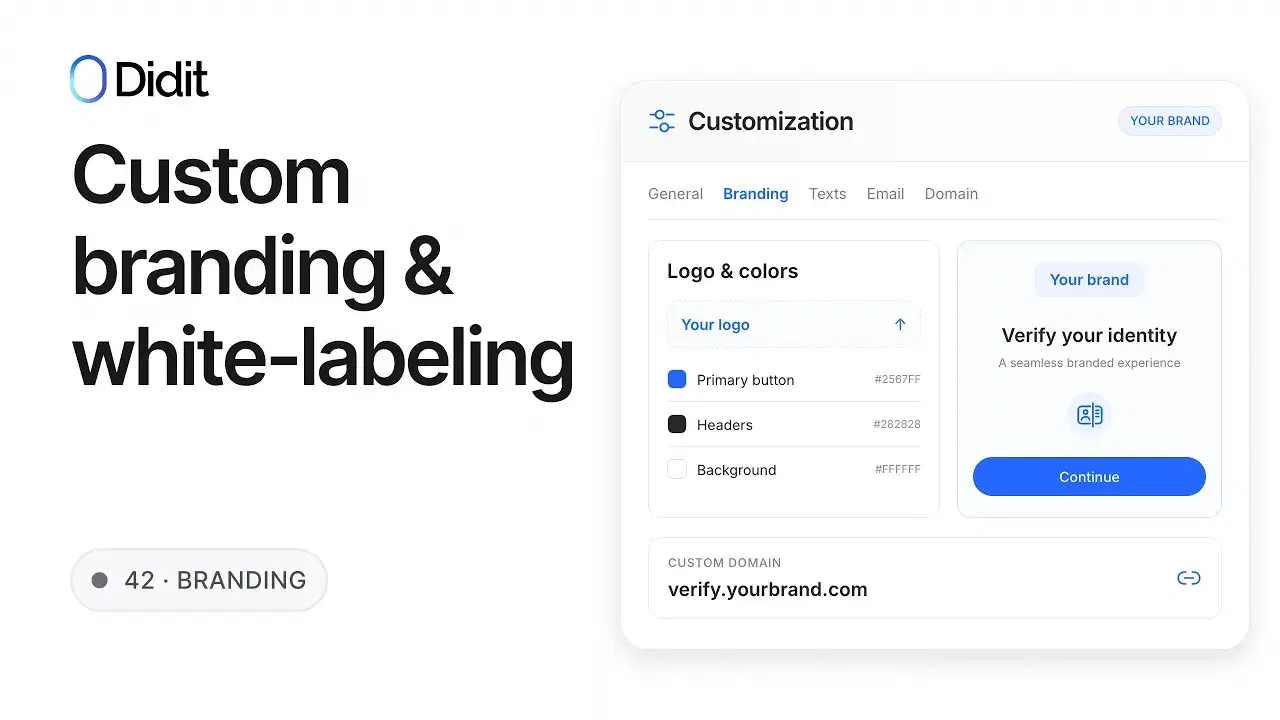
With Didit's white-label capabilities, telcos can fully customize the verification experience. This includes adjusting colors, typography, logos, and even the layout to perfectly match your brand guidelines. You can upload square and rectangular logos, define border radius for panels and buttons, and even host the verification process on your own custom domain instead of a generic third-party URL. This level of customization ensures that the identity verification process feels like an organic part of your app, reducing user apprehension and increasing completion rates. The ability to show or skip the login screen also provides flexibility for different onboarding workflows. By enabling the custom style per workflow in the Didit Business Console, telcos can precisely control which verification journeys reflect their unique branding.
Optimizing for High-Volume Efficiency and Accuracy
Telcos operate at scale, processing thousands, if not millions, of new subscribers. Therefore, the integrated identity verification SDK must be built for high-volume efficiency without sacrificing accuracy or security. This requires cutting-edge technology that can perform rapid document and biometric checks.
Didit's iOS SDK is designed with these demands in mind. It supports advanced ID Verification features such as OCR (Optical Character Recognition) for fast data extraction from IDs, MRZ (Machine Readable Zone) scanning for passports, and barcode reading. Crucially, it incorporates Passive & Active Liveness detection to combat sophisticated deepfake attacks and ensure the person presenting the ID is physically present and real. For enhanced security and speed, NFC Verification allows for direct reading of ePassports and eIDs, pulling cryptographically secure data directly from the chip. This not only speeds up the process but also significantly reduces the risk of fraud. The SDK's AI-native architecture ensures these checks are performed with high precision and minimal manual intervention, critical for telcos managing massive onboarding queues.
Meeting Regulatory Demands with Robust Verification
Telcos are heavily regulated industries, facing stringent KYC and AML requirements to prevent fraud, money laundering, and terrorist financing. Any identity verification solution must therefore offer comprehensive tools to ensure compliance across various jurisdictions. This includes not only verifying the identity but also screening against watchlists and verifying addresses.
Didit's platform provides the necessary components for robust compliance. Beyond ID Verification, it offers AML Screening & Monitoring, which allows telcos to check applicants against global sanctions lists, politically exposed persons (PEPs) lists, and adverse media. Proof of Address verification is another critical component, ensuring that the customer's stated residence is legitimate. The modular nature of Didit's platform allows telcos to compose these different checks into tailored workflows that meet specific regional or national regulations. Furthermore, the platform's focus on structured identity data and complete audit trails simplifies reporting and demonstrates due diligence to regulatory bodies, reinforcing trust and maintaining operational integrity.
How Didit Helps
Didit is uniquely positioned to empower telcos with a superior identity verification experience. Our AI-native, developer-first platform offers an open, modular identity layer that can be seamlessly integrated into any iOS application. For high-volume telco onboarding, Didit provides a comprehensive suite of tools that are both powerful and flexible.
Our ID Verification capabilities, including OCR, MRZ, and barcode scanning, combined with Passive & Active Liveness detection, ensure rapid and secure identity checks. The iOS SDK specifically supports SwiftUI and UIKit, NFC passport reading, and liveness detection, making integration straightforward for developers. Didit's white-label features allow for complete customization of the verification flow, ensuring perfect brand alignment. Leveraging our modular architecture, telcos can orchestrate complex KYC workflows, incorporating AML Screening & Monitoring, and Proof of Address to meet all compliance obligations. Didit stands out by offering Core KYC, a pay-per-successful check pricing model, and no setup fees, making it an economically viable and scalable solution for telcos looking to optimize their onboarding process and automate trust at scale.
Ready to Get Started?
Ready to see Didit in action? Get a free demo today.
Start verifying identities for free with Didit's free tier.
Try it
Try this in the sandbox
Run the check this guide describes, free.
The product this post is about, taken from its topic. Run it free in the sandbox.
Author
Alejandro Rosas
Co-founder and CTO

Keep reading
Other guides in the same topic.
 What Is the Purpose of FICA in South Africa? 2026 Guide
FICA is South Africa's anti-money laundering law. It creates the Financial Intelligence Centre and requires accountable institutions to identify and verify clients, screen for PEP and sanctions risk and report suspicious.
Alberto RosasNov 26, 2026 Sixth Money Laundering Directive (6AMLD): What Changed and Which Rules Apply
6AMLD is Directive (EU) 2018/1673: Member States must criminalise laundering, widen predicate offences and set a four-year penalty floor. It adds no new due diligence duties for firms.
Alberto RosasNov 26, 2026 Automated Sanctions Screening: Canada, the Entity List and Embargoes
Automated sanctions screening matches people and companies against lists such as Canada's autonomous sanctions made under SEMA and JVCFOA and the OFAC SDN List, and returns candidate hits scored for identity confidence and.
Alberto RosasNov 26, 2026Questions
Blog questions
Who writes the Didit blog?
Which topics does the blog cover?
Is the blog available in my language?
Where do I find product updates?
Are these posts legal advice?
How do I find posts on one topic?
Are posts dated?
Do posts link to the docs?
Is the blog the same as the docs?
Compliance built in
Audited, certified and attested.
We hold the certifications and build each country's rules into your flows, so you can launch anywhere without worrying. Security and Compliance center
- Regulation encoded into your flows
Tell us what you do and where. Didit lists the rules that apply to you, with sources, and builds the checks each country needs into one workflow.
- Ready for AMLR
Every requirement of the new EU anti-money laundering rules, from checking customers to human review, is already covered by a Didit check.
- Tested in Spain's Treasury sandbox
Spain's Treasury published its supervised sandbox report on Didit's NFC plus active liveness onboarding; SEPBLAC took part and valued the added measures positively.
- Audited, not self-declared
iBeta Level 1 and Level 2. Liveness tested under ISO/IEC 30107-3.
Your obligations · 3 regions
 SOC 2 Type 2
 ISO 27001
 iBeta Level 1 and Level 2
 EU regulator attestation
 FSM youth protection
 GDPR
 EBA remote onboarding
 MiCA compatible
 FIDO Alliance member
- AMLREU AML Regulation ready
Integration · Didit MCP
Run Didit from your own AI agent
Connect Didit to Claude, Cursor, VS Code or ChatGPT and just ask in plain words. Your agent can do anything you can do in the console, with the same permissions you have.
 Add to Claude
 ChatGPT
 Cursor
- Build workflowsDescribe the checks you need. The agent creates and publishes the flow.
- Run investigationsAsk why a session was declined, review cases, search people and companies.
- Change rulesCreate payment rules, test them on past data and switch them on.
- Pull reportsAsk for numbers, exports or the audit log.
Didit Academy