Send browser fraud events without an API key (2026 how-to)
Mint a scoped monitoring token server-side with POST /v3/events/sdk-token/, then post events from the browser with the X-Monitoring-Token header. The API key and the subject stay server-side, enforced by Didit.
 Alberto RosasCo-founder and CEO
Contents
In this guide
Jump to the part you need.
This page is for teams that capture logins and sessions in a browser or mobile app and want Didit fraud rules to score that activity without shipping an API key to the device. Two calls: your backend mints a scoped token, the device submits events with it. Monitored transactions cost $0.001 beyond your plan allowance; no per-event unit price is published. The caveat: event ingestion is off by default and an over-broad token is the real risk.
Last updated: November 26, 2026. Prices checked against the live Didit price feed on November 26, 2026.
| Piece | What it does | Who runs it |
|---|---|---|
POST /v3/events/sdk-token/ | Mints a short-lived credential scoped to one vendor_data | Your backend, with x-api-key |
POST /v1/events/ | Sends one event from the device | Browser or app, with X-Monitoring-Token |
POST /v1/events/batch/ | Sends a flushed buffer, up to 500 events | Browser or app, with X-Monitoring-Token |
POST /v3/events/ | Sends an event with no end user present | Your backend, with x-api-key |
| Event ingestion setting | Switches every write lane on. Off by default, returns 403 until enabled | Business Console, Transactions, Settings |
Start free in the sandbox at business.didit.me, no sales call, and read the per-check numbers on Didit pricing. Events feed the same engine described on the Transaction Monitoring product page. If you work from an AI assistant, connect the Didit MCP server and let it call the documented endpoints for you.
One price note before the steps, because it is the first thing finance asks. The published monitoring line is $0.001 per transaction beyond the plan allowance, and the price feed does not publish a separate per-event unit price for the event lane. Confirm how your event volume is metered in the console.
The outcome, and the method we recommend
The device knows things your server does not. That a login failed three times in 40 seconds, that a round started, that this browser rendered in software. Sending those events from the browser or app means rules see them while the session is live instead of after a batch job.
The problem is credentials. An API key in a browser is a key anyone can read. The device lane solves that with a scoped credential. Your backend mints a short-lived token bound to one user, the device posts events with X-Monitoring-Token, and Didit enforces subject, network context and category scope on the server. The payload carries no API key and no subject, because both are enforced server-side.
Use the server lane, POST /v3/events/ with x-api-key, when no end user is present: back-office writes, imports, or events your own systems already know. It is also the only lane that lets your own bot detection become the device score.
Prerequisites
- A Didit application with an API key. The key is sent as
x-api-keytohttps://verification.didit.meand never leaves your backend. - Event ingestion switched on: Transactions, Settings, Event monitoring. Until it is on, every write lane answers
403with{"code": "event_monitoring_disabled"}and nothing is stored. - A stable user id to use as
vendor_data. It is the subject every event submitted with the token belongs to. - A backend route your front end can call to get a token per session.
- An origin you can name exactly, if you want origin binding.
The five steps
- Turn on event monitoring for the application.
- Mint a monitoring token from your backend for one
vendor_data. - Submit events from the device with
X-Monitoring-Token. - Batch the flush so page-view events do not cost one request each.
- Read the outcome and confirm which rules ran.
Step 1: turn on event ingestion
Event ingestion is opt-in. Open the Business Console, go to Transactions, Settings, Event monitoring and switch it on. Your existing transaction rules keep firing on transactions only, and an event rule cannot be created by accident, because a rule applies to transactions unless you explicitly include events. Once ingestion is on, the mint endpoint stops answering 403.
Step 2: mint the scoped token on your backend
This call uses your API key, so it runs on the server. One token per user session, not one per app launch.
curl -X POST https://verification.didit.me/v3/events/sdk-token/ \
  -H "x-api-key: YOUR_API_KEY" \
  -H "Content-Type: application/json" \
  -d '{
    "vendor_data": "user_391",
    "allowed_event_categories": ["auth", "session", "gameplay"],
    "ttl_seconds": 900,
    "max_uses": 1000,
    "bind_to_origin": "https://operator.example"
  }'
The response carries the credential, its expiry, and the scope you asked for:
{
  "monitoring_token": "...",
  "expires_at": "2026-08-31T21:00:00Z",
  "allowed_event_categories": ["auth", "session", "gameplay"],
  "max_uses": 1000,
  "bind_to_origin": "https://operator.example"
}| Field | Default | What it controls |
|---|---|---|
vendor_data | Required | The subject every event submitted with this credential belongs to |
entity_type | individual | individual or company |
allowed_event_categories | All | Narrows what a leaked credential could write |
ttl_seconds | 900 | 60 to 86400 seconds |
max_uses | 1000 | One use per event, not per request |
bind_to_origin | None | When set, the browser Origin must match exactly |
Three settings do most of the safety work. Keep allowed_event_categories to what the page actually produces. Keep max_uses close to the number of events you expect from that session, remembering that a batch spends one use per event. Set bind_to_origin unless you genuinely serve multiple origins, because a request with no Origin at all is refused once it is set.
Step 3: submit events from the device
The app posts to the device lane with the minted token in the header. No API key, no subject block.
curl -X POST https://verification.didit.me/v1/events/ \
  -H "X-Monitoring-Token: THE_MINTED_TOKEN" \
  -H "Content-Type: application/json" \
  -d '{
    "event_id": "session-abc-login-1",
    "event_category": "auth",
    "action_type": "login",
    "occurred_at": "2026-08-31T20:40:31.123Z",
    "session": { "session_id": "web-session-abc", "sequence": 1 },
    "device_context": { "fingerprint": "didit-fp-v2:a8c1" },
    "payload": { "method": "password" }
  }'
Note what the payload does not carry: no API key, and no subject. Both are enforced server-side. If a tampered client adds a subject block, the credential binding overwrites it, so a client cannot write to another user's timeline.
event_idis your own identifier and the idempotency key.event_categorymust be inside the token scope, or the request is rejected with400.occurred_atis accepted up to 7 days in the past and 5 minutes in the future. Send at collection time.
Step 4: batch the flush
One request per login is fine. One request per page view adds a lot of request volume for little signal, so buffer page-view events on the device and flush them together.
curl -X POST https://verification.didit.me/v1/events/batch/ \
  -H "X-Monitoring-Token: THE_MINTED_TOKEN" \
  -H "Content-Type: application/json" \
  -d '{ "events": [ { "...": "..." }, { "...": "..." } ] }'
Up to 500 events per flush, with the same per-item outcomes as the server batch endpoint. A good default flush is 25 events, 5 seconds, or page and app backgrounding. If you have to shed events under backpressure, drop the cheap ones first: session.page_view, session.sdk_heartbeat, session.sdk_loaded and session.device_seen.
Step 5: read the outcome
Each accepted event returns the documented per-event outcome record. This is the shape POST /v3/events/ returns, and the batch endpoints return the same per-item outcomes.
{
  "event_uuid": "0f2b...",
  "event_id": "login-2026-08-31-000001",
  "status": "ACCEPTED",
  "score": 0,
  "rules_evaluated_count": 6,
  "rules_matched_count": 0,
  "correlation_pending": false,
  "retention_class": "standard",
  "expires_at": "2026-09-30T20:40:31.123Z",
  "idempotent_replay": false,
  "rule_matches": []
}
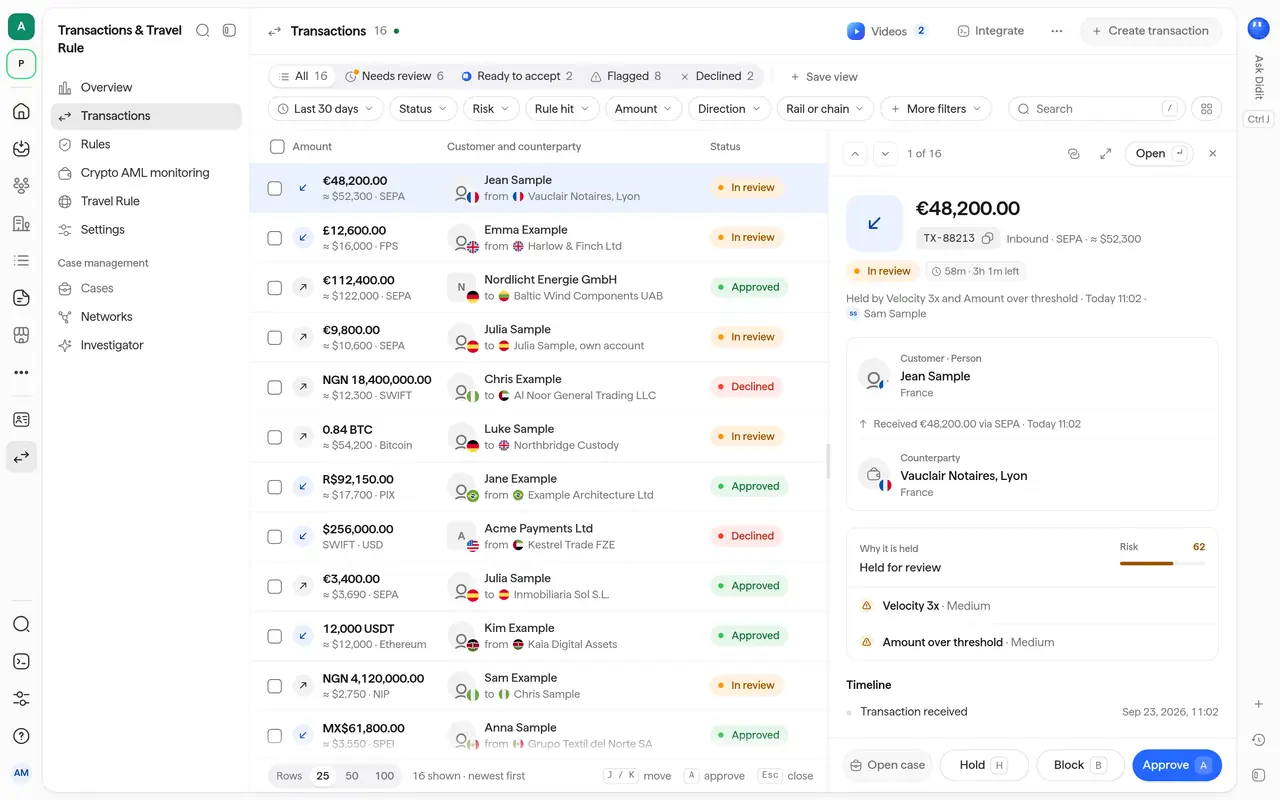
Read three fields first. status tells you the event was stored. rules_evaluated_count tells you a rule was in scope for that category, which is the number to check when a rule never fires. rule_matches shows what contributed to the score. For a full trace, call GET /v3/events/{event_uuid}/ with your API key, or pull a subject's timeline from GET /v3/events/subjects/{vendor_data}/.
What the server enforces, and what that prevents
| Control | Behaviour |
|---|---|
| Subject binding | The credential is scoped to one vendor_data at mint time. A subject block in the body is overwritten |
| Network context | IP address, user agent, accept-language and origin are derived from the request and win over client hints. Rule evidence records the difference as a field source |
| Automation score | Didit decides device_context.bot_score server-side on a 0 to 100 scale |
| Category scope | A credential scoped to session cannot submit a payment event. It is rejected with 400 |
| Use budget | The budget is spent per event, so a 500-event batch cannot slip past a 10-use credential as one use |
| Origin binding | A request whose Origin does not match is refused, including one with no Origin at all |
Why a bot_score posted by the browser is not the score your rules read
Clients lie, and a rule that trusts a number the client computed about itself is not a fraud rule. Didit decides device_context.bot_score on the server, on a 0 to 100 scale, and that is the value event.device.bot_score rules compare.
What the server reads instead:
- The request itself. A user agent that names an automation tool, such as a headless browser or a browser driver, scores 100.
- The device evidence newer Didit SDK versions send with every batch: what the SDK read on the device, not a score. On the web, signs that an automation tool drives the browser, and, on a page that collects the full device fingerprint, that it renders in software. In an app, a hooking framework, an emulator or simulator, a debugger, or a rooted or jailbroken device.
- Older SDK versions, which report their own score on a 0 to 1 scale in the
X-Didit-FP-Bot-Scoreheader and in the batch'sfingerprint_v2.bot.score. 0.9 becomes 90.
Three consequences matter when a rule does not fire. A bot_score your page or app posts in device_context does not set the score, it is kept as device_context.metadata.client_bot_score. A bot_score in the event's payload stays in the payload, where event.bot.* rules read it, which is a different field from event.device.bot_score. Nothing a device sends can lower the score, only raise it, and when Didit has nothing to go on the event has no bot score, not 0.
To report your own bot detection as the device score, submit the event from your backend with POST /v3/events/ and the API key. The device lane is for device evidence.
Browser family, platform, and the fields event rules actually read
The event rule vocabulary is a fixed list of namespaced paths, and a condition can only read a path that resolves. If a rule reads subject_browser_family or subject_platform and never matches on an event, the cause is usually that those paths are not part of the event field set: browser family is not derived from the user agent for event rules. Grouping by a value the event does not carry means the aggregation simply does not match, whatever the operator.
The user agent is still captured, just not in the role people expect. IP address, user agent, accept-language and origin are derived from the request and recorded as rule evidence, and the server-derived value wins over any client hint. The evidence shows the difference as a field source, so you can prove in a review that the network context came from the request and not from the page.
| Need | Path |
|---|---|
| Country, ASN, VPN, Tor, data centre, proxy | event.ip.country, event.ip.asn_organization, event.ip.is_vpn_or_tor, event.ip.is_data_center, event.ip.proxy_type |
| Device identity and automation | event.device.fingerprint, event.device.persistent_device_id, event.device.bot_score |
| Behaviour telemetry | event.bot.timing_variance_ms, event.bot.actions_per_minute, event.bot.pointer_entropy |
| Anything you define | event.payload.<key> and custom_values.<key>, up to 100 scalar custom keys |
If you need browser family in a rule, send it from your own code as a custom_values entry or a payload key, then write the condition on that key. Custom values are addressable from rules as custom_values.<key>.
Inputs and outputs
| Direction | Field | Notes |
|---|---|---|
| Mint input | vendor_data | Required. The subject for this credential |
| Mint input | ttl_seconds, max_uses, allowed_event_categories, bind_to_origin, entity_type | All optional, with the defaults above |
| Mint output | monitoring_token, expires_at | The token travels to the device. Nothing else does |
| Submit input | event_id, event_category, action_type, occurred_at | Required on every event |
| Submit input | session, device_context, payload, custom_values, transaction_context | Optional. Payload is capped at 16 KB |
| Submit output | event_uuid, status, score, rules_evaluated_count, rules_matched_count, rule_matches, idempotent_replay | Status is ACCEPTED on a stored event |
Failure cases and recovery
| Symptom | Cause | Recovery |
|---|---|---|
403 with event_monitoring_disabled on mint | Event ingestion is off for the application | Turn it on in Transactions, Settings, Event monitoring, then mint again |
401 on mint | Wrong or expired API key | Issue a fresh key and keep it on the server |
403 on mint with a key you know works | The header is missing from the request | Send x-api-key |
400 on submit | Category outside the token scope | Mint with that category in allowed_event_categories |
| Request refused with a valid token | Origin missing or not equal to bind_to_origin | Call from the bound origin, or drop the binding for that app |
| Events stop after the token lifetime | Token past ttl_seconds | Mint per session and refresh before expiry |
| A batch is rejected part way | Use budget spent, one use per event | Raise max_uses or mint a fresh token |
| Event rejected on time | occurred_at older than 7 days or more than 5 minutes ahead | Send at collection time, not on a later replay |
| A retried submission of an event you already sent | A replay uses the same event_id; inspect idempotent_replay in the response | Check idempotent_replay before treating the submission as a second event |
Two more failures cost you data rather than errors. A privacy extension that blocks the fingerprint script leaves the event with no device fingerprint, and events with no fingerprint are never grouped as the same device. And a rule scoped to transactions only will evaluate zero events, because a rule applies to transactions unless you set scope.record_types to ["event"] or to both.
Paid steps and review boundaries
Minting is a credential call, not a check. The published price lines around this lane are the Transaction Monitoring lines: the plan allowance plus $0.001 per transaction beyond it. Each plan includes 1,000 (Free), 10,000 (Growth) or 100,000 (Scale) monitored transactions a month, and Enterprise sets its allowance in the contract. The price feed does not publish a separate per-event unit price for the event lane, so confirm how event volume is metered in the console rather than assuming a per-event fee.
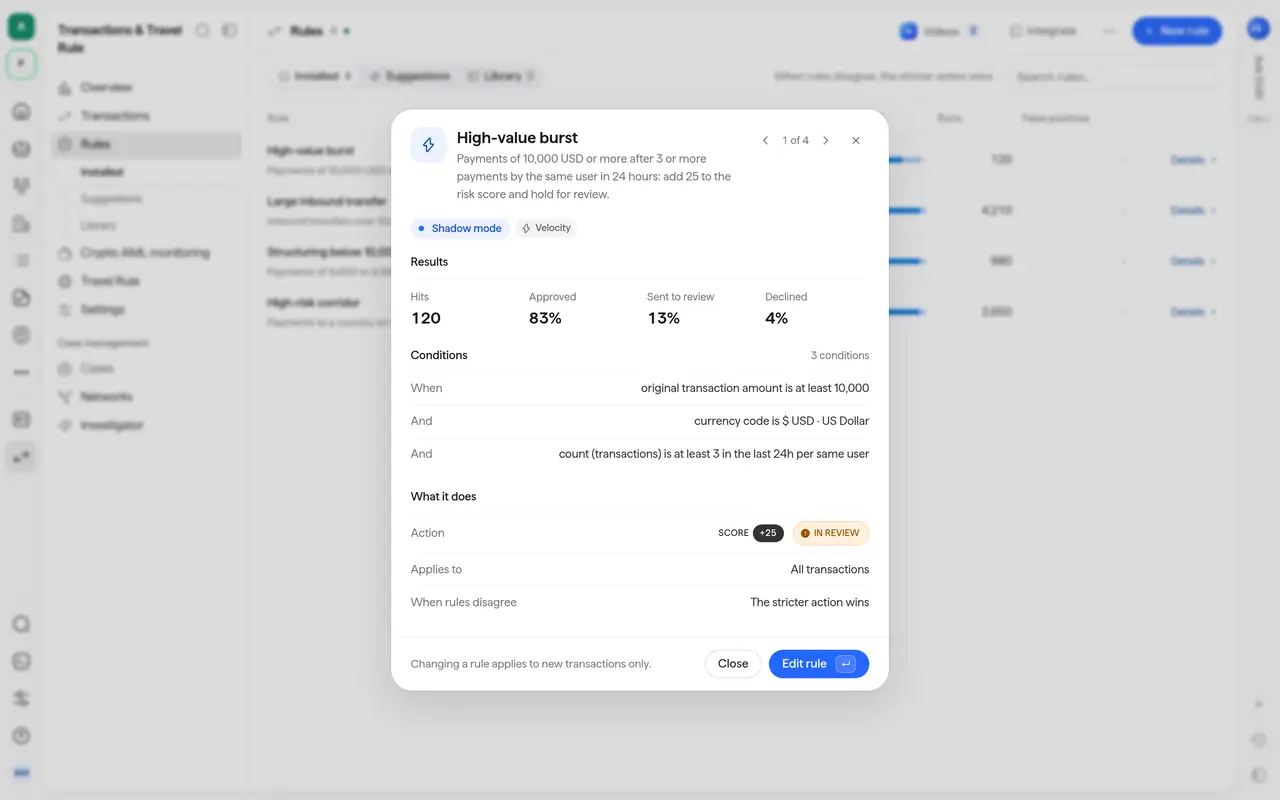
What stays your decision: the review and decline thresholds, which of your categories are risk-grade, and whether a VPN or a high bot score blocks a session or only sends it to review. Rules can run in TEST mode first, which evaluates against records without contributing to score or status, so you can measure selectivity before a rule can decline anyone. Price lines for the checks you run alongside events, such as a full ID check at $0.33, are separate.
Worked cost example
A payments app on the Scale plan, 8,000 new users a month and 260,000 monitored transactions a month. Only published unit prices go into this sum.
- Full ID check at Scale: $0.33 less 10% = $0.297. 8,000 x $0.297 = $2,376.00
- Monitored transactions: 260,000 less the 100,000 allowance = 160,000 x $0.001 = $160.00
- Usage: $2,376.00 + $160.00 = $2,536.00
- Plan credit applied: $2,536.00 less $350.00 = $2,186.00 from top-ups
- Monthly total: $2,186.00 + $299.00 plan fee = $2,485.00
The device and IP analysis line at $0.03 is already inside the $0.33 full check, so nothing extra is billed for the network context rules read. The calculation stops at transactions because that is the only published monitoring line: the price feed states $0.001 per transaction beyond the allowance and does not state how event volume is priced or whether events share that allowance. Check the console usage meter against your own mix before you model an event budget.
Sources
- Didit docs: SDK Event Submission
- Didit docs: Event Ingestion API
- Didit docs: Event Rules
- Didit docs: Transaction Risk Scoring
- Didit docs: API Authentication
- Didit docs: Device Fingerprinting and IP Risk
- Didit pricing and pricing in the docs
- Didit Transaction Monitoring
- Didit MCP server setup
The next step takes about a minute: create a free organization at business.didit.me, turn on event monitoring, mint one token and post one login event. Sandbox testing is free and unlimited, no sales call.
Try it
Try this in the sandbox
Run the check this guide describes, free.
The product this post is about, taken from its topic. Run it free in the sandbox.
Author
Alberto Rosas
Co-founder and CEO

Keep reading
Other guides in the same topic.
 Verify a Company in Switzerland: Registry, UBO and KYB Checks
Verify a Swiss company with a commercial register lookup, officers and UBOs at the 25% control threshold. Didit charges $2.00 Lite, $5.00 Shareholders and $9.00 UBOs per company, plus linked KYC and AML per person.
Alberto RosasNov 26, 2026 Client-Side SDK vs Server-Side Transaction Submission (2026)
Client-side SDK: use it when an end user is present, for subject binding, device data and wallet ownership. Server-side POST /v3/transactions/: back-office, batch, system events. Same records, rules and webhooks.
Alberto RosasNov 26, 2026 Submit Travel Rule Transactions From Mobile With Scoped SDK Tokens
Mint a scoped transaction token on your backend, submit from the app with the X-Transaction-Token header, and keep the API key server-side.
Alberto RosasNov 26, 2026Questions
Frequently asked questions
How do I send fraud monitoring events from the browser without exposing my API key?
Your backend calls POST /v3/events/sdk-token/ with the API key and the user's vendor_data, and returns only the monitoring_token to the device. The browser then posts to POST /v1/events/ or POST /v1/events/batch/ with the X-Monitoring-Token header. The payload contains no API key and no subject, because Didit enforces both from the token binding.
Which endpoints make up the two-step flow?
Mint with POST /v3/events/sdk-token/ using x-api-key. Submit with POST /v1/events/ for one event or POST /v1/events/batch/ for a flush of up to 500, both using X-Monitoring-Token. Rules then run exactly as they do on a server-submitted event.
Why is my device_context bot_score not used by fraud rules?
Because Didit does not accept a bot score the client computed about itself. A bot_score posted in device_context is kept as device_context.metadata.client_bot_score, while event.device.bot_score is decided server-side on a 0 to 100 scale from the request and from the evidence newer SDK versions send. Nothing a device sends can lower that score, only raise it.
How do I report my own bot detection as the device score?
Submit the event from your backend with POST /v3/events/ and your API key, where your own detection result is the value you send. The device lane is reserved for device evidence, so a client-side number cannot become the score rules compare.
Why does a rule on subject_browser_family or subject_platform never match an event?
Those paths are not part of the documented event field set, and browser family is not derived from the user agent for event rules. Conditions can only read paths that resolve, so the aggregation does not match. Write the rule on event.ip.country, event.ip.asn_organization, event.device.fingerprint or event.device.bot_score, or send browser family from your own code as a custom_values key.
What happens if I set bind_to_origin?
The browser Origin on the submit request must match the value exactly, and a request with no Origin at all is refused. It restricts a copied token to the specified origin. Leave it unset only if the same token genuinely has to serve more than one origin.
How long should the token live and how many uses should it have?
The default ttl_seconds is 900, and the range is 60 to 86400. Mint per user session and keep the lifetime to that session. max_uses defaults to 1000 and is counted per event, not per request, so a 500-event batch spends 500 uses.
What does event_monitoring_disabled mean?
It means event ingestion is off for that application, so every write lane answers 403 and nothing is stored, enriched or evaluated. Turn it on under Transactions, Settings, Event monitoring. Reads are unaffected while it is off.
What does event monitoring cost?
The price feed publishes $0.001 per monitored transaction beyond the plan allowance, with 1,000 transactions included on Free, 10,000 on Growth and 100,000 on Scale. It does not publish a separate per-event unit price for the event lane. Check the console usage meter to see how your event volume is counted.
Does the device lane run different rules than the server lane?
No. Device events are enriched, rolled up and evaluated by the same rule engine as a server-submitted event. The only differences are how the subject and network context are established and the scope limits on the credential.
Can I drop events when the device is under backpressure?
Yes, and you should drop the cheap ones first: session.page_view, session.sdk_heartbeat, session.sdk_loaded and session.device_seen. Keep the auth, security and payment events, which are the ones rules need.
Compliance built in
Audited, certified and attested.
We hold the certifications and build each country's rules into your flows, so you can launch anywhere without worrying. Security and Compliance center
- Regulation encoded into your flows
Tell us what you do and where. Didit lists the rules that apply to you, with sources, and builds the checks each country needs into one workflow.
- Ready for AMLR
Every requirement of the new EU anti-money laundering rules, from checking customers to human review, is already covered by a Didit check.
- Tested in Spain's Treasury sandbox
Spain's Treasury published its supervised sandbox report on Didit's NFC plus active liveness onboarding; SEPBLAC took part and valued the added measures positively.
- Audited, not self-declared
iBeta Level 1 and Level 2. Liveness tested under ISO/IEC 30107-3.
Your obligations · 3 regions
 SOC 2 Type 2
 ISO 27001
 iBeta Level 1 and Level 2
 EU regulator attestation
 FSM youth protection
 GDPR
 EBA remote onboarding
 MiCA compatible
 FIDO Alliance member
- AMLREU AML Regulation ready
Integration · Didit MCP
Run Didit from your own AI agent
Connect Didit to Claude, Cursor, VS Code or ChatGPT and just ask in plain words. Your agent can do anything you can do in the console, with the same permissions you have.
 Add to Claude
 ChatGPT
 Cursor
- Build workflowsDescribe the checks you need. The agent creates and publishes the flow.
- Run investigationsAsk why a session was declined, review cases, search people and companies.
- Change rulesCreate payment rules, test them on past data and switch them on.
- Pull reportsAsk for numbers, exports or the audit log.
Didit Academy


