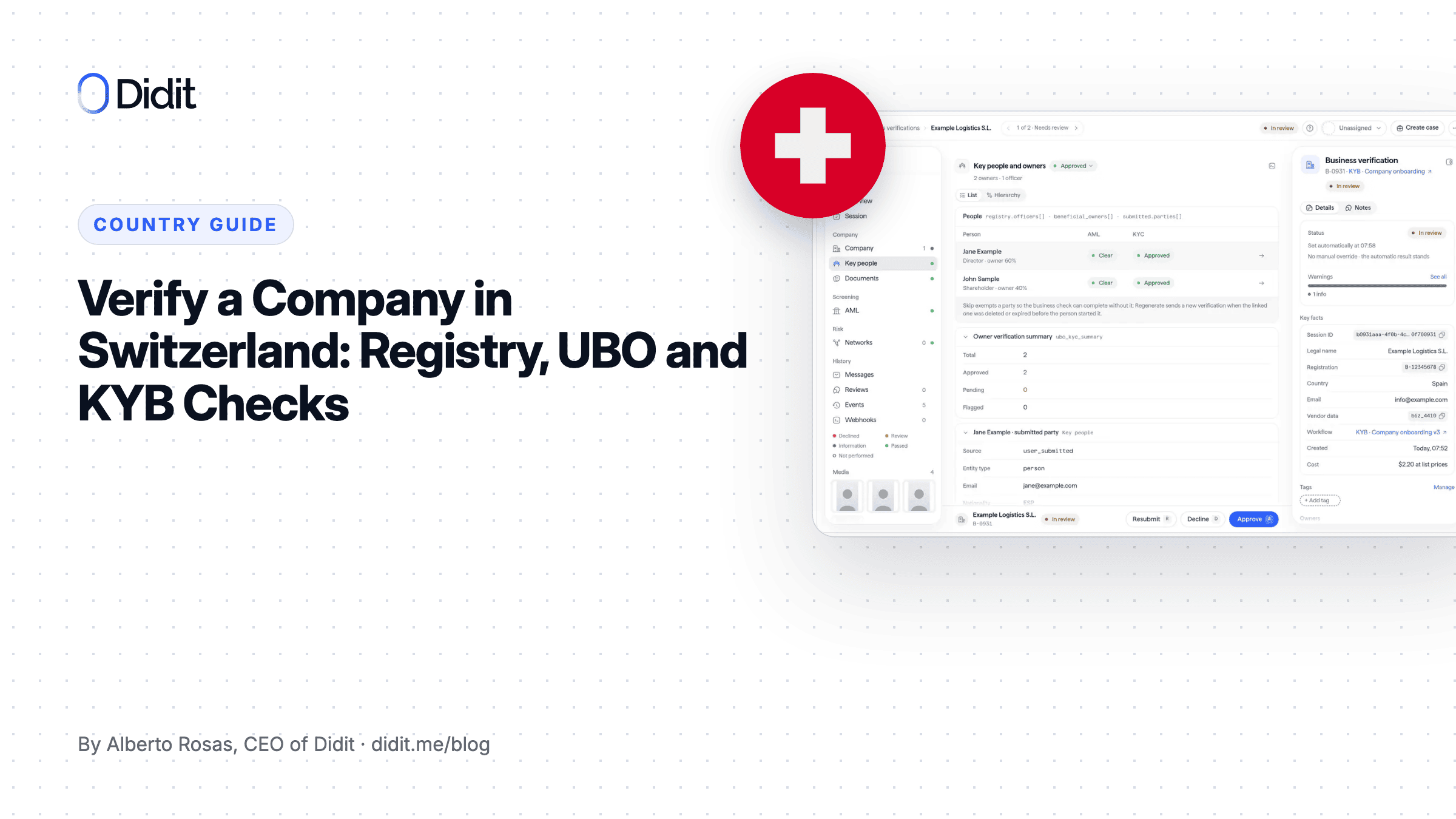
Verify a Company in Switzerland: Registry, UBO and KYB Checks
Verify a Swiss company with a commercial register lookup, officers and UBOs at the 25% control threshold. Didit charges $2.00 Lite, $5.00 Shareholders and $9.00 UBOs per company, plus linked KYC and AML per person.
 Alberto RosasCo-founder and CEO
Contents
In this guide
Jump to the part you need.
A Switzerland business verification fits anyone onboarding a company registered in the Swiss commercial register: a marketplace paying out a GmbH, a bank taking on a corporate client, a vendor checking a counterparty. Price depends on the data tier: $2.00 for Lite, $5.00 for Shareholders, $9.00 for UBOs per company. The main caveat is ownership. Switzerland's federal transparency register is not public, so UBO data has to be confirmed with the company, not read off a state database.
Last updated: November 26, 2026. Prices checked against the live Didit price feed on November 26, 2026.
| Option | Price per company | What you get | Best for |
|---|---|---|---|
| Lite | $2.00 | Company profile, identifiers, status, registered address, activity, headcount, contact details and officers | Supplier onboarding, confirming the company exists and is active |
| Shareholders | $5.00 | Lite plus the direct shareholders, people and corporate entities, with ownership bands | Mid-risk files where you need the first ownership layer |
| UBOs | $9.00 | Shareholders plus beneficial owners resolved through the ownership chain | Regulated onboarding and any file where you must name the natural persons behind the company |
| Manual entry | $0.75 flat | Company typed in by the applicant when the registry has no match | Registry miss, registry outage, newly formed entities |
| Registry monitoring | $2.00 per company per year, configured | Planned push of status, officer, ownership and address changes | Coming soon. Not enabled for any country in the price list checked on November 26, 2026 |
Start free in the sandbox at business.didit.me, no sales call, and read the tiers on the Business Verification product page and didit.me/pricing. If you build with an AI assistant, connect Didit through didit.me/developers/mcp.
What you have to verify in Switzerland, and the law behind it
Two federal texts set the ground rules, and both are worth reading before you design a Swiss file.
The first is the Federal Council's message 24.046 of 22 May 2024, signed by Bundespräsidentin Viola Amherd and Bundeskanzler Viktor Rossi, which proposed a federal register of the beneficial owners of legal entities. See fedlex.admin.ch (Schweizerische Bundeskanzlei / Fedlex) Botschaft 24.046, read November 26, 2026. The message is explicit that the register is not public: the data serves criminal prosecution authorities and a narrowly defined set of other authorities. The register is to be run by the Eidgenössisches Justiz- und Polizeidepartement (EJPD), with a control office at the Eidgenössisches Finanzdepartement (EFD), and reporting is meant to be simple, fast, free of charge and normally routed through the commercial register.
The second is the ordinance that now governs the scheme: the Verordnung über die Transparenz juristischer Personen und die Identifikation der wirtschaftlich berechtigten Personen (TJPV) of 12 June 2026, published as AS 2026/364, issued on the basis of the Bundesgesetz vom 26. September 2025 über die Transparenz juristischer Personen und die Identifikation der wirtschaftlich berechtigten Personen (TJPG). See Schweizerischer Bundesrat / Schweizerische Eidgenossenschaft (Fedlex, Systematische Rechtssammlung) TJPV, AS 2026/364, read November 26, 2026.
The practical consequence for a private KYB is simple. The state does not hand you the ownership answer. You verify the company's identity from the commercial register, you collect the ownership disclosure from the company itself, and you test that disclosure against the registry record, the officers you can see, and the documents you hold.
The two thresholds that shape a Swiss ownership file
The TJPV defines control in a way you should mirror in your workflow configuration rather than leave to a default.
- Direct participation. Art. 1 TJPV: a direct holding of at least 25 percent of the capital or of the voting rights of a legal entity establishes control.
- Indirect participation. Art. 2 TJPV: an indirect holding establishes control when it covers more than 50 percent of one or more intermediary entities that themselves hold, directly or indirectly, at least 25 percent of the capital or voting rights.
The indirect rule is not a plain multiplication of percentages down the chain, so a workflow that only multiplies will disagree with the ordinance on some structures. Set your UBO threshold on purpose. Didit exposes it at Workflows → [KYB workflow] → Risk → UBO threshold, and Didit records economic ownership and voting percentages separately, which matters when dual class shares split the two.
The same ordinance lists the identification data you must collect for a natural person: first name and surname, date of birth, nationalities, and the municipality, postal code and state of residence. It also requires you to establish whether an AHV number exists and, where it does not, to keep a copy of a passport, an identity card or an equivalent document. Those are the fields to require in the Key People form for a Swiss file, and Didit lets you add them as custom fields per person so they land in custom_fields on the decision.
The registers and what each one can prove
- Handelsregister (commercial register). The record of a Swiss company's existence, legal form, registered office, officers and filings. The Botschaft names it as the usual channel for reporting to the transparency register, which tells you it is the anchor record for entity identity in Switzerland.
- Federal transparency register. Proposed by message 24.046, governed by the TJPV from 12 June 2026, kept by the EJPD. Not public. It is a source for authorities, not a database a counterparty can query during onboarding, so it cannot be your UBO evidence today.
- Didit's registry lookup. Queries official company registers in supported countries and returns the structured company profile described below. Switzerland is one of the markets where the ownership tiers are priced, which is what makes a Swiss UBO check buyable at a published rate.
What Didit returns for a Swiss company
Switzerland sits in the group of European markets that moved to the worldwide ownership source prices: the pricing note in the Didit documentation records Switzerland moving from $4.00 Shareholders and $5.00 UBOs to $5.00 and $9.00. Budget with the current numbers, and confirm the tier per country in the console before you rely on a rate in production.
Billing follows the tier actually delivered, which matters for Swiss files where the ownership layer is thin:
- Where the registry holds no ownership record, a Shareholders or UBO request is delivered and billed as Lite, at $2.00.
- Where the resolved chain names no natural person as a beneficial owner, a UBO request is delivered and billed as Shareholders, at $5.00. A corporate chain is not a beneficial owner.
- A company that is not found and is typed in manually is billed a flat $0.75.
- Hosted workflow searches carry no separate search fee. Standalone API searches can incur $0.50 per successful request.

Step by step in the Business Console
- Create the workflow. Go to
Workflows → Create workflowand choose Business Verification. Enable Company registry lookup (required), Company AML (recommended), Key People (required for most regulated industries) and Documents if you need articles of association or a shareholder register. Save and copy theworkflow_id. - Scope the country. Under
Workflows → KYB Registry Check → Countriesevery country starts at Lite. Move Switzerland to Shareholders or UBOs to match your policy, and leave the other markets where you want them. You pay only for the tiers you actually request per country. - Set the threshold. Under
Workflows → [KYB workflow] → Risk → UBO threshold, set the percentage your Swiss file uses, keeping the Art. 1 and Art. 2 definitions from the TJPV in mind. - Set role rules. Under
Key People, decide which roles require individual KYC, which KYC workflow each role uses, and which roles an applicant may skip. Directors and UBOs above the threshold are the usual candidates for required verification. - Start a session and deliver the hosted link. The applicant selects the company, confirms or corrects the details, adds key people and UBOs, and uploads documents.
- Read the decision. The
status.updatedwebhook carries the full decision, and business sessions carrysession_kind: "business"insidedata, so filter on that to route the event. If you did not subscribe, fetch the decision withGET /v3/session/{session_id}/decision/.

Step by step via the API
Create the session, hand the returned url to your business contact, and wait for the webhook. If you already know the company, pass expected_details at creation to pre-select and lock the country and pre-fill the search.
curl -X POST https://verification.didit.me/v3/session/ \
  -H "x-api-key: YOUR_API_KEY" \
  -H "Content-Type: application/json" \
  -d '{
    "workflow_id": "YOUR_KYB_WORKFLOW_ID",
    "vendor_data": "ch-supplier-001",
    "expected_details": {
      "company_name": "YOUR COMPANY NAME",
      "registry_country": "CH",
      "registration_number": "YOUR REGISTRATION NUMBER"
    }
  }'
Prefill only. Both fields stay editable, and an applicant who selects a different company than the one you asserted does not trigger a warning, so treat the prefill as a convenience and verify the selected entity from the decision.
curl https://verification.didit.me/v3/session/SESSION_ID/decision/ \
  -H "x-api-key: YOUR_API_KEY"
Verify the X-Signature-V2 HMAC signature on every webhook before trusting the payload, and store the destination's secret_shared_key as DIDIT_WEBHOOK_SECRET. The decision contains registry data, key people with roles and ownership percentages, AML hits, documents and per-feature results. Full shapes are in the KYB quickstart and the company registry reference.

Worked cost example
A Swiss company at the UBO tier, two beneficial owners who are also directors, one document collection step, company AML switched on. Unit prices from the live feed on November 26, 2026:
- Registry check, UBO tier, Switzerland: $9.00
- Company AML screening: $0.20
- Person AML, 2 people at $0.20 each: $0.40
- Linked full ID check (KYC), 2 people at $0.33 each: $0.66
- KYB documents, one step regardless of uploads: $0.20
Total at list price: 9.00 + 0.20 + 0.40 + 0.66 + 0.20 = $10.46 for the completed company file. Key People extraction itself carries no fee.
The same file on the Scale plan takes the 10 percent discount on every line: 8.10 + 0.18 + 0.36 + 0.594 + 0.18 = $9.41.
If the registry holds no ownership record for this company and the check is delivered and billed at Lite, the registry line drops to $2.00 and the file becomes 2.00 + 0.20 + 0.40 + 0.66 + 0.20 = $3.46. That is the number to hold in reserve when you forecast a Swiss book with many small entities.
Fallbacks when the register is down or has no match
Registry lookups run asynchronously, so design for a slow or empty answer instead of assuming an instant hit.
- No match found. Widen the search: switch from exact to contains mode, or use the one-tap
Search as company name insteadoverride on a registration-number result. If nothing matches, the applicant submits the company manually, the session continues, andis_from_registryis set tofalse. Manual entry is billed at a flat $0.75. - Slow registry or pending ownership report. Some registries return the company profile before the ownership report is ready. The report continues in the background while the applicant completes independent steps, corrections are preserved when it lands, and Lite is charged at selection with only the difference to the delivered ownership tier charged later at the selection-time quote. A pending report is not a completed registry check and not an automatic approval.
- Lookup failure. Track
fetch_status(pending,resolved,failed) rather than treating silence as a pass, and route failed lookups to manual review. - Ownership not held by the registry. A Shareholders or UBO request in a country whose registry holds no ownership record is delivered and billed at the highest tier that country can serve, usually Lite. No additional ownership charge applies, and the total never exceeds the requested tier's quote.
- Company status is not active.
dissolved,struck_off,in_liquidationanddormantcan be flagged or declined depending on workflow configuration. Decide the policy before you get the first hit. - A person cannot be verified. Mark the party with
is_skipped: truefrom the console or the hosted flow where the role allows skipping. The party stays in the response for audit and is excluded from the verification gate.
Identifiers and fields for a Swiss check
| Identifier or field | Where it comes from | What it holds |
|---|---|---|
registry_country / country selection | You supply it; the country list keys Switzerland as CH | The jurisdiction whose register is queried |
registration_number | Registry | Official company registration or incorporation number, normalized where the registry requires it |
company_name | Registry | Legal name as registered with the authority |
company_type | Registry | Legal entity type as the register records it |
registry_status | Registry | Active, dissolved, struck off, in liquidation or dormant |
incorporation_date | Registry | Date the company was originally registered |
registered_address | Registry | Official registered office |
tax_number | Registry, where available | Tax identification number |
legal_entity_identifier | Registry | LEI, for financial institutions and listed entities |
registered_capital | Registry | Authorized or issued capital as an amount and currency pair |
industries[] | Registry | Industry classification codes, SIC, NACE or local equivalents |
accounts.last_annual_return_date | Registry, where reported | Filing dates, distinct from financial accounts |
searched_by | Didit | How results matched: name, registration number, or both combined |
is_from_registry | Didit | true for registry-sourced data, false for manual entry |
fetch_status and verification_status | Didit | Lookup state and whether the registry data was verified, failed or unknown |
key_people_checks[].registry.beneficial_owners[] | Didit | Registry-derived owners, with roles such as ubo, shareholder and director |
ownership_percent / voting_percent | Registry or applicant | Economic and voting share per role, recorded separately |
Didit runs this across 220+ countries and serves 4,000+ companies in production. The Swiss specifics above are what you configure on top of the shared KYB flow. The tier tables live in KYB supported countries, the per-country rates in KYB registry pricing, and the ownership mechanics in UBO extraction and officers and representatives.
Sources
- Didit docs: KYB supported countries and registry coverage
- Didit docs: KYB registry pricing by country, Lite, Shareholders, UBOs
- Didit docs: KYB quickstart
- Didit docs: company registry API and retrieved fields
- Didit docs: UBO extraction and ownership chains
- Didit docs: officers and representatives
- Didit docs: business AML screening
- Didit pricing page and pricing.json
- fedlex.admin.ch (Schweizerische Bundeskanzlei / Fedlex) Botschaft 24.046 vom 22. Mai 2024, read November 26, 2026
- Schweizerischer Bundesrat / Schweizerische Eidgenossenschaft (Fedlex, Systematische Rechtssammlung) Verordnung TJPV vom 12. Juni 2026, AS 2026/364, read November 26, 2026
Next step: create a free application and run a Swiss registry check in the sandbox at business.didit.me. No sales call, and the sandbox is free on every plan.
Try it
Try this in the sandbox
Run the check this guide describes, free.
The product this post is about, taken from its topic. Run it free in the sandbox.
Author
Alberto Rosas
Co-founder and CEO

Keep reading
Other guides in the same topic.
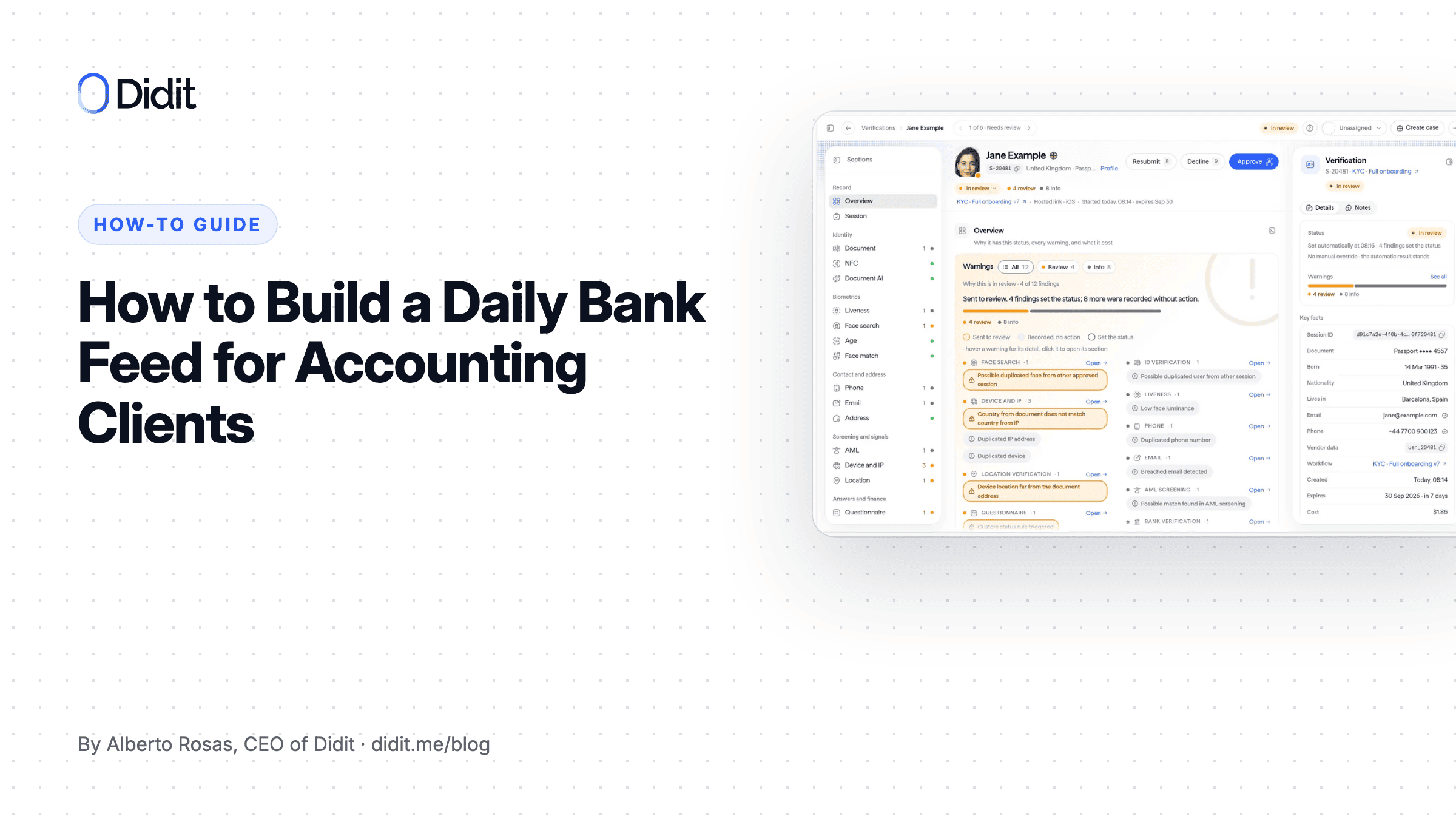 How to Build a Daily Bank Feed for Accounting Clients
Create a Didit bank link with access set to ongoing, store the connection id, cursor and consent end, then read only what changed from transactions/sync each time a bank.data.updated webhook arrives.
Alberto RosasNov 26, 2026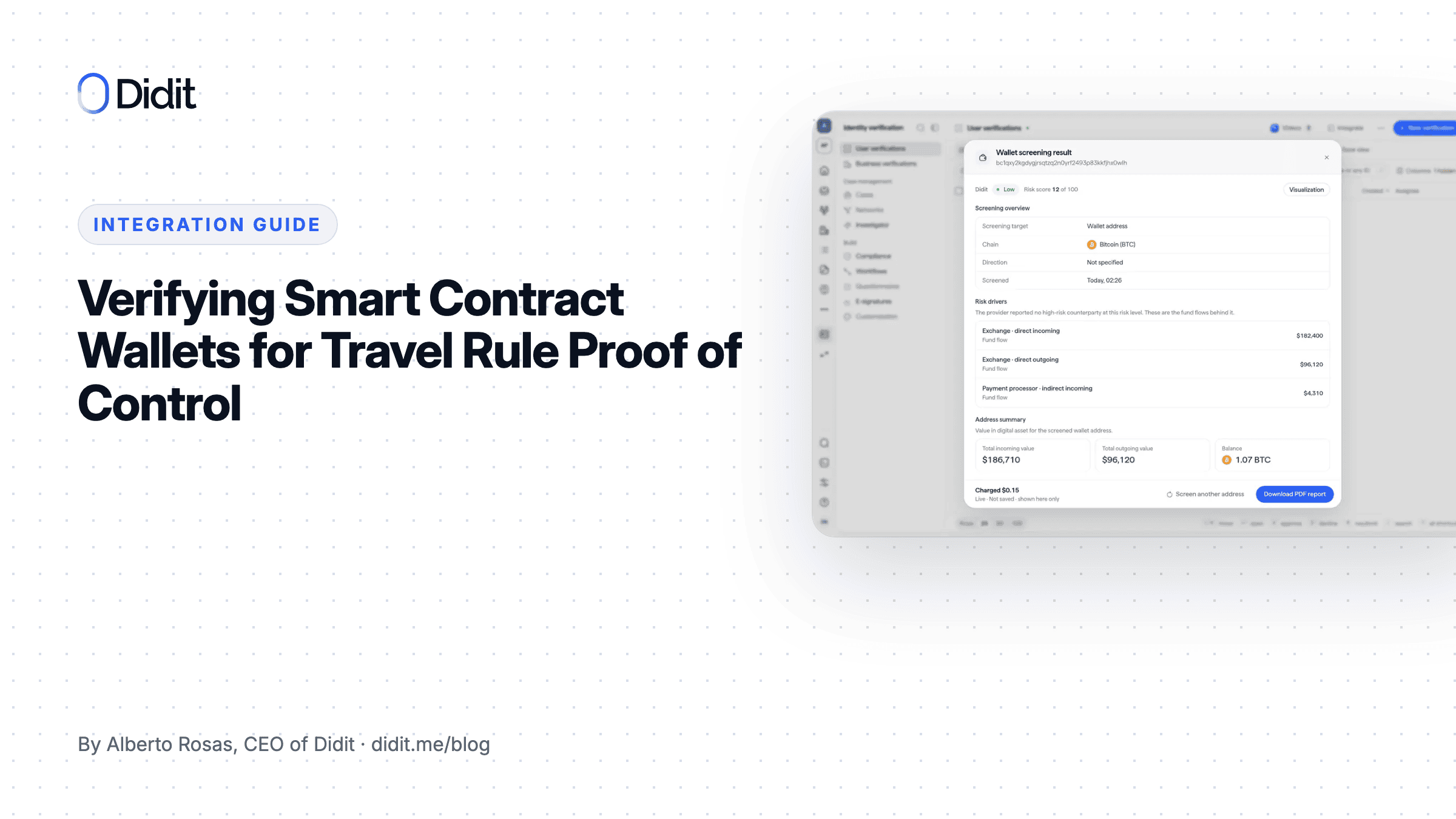 Verifying Smart Contract Wallets for Travel Rule Proof of Control
We prove control of ERC-4337 smart wallets by asking the account's contract on its declared chain (ERC-1271), and we check ERC-6492 for undeployed accounts without deploying or sending a transaction.
Alberto RosasNov 26, 2026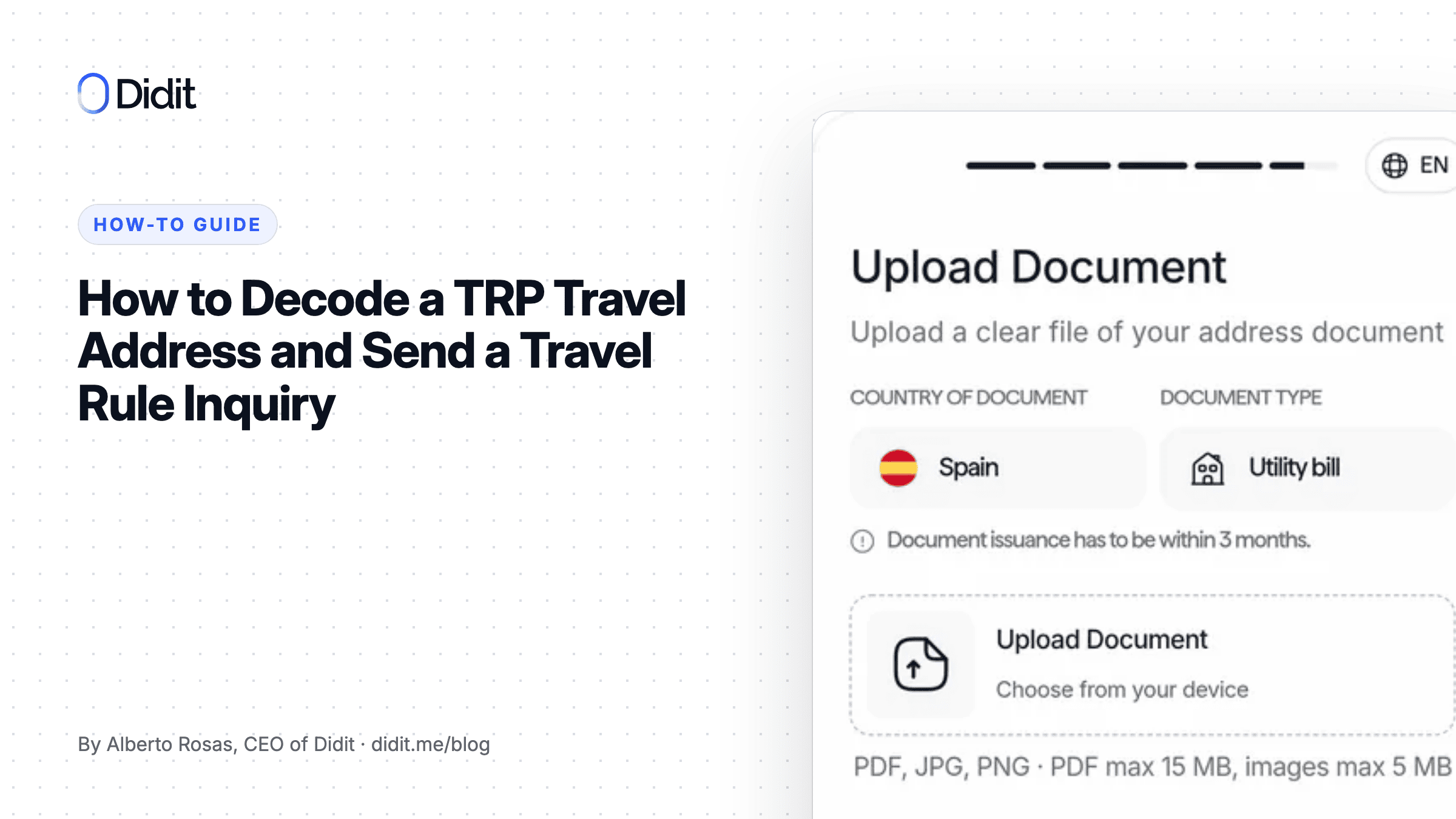 How to Decode a TRP Travel Address and Send a Travel Rule Inquiry
A ta address is Base58Check over an HTTPS URL: strip ta, decode with the Bitcoin alphabet, verify the double SHA-256 checksum, prepend https, then GET the identity and POST the inquiry to the t=i path.
Alberto RosasNov 26, 2026Questions
Frequently asked questions
How do I verify a company in Switzerland?
Run a registry lookup against the Swiss commercial register using the company name, the registration number, or both, then confirm the profile, the officers and the ownership chain. On Didit you enable Company registry lookup in a Business Verification workflow, move Switzerland to the UBO tier if you need beneficial owners, and send the applicant a hosted link. The check is billed per company at $2.00 for Lite, $5.00 for Shareholders and $9.00 for UBOs.
Is the Swiss beneficial ownership register public?
No. The Botschaft 24.046 of 22 May 2024 describes a federal transparency register that is not publicly accessible and is intended for criminal prosecution authorities and a narrowly defined set of other authorities, run by the EJPD. The ordinance TJPV of 12 June 2026 (AS 2026/364) sets the rules and the identification data to collect. A private counterparty therefore verifies ownership from the company's disclosure cross-checked against registry data and documents.
What is the UBO threshold in Switzerland?
Under Art. 1 TJPV a direct holding of at least 25 percent of the capital or voting rights establishes control. Under Art. 2 an indirect holding establishes control where it covers more than 50 percent of one or more intermediary entities that themselves hold at least 25 percent directly or indirectly. Because the indirect rule is not a simple product of percentages, set your workflow threshold deliberately instead of relying on a default.
How much does a Switzerland KYB check cost on Didit?
Registry data is priced by tier: $2.00 for Lite, $5.00 for Shareholders and $9.00 for UBOs per company, at list price checked on November 26, 2026. Company AML is $0.20, person AML is $0.20 per person, a KYB document step is $0.20 and each linked full ID check is $0.33. If the registry holds no ownership record, the ownership check is delivered and billed at Lite.
What does the Switzerland UBO tier return?
The UBO tier returns the full company profile, the direct shareholders with ownership bands, and the beneficial owners resolved through the ownership chain. Each party carries one or more roles such as ubo, shareholder or director, plus economic and voting percentages where known. Where the chain ends in corporate entities with no natural person, the check is delivered and billed as Shareholders, not UBOs.
What happens if Didit cannot find the Swiss company in the register?
The search runs asynchronously and you can widen it with contains mode or the search-as-company-name override. If nothing matches, the applicant submits the company details manually, the session continues, is_from_registry is set to false, and the manual entry is billed at a flat $0.75. Track fetch_status so a failed lookup is routed to review instead of being read as a pass.
Can I verify Swiss directors and UBOs as individuals?
Yes. Every identified key person can be linked to their own KYC session, billed at $0.33 for the full ID check, and every key person is screened against AML watchlists at $0.20 per person. Each party carries a requires_verification flag that tells you whether KYC must complete before the company session can approve. You configure which roles require it in the workflow.
Can I monitor a Swiss company for changes?
Registry monitoring is coming soon. The configured rate is $2.00 per company per year, but no country in the price list checked on November 26, 2026 has monitoring enabled, and a published price does not mean the feature is available. When it ships, monitored changes will fire a data.updated webhook with trigger: "kyb_registry_change" and send the business session back to review.
Which country code do I use for Switzerland in the API?
Use CH, the ISO 3166-1 alpha-2 code listed for Switzerland in Didit's KYB country table. Pass it as registry_country in expected_details when creating the session, or let the applicant select it from the country list in the hosted flow. US states use the extended format such as US-DE, Switzerland does not need a subdivision.
Does Didit resell Swiss registry data or query the register?
Didit queries official company registers in supported countries to retrieve and validate company information, and delivers the record as structured fields in the decision. For Switzerland that means the company profile, officers and, where the source holds them, the shareholder and beneficial owner layers. Where the source holds no ownership record, the check is delivered and billed at Lite rather than being padded with inference.
Compliance built in
Audited, certified and attested.
We hold the certifications and build each country's rules into your flows, so you can launch anywhere without worrying. Security and Compliance center
- Regulation encoded into your flows
Tell us what you do and where. Didit lists the rules that apply to you, with sources, and builds the checks each country needs into one workflow.
- Ready for AMLR
Every requirement of the new EU anti-money laundering rules, from checking customers to human review, is already covered by a Didit check.
- Tested in Spain's Treasury sandbox
Spain's Treasury published its supervised sandbox report on Didit's NFC plus active liveness onboarding; SEPBLAC took part and valued the added measures positively.
- Audited, not self-declared
iBeta Level 1 and Level 2. Liveness tested under ISO/IEC 30107-3.
Your obligations · 3 regions
 SOC 2 Type 2
 ISO 27001
 iBeta Level 1 and Level 2
 EU regulator attestation
 FSM youth protection
 GDPR
 EBA remote onboarding
 MiCA compatible
 FIDO Alliance member
- AMLREU AML Regulation ready
Integration · Didit MCP
Run Didit from your own AI agent
Connect Didit to Claude, Cursor, VS Code or ChatGPT and just ask in plain words. Your agent can do anything you can do in the console, with the same permissions you have.
 Add to Claude
 ChatGPT
 Cursor
- Build workflowsDescribe the checks you need. The agent creates and publishes the flow.
- Run investigationsAsk why a session was declined, review cases, search people and companies.
- Change rulesCreate payment rules, test them on past data and switch them on.
- Pull reportsAsk for numbers, exports or the audit log.
Didit Academy


