How to Verify a South African Company: CIPC, UBOs and KYB
Verify a South African company by matching it against CIPC registry data, confirming status and officers, then resolving owners against the FIC's 5% beneficial-ownership recommendation and screening every owner for AML.
 Alberto RosasCo-founder and CEO
Contents
In this guide
Jump to the part you need.
This guide fits compliance, risk and onboarding teams that need to verify a South African company before opening an account or starting a relationship. It walks through CIPC registry search, the FIC's 5% beneficial-ownership recommendation and AML screening, and it shows what Didit returns from one Business Verification workflow, from $2.00 per company. The main caveat: CIPC enterprise search now sits behind a login on BizPortal, and the exact tier South Africa serves should be checked before you promise a UBO result.
Last updated: November 26, 2026. Prices checked against the live Didit price feed on November 26, 2026.
| What you verify | Where it lives | What Didit returns | Price |
|---|---|---|---|
| Legal existence, legal name, registration number | CIPC register, reached through BizPortal (BizProfile) or CIPC eServices | company_name, registration_number, company_type, incorporation_date, location_of_registration | Lite tier, $2.00 per company |
| Status and standing | CIPC register, as returned by the Didit registry lookup | registry_status: active, dissolved, struck_off, in liquidation, dormant | Included in Lite |
| Registered address, activity, contact details | CIPC register, as returned by the Didit registry lookup | registered_address, addresses[], nature_of_business, industries[], website, email, phone | Included in Lite |
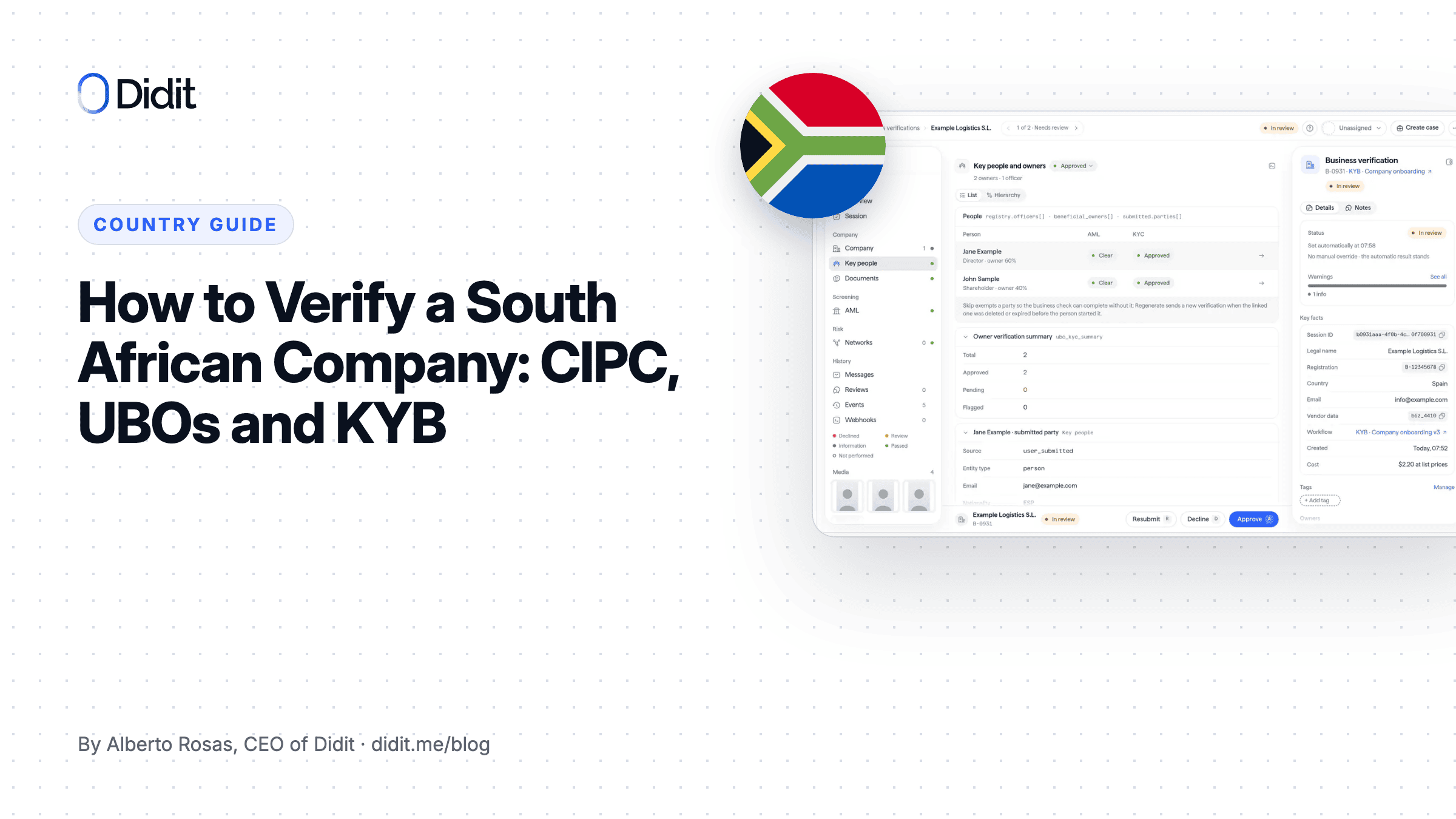
| Directors, secretary, authorized signatories | CIPC register, searched through BizProfile or eServices; Didit Key People | Key People records with roles: director, secretary, authorized_signatory, representative | Key People extraction free, person AML $0.20 each |
| Direct shareholders and ownership bands | Registry ownership source, as returned by Didit where available | Shareholders as natural persons and corporate entities, with ownership bands | Shareholders tier, $5.00 list price |
| Ultimate beneficial owners at the FIC's 5% recommendation | FIC Act section 21B and PCC 59 set the obligation; the FIC recommends 5% | beneficial_owners[] with ownership_percent and voting_percent | UBOs tier, $9.00 list price; confirm ZA availability |
| Sanctions, PEP, adverse media on company and people | Didit AML, 1,300+ lists | Company AML hits and per-person AML hits in the decision | $0.20 per check or person |
| Identity of each owner and director | Linked Didit KYC session | Per-person KYC status on the key people record | $0.33 per person |
Run your first South African company in the sandbox today at business.didit.me. It is free, there is no sales call, and you can set the ZA tier in the workflow before you spend credit. If you build with an AI coding assistant, connect Didit to it through the MCP server and let the agent create the workflow. Full detail is on the Business Verification product page and the pricing page. If you are switching from another provider, didit.me/switch covers the migration path.
One billing note before you plan a budget. The pricing doc describes $2.00 Lite, $5.00 Shareholders and $9.00 UBOs as the worldwide list and worldwide ownership source prices, and says no country in its catalog is priced below $5.00 and $9.00. The per-country table is still the source of truth, so read the ZA row in the pricing feed or the console Countries tab before you quote a production rate. Tier availability for ZA is a separate question from price: the supported-countries table tells you which tiers the registry can serve, and a request above that tier is delivered and billed at the highest tier served.
What South African law requires you to check
The obligation to look through a company to its owners is written into section 21B of the Financial Intelligence Centre Act, 2001 (Act 38 of 2001). The Financial Intelligence Centre, in its beneficial ownership guidance, read November 26, 2026, states that accountable institutions listed under Schedule 1 of the FIC Act must identify beneficial owners of clients that are companies, trusts or other corporate vehicles and take reasonable steps to verify their identities.
The General Laws (Anti-Money Laundering and Combating Terrorism Financing) Amendment Act, 2022 (Act 22 of 2022) commenced in December 2022 and amended those obligations, as Public Compliance Communication 59 (PCC 59), read November 26, 2026, records. PCC 59 runs in five parts: Part A legal persons, Part B trusts, Part C partnerships, Part D non-profit organisations, Part E adequate, accurate and up to date information. Section 21B(1) requires an accountable institution to establish the nature of the client's business and the ownership and control structure of the client.
The FIC Act definition of beneficial owner, as quoted in PCC 59, includes a natural person who directly or indirectly ultimately owns or exercises effective control of a client, or of a legal person, partnership or trust that owns or exercises effective control of a client. That wording is why a registry lookup alone does not close the file. You have to reach a person.
The FIC recommends that accountable institutions identify natural persons holding five percent or more of ownership interest in a legal person as beneficial owners.
The 5% figure is FIC guidance, not a statutory ownership threshold. The FIC Act requires reasonable steps to identify beneficial owners, and the FIC material we read does not set a universal statutory percentage. Set your workflow threshold to reflect applicable policy and legal advice. The FIC guidance, read November 26, 2026, traces the pressure back to the FATF's 2019 mutual evaluation report of South Africa, which called for enhanced beneficial ownership controls by accountable institutions. FATF Recommendations 24 and 25 set the international standard for legal persons and legal arrangements.
A policy set to 25% will name fewer owners than the FIC's 5% recommendation would surface. Treat that as a policy comparison, not a legal safe harbour. If your legal advice points to 5%, configure the workflow accordingly and document the decision.
The registers you are actually checking
The Companies and Intellectual Property Commission (CIPC) is the authority. Its search and registration page, read November 26, 2026, routes company record searches to bizportal.gov.za and eservices.cipc.co.za, designs and patents to iponline.cipc.co.za, and trade marks to esearch.cipc.co.za. The same page publishes the service turnaround table: Annual Returns are listed as immediate, CEMS queries take 8 business days, and Corporate Governance Surveillance and Enforcement closes or appoints inspectors on 80% of requests within 25 working days.
There is a practical barrier. The CIPC eServices Entity Search page, read November 26, 2026, states that enterprise search has moved to the BizPortal website and is now called BizProfile, and that users must log in before conducting any search, a requirement it attributes to compliance with the Protection of Personal Information regulations. So a self-serve lookup against the South African register is one company at a time, behind an account. The CIPC pages we read describe a logged-in BizProfile search.
Use the registration number shown by CIPC. Didit normalizes a registration number only where the registry requires it; the docs give the UK zero-padding example, not a South African rule. Didit queries official registries in supported countries when a business session starts. In the hosted flow the applicant selects the country of incorporation and enters the company name, the registration number, or both, and at least one is required. When both identifiers are supplied the lookup combines them. A search returns searched_by, which reports how the match happened: name, registration_number, or registration_number_and_name.

What Didit returns for a South African company
Registry data is sold in three tiers. The tier you get depends on the country and on what that country's registries actually hold. The fields below are documented by Didit's company registry API. The CIPC pages cited here document search access, not the returned schema, so a field the South African register does not expose stays empty rather than being guessed.
| Tier | What the check returns | List price |
|---|---|---|
| Lite | Company profile: legal name, registration and VAT numbers, legal form, status, incorporation date, registered address, activity, headcount and contact details, plus the officers | $2.00 per company |
| Shareholders | Lite plus the direct shareholders, natural persons and corporate entities, with their ownership bands | $5.00 per company |
| UBOs | Shareholders plus the ultimate beneficial owners resolved through the ownership chain | $9.00 per company |
Ownership is priced for what is delivered, not for what you asked for. Where the registry holds no ownership record for a company, a Shareholders or UBO request is delivered and billed as Lite. Where the resolved chain names no natural person, because it ends in corporate entities the register cannot trace to a person, a UBO check is delivered and billed as Shareholders, since a corporate ownership chain is not a beneficial owner. A company that cannot be found and is typed in manually is billed a flat $0.75.
| Identifier or field | Source | Notes |
|---|---|---|
company_name | Didit registry lookup | Legal name as registered with the authority |
registration_number | Didit registry lookup | Search by name, number or both. Pass it as CIPC prints it; normalization is applied only where the registry requires it |
country_code | Session input | ZA in the supported countries table |
company_type | Didit registry lookup | Legal entity type as the registry records it |
registry_status | Didit registry lookup | active, dissolved, struck_off, in liquidation, dormant |
incorporation_date | Didit registry lookup | Original registration date |
registered_address, addresses[] | Didit registry lookup | Official registered office plus additional addresses |
tax_number | Didit registry lookup, where available | Tax identification number |
legal_entity_identifier | Didit registry lookup, where available | LEI, for financial institutions and listed entities |
registered_capital | Didit registry lookup, where available | Amount and currency object |
accounts.last_annual_return_date | Didit registry lookup, where reported | Annual returns and meetings are distinct from financial accounts |
is_from_registry | Didit | true for registry data, false for manual entry |
fetch_status | Didit | pending, resolved, failed |
verification_status | Didit | verified, failed, unknown |
Apply the FIC's 5% beneficial-ownership recommendation
Didit records economic ownership and voting power separately, because they diverge with dual-class shares and preferred equity. Effective ownership through a chain is computed by multiplying percentages along the path. In the documented three-layer example, Acme Corp is 60% owned by Acme Holdings Ltd, which is 75% owned by Jane Doe, so Jane's effective ownership is 60% x 75% = 45%, and a second holder at 40% is disclosed alongside her.
With a 25% threshold both people are named. At 50%, nobody crosses the line and Didit flags the gap as a transparency concern. For South Africa the FIC recommends 5%, but that recommendation is not a statutory threshold. Set the workflow threshold from Workflows, your KYB workflow, Risk, UBO threshold to reflect applicable policy and legal advice. Confirm the number with counsel. Route to review when no owner meets the threshold. Every role is configured per workflow: enabled or disabled, whether it requires KYC, which KYC workflow to use, and whether the person can skip it. A party below the threshold does not trigger individual verification even if the role would otherwise require it.

Step by step in the Business Console
- Open business.didit.me and create an application with KYB enabled.
- Go to Workflows, then Create workflow, and choose Business Verification as the workflow type.
- Enable Company registry lookup (required), Company AML (recommended), Key People (required for most regulated industries) and Documents if you want document collection. Document collection is billed $0.20 per step regardless of how many files the applicant uploads in that step.
- Open Workflows, KYB Registry Check, Countries and set the tier for South Africa. Every country starts at Lite, so you only pay for ownership where you switch it on.
- Open Key People and set per-role rules. A common pattern is directors and UBOs above your threshold require KYC, while secretaries and non-executive board members do not.
- Set the workflow UBO threshold under Risk to reflect the FIC's 5% recommendation and your legal advice. Do not treat 5% as a statutory default.
- Save the workflow and copy its
workflow_id.
Step by step through the API
Create a business session with the documented session call. The workflow's KYB type flags the session as a business session automatically.
curl -X POST https://verification.didit.me/v3/session/ -H "x-api-key: YOUR_API_KEY" -H "Content-Type: application/json" -d '{"workflow_id": "YOUR_KYB_WORKFLOW_ID", "vendor_data": "biz-za-001"}'The response contains session_id, session_number and url. Deliver the url to the company admin through your own email or chat. If you already know the company, pass expected_details so the hosted flow pre-selects and locks the country, pre-fills the search fields and runs the asserted search:
{
  "workflow_id": "YOUR_KYB_WORKFLOW_ID",
  "vendor_data": "biz-za-001",
  "expected_details": {
    "company_name": "COMPANY_NAME_FROM_CIPC",
    "registry_country": "ZA",
    "registration_number": "REGISTRATION_NUMBER_FROM_CIPC"
  }
}
Both fields stay editable so the applicant can correct a wrong assertion. When the session reaches a terminal status, Didit posts a status.updated event. Business events carry session_kind: "business" inside data, so filter on that. Verify the X-Signature-V2 HMAC signature before trusting the event. The webhook payload already contains the full decision; if you prefer to pull it, the documented call is:
curl https://verification.didit.me/v3/session/SESSION_ID/decision/ -H "x-api-key: YOUR_API_KEY"Act on status. Approved means onboard the business. Declined means reject and log the warnings[] tags. In Review means wait for the analyst decision, which arrives as another webhook. If you need one tier only, the standalone endpoints are select for Lite, shareholders and ubo, documented at docs.didit.me/standalone-apis. Hosted workflow searches carry no separate search fee; standalone API searches can incur a $0.50 fee per successful request.

Worked cost example
Take one South African private company verified at the UBOs tier where the ZA registry serves it, with two people who each own above the FIC's 5% recommendation and must complete KYC, plus one document collection step. Registry line at the $9.00 worldwide ownership source list price:
| Line | Unit price | Qty | Cost |
|---|---|---|---|
| Registry lookup, UBOs tier | $9.00 | 1 | $9.00 |
| Company AML screening | $0.20 | 1 | $0.20 |
| Person AML, per UBO and officer | $0.20 | 2 | $0.40 |
| Linked full ID check, per key person | $0.33 | 2 | $0.66 |
| KYB document step | $0.20 | 1 | $0.20 |
| Total | $10.46 |
The arithmetic is 9.00 + 0.20 + 0.40 + 0.66 + 0.20 = 10.46. Key People extraction adds nothing, it is free per person. The same company at Lite without documents is 2.00 + 0.20 = $2.20. A company the registry does not return, entered manually, is 0.75 + 0.20 = $0.95. On the Scale plan the same 10% discount applies to every Didit line, so the UBOs bundle becomes 8.10 + 0.18 + 0.36 + 0.594 + 0.18 = 9.414, about $9.41 per company. Plan credit is spent first, then top-ups, and unused monthly credit does not roll over. If the ZA registry does not serve the UBOs tier, billing falls back to the highest tier served, which is usually Lite, and the registry line is lower than this example.

When the registry is down or has no match
- The company is not found. Submit the company data manually. The session continues with the data provided,
is_from_registryis set tofalse, and the company is billed the flat $0.75. - The ownership report is still pending. Some registries return the company profile before the ownership report is ready. That report continues in the background while the applicant completes independent steps such as document upload. Prefill does not block the Key People form, and the applicant can enter people manually while registry people appear before submission as the report arrives.
- Pending is not approved. A pending report does not count as a completed registry check or an automatic approval, and billing uses the tier actually delivered. If ownership is pending, Lite is charged at selection and only the difference to the delivered ownership tier is charged later, using the selection-time quote.
- The register holds no ownership record. A Shareholders or UBO request is delivered and billed at the highest tier the country's registries can serve, usually Lite. No additional ownership charge applies, and the total never exceeds the requested tier's quote.
- The number matches the wrong company. The hosted UI offers a one-tap search-as-company-name override on registration-number results, and both name and number can be combined in a single search. Use the Contains search mode when the exact legal name is unknown.
- The status is not Active. Companies with a status other than Active may be automatically flagged or declined depending on your workflow configuration. Check the configuration before a renewal run catches a company that is in liquidation.
- The lookup fails.
fetch_statusreturnsfailedandverification_statusreturnsfailedorunknown. Treat that as an unresolved check, not as a pass. Selection incurs the charge even when the applicant leaves early, so route failed lookups to analyst review rather than re-running the session by hand.
Monitoring a South African company after onboarding
Registry monitoring is coming soon. The pricing doc states plainly that no country in the KYB price list checked on September 7, 2026 had monitoring enabled, and that a configured rate does not mean the feature is available. The planned behaviour: companies verified at the Shareholders or UBO tier can be kept under continuous registry monitoring for $2.00 per company per year, the registry pushes changes of status, officers, ownership and address, the business session returns to review and a data.updated webhook fires with trigger: "kyb_registry_change". It is enabled per workflow and can be cancelled from the business page. When the wallet cannot cover the yearly renewal, monitoring stops rather than running unpaid.
In the meantime, re-run the registry check on your own renewal cycle and re-screen the people. Ongoing AML monitoring is available today at $0.07 per person per year, which covers the sanctions and PEP side between full KYB refreshes.
Sources
- Didit docs: KYB supported countries and registry coverage, read November 26, 2026.
- Didit docs: KYB registry pricing by country, Lite, Shareholders and UBOs, read November 26, 2026.
- Didit docs: KYB quickstart, read November 26, 2026.
- Didit docs: company registry API and retrieved fields, read November 26, 2026.
- Didit docs: UBO API and beneficial ownership extraction, read November 26, 2026.
- Didit docs: KYB officers and representatives, key people roles, read November 26, 2026.
- Didit docs: business AML screening for entities and people, read November 26, 2026.
- Didit pricing page, including the live price feed, read November 26, 2026.
- Didit pricing as JSON, read November 26, 2026.
- Companies and Intellectual Property Commission (CIPC), online search and registration links and service turnaround table, https://www.cipc.co.za/?page%5Fid=1649, read November 26, 2026.
- CIPC eServices Entity Search page, notice that enterprise search moved to BizPortal as BizProfile and requires login, https://eservices.cipc.co.za/Search.aspx, read November 26, 2026.
- Financial Intelligence Centre (FIC), beneficial ownership obligations guidance, https://www.fic.gov.za/2026/03/09/beneficial-ownership-obligations/, read November 26, 2026.
- Financial Intelligence Centre (FIC), Public Compliance Communication 59 on beneficial ownership and section 21B of the FIC Act, https://www.fic.gov.za/wp-content/uploads/2024/08/PCC-59-Beneficial-ownership.pdf, read November 26, 2026.
- Financial Action Task Force (FATF), Recommendations 24 and 25 and the 2019 mutual evaluation of South Africa, https://www.fatf-gafi.org/, read November 26, 2026.
Start in the sandbox at business.didit.me, create one Business Verification workflow, set South Africa to the tier your policy and legal advice support, and run a real company through it. No sales call, and the free plan includes monthly credit for eligible work email signups. We run this for 4,000+ companies today. Check the ZA row of the pricing feed before you go live.
Try it
Try this in the sandbox
Run the check this guide describes, free.
The product this post is about, taken from its topic. Run it free in the sandbox.
Author
Alberto Rosas
Co-founder and CEO

Keep reading
Other guides in the same topic.
 Automated KYC Checks in 8 Steps: Cut Manual Review (2026)
Automated KYC runs document capture, liveness, face match, device and IP analysis and watchlist screening, then sends only sessions that breach your rules to a human queue.
Alberto RosasNov 26, 2026 Aadhaar API Integration Guide: Database Validation in Didit
Didit runs an Aadhaar lookup as a Database Validation call: POST /v3/database-validation/ with issuing_state IND. One server-to-server request, priced per successful hit, with the India rate read from the per-service table.
Alberto RosasNov 26, 2026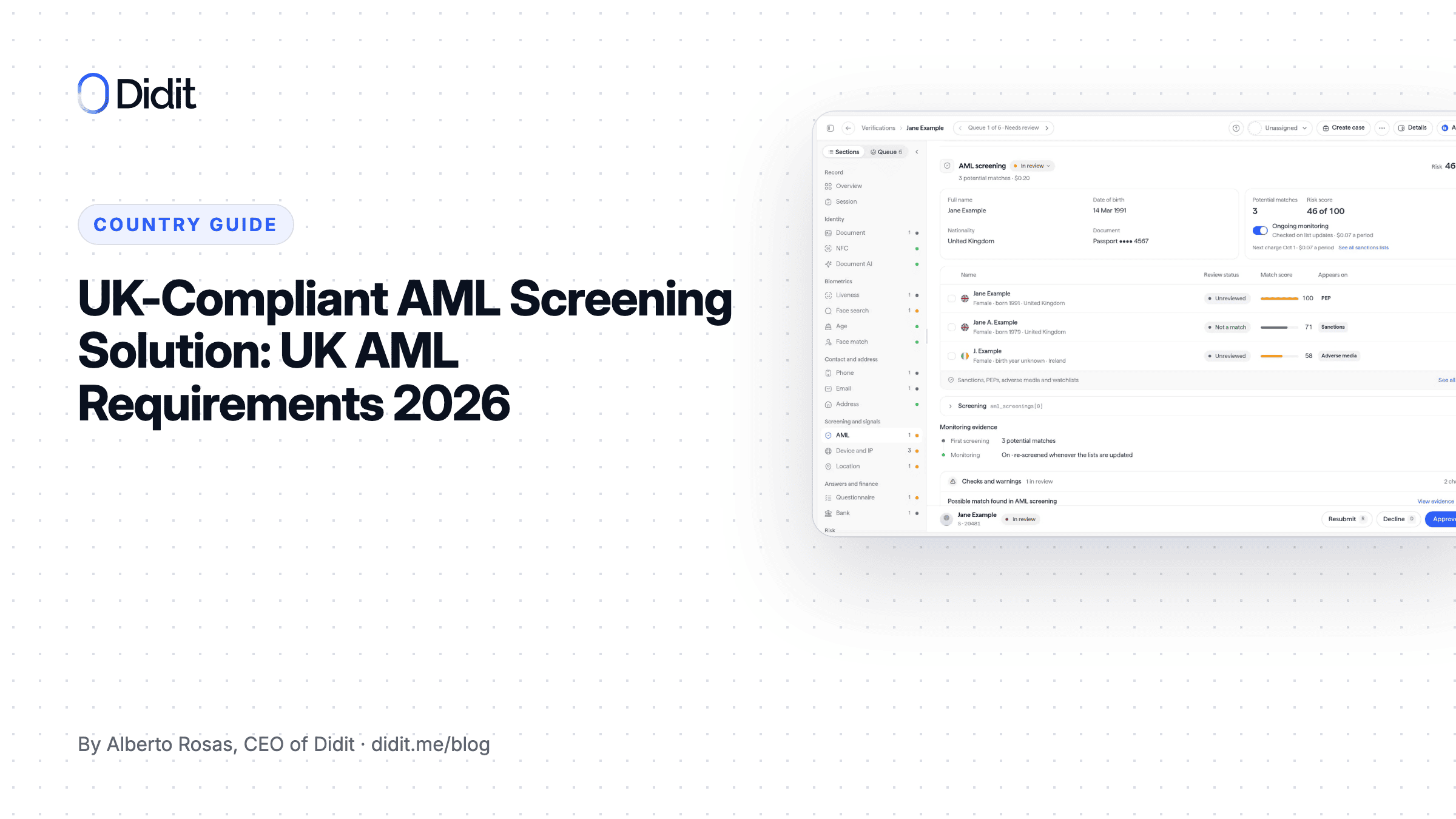 UK-Compliant AML Screening Solution: UK AML Requirements 2026
UK firms run risk-based CDD under SI 2017/692 and screen customers and beneficial owners against sanctions and PEP data. Didit runs that screen at $0.20 per check against 1,300+ lists and returns a match score and a risk score.
Alberto RosasNov 26, 2026Questions
Frequently asked questions
How do I verify a South African company's registration number?
Search the CIPC register by company name, registration number, or both. CIPC moved enterprise search to BizPortal under the name BizProfile and requires a login before any search, attributed to the Protection of Personal Information regulations. A Didit KYB session runs the same registry lookup and returns searched_by so you can see whether the match came from the name, the number, or both combined.
Is CIPC company data available through an API?
The cited CIPC pages describe logged-in BizProfile search. Didit connects to company registries in supported countries and returns registry data as structured fields, priced by country and tier from $2.00 per company. For an API integration, use Didit's documented KYB session or standalone registry endpoints.
What is a UBO in South Africa and what ownership threshold should I use?
A beneficial owner is a natural person who directly or indirectly ultimately owns or exercises effective control of a client, or of a legal person or trust that owns or controls the client, under the FIC Act definition quoted in PCC 59. The FIC recommends identifying natural persons holding five percent or more of ownership interest. That is guidance, not a statutory threshold, so set your workflow threshold from applicable policy and legal advice.
Does Didit resolve beneficial owners for South African companies?
Didit sells registry lookups in three tiers, Lite, Shareholders and UBOs, and publishes which tiers each jurisdiction supports in its supported-countries table, keyed by ISO code ZA. Check the ZA row first. Where the registry holds no ownership record, a Shareholders or UBO request is delivered and billed at the highest tier the registries can serve, usually Lite.
How much does a South African KYB check cost?
A registry check starts at $2.00 for Lite. The worldwide ownership source list prices are $5.00 for Shareholders and $9.00 for UBOs, where the ZA registry serves those tiers. Add $0.20 company AML, $0.20 per person AML, $0.33 per linked ID check for each owner or director, and $0.20 for each document collection step. List prices apply before plan discounts.
What happens if CIPC has no match for the company I am onboarding?
Submit the company data manually. The session continues with the data provided, is_from_registry is set to false, and the company is billed a flat $0.75. In a hosted workflow, selecting a company incurs the registry charge at selection even if the applicant leaves before confirming, so keep an analyst review path for failed lookups.
Do I have to verify each director and owner individually?
Not always, but usually for regulated onboarding. Each key person carries a requires_verification flag set by your per-role workflow configuration. When a role requires KYC, Didit starts a child User Verification session for that person and tracks the status back on the party. A director who is also a 15% shareholder holds both roles on one record.
Which South African law requires beneficial ownership checks?
Section 21B of the Financial Intelligence Centre Act, 2001 (Act 38 of 2001), as amended by the General Laws (Anti-Money Laundering and Combating Terrorism Financing) Amendment Act, 2022 (Act 22 of 2022), which commenced in December 2022. The detail is set out in Public Compliance Communication 59. FATF Recommendations 24 and 25 are the international standard behind it.
Can I monitor a South African company for registry changes?
Not yet. Registry monitoring is coming soon, and the pricing doc states that no country had monitoring enabled when it was checked on September 7, 2026. The planned rate is $2.00 per company per year for companies verified at the Shareholders or UBO tier, with a data.updated webhook on changes. Ongoing AML monitoring at $0.07 per person per year is available today.
What country code do I use for South Africa in the API?
ZA. The supported-countries table is keyed by ISO country code and South Africa is ZA. In a hosted workflow you set the tier per country under Workflows, KYB Registry Check, Countries, and every country starts at Lite.
Compliance built in
Audited, certified and attested.
We hold the certifications and build each country's rules into your flows, so you can launch anywhere without worrying. Security and Compliance center
- Regulation encoded into your flows
Tell us what you do and where. Didit lists the rules that apply to you, with sources, and builds the checks each country needs into one workflow.
- Ready for AMLR
Every requirement of the new EU anti-money laundering rules, from checking customers to human review, is already covered by a Didit check.
- Tested in Spain's Treasury sandbox
Spain's Treasury published its supervised sandbox report on Didit's NFC plus active liveness onboarding; SEPBLAC took part and valued the added measures positively.
- Audited, not self-declared
iBeta Level 1 and Level 2. Liveness tested under ISO/IEC 30107-3.
Your obligations · 3 regions
 SOC 2 Type 2
 ISO 27001
 iBeta Level 1 and Level 2
 EU regulator attestation
 FSM youth protection
 GDPR
 EBA remote onboarding
 MiCA compatible
 FIDO Alliance member
- AMLREU AML Regulation ready
Integration · Didit MCP
Run Didit from your own AI agent
Connect Didit to Claude, Cursor, VS Code or ChatGPT and just ask in plain words. Your agent can do anything you can do in the console, with the same permissions you have.
 Add to Claude
 ChatGPT
 Cursor
- Build workflowsDescribe the checks you need. The agent creates and publishes the flow.
- Run investigationsAsk why a session was declined, review cases, search people and companies.
- Change rulesCreate payment rules, test them on past data and switch them on.
- Pull reportsAsk for numbers, exports or the audit log.
Didit Academy


