UK-Compliant AML Screening Solution: UK AML Requirements 2026
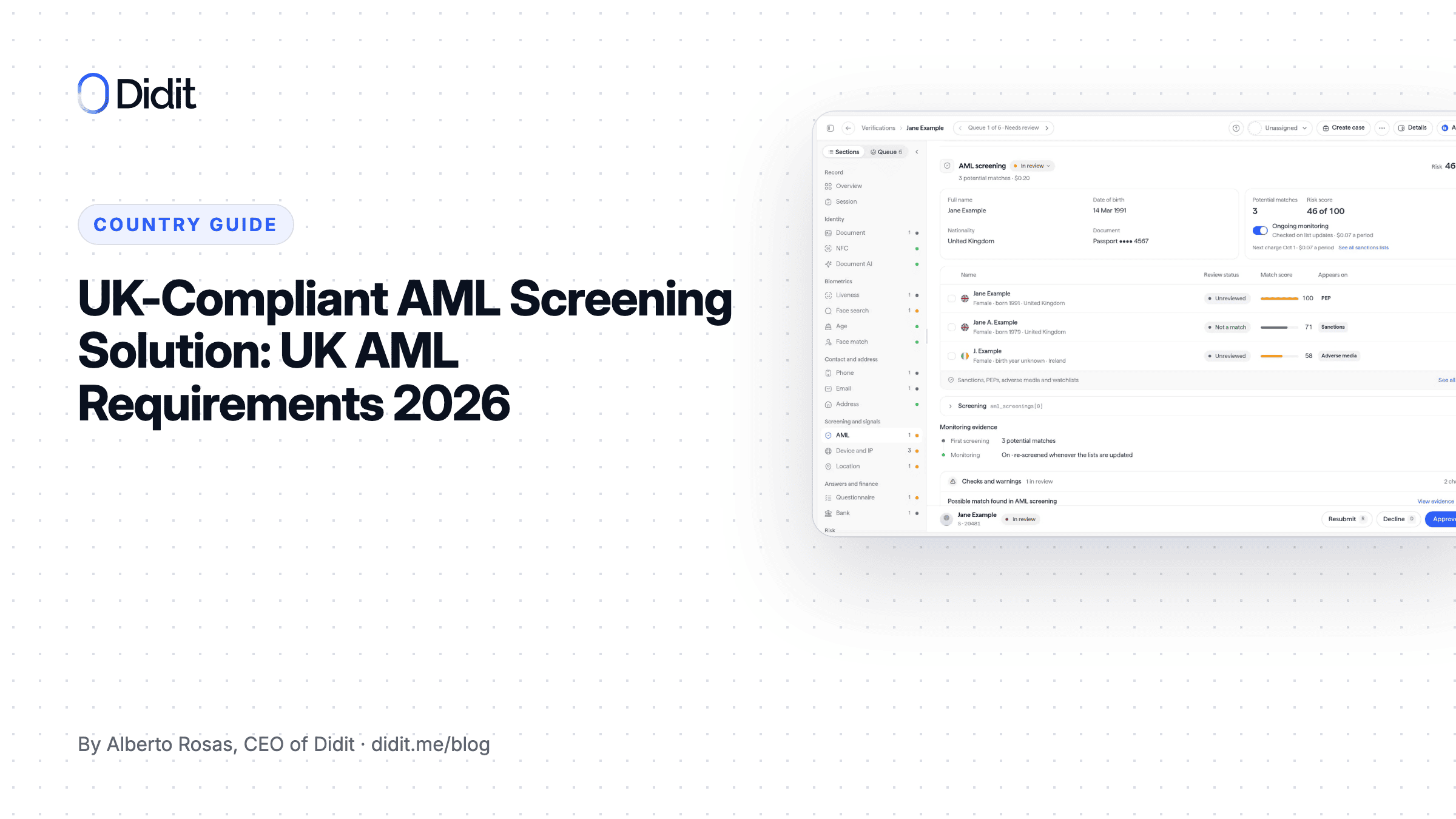
UK firms run risk-based CDD under SI 2017/692 and screen customers and beneficial owners against sanctions and PEP data. Didit runs that screen at $0.20 per check against 1,300+ lists and returns a match score and a risk score.
 Alberto RosasCo-founder and CEO
Contents
In this guide
Jump to the part you need.
This guide is for UK firms that need an AML screening process they can defend to the FCA: banks, payment and e-money institutions, lenders, cryptoasset businesses and the other firms the Money Laundering Regulations cover. Didit screens a person or a company against 1,300+ sanctions, PEP and watchlist sources, plus adverse media, at $0.20 per AML check. One caveat first: we supply the checks and the evidence, you remain the obliged entity and you own the decision.
Last updated: November 26, 2026. Prices checked against the live Didit price feed on November 26, 2026.
| What UK rules ask | What you have to do | Where it lives in Didit |
|---|---|---|
| Risk-based customer due diligence under the 2017 Regulations (SI 2017/692) | Keep a risk assessment, systems and controls, an MLRO and senior oversight | Sessions, statuses and an audit log in the Business Console |
| Screen the customer and the beneficial owners | Sanctions, PEP and watchlist checks at onboarding and on change | AML Screening $0.20 per check, 1,300+ lists, two scores per hit |
| Know the entity behind the person | Registry data plus person AML on every officer and UBO | KYB from $2.00 per company, $0.20 company AML, $0.20 person AML |
| Keep the file | Decision payload, hit review notes, reports | aml_screenings[] on the decision, PDF export, audit log |
| Keep watching | Re-screen when a list or the customer changes | Ongoing AML monitoring, $0.07 per person a year |
| Put a human on the edge cases | Route In Review to a named reviewer | Hit review in the console, PATCH /v3/session/{sessionId}/update-status/ |
Start free in the sandbox at business.didit.me, with no sales call. Developers who want the screen wired into an agent can connect Didit to an AI assistant through the MCP server at didit.me/developers/mcp. The product page is AML Screening and every unit price is on didit.me/pricing.
What UK law asks you to verify
The legal base is secondary legislation. The Money Laundering, Terrorist Financing and Transfer of Funds (Information on the Payer) Regulations 2017 are UK Statutory Instrument 2017 No. 692, published on legislation.gov.uk, and the version we read on November 26, 2026 is stated to be up to date with all changes known to be in force on or before 23 November 2026, with some changes still to come, including reg. 34A and Sch. 6 para. 7(ga) inserted by S.I. 2026/621 (legislation.gov.uk, the 2017 Regulations, read November 26, 2026). Regulation 28 sits in Part 3, Chapter 1 of the same instrument, and both the latest revised and the as-made versions are available; the operative text was not captured on the page we read, so we do not paraphrase it here (legislation.gov.uk, Regulation 28, read November 26, 2026).
The FCA frames the same duty around three statutes: the Proceeds of Crime Act 2002, the 2017 Regulations and the Terrorism Act 2000 (FCA, Money laundering and terrorist financing, read November 26, 2026). That page, last updated 24/11/2026, lists what supervision expects: a risk assessment, systems and controls, customer due diligence, and a Money Laundering Reporting Officer, with overall AML responsibility held by a director or senior manager. It also notes that a sole trader with no employees is not subject to the MLRO requirement. The FCA supervises banks, building societies, credit unions and cryptoasset businesses under the Regulations, plus firms carrying on activities listed in Schedule 2.
Then there is the quality bar. The FCA's 2025 multi-firm review of customer due diligence, enhanced due diligence and ongoing monitoring assessed controls against the 2017 Regulations, the FCA Financial Crime Guide, SYSC, JMLSG guidance and FATF guidance, and it states that the findings apply to every firm undertaking CDD, not only the asset managers, crowdfunding firms, wholesale banks, CFD providers and non-bank lenders in the sample (FCA, Firms' customer due diligence processes and controls, read November 26, 2026). The audience it names is MLROs, senior managers with financial crime oversight and practitioners in financial crime prevention roles.
In plain terms, the UK checklist a build has to satisfy: identify the customer, identify the beneficial owners, screen both against sanctions and PEP data, decide with a documented rationale, keep the record, and re-check on change. We supply the checks and the evidence. You stay the obliged entity, so the risk profile, the onboarding decision and liability for anything you outsource remain yours.
Keep the two apart. The legal obligation is yours: the 2017 Regulations and FCA supervision set what due diligence you run, who owns it and what you must be able to show. The capability is ours: a real-time screen against 1,300+ sources, two scores per hit, a stored decision payload and optional daily re-screening. This guide is operational, not legal advice, so confirm how each rule applies with your counsel and your supervisor.
Which lists and registers the screen runs against
Didit screens in real time against 1,300+ sources and covers 220+ countries. The catalogue for legal entities is documented on our business AML coverage page: the UN Security Council consolidated list, the EU consolidated financial sanctions and its travel-ban list, OFAC, the debarment and ineligibility registers of the multilateral development banks (World Bank, ADB, AIIB, IDB, AfDB, EBRD, EIB, CDB), Swiss SECO, Australia's DFAT consolidated list, the Dutch National Sanction List and Central Bank of Aruba lists, alongside regulatory watchlists published by securities regulators, central banks, trade and antitrust authorities.
Company screenings also flag insolvency and bankruptcy registers, among them India's IBBI, China's National Enterprise Bankruptcy Information Disclosure Platform, the FDIC and US insurance guaranty associations, German insolvency announcements and the Polish court-business monitor. Every match carries structured metadata: company name, registration number, jurisdiction, aliases, addresses, listing date and source URL. That metadata is what lets a reviewer separate two companies with similar names and record why one was cleared.
The UK's own consolidated sanctions list is published on gov.uk. Our catalogue page lists every publisher we return records from, so check it against the lists your supervisor names before you switch anything over.
What Didit returns for a UK screen
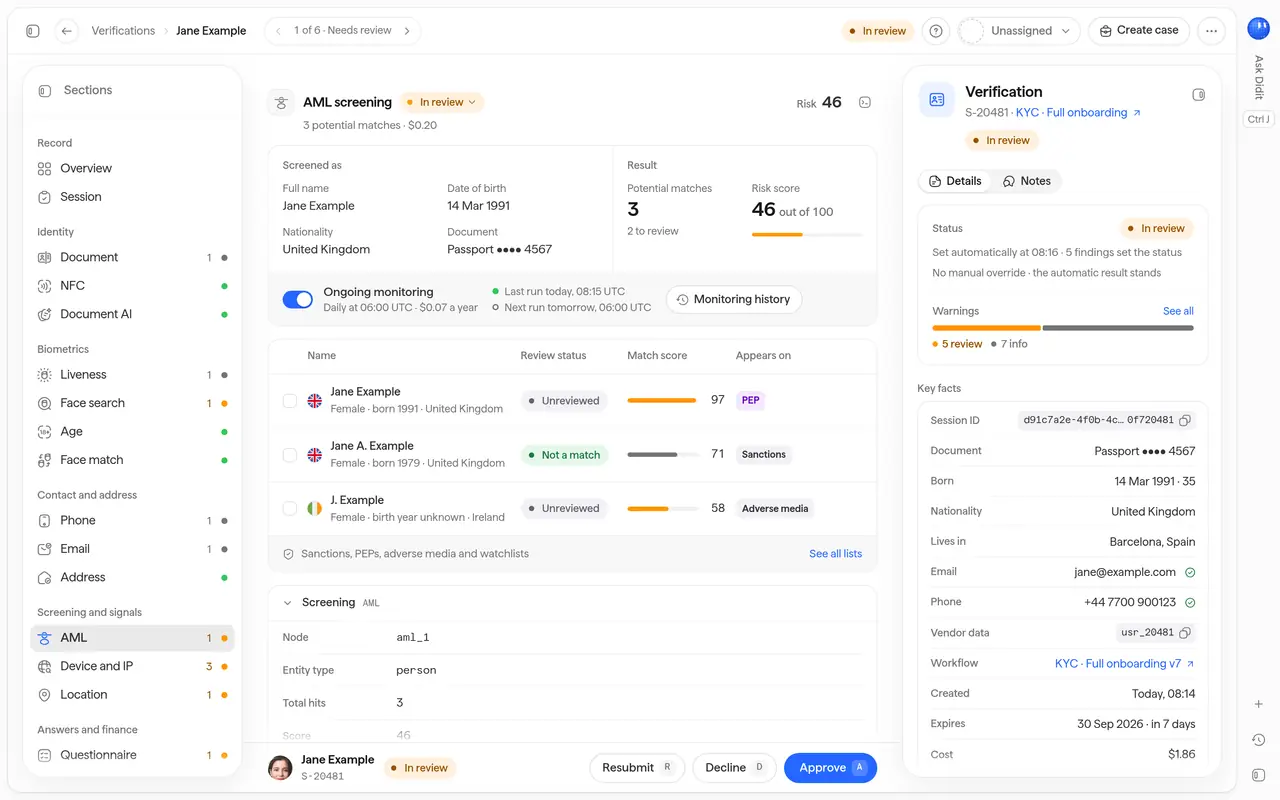
There are two scores per hit and the difference matters in a review. The match_score answers whether this is the same person: it combines name, date of birth and country using weights you set, and any hit below the match threshold (default 93) is tagged False Positive and excluded from risk. The risk_score answers how risky the listed entity is if the match is real, and the highest risk score among the remaining hits becomes aml.score. Your thresholds then drive status: a score above the review threshold (default 100) is Declined, a score above the approve threshold (default 80) is In Review, otherwise Approved.
The three weights aml_name_weight, aml_dob_weight and aml_country_weight default to 60 / 25 / 15 and must sum to exactly 100, or the request is rejected with HTTP 400. A matching document_number acts as a golden key and overrides the match score to 100.
The screen reports a PEP_MATCH warning when a hit is classified as a politically exposed person. Whether that match means enhanced due diligence, senior management sign-off, source-of-funds evidence or a decline is not something the screen decides: apply your firm's own procedures and record the reasoning in the file.

| Identifier or field | Where it appears | What it tells you |
|---|---|---|
request_id | Response root | Correlation id. With save_api_request on it works with GET /v3/session/{sessionId}/decision/, /generate-pdf/ and the console. |
aml.status | aml_screenings[].status | Not Started, In Progress, Approved, In Review, Declined, Abandoned, Kyc Expired. |
aml.screening_id | Response | Identifier of the screening itself, for your own record. |
aml.score | Response | Highest risk score among hits that were not tagged False Positive. |
hits[].match_score | Each hit | 0 to 100 identity confidence from the name, date of birth and country weights. |
hits[].risk_score | Each hit | 0 to 100 entity risk from country risk, category and criminal records. |
hits[].review_status | Each hit | False Positive (below the match threshold) or Unreviewed (counted in risk). |
warnings[] | Response | POSSIBLE_MATCH_FOUND, MATCH_FOUND, HIGH_RISK_COUNTRY, ADVERSE_MEDIA_HIT, SANCTIONED_ENTITY, PEP_MATCH, ONGOING_MONITORING_ENABLED. |
vendor_data | Request, echoed back | Your own customer id, so the screen ties to your record. |
| Match metadata | Each business hit | Company name, registration number, jurisdiction, aliases, addresses, listing date, source URL. |
The published AML price is $0.20 per check. Confirm the lists and registers relevant to your use case before launch. Which lists and registers return records depends on the name you send, which is why the publisher metadata above matters in a review.
Run it in the Business Console
- Open the workflow in the Business Console and add the AML Screening step. The same step can be added to a workflow through
POST /v3/workflows/. - Set four things before you go live:
aml_match_score_threshold,aml_score_approve_threshold,aml_score_review_thresholdand the three weights. Start from the defaults (93, 80, 100 and 60/25/15) and move them only against cases from your own book. - Create a session with
POST /v3/session/, passingworkflow_id,vendor_dataandcallback. In the sandbox, run it from the console instead. - Read the decision from
GET /v3/session/{sessionId}/decision/or wait for thesession.status.updatedwebhook. AML results arrive inaml_screenings[]. - Review each hit in the console, compare the two scores, and mark the outcome. An In Review status goes to a person, not to an automatic decline.
- Turn on ongoing monitoring if you want provider-driven re-screening every day. It only runs with
save_api_request=true, and it is switched off from the console.

Run the same check through the API
The standalone endpoint is POST https://verification.didit.me/v3/aml/ with an x-api-key header. It is documented in full on the AML Screening API reference, and the session-based route is described on the AML Screening overview.
curl -X POST 'https://verification.didit.me/v3/aml/' \
-H "x-api-key: $DIDIT_API_KEY" \
-H "Content-Type: application/json" \
-d '{
  "full_name": "Javier Ejemplo Modelo",
  "entity_type": "person",
  "date_of_birth": "1974-01-01",
  "nationality": "ES",
  "include_adverse_media": true,
  "vendor_data": "user-1234"
}'
It returns { request_id, aml: { status, screening_id, hits: [...], warnings: [...] } }. save_api_request defaults to true, so the screening is stored as a session, request_id works with GET /v3/session/{sessionId}/decision/, the result appears in the console and a status.updated webhook fires. Add an Idempotency-Key header when you retry after a timeout: an identical replay returns the stored response without running or billing a second screening, while the same key with a different body returns 409.
- 400 when the three weights do not sum to 100, or when ongoing monitoring is requested without
save_api_request=true. - 403 when the balance is out of credit, returned before any new screening runs.
- Declined means the highest risk score exceeded your review threshold, which is the decline threshold (default 100). In Review means the risk score sits between the approve and review thresholds and belongs in a manual queue.
- Set a client timeout of at least 60 seconds when
include_adverse_mediais true, because adverse media enrichment is the slow part of the call.
Worked cost example
A UK e-money institution onboards 1,500 customers a month, runs a full ID check plus an AML screen on each one, and keeps every customer under ongoing monitoring. Start with list-price usage for one month's cohort:
- Full ID check: 1,500 x $0.33 = $495.00
- AML screening: 1,500 x $0.20 = $300.00
- List-price usage for the month: $495.00 + $300.00 = $795.00
Ongoing monitoring is charged per person per year, so read it as a cohort figure. One first-year cohort of 1,500 customers monitored for one year is 1,500 x $0.07 = $105.00 at list price. If the firm keeps onboarding 1,500 customers a month, the recurring annual monitoring total is 18,000 x $0.07 = $1,260.00 a year.
Now separate list-price usage, plan fee and included credit. On Scale the same volume prices at $0.297 + $0.18 = $0.477 per customer, so list-price usage for the month is 1,500 x $0.477 = $715.50. The plan fee is $299.00 a month and the plan includes $350.00 of credit, which covers the first $350.00 of that usage. Cash for the month is $299.00 + ($715.50 - $350.00) = $664.50, which is $130.50 below the $795.00 list-price run rate. At Scale the same cohort costs 1,500 x $0.063 = $94.50 a year for monitoring, and the recurring 18,000-person annual total is 18,000 x $0.063 = $1,134.00.
For a KYB flow, 25 UK companies a month with three UBOs each: 25 x $2.00 = $50.00 for registry data, 25 x $0.20 = $5.00 for company AML, 75 x $0.20 = $15.00 for person AML and 75 x $0.33 = $24.75 for linked KYC, so $94.75 a month at list price. KYB pricing varies by country and data tier (Lite, Shareholders, UBOs), so confirm the UK tier on the product page before quoting internally.
When a source is down or there is no match
There are three documented behaviours to build around. If no hit survives the match threshold, the score is 0 and no POSSIBLE_MATCH_FOUND warning is added, because a score of exactly 0 never warns; the status is Approved and that decision is stored like any other. If adverse media enrichment times out, the API returns the result without adverse media hits and the rest of it is still actionable, so treat a missing adverse media section as an open item rather than a clear result. If a call returns 403 you are out of credit and nothing was screened, so a 403 must never be read as a pass.
Ongoing monitoring closes part of the gap: include_ongoing_monitoring=true keeps the entity under provider-driven monitoring, dated every day, so updates reach the report, and it is priced at $0.07 per person a year. What our docs do not describe is a full outage of an upstream list, so keep a manual route in the process: a reviewer opens the session in the console, records the decision and the compensating control in the customer file. Didit has 4,000+ active customer companies.
Sources
- legislation.gov.uk, The Money Laundering, Terrorist Financing and Transfer of Funds (Information on the Payer) Regulations 2017, SI 2017 No. 692, read November 26, 2026.
- legislation.gov.uk, Regulation 28, SI 2017/692, read November 26, 2026. The retrieved page showed navigation and version controls only; the operative text was not verifiable.
- FCA, Money laundering and terrorist financing, last updated 24/11/2026, read November 26, 2026.
- FCA, Firms' customer due diligence processes and controls: our findings, read November 26, 2026.
- FATF, risk-based approach guidance referenced in the FCA review.
- Didit docs, AML Screening overview and AML warnings catalogue.
- Didit docs, AML Screening standalone API and Create Session API.
- Didit docs, business AML coverage.
- Didit docs, pricing and billing rules and didit.me/pricing.
- Didit docs, security and compliance.
If you want the UK screen running today, create a free sandbox application at business.didit.me and run one screening with adverse media on. Sandbox results are mocked: they show you the shape of the response, not a live provider screening. When you are ready for real hits, add credit and run the same call against live lists. No sales call is involved at any point.
Try it
Try this in the sandbox
Run the check this guide describes, free.
The product this post is about, taken from its topic. Run it free in the sandbox.
Author
Alberto Rosas
Co-founder and CEO

Keep reading
Other guides in the same topic.
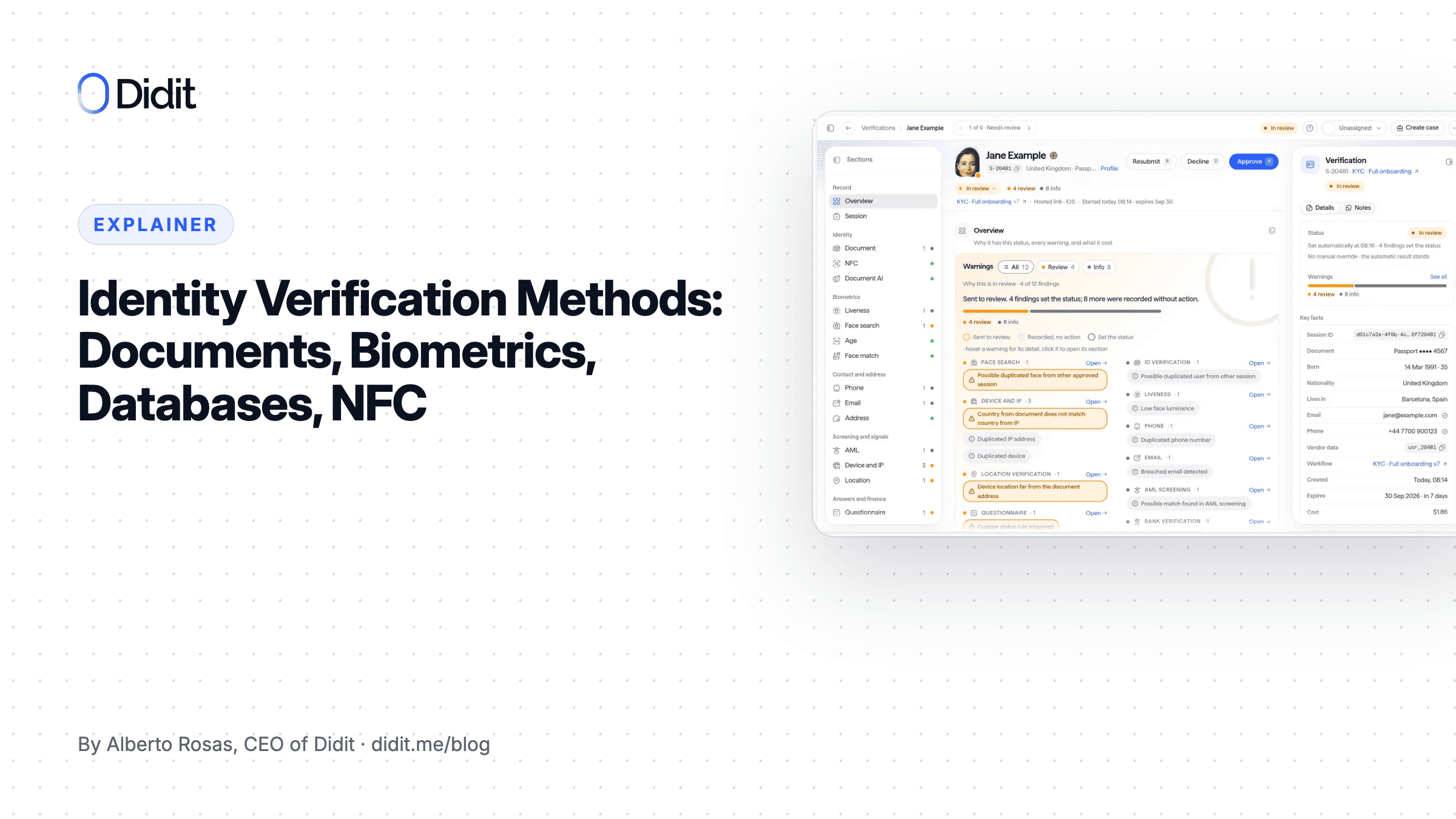 Identity Verification Methods: Documents, Biometrics, Databases, NFC
Identity verification methods are the evidence a check collects: a captured document, a biometric, an authoritative database record, an NFC chip read or a digital ID wallet sign-in.
Alberto RosasNov 26, 2026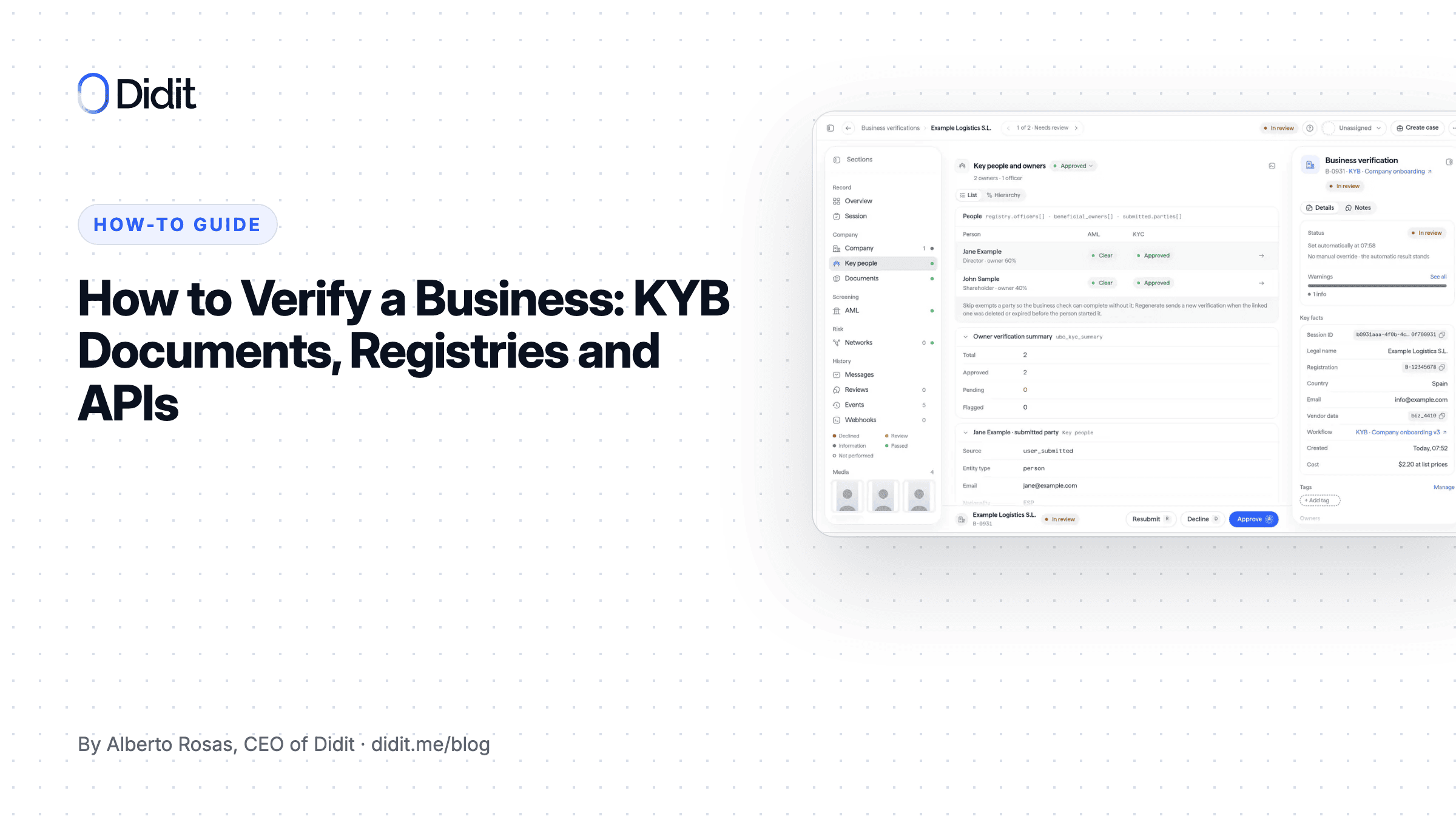 How to Verify a Business: KYB Documents, Registries and APIs
Verify a business by joining a company registry lookup, UBO and officer extraction, corporate document cross-checks and company plus person AML on one session, then acting on that session's status.
Alberto RosasNov 26, 2026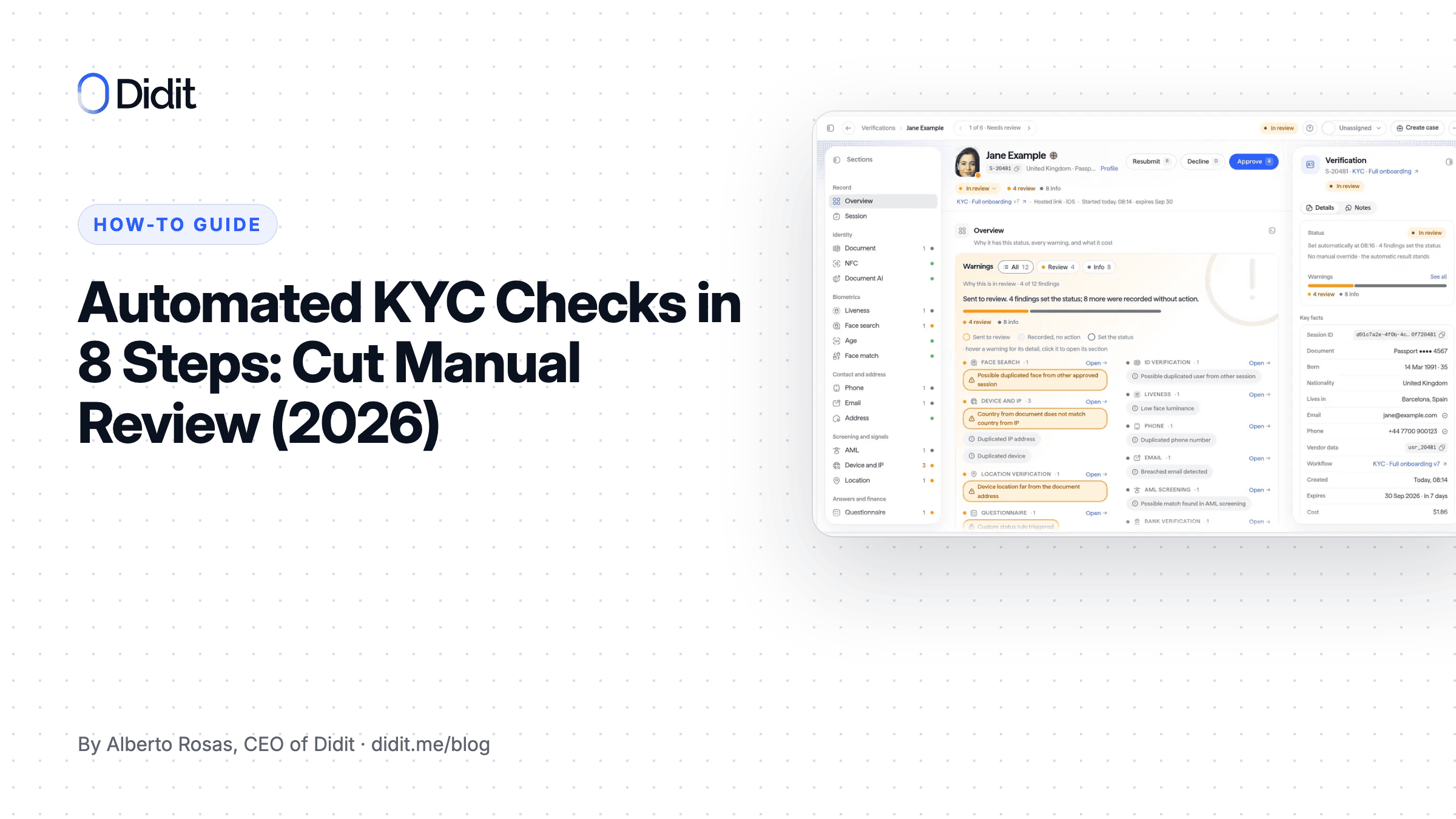 Automated KYC Checks in 8 Steps: Cut Manual Review (2026)
Automated KYC runs document capture, liveness, face match, device and IP analysis and watchlist screening, then sends only sessions that breach your rules to a human queue.
Alberto RosasNov 26, 2026Questions
Frequently asked questions
What does UK AML screening require me to check?
Under the Money Laundering, Terrorist Financing and Transfer of Funds (Information on the Payer) Regulations 2017 (SI 2017/692) you run risk-based customer due diligence, and the FCA expects due diligence, enhanced due diligence and ongoing monitoring controls to be in place (FCA, read November 26, 2026). In practice that means identifying the customer, identifying the beneficial owners, and screening both against sanctions and PEP data at onboarding and when something changes. Didit runs the screens and keeps the evidence, but the risk decision stays with you.
Does using Didit make my firm compliant with UK AML rules?
No. We provide verification, screening and the evidence trail; we are not your compliance function. You keep the risk assessment, the MLRO appointment, the senior oversight and the onboarding decision, and you stay liable for anything you outsource. Using Didit does not by itself make a firm compliant with the 2017 Regulations.
Which sanctions and PEP lists does Didit screen against?
Didit screens against 1,300+ sources in real time, including the UN Security Council consolidated list, the EU consolidated financial sanctions and travel bans, OFAC, the multilateral development bank debarment lists, Swiss SECO, Australia's DFAT consolidated list and the Dutch National Sanction List, plus PEP, watchlist and adverse media data. Every match comes back with publisher metadata such as listing date and source URL. The full publisher list is on our business AML coverage page.
How much does one AML screening check cost?
AML Screening is $0.20 per check at list price, $0.192 on Growth and $0.18 on Scale. Ongoing monitoring is $0.07 per person a year at list price, $0.0672 on Growth and $0.063 on Scale. Billing is per completed check from prepaid credit, and the sandbox is free on every plan.
What is the difference between a match score and a risk score?
The match score is identity confidence, 0 to 100, built from name, date of birth and country with weights that must sum to 100. Hits below the match threshold, default 93, are tagged False Positive and ignored for risk. The risk score is how risky the listed entity is if the match is real, and the highest risk score among the surviving hits becomes the AML score that drives Approved, In Review or Declined.
What happens if the adverse media lookup times out?
The API returns the result without adverse media hits, and the sanctions and PEP portion is still usable. Set a client timeout of at least 60 seconds when you enable adverse media, and treat the missing section as an open item to re-run or review rather than a clear result. A re-run with the same Idempotency-Key returns the stored response and is not billed twice.
Can I screen a company and its beneficial owners in one flow?
Yes. Business verification retrieves official registry data from $2.00 per company, with tiers for Lite, Shareholders and UBOs, and company AML screening is $0.20 per check. Each officer or UBO then takes person AML at $0.20 and, if you want them verified as individuals, a linked full ID check at $0.33.
What evidence does Didit keep for an FCA review?
Every screening is stored as a session with its decision payload, hit review statuses, warnings and status history, and you can generate a PDF from the session. Audit log retention follows your plan: 30 days on Free, 1 year on Growth, 3 years on Scale, and what your contract sets on Enterprise. How long you must keep customer due diligence records is set by the regulations and your supervisor, so confirm that period with your counsel.
Can I test all of this without a sales call?
Yes. Sandbox testing is free and unlimited, and sandbox keys skip screening and billing and return a mocked Approved result with zero hits unless you pass sandbox_scenario. A sandbox result is not a live provider screening, so do not read it as one. The first organization created with an eligible work email for a company domain gets $10 of monthly Free-plan credit. Start at business.didit.me and add live credit only when you are ready.
Compliance built in
Audited, certified and attested.
We hold the certifications and build each country's rules into your flows, so you can launch anywhere without worrying. Security and Compliance center
- Regulation encoded into your flows
Tell us what you do and where. Didit lists the rules that apply to you, with sources, and builds the checks each country needs into one workflow.
- Ready for AMLR
Every requirement of the new EU anti-money laundering rules, from checking customers to human review, is already covered by a Didit check.
- Tested in Spain's Treasury sandbox
Spain's Treasury published its supervised sandbox report on Didit's NFC plus active liveness onboarding; SEPBLAC took part and valued the added measures positively.
- Audited, not self-declared
iBeta Level 1 and Level 2. Liveness tested under ISO/IEC 30107-3.
Your obligations · 3 regions
 SOC 2 Type 2
 ISO 27001
 iBeta Level 1 and Level 2
 EU regulator attestation
 FSM youth protection
 GDPR
 EBA remote onboarding
 MiCA compatible
 FIDO Alliance member
- AMLREU AML Regulation ready
Integration · Didit MCP
Run Didit from your own AI agent
Connect Didit to Claude, Cursor, VS Code or ChatGPT and just ask in plain words. Your agent can do anything you can do in the console, with the same permissions you have.
 Add to Claude
 ChatGPT
 Cursor
- Build workflowsDescribe the checks you need. The agent creates and publishes the flow.
- Run investigationsAsk why a session was declined, review cases, search people and companies.
- Change rulesCreate payment rules, test them on past data and switch them on.
- Pull reportsAsk for numbers, exports or the audit log.
Didit Academy


