Stablecoin Issuer Customer Identification: The 2026 CIP Proposal
Five US agencies proposed a customer identification program for permitted payment stablecoin issuers on 22 June 2026. It covers issuance and redemption, not transfers between holders.
 Alberto RosasCo-founder and CEO
Contents
In this guide
Jump to the part you need.
This page is for compliance leads and engineers at permitted payment stablecoin issuers, and for banks and exchanges deciding whether the rule reaches them. The joint proposal of 22 June 2026 would write the bank customer identification program into a new 31 CFR Part 1033. Didit runs the checks it asks for, from $0.33 per full ID check. The caveat matters: nothing is in force, and the duty stops at the issuer's own customer.
Last updated: November 26, 2026. Prices checked against the live Didit price feed on November 26, 2026.
| Question | Answer |
|---|---|
| Instrument | Joint notice of proposed rulemaking, 22 June 2026, by FinCEN with the OCC, the Federal Reserve Board, the FDIC and the NCUA. Proposed 31 CFR Part 1033, section 1033.220. RIN 1506-AB74, docket FINCEN-2026-0101. It is a proposal, not a final rule. |
| Who is subject | Permitted payment stablecoin issuers, which the GENIUS Act treats as financial institutions under the Bank Secrecy Act. |
| Where | United States, in the federal Bank Secrecy Act framework, written by FinCEN with the federal banking agencies. |
| From when | Not in force. Comments closed 21 August 2026. The agencies propose that a final rule take effect 12 months after issuance. |
| What it asks for | Name, date of birth or formation, street address and an identification number before an account opens, verification within a reasonable time, a check against Federal terrorist lists, five-year records. |
| Address collection and address proof are two different things | The proposal requires collecting a street address. It does not require a paid proof-of-address check for every customer. Adding one is an implementation decision you make for your own risk assessment, at $0.20 per proof-of-address check. |
| What it does not reach | Transfers between other holders, which the proposal calls the secondary market. The agencies asked for comment on extending the duty there. |
| Didit prices for the checks | Full ID check $0.33, AML screening $0.20, proof of address $0.20, ongoing AML monitoring $0.07 per person a year. |
Start free in the sandbox at business.didit.me, no sales call. If you build with a coding agent, connect Didit to an AI assistant through the MCP server, and check the list prices on the pricing page before you size anything.
Who is subject, where, and from when
The proposal is aimed at one kind of firm: the permitted payment stablecoin issuer. Proposed section 1033.220 would apply to a permitted payment stablecoin issuer as that term is set by the GENIUS Act, the Guiding and Establishing National Innovation for U.S. Stablecoins Act. The statute is what makes the duty possible at all. It directs that permitted payment stablecoin issuers be treated as financial institutions under the Bank Secrecy Act, the 1970 law that requires banks to identify their customers and report suspicious activity.
Geographically the duty is federal. It would sit in a new 31 CFR Part 1033, written by the Financial Crimes Enforcement Network with the Office of the Comptroller of the Currency, the Federal Reserve Board, the Federal Deposit Insurance Corporation and the National Credit Union Administration. FinCEN writes the rule. The banking agencies reach the issuers they supervise.
On timing, the honest answer is that nothing is in force. Comments closed on 21 August 2026 under docket FINCEN-2026-0101 and RIN 1506-AB74. The agencies proposed that any final rule take effect 12 months after issuance, which they say is to give issuers time to build. Plan the build from the date a final rule publishes, not from the proposal.
The bank template is 31 CFR 1020.220
The proposal is a copy of a rule that has applied to banks since 2003: the customer identification program at 31 CFR 1020.220. That rule gives a bank four jobs. Collect identifying information. Verify it, by documents, non-documentary methods or both, within a reasonable time. Compare the customer against government lists. Keep records. Read the proposal next to it and the shape is the same, with the population changed from banks to stablecoin issuers.
If your team has built a bank customer identification program, you will recognise the four data items and the five-year retention. If it has not, treat 31 CFR 1020.220 as the design document, because the agencies did. They modelled the stablecoin rule on it directly, and most of what they ask for comment on is what changes when the customer is a stablecoin holder rather than a depositor.
AML and KYC requirements for stablecoins, as they stand today
There are two layers, and only one of them is finished. The Bank Secrecy Act duties that the GENIUS Act attaches to a permitted issuer are law. The customer identification program is a proposal. Around it sit four more proposals covering the anti-money laundering program, sanctions standards, reporting and recordkeeping for the same firms. Until a final rule issues, an issuer builds to the proposal and to what its own supervisor expects, and keeps the evidence either way.
That is why a search for AML KYC requirements for stablecoins keeps returning rules written for banks. The framework is the bank framework. The novelty is the entity it now reaches, and the fact that a token changes hands between people the issuer never sees.
Dated applicability table
Five agencies published five separate proposed rules implementing the GENIUS Act between 18 May and 9 July 2026, each with its own comment window. All five windows closed by 8 September 2026. The identity rule is the joint one, and it is the one that decides what an issuer must collect from a customer.
| Date published | Agency and instrument | Federal Register | Comments closed |
|---|---|---|---|
| 18 May 2026 | NCUA, GENIUS Act stablecoin issuance, for entities subject to NCUA jurisdiction | 2026-09915 | 17 July 2026 |
| 5 June 2026 | FDIC, Bank Secrecy Act and sanctions standards for FDIC-supervised permitted payment stablecoin issuers | 2026-11342 | 4 August 2026 |
| 22 June 2026 | FinCEN with the OCC, the Federal Reserve Board, the FDIC and the NCUA, Customer Identification Program, proposed 31 CFR Part 1033, RIN 1506-AB74, docket FINCEN-2026-0101. This is the identity rule. | Joint notice, docket FINCEN-2026-0101 | 21 August 2026 |
| 24 June 2026 | OCC, AML/CFT and sanctions risk management, program, reporting and recordkeeping obligations | 2026-12692 | 24 July 2026 |
| 9 July 2026 | Federal Reserve Board, AML/CFT programs | 2026-13919 | 8 September 2026 |
| Not yet issued | Any final rule takes effect 12 months after issuance | None | Not applicable |
If you meant to comment and missed a window, the docket is still readable and the questions the agencies asked are the map of what a final rule is likely to change. The identity rule asked, as its first question, whether any part of the program should reach the secondary market.
What the proposal would require before an account opens
Proposed section 1033.220 asks for four items from every customer before an account opens: name; date of birth for an individual, or date of formation otherwise; address; and an identification number. The agencies modelled this on 31 CFR 1020.220, so the items look familiar to anyone who has onboarded a bank customer.

The address element is stricter than it reads. For an individual the proposal asks for a residential or business street address and a mailing address. For anything other than an individual it asks for a principal place of business, local office or other physical address, plus a mailing address. A post office box alone would not satisfy it. What the text asks for is the address itself, collected and recorded. It does not name a document check as the way to get there, so a proof-of-address step is your choice rather than a requirement of the proposal.
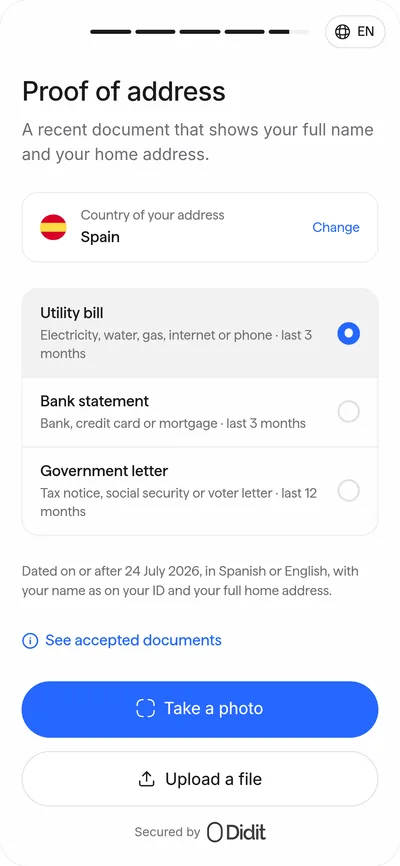
Collecting is half the job. The program must also contain procedures to verify each new customer's identity within a reasonable time before or after the account opens, by documents, non-documentary methods or both. The non-documentary methods the proposal names are contacting the customer, comparing what the customer supplied against a consumer reporting agency, public database or other source, checking references with another financial institution, and obtaining a financial statement.
Two duties sit alongside. The issuer must check each customer against any list of known or suspected terrorists issued by a Federal agency and designated by Treasury, which implements section 5318(l)(2)(C) of title 31 of the United States Code. And it must keep the identifying information for five years after the account closes, and the record of how identity was verified for five years after that record is made.
There is one carve-out. A customer who has applied for a taxpayer identification number but does not yet have one may open an account, provided the program confirms the application was filed and obtains the number within a reasonable period afterwards. Nothing else in the four items is waived for anyone.
Where the duty stops: issuance and redemption, not what happens next
The joint proposal defines two zones. The primary market is the issuer dealing directly with a holder: issuing, converting, redeeming, repurchasing, burning and reissuing stablecoins, plus associated services such as custody. The secondary market is activity between other parties. The identity duty attaches to the first and stops there.
That is a statement about the draft, not a criticism of it. A customer identification program is built around the moment an account opens, and an issuer only has an account relationship with the people it deals with directly. A bank knows who holds a deposit because the deposit exists only on the bank's own ledger. A stablecoin works differently. The issuer creates the token and redeems it, and in between it circulates on a public network where the issuer is not a counterparty to any of the movements.
Governor Michael S. Barr of the Federal Reserve said on 18 June 2026 that it is "far too easy for bad actors to evade these restrictions and operate without detection when transacting in digital assets". He supported the proposal and set out a reservation in the same statement. It deserves quoting in full, because it is the clearest description of the boundary from one of the regulators who issued the rule.
"I remain concerned, however, that the GENIUS Act regulatory framework does not do enough so far to address the risks of illicit finance conducted through secondary market transactions in payment stablecoins." Michael S. Barr, Governor, Board of Governors of the Federal Reserve System, statement of 18 June 2026.
The agencies treat the point as unsettled too. The proposal asks for comment on whether any portion of the identity requirements should extend to secondary market activity, and Barr said he would review those comments and assess whether the framework as a whole gives adequate protection. The gap is not buried in drafting. It is question one on the agencies' own list.
For a builder, the boundary decides where the work goes. The check the proposal asks for happens at the counter where the issuer hands over the token or takes it back. If you choose to look past that counter on your own account, wallet screening runs at $0.15 per screening inside Transaction Monitoring, and if you already have a screening provider you can bring it and run it inside Didit. That is your risk decision, not a requirement of this proposal.
Obligations against Didit capability
The table keeps the two apart. Left side, what the proposal asks for. Right side, what a verification provider can carry and what stays on your desk. Prices are list prices on November 26, 2026; the full table is on the pricing page and in the docs.

| Proposed obligation | Where it sits | What Didit runs | What stays with the issuer |
|---|---|---|---|
| Collect four data items before an account opens | Proposed section 1033.220 | ID Verification reads name, date of birth, document number and address from 14,000+ document types in 220+ countries, $0.15 per check in a workflow | Deciding what counts as an account in your product, and keeping the customer record |
| Verify identity within a reasonable time, by documents, non-documentary methods or both | Proposed section 1033.220 | Full ID check at $0.33: ID document $0.15, passive liveness $0.10, face match $0.05, device and IP analysis $0.03. Database Validation where a country allows it, priced per country | Setting what reasonable means in your risk assessment |
| A residential or business street address, not a post office box | Proposed section 1033.220, address element. Collection is required; a paid document check is not | Proof of Address at $0.20 per check, if you choose to add it | Judging whether the address you hold is enough, and whether to ask for a document at all |
| Compare each customer against Federal terrorist lists designated by Treasury | 31 U.S.C. 5318(l)(2)(C) | AML Screening at $0.20 per check against 1,300+ sanctions, PEP and watchlist sources, with a match score and a risk score | Resolving a possible match and making the decision that follows |
| Keep the relationship screened after onboarding | The AML program proposals from the OCC, the FDIC, the Fed and the NCUA, not the identity rule | Ongoing AML Monitoring at $0.07 per person a year | Deciding what to do when a customer appears on a list later |
| Keep identity records five years after the account closes, and verification records five years after they are made | Proposed section 1033.220, recordkeeping | Data retention by plan: five years on Growth, up to ten years on Scale, custom on Enterprise. Audit-log export is a Scale capability, a three-year audit log with export | The obligation itself, and the written program behind it |
| Watch transfers once you look past the customer relationship | Companion OCC AML/CFT proposal, transfer-level duties | Transaction Monitoring at $0.001 per transaction beyond the monthly allowance, Travel Rule at $0.02 per transaction, wallet screening at $0.15 per screening | Whether to extend checks into the secondary market at all, which the proposal leaves open |
Most of the program stays with you. Didit does not determine whether your entity is a permitted payment stablecoin issuer, does not decide what a reasonable period for verification means in your risk assessment, does not resolve a possible match against a terrorist list, and does not make the judgement call that follows a hit. The five-year retention of identity and verification records is your obligation, and so is the program document, which the rule expects to be written, risk-based and approved. Didit runs the checks and provides retained decision data subject to your plan's retention settings. It does not hold the pen on the program.
Worked cost example: 1,000 customers at launch, an illustrative assumption
FinCEN's own estimate is that roughly 50 permitted issuers would be covered in the first three years, each with an average of 1,000 customers and about 650 new customers a year. For an illustrative implementation, assume a full ID check, an AML screen and a proof-of-address check for every customer. The proposal requires address collection, but it does not require this paid proof method for every customer. Then add ongoing monitoring for everyone on the book. The 1,000-customer base, the 650 a year and the three-check bundle are all illustrative implementation assumptions here, not requirements of the proposal.
| Line | List price calculation | List total | Scale price calculation | Scale total |
|---|---|---|---|---|
| Full ID check | 1,000 x $0.33 | $330.00 | 1,000 x $0.297 | $297.00 |
| AML screening | 1,000 x $0.20 | $200.00 | 1,000 x $0.18 | $180.00 |
| Proof of address | 1,000 x $0.20 | $200.00 | 1,000 x $0.18 | $180.00 |
| Onboarding subtotal | $330 + $200 + $200 | $730.00 | $297 + $180 + $180 | $657.00 |
| Ongoing monitoring, year one | 1,000 x $0.07 | $70.00 | 1,000 x $0.063 | $63.00 |
| Year one total | $730 + $70 | $800.00 | $657 + $63 | $720.00 |
On the same illustrative assumption, year two adds 650 customers at the same unit prices: 650 x $0.73 = $474.50 to onboard, and monitoring on the whole book of 1,650 customers at 1,650 x $0.07 = $115.50. Total for the year $590.00. On the Scale plan the same illustrative year costs 650 x $0.657 = $427.05 plus 1,650 x $0.063 = $103.95, so $531.00.
Scale costs $299 a month, comes with $350 of monthly credit and takes 10% off every price, so the illustrative $657 onboarding total is paid across the month or months in which those checks complete, from credit first and then from top-ups, which last 12 months. The Free plan gives $10 of credit a month to organizations that sign up with a work email, and the sandbox is free on every plan, so the workflow can be built and tested before any of this is spent. You pay for a check only when it finishes with a result.
Exceptions, carve-outs and open questions
- The taxpayer identification number carve-out. A customer who has applied for a number but does not have one may open an account if the program confirms the filing and obtains the number within a reasonable period. The proposal leaves that period to you.
- A post office box. It does not satisfy the address element on its own, for people or for entities. If your onboarding accepts a mailing address as the only address, this is the change to make first.
- Address collection against address proof. The proposal requires the address to be collected and recorded. It does not require a document check for every customer, so a proof-of-address step is a risk decision you document, not a line item the rule forces on you.
- Reasonable time is not a number. The proposal uses the same language as the bank rule and leaves the period to the issuer's risk assessment, which means your document has to state it.
- Whether the duty reaches the secondary market. This is the open question, and the agencies asked for comment on it rather than deciding it.
- Whether the population matches the risk. About 50 issuers with roughly 1,000 customers each is a small population for a bank-grade standard. One reading is that a small, well-defined population is where a demanding standard is cheapest to apply, and setting it now avoids retrofitting later. The other is that the volume of stablecoin activity is not concentrated at the issuance moment the rule governs.
- Custody and associated services. The primary market definition includes associated services such as custody. Where your product stops being a service to the holder is a question for your counsel, not for a vendor.
- A second calendar outside the United States. The EU Anti-Money Laundering Regulation, Regulation (EU) 2024/1624, applies from 10 July 2027 and binds crypto-asset service providers among others. A US issuer with EU customers plans for two dates.

Implementation checklist for an issuer
- Write the program document before you write code. The proposal expects a written, risk-based and approved customer identification program, and a workflow does not produce one.
- Decide what counts as an account in your product. Minting, redemption, repurchase and custody all touch a customer relationship. The primary market list in the proposal is a starting point, not a substitute for your own analysis.
- Build the four fields into one workflow: document reading, passive liveness, face match and AML screening. Do it in the console or by API, and pin the workflow id in your configuration.
- Make the street address a required field. Add a proof-of-address check at $0.20 where the document you hold does not carry the address you need; the proposal does not require that paid check for every customer.
- Set retention to five years or longer. Growth keeps five years, Scale up to ten, and Enterprise is set in the contract.
- Turn on ongoing monitoring for everyone you onboard, at $0.07 per person a year, so a customer who appears on a list in month nine is caught.
- Route every In Review result to a named human before the account opens, with the match score and risk score in front of them.
- Keep the decision payload and the webhook delivery as your evidence of how identity was verified, and verify the signature header before you trust a delivery. Moving from another provider? The switch page is the starting point.
One workflow, one session, one decision. The call that starts a check is the same for every module in the workflow:
curl -X POST https://verification.didit.me/v3/session/ \
-H "x-api-key: YOUR_API_KEY" \
-H "Content-Type: application/json" \
-d '{"workflow_id": "WORKFLOW_ID", "vendor_data": "customer-1042"}'
The decision comes back from GET /v3/session/{session_id}/decision/, or from the status.updated webhook. The identity result sits in id_verifications[] and the sanctions and PEP result in aml_screenings[]. Both are arrays, so read every entry rather than the first one. The build steps are in the quick start, and the screening endpoints are documented in AML Screening and the product page.
Sources
- Didit pricing page, read November 26, 2026.
- Didit docs, pricing and billing, read November 26, 2026.
- Didit docs, ID Verification API, read November 26, 2026.
- Didit docs, AML Screening API, read November 26, 2026.
- Didit docs, Transaction Monitoring, read November 26, 2026.
- Didit docs, wallet screening, read November 26, 2026.
- Didit docs, quick start, read November 26, 2026.
- Didit docs, AMLR 2024/1624 compliance guide, read November 26, 2026.
- Joint notice of proposed rulemaking, customer identification program for permitted payment stablecoin issuers, FinCEN with the OCC, the Federal Reserve Board, the FDIC and the NCUA, 22 June 2026, proposed 31 CFR Part 1033, RIN 1506-AB74, docket FINCEN-2026-0101, published on federalregister.gov. Not a final rule.
- NCUA proposed rule, Federal Register 2026-09915, 18 May 2026.
- FDIC proposed rule, Federal Register 2026-11342, 5 June 2026.
- OCC proposed rule, Federal Register 2026-12692, 24 June 2026.
- Federal Reserve Board proposed rule, Federal Register 2026-13919, 9 July 2026.
- 31 CFR 1020.220, customer identification programs for banks, and 31 U.S.C. 5318(l)(2)(C), read November 26, 2026.
- Statement of Governor Michael S. Barr, Board of Governors of the Federal Reserve System, 18 June 2026.
- Regulation (EU) 2024/1624, the Anti-Money Laundering Regulation, which applies from 10 July 2027.
- FATF, for the travel rule standard in Recommendation 16.
Next step: open the sandbox at https://business.didit.me/, build the four-field workflow and run it on test data. No sales call, no commitment, and the sandbox is free on every plan. Didit serves 4,000+ companies, and you can start without speaking to any of us.
Try it
Try this in the sandbox
Run the check this guide describes, free.
The product this post is about, taken from its topic. Run it free in the sandbox.
Author
Alberto Rosas
Co-founder and CEO

Keep reading
Other guides in the same topic.
 What Is the Purpose of FICA in South Africa? 2026 Guide
FICA is South Africa's anti-money laundering law. It creates the Financial Intelligence Centre and requires accountable institutions to identify and verify clients, screen for PEP and sanctions risk and report suspicious.
Alberto RosasNov 26, 2026 Sixth Money Laundering Directive (6AMLD): What Changed and Which Rules Apply
6AMLD is Directive (EU) 2018/1673: Member States must criminalise laundering, widen predicate offences and set a four-year penalty floor. It adds no new due diligence duties for firms.
Alberto RosasNov 26, 2026 Automated Sanctions Screening: Canada, the Entity List and Embargoes
Automated sanctions screening matches people and companies against lists such as Canada's autonomous sanctions made under SEMA and JVCFOA and the OFAC SDN List, and returns candidate hits scored for identity confidence and.
Alberto RosasNov 26, 2026Questions
Frequently asked questions
What are the AML and KYC requirements for stablecoins in the United States today?
The GENIUS Act treats permitted payment stablecoin issuers as financial institutions under the Bank Secrecy Act, so the anti-money laundering program, reporting and recordkeeping duties attach to those firms as law. The customer identification program is still a proposal: FinCEN and four banking agencies published it on 22 June 2026, comments closed on 21 August 2026, and no final rule is in force. In practice an issuer builds to the proposal and to its supervisor's expectations while the rule is pending.
What is 31 CFR 1020.220 and why does it matter for a stablecoin issuer?
31 CFR 1020.220 is the customer identification program that has applied to banks since 2003. It requires a bank to collect identifying information, verify it within a reasonable time, compare the customer against government lists and keep records for five years. The joint stablecoin proposal copies that structure into a new 31 CFR Part 1033 at section 1033.220, so anyone who has built a bank program already knows the shape of the work.
Does the stablecoin customer identification rule cover secondary market transfers?
No, as drafted. The duty attaches to the primary market, meaning the issuer dealing directly with a holder through issuing, converting, redeeming, repurchasing, burning and reissuing, plus associated services such as custody. Transfers between other holders are the secondary market, and the agencies asked for comment on whether any part of the program should extend there instead of deciding it. Governor Barr filed a reservation saying the framework does not yet do enough about illicit finance in secondary market transactions.
When does the stablecoin issuer customer identification rule take effect?
It does not take effect yet, because it is a proposal and not a final rule. It was published on 22 June 2026 under RIN 1506-AB74 and docket FINCEN-2026-0101, and the comment window closed on 21 August 2026. The agencies proposed that any final rule take effect 12 months after issuance, to give issuers time to build.
What four items must a stablecoin issuer collect before opening an account?
Name; date of birth for an individual or date of formation otherwise; address, meaning a residential or business street address plus a mailing address for an individual, or a physical address plus a mailing address for an entity; and an identification number. A customer who has applied for a taxpayer identification number but does not yet have one may open an account if the program confirms the filing and collects the number within a reasonable period.
Does the proposal require a proof-of-address check for every customer?
No. The proposal requires the street address to be collected and recorded, and it does not name a document check as the way to obtain it. A proof-of-address check is an implementation choice you make for your own risk assessment, priced at $0.20 per check on Didit. Many issuers will still run one where the address cannot be confirmed from another source.
Does a post office box satisfy the proposed address requirement?
Not on its own. The proposal asks for a residential or business street address for an individual and a principal place of business, local office or other physical address for anything that is not an individual, in each case with a mailing address as well. A mailing address is an addition to the street address, not a replacement for it.
How long must a stablecoin issuer keep identity records?
Five years. Identifying information about a customer is kept for five years after the account closes, and the record of how the customer's identity was verified is kept for five years after that record is made. On Didit, Growth keeps five years of data, Scale up to ten years, and Enterprise sets retention in the contract; export of the audit log comes with Scale.
What does a stablecoin KYC check cost on Didit?
A full ID check is $0.33 at list price, made up of the identity document at $0.15, passive liveness at $0.10, face match at $0.05 and device and IP analysis at $0.03. AML screening is $0.20, proof of address is $0.20 and ongoing AML monitoring is $0.07 per person a year. On the illustrative assumption of 1,000 customers with all three checks, onboarding costs $730.00 at list price, or $657.00 on Scale where every price is 10% lower.
Does using Didit make an issuer compliant with the rule?
No. Didit runs the checks and provides retained decision data subject to your plan's retention settings: document reading, liveness, face match, sanctions and PEP screening, proof of address and ongoing monitoring. Your team still decides whether the entity is a permitted payment stablecoin issuer, what reasonable time means in your risk assessment, how a possible match is resolved, and how the written program is approved and retained. Nothing purchased makes a firm compliant with a rule that has not been made final.
Is there a deadline outside the United States for stablecoin KYC?
Yes, if you serve EU customers. The EU Anti-Money Laundering Regulation, Regulation (EU) 2024/1624, applies from 10 July 2027 and binds crypto-asset service providers among other obliged entities. Didit maps its workflows to the AMLR articles in a separate compliance guide.
Compliance built in
Audited, certified and attested.
We hold the certifications and build each country's rules into your flows, so you can launch anywhere without worrying. Security and Compliance center
- Regulation encoded into your flows
Tell us what you do and where. Didit lists the rules that apply to you, with sources, and builds the checks each country needs into one workflow.
- Ready for AMLR
Every requirement of the new EU anti-money laundering rules, from checking customers to human review, is already covered by a Didit check.
- Tested in Spain's Treasury sandbox
Spain's Treasury published its supervised sandbox report on Didit's NFC plus active liveness onboarding; SEPBLAC took part and valued the added measures positively.
- Audited, not self-declared
iBeta Level 1 and Level 2. Liveness tested under ISO/IEC 30107-3.
Your obligations · 3 regions
 SOC 2 Type 2
 ISO 27001
 iBeta Level 1 and Level 2
 EU regulator attestation
 FSM youth protection
 GDPR
 EBA remote onboarding
 MiCA compatible
 FIDO Alliance member
- AMLREU AML Regulation ready
Integration · Didit MCP
Run Didit from your own AI agent
Connect Didit to Claude, Cursor, VS Code or ChatGPT and just ask in plain words. Your agent can do anything you can do in the console, with the same permissions you have.
 Add to Claude
 ChatGPT
 Cursor
- Build workflowsDescribe the checks you need. The agent creates and publishes the flow.
- Run investigationsAsk why a session was declined, review cases, search people and companies.
- Change rulesCreate payment rules, test them on past data and switch them on.
- Pull reportsAsk for numbers, exports or the audit log.
Didit Academy


