Top 10 Fraud Prevention Platforms to Compare for Identity Verification (2026)
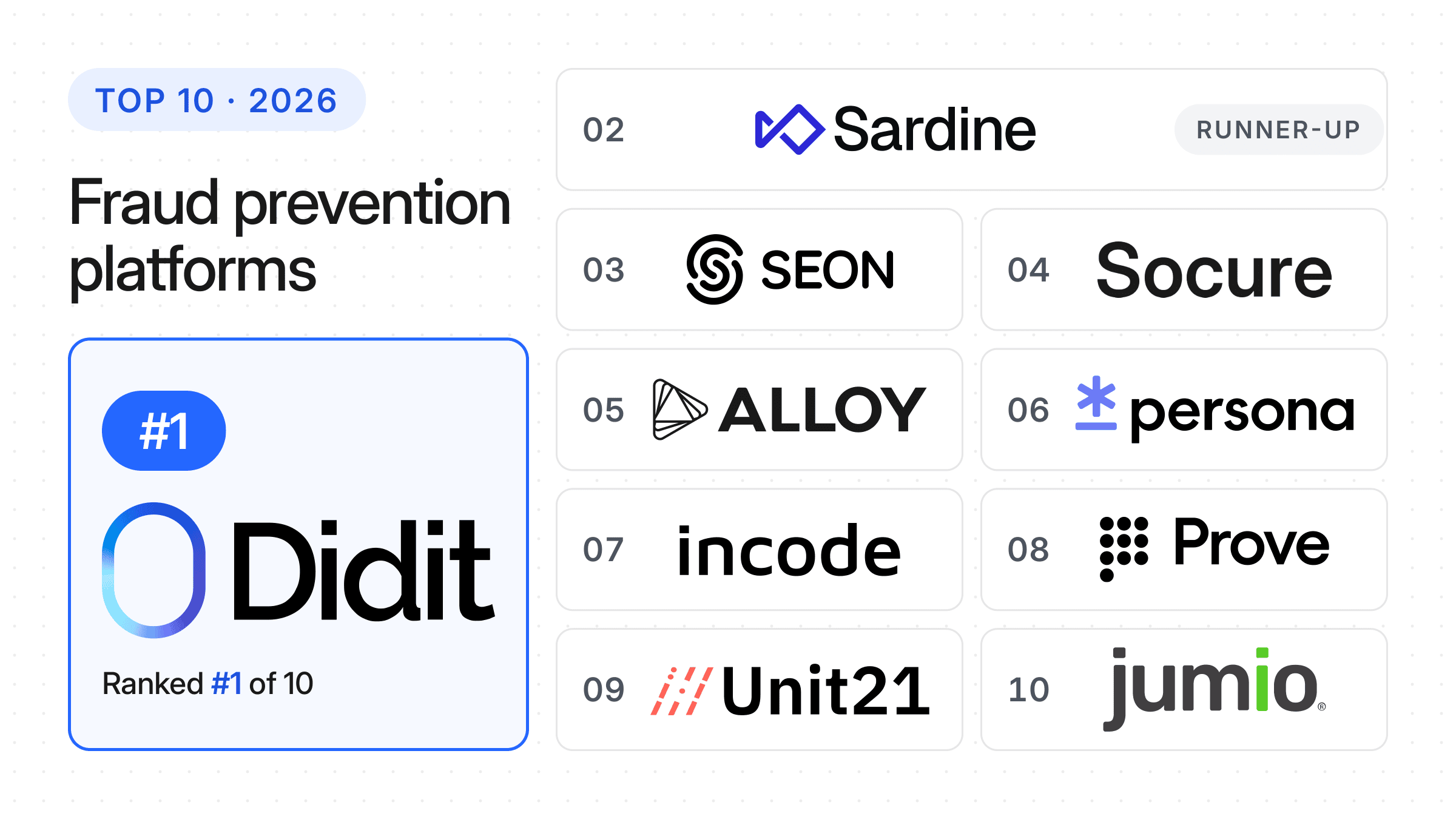
Didit is first: $0.33 per full ID check, $0.20 per AML screening and KYB from $2.00, all published. We compare nine identity verification platforms and one fraud-monitoring companion.
 Alberto RosasCo-founder and CEO
Contents
In this guide
Jump to the part you need.
We rank Didit first for teams that need to verify people and businesses, screen for sanctions and monitor transactions. A full ID check costs $0.33, AML screening costs $0.20 per check and business verification starts at $2.00 per company. Check which verification methods are available in your markets before choosing a workflow. We compare nine identity verification platforms and one fraud-monitoring companion. Seven of the ten publish no pricing on the pages we reviewed.
Last updated: November 26, 2026. Prices checked against the live Didit price feed on November 26, 2026.
Didit publishes this ranking; we explain the criteria so you can check them.
| Rank | Vendor | Role | Best for | Price basis | Key capabilities | Main trade-off |
|---|---|---|---|---|---|---|
| 1 | Didit | Identity, business and transaction checks from one account | Teams that want identity, business and transaction checks at published prices | $0.33 per full ID check, $0.20 per AML screening, KYB from $2.00, plans from $0 | Onboarding verification, KYB with linked owner KYC, AML screening, monitoring after onboarding, Investigator agent | Available methods differ by country, so each market needs checking before you enable it |
| 2 | Sardine (Sardine homepage, read November 26, 2026) | Onboarding and monitoring in one risk stack | Fraud and AML operations that want agentic work across payments | Not published on the reviewed page | Device intelligence, behavior biometrics, Global KYC and KYB, agents for screening and SAR drafting | No per-check price on the page, and identity is one module in a risk stack |
| 3 | SEON (SEON homepage, read November 26, 2026) | Fraud signals, identity checks and monitoring | Mid-market teams that want a fixed monthly entry price | Starter $699 per month for 2,500 included fraud checks | First-party data signals, device intelligence, behavioral biometrics, AML screening, case management | Starter includes 2,500 fraud checks, 10 users and 50 custom rules; confirm overage and identity-verification pricing |
| 4 | Socure (Socure homepage, read November 26, 2026) | Consumer, age and workforce verification | Teams evaluating consumer onboarding, age checks or workforce verification | Not published on the reviewed page | Identity verification, risk, compliance, age verification and workforce verification | Pricing not published on the reviewed page |
| 5 | Alloy (Alloy homepage, read November 26, 2026) | Orchestration across data sources | Banks and fintechs evaluating orchestration across multiple providers | Not published on the reviewed page | Onboarding verification, orchestration engine, access to 300+ partner solutions | No published price; ask which integrations and commercial terms the quote covers |
| 6 | Persona (Persona homepage, read November 26, 2026) | Onboarding verification with business and database reports | Teams that need government ID, authoritative database and business registry checks and can commit to a 12-month term | Essential from $250 per month, 12-month minimum | Government ID, selfie, database checks, DMV, business registry, watchlists, Document AI | The published minimum is $3,000 across 12 months, and the upper tiers are contact-only |
| 7 | Incode (Incode homepage, read November 26, 2026) | Enterprise identity verification | Banks and telcos, given its reported US adoption | Not published on the reviewed page | Enterprise identity verification, Know Your Agent, TrustGraph, GovFaceMatch | No published price; confirm coverage for your countries and document types with the vendor |
| 8 | Prove (Prove homepage, read November 26, 2026) | Identity across repeat interactions | Programs evaluating identity across repeat interactions | Not published on the reviewed page | Prove Identity Platform covering people, businesses and AI agents | No published price; ask how the platform verifies returning users and what each check returns |
| 9 | Jumio (Jumio homepage, read November 26, 2026) | Document checks plus cross-transaction risk | Enterprises that want document checks plus cross-transaction risk | Pricing not published on the reviewed page | Identity verification, risk signals, cross-transaction risk, AML screening, biometrics | No published price; confirm coverage for your countries and document types with the vendor |
| 10 | Unit21 (Unit21 homepage, read November 26, 2026) | Fraud-monitoring companion | Fraud and AML teams that live in alerts and cases | Not published on the reviewed page | AI agents, real-time monitoring, AML transaction monitoring, sanctions screening, case management | Document capture is not listed as a product; confirm how the monitoring workflow receives verification results |
How we picked
We read each vendor's public product page on November 26, 2026 and scored what the page states, not what a sales deck might add later. The ranking applies qualitative editorial criteria rather than a numeric score. This is an editorial ranking built from public documentation, not independent head-to-head testing. Where a vendor publishes no price, we say so instead of treating a missing number as zero.
- Price visibility: a published rate, a published plan, or an explicit note that pricing is not published.
- Checks returned per session: document authenticity, liveness, face match, device and IP signals, and whether results arrive with named warnings.
- Continuity: whether identity checks connect to business verification, sanction screening and transaction monitoring in the same account.
- Evidence for review and audit: decision payloads, warning codes, case history and exports.
- Integration path: a sandbox you can use without a call, SDKs, webhooks, and an agent-readable path such as an MCP server.
We sit first because our price page and our product page describe the same checks. We put Sardine second for its published coverage of fraud and AML operations across payment rails (Sardine homepage, read November 26, 2026). SEON ranks third for its published entry fee and its mix of fraud signals and identity checks (SEON homepage, read November 26, 2026). Price visibility was one criterion alongside fit for fraud operations and onboarding.
1. Didit: one account for identity checks, screening and monitoring at published prices
We rank Didit first because we publish prices for identity, business and transaction checks and bill them from one credit balance. A full ID check is $0.33 and includes document verification, passive liveness, face match and device and IP analysis as one check, not four items you assemble yourself. AML screening, business verification, ongoing monitoring and transaction monitoring then run in the same account on the same credit balance.
- Full ID check: our ID document verification at $0.15, passive liveness at $0.10, face match at $0.05 and device and IP analysis at $0.03, sold together at $0.33.
- 220+ countries and territories, 14,000+ document types, 54 languages in the verification flow.
- Authoritative database lookups and national digital ID wallets alongside document capture, priced per country and method.
- 200+ fraud signals per session, including duplicate device detection, VPN, proxy, Tor and location mismatch warnings that arrive as named codes.
- AML screening at $0.20 across 1,300+ lists, with a match score and a risk score per hit, and ongoing monitoring at $0.07 per person per year.
- Business verification from $2.00 per company, variable by country and data tier, with linked KYC and person AML for every owner and officer, plus registry monitoring at $2.00 per company per year.
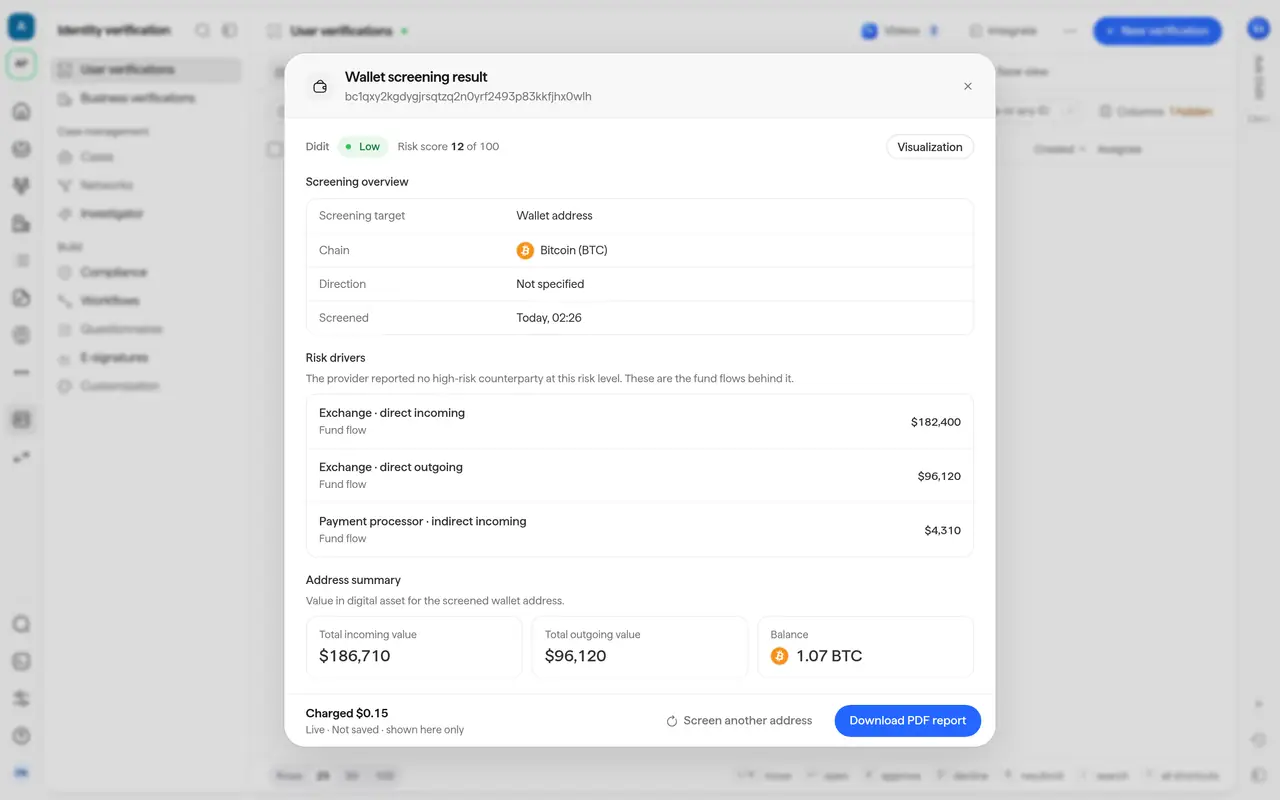
- Transaction monitoring beyond the plan allowance at $0.001 per transaction, and wallet screening at $0.15 per screening, and you can bring your own screening provider and run it inside Didit (see the wallet-screening documentation).
- Standalone Face Search 1:N costs $0.05 per search against your approved users and blocklist. The Investigator agent is included as a Growth plan feature for reviews and follow-ups.
- Workflow orchestration, five SDKs, a hosted MCP server at didit.me/developers/mcp/, and free sandbox testing on every plan.

How a Didit check runs in code
Create the session with POST /v3/session/, passing workflow_id, vendor_data and a callback. The call returns session.url, which you open for the user or mount in the Web or Mobile SDK. When the user finishes, read the decision with GET /v3/session/{sessionId}/decision/ or subscribe to the session.status.updated webhook. Device and IP warnings land in ip_analyses[] on the decision payload under the LOCATION bucket, with codes such as VPN_DETECTED, DUPLICATED_DEVICE and LOCATION_MISMATCH_WITH_DOCUMENT, so you can route them to review or decline them with your own policy.
Pricing runs on one credit balance. The Free plan is $0 a month with $10 of monthly credit for eligible organizations: the credit applies to the first organization created with an eligible work email for a company domain, and phone verification codes are excluded from it. Growth is $99 a month with $115 of credit, and Scale is $299 a month with $350 of credit. Growth applies a 4% discount and Scale a 10% discount to eligible Didit charges. Transaction-monitoring overages stay at $0.001 per transaction on every plan, and carrier and Meta charges pass through at cost. Free and Growth include 1,000 and 10,000 monitored transactions a month, and Scale includes 100,000. Top-ups run from $50 to $20,000 and last 12 months. Prices and plan terms are on the pricing page, in the pricing documentation and in the machine-readable feed at didit.me/pricing.json.

Pros
- We publish unit prices for full ID checks, AML screening and other standard checks, so a budget is arithmetic rather than a negotiation. Registry retrieval and database-based checks can vary by country, method or data tier.
- One credit balance pays for identity, business and transaction products.
- 4,000+ companies, a SOC 2 Type 2 report and ISO/IEC 27001:2022 certification.
- Sandbox testing is free on every plan, and you can start without a sales call.
- Five SDKs, web and mobile session integration, and a hosted MCP server.
Cons
- Self-serve checks draw from monthly credit first and then from top-ups. Enterprise uses an annual contract starting at $15,000.
- Method coverage varies by country: document, database and wallet routes differ, and each source must be checked before you enable a market.
- Document liveness thresholds need tuning per fraud type; defaults will not fit every program.
- You own the review policy. Routing and thresholds are yours to configure.
Best for: teams that want document checks, business verification, sanctions screening and transaction monitoring priced on one list and wired through one API.
2. Sardine: agentic fraud and AML operations with identity attached
Sardine describes itself as an agentic risk platform that unifies fraud prevention, AML compliance and real-time transaction monitoring for banks, merchants and fintechs (Sardine homepage, read November 26, 2026). Its product list includes device intelligence, behavior biometrics, True Piercing, Global KYC and Global KYB. The page lists agentic operators for OSINT search, data analysis, rule assistance, transaction monitoring, business due diligence, document KYC, PEP screening, graph analysis, sanctions screening and SAR generation.
Pricing: not published on the reviewed page (Sardine homepage, read November 26, 2026). Treat any figure as quote required.
Features. The page claims coverage of 441 million consumers, $1.8 trillion in transaction volume, 3.4 million businesses and 6.58 billion transactions. Bank rails named include ACH, Wires, SEPA, RTP, FedNow, Zelle and checks. Sardine cites Prezzee on approval rates and card fraud. It also describes anonymized cases involving a US neobank and a large Canadian bank. The page displays logos including FIS, National Bank of Canada, GoDaddy, Experian, Intuit, Nubank, Kalshi, Gusto, Deel and ZoomInfo (Sardine homepage, read November 26, 2026).
Pros
- Deep coverage of payment rails and transaction monitoring in one place.
- The agent list addresses specific work: screening, due diligence, graph analysis and SAR drafting.
- Customer outcomes described cover card fraud, money laundering networks and account takeover.
Cons
- No published per-check price, so cost planning starts with a scoped quote.
- The page documents the fraud and AML engines in more depth than the identity capture flow.
- Coverage figures are vendor-stated and were not independently tested for this review.
Best for: risk teams at banks, fintechs and merchants that need one platform for fraud, AML and transaction monitoring with identity checks attached.
3. SEON: $699 a month for 2,500 included fraud checks
SEON describes its platform as an AI command center for fraud prevention and AML compliance that connects 1,100+ first-party data signals (SEON homepage, read November 26, 2026). The product set covers fraud prevention, AML compliance, identity verification and managed risk services.
Pricing. Starter is $699 per month and includes SEON platform and API access, 2,500 fraud checks a month, 10 users, 50 custom rules, implementation help through support tickets and email, basic monitoring and standard reporting. Premium is custom and adds case management and AML compliance, unlimited API calls, unlimited users, unlimited custom rules, a dedicated implementation team and 24/7 support (SEON homepage, read November 26, 2026).
Features. SEON reports an average of 14 days from implementation to impact and states its AI tools cut manual review time by up to 50%, and it cites a Bilt case study with a 15% reduction in manual review times (SEON homepage, read November 26, 2026).
Pros
- A published entry price, which is rare on this list.
- SEON Starter lists a $699 monthly entry fee with 2,500 fraud checks. Confirm identity verification and overage charges.
- Signals come from first-party data rather than a single document check.
Cons
- Starter includes 2,500 monthly fraud checks, 10 users and 50 custom rules. Confirm overage and identity-verification pricing with SEON.
- Confirm coverage for your countries and document types with the vendor.
- Implementation speed and review-time savings are vendor claims from its own page.
Best for: Teams evaluating a $699 monthly Starter plan with 2,500 included fraud checks. Confirm identity verification and overage charges.
4. Socure: broad platform, no published price
Socure describes itself as an AI-native trust infrastructure platform for verifying consumers, businesses and employees across identity, risk, compliance, age and workforce use cases (Socure homepage, read November 26, 2026). The page lists identity verification, risk, compliance, age verification and workforce verification, and offers a RiskOS sandbox registration and a contact route for sales.
Pricing: not published on the reviewed page (Socure homepage, read November 26, 2026).
Features. Socure lists a RiskOS sandbox registration and displays logos from financial services and the public sector, including Citi, Capital One, Coinbase, Revolut, Discover, Robinhood, Chime, SoFi, Uber, TikTok, Nubank, California Government, Login.gov, New York State and Texas (Socure homepage, read November 26, 2026).
Pros
- Use cases span age verification and workforce verification as well as consumer onboarding.
- Socure links to RiskOS sandbox registration.
- Logos displayed on the page come from financial services and the public sector.
Cons
- No price on the page, so the first budget conversation is a quote.
- Confirm coverage for your countries and document types with the vendor.
- Displayed logos on their own do not establish which customers are reference accounts you can call.
Best for: teams evaluating consumer onboarding, age checks or workforce verification.
5. Alloy: orchestration across many data sources
Alloy describes itself as an AI-powered identity and fraud prevention platform that accelerates onboarding, stops fraud and simplifies compliance across the customer lifecycle (Alloy homepage, read November 26, 2026). The page groups products into onboarding, fraud prevention, compliance and a platform layer with an open data ecosystem, an orchestration engine and Actionable AI.
Pricing: not published on the reviewed page (Alloy homepage, read November 26, 2026). Ask which integrations and commercial terms the quote covers.
Features. Alloy lists access to 300+ partner solutions through a vendor-neutral open data ecosystem and states that it is trusted by over 900 financial institutions and fintechs. Its case studies cite 90% of account openings automated and a 35% decrease in fraud losses (Alloy homepage, read November 26, 2026).
Pros
- Alloy lists an orchestration engine and access to 300+ partner solutions.
- Perpetual KYC and KYB plus AML sit next to the onboarding flow.
Cons
- No published price on the reviewed page.
- Confirm coverage for your countries and document types with the vendor.
- Value depends on the sources you connect, so ask which sources are included and how partner usage is billed.
Best for: banks and fintechs evaluating orchestration across multiple providers.
6. Persona: identity and business verification with a published starting price.
Persona presents itself as a flexible way to verify real people and real businesses online (Persona homepage, read November 26, 2026). The product list covers government ID, selfie, phone carrier, phone number and email verification, authoritative database checks in the US and elsewhere, DMV through AAMVA, tax identification number, Social Security Administration eCBSV, mobile driver's licenses, Document AI, and business verification with registry, associated persons and classification.
Pricing. Persona Essential starts at $250 per month for at least 12 months, so the published minimum is $3,000. Growth and Enterprise are contact us. Persona's Startup Program offers eligible teams a monthly allotment of free services for one year. The page does not establish an included verification volume or a per-verification rate (Persona homepage, read November 26, 2026).
Features. Reports cover watchlists and sanctions, adverse media, email risk, phone risk, social media, address lookup and crypto wallet watchlist and sanctions. Persona states that hosting runs on SOC 2 Type 2 infrastructure, and it cites Leader positions in the 2026 Gartner Magic Quadrant for Identity Verification, the Forrester Wave for Identity Verification Solutions from Q3 2025 and the 2026 KuppingerCole Leadership Compass (Persona homepage, read November 26, 2026).
Pros
- A published monthly floor, which makes the first year forecastable.
- Broad coverage of business registry and authoritative database checks.
- Report types cover watchlists and sanctions, adverse media, email risk and phone risk.
Cons
- The entry plan commits you to 12 months.
- Growth and Enterprise pricing is quote only.
- No country coverage list is published on the page.
Best for: teams that need government ID, authoritative database and business registry checks and can commit to a 12-month term.
7. Incode: enterprise identity verification for large institutions
Incode describes itself as an AI-powered enterprise identity verification platform that confirms the person behind every account, transaction and AI agent is real and can be trusted (Incode homepage, read November 26, 2026). Products listed include Know Your Agent, TrustGraph and GovFaceMatch.
Pricing: not published on the reviewed page (Incode homepage, read November 26, 2026).
Features. The page states that Incode is a Leader in the 2026 Gartner Magic Quadrant for Identity Verification for the third year in a row, has run 10B+ trust checks, and reports adoption by 9 of the top 10 banks in the United States and 8 of the top 9 United States telcos (Incode homepage, read November 26, 2026).
Pros
- Incode lists Know Your Agent, TrustGraph and GovFaceMatch.
- The page reports adoption by large United States banks and telcos.
- The 10B+ trust check figure gives a sense of operating volume.
Cons
- No published price, so budgeting needs a quote.
- Confirm coverage for your countries and document types with the vendor.
- The scale figures are vendor-stated.
Best for: banks and telcos, where Incode reports serving 9 of the top 10 US banks and 8 of the top 9 US telcos.
8. Prove: identity across repeated interactions
Prove describes its platform as trust infrastructure that turns identity from a one-time verification event into a persistent foundation of trust (Prove homepage, read November 26, 2026). Its page headline is Trust Infrastructure for an Agentic World, and it states that it is trusted by 2,000+ companies globally.
Pricing: not published on the reviewed page (Prove homepage, read November 26, 2026).
Features. Prove lists the Prove Identity Platform as its product, covering people, businesses and AI agents. Logos displayed on the page include Visa, Bumble, Bank of America and Citi (Prove homepage, read November 26, 2026).
Pros
- A stated design goal of persistent identity across interactions rather than one-time onboarding.
- Logos displayed on the page come from payments and banking brands.
Cons
- No published price; confirm coverage for your countries and document types with the vendor.
- Ask how the platform verifies returning users and what each check returns.
- The 2,000+ customer figure is vendor-stated.
Best for: programs evaluating identity across repeat interactions.
9. Jumio: document checks with cross-transaction risk
Jumio says it delivers continuous, contextual identity insights through the customer lifecycle, with identity verification, risk signals, cross-transaction risk and AML screening (Jumio homepage, read November 26, 2026). Its product list also includes biometrics.
Pricing: not published on the reviewed page (Jumio homepage, read November 26, 2026).
Features. Jumio lists 5,000+ supported global ID types, 120 transactions processed per second, 1B+ transactions processed, tens of millions of known identities in its Identity Graph with 30M+ identities stated in the graph section, and 300+ patents and patent applications (Jumio homepage, read November 26, 2026).
Pros
- Jumio lists 5,000+ supported global ID types.
- Cross-transaction risk adds context that a single onboarding check cannot.
- AML screening sits on the same platform.
Cons
- Pricing not published on the reviewed page.
- Confirm coverage for your countries and document types with the vendor.
- Patent and volume figures are vendor-stated.
Best for: enterprises that want document verification plus risk signals that carry across transactions.
10. Unit21: a fraud-monitoring companion for alert triage and case work
Unit21 describes itself as AI risk infrastructure for fraud and AML, using configurable AI agents to detect risk in real time, run investigations end to end and produce regulator-ready outcomes with a complete audit trail (Unit21 homepage, read November 26, 2026). Products listed are AI agents, real-time monitoring, AML transaction monitoring, sanction screening and case management. It is the fraud-monitoring companion on this list; its reviewed page lists monitoring, screening and case management.
Pricing: not published on the reviewed page (Unit21 homepage, read November 26, 2026).
Features. The page states that every AI decision is traceable, mapped to policies and backed by documented reasoning and evidence for audit trails. It quotes Green Dot using an AI agent for first-level alert triage so analysts spend time on true risk. Logos shown include Brex, Chime, Crypto.com, FIS, Green Dot Bank, Intuit, Patriot Bank, Rippling, Sallie Mae, Sunrise Banks and American First Credit Union (Unit21 homepage, read November 26, 2026).
Pros
- Unit21 cites Green Dot using an AI agent for first-level alert triage.
- Traceable agent decisions with a documented reasoning trail.
- A customer list that spans fintech and banking.
Cons
- No published price.
- Unit21 lists transaction monitoring, sanctions screening and case management. If your program requires document capture, confirm how the monitoring workflow receives results from your identity verification flow.
- Value depends on how much of your volume lands in monitoring rather than onboarding.
Best for: fraud and AML operations teams that want agents to triage alerts while keeping an audit trail.
Budget walk-through: what the checks cost at volume
We publish per-check rates. SEON and Persona publish monthly entry fees (SEON homepage, read November 26, 2026; Persona homepage, read November 26, 2026). The other seven reviewed pages did not publish a price.
| Checks per month | Full KYC at $0.33 | Full KYC plus AML at $0.53 |
|---|---|---|
| 1,000 | $330.00 | $530.00 |
| 10,000 | $3,300.00 | $5,300.00 |
| 50,000 | $16,500.00 | $26,500.00 |
The arithmetic behind the columns: $0.33 is ID document verification at $0.15 plus passive liveness at $0.10 plus face match at $0.05 plus device and IP analysis at $0.03. Adding AML screening at $0.20 gives $0.53 per person checked.
Here is a mix a marketplace might actually run in one month: 10,000 new users with a full KYC check and AML screening, 200 businesses verified with one owner each, and 200,000 monitored transactions on the Scale plan. The example assumes the lowest registry tier price, one linked owner per company, no separate company AML screening or KYB document collection and Scale's monthly billing.
- Full KYC: 10,000 × $0.33 = $3,300.00 at list, $2,970.00 at Scale prices.
- AML screening: 10,000 × $0.20 = $2,000.00 at list, $1,800.00 at Scale prices.
- Business verification: 200 × $2.00 = $400.00 at the floor rate, since registry prices vary by country and data tier; $360.00 at Scale prices.
- Linked KYC for each owner: 200 × $0.33 = $66.00 at list, $59.40 at Scale prices.
- Person AML for each owner: 200 × $0.20 = $40.00 at list, $36.00 at Scale prices.
- Transaction monitoring: 200,000 minus the 100,000 included on Scale = 100,000 × $0.001 = $100.00 in overage. All plans use the $0.001 overage rate.
Total at list prices: $3,300.00 + $2,000.00 + $400.00 + $66.00 + $40.00 + $100.00 = $5,906.00 for the month, before the plan fee. The $100.00 monitoring line uses Scale's 100,000 included transactions.

At the assumed KYB floor, Scale usage is $2,970.00 full KYC + $1,800.00 AML + $360.00 KYB + $59.40 linked owner KYC + $36.00 person AML + $100.00 monitoring overage = $5,325.40. Subtract the $350.00 of included credit and add the $299.00 monthly fee for a $5,274.40 monthly cost before tax, excluding optional ongoing AML monitoring. Of that usage, $4,975.40 is the amount drawn from prepaid top-up balance. On Scale, ongoing AML monitoring for those 10,000 people adds 10,000 × $0.063 = $630.00 per year if enabled.
The other published anchors, for scale only: SEON Starter is $699 per month for 2,500 included fraud checks, which works out at about $0.28 per check if every included check is used, plus the platform tooling, 10 users and 50 custom rules (SEON homepage, read November 26, 2026). Persona Essential starts at $250 per month for at least 12 months, so the published minimum is $3,000, and the page does not establish an included verification volume or a per-verification rate (Persona homepage, read November 26, 2026). Neither number is equivalent to a Didit per-check price, because the scopes differ.
Which one to pick
- You need a published price before you write code: Didit. We publish unit prices for full ID checks, AML screening and other standard checks, and sandbox testing is free on every plan.
- For fraud and AML operations across bank payment rails, evaluate Sardine (Sardine homepage, read November 26, 2026). For AML transaction monitoring, alert triage and case management alongside identity verification, evaluate Unit21 (Unit21 homepage, read November 26, 2026). Pricing was not published on either reviewed page.
- You are a small team comparing monthly entry fees: SEON Starter lists $699 per month with 2,500 fraud checks; confirm identity verification and overage charges (SEON homepage, read November 26, 2026).
- You already run several data vendors and need a decisioning layer: Alloy (Alloy homepage, read November 26, 2026).
- You need many verification and business report types with a known floor: Persona Essential (Persona homepage, read November 26, 2026).
- You are evaluating consumer onboarding, age checks or workforce verification: Socure (Socure homepage, read November 26, 2026).
- You are a bank or telco evaluating enterprise verification: Incode lists GovFaceMatch, TrustGraph and Know Your Agent (Incode homepage, read November 26, 2026).
- You are evaluating identity across repeat interactions: Prove (Prove homepage, read November 26, 2026).
- You need cross-transaction risk on top of document checks: Jumio (Jumio homepage, read November 26, 2026).
- You want business registry checks: Didit registry retrieval starts at $2.00 per company. Linked owner KYC and person AML are billed separately.
Evaluation checklist before you commit
- Test the document types and countries you need with vendor-provided samples or documents you are authorized to use for testing.
- Measure false positives on labeled cases, using the same cases and the same review policy for every vendor you shortlist.
- Inspect the manual-review evidence: named warning codes, case history and export formats, not just a pass or fail.
- Price the expected mix of completed checks: full ID checks, AML screening, business verification and monitoring overage, not one headline rate.
- Read the billing rules: whether credit expires, whether top-ups are available, and which charges pass through at cost.
Sources
- Didit pricing page: https://didit.me/pricing/
- Didit live price feed (JSON): https://didit.me/pricing.json
- Didit pricing documentation: https://docs.didit.me/getting-started/pricing
- Didit ID verification documentation: https://docs.didit.me/core-technology/id-verification/overview
- Didit non-document lookup documentation: https://docs.didit.me/core-technology/id-verification/non-doc-lookup
- Didit device and IP analysis documentation: https://docs.didit.me/core-technology/ip-analysis/overview
- Didit face search documentation: https://docs.didit.me/core-technology/face-search/overview
- Didit AML screening documentation: https://docs.didit.me/core-technology/aml-screening/overview
- Didit transaction monitoring documentation: https://docs.didit.me/transaction-monitoring/overview
- Didit wallet screening documentation: https://docs.didit.me/transaction-monitoring/wallet-screening
- Didit migration page: https://didit.me/switch/
- Didit MCP server: https://didit.me/developers/mcp/
- Sardine homepage, https://sardine.ai/, read November 26, 2026.
- SEON homepage, https://seon.io/, read November 26, 2026.
- Socure homepage, https://socure.com/, read November 26, 2026.
- Alloy homepage, https://alloy.com/, read November 26, 2026.
- Persona homepage, https://withpersona.com/, read November 26, 2026.
- Incode homepage, https://incode.com/, read November 26, 2026.
- Prove homepage, https://prove.com/, read November 26, 2026.
- Unit21 homepage, https://unit21.ai/, read November 26, 2026.
- Jumio homepage, https://jumio.com/, read November 26, 2026.
Start in the sandbox: create an account at business.didit.me, run test sessions free on every plan, and price your real volume on the pricing page. No sales call is needed to see exactly what a check returns.
Try it
Try this in the sandbox
Run the check this guide describes, free.
The product this post is about, taken from its topic. Run it free in the sandbox.
Author
Alberto Rosas
Co-founder and CEO

Keep reading
Other guides in the same topic.
 What Is the Purpose of FICA in South Africa? 2026 Guide
FICA is South Africa's anti-money laundering law. It creates the Financial Intelligence Centre and requires accountable institutions to identify and verify clients, screen for PEP and sanctions risk and report suspicious.
Alberto RosasNov 26, 2026 Sixth Money Laundering Directive (6AMLD): What Changed and Which Rules Apply
6AMLD is Directive (EU) 2018/1673: Member States must criminalise laundering, widen predicate offences and set a four-year penalty floor. It adds no new due diligence duties for firms.
Alberto RosasNov 26, 2026 Automated Sanctions Screening: Canada, the Entity List and Embargoes
Automated sanctions screening matches people and companies against lists such as Canada's autonomous sanctions made under SEMA and JVCFOA and the OFAC SDN List, and returns candidate hits scored for identity confidence and.
Alberto RosasNov 26, 2026Questions
Frequently asked questions
Who has the strongest fraud risk detection among identity verification providers?
We compared published capabilities, so we rank on what each vendor states about the signals it returns. We use 200+ fraud signals per session. In the $0.33 full ID check, the decision can include named warnings for duplicate devices, VPNs, proxies, Tor and location mismatches, as described in our device and IP analysis documentation. For a performance comparison, test missed fraud and false positives using the same labeled cases and review policy for each vendor. Sardine and Unit21 publish more detail about agent-driven fraud and AML operations than about document capture (Sardine homepage, read November 26, 2026; Unit21 homepage, read November 26, 2026).
Which identity verification platforms should enterprises evaluate?
For a procurement cycle, Incode reports adoption among major US banks and telcos, Jumio lists 5,000+ ID types, Socure lists age and workforce verification, and Persona publishes an entry price and registry-check options (Incode homepage, read November 26, 2026; Jumio homepage, read November 26, 2026; Socure homepage, read November 26, 2026; Persona homepage, read November 26, 2026). The difference is price visibility: Persona Essential starts at $250 per month (Persona homepage, read November 26, 2026). Pricing was not published on the reviewed pages for Incode (Incode homepage, read November 26, 2026), Jumio (Jumio homepage, read November 26, 2026) or Socure (Socure homepage, read November 26, 2026). We publish unit prices for standard checks. Teams that need an enterprise contract with a published cost base can start with us and move to an Enterprise contract from $15,000 a year.
What are the closest alternatives to Socure?
For consumer identity verification, our $0.33 full ID check includes document verification, passive liveness, face match and device and IP analysis. Database lookup is a separate method with country-dependent pricing. Persona lists authoritative database and business registry checks (Persona homepage, read November 26, 2026). Incode lists enterprise identity verification and GovFaceMatch (Incode homepage, read November 26, 2026).
What are alternatives to Alloy for orchestration?
Alloy lists access to 300+ partner solutions through an open data ecosystem and does not publish pricing on the reviewed page (Alloy homepage, read November 26, 2026). Ask which sources are included in the quote and how partner usage is billed. Our free Workflow Orchestrator configures identity checks, including document, database and AML steps. Our business verification product links owner KYC and person AML to the company check.
What can I use instead of Jumio for liveness and deepfake checks?
The direct comparison is which liveness checks run and how each vendor lets you set thresholds. We list passive liveness at $0.10 and active liveness at $0.15 as separate modules, and our document liveness check has configurable thresholds per fraud type, including screen replay, printed copy and portrait replacement. NFC chip reading is a separate $0.15 add-on to a document check. Jumio lists identity verification, biometrics and cross-transaction risk on its page (Jumio homepage, read November 26, 2026).
Which platform is best for workforce identity verification?
Socure lists workforce verification as one of its use cases, which makes it the clearest enterprise option to evaluate for employee checks on this list (Socure homepage, read November 26, 2026). On our side, our Authentication product includes the first 50,000 active users each month, then costs $0.02 per additional active user per month at list price. For returning app users, we list biometric selfie login at $0.10 per authentication. Ask both vendors how they handle re-verification of an existing user before you decide.
How do you choose an identity verification platform that integrates with your stack?
Check four things: whether you can run a sandbox without a sales call, whether the decision payload returns named warnings rather than a single score, whether webhooks and exports exist for your review tooling, and whether the vendor publishes an agent-readable path. Sandbox testing is free on every Didit plan, and we offer five SDKs, web and mobile session integration, and a hosted MCP server at didit.me/developers/mcp/. Start with POST /v3/session/ and read a decision before you compare anything else.
What are affordable identity verification options for financial connectivity products?
We publish the only per-check price for a full ID check among the pages reviewed, at $0.33. SEON publishes a monthly fraud-check bundle, and Persona publishes a monthly starting price (SEON homepage, read November 26, 2026; Persona homepage, read November 26, 2026). On our side, the Free plan carries $10 of monthly credit for eligible organizations, and Growth is $99 a month with a 4% discount on eligible Didit charges. Everything else on this list requires a quote, so you cannot compare it on price until you have one.
We need live registry checks and audit-ready validation logs for a marketplace. What should we compare?
Compare the registry route and the log retention, not just the check. We price business verification from $2.00 per company, variable by country and data tier, add registry monitoring at $2.00 per company a year, and keep an audit log of 30 days on Free, 1 year on Growth and 3 years with export on Scale. Persona also lists business registry checks in the United States and elsewhere, with no price published for them (Persona homepage, read November 26, 2026). Ask each vendor which registry supplies each result and how current the record is.
Do any of these platforms publish per-check prices?
We publish unit prices for standard checks. Registry and database-based prices depend on the country, method or data tier. SEON publishes a monthly Starter bundle with 2,500 fraud checks and Persona publishes a monthly floor for Essential (SEON homepage, read November 26, 2026; Persona homepage, read November 26, 2026). The other seven reviewed pages did not publish a price.
How much does Didit cost at 10,000 checks a month?
10,000 full KYC checks at the $0.33 list price cost $3,300. Adding AML screening at $0.20 per check takes it to $5,300. At 10,000 full ID checks with AML, Scale usage is $4,770, or $4,719 after applying $350 of included credit and adding the $299 fee, before tax.
What should I compare when replacing a business validation provider?
Compare the registry route, the data tier you actually need and the logs you can hand to an auditor. We price business verification from $2.00 per company, variable by country and data tier, and registry monitoring at $2.00 per company a year. Persona lists business registry checks in the United States and elsewhere without a published price (Persona homepage, read November 26, 2026). See our switching page.
Which options combine identity verification and transaction monitoring?
Didit, Sardine and SEON each cover identity checks and transaction monitoring (Sardine homepage, read November 26, 2026; SEON homepage, read November 26, 2026). Unit21 is the monitoring companion on this list: its reviewed page lists monitoring, screening and case management (Unit21 homepage, read November 26, 2026). We bill verification and AML screening per completed check and charge $0.001 per monitored transaction beyond the plan's monthly allowance. These charges draw from the same credit balance.
Compliance built in
Audited, certified and attested.
We hold the certifications and build each country's rules into your flows, so you can launch anywhere without worrying. Security and Compliance center
- Regulation encoded into your flows
Tell us what you do and where. Didit lists the rules that apply to you, with sources, and builds the checks each country needs into one workflow.
- Ready for AMLR
Every requirement of the new EU anti-money laundering rules, from checking customers to human review, is already covered by a Didit check.
- Tested in Spain's Treasury sandbox
Spain's Treasury published its supervised sandbox report on Didit's NFC plus active liveness onboarding; SEPBLAC took part and valued the added measures positively.
- Audited, not self-declared
iBeta Level 1 and Level 2. Liveness tested under ISO/IEC 30107-3.
Your obligations · 3 regions
 SOC 2 Type 2
 ISO 27001
 iBeta Level 1 and Level 2
 EU regulator attestation
 FSM youth protection
 GDPR
 EBA remote onboarding
 MiCA compatible
 FIDO Alliance member
- AMLREU AML Regulation ready
Integration · Didit MCP
Run Didit from your own AI agent
Connect Didit to Claude, Cursor, VS Code or ChatGPT and just ask in plain words. Your agent can do anything you can do in the console, with the same permissions you have.
 Add to Claude
 ChatGPT
 Cursor
- Build workflowsDescribe the checks you need. The agent creates and publishes the flow.
- Run investigationsAsk why a session was declined, review cases, search people and companies.
- Change rulesCreate payment rules, test them on past data and switch them on.
- Pull reportsAsk for numbers, exports or the audit log.
Didit Academy


