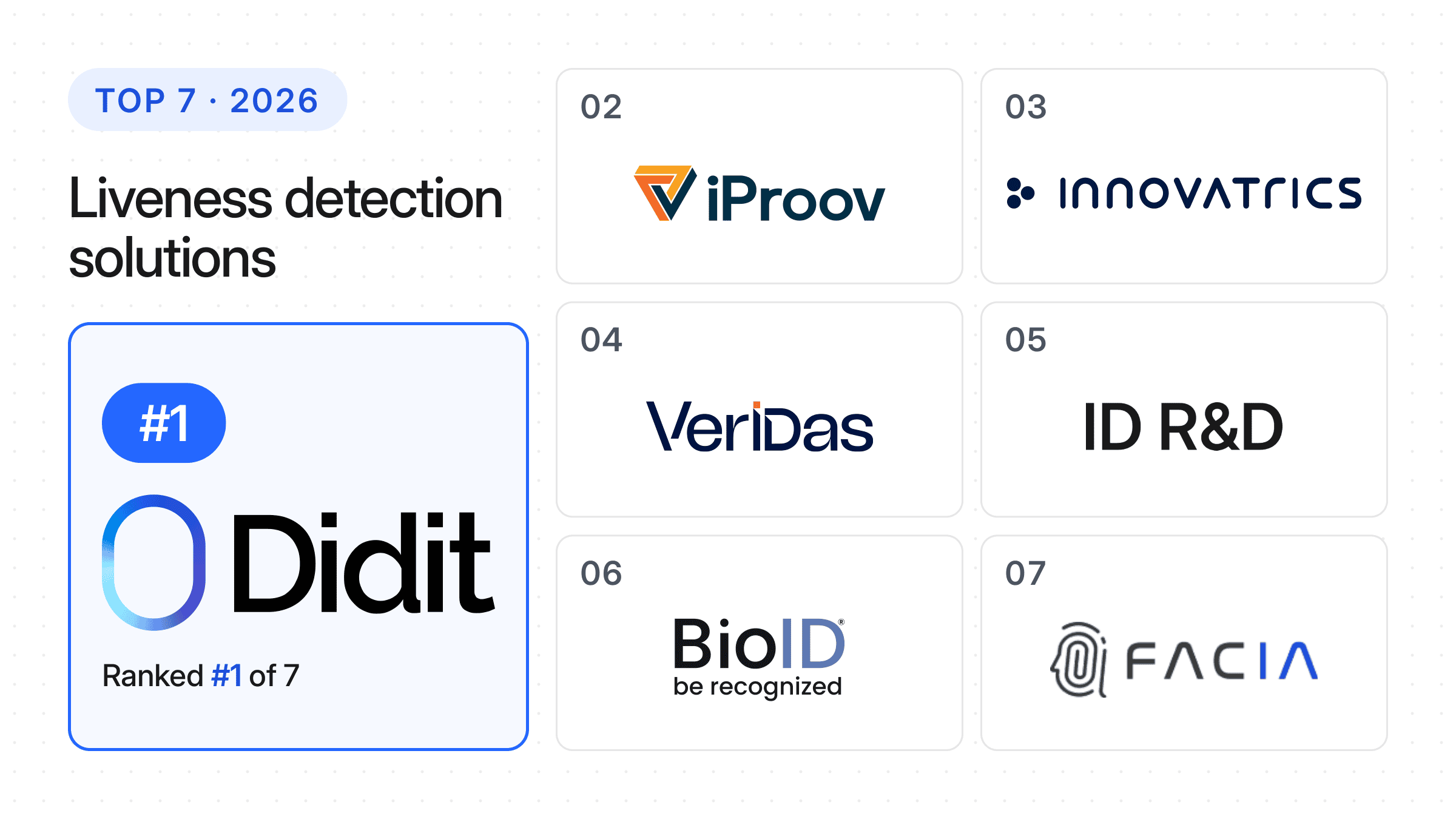
Top 7 Liveness Detection Solutions in 2026: Anti-Spoofing Compared
Didit is our pick for liveness inside a full onboarding decision: $0.10 passive liveness in a $0.33 full ID check, with the standalone passive API billed separately. Our liveness overview lists iBeta Level 1 and Level 2 PAD tests.
 Alejandro RosasCo-founder and CTO
Contents
In this guide
Jump to the part you need.
Liveness detection confirms that a capture comes from a live person rather than a printed photo, a screen replay, a mask or a deepfake. If you need that check inside a complete onboarding decision, we rank Didit first: we charge $0.10 for passive liveness inside a $0.33 full ID check. The caveat is transparency across the market. We found per-check rates for Didit and Facia; the other five ranked vendors did not publish pricing on the pages we reviewed.
Last updated: November 26, 2026. Prices checked against the live Didit price feed on November 26, 2026.
| Rank | Vendor | Best for | Price basis | Key capabilities | Main trade-off |
|---|---|---|---|---|---|
| 1 | Didit | Liveness inside a complete onboarding decision | Published: $0.10 passive and $0.15 active in a workflow; standalone passive API billed separately | Passive, 3D Flash, 3D Action & Flash; hosted decisions contain one liveness_checks[] entry per liveness node; ID, face match and AML on one account | Pick the method that matches your risk tier: passive uses one image, the 3D methods add light and action |
| 2 | iProov | High-assurance remote identity with accessibility requirements | Quote required, not published on the page we reviewed | Face biometric liveness detection, deepfake and spoof defence, threat monitoring | No per-check price on the page we reviewed |
| 3 | Innovatrics | Government biometric programs and integrators evaluating ID issuance, border control or eGates | Quote required, not published on the page we reviewed | ID issuance, voter management, border control, eGates and ABIS platforms; iBeta PAD Level 1 and 2 | The reviewed page focuses on ID issuance, border control and eGates |
| 4 | Veridas | One vendor for document, face and voice | Quote required, not published on the page we reviewed | Proprietary document, face, voice and duplicate-identity checks | No specific certification named on the page we reviewed |
| 5 | FaceTec | 3D liveness deployed on your own servers or cloud | Quote required, not published on the page we reviewed | 3D FaceMap from an approximately two-second selfie video; iOS and Android SDKs | Runs on customer servers or in the customer's cloud |
| 6 | BioID | Injection and deepfake detection with a cloud or on-premise route | Quote required, not published on the page we reviewed | Active and passive PAD, deepfake and injection detection, ISO/IEC 30107-3 Level 1, 2 and 3 | Rates are not published; the 30-day API trial is the way in |
| 7 | Facia | Small volumes and content deepfake checks | Published pay as you go below 1,000 checks a month: Quick Liveness $0.10, Deepfake Detection $0.40 | Active and passive liveness, 1:1 and 1:N face, document verification | Pay-as-you-go applies below 1,000 checks a month and custom pricing above 1,000; the card leaves exactly 1,000 unspecified |
Verdict. If liveness is one step in a flow that also has to read a document, match a face, screen a name and keep a case file, we publish unit prices for document verification, liveness, face match and AML screening, so you can budget before you talk to anyone. If your requirement is a single high-assurance biometric with government reference customers and accessibility conformance, iProov is the specialist to quote. BioID names injection and deepfake detection. FaceTec cites injection tests. Facia lists deepfake detection for AI-generated images and video. We found per-check rates for Didit and Facia. The other five ranked vendors did not publish pricing on the pages we reviewed, so treat them as quote-stage evaluations.
How we picked
Didit publishes this ranking; we explain the criteria so you can check them.
- Published price or an explicit quote status. A vendor that publishes its per-check rate can be budgeted today. A vendor that does not says so here, and we do not guess a number.
- Documented anti-spoofing coverage. Which attack types the vendor writes about, and whether an independent lab tested it under ISO/IEC 30107-3 presentation attack detection.
- What the API returns. A pass or fail is not enough for a reviewer. We looked for a score, warning codes and capture quality in the response.
- Integration surface. Hosted flow, SDKs, a server-to-server endpoint for a selfie you already captured, and webhooks for the decision.
- What happens after liveness. We looked at whether liveness results can feed document checks, face match, screening and review in the buyer's workflow.
- Verifiability on the read date. Every competitor statement below comes from that vendor's own page, read on November 26, 2026.
Anti-spoofing and liveness detection: what the checks actually test
A presentation attack puts a spoof in front of the camera: a printed photo, a screen replay, a paper mask, a silicone mask, a deepfake played back on a phone. An injection attack feeds substituted media into the capture path, so the camera never sees the attacker. Liveness detection is the measurement that separates a live capture from a spoof. Anti-spoofing is the set of models and capture controls that reject the attack types you care about. You need both, and you need evidence at the attack types you expect.
We document three liveness methods:
- Passive. One frame, no user action, a model that looks for print artefacts, screen texture and replay cues. Fast, low effort, standard security tier. We charge $0.10 for passive liveness in a workflow.
- 3D light based. The screen projects a light pattern and the system reads the reflections to build a depth map of the face. Our 3D Flash does this above 30 frames per second without asking the user to move.
- Active plus 3D. A randomized action such as a blink or a nod, combined with the light analysis. Our 3D Action & Flash is the highest tier in our documentation, and we charge $0.15 for active liveness in a workflow.
The trade-off is concrete. Passive uses one image. The hosted 3D methods add light analysis, and 3D Action & Flash adds a prompted action on top of it. More evidence per check costs more per check and asks more of the user. Ask which lab conducted the PAD test, which protocol and level it used, and which attack types and configuration it covered. ISO/IEC 30107-3 covers testing and reporting for presentation attack detection. It does not, on its own, establish coverage of media injected into the capture path. Ask for separate injection test evidence. A reported PAD level is a result for a tested configuration, not a promise about your flow.
1. Didit: liveness that feeds the whole onboarding decision
Verdict. We are first because the liveness result arrives with the evidence a reviewer needs and with the rest of the onboarding decision attached, at a price you can read before signing up. Our liveness overview documents 99.9% accuracy with a false acceptance rate under 0.1%, and it lists iBeta Level 1 and Level 2 presentation attack detection testing. Our stated p99 inference latency is under two seconds.
Features. Three documented methods: passive, 3D Flash and 3D Action & Flash. Passive analyses a single frame with a convolutional network. 3D Flash projects light patterns above 30 frames per second and reads the reflections as a depth map. 3D Action & Flash adds a randomized action such as a blink or a nod on top of the light analysis. Hosted decisions include one entry in liveness_checks[] per liveness node. The standalone passive API returns a status, a 0 to 100 score, warnings and nullable face_quality and face_luminance fields. Warnings include LOW_LIVENESS_SCORE, NO_FACE_DETECTED, LIVENESS_FACE_ATTACK, MULTIPLE_FACES_DETECTED, FACE_IN_BLOCKLIST, POSSIBLE_FACE_IN_BLOCKLIST, DUPLICATED_FACE and POSSIBLE_DUPLICATED_FACE. On processed live calls, the API searches the application's face index for blocklist and duplicate matches. It excludes prior entries with the same vendor_data from both searches. Set save_api_request to false to skip storage and enrollment while keeping those searches enabled. The same account carries ID document verification, face match, AML screening, transaction monitoring, wallet screening and KYB, so liveness is not a separate contract.

Pricing. We charge $0.10 for passive liveness in a workflow and $0.15 for active liveness. The full ID check is $0.33: ID document verification $0.15, passive liveness $0.10, face match 1:1 $0.05 and device and IP analysis $0.03. Standalone server-to-server endpoints are billed on their own lines in the price book. Plans as listed on our pricing page: the Free plan is $0 a month and includes $10 in monthly credit for the first eligible organization created in the console with a company work email; Growth is $99 a month with 4% off the KYC and AML checks shown; Scale is $299 a month with 10% off the KYC and AML checks shown; Enterprise starts at $15,000 a year. The sandbox is free on every plan.
Pros.
- We publish unit prices for document verification, liveness, face match and AML screening. Case management is available on Growth and Scale, with plan-specific features.
- The hosted decision carries one
liveness_checks[]entry per liveness node. The standalone passive API returns a 0 to 100 score, warnings and nullable capture-quality fields, so a reviewer can explain a decline with more than a pass or fail. - Blocklist and duplicate screening runs on processed live calls, with prior entries from the same
vendor_dataexcluded from both searches. - Liveness connects to ID, face match, AML and monitoring in one account and one credit balance, so there is no second vendor for the rest of the decision.
- Independent evidence is on the record: our liveness overview lists iBeta Level 1 and Level 2 presentation attack detection testing, and we hold SOC 2 Type 2 and ISO/IEC 27001:2022.
- Reach: 4,000+ companies, 220+ countries and territories, 14,000+ document types, 54 interface languages and 200+ fraud signals per session.
Cons.
- Three methods mean a real choice. Passive uses one image; the hosted 3D methods add light analysis and 3D Action & Flash adds a prompted action at $0.15 against $0.10.
- Our liveness documentation is written around presentation attacks. If injected media is your main threat, ask us for the current written evidence rather than assuming coverage.
- Volume discounts sit behind a paid plan: 4% on Growth and 10% on Scale, with Enterprise priced on a custom contract.
Best for. Product and risk teams that want one account to run liveness, document checks, face match, screening and monitoring, with a published price per check and a decision payload a reviewer can audit.
2. iProov: the high-assurance specialist
Verdict. Shortlist iProov for high-assurance facial biometrics and vendor-reported accessibility conformance. iProov homepage, read November 26, 2026.
Features. The page describes science-based facial biometric liveness detection and authentication that verifies a user is the right person, a real person and authenticating right now, defending against deepfakes and spoofing. Listed products are Liveness Detection, Physical Access and Workforce. It states it was the first biometrics vendor independently certified to meet the NIST SP 800-63-4 Digital Identity Guidelines, and that it is the first WCAG 2.2 AA and Section 508 compliant biometric vendor. It lists a Security Operations Center and a Threat Intelligence Report 2026, and case studies with the US Department of Homeland Security, UBS and Rabobank.
Pricing. Not published on the page we reviewed. Quote required.
Pros.
- Vendor-listed standards, certifications and assurance references: eIDAS Level of Assurance High, ISO/IEC 30107-3, SOC 2 Type II, NIST SP 800-63-4, CEN/TS 18099, iBeta, FIDO Face Verification, iRAP and CSA STAR Level 2.
- Accessibility conformance claimed at WCAG 2.2 AA, Section 508 and the European Accessibility Act, which matters for public sector and regulated retail.
- Named government and banking references: the US Department of Homeland Security, UBS and Rabobank.
- A Security Operations Center and a published Threat Intelligence Report 2026, for buyers who want the vendor watching attack trends, not just shipping a model.
Cons.
- No per-check price on the page we reviewed, so you cannot budget liveness from the website.
- The reviewed page lists Liveness Detection, Physical Access and Workforce. Confirm how the liveness result would fit your document and screening workflow.
- Diligence question: ask which attack types, devices and configuration its ISO/IEC 30107-3 result covers.
Best for. Banks, public sector and high-value consumer services where a single certified face biometric, accessibility conformance and third-party attestations are the shortlist criteria.
3. Innovatrics: biometrics for programs and integrators
Verdict. The reviewed page focuses on ID issuance, border control and eGates. Innovatrics homepage, read November 26, 2026.
Features. The page describes biometric solutions used by governments, businesses and law enforcement for identity verification, onboarding and public safety. The listed products are a Biometric Platform for ID Issuance, a Voter Management Platform, a Border Control Platform, Smart Corridors and eGates, and ABIS for criminal investigation. It cites 20 years in the biometric business, over 600 projects in over 80 countries, results in NIST MINEX III, IREX, FRVT and ELFT, and iBeta Presentation Attack Detection conformance Level 1 and Level 2. Innovatrics states that customers retain supervision, control and ownership of their data.
Pricing. Not published on the page we reviewed. Quote required.
Pros.
- iBeta PAD Level 1 and Level 2 conformance, stated plainly on the page.
- Published NIST results across fingerprint, iris and face, which gives a technical buyer something to interrogate.
- The page states that customers retain supervision, control and ownership of their data, which matters for public sector procurement.
- One vendor can cover issuance, border and eGate programs if the deployment scope grows.
Cons.
- No published price for liveness or verification, so cost stays unknown until a scoped quote.
- Diligence question: ask which listed platform covers hosted online onboarding, and which lab report applies to that configuration.
Best for. Government biometric programs and integrators evaluating ID issuance, border control or eGates.
4. Veridas: document, face and voice from one proprietary stack
Verdict. Veridas makes the strongest case here for buyers who want document, face, voice and duplicate-identity checks from a single proprietary stack, and who are comfortable with a quote. Its certification story is thinner on the page than its product story. Veridas homepage, read November 26, 2026.
Features. Veridas describes a proprietary suite for document, face, voice and duplicate-identity checks. Its document verification can run on its own or with facial biometrics. Listed products include the Identity Verification Platform, Nexus Identity Wallet, Face Authentication, Duplication Defense for duplicate and synthetic identity detection, and Voice Authentication. It claims verification across social media browsers, mobile apps and in-person flows. It was named a Visionary in the 2026 Gartner Magic Quadrant for Identity Verification for the second consecutive year, and it is available on Google Cloud and AWS Marketplace, which the page says lets clients use existing cloud credits. A cited customer case reports a 1000x increase in financing volume, 85% of onboardings automatically validated and an average validation time of 5 seconds.
Pricing. Not published on the page we reviewed. Quote required.
Pros.
- Document, face, voice and duplicate detection from one proprietary stack, which simplifies vendor management.
- Available on Google Cloud and AWS Marketplace, where Veridas says buyers can use existing cloud credits.
- A named analyst position and a published customer outcome with three concrete numbers.
Cons.
- The page states its technology is tested and certified by third-party experts but names no specific certification, so PAD level and scope need to come from the vendor in writing.
- No country or document coverage list and no published price on the page we reviewed.
- Diligence question: ask for the presentation attack detection report, the lab and the tested configuration, since the page does not name one.
Best for. Enterprises that want document, face and voice verification from one vendor and already buy through a cloud marketplace.
5. FaceTec: 3D liveness that runs on your own servers
Verdict. FaceTec documents deployment on the buyer's servers or in the buyer's cloud. FaceTec homepage, read November 26, 2026.
Features. FaceTec lists iOS and Android SDKs and says its software runs on customer servers or in the customer's cloud. Its 3D Liveness software builds a 3D FaceMap from an approximately two-second selfie video taken with a standard 2D camera, and matches it 3D:3D. The page cites ISO 30107-3 Levels 1 to 3 results with 0% attack success across iBeta (Level 1 in 2018, Level 2 in 2019) and BixeLab (Levels 1 to 3, October 2025), an Ingenium Level 2 injection test on Android in November 2025, a BixeLab test that rejected 48 of 48 injection attacks on Android, iOS and web in October 2025, a 3D:3D match false accept rate of 1 in 125,000,000 at under 1% FRR, and a standing spoof bounty of $600,000 on the production AI since 2019.
Pricing. Not published on the page we reviewed. Quote required.
Pros.
- Customer-hosted deployment, with no biometric data sent to FaceTec, as the page describes it.
- Independent test results with the labs named, including Levels 1 to 3 at BixeLab and injection testing across three platforms.
- A standing spoof bounty on the production model, which gives a buyer a public signal about ongoing attack testing.
Cons.
- Confirm who handles hosting, upgrades and monitoring.
- No published per-check or per-licence price on the page we reviewed.
- Diligence question: ask which test platform, version and configuration covers your specific deployment before you rely on a lab level.
Best for. Buyers who want 3D liveness running on their own servers or cloud and will operate it themselves.
6. BioID: injection and deepfake coverage with a cloud or on-premise route
Verdict. BioID lists detection of face swaps, reenactment, deepfakes and injection attacks. It reports Level 1, 2 and 3 PAD conformance under ISO/IEC 30107-3 testing. BioID also offers a 30-day API trial with no setup fees, which is the concrete way in for a buyer who cannot get a published rate. BioID homepage, read November 26, 2026.
Features. The page describes privacy-first face biometrics with AI face recognition, liveness and presentation attack detection, deepfake detection, injection attack detection and ID face matching, delivered through the BioID Web Service as a cloud API or on-premise through one service. It says the technology detects face swaps, AI-generated faces, reenactment and injection attacks, supports active and passive PAD, and that it is ISO/IEC 30107-3 Level 1, 2 and 3 compliant, stating it is the first PAD to score 100% in ISO 30107 Level 3 testing, tested by TÜViT in Germany. It lists ISO 27001 certification, EU AI Act compliance and GDPR compliance, says it was built in Germany since 1998, and offers a 30-day free API trial with no setup fees.
Pricing. Not published on the page we reviewed. Quote required.
Pros.
- Explicit injection attack and deepfake detection.
- ISO/IEC 30107-3 coverage stated to Level 3, with the testing body named.
- BioID offers cloud API and on-premise integration through its Biometric Authentication Web Service.
- A 30-day free API trial with no setup fees.
Cons.
- No published per-check rate, so you cannot model cost per thousand checks from the website.
- Liveness and face matching are the product. Ask how the result would feed your document checks, screening and review in your own workflow.
- Diligence question: ask which lab protocol, attack list and configuration the reported Level 3 claim covers.
Best for. Teams whose fraud model includes injected media and deepfakes, and that need an on-premise option and a free trial before a purchase decision.
7. Facia: published rates and a deepfake layer
Verdict. Facia is the second vendor here that publishes per-check prices, and the only one that publishes a separate price for deepfake detection. That makes it easy to pilot below 1,000 checks a month. The published rates are pay as you go for under 1,000 checks, so they are not a 10,000-check price. Facia homepage, read November 26, 2026.
Features. The page describes deepfake fraud prevention, liveness detection and facial recognition for businesses and governments, including a DeepLiveness deepfake detection layer. Listed products include active and passive liveness with AI-generated and synthetic face detection, media and content deepfake detection for AI-generated images and deepfake video, 1:1 face matching and 1:N face searching, image-to-video and video-to-video matching, document verification and age estimation. Published pay-as-you-go rates below 1,000 checks a month are Quick Liveness $0.10, Detailed Liveness $0.12, Deepfake Detection $0.40, Age Estimation $0.10, Document Verification $0.70, Face Match 1:1 $0.15 and Face Search 1:N $0.15, starting with 10 credits and no card. It states iBeta Level 2 compliance with ISO 30107-3, 0% FAR at under 1% FRR, a NIST FRVT report card, protection against 56+ spoofing types with responses under one second, and rate limits of 20 verifications per minute on pay as you go against 60 per minute on Enterprise. On-premise deployment and priority support are Enterprise only. Testimonials on the page claim over 90% deepfake detection accuracy for live video calls. We record those as testimonials, not as product documentation.
Pricing. Published pay-as-you-go rates per check as listed above. Above 1,000 checks a month it is a custom quote, which the page says can be up to 10 times less than the individual rates.
Pros.
- Published prices for liveness and for deepfake detection separately, so you can see what each layer costs.
- Starts with 10 credits and does not require a credit card.
- iBeta Level 2 compliance stated with the FAR and FRR figures behind it.
- Media and content deepfake detection for AI-generated images and deepfake video.
Cons.
- The published rates are for under 1,000 checks a month. At onboarding volume you are back to a quote.
- The pay-as-you-go tier is capped at 20 verifications per minute, so compare that cap with your peak traffic; on-premise and priority support sit behind Enterprise.
- Liveness, face and document checks are the scope of the page we reviewed. Ask how screening, monitoring and case management would fit.
Best for. Teams under 1,000 checks a month, and media or marketplace businesses that need deepfake detection on images and video content, with published rates for a first pilot.
Hosted workflow or standalone API: what the integration looks like
There are two integration shapes, and they answer different questions. The hosted workflow answers whether a person passes the whole onboarding flow. The standalone endpoint answers whether one selfie you already hold is live.
Hosted session. Set the workflow's liveness method with face_liveness_method to PASSIVE, ACTIVE_3D or FLASHING, in the console or with POST /v3/workflows/. Create a session with POST /v3/session/. workflow_id is required, vendor_data is recommended and callback is optional. Redirect the user to the returned url. Receive the decision from a signed status.updated webhook, verifying the X-Signature-V2 HMAC-SHA256 header, or fetch GET /v3/session/{sessionId}/decision/ as a fallback. Only certain status events carry the decision. Read liveness_checks[] for one entry per liveness node.
Standalone passive API. Send POST https://verification.didit.me/v3/passive-liveness/ with your key in the x-api-key header and the image as the multipart field user_image. Accepted formats are jpg, jpeg, png, tiff and webp up to 5 MB, and PDFs are rejected. The response carries a status, a 0 to 100 score, warnings and nullable face_quality and face_luminance fields. Each live HTTP 200 response consumes one Passive Liveness API credit, including responses with a Declined result. Sandbox keys skip processing and billing.
The hosted route is documented in our webhook reference and the session API, and the standalone route in the passive liveness API reference. If you drive the build from a coding agent, our MCP server and the integration prompt cover the end-to-end recipe, and didit.me/switch covers a migration from another provider.
Budget walk-through: 10,000 onboarding checks a month
Here is the arithmetic using only published unit prices. The scenario is a fintech or marketplace completing 10,000 full ID checks in a month, each with passive liveness and a name screened against AML lists.
| Line | Arithmetic | Cost |
|---|---|---|
| ID document verification | 10,000 x $0.15 | $1,500 |
| Passive liveness | 10,000 x $0.10 | $1,000 |
| Face match 1:1 | 10,000 x $0.05 | $500 |
| Device and IP analysis | 10,000 x $0.03 | $300 |
| Core KYC subtotal | 10,000 x $0.33 | $3,300 |
| AML screening | 10,000 x $0.20 | $2,000 |
| Month total | $3,300 + $2,000 | $5,300 |

- Budget active liveness separately. At $0.15 per completed workflow check, 10,000 active liveness checks cost $1,500 at list price. The published $0.33 full ID check includes passive liveness, so treat active liveness as a separate line rather than a swap inside the bundle.
- Run liveness only, on selfies you already capture. The standalone passive liveness API is billed per call on its own line in the price book. Confirm the current rate there before you budget it. It covers liveness alone, with no document check, face match or device analysis.
- Apply a plan discount. Scale reduces the full ID check from $0.33 to $0.297, so 10,000 checks cost $2,970. Growth reduces it from $0.33 to $0.3168, so 10,000 checks cost $3,168.
- Add ongoing AML monitoring. It is $0.07 per person a year: 10,000 x $0.07 = $700 a year for that cohort.
If you also screen transactions, each transaction beyond the plan allowance is $0.001, the same on every plan. On Scale, 100,000 monitored transactions are included each month, so a month of 250,000 transactions adds 150,000 x $0.001 = $150. Wallet screening is $0.15 per screening. You can also bring your own screening provider and run it inside Didit.
| Line | Free | Growth (4% off) | Scale (10% off) |
|---|---|---|---|
| KYC usage | 10,000 x $0.33 = $3,300 | 10,000 x $0.3168 = $3,168 | 10,000 x $0.297 = $2,970 |
| AML usage | 10,000 x $0.20 = $2,000 | 10,000 x $0.192 = $1,920 | 10,000 x $0.18 = $1,800 |
| Discounted usage total | $5,300 | $5,088 | $4,770 |
| Monthly plan fee | $0 | $99 | $299 |
| Monthly credit included | $10 | $115 | $350 |
| Drawn from top-ups | $5,290 | $4,973 | $4,420 |
| Monthly plan fee plus top-up credit used | $0 + $5,290 = $5,290 | $99 + $4,973 = $5,072 | $299 + $4,420 = $4,719 |
Cash spent in that month depends on your existing balance and when top-ups are purchased. On Free, the $10 credit applies to the first eligible organization created in the console with a company work email. Free supports top-ups at list prices. Growth and Scale offer 4% and 10% discounts on the KYC and AML checks shown, and their credit is included in the monthly fee. Enterprise pricing is custom, from $15,000 a year, with the annual commitment acting as credit and usage beyond it invoiced as overage.
For the quote-stage vendors, no comparable arithmetic is possible. We found per-check rates for Didit and Facia. The other five ranked vendors did not publish pricing on the pages we reviewed, so the liveness line in your budget stays blank until you have a scoped quote for the same volume and the same checks. At 10,000 checks a month, Facia requires an Enterprise quote. Compare that quote with $1,000 for 10,000 Didit workflow passive-liveness checks at list price. Confirm that the quote covers the same checks and integration.
Which one to pick
- Liveness inside a full onboarding decision, with a price you can budget today. We charge $0.10 for passive liveness inside the $0.33 full ID check, and the rest of the flow sits on the same account and credit balance.
- A single high-assurance face biometric for banking or public sector. iProov, on a quote. The reviewed page lists Liveness Detection, Physical Access and Workforce, so confirm how the liveness result would fit your document and screening workflow.
- A government or integrator program. Innovatrics, on a quote, with iBeta PAD Level 1 and 2; ask which platform covers hosted online onboarding and which lab report applies.
- Document, face and voice from one vendor through a cloud marketplace. Veridas, on a quote, and ask for the certification scope in writing.
- 3D liveness that runs on your own servers. FaceTec, on a quote, as a customer-hosted deployment. Compare that deployment with our documented hosted session methods only when either deployment can meet your requirements.
- Injected media and deepfakes are your main fraud model. BioID, which names injection attack detection and ISO/IEC 30107-3 Level 3 and offers a 30-day API trial. Facia if you also need deepfake detection on images and video content.
- You are under 1,000 checks a month and want a published rate. Facia's pay-as-you-go rates, or our Free plan, which is $0 a month and includes $10 in monthly credit for the first eligible organization created in the console with a company work email.
- Comparing alternatives to Jumio or Onfido for deepfake checks. Compare on what the response gives your reviewer, not on the label. Our hosted decision carries one
liveness_checks[]entry per liveness node, and the standalone passive API returns a 0 to 100 score, warnings and nullable capture-quality fields. Workflow passive liveness is published at $0.10.
Also considered, not ranked
Jumio. Jumio's page describes AI-driven identity verification and continuous identity intelligence with biometrics, risk signals, cross-transaction risk and AML screening, 1B+ transactions processed, 5K+ supported ID types and an identity graph of 30M+ identities. Pricing is not published on the page. Jumio homepage, read November 26, 2026. It is a credible single-vendor option for a full verification program, but with no published price it cannot be budgeted from the page.
Onfido. Onfido's identity verification is now branded Entrust Identity Verification. Onfido homepage, read November 26, 2026. Best for teams evaluating document and biometric verification alongside vendor-reported detection of deepfakes, synthetic identities and injection attacks. The page states it detects deepfakes, synthetic identities and injection attacks using AI biometrics, document intelligence, device and behavioral signals. Pricing is not published, and the linked pricing page returned a 404 error when we read it.
ID R&D. Details were not verifiable.
How to test anti-spoofing before you buy
Test the capture method, devices and browsers you plan to deploy. Record the decision and warnings for each case.

- Reproduce the four cheap attacks. A printed photo, a photo displayed on a second phone, a printed photo with a cut-out eye area, and a recorded video replay. Run each against the method you plan to ship, not against the vendor's demo.
- Run the deepfake case. A face-swapped live call and an AI-generated face on a screen. Record what the response returns when it fails, not only whether it fails.
- Test injection in your own capture path. If your app or browser can be fed substituted media, ask the vendor for their documented injection coverage and test it. BioID and FaceTec both write about injection on their pages. A presentation attack detection level does not by itself cover injected media.
- Read the response payload. Our hosted decision includes one entry in
liveness_checks[]per liveness node. Our standalone passive API returns a status, a 0 to 100 score, warnings and nullableface_qualityandface_luminancefields. If a vendor returns only a boolean, your reviewer has nothing to defend a decline with. - Check the configuration behind the certification. A PAD level applies to a tested device, browser and backend. Ask for the report, the date, the lab protocol and the attack list.
- Rehearse the decision. Decide in advance which warnings decline, which go to review and which are recorded. Blocklist and duplicate signals need a policy, not just a threshold.
Scorecard. Turn the plan into a table with one row per case and one column per device and browser. Record the attack outcome, whether a genuine user had to retry, the full warning payload, and the time to complete. That gives you a defensible comparison instead of a demo video.
The sandbox is free on every plan and supports deterministic test scenarios, so you can check how your code handles each decision. A sandbox result is not a detection measurement: the standalone passive sandbox skips processing and returns a static Approved payload, and scripted declines do not test the model. Use sandbox scenarios to verify how your integration handles decisions. Use a controlled live pilot to measure attack rejection on the capture path you plan to deploy. Open a free sandbox at business.didit.me and inspect a test decision. No sales call is needed.
Sources
- Didit liveness overview: docs.didit.me/core-technology/liveness/overview
- Didit passive liveness API reference: docs.didit.me/standalone-apis/passive-liveness
- Didit liveness warning codes: docs.didit.me/core-technology/liveness/warnings-liveness
- Didit pricing and billing terms: didit.me/pricing and docs.didit.me/getting-started/pricing
- Didit live price feed, read November 26, 2026: verification.didit.me/v3/organization/price-book/ and didit.me/pricing.json
- Didit session creation: docs.didit.me/sessions-api/create-session
- Didit webhooks: docs.didit.me/integration/webhooks
- Didit integration prompt: docs.didit.me/integration/integration-prompt
- Didit sandbox testing: docs.didit.me/integration/sandbox-testing
- Didit quick start: docs.didit.me/getting-started/quick-start
- Didit MCP server: didit.me/developers/mcp
- Didit migration guide: didit.me/switch
- iProov homepage, read November 26, 2026 (plain text, no link published here)
- Innovatrics homepage, read November 26, 2026 (plain text, no link published here)
- Veridas homepage, read November 26, 2026 (plain text, no link published here)
- FaceTec homepage, read November 26, 2026 (plain text, no link published here)
- BioID homepage, read November 26, 2026 (plain text, no link published here)
- Facia homepage, read November 26, 2026 (plain text, no link published here)
- Jumio homepage, read November 26, 2026 (plain text, no link published here)
- Onfido homepage, read November 26, 2026 (plain text, no link published here)
- ID R&D homepage, access attempted November 26, 2026. Details were not verifiable (plain text, no link published here)
- ISO/IEC 30107-3, biometric presentation attack detection testing and reporting standard (referenced by name only)
Next step: open a free sandbox at business.didit.me and inspect a test decision. No sales call is needed, and the sandbox costs nothing on any plan.
Try it
Try this in the sandbox
Run the check this guide describes, free.
The product this post is about, taken from its topic. Run it free in the sandbox.
Author
Alejandro Rosas
Co-founder and CTO

Keep reading
Other guides in the same topic.
 What Is the Purpose of FICA in South Africa? 2026 Guide
FICA is South Africa's anti-money laundering law. It creates the Financial Intelligence Centre and requires accountable institutions to identify and verify clients, screen for PEP and sanctions risk and report suspicious.
Alberto RosasNov 26, 2026 Sixth Money Laundering Directive (6AMLD): What Changed and Which Rules Apply
6AMLD is Directive (EU) 2018/1673: Member States must criminalise laundering, widen predicate offences and set a four-year penalty floor. It adds no new due diligence duties for firms.
Alberto RosasNov 26, 2026 Automated Sanctions Screening: Canada, the Entity List and Embargoes
Automated sanctions screening matches people and companies against lists such as Canada's autonomous sanctions made under SEMA and JVCFOA and the OFAC SDN List, and returns candidate hits scored for identity confidence and.
Alberto RosasNov 26, 2026Questions
Frequently asked questions
What is the difference between anti-spoofing and liveness detection?
Liveness detection is the measurement that a live person is present at the camera rather than a photo, a replay, a mask or a deepfake. Anti-spoofing is the set of models and capture controls that reject the attack types you care about, including media injected into the capture path. ISO/IEC 30107-3 covers testing and reporting for presentation attack detection. Ask for separate evidence on injection, and for any reported PAD level, ask which lab protocol, attacks and configuration the result covers.
What is the best liveness detection software in 2026?
For most teams that need liveness as part of an onboarding decision, Didit is our pick: we charge $0.10 for passive liveness inside a $0.33 full ID check, and the hosted decision carries one liveness_checks[] entry per liveness node. The standalone passive API returns a 0 to 100 score, warnings and nullable capture-quality fields. For a single high-assurance biometric with a long certification list, iProov is the specialist to quote. For injection and deepfake coverage on a quote, look at BioID.
How much does liveness detection cost per check?
We charge $0.10 for passive liveness in a workflow and $0.15 for active liveness, and standalone server-to-server calls sit on their own lines in the price book. Facia publishes $0.10 for Quick Liveness, $0.12 for Detailed Liveness and $0.40 for deepfake detection on its pay-as-you-go tier below 1,000 checks a month. The other five ranked vendors did not publish pricing on the pages we reviewed, so those are quote required.
Does passive liveness stop deepfakes?
Passive liveness analyses a single frame for artefacts and replay cues, and our liveness documentation covers deepfake, mask and presentation attacks with a dedicated LIVENESS_FACE_ATTACK warning code. It is the standard security tier in our own documentation: fast, one image, less depth evidence than the 3D methods. For higher-risk flows, evaluate 3D Action & Flash as a hosted alternative and test the deepfake case on your own capture path.
What is 3D liveness detection and do I need it?
3D liveness uses depth cues rather than a flat image. Our 3D Flash projects light patterns above 30 frames per second and reads the reflections as a depth map, and 3D Action & Flash adds a randomized action such as a blink or a nod on top. You need it if the account value or regulatory tier justifies the extra step and the $0.15 active liveness price. For low-risk sign-ups, passive at $0.10 is usually the right call.
Is passive liveness enough for a bank or a crypto exchange?
Our documentation classifies passive liveness as the standard security tier, 3D Flash as high, and 3D Action & Flash as the highest, recommended for banking, healthcare and government. The cost difference is $0.05 per check between passive at $0.10 and active at $0.15. The decision should come from your own attack tests and your regulator's expectations, not from the tier names.
Can I run liveness on its own without a full KYC flow?
Yes. We expose a standalone endpoint, POST https://verification.didit.me/v3/passive-liveness/, which takes a face image of up to 5 MB and an API key in the x-api-key header, and returns a status, a 0 to 100 score, warnings and nullable face_quality and face_luminance fields. Each live HTTP 200 response consumes one Passive Liveness API credit, including responses with a Declined result. Sandbox keys skip processing and billing and return a static Approved payload; sandbox calls consume no Didit credits.
What happens when a liveness check fails?
In the standalone passive API, an error-severity warning sets the result to Declined: NO_FACE_DETECTED, LOW_LIVENESS_SCORE at or below the decline threshold, LIVENESS_FACE_ATTACK, or a blocklist match. MULTIPLE_FACES_DETECTED is a warning and does not decline, and duplicate face signals are informational. Route clear attacks to decline, ambiguous cases to review, and record the warning in the case.
Is there a free way to test liveness detection?
Our sandbox is free on every plan and supports deterministic test scenarios, so you can check how your integration handles a decision without spending a credit. The Free plan is $0 a month and includes $10 in monthly credit for the first eligible organization created in the console with a company work email. BioID offers a 30-day API trial with no setup fees, and Facia starts with 10 credits and no card.
What can I use instead of Jumio or Onfido for deepfake checks?
Onfido, now branded Entrust Identity Verification, states on its page that it detects deepfakes, synthetic identities and injection attacks. Jumio lists biometrics, risk signals, cross-transaction risk and AML screening as products, and its page does not make a specific deepfake detection claim. Neither publishes pricing, and the Onfido pricing page returned a 404 when we read it. We charge $0.10 for workflow passive liveness. Hosted decisions contain one liveness_checks[] entry per liveness node. Our separately billed standalone passive API returns a 0 to 100 score, warnings and nullable capture-quality fields.
What is a good alternative to iProov for deepfake defence?
iProov's strength is certification breadth, including NIST SP 800-63-4, ISO/IEC 30107-3 and accessibility conformance, but its per-check price is not published on the page we reviewed. If you need published pricing, we charge $0.10 for workflow passive liveness and $0.15 for active liveness. If you specifically need a 3D liveness SDK with independent Level 1 to 3 results, FaceTec publishes its BixeLab and iBeta results on its page.
Which vendors support strong biometric liveness in the United States?
We verify users in 220+ countries and territories, so US flows use the same price list. In Auto consent mode, our session docs say a user_state of Illinois, Texas or Colorado makes the flow ask for explicit biometric consent before the first face capture. iProov lists a Federal Reserve SIF Mitigation Provider status and a US Department of Homeland Security case study on its page. Confirm state-level legal requirements with each vendor in writing before launch.
Compliance built in
Audited, certified and attested.
We hold the certifications and build each country's rules into your flows, so you can launch anywhere without worrying. Security and Compliance center
- Regulation encoded into your flows
Tell us what you do and where. Didit lists the rules that apply to you, with sources, and builds the checks each country needs into one workflow.
- Ready for AMLR
Every requirement of the new EU anti-money laundering rules, from checking customers to human review, is already covered by a Didit check.
- Tested in Spain's Treasury sandbox
Spain's Treasury published its supervised sandbox report on Didit's NFC plus active liveness onboarding; SEPBLAC took part and valued the added measures positively.
- Audited, not self-declared
iBeta Level 1 and Level 2. Liveness tested under ISO/IEC 30107-3.
Your obligations · 3 regions
 SOC 2 Type 2
 ISO 27001
 iBeta Level 1 and Level 2
 EU regulator attestation
 FSM youth protection
 GDPR
 EBA remote onboarding
 MiCA compatible
 FIDO Alliance member
- AMLREU AML Regulation ready
Integration · Didit MCP
Run Didit from your own AI agent
Connect Didit to Claude, Cursor, VS Code or ChatGPT and just ask in plain words. Your agent can do anything you can do in the console, with the same permissions you have.
 Add to Claude
 ChatGPT
 Cursor
- Build workflowsDescribe the checks you need. The agent creates and publishes the flow.
- Run investigationsAsk why a session was declined, review cases, search people and companies.
- Change rulesCreate payment rules, test them on past data and switch them on.
- Pull reportsAsk for numbers, exports or the audit log.
Didit Academy


