5 Best Deepfake Detection Tools for Identity Verification in 2026
Our full KYC check costs $0.33. Facia lists standalone deepfake detection at $0.40 per check on pay as you go below 1,000 checks a month. Compare liveness methods, pricing and the evidence each vendor documents.
 Alejandro RosasCo-founder and CTO
Contents
In this guide
Jump to the part you need.
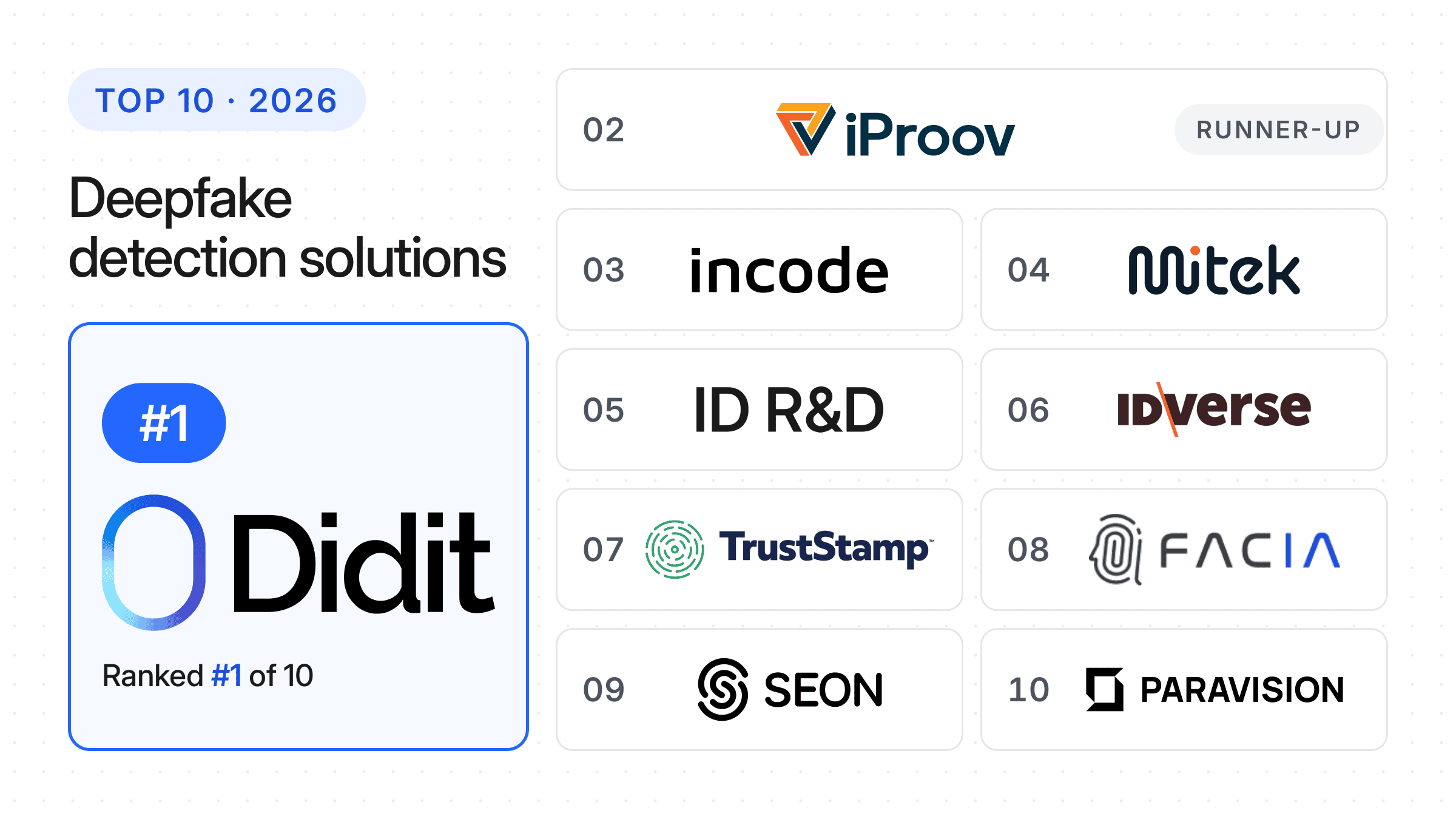
We rank Didit first for teams that need deepfake evidence attached to the verification session, at $0.33 per full KYC check with four priced line items across three parts: the document check, biometrics (passive liveness and face match) and Device & IP Analysis. Facia lists standalone deepfake detection at $0.40 per check on pay as you go below 1,000 checks a month. The reviewed sources provide no shared test set for comparing false-accept rates, so we rank the tools by workflow fit, published cost and the evidence returned.
Last updated: November 26, 2026. Prices checked against the live Didit price feed on November 26, 2026.
The shortlist at a glance
| Rank | Vendor | Best for | Price basis | Key capabilities | Main trade-off |
|---|---|---|---|---|---|
| 1 | Didit | Teams that need deepfake evidence returned in the verification session, priced per component | $0.33 per full KYC check, with four priced line items published for the check | Passive, 3D flash and 3D action liveness, face match, face search, Device & IP Analysis; AML, KYB, wallet screening and transaction monitoring as separate capabilities | Device & IP Analysis is session-only, so an image-only standalone call returns less evidence |
| 2 | Facia | Teams that need separately priced deepfake detection for media and content | Pay as you go below 1,000 checks a month: Deepfake Detection $0.40, Document Verification $0.70, Quick Liveness $0.10, Face Match 1:1 $0.15; custom quote above 1,000 | Deepfake detection, liveness, face match 1:1, face search 1:N, document verification, age estimation | Budget separately for each module your flow uses |
| 3 | iProov | Buyers whose procurement turns on a named certification or standard | not published on the reviewed page; quote required | Liveness detection and authentication, physical access, workforce | Pricing not published, and document verification or AML are not listed as products |
| 4 | Onfido | Teams that want document and biometric checks assembled in a no-code builder | not published on the reviewed page; quote required | Document verification, biometric verification, fraud detection including deepfakes and injection attacks, KYC and AML support, Workflow Studio, Smart Capture SDK | No separate published price for the deepfake and injection checks |
| 5 | IDVerse | Buyers already evaluating LexisNexis Risk Solutions products | not published on the reviewed page; quote required | Document authentication, biometric verification, deepfake and forged-document detection | No price, country coverage or certification list on the reviewed page |
Our reading of the evidence: start with Didit if you need deepfake evidence attached to onboarding, screening and review at a published unit price. Start with Facia if you only need a deepfake model for media and content that you can price per check. If a named certification or standard decides the purchase, put iProov in the final two and plan for a quote cycle.
How we picked these five
Didit publishes this ranking; we explain the criteria so you can check them.
This is a buyer-fit ranking, not a measured ordering of deepfake detection accuracy. The reviewed sources provide no shared test set for comparing false-accept and false-reject rates. Where a performance figure appears below, it is attributed to the vendor that published it, and we name the reported test context when the page supplied one.
We assessed every vendor on the same seven criteria:
- Published cost. A buyer can read a unit price or a plan without a sales call. A published rate ranks above a quote, all else equal.
- Evidence returned. A score alone does not help a reviewer. We looked for named reasons, warnings or risk codes that a case reviewer can act on and defend later.
- Coverage of the face check. The liveness model and the capture path around it. A vendor that documents both ranks above one that documents only the model.
- Workflow fit. Whether the checks a team needs after onboarding are available on the same account, rather than in a second contract.
- Access. A self-created sandbox account ranks above an invitation-only evaluation, because a team can validate requests and decision handling before committing.
- Certifications and standards evidence. A published certification or standards list ranks above a general compliance statement, because a buyer can check the former independently.
- Published ID coverage. A stated count of supported document types or identity records ranks above no stated coverage.
We ranked vendors whose reviewed pages document deepfake detection. When ranked vendors were close on price visibility, we used named certifications and published ID coverage to break ties.
What deepfake detection for KYC has to cover
Deepfake risk reaches a KYC flow at three points. First, the face in front of the camera: a synthetic face, a replayed video, a mask or a face swap applied in real time. Second, the capture path: a virtual camera, frames injected between the camera and the app, or a compromised device. Third, the identity data around the face: a genuine document bound to a different person, or the same face returning under a second name.
A vendor that only scores the selfie covers the first point and leaves the other two to somebody else. That is the most useful question to ask: what does each layer return as evidence, and what does it cost.

The liveness model
The liveness model decides whether a live person is present. Passive liveness needs a selfie without a gesture prompt and runs a single-frame convolutional model over the image, looking for artifacts and texture patterns. 3D flash uses reflected light patterns to assess facial depth without requiring a gesture. 3D action with flash combines those depth cues with a randomized request to move, such as blinking or nodding. Our liveness documentation reports 99.9% accuracy and a false acceptance rate under 0.1%, and we hold iBeta Level 1 PAD. In a Didit session the liveness result comes back with named warnings such as LIVENESS_FACE_ATTACK, LOW_LIVENESS_SCORE, MULTIPLE_FACES_DETECTED and NO_FACE_DETECTED. Read the liveness documentation for the method comparison.
The capture path
A deepfake that never touches a real camera is the harder case, because the liveness model judges whichever frames it receives. Device & IP Analysis adds risk indicators such as duplicate devices and links to prior liveness attacks: a repeated device fingerprint, a VPN, a proxy, Tor, a datacenter IP, or a device already tied to a liveness attack. We return those as location warnings including DUPLICATED_DEVICE, VPN_DETECTED and DEVICE_LINKED_TO_LIVENESS_ATTACK. Ask vendors to demonstrate how they detect a virtual camera or an injected feed, and test that yourself in a pilot. Read the device and IP analysis documentation for the full list.
The identity record
A duplicate-face warning gives reviewers a reason to investigate possible account reuse. On live standalone passive liveness calls that warning is informational, and prior faces with the same vendor_data are excluded from the index search, so re-running liveness for the same user does not raise it. In a session the same signals sit next to the document and device results a reviewer already reads.
1. Didit: deepfake evidence that stays on the verification session
Verdict. We rank Didit first on two documented criteria: a published unit price for every part of the check, and named evidence returned in the session that a reviewer can act on. Reviewers can examine document, liveness, face match and Device & IP results in the same verification session.
Features. Three liveness methods: passive, 3D flash and 3D action with flash. Passive liveness declines on a face attack or a score at or below the configured threshold. The standalone endpoint is POST /v3/passive-liveness/. Live standalone calls screen a detected face against your blocklist and face index, including when saving is disabled, and both checks exclude prior faces with the same vendor_data. Face match compares the selfie with the document portrait and returns a similarity score from 0 to 100, with a decline threshold of 30 by default, adjustable through face_match_score_decline_threshold on POST /v3/face-match/. Document verification covers 14,000+ document types across 220+ countries and territories and returns forgery and document liveness warnings including DOCUMENT_LIVENESS_FAILED and FRAUD_RISK_FROM_OCR. Device & IP Analysis runs inside the session. AML screening against 1,300+ lists, KYB, wallet screening and transaction monitoring are separately available capabilities on the same account. Where case management matters, Growth includes one case management blueprint and Scale adds routing.
Hosted session or standalone call
Pick one mode before you write code. Each mode reads its decision in a different place.
- Hosted session when the user goes through a Didit flow. Set the liveness method on the workflow with
face_liveness_method(PASSIVE,ACTIVE_3DorFLASHING), create the session withPOST /v3/session/, then opensession.url. Read the result fromGET /v3/session/{sessionId}/decision/in theliveness_checks[]array, or subscribe to thesession.status.updatedwebhook. Device and IP signals exist only in this mode. - Standalone call when you already hold a selfie. Send
POST https://verification.didit.me/v3/passive-liveness/as multipart form data with the requiredx-api-keyheader and the requireduser_imagefield (jpg, jpeg, png, tiff or webp, maximum 5 MB, no PDFs), then readliveness.statusandliveness.scorein the response.save_api_requestdefaults totrue, which stores the images and enrolls the detected face in your face index. Set it tofalsefor a one-shot call that stores nothing and enrolls nothing.
In production, each HTTP 200 consumes one Passive Liveness API credit. HTTP 403 can indicate insufficient credit or missing or invalid API credentials. A sandbox key skips processing and billing and returns a static Approved mock payload for valid requests. For integration steps, see the integration prompt and the MCP server.
Pricing. Full KYC is $0.33 per completed check: the document check is ID verification $0.15, biometrics are passive liveness $0.10 and face match 1:1 $0.05, and Device & IP Analysis is $0.03. We publish four priced line items for the full KYC check. Passive liveness is $0.10 inside a workflow. Active liveness is $0.15, ID verification through the standalone API is $0.20, face search 1:N is $0.05 per search, AML screening is $0.20 per check, ongoing AML monitoring is $0.07 per user per year, wallet screening is $0.15 per screening, transaction monitoring is $0.001 per transaction beyond the plan allowance, and KYB starts at $2.00 per company. On plans: the first eligible Free organization created in the console with a work email for its company domain receives $10 of credit a month. Growth is $99 a month with a 4% discount on eligible prices. Scale is $299 a month with a 10% discount on eligible prices. Transaction Monitoring overages stay at $0.001 per transaction on both plans. Enterprise is a custom annual contract from $15,000 a year. Read the pricing page, the machine-readable pricing JSON and the pricing documentation.

Pros
- We publish four priced line items for the full KYC check, so the check can be costed before integration.
- Three liveness methods configured per workflow, rather than one model applied to every risk level.
- Device and IP signals arrive in the same session and the same $0.33 check.
- Live standalone passive liveness calls screen the detected face against your blocklist and face index, including when saving is disabled.
- AML screening, KYB, wallet screening and transaction monitoring are available on the same account as separate capabilities.
- We serve 4,000+ companies, have a SOC 2 Type 2 report and are ISO/IEC 27001:2022 certified.
- The sandbox is free on every plan and no sales call is needed to start.
Cons
- Device & IP Analysis is session-only, so an image-only standalone liveness call returns a smaller evidence set.
- Our liveness documentation reports 99.9% accuracy and a false acceptance rate under 0.1%. The reviewed sources provide no shared test set for comparing those figures across vendors.
- Active liveness costs $0.15 rather than the $0.10 passive price.
- Case management is plan-specific: one blueprint on Growth, routing on Scale.
Best for: fintech, crypto and marketplace teams that need onboarding evidence to stay usable in ongoing fraud and AML operations, and that want to read every unit price before building.
2. Facia: the separately priced deepfake module
Verdict. Facia earns second place on the published-cost criterion: deepfake detection is its own per-check product on pay as you go below 1,000 checks a month, which no other vendor on this list documents. Teams that need separately priced deepfake detection for media and content should evaluate it first.
Features. Facia homepage, read November 26, 2026, lists liveness detection, deepfake detection for media and content, facial recognition with 1:1 matching and 1:N searching, age estimation and document verification. The same page states protection against 56+ spoofing types and a response under 1 second. Facia reports that an algorithm update reduced the false acceptance rate to 0.06% and the false rejection rate to 0.3%. The reviewed Facia homepage lists a NIST FRVT report card for facia_001. Rate limits are 20 verifications per minute on pay as you go and 60 per minute on Enterprise, and on-premises deployment with priority support is Enterprise only. No specific country coverage is stated.
Pricing. Pay as you go below 1,000 checks a month, per check: Quick Liveness $0.10, Detailed Liveness $0.12, Deepfake Detection $0.40, Age Estimation $0.10, Document Verification $0.70, Face Match 1:1 $0.15, Face Search 1:N $0.15. Pay as you go starts with 10 credits and requires no credit card. Facia lists pay-as-you-go unit rates below 1,000 checks a month and custom pricing above 1,000. The reviewed page leaves pricing at exactly 1,000 checks unspecified.
Pros
- Deepfake detection is a named, priced product rather than an unnamed feature of a biometric check.
- Published per-check rates and a free start with 10 credits.
- Separate liveness, face and document modules, so you buy only what the flow needs.
Cons
- At pay-as-you-go rates, Facia document verification ($0.70), Quick Liveness ($0.10) and Face Match ($0.15) total $0.95. This subtotal excludes device and IP analysis and Facia's $0.40 media and content deepfake check.
- On-premises deployment, priority support and higher rate limits require the Enterprise tier.
- No country coverage is stated on the reviewed page.
Best for: teams that need separately priced deepfake detection for media and content on pay as you go below 1,000 checks a month, and want to test it before committing.
3. iProov: the certification-led choice
Verdict. iProov earns third place on the certification criterion: the reviewed page carries the longest list of certifications, standards, accessibility conformance and program statuses here. If procurement turns on a named standard, start there.
Features. iProov homepage, read November 26, 2026, lists liveness detection, physical access and workforce products, and states it is the first biometrics vendor independently certified to meet the NIST SP 800-63-4 digital identity guidelines. The page lists standards and statuses including eIDAS Level of Assurance High, ISO/IEC 30107-3, SOC 2 Type II, CEN/TS 18099, iBeta, FIDO Face Verification Certification, iRAP, UK National Physical Laboratory, CSA STAR Level 2, WCAG 2.2 AA, Section 508 and the European Accessibility Act, plus Certified G-Cloud Supplier status and Federal Reserve SIF Mitigation Provider status. It also describes an in-house security operations center.
Pricing. not published on the reviewed page; the pricing address returned an error page, so a quote is required.
Pros
- The deepest published certification, standards and accessibility list of the five.
- Accessibility conformance stated explicitly, with WCAG 2.2 AA and Section 508.
- Published case studies name the US Department of Homeland Security, UBS and Rabobank.
Cons
- No readable price, which makes budgeting a separate exercise.
- The page describes deepfake defence as part of liveness detection, with no separate product or price.
- Document verification and AML are not listed as products on the reviewed page.
Best for: regulated enterprises and public-sector buyers whose decision turns on a named certification or standard.
4. Onfido: document and biometric checks behind a workflow studio
Verdict. Onfido earns fourth place on the evidence criterion: Onfido's reviewed page explicitly names both deepfakes and injection attacks as fraud types it detects. It does not publish a separate price for those checks.
Features. Onfido homepage, read November 26, 2026, describes AI-powered biometric and document-based identity verification that detects fraud such as deepfakes and injection attacks and supports KYC and AML compliance, extensible to authentication, account recovery and digital signing. Products listed are document verification, biometric verification, KYC compliance, data verification and fraud detection. It also lists Workflow Studio, a no-code builder for assembling verification workflows, and a Smart Capture SDK. The page states support for KYC, AML and eIDAS 2.0 requirements, cites G2 Summer 2026 badges and an Entrust award, and lists integrations with Microsoft Entra Verified ID and Okta Workforce Identity.
Pricing. not published on the reviewed page; quote required.
Pros
- Names deepfakes and injection attacks as fraud types it detects.
- A no-code builder for assembling verification workflows.
- Document, biometric and data checks in one product family.
Cons
- No published price, and no separate price for the deepfake and injection checks.
- The page names no formal certifications, only supported regulatory requirements.
- The reviewed page does not specify where the checks run in a workflow or how they are packaged.
Best for: teams that want document and biometric checks assembled in a no-code builder, and that will price the deepfake checks inside a quote.
5. IDVerse: document-first and automated
Verdict. IDVerse earns fifth place on documentation depth. The reviewed page supports automation and detection, but publishes no price, coverage or certification list, which makes it harder to compare without a pilot.
Features. IDVerse product page on LexisNexis Risk Solutions, read November 26, 2026. The page describes automated document authentication and identity verification within seconds. It also lists deepfake and forged-document detection, built on proprietary AI models and a deep neural network.
Pricing. not published on the reviewed page; quote required.
Pros
- Describes document authentication, biometric verification and deepfake and forged-document detection together.
- IDVerse says it automates document authentication and identity verification within seconds.
Cons
- No price, country coverage or certification list on the reviewed page.
- Deepfake detection is described as a capability rather than as a separately priced product, so scope has to be confirmed in a demo.
Best for: buyers already evaluating LexisNexis Risk Solutions products who want document authentication with deepfake detection attached.
Related verification and fraud products
These vendors are not ranked as deepfake detectors. Their reviewed pages document adjacent verification and fraud products, and the reviewed information leaves deepfake detection unverified.
Sumsub
Sumsub homepage, read November 26, 2026, lists ID Verification, Liveness & Face Match, AML Screening, Ongoing AML Monitoring and Transaction Monitoring. Basic is $1.35 per verification with a $149 monthly minimum; Compliance is $1.85 per verification with a $299 monthly minimum. Sumsub lists AML screening and ongoing AML monitoring. The reviewed information leaves the scope of those features under Basic and Compliance unspecified. Best for buyers who want published per-verification rates and can budget for a monthly minimum.
Jumio
Jumio homepage, read November 26, 2026, lists identity verification, biometrics, risk signals, cross-transaction risk signals and AML screening. It reports 5,000+ supported ID types and 30M+ known identities in its Identity Graph. Pricing is not published on the reviewed page; quote required. The page does not describe a dedicated deepfake check. Best for teams evaluating identity verification alongside cross-transaction risk signals.
SEON
SEON homepage, read November 26, 2026, lists fraud prevention, AML compliance, identity verification, case management and managed risk services. Starter is $699 per month including 2,500 fraud checks; Premium is custom priced. The reviewed page does not document a standalone deepfake check. Best for fraud operations teams that need case management alongside fraud prevention and AML compliance.
Incode homepage, read November 26, 2026. Details were not verifiable. Veriff homepage, read November 26, 2026. Details were not verifiable.
Budget walk-through: 1,000, 10,000 and 50,000 checks
Every figure below comes from a published unit price. The billing units differ, so read the caption before comparing columns.
| Monthly volume | Didit full KYC, $0.33 per check | Sumsub Basic, $1.35 per successful verification (examples, subject to the $149 monthly minimum) | SEON Starter, $699 per month |
|---|---|---|---|
| 1,000 | $330 | $1,350 | A subscription that includes 2,500 fraud checks; the unit is a fraud check, not a KYC check |
| 10,000 | $3,300 | $13,500 | No comparable published price. Starter includes 2,500 fraud checks per month, and Premium is custom priced |
| 50,000 | $16,500 | $67,500 | No comparable published price. Starter includes 2,500 fraud checks per month, and Premium is custom priced |
The arithmetic: 1,000 × $0.33 = $330, 10,000 × $0.33 = $3,300 and 50,000 × $0.33 = $16,500 for Didit. Sumsub Basic: 1,000 × $1.35 = $1,350, 10,000 × $1.35 = $13,500 and 50,000 × $1.35 = $67,500; those are examples for successful verifications, and the $149 monthly minimum is already exceeded at every volume shown. SEON Starter is a subscription, so it does not enter a per-KYC comparison.
Facia publishes pay-as-you-go rates per check for volumes below 1,000 checks a month. At pay-as-you-go rates, Facia document verification ($0.70), Quick Liveness ($0.10) and Face Match ($0.15) total $0.95. This subtotal excludes device and IP analysis and Facia's $0.40 media and content deepfake check. Above 1,000 checks a month, Facia lists custom pricing, and the reviewed page leaves pricing at exactly 1,000 checks unspecified, so we do not project a monthly figure at 1,000 or above.
Now a worked month on Didit usage, using illustrative counts rather than measured usage. Ten thousand full KYC checks at $0.33 is $3,300. Eight thousand AML screens at $0.20 is $1,600. Two thousand wallet screenings at $0.15 is $300. The monthly usage subtotal is 10,000 × $0.33 + 8,000 × $0.20 + 2,000 × $0.15 = $5,200 at list prices, before credits and tax. Ongoing AML monitoring is billed per user per year: 8,000 × $0.07 = $560 per year, shown separately. On Scale the KYC line alone is 10,000 × $0.297 = $2,970, before the plan fee and credits.
A low-volume example shows how credit and minimums change the bill. A team on Growth runs 500 full KYC checks in a month. Growth is $99 a month with a 4% discount on eligible prices, so each check is $0.3168: 500 × $0.3168 = $158.40. The plan's $115 of credit covers the first $115. The remaining $43.40 is drawn from the prepaid top-up balance. Plan fee plus usage beyond the included credit is $99 + $43.40 = $142.40 before tax, and that figure is not the cash needed to fund the account: a new top-up starts at $50. A check is billed only when it finishes with a result. Compare a monthly minimum instead: 100 Sumsub Basic verifications at $1.35 is $135, but the $149 monthly minimum applies, so the bill is $149.
If the budget is small
On Didit, the first eligible Free organization created in the console with a work email for its company domain receives $10 of credit a month, which covers 30 completed full KYC checks at $0.33 each. The sandbox is free on every plan. Facia pay as you go starts with 10 credits and requires no credit card. Sumsub offers a 14-day trial with 50 free checks. SEON's published entry subscription at $699 a month is a different scale, and it buys fraud checks rather than KYC checks.

Which one to pick
Fintech at scale
Start with Didit. Combine the $0.33 full KYC check with AML screening at $0.20 and ongoing monitoring at $0.07 per user per year. Reviewers can route face-attack and device warnings, and AML hits, into a shared review queue in your own application. If procurement needs a named certification list before any technical test, evaluate iProov in parallel.
Crypto and exchanges
Didit, because wallet screening at $0.15 per screening and transaction monitoring sit on the same account as the onboarding evidence. From Growth, you can also bring your own screening provider and run it inside Didit. Read the wallet screening documentation for the setup. Sumsub publishes per-verification rates with monthly minimums if you prefer a vendor with a readable rate card.
Marketplaces and repeat accounts
Face search at $0.05 per search matters here, because the fraud is often the same person returning under a new name. Live standalone passive liveness calls screen a detected face against your blocklist and face index, including when saving is disabled, and prior faces with the same vendor_data are excluded from both checks. Add business verification from $2.00 per company for sellers, with $0.20 per owner AML check and $0.33 per linked owner KYC.
Replacing Onfido or Jumio
Neither publishes a per-check price on its reviewed page, so the first gain from switching is that you can read the price of each check. Use the sandbox to validate requests and response parsing; the standalone endpoint returns a mock Approved result for valid requests. Use application fixtures to test how your integration handles declines and review states. For detection rates, run an authorized pilot that processes real checks with your own samples. The migration path covers the switch itself.
You only need a deepfake model
Choose Facia if you already have an identity system and want separately priced deepfake detection for media and content at $0.40 per check on pay as you go below 1,000 checks a month. Choose Didit if you would rather buy a full check at $0.33 that includes ID verification, passive liveness, face match and Device & IP Analysis together.
Certification decides the purchase
iProov publishes the longest certification and standards list of the five and should be in the final two. Accept that pricing is not published on the reviewed page and plan for a quote cycle.
Sources
- Didit pricing page, prices read from the live price feed on November 26, 2026.
- Didit pricing JSON, machine-readable list prices.
- Didit pricing and billing documentation.
- Didit liveness detection overview.
- Didit passive liveness API reference.
- Didit face match API reference.
- Didit ID verification overview.
- Didit device and IP analysis overview.
- Didit wallet screening documentation.
- Didit integration prompt and the raw Markdown version.
- Didit MCP server and the migration path.
- Facia, facia.ai homepage, read November 26, 2026.
- iProov, iproov.com homepage, read November 26, 2026.
- Sumsub, sumsub.com homepage, read November 26, 2026.
- Jumio, jumio.com homepage, read November 26, 2026.
- Onfido, onfido.com homepage, read November 26, 2026.
- IDVerse product page on LexisNexis Risk Solutions, read November 26, 2026.
- SEON, seon.io homepage, read November 26, 2026.
- Incode homepage, read November 26, 2026. Details were not verifiable.
- Veriff homepage, read November 26, 2026. Details were not verifiable.
Start in the sandbox and read the price of every check before you build. Create an account at business.didit.me without a sales call, validate requests and decisions on a free sandbox, and add screening and monitoring to the same account when you are ready.
Try it
Try this in the sandbox
Run the check this guide describes, free.
The product this post is about, taken from its topic. Run it free in the sandbox.
Author
Alejandro Rosas
Co-founder and CTO

Keep reading
Other guides in the same topic.
 What Is the Purpose of FICA in South Africa? 2026 Guide
FICA is South Africa's anti-money laundering law. It creates the Financial Intelligence Centre and requires accountable institutions to identify and verify clients, screen for PEP and sanctions risk and report suspicious.
Alberto RosasNov 26, 2026 Sixth Money Laundering Directive (6AMLD): What Changed and Which Rules Apply
6AMLD is Directive (EU) 2018/1673: Member States must criminalise laundering, widen predicate offences and set a four-year penalty floor. It adds no new due diligence duties for firms.
Alberto RosasNov 26, 2026 Automated Sanctions Screening: Canada, the Entity List and Embargoes
Automated sanctions screening matches people and companies against lists such as Canada's autonomous sanctions made under SEMA and JVCFOA and the OFAC SDN List, and returns candidate hits scored for identity confidence and.
Alberto RosasNov 26, 2026Questions
Frequently asked questions
What is the best deepfake detection tool for KYC in 2026?
For most teams the deciding factor is whether the face check stays attached to the identity record. Didit ranks first because a full KYC check is $0.33, four priced line items are published for the check, and reviewers can examine document, liveness, face match and Device & IP results in the same verification session. Facia is the better fit if you only need separately priced deepfake detection for media and content at $0.40 per check on pay as you go below 1,000 checks a month.
How much does deepfake detection cost per check?
In a Didit workflow, passive liveness costs $0.10 per check and active liveness costs $0.15 per check. A full KYC check is $0.33 per completed check, which includes ID verification, passive liveness, face match and Device & IP Analysis. Facia's $0.40 is a media and content deepfake check on pay as you go below 1,000 checks a month, so it is a different unit from a KYC check. Sumsub publishes per-verification rates from $1.35 with a $149 monthly minimum, and SEON's $699 Starter is a fraud-check subscription. iProov, Jumio, Onfido and IDVerse do not publish a per-check price on the reviewed pages.
What is a good alternative to Onfido for deepfake detection?
Didit is our alternative. The reviewed Onfido page explicitly names both deepfakes and injection attacks as fraud types it detects, and does not publish a separate price for those checks. We publish $0.33 for a full KYC check that includes passive liveness and face match. Test both on your own replayed videos, virtual camera sessions and masks in an authorized pilot before switching.
What is a good alternative to Jumio for deepfake detection?
Didit, on price visibility first: the reviewed Jumio page cites its identity graph and cross-transaction risk signals but no per-check price, and we publish $0.33. Jumio's page also does not describe a dedicated deepfake check, so ask for a demonstration. If cross-transaction risk signals are the main requirement rather than deepfake evidence, keep Jumio in the shortlist and compare on your own transaction data.
Can deepfake detection stop a virtual camera or an injected video feed?
A liveness score alone often cannot, because injection sits between the camera and the app. Device & IP Analysis adds risk indicators such as duplicate devices and links to prior liveness attacks. Ask vendors to demonstrate how they detect a virtual camera or an injected feed, and test it yourself. An image-only standalone liveness call collects no device signals at all.
Should I use passive or active liveness for deepfake detection?
Passive liveness needs a selfie without a gesture prompt and runs a single-frame model, which suits high-volume, lower-risk onboarding. 3D flash uses reflected light patterns to assess facial depth without requiring a gesture. 3D action with flash combines those depth cues with a randomized request to move, such as blinking or nodding. Our passive liveness is $0.10 in a workflow and active liveness is $0.15.
Which vendors publish deepfake detection prices?
Facia publishes per-check rates, and we publish four priced line items for the full KYC check. Sumsub publishes per-verification rates with monthly minimums. SEON publishes a $699 monthly subscription that includes 2,500 fraud checks, which is a different unit from a completed KYC check. iProov, Jumio, Onfido and IDVerse do not publish a per-check price on the reviewed pages.
What is the most affordable video KYC option for a small business?
The reviewed sources do not establish which live-video KYC option is cheapest. For selfie-based onboarding, our full KYC check costs $0.33, and $10 in monthly credit covers 30 completed checks for eligible Free organizations. Facia pay as you go starts with 10 credits and requires no credit card, and Sumsub offers a 14-day trial with 50 free checks. SEON's $699 monthly subscription is a different scale and buys fraud checks, not KYC checks.
Does deepfake detection replace document verification?
No, document verification checks the authenticity of the submitted ID. Face Match compares the selfie with the document portrait, and liveness checks the selfie for signs of a live capture. Our document check covers 14,000+ document types across 220+ countries and territories and returns forgery and document liveness warnings. Reviewers can use device signals as additional context when the identity evidence is inconclusive.
How do I test a vendor's deepfake detection before signing?
Build a scorecard before the pilot. Calculate false acceptance against the number of attack samples and false rejection against the number of genuine samples, then report both by capture channel and attack category, with the threshold and retry policy recorded for each run. Use the sandbox for request validation and response parsing only, because our standalone endpoint returns a mock Approved result for valid requests. For detection rates, ask each vendor for an authorized pilot that processes your samples, and write down the test context behind any figure they quote.
Compliance built in
Audited, certified and attested.
We hold the certifications and build each country's rules into your flows, so you can launch anywhere without worrying. Security and Compliance center
- Regulation encoded into your flows
Tell us what you do and where. Didit lists the rules that apply to you, with sources, and builds the checks each country needs into one workflow.
- Ready for AMLR
Every requirement of the new EU anti-money laundering rules, from checking customers to human review, is already covered by a Didit check.
- Tested in Spain's Treasury sandbox
Spain's Treasury published its supervised sandbox report on Didit's NFC plus active liveness onboarding; SEPBLAC took part and valued the added measures positively.
- Audited, not self-declared
iBeta Level 1 and Level 2. Liveness tested under ISO/IEC 30107-3.
Your obligations · 3 regions
 SOC 2 Type 2
 ISO 27001
 iBeta Level 1 and Level 2
 EU regulator attestation
 FSM youth protection
 GDPR
 EBA remote onboarding
 MiCA compatible
 FIDO Alliance member
- AMLREU AML Regulation ready
Integration · Didit MCP
Run Didit from your own AI agent
Connect Didit to Claude, Cursor, VS Code or ChatGPT and just ask in plain words. Your agent can do anything you can do in the console, with the same permissions you have.
 Add to Claude
 ChatGPT
 Cursor
- Build workflowsDescribe the checks you need. The agent creates and publishes the flow.
- Run investigationsAsk why a session was declined, review cases, search people and companies.
- Change rulesCreate payment rules, test them on past data and switch them on.
- Pull reportsAsk for numbers, exports or the audit log.
Didit Academy


