Top 7 KYC Providers for Fintech Startups in 2026
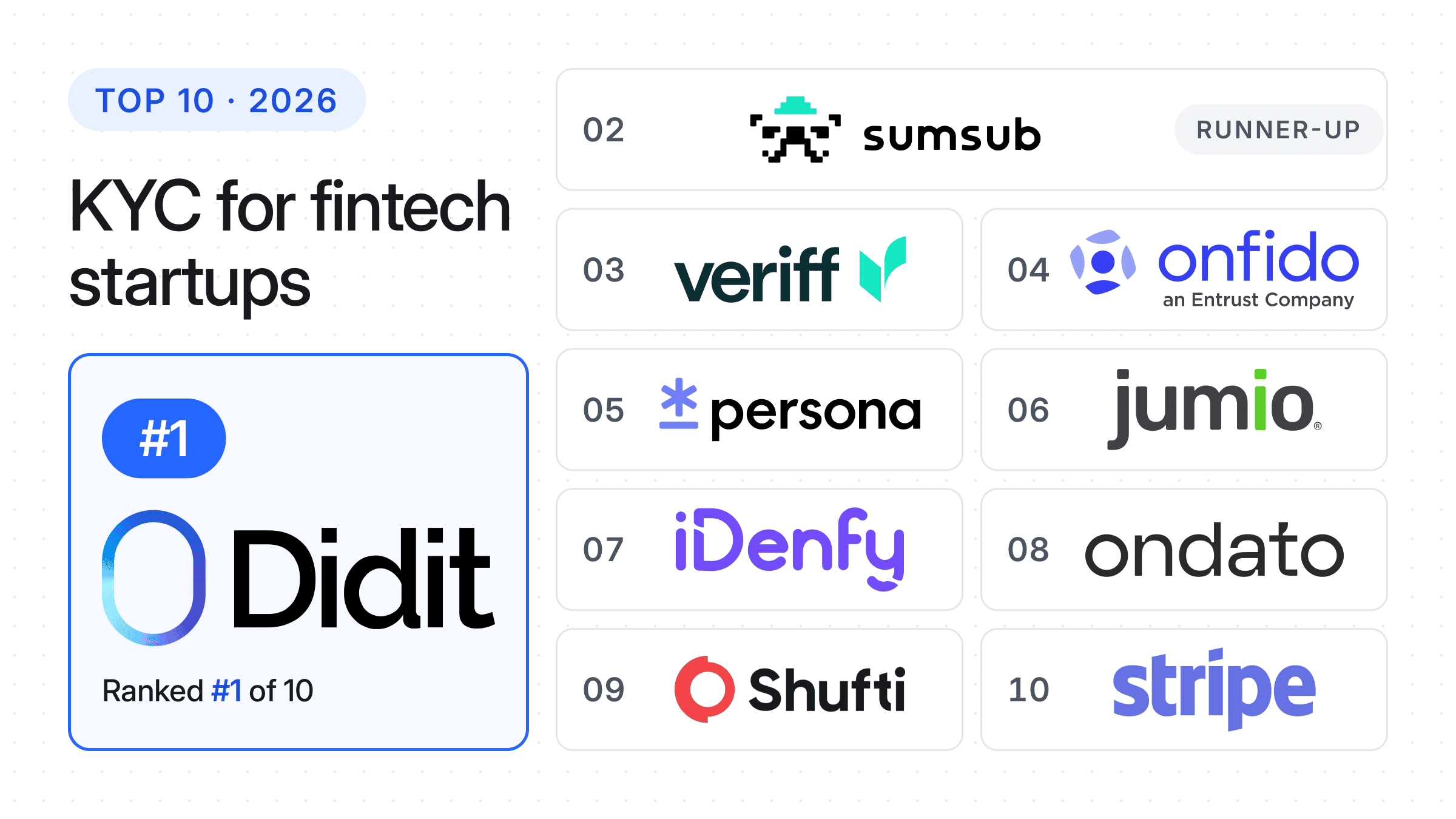
Didit leads at $0.33 per completed full KYC check. Persona, Sumsub and iDenfy fit other cases. Seven providers ranked with published prices and minimums.
 Alberto RosasCo-founder and CEO
Contents
In this guide
Jump to the part you need.
This ranking is for fintech startups that need to budget KYC before they integrate. We rank seven providers on published prices, minimums and the checks you add after launch. We lead at $0.33 per completed full KYC check. The caveat: several reviewed pages publish no per-check price, and registry, database and non-document lookup prices can vary.
Last updated: November 26, 2026. Prices checked against the live Didit price feed on November 26, 2026.
Didit publishes this ranking; we explain the criteria so you can check them.
Our verdict for a fintech startup: Didit, because we publish list prices for full KYC, AML screening and ongoing AML monitoring. Registry, database and non-document lookup prices can vary, and phone codes include carrier charges. One credit balance covers these products. An identity session can return its AML screening results alongside its verification decision. If you are an eligible startup that wants a monthly allotment, read the Persona entry. If you need VideoIdent, read the Shufti Pro entry and confirm operating mode and price.
| Rank | Provider | Best for | Price basis | Key capabilities | Main trade-off |
|---|---|---|---|---|---|
| 1 | Didit | Startups that want to model the full cost before integrating and go live without a sales call | Full KYC $0.33, AML $0.20, KYB from $2.00 | KYC, AML screening and monitoring, KYB, transaction monitoring, digital ID wallets, workflow builder, MCP server | Your team chooses and configures the workflow; Enterprise contracts start at $15,000 a year |
| 2 | Persona | Eligible startups that want a monthly free allotment, or teams that need the US sources listed on its page | Essential $250 a month with a 12-month minimum, a $3,000 starting commitment; per-check pricing not published | Government ID, selfie, phone carrier, phone number and email verification, cases | No per-check price; Growth and Enterprise are contact-us |
| 3 | Sumsub | Teams that want published per-verification rates and a monthly floor they can budget | Basic $1.35 per verification with a $149 monthly minimum; Compliance $1.85 with a $299 minimum | ID verification, KYB, AML screening, AML transaction monitoring, fraud prevention | Published bundles include different checks; confirm add-on application |
| 4 | Shufti Pro | Teams evaluating VideoIdent alongside document checks | Pricing is not published | Document verification, face verification, eIDV, VideoIdent, AML screening | Quote required; confirm operating mode and price |
| 5 | iDenfy | Teams that want listed add-on prices and ISO 27001 and SOC 2 commitments in the contract | $1.35 Basic with a $135 monthly minimum; listed add-ons priced | Identity verification, KYC, KYB, AML, ongoing monitoring, 24/7 manual review | Basic plus 3D liveness and sanctions/PEP screening is $2.10 before monitoring; Enterprise is tailored |
| 6 | Jumio | Later-stage fintechs scoring published throughput, volume and named customers in an RFP | Pricing is not published on the reviewed page. Ask for a quote. | Identity verification, risk signals, cross-transaction risk, AML screening, biometrics | Quote required |
| 7 | Onfido (Entrust) | Teams whose fraud model includes synthetic identities and injection attacks | Pricing is not published on the reviewed page. Ask for a quote. | Document verification, biometric verification, data verification, fraud detection, workflow studio | No price to budget without a quote |
How we picked
This is our editorial ranking of seven providers for a fintech startup, built from each provider's own public pages read on November 26, 2026. We did not run a paid pilot with every vendor. The ranking rests on what each provider publishes, plus what we know about our own product. Five criteria, in the order a startup feels them:
Where two providers were close, the tie went to day-one breadth, then to commitment. Persona ranks ahead of Sumsub on the strength of its named US database sources, AAMVA and eCBSV, and its monthly free allotment for eligible startups. Sumsub publishes per-verification rates for Basic and Compliance. Shufti Pro ranks ahead of iDenfy because the ranking gives weight to Shufti Pro’s published VideoIdent and eIDV offerings. iDenfy publishes a $1.35 Basic rate and prices for its listed add-ons.
- Published cost. Can you find a per-check or per-month price without a call, and can you find the price of the second and third thing you will buy: AML screening, ongoing monitoring, business verification, manual review?
- Day-one breadth. Documents, liveness, face match, fraud signals, sanctions screening and business checks on one account, so a launch does not stall while you sign a second contract.
- Commitment. Monthly minimums, contract length and whether billing runs per completed check or per attempt.
- Integration effort. Public documentation, a sandbox you can use before you buy, SDKs and an API your engineers can read without a call.
- Evidence. Certifications, named customers and coverage numbers a compliance team can put in a file.
Where a pricing page was broken, we say so. Sumsub, Persona, Shufti Pro, iDenfy, Jumio and Onfido (Entrust) are described only from their own pages, read November 26, 2026.
What affordable means for a fintech startup
A headline price per check is not a budget. Three numbers decide what you pay: the per-check rate, the monthly floor, and the price of the checks you add after launch. A provider that publishes one of those and hides two is harder to plan around than one that publishes all three.
Run the arithmetic at the volume you expect in month twelve, not month one. At 10,000 completed checks a month, our full KYC is 10,000 multiplied by $0.33, which is $3,300. Sumsub Basic at $1.35 per verification is 10,000 multiplied by $1.35, which is $13,500. iDenfy Basic plus 3D liveness and sanctions/PEP screening is $2.10 per check, so 10,000 multiplied by $2.10, which is $21,000. Persona publishes no per-check price.
Then check what you are billed for. We bill a check when it finishes with a result, and the pricing docs list the exceptions, including some no-match database lookups and retries that are billable. Ask every vendor what counts as a billable verification, including retries. iDenfy, for example, lists charging on approved-only results at +$0.50 per verification.
A sandbox you can use before a contract matters. Sandbox testing is free on every plan. Engineers test the Sessions API with a sandbox key, so they can build before a contract exists.
1. Didit: $0.33 full KYC, with every module on one credit balance
Verdict. We are first because we publish list prices for full KYC, AML screening and ongoing AML monitoring. Registry, database and non-document lookup prices can vary, and phone codes include carrier charges. One credit balance pays for onboarding, AML screening, monitoring and business verification. Growth includes case management with one blueprint, and Scale adds routing. That is the difference between a quote you negotiate and a budget you can build in a spreadsheet.
Features. We support 14,000+ document types across 220+ countries and territories, with OCR, MRZ and barcode parsing. The verification flow and native SDKs support 54 languages, and document recognition covers 130+ languages. We offer passive and active liveness, plus 1:1 face match. Optional NFC chip reading costs $0.15 per check. Non-document lookup runs against authoritative sources where a country allows it. National digital IDs are priced per completed verification, for example MitID at $0.25, BankID Sweden at $0.20, Smart-ID at $0.21, iDIN at $0.95 and Google Wallet at $0.10. AML screening checks 1,300+ lists at $0.20 per check, ongoing monitoring is $0.07 per person a year, transaction monitoring is $0.001 per transaction beyond the plan allowance, and wallet screening is $0.15 per screening. On Growth and higher plans, you can bring your own screening provider and run it inside Didit. KYB pulls official registry data from $2.00 per company with a linked KYC for each owner. Every session carries 200+ fraud signals. We offer a no-code workflow builder and publish check prices on our pricing page. Case review is available: Growth includes one case blueprint, and Scale adds routing.

Pricing. Free costs $0 a month. We give $10 in monthly credit to the first organization created with an eligible work email for a company domain. The credit excludes phone verification codes and expires at the end of the plan month. Growth costs $99 a month with $115 of credit and 4 percent off Didit prices. Scale costs $299 a month with $350 of credit and 10 percent off Didit prices. Transaction monitoring overage stays $0.001 on every plan, and carrier and Meta charges pass through at cost. Registry retrieval varies by country and data tier. Enterprise starts at $15,000 a year. Billing is per completed check from prepaid credit; plan credit resets monthly and top-ups last 12 months. Full KYC is $0.33 per completed check: ID document $0.15 + passive liveness $0.10 + face match $0.05 + device and IP analysis $0.03.
curl -X POST https://verification.didit.me/v3/session/ -H "x-api-key: $DIDIT_API_KEY" -H "Content-Type: application/json" -d '{"workflow_id":"REPLACE_WITH_WORKFLOW_UUID","vendor_data":"user-42"}'Replace REPLACE_WITH_WORKFLOW_UUID with your sandbox workflow UUID, and use your sandbox key as DIDIT_API_KEY. The response returns a url field to open for the user. The decision arrives by webhook, or retrieve it from the retrieve decision API.
Integration checklist
- Create a sandbox workflow from a template in the quick start, then note the workflow UUID.
- Create a session with
POST /v3/session/using the workflow UUID and a vendor identifier. See create session. - Register a webhook destination and verify
X-Signature-V2with the destination secret. See webhooks. - Retrieve the decision from
GET /v3/session/{session_id}/decision/as a fallback. See retrieve decision. - Route
In Reviewsessions to manual review in the console. Growth includes one case blueprint, and Scale adds routing.

- Published list prices for full KYC, AML screening and ongoing AML monitoring. Registry, database and non-document lookup prices can vary, and phone codes include carrier charges.
- One credit balance covers these products. An identity session can return its AML screening results alongside its verification decision.
- We serve 4,000+ companies.
- We have a SOC 2 Type 2 report, ISO/IEC 27001:2022 certification under certificate ES144068, and iBeta Level 1 PAD testing.
- Sandbox testing is free on every plan. We offer five SDKs and a hosted MCP server. Our quick start shows how to build a workflow, create a session and receive a decision by webhook.
- Your team chooses the checks and configures the workflow.
- Enterprise pricing starts at $15,000 a year, so larger buyers must talk to sales.
- Some lines are variable by country, such as database validation and KYB registry data, so estimate before you commit.
- Phone verification adds the carrier's price for the country on top of our fee.
Best for: a fintech startup that wants to model onboarding, AML and monitoring costs in one spreadsheet and ship against the sandbox this sprint.
2. Persona: the startup program and US database checks
Verdict. Persona is a fit for eligible startups that want a monthly allotment or teams that need the US sources listed on its page. Its per-check price is not published, so the unit economics stay unknown until you talk to sales.
Features. Persona withpersona.com, read November 26, 2026, describes templated identity services, configurable flows and case tooling. Products listed are government ID verification, selfie verification, phone carrier verification, phone number verification and email verification. Coverage claims include an authoritative database for the US and non-US countries, business registries, DMV checks through AAMVA, Social Security checks through eCBSV and mobile driver's licences. It states it is hosted on SOC 2 Type 2 infrastructure.
Pricing. Eligible startups can apply for a one-year program with a monthly free allotment. Essential starts at $250 a month with a 12-month minimum, a starting commitment of $3,000. Per-check pricing is not published. Growth and Enterprise are contact-us. Volume-based and feature-based pricing are also listed.
- Published entry price of $250 a month, so you can budget the floor.
- Startup program with a monthly free allotment for eligible companies.
- Persona lists AAMVA and eCBSV among its US sources and separately lists mobile driver's licences.
- SOC 2 Type 2 hosting stated on the page.
- 12-month minimum turns $250 a month into $3,000 committed.
- No per-check price, so you cannot compare unit cost with Didit or Sumsub without a quote.
- Growth and Enterprise require a conversation.
Best for: an eligible startup that wants a monthly free allotment, or a lender that specifically needs US database checks alongside document verification.
3. Sumsub: two tiers with published prices and monthly minimums
Verdict. Sumsub publishes two tiers with published prices and monthly minimums. Basic is $1.35 per verification with a $149 minimum monthly commitment. Compliance is $1.85 per verification with a $299 minimum monthly commitment.
Features. Sumsub sumsub.com, read November 26, 2026, describes itself as AI-powered trust infrastructure for compliance operations, connecting identity, fraud, AML, transaction and case data. Products listed are ID verification, business verification, AML screening, AML transaction monitoring and fraud prevention. The page states it claims 4,000+ clients and cites a Forrester Total Economic Impact study of 272 percent three-year ROI with under six months payback. It also describes configuring flows and risk scoring with coding agents. No named certifications appear on the page; it says only security-tested and compliance-ready.
Pricing. Basic is $1.35 per verification with a $149 minimum monthly commitment and covers ID verification, liveness and face match, Sumsub ID, reusable KYC, email and phone verification and Travel Rule. Compliance is $1.85 per verification with a $299 minimum monthly commitment and adds AML screening, ongoing AML monitoring and address verification. The Custom plan is priced on request. Sumsub lists ongoing AML monitoring under Compliance and separately publishes an add-on rate of $0.08 per initial check and per checked match. Confirm when that rate applies. Email verification is +$0.04 per applicant, and phone verification is +$0.04 per successful verification.
- Two tiers with published prices and monthly minimums of $149 and $299.
- Broad product list including KYB and transaction monitoring.
- Integration assisted by coding agents, described on its own page.
- Basic is $1.35 per verification; our full KYC is $0.33, and the bundles include different checks.
- Sumsub lists ongoing AML monitoring under Compliance and separately publishes an add-on rate of $0.08 per initial check and per checked match. Confirm when that rate applies.
- No named certifications on the page we read.
- The Custom plan requires a sales conversation.
Best for: teams that want published per-verification rates and a monthly floor they can budget.
4. Shufti Pro: VideoIdent and eIDV
Verdict. Shufti Pro lists VideoIdent, eIDV, document verification and face verification. Its own page cites G2 rankings for identity verification and AML in Fall 2026 and a Datos Insights award in 2026.
Features. Shufti Pro shufti.pro, read November 26, 2026, describes itself as a Glocal Trust OS for identity verification, AML and fraud prevention, with agentic AI across the customer lifecycle. Products listed are document verification, face verification, eIDV, VideoIdent and AML screening. The page cites G2 rankings for identity verification and AML in Fall 2026 and a Datos Insights award in 2026.
Pricing. Pricing is not published on the reviewed page. Ask for a quote.
- VideoIdent appears on the product list.
- Shufti Pro lists eIDV and document verification. Ask which eIDV sources are available in your target markets.
- G2 rankings and a Datos Insights award are published on its own page.
- No published price, so no way to model cost without a quote.
- The operating mode and price need confirmation with the vendor.
Best for: teams evaluating VideoIdent alongside document checks.
5. iDenfy: listed add-ons and certification commitments
Verdict. iDenfy publishes prices for the listed add-ons and says ISO 27001 and SOC 2 commitments are written into the contract. Build a real bundle and compare it with ours before you sign, because the $1.35 headline is not a full KYC with AML.
Features. iDenfy idenfy.com, read November 26, 2026, describes AI-powered biometric identity verification, KYC and KYB, AML compliance and fraud prevention. It claims onboarding for 200+ countries and territories, extraction from 16,000+ government-issued documents and coverage of 180+ company registries. It describes 3D liveness detection or passive verification, and states 24/7 human supervision within 3 minutes. It states ISO 27001 and SOC 2 commitments written into your contract. The Enterprise plan lists up to $1M cyber insurance coverage, a 99.9 percent uptime SLA and up to 8-year data retention.
Pricing. Basic is $1.35 per verification with a $135 monthly minimum. Enterprise is tailored. Add-ons include 3D face liveness at +$0.25, 24/7 manual review at +$0.55, charging on approved-only results at +$0.50, proof of address at +$1.00, sanctions and PEP checks at +$0.50, duplicate detection at +$0.10, SMS at +$0.10, blocklist at +$0.10, IP proxy risk at +$0.15 and a US criminal background check at +$2.00.
- iDenfy publishes prices for the listed add-ons.
- Low $135 monthly floor on Basic.
- iDenfy says ISO 27001 and SOC 2 commitments are written into the contract.
- Manual review is available as a priced add-on rather than a custom quote.
- Basic plus 3D liveness and sanctions/PEP screening is $1.35 + $0.25 + $0.50 = $2.10 per check before monitoring.
- Approved-only billing costs an extra $0.50 per verification.
- Enterprise terms are not published.
Best for: teams that want listed add-on prices and ISO 27001 and SOC 2 commitments in the contract.
6. Jumio: published throughput and named customers for an RFP
Verdict. Jumio publishes throughput and transaction-volume figures and names customers, including Webull and Alaska Airlines.
Features. Jumio jumio.com, read November 26, 2026, describes AI-driven identity verification and continuous identity intelligence, including biometrics, risk signals, cross-transaction risk and AML screening, powered by the Jumio Identity Graph. Coverage claims are 5,000+ supported ID types and a graph of 30M+ identities. The page states 120 transactions processed per second, 1B+ transactions processed and 300+ patents and patent applications. Named customers on the page include Alaska Airlines, United, Webull, Stanleybet and Personal Pay.
Pricing. Pricing is not published on the reviewed page. Ask for a quote.
- Published throughput and volume figures a procurement team can score.
- Jumio lists cross-transaction risk and the Jumio Identity Graph.
Best for: a later-stage fintech running an RFP where published throughput, volume and named customers are scored criteria.
7. Onfido (Entrust): documented fraud-lab defenses
Verdict. Onfido, now part of Entrust, is the entry to read if deepfakes and injection attacks are the risk your board asks about.
Features. Onfido (Entrust) onfido.com, read November 26, 2026, describes AI-powered biometrics and document intelligence that verifies customers at onboarding and at later interactions. Products listed are document verification, biometric verification, KYC compliance, data verification and fraud detection. Fraud defenses cited include detection of deepfakes, synthetic identities and injection attacks, plus device and behavioral signals backed by Entrust Fraud Lab intelligence. It also lists a no-code Workflow Studio, Smart Capture SDKs and integrations with Microsoft Entra Verified ID and Okta Workforce Identity. The page states the solutions support KYC, AML and eIDAS 2.0 requirements, and lists no formal certifications.
Pricing. Pricing is not published on the reviewed page. Ask for a quote. Its linked pricing page returned a 404 error at review.
- Explicit deepfake, synthetic identity and injection-attack detection.
- No-code Workflow Studio and Smart Capture SDKs.
- Integration with two enterprise identity providers.
- No published price, and the pricing page was broken at review.
- No formal certifications listed on the page.
Best for: a team whose fraud model includes synthetic identities and injection attacks, and that can run a quote process.
Budget walk-through: what 1,000, 5,000 and 10,000 customers cost on Didit
This model uses our published unit prices. It assumes one full KYC and one AML screen per individual customer, one additional business per ten individual customers, two owners per business and the starting registry rate. The totals are illustrative monthly usage at list prices, before plan fees and credits.
| Line | Unit price | 1,000 customers | 5,000 customers | 10,000 customers |
|---|---|---|---|---|
| Full KYC checks | $0.33 | $330 | $1,650 | $3,300 |
| AML screening | $0.20 | $200 | $1,000 | $2,000 |
| KYB registry retrieval | from $2.00 | $200 | $1,000 | $2,000 |
| Company AML screening | $0.20 | $20 | $100 | $200 |
| Linked owner KYC | $0.33 | $66 | $330 | $660 |
| Owner person AML | $0.20 | $40 | $200 | $400 |
| Monthly usage before plan fees and credits | $856 | $4,280 | $8,560 | |
| Ongoing AML monitoring, one year for the individual cohort | $0.07 per person | $70 | $350 | $700 |
The arithmetic, line by line at 5,000 customers: 5,000 multiplied by $0.33 is $1,650. 5,000 multiplied by $0.20 is $1,000. 500 businesses multiplied by $2.00 is $1,000. 500 multiplied by $0.20 is $100. 1,000 owners multiplied by $0.33 is $330. 1,000 multiplied by $0.20 is $200. Those add to $4,280 for the month in list-price usage before plan fees and credits. Add 5,000 multiplied by $0.07, which is $350 for one year of ongoing monitoring for the individual cohort. Transaction monitoring is separate: the Free plan includes 1,000 monitored transactions a month, Growth 10,000 and Scale 100,000, and each transaction beyond the allowance is $0.001.
On Growth, the same 1,000-customer basket at Growth discounts on fixed-price lines and the starting registry rate is $829.76 in usage: 1,000 multiplied by $0.3168 is $316.80; 1,000 multiplied by $0.192 is $192; 100 multiplied by $2.00 is $200; 100 multiplied by $0.192 is $19.20; 200 multiplied by $0.3168 is $63.36; 200 multiplied by $0.192 is $38.40. Growth costs $99 a month and includes $115 of credit. This Growth example assumes $2.00 per registry retrieval and applies the published Growth rates to the other lines. The $829.76 in usage consumes $115 in included credit and $714.76 in prepaid top-ups. The monthly plan fee is $99. The fee plus the value drawn from top-ups is $813.76, before ongoing monitoring.
On Scale, full KYC costs $0.297 and AML screening costs $0.18. Transaction monitoring overage stays $0.001 on every plan, and carrier and Meta charges pass through at cost. Registry retrieval varies by country and data tier.

Now 5,000 individual verifications at published competitor rates, for scale. These examples price 5,000 individual verifications using the listed packages and add-ons. The checks included vary by package. The totals exclude the business registry, company AML and linked owner checks in the Didit example. Sumsub Basic at 5,000 multiplied by $1.35 is $6,750, and Compliance at 5,000 multiplied by $1.85 is $9,250. iDenfy Basic plus 3D liveness and sanctions/PEP screening is $2.10 per check, so 5,000 multiplied by $2.10 is $10,500 before monitoring. Persona publishes no per-check price.
At 200 completed full KYC checks, list-price usage is 200 multiplied by $0.33, which is $66. If the full $10 in eligible Free monthly credit is available, $56 comes from prepaid top-ups. Each top-up starts at $50.
Switching from a legacy KYC vendor
A staged pilot is the safer route. Start with one defined market or release. Map your current verification workflows, status values, rules, cases and webhooks onto our workflows, statuses, monitoring rules, case management and webhooks. Status strings matter, because the webhook payload uses exact values such as Approved, Declined, In Review and Kyc Expired, and your handlers must treat them as case sensitive.
Verify X-Signature-V2 with the destination secret and reject a delivery if X-Timestamp differs from the server time by more than 300 seconds in either direction. Compare completion and evidence against criteria you set before the pilot. If the pilot meets them, widen traffic. Our switch page describes the staged route.
Which one to pick
You run 200 to 1,000 checks a month and have no budget for a sales cycle
Didit. Start on Free if you are an eligible Free organization, build a workflow from the quick start, and use the eligible $10 monthly credit first. Top up from $50 when expected live usage exceeds the available balance. At 1,000 customers the basket in Table 2 comes to $856 in list-price usage at the starting registry rate, before credits, plan fees and ongoing monitoring.
You are a small lender or credit union
Didit as the default, because KYB, owner KYC and person AML are priced per unit. We publish unit prices for company AML, linked KYC and person AML. To estimate business onboarding for a loan applicant, confirm the registry country and data tier, then count the owners and officers who need checks. iDenfy is the alternative if you want manual review and the listed add-ons, with ISO 27001 and SOC 2 commitments written into the contract.
You need identity checks tied to bank account data
At list price, we charge $0.33 for full KYC and $0.02 for the bank check using your own bank provider, for $0.35 in Didit charges when both checks run. A statement upload is priced separately at $0.20. Confirm method availability and any provider fees.
You are venture-backed and want a free allotment
Persona. Eligible startups can apply for a one-year program with a monthly free allotment. Essential starts at $250 a month with a 12-month minimum, a starting commitment of $3,000. Per-check pricing is not published.
You want published per-verification rates and a low monthly floor
Sumsub. Basic is $1.35 per verification with a $149 minimum, and Compliance is $1.85 and adds AML screening and ongoing AML monitoring.
You need VideoIdent
Shufti Pro lists VideoIdent alongside document and face verification. Pricing is not published. Ask for a quote, and confirm the operating mode and price.
You are running an RFP at enterprise volume
Shortlist Didit Enterprise, Sumsub Custom, Jumio and Onfido (Entrust). Ask every vendor the same four questions: the per-check price for a full KYC, the price of AML screening and ongoing monitoring, whether billing runs on attempts or on completed checks, and what SLA is in the contract. Our public pricing covers list rates and self-serve billing. Ask us to confirm Enterprise rates and uptime terms in the contract. Include a regional provider if the shortlist cannot verify the IDs or methods you need in a target market.
You are mid-contract with a legacy vendor
Run a staged pilot on Didit rather than waiting for renewal. You keep the current provider live, and you get a real cost and completion comparison before you decide.
Sources
- Didit pricing page and the live price feed, read November 26, 2026.
- Didit pricing documentation, plans, credit and billing rules, read November 26, 2026.
- Didit price-book and digital ID wallet prices, read November 26, 2026.
- Didit quick start, account, workflow, session and webhook setup.
- Didit create session API and retrieve decision API.
- Didit webhooks documentation, signature handling, event types and status values.
- Didit ID verification overview, document coverage, languages and standalone API pricing.
- Didit non-document lookup documentation, for lookup pricing qualifiers.
- Didit MCP server and switching to Didit.
- Sumsub, sumsub.com, read November 26, 2026.
- Persona withpersona.com, read November 26, 2026.
- Shufti Pro, shufti.pro, read November 26, 2026.
- iDenfy, idenfy.com, read November 26, 2026.
- Jumio, jumio.com, read November 26, 2026.
- Onfido (Entrust) onfido.com, read November 26, 2026.
- Stripe Identity stripe.com, read November 26, 2026. Identity pricing was not published on the reviewed page, and the page did not describe identity checks.
- Veriff veriff.com, read November 26, 2026. Details were not verifiable.
- Ondato ondato.com, read November 26, 2026. Details were not verifiable.
If you want to check the numbers in this page yourself, open the pricing page, create a free account at business.didit.me and build your first workflow in the sandbox. No sales call is needed to start.
Try it
Try this in the sandbox
Run the check this guide describes, free.
The product this post is about, taken from its topic. Run it free in the sandbox.
Author
Alberto Rosas
Co-founder and CEO

Keep reading
Other guides in the same topic.
 What Is the Purpose of FICA in South Africa? 2026 Guide
FICA is South Africa's anti-money laundering law. It creates the Financial Intelligence Centre and requires accountable institutions to identify and verify clients, screen for PEP and sanctions risk and report suspicious.
Alberto RosasNov 26, 2026 Sixth Money Laundering Directive (6AMLD): What Changed and Which Rules Apply
6AMLD is Directive (EU) 2018/1673: Member States must criminalise laundering, widen predicate offences and set a four-year penalty floor. It adds no new due diligence duties for firms.
Alberto RosasNov 26, 2026 Automated Sanctions Screening: Canada, the Entity List and Embargoes
Automated sanctions screening matches people and companies against lists such as Canada's autonomous sanctions made under SEMA and JVCFOA and the OFAC SDN List, and returns candidate hits scored for identity confidence and.
Alberto RosasNov 26, 2026Questions
Frequently asked questions
What is the cheapest KYC provider for a fintech startup in 2026?
Among the reviewed providers with a published per-check rate, we have the lowest listed starting rate at $0.33 for full KYC. That is 1,000 completed checks for $330. Sumsub Basic publishes $1.35 per verification, and its included checks are ID verification, liveness and face match, Sumsub ID, reusable KYC, email and phone verification and Travel Rule. iDenfy Basic publishes $1.35 plus priced add-ons. The reviewed bundles differ, so compare the rates with the included checks in view.
Which KYC providers actually publish a per-check price?
We publish list prices for full KYC, AML screening and ongoing AML monitoring. Registry, database and non-document lookup prices can vary, and phone codes include carrier charges. Sumsub publishes two tiers with published prices and monthly minimums. iDenfy publishes a Basic rate plus listed add-ons. Persona publishes a monthly starting price but no per-check price. Shufti Pro, Jumio and Onfido (Entrust) did not publish a per-check price on the pages we read.
Which firms replace a legacy KYC vendor?
We support a staged replacement. Start with one defined market or release on our API while the old provider keeps the rest, map status values, rules, cases and webhooks, then widen traffic when completion and evidence meet your criteria. Ask any shortlisted vendor for its migration plan, quote and project terms before you compare cost.
How long does it take to integrate a KYC provider?
With Didit, an engineer can test the Sessions API with a sandbox key the same day: build a workflow from a template, create a session, and receive the decision by webhook. Sandbox testing is free on every plan. We offer five SDKs and a hosted MCP server. Our quick start shows how to build a workflow, create a session and receive a decision by webhook.
Among fintech KYC providers, who has the best global regulatory coverage?
Compare published specifics rather than adjectives. We publish 220+ countries and territories, 14,000+ document types, 54 verification-flow languages, 1,300+ AML lists and 1,000+ government data sources. Jumio publishes 5,000+ ID types, and iDenfy publishes 200+ countries and 16,000+ documents. Every number is self-reported, so verify the exact country, document or method and the applicable requirements with the vendor and your regulator.
Which companies belong on a KYC RFP shortlist for a fintech?
Didit, Sumsub, Persona, Jumio and Onfido (Entrust) cover published per-check rates and quote-based enterprise options. Include a regional provider if the shortlist cannot verify the IDs or methods you need in a target market. Send each the same template: per-check price for a full KYC, AML and monitoring prices, billing on attempts versus completed checks, monthly minimum, contract length, certifications and uptime SLA.
Do KYC and AML screening need to come from the same provider?
No, but one credit balance covers these products. An identity session can return its AML screening results alongside its verification decision. On Didit, a full KYC at $0.33 plus an AML screen at $0.20 is $0.53 per customer, with ongoing monitoring at $0.07 per person a year. Sumsub lists ongoing AML monitoring under Compliance and separately publishes an add-on rate of $0.08 per initial check and per checked match. Confirm when that rate applies.
What does KYB cost for a fintech startup?
On Didit, registry data starts at $2.00 per company, company AML screening is $0.20, each owner takes a linked full KYC at $0.33 and person AML at $0.20. One business with two owners is $2.00 + $0.20 + $0.66 + $0.40, which is $3.26. Registry price varies by country and data tier, so confirm the tier you need.
Can I test KYC providers for free?
Sandbox testing is free on every plan. On Free, we give $10 in monthly credit to the first organization created with an eligible work email for a company domain. The credit excludes phone verification codes and expires at the end of the plan month. Persona offers a startup program with a monthly free allotment for eligible companies.
Which API-first identity and authentication providers should a startup rank first?
Rank on published price and documentation rather than brand. We publish biometric authentication at $0.10 per authentication. The first 50,000 authentication active users each month are free, and active users after that are $0.02 per active user per month. That runs on the same API as verification and monitoring. Sumsub publishes per-verification rates for Basic and Compliance. The reviewed Shufti Pro, Jumio and Onfido (Entrust) pages list no prices.
Is there affordable identity verification designed for financial connectivity?
At list price, we charge $0.33 for full KYC and $0.02 for the bank check using your own bank provider, for $0.35 in Didit charges when both checks run. A statement upload is priced separately at $0.20. Confirm method availability and any provider fees.
Compliance built in
Audited, certified and attested.
We hold the certifications and build each country's rules into your flows, so you can launch anywhere without worrying. Security and Compliance center
- Regulation encoded into your flows
Tell us what you do and where. Didit lists the rules that apply to you, with sources, and builds the checks each country needs into one workflow.
- Ready for AMLR
Every requirement of the new EU anti-money laundering rules, from checking customers to human review, is already covered by a Didit check.
- Tested in Spain's Treasury sandbox
Spain's Treasury published its supervised sandbox report on Didit's NFC plus active liveness onboarding; SEPBLAC took part and valued the added measures positively.
- Audited, not self-declared
iBeta Level 1 and Level 2. Liveness tested under ISO/IEC 30107-3.
Your obligations · 3 regions
 SOC 2 Type 2
 ISO 27001
 iBeta Level 1 and Level 2
 EU regulator attestation
 FSM youth protection
 GDPR
 EBA remote onboarding
 MiCA compatible
 FIDO Alliance member
- AMLREU AML Regulation ready
Integration · Didit MCP
Run Didit from your own AI agent
Connect Didit to Claude, Cursor, VS Code or ChatGPT and just ask in plain words. Your agent can do anything you can do in the console, with the same permissions you have.
 Add to Claude
 ChatGPT
 Cursor
- Build workflowsDescribe the checks you need. The agent creates and publishes the flow.
- Run investigationsAsk why a session was declined, review cases, search people and companies.
- Change rulesCreate payment rules, test them on past data and switch them on.
- Pull reportsAsk for numbers, exports or the audit log.
Didit Academy