Trade-Based Money Laundering: Definition and Red Flags
Trade-based money laundering is moving value through trade transactions, usually by mispricing goods on invoices. Watch unit prices, quantities, related parties and high-risk routes.
 Alberto RosasCo-founder and CEO
Contents
In this guide
Jump to the part you need.
Trade-based money laundering moves criminal money through the trade system, usually by mispricing, misdescribing or double-invoicing goods. This page defines the term, lists the red flags to monitor, and shows how to put controls around trade payments. It fits banks, payment firms, marketplaces and trading companies that see cross-border trade flows. The documented flow requires you to submit invoice and shipment fields yourself, while benchmark and customs comparisons must come from your own sources.
Last updated: November 26, 2026. Prices checked against the live Didit price feed on November 26, 2026.
| Item | Detail | Didit line and list price |
|---|---|---|
| Definition | Value crossing a border inside a trade transaction whose documents do not describe the real goods, price or quantity | This glossary page, no billing involved |
| Main techniques | Over-invoicing, under-invoicing, multiple invoicing, over- and under-shipment, phantom shipment, carousel trade | Transaction Monitoring, $0.001 per transaction beyond the monthly allowance |
| Documents to read | Commercial invoices, bills of lading, packing lists, letters of credit, customs entries | The numbers go into Transaction Monitoring fields; the documents themselves are attached to the case as evidence |
| Companies to verify | Exporter, importer, agent, freight forwarder | Business Verification, from $2.00 per company, priced by country and data tier |
| People to screen | Directors, shareholders and UBOs behind both sides of the trade | AML Screening $0.20 per check, person AML $0.20 per person |
| Investigation | Held payments, cases, evidence packs, SAR preparation | Transaction Monitoring alerts and cases, $0.001 per transaction beyond the allowance |
Start free in the sandbox at https://business.didit.me/, no sales call. For developers, connect Didit to an AI assistant through the MCP server at https://didit.me/developers/mcp/. The monitoring layer is described on the Transaction Monitoring product page, and every unit price sits on the pricing page. Teams replacing an existing provider can start at https://didit.me/switch/.
Trade-based money laundering: the definition
Trade-based money laundering (TBML) is the use of trade transactions to disguise where money came from, most often by stating a price, quantity or quality of goods on the paperwork that does not match reality. The Financial Action Task Force frames it as disguising the proceeds of crime and moving value through trade transactions to legitimise their origin, and treats it as one of the main channels for moving value across borders next to cash smuggling and electronic transfers.
The plain version: goods move one way, money moves the other, and the documents are the part that lies. The goods may be real and legal. The price, the quantity, the description or the number of invoices is where the laundering sits.
What the definition does not cover
TBML is not the same as structuring a cash deposit, and it is not the same as a shell company layering wire transfers with no trade behind them. It is a trade transaction with a commercial paper trail that has been manipulated. In practice the three patterns are often stacked in one scheme, which is why a monitoring rule on round amounts will not carry the whole load.
Where the term is used
- Trade finance desks at banks, where letters of credit and documentary collections are checked against documents, not against goods.
- Correspondent banking and payment institutions settling cross-border commercial payments.
- Customs and tax authorities, who compare declared value with market value and with the goods actually shipped.
- Regulators and standard setters: the FATF Recommendations on trade transparency, the EU anti-money laundering directives, and national FIU guidance.
- Marketplaces, exporters and importers running their own third-party risk programs, especially around free trade zones.
- Crypto businesses at the moment funds convert into goods, where a virtual asset leg meets a physical trade leg.
How the laundering works: six techniques
Every technique below changes one of four things: the price, the quantity, the goods description, or the number of times the same shipment is invoiced. Monitoring works when you capture those four dimensions as data.
| Technique | How value moves | What an analyst sees |
|---|---|---|
| Over-invoicing | The importer pays above market price and the exporter credits the difference offshore | Unit price several times the benchmark for the same goods and vintage |
| Under-invoicing | The importer pays less on paper and settles the balance through another channel | Declared value that looks low against freight and insurance cost, or far below the exporter's own earlier invoices; freight and insurance vary by shipment, so read it as an indicator, not a conclusion |
| Multiple invoicing | The same shipment is billed more than once | The same invoice number or payment reference paid two or more times |
| Over-shipment and under-shipment | The quantity shipped differs from the quantity invoiced | Units on the invoice do not match the bill of lading or the customs entry |
| Phantom shipment | No goods move, only documents and money | No customs record, or a carrier reference that does not resolve |
| Carousel trade | The same goods loop between related companies, each round with a markup | Repeat counterparties, round amounts, the same route and the same goods |
Over-invoicing and under-invoicing in detail
Both move value between two companies. With over-invoicing, the importing company pays more than the goods are worth and the surplus ends up with the exporter, often a related entity in a jurisdiction with lighter reporting. That drains the importer and parks clean-looking funds abroad. With under-invoicing, the importer pays less on the invoice and the balance is settled elsewhere, which lets the exporter invoice a small profit and keep the rest outside the banking system.
The detection hooks are prices per unit, prices per kilogram, declared value against freight cost, and the same goods priced differently by the same pair of companies over time. You need a benchmark, either your own history for that product or a third-party index.
Multiple invoicing and carousel trade
Multiple invoicing is the cheapest one to catch, because it leaves a texture in the payment data: the same invoice number, order reference or bill of lading number appears more than once. Carousel trade needs the relationship graph more than the single payment. Two companies that trade the same category back and forth at increasing values are not running a normal commercial relationship.
Trade finance risks that matter most
- Letters of credit. The bank pays against documents, not against goods, so document quality is the whole control.
- Documentary collections and open account trade. Less bank scrutiny per shipment, so the payment data is the only record.
- Related-party trade. When buyer and seller share owners, price manipulation needs no negotiation.
- Free trade zones and transshipment hubs. Goods can be re-labelled, re-invoiced and re-routed before they reach the destination country.
- Hard-to-price goods. Art, scrap metal, second-hand machinery, textiles and pharmaceuticals have wide plausible price ranges.
- Newly formed importers. A company incorporated last month that suddenly moves six figures of goods has no baseline to defend.
- Services and intangibles. Management fees, royalties and consulting invoices have no shipment to compare against, which makes them a popular wrapper.
Red flags to monitor
Red flags are only useful if a rule fires on them. The table maps each one to a control you can install today.
| Red flag | Why it matters | Control that catches it |
|---|---|---|
| Unit price far from the market benchmark | The core signal for over- and under-invoicing | Custom rule on amount plus counterparty country, with the quantity held in payment_details for the analyst |
| Payment just under a reporting or approval threshold | Deliberate splitting across shipments | Preset single-transaction-just-below-threshold, +25 score |
| Suspiciously round amounts | Fabricated pricing rather than a negotiated deal | Preset round-amount-layering, +20 score |
| One payment of $25,000 or more with no trade history | New relationship carrying unusual size | Preset large-single-transaction, +50 score and held as IN_REVIEW |
| Same invoice number paid twice | Multiple invoicing | Rule on repeated payment_reference_id values per counterparty |
| Counterparty in a high-risk jurisdiction | Lighter oversight and weaker registry data | FATF bundle rules on high-risk jurisdiction exposure |
| Exporter and importer share owners or an address | Related-party pricing | Business Verification with the key people graph |
| Goods outside the company's registered activity | Front company or misdescribed cargo | KYB registry data compared with payment_details |
| Payer unrelated to the invoice | Third-party settlement to break the paper trail | Subject and counterparty mismatch in the transaction payload |
| Volume that jumps after a quiet period | Dormant company reactivated for a scheme | Anomaly detection bundle, dormant reactivation preset |
Worked example: a $500,000 invoice for $120,000 of goods
The scenario below is illustrative. The companies are invented and the figures are round numbers chosen to make the arithmetic easy to follow. Northline Imports SL buys 12,000 consumer electronics units from Orchid Trading FZE in a free trade zone. The commercial invoice states $500,000, which is $41.67 per unit. Comparable units trade at $10, so the fair value of the shipment is about $120,000. Roughly $380,000 of value leaves the importer and lands with the exporter, and the invoice makes it look like an ordinary purchase.
The payment arrives at your transaction monitoring endpoint with the invoice number as the payment reference:
curl -X POST https://verification.didit.me/v3/transactions/ \
  -H "x-api-key: YOUR_API_KEY" \
  -H "Content-Type: application/json" \
  -d '{
    "transaction_id": "trade-2026-0912",
    "transaction_category": "finance",
    "transaction_details": {
      "direction": "outbound",
      "amount": "500000.00",
      "currency": "USD",
      "action_type": "import_payment",
      "payment_details": "Invoice INV-2026-0912, 12000 units consumer electronics",
      "payment_reference_id": "INV-2026-0912"
    },
    "subject": { "entity_type": "company", "vendor_data": "business-8891", "full_name": "Northline Imports SL" },
    "counterparty": { "entity_type": "company", "vendor_data": "business-2043", "full_name": "Orchid Trading FZE", "country_code": "AE" }
  }'
The response returns a status, a score and the list of rules that ran. On this payment, round-amount-layering adds 20 and large-single-transaction adds 50 and holds the payment as IN_REVIEW. The analyst then sees that the same payment_reference_id appeared three times in 40 days, that the exporter was incorporated five months ago, and that the goods are outside Northline's registered activity. Two more payments of $47,000 each followed within 30 days. The initial $500,000 payment already exceeds the cumulative-outbound-volume threshold of $100,000 in 30 days, so that preset also fires. The later two $47,000 payments add further evidence but are not what first crosses the threshold. The structuring preset is a different pattern: it needs 20 or more transfers under $10,000 from the same subject within 30 days, which this file does not show, so it stays out of the picture until that volume pattern appears.
The analyst opens a case, retrieves the exporter's registry record through Business Verification (from $2.00 per company, priced by country and data tier), runs AML Screening on the two UBOs ($0.20 each) and attaches the invoice, the bill of lading and the customs entry. The case closes with a resolution of valid threat or false positive, and the case evidence can support any filing your compliance team must make.
Terminology and field mapping
The vocabulary of trade finance does not map one to one onto a payment API. This table shows where each trade concept lands when you submit a transaction. The payload reference is in the Submit Transactions documentation.
| Trade term | Meaning | Where it lands |
|---|---|---|
| Exporter and importer | The two commercial parties on the invoice | subject and counterparty parties with entity_type set to company |
| Invoice value | The amount payable under the commercial invoice | transaction_details.amount as a decimal string, with currency |
| Invoice or order number | The reference that ties payments to one shipment | transaction_details.payment_reference_id |
| Goods description | What is being shipped and in what quantity | transaction_details.payment_details free text |
| Settlement instrument | Letter of credit, documentary collection, open account transfer | payment_method.method_type on each party |
| Country of the bank or the goods origin | Where the payment instrument or the cargo originates | issuing_country on the payment method, country_code on the party |
| Company identity | The legal entity behind a party | vendor_data linking to a verified business profile |
| Shipment route and incoterms | Ports, carrier and delivery terms for the cargo | Custom properties on the transaction, which the rules engine evaluates |
Trade-document evidence versus transaction data fields
These are two different things, and mixing them up is where trade monitoring programmes stall. The rules engine only sees the data you submit: amount, currency, direction, the two parties, the payment reference and any custom properties you attach. That is what a rule can score in real time, and it is also what a velocity or cumulative volume rule aggregates over time. The invoice, the bill of lading and the customs entry are evidence. They live in the case file, attached by the analyst, and they are what a reviewer or an auditor reads after an alert is resolved. If you want the numbers printed on a document inside the rule engine, something has to put them there. Document AI is priced separately at $0.20 per document, and any value you want a rule to score still has to reach the transaction payload. Nothing in Didit reads a customs database on your behalf.
How Didit implements TBML monitoring
Didit's documented Transaction Monitoring flow evaluates the transaction data you submit. Commodity benchmarks and customs comparisons must come from your own sources. What we have is the layer behind a trade payment: a rules engine, party screening and case management. If your institution already captures invoice and shipment data, you can score it here. If you need a commodity index comparison or customs valuation data, that has to come from your own source. Didit runs identity and fraud checks for 4,000+ companies across 220+ countries.
Submit the trade payment
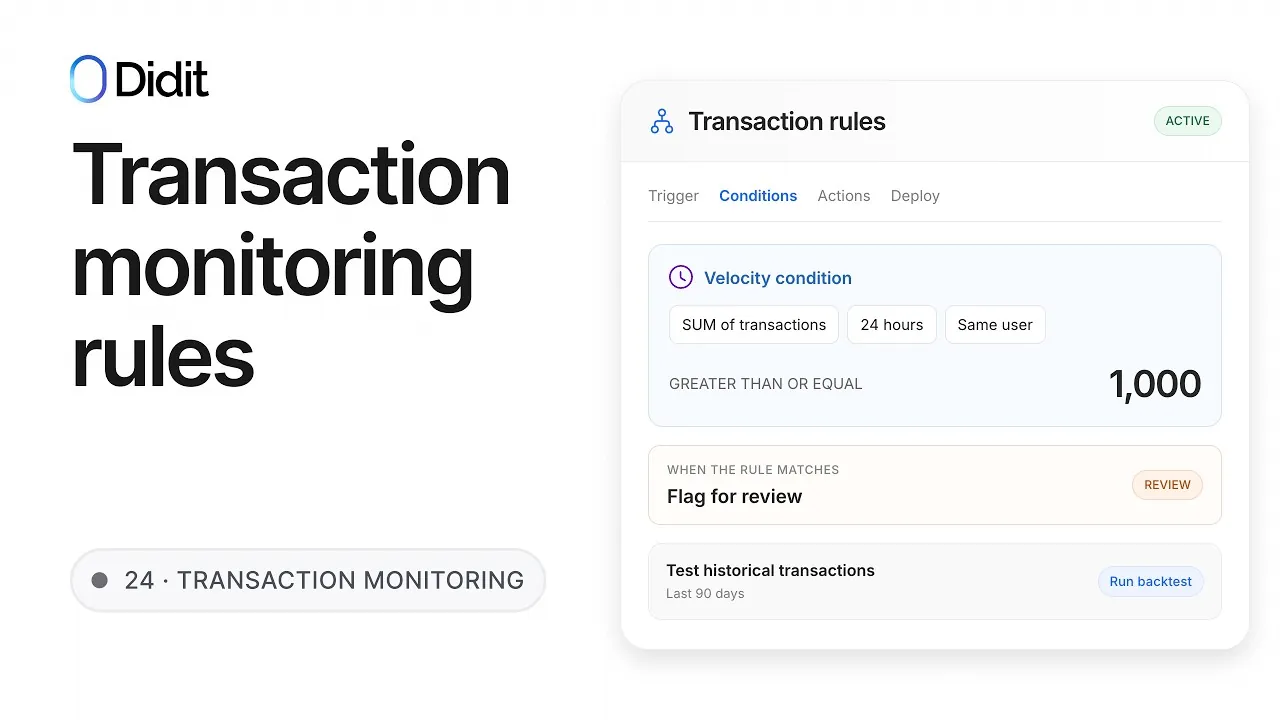
Send each payment to the Create Transaction API with the parties, amount, currency, reference and payment description, as in the ten minute quickstart. When vendor_data matches an existing user or business profile, Didit links the transaction to that entity, which enables cross-session rule evaluation and velocity checks on that importer over time. The response returns a status of APPROVED, IN_REVIEW, DECLINED or AWAITING_USER, a score, and the rules that ran.
Install the presets and write your own rules
The rule library ships over 150 preset scenarios drawn from FATF recommendations, FinCEN advisories, Wolfsberg principles and Egmont typologies. The finance bundle covers structuring, cumulative volume, layering and round amounts, the fatf bundle covers high-risk jurisdiction exposure, and anomaly_detection covers velocity and dormant reactivation. A price deviation check against your own benchmark is a custom rule, because no preset knows what your product should cost. Install presets from Transactions, Rules, Library in the console, through the rule library API, or with the didit_transaction_rule_library_list and didit_transaction_rule_install MCP tools.
Work the alerts
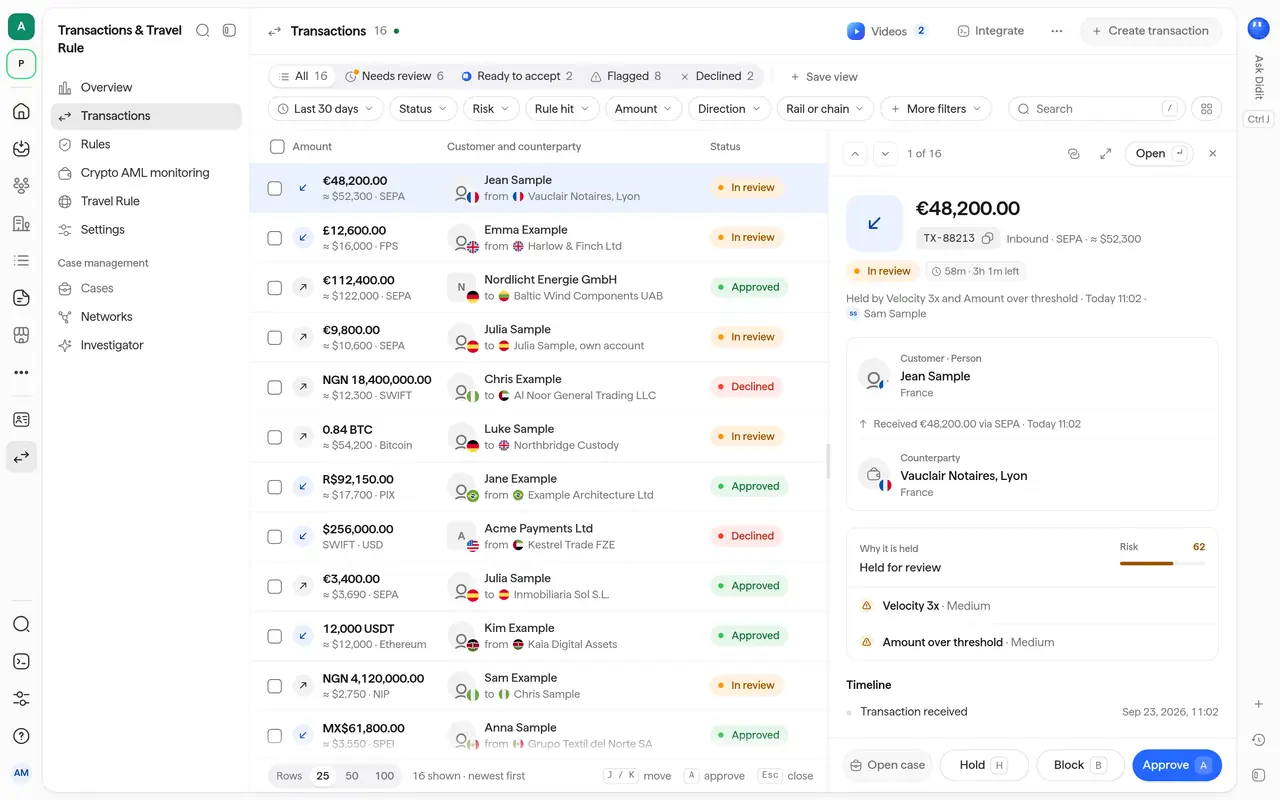
An alert on Didit is a transaction held in IN_REVIEW or AWAITING_USER. There is no separate alert record, so the held transaction is the unit of work. Filter by status, assign to an analyst, add a note, approve or decline, or escalate into a case. When a rule sends a payment to AWAITING_USER, Didit creates a linked remediation session and returns a verification URL for the importer. The triage workflow is documented under KYT alerts.
Open a case and prepare the filing
Add the Create case effect to a rule and any matching payment opens a case automatically, attached to the subject and routed by blueprint, with the matched transaction linked. Cases from transaction rules use the same case management module as every other case in the console. For jurisdictions that require a suspicious activity report, the filing is generated from the resolved case. Didit does not submit reports to regulators, that stays with your compliance team.
Screen the parties on both sides
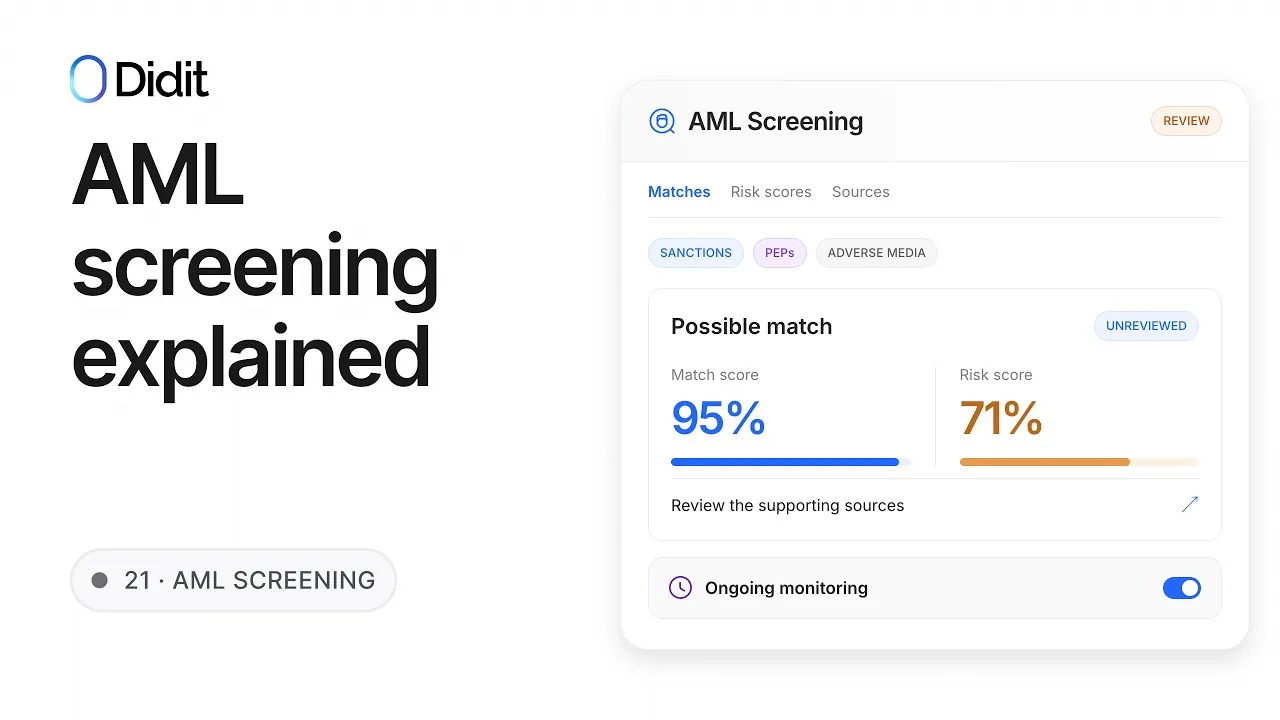
AML Screening checks a person or company against 1,300+ sanctions, PEP and watchlist sources and returns two scores: a match score for how likely the match is the same party, and a risk score for how risky the listed entity is. That split helps analysts distinguish possible matches from entity risk. Ongoing monitoring keeps the person under daily rescreening at $0.07 per person per year. For crypto legs of a trade settlement, wallet screening is $0.15 per screening, or bring your own screening provider and run it inside Didit.
What a trade monitoring program costs
Here is a monthly profile for a payment institution: 20 trading companies verified, 40 UBOs and officers, 500 trade documents, 200 counterparty screening checks and 250,000 monitored transactions. All figures are published list prices, and Business Verification is counted at the $2.00 starting price per company.
- Business Verification: 20 companies x $2.00 = $40.00
- Linked KYC for UBOs: 40 x $0.33 = $13.20
- Person AML: 40 x $0.20 = $8.00
- Company AML: 20 x $0.20 = $4.00
- Document AI: 500 documents x $0.20 = $100.00
- Counterparty AML Screening: 200 x $0.20 = $40.00
- Transaction Monitoring on Scale: 250,000 transactions, 100,000 included, so 150,000 x $0.001 = $150.00
List price total: 40.00 + 13.20 + 8.00 + 4.00 + 100.00 + 40.00 + 150.00 = $355.20. On the Scale plan the identity and AML lines take the 10% discount: 205.20 x 0.90 = $184.68, plus $150.00 of transaction fees, which gives $334.68. The Scale plan costs $299.00 a month and includes $350.00 of monthly credit, so this month of usage is covered by the credit. On Growth the same volumes would run past the included allowance sooner, because Growth includes 10,000 monitored transactions a month and Free includes 1,000.
Common mistakes
- Treating TBML as a bank-only problem. Any company that pays foreign suppliers against an invoice can be the importer in the scheme.
- Checking the parties and never the price. A perfectly verified company can still invoice $41.67 per unit for goods worth $10.
- Relying on a single amount threshold. Split shipments stay under it, which is why velocity and cumulative volume rules exist.
- Discarding the invoice reference. Without it, multiple invoicing is invisible.
- Screening the importer and exporter but not the agent, the forwarder or the free zone intermediary.
- Resolving alerts without a case record, which leaves nothing to file and nothing to review at audit.
- Verifying the trading companies once. Registry monitoring refreshes the company record at $2.00 per company a year.
- Treating an AML name match as a confirmed hit. Read the match score before the risk score, or the queue fills with false positives.
Sources
- Didit docs: Real-Time Transaction Monitoring API overview
- Didit docs: Transaction Monitoring quickstart
- Didit docs: Submit Transactions API payload and data model
- Didit docs: KYT rules library and preset bundles
- Didit docs: KYT alerts, triage and resolution
- Didit docs: KYT cases and SAR investigations
- Didit docs: AML screening overview and two-score system
- Didit pricing page and pricing as JSON, read November 26, 2026
- Didit docs: pricing and billing rules
- Didit Transaction Monitoring product page
- FATF: recommendations and trade-based money laundering guidance
- EUR-Lex: EU anti-money laundering directives
The next step is the sandbox: create an organization at https://business.didit.me/, submit one trade payment with an invoice reference and see which presets fire, with no sales call and no contract.
Try it
Try this in the sandbox
Run the check this guide describes, free.
The product this post is about, taken from its topic. Run it free in the sandbox.
Author
Alberto Rosas
Co-founder and CEO

Keep reading
Other guides in the same topic.
 What Is the Purpose of FICA in South Africa? 2026 Guide
FICA is South Africa's anti-money laundering law. It creates the Financial Intelligence Centre and requires accountable institutions to identify and verify clients, screen for PEP and sanctions risk and report suspicious.
Alberto RosasNov 26, 2026 Sixth Money Laundering Directive (6AMLD): What Changed and Which Rules Apply
6AMLD is Directive (EU) 2018/1673: Member States must criminalise laundering, widen predicate offences and set a four-year penalty floor. It adds no new due diligence duties for firms.
Alberto RosasNov 26, 2026 Automated Sanctions Screening: Canada, the Entity List and Embargoes
Automated sanctions screening matches people and companies against lists such as Canada's autonomous sanctions made under SEMA and JVCFOA and the OFAC SDN List, and returns candidate hits scored for identity confidence and.
Alberto RosasNov 26, 2026Questions
Frequently asked questions
What is trade-based money laundering?
Trade-based money laundering is the movement of illicit value through trade transactions, most often by over-invoicing, under-invoicing, multiple invoicing or misdescribing the goods. The trade itself can be real and the goods legal. What is manipulated is the price, the quantity or the paperwork that banks and customs rely on.
What is an example of trade-based money laundering?
An importer buys 12,000 units worth about $120,000 but the invoice states $500,000. The importer pays the full amount, roughly $380,000 of value moves to the exporter in a free trade zone, and the invoice makes the payment look like an ordinary purchase. If the same invoice number is paid twice, a second technique is stacked on top.
How do you detect trade-based money laundering?
Compare declared unit prices against a benchmark, check quantities against the bill of lading and customs entry, watch for repeated invoice references, and look at the relationship between buyer and seller. Then score the payment in real time against rules for round amounts, near-threshold amounts, cumulative volume, high-risk jurisdictions and dormant companies coming back to life.
What is the difference between over-invoicing and under-invoicing?
Over-invoicing states a price above market value, so the importer pays out more than the goods are worth and the surplus lands with the exporter. Under-invoicing states a price below market value, so the importer pays less on paper and the balance is settled through another channel. Both move value between the same two companies, in opposite directions.
What is over-shipment and under-shipment?
Over-shipment means more goods are shipped than the invoice states, and under-shipment means fewer. Either way the payment no longer matches the cargo, so value can be adjusted without touching the price on the invoice. Detection requires the quantity on the invoice to be compared with the bill of lading and the customs entry.
Why is trade-based money laundering hard to detect?
The underlying trade is usually legitimate, and the manipulation sits in documents that different parties hold. Banks see paperwork, customs see cargo, and payment providers see the transfer, so nobody sees the whole picture by default. Hard-to-price goods and free trade zones widen the plausible range further.
Can Didit detect trade-based money laundering?
Didit scores trade payments against a rules engine with over 150 presets and any custom rule you build, screens the parties on both sides, and manages the investigation in cases. The numbers a price check needs have to arrive in the transaction payload or a custom property, because Didit does not supply commodity benchmarks or customs data. Didit's documented flow evaluates the transaction data you submit. Commodity benchmarks and customs comparisons must come from your own sources.
How much does transaction monitoring cost on Didit?
Transaction Monitoring is $0.001 per transaction beyond the plan allowance. The allowance is 1,000 monitored transactions a month on Free, 10,000 on Growth and 100,000 on Scale, and it resets on the first of each month without rolling over. AML Screening on a counterparty is $0.20 per check and Business Verification starts at $2.00 per company. Usage is paid from the month's plan credit first, then from top-ups.
Do I need KYB to monitor trade-based money laundering?
You need it for the entities on both sides of the invoice. Business Verification pulls official registry data, returns directors and shareholders where the data tier includes them, and lets you link a full identity check for each owner. A verified company profile is what makes related-party trade visible, because shared owners or a shared address are the signal.
Is trade-based money laundering covered by FATF recommendations?
Yes. The FATF publishes guidance on trade-based money laundering and keeps trade transparency on its agenda, and national regimes built on the recommendations require institutions to monitor trade finance activity. The FATF also maintains the list of jurisdictions under increased monitoring that many rule sets use as a high-risk country input.
What is the difference between TBML and structuring?
Structuring splits cash or transfers into amounts below a reporting threshold. Trade-based money laundering manipulates the price, quantity or documentation of goods. The two combine often: a payment just under an approval level for a shipment that is itself over-invoiced shows both patterns at once.
Compliance built in
Audited, certified and attested.
We hold the certifications and build each country's rules into your flows, so you can launch anywhere without worrying. Security and Compliance center
- Regulation encoded into your flows
Tell us what you do and where. Didit lists the rules that apply to you, with sources, and builds the checks each country needs into one workflow.
- Ready for AMLR
Every requirement of the new EU anti-money laundering rules, from checking customers to human review, is already covered by a Didit check.
- Tested in Spain's Treasury sandbox
Spain's Treasury published its supervised sandbox report on Didit's NFC plus active liveness onboarding; SEPBLAC took part and valued the added measures positively.
- Audited, not self-declared
iBeta Level 1 and Level 2. Liveness tested under ISO/IEC 30107-3.
Your obligations · 3 regions
 SOC 2 Type 2
 ISO 27001
 iBeta Level 1 and Level 2
 EU regulator attestation
 FSM youth protection
 GDPR
 EBA remote onboarding
 MiCA compatible
 FIDO Alliance member
- AMLREU AML Regulation ready
Integration · Didit MCP
Run Didit from your own AI agent
Connect Didit to Claude, Cursor, VS Code or ChatGPT and just ask in plain words. Your agent can do anything you can do in the console, with the same permissions you have.
 Add to Claude
 ChatGPT
 Cursor
- Build workflowsDescribe the checks you need. The agent creates and publishes the flow.
- Run investigationsAsk why a session was declined, review cases, search people and companies.
- Change rulesCreate payment rules, test them on past data and switch them on.
- Pull reportsAsk for numbers, exports or the audit log.
Didit Academy


