Travel Document Scanning: Enhancing Airport & Border Security
Automated travel document scanning is revolutionizing airport and border security. This blog explores how advanced ID Verification, liveness detection, and biometric matching secure borders, prevent fraud, and streamline.
 Alberto RosasCo-founder and CEO
Contents
In this guide
Jump to the part you need.
Automated SecurityModern travel document scanning leverages AI for rapid and accurate verification, significantly enhancing airport and border security by automating checks and reducing human error.
Fraud PreventionAdvanced technologies like liveness detection and 1:1 Face Match are critical in preventing sophisticated identity fraud, deepfakes, and the use of forged documents at entry points.
Operational EfficiencyStreamlining document checks through OCR and NFC verification reduces processing times, improves passenger flow, and allows security personnel to focus on higher-risk cases.
Didit's AI-Native SolutionDidit provides a comprehensive, modular suite of identity verification tools, including ID Verification, Passive & Active Liveness, and 1:1 Face Match, offering Core KYC and no setup fees to fortify border security.
The Pivotal Role of Automated Travel Document Scanning
In an increasingly interconnected world, the security of airports and national borders is paramount. The sheer volume of travelers necessitates highly efficient and accurate systems for identity verification. Manual checks, while foundational, are prone to human error, slow processing, and vulnerable to sophisticated fraud attempts. This is where automated travel document scanning comes into play, transforming how security agencies operate. By leveraging cutting-edge technology, these systems can rapidly and reliably verify identities, detect fraudulent documents, and ensure a seamless yet secure passage for legitimate travelers.
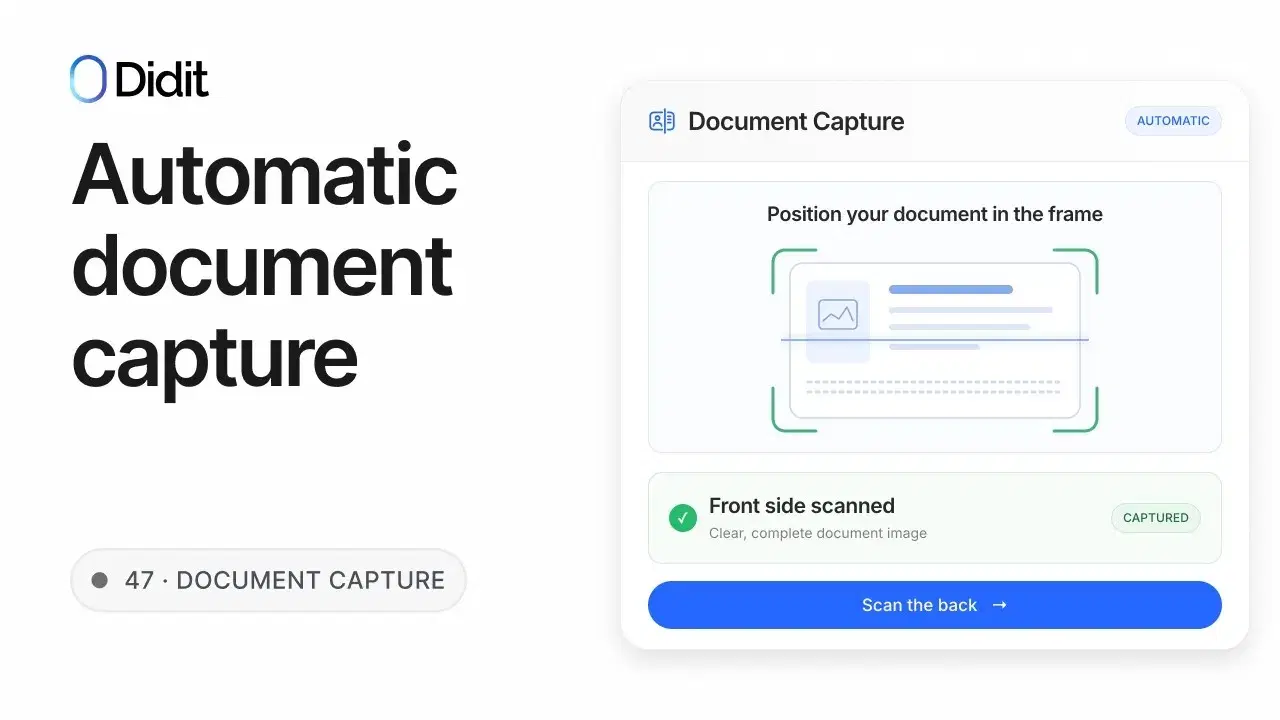
The core of this transformation lies in the ability to quickly and accurately extract data from various travel documents—passports, visas, and national IDs. Didit's ID Verification technology, for instance, utilizes Optical Character Recognition (OCR), Magnetic Stripe Readers (MSR), Machine Readable Zone (MRZ) scanning, and barcode reading to instantly capture and cross-reference crucial information. This not only speeds up the process but also creates a digital trail that enhances accountability and auditability. The integration of such advanced scanning capabilities is no longer a luxury but a necessity for modern border security.
Combating Fraud with Advanced Biometrics and Liveness Detection
One of the most significant challenges in border security is the constant evolution of identity fraud. From expertly forged documents to the use of deepfakes and presentation attacks, fraudsters are always seeking new ways to bypass security measures. Automated travel document scanning, when combined with biometric verification and liveness detection, offers a powerful defense. After a document is scanned and its data extracted, a crucial next step is to verify that the person presenting the document is indeed its legitimate holder.
Didit's Passive & Active Liveness detection ensures that the individual being verified is a real, live person and not a spoof attempt using a photo, video, or 3D mask. This is further bolstered by 1:1 Face Match, which compares a live selfie taken at the point of entry against the photo embedded in the travel document. This biometric comparison provides a high degree of certainty that the traveler matches their identity document. Furthermore, Didit's Document Monitoring feature automatically tracks document expiration dates, alerting authorities to potentially expired or invalid IDs, which is vital for maintaining continuous compliance and reducing fraud risks. This multi-layered approach to verification is essential for catching fraudulent activity that traditional methods might miss.
Streamlining Passenger Flow and Enhancing Operational Efficiency
Beyond security, automated travel document scanning plays a critical role in improving operational efficiency at busy airports and border crossings. Manual data entry and visual inspection are time-consuming and can lead to long queues, passenger frustration, and increased operational costs. By automating these processes, security personnel can process more travelers in less time, significantly improving throughput.
The ability to instantly extract data from documents, cross-reference it with databases, and perform biometric checks frees up security staff from repetitive tasks. This allows them to focus their expertise on analyzing flagged cases, conducting more thorough interviews, and addressing higher-risk situations that require human judgment. Didit's modular architecture means that these verification tools can be seamlessly integrated into existing systems, minimizing disruption and maximizing the benefits. Additionally, features like NFC Verification (ePassport/eID) allow for the secure and rapid extraction of encrypted data directly from chip-enabled documents, providing an even higher level of assurance and efficiency.
Maintaining Compliance and Data Integrity
Regulatory compliance, such as Know Your Customer (KYC) and Anti-Money Laundering (AML) regulations, extends to border control. Ensuring that all travelers are accurately identified and screened against watchlists is a critical aspect of national security and financial crime prevention. Automated document scanning and identity verification systems are indispensable for meeting these stringent requirements.
Didit's platform provides AML Screening & Monitoring capabilities, allowing authorities to screen individuals against global sanctions lists, politically exposed persons (PEPs) lists, and adverse media. This proactive approach helps prevent individuals involved in illicit activities from crossing borders. The structured identity data generated by Didit's AI-native platform ensures that all verification results are standardized, auditable, and easily accessible for reporting and compliance purposes. This commitment to data integrity and compliance is further underscored by Didit's ISO 27001 certification, GDPR compliance, and iBeta Level 1 and Level 2 certification, ensuring enterprise-grade security for sensitive information.
How Didit Helps
Didit stands as the premier AI-native identity platform engineered to enhance airport and border security. Our modular suite of identity primitives is designed for quick integration and unparalleled accuracy. With Didit's ID Verification, authorities can leverage OCR, MRZ, and barcode scanning for rapid and precise document data extraction. Our Passive & Active Liveness detection, combined with 1:1 Face Match, provides robust protection against deepfakes and presentation attacks, ensuring the person presenting the document is its rightful owner. Furthermore, NFC Verification offers the highest level of security by reading encrypted data directly from ePassports and eIDs.
Didit's platform is built to be developer-first, offering an instant sandbox and clean APIs for seamless integration, alongside a no-code Business Console for easy management. We provide Core KYC, pay-per-successful check pricing, and no setup fees, making advanced security accessible. Our AI-native approach ensures continuous improvement in fraud detection and verification accuracy, making Didit the optimal choice for fortifying national security and streamlining travel.
Ready to Get Started?
Ready to see Didit in action? Get a free demo today.
Start verifying identities for free with Didit's free tier.
Try it
Try this in the sandbox
Run the check this guide describes, free.
The product this post is about, taken from its topic. Run it free in the sandbox.
Author
Alberto Rosas
Co-founder and CEO

Keep reading
Other guides in the same topic.
 What Is the Purpose of FICA in South Africa? 2026 Guide
FICA is South Africa's anti-money laundering law. It creates the Financial Intelligence Centre and requires accountable institutions to identify and verify clients, screen for PEP and sanctions risk and report suspicious.
Alberto RosasNov 26, 2026 Sixth Money Laundering Directive (6AMLD): What Changed and Which Rules Apply
6AMLD is Directive (EU) 2018/1673: Member States must criminalise laundering, widen predicate offences and set a four-year penalty floor. It adds no new due diligence duties for firms.
Alberto RosasNov 26, 2026 Automated Sanctions Screening: Canada, the Entity List and Embargoes
Automated sanctions screening matches people and companies against lists such as Canada's autonomous sanctions made under SEMA and JVCFOA and the OFAC SDN List, and returns candidate hits scored for identity confidence and.
Alberto RosasNov 26, 2026Questions
Blog questions
Who writes the Didit blog?
Which topics does the blog cover?
Is the blog available in my language?
Where do I find product updates?
Are these posts legal advice?
How do I find posts on one topic?
Are posts dated?
Do posts link to the docs?
Is the blog the same as the docs?
Compliance built in
Audited, certified and attested.
We hold the certifications and build each country's rules into your flows, so you can launch anywhere without worrying. Security and Compliance center
- Regulation encoded into your flows
Tell us what you do and where. Didit lists the rules that apply to you, with sources, and builds the checks each country needs into one workflow.
- Ready for AMLR
Every requirement of the new EU anti-money laundering rules, from checking customers to human review, is already covered by a Didit check.
- Tested in Spain's Treasury sandbox
Spain's Treasury published its supervised sandbox report on Didit's NFC plus active liveness onboarding; SEPBLAC took part and valued the added measures positively.
- Audited, not self-declared
iBeta Level 1 and Level 2. Liveness tested under ISO/IEC 30107-3.
Your obligations · 3 regions
 SOC 2 Type 2
 ISO 27001
 iBeta Level 1 and Level 2
 EU regulator attestation
 FSM youth protection
 GDPR
 EBA remote onboarding
 MiCA compatible
 FIDO Alliance member
- AMLREU AML Regulation ready
Integration · Didit MCP
Run Didit from your own AI agent
Connect Didit to Claude, Cursor, VS Code or ChatGPT and just ask in plain words. Your agent can do anything you can do in the console, with the same permissions you have.
 Add to Claude
 ChatGPT
 Cursor
- Build workflowsDescribe the checks you need. The agent creates and publishes the flow.
- Run investigationsAsk why a session was declined, review cases, search people and companies.
- Change rulesCreate payment rules, test them on past data and switch them on.
- Pull reportsAsk for numbers, exports or the audit log.
Didit Academy