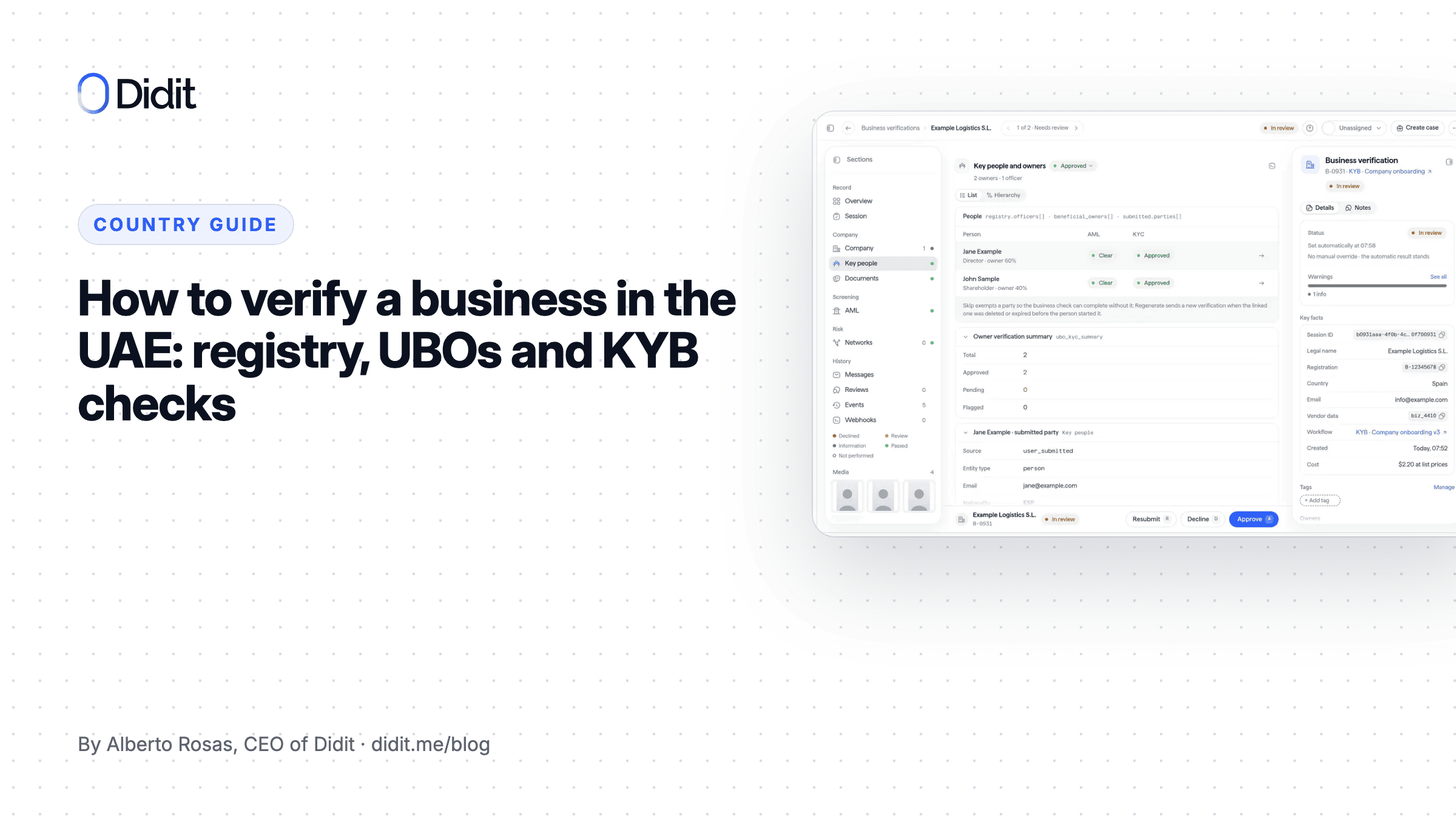
How to verify a business in the UAE: registry, UBOs and KYB checks
Didit verifies UAE companies from $2.00 per company at the Lite tier, with Shareholders and UBO tiers priced per country. Ownership depth depends on what the register holds for that company.
 Alberto RosasCo-founder and CEO
Contents
In this guide
Jump to the part you need.
Didit verifies companies in the United Arab Emirates inside Business Verification (KYB), priced per country and data tier, from $2.00 per company. Lite returns registry identity and status, Shareholders adds direct owners, UBOs resolves the ownership chain to natural persons. This guide covers the UAE legal basis, the public registers, the fields we return, the console and API flow, and a cost example. The caveat: ownership depth depends on what the register holds for that company.
Last updated: November 26, 2026. Prices checked against the live Didit price feed on November 26, 2026.
| Item | Answer |
|---|---|
| Legal basis | Cabinet Resolution No. (109) of 2023 on Real Beneficiary Procedures, built on Federal Decree-Law No. (20) of 2018 (AML), No. (32) of 2021 (Commercial Companies) and No. (37) of 2021 (Commercial Register) |
| Beneficial owner threshold | 25% or more of capital or voting rights, direct or indirect |
| Penalties | Cabinet Resolution No. (132) of 2023, including licence suspension and store closure for a third violation |
| Official lookups | National Economic Registry (Ministry of Economy and Tourism), u.ae licence enquiry services, Abu Dhabi TAMM |
| Didit tiers | Lite, Shareholders, UBOs, priced per country and per tier |
| Didit price | Registry retrieval from $2.00 per company. The UAE has its own Lite, Shareholders and UBO rates in the live per-country price table, so read that row before you quote. For reference, the worldwide ranges are Lite $2.00 to $3.00, Shareholders $5.00 to $22.00 and UBOs $9.00 to $96.00 by country. Manual entry when the company is not found: $0.75 |
| Per-entity extras | Company AML $0.20, person AML $0.20 per party, linked KYC $0.33 per person, KYB documents $0.20 per step |
| Main caveat | You pay for the tier delivered. Where the register holds no ownership record, an ownership request is delivered and billed as Lite |
Start free in the sandbox at https://business.didit.me/, with no sales call. Developers can connect Didit to an AI assistant through https://didit.me/developers/mcp/. The product page is https://didit.me/products/business-verification and every number below is on https://didit.me/pricing/.
What the UAE requires you to verify
Cabinet Resolution No. (109) of 2023 Regulating the Real Beneficiary Procedures (UAE Legislation, Cabinet Resolution No. (109) of 2023, read November 26, 2026) sets the framework and names its own legal basis: Federal Decree-Law No. (20) of 2018 on anti-money laundering and combating the financing of terrorism, Federal Decree-Law No. (32) of 2021 on Commercial Companies, and Federal Decree-Law No. (37) of 2021 on the Commercial Register.
Two definitions drive your file. A Real Beneficiary is a natural person who owns or controls 25% or more of a legal person's capital or voting rights, directly or indirectly. A legal person must keep a private Real Beneficiary Register with each beneficiary's information, opened within 60 days of the Resolution taking effect or of the company coming into existence (UAE Legislation, Cabinet Resolution No. (109) of 2023, read November 26, 2026).
Scope decides how you build the check. The Resolution applies to the Registrar and to legal persons licensed or registered in the State. It excludes companies wholly owned by the Federal or Local Government, companies wholly owned by those companies, Financial Free Zones, and Government Partners.
Penalties are administrative and they escalate. Cabinet Resolution No. (132) of 2023 (UAE Legislation, Cabinet Resolution No. (132) of 2023, read November 26, 2026) was issued on 15 December 2023, effective 30 December 2023 and published in Official Gazette No. 766. Article 3 lets the Registrar impose the penalties in the attached table and, for a third-time violation, also suspend the commercial licence and close the commercial store. Article 1 defines the Beneficiary Register and the Partners or Shareholders Register. Article 2 reaches legal persons licensed or registered in the State, including non-financial free zones, that breach Resolution 109.
Read together, the compliance file for a UAE counterparty is: who the entity is, whether it is in good standing, who owns it down to natural persons at 25%, and whether the company and those people appear on sanctions, PEP or adverse media lists.
The official UAE registers and what each one answers
The UAE Government Portal describes the public registry and licence enquiry services, while the private registers are required by UAE legislation. Read them as different lookups with different answers.
- National Economic Registry (NER). A federal platform that integrates accessible government data at local and national levels, attributed on the portal to the Ministry of Economy and Tourism. The portal says NER provides instant, accurate and comprehensive data for listed economic licences in the UAE, and serves government entities, businessmen, researchers and investors. Through NER you may enquire about economic licences, enquire about an economic activity, or search for the availability of trade names (UAE Government Portal (u.ae), National Economic Register, read November 26, 2026).
- Licence enquiry services. The portal lists links that help check business activities registered and licences issued in the UAE. It attributes enquiries about commercial companies' licences to the Ministry of Economy and Tourism, name ideas to the Telecommunications and Digital Government Regulatory Authority, and says Abu Dhabi provides an Enquire about economic licences service via TAMM (UAE Government Portal (u.ae), Inquire about licences, names and activities, read November 26, 2026).
- The company's own private registers. The Real Beneficiary Register and the Partners or Shareholders Register are private registers that the legal person must maintain under the Resolution. They are not a public lookup, which is why ownership has to come from a data source that resolves the chain rather than from the applicant's word (UAE Legislation, Cabinet Resolution No. (109) of 2023, read November 26, 2026).
Note the gap that slows operations teams down. The Resolution excludes Financial Free Zones and government-owned companies, and the portal routes different enquiries to different authorities: commercial company licences to the Ministry of Economy and Tourism, Abu Dhabi economic licences to TAMM. A UAE check is a coverage question, not a single-register question.
Identifiers and the fields Didit returns
Country keying first, because two formats appear in the docs. The KYB coverage table keys every jurisdiction by ISO 3166-1 alpha-2 and says that code is used across Didit KYB APIs, so the UAE is AE on the registry check and in country_code on session creation and business entity fields. The company data page describes country_code on the stored company record as ISO 3166-1 alpha-3 (ARE). Send AE; read the value you actually receive rather than assuming a format. In the hosted flow the applicant picks the country of incorporation and supplies the company name, the registration number, or both; at least one is required, and when both arrive the lookup combines them. Numbers are normalized where a registry requires it.
| Field | What it holds | Implementation note, not part of the response |
|---|---|---|
company_name | Legal name as registered with the authority | Use it to match the licence and the contract counterparty |
registration_number | Official company registration or incorporation number | Use it with the relevant licensing authority's enquiry service to check the entity |
tax_number | Tax identification number where available | Use it to reconcile the entity with its invoices and tax filings |
company_type | Legal entity type as the registry states it | Use it to confirm the legal form your contract binds |
registry_status | active, dissolved, struck_off, in_liquidation, dormant | Use workflow configuration to flag statuses other than Active |
incorporation_date | Date the company was originally registered | Use it to separate a new shelf company from an operating business |
registered_address | Registered office address | Use it to cross-check the address on the trade documents |
registered_capital | Authorized or issued capital as an amount and currency | Use it as context for the ownership percentages you receive |
legal_entity_identifier | LEI, for financial institutions and listed entities | Use it to link the entity to global reference data where one exists |
is_from_registry | true for registry data, false for manual entry | Use it to see whether a human typed the company in |
registry_ownership_status | not_requested, delivered, not_held, unavailable, pending | Use it to see whether the ownership part of your request was served, and why not |
The third column above is guidance for your workflow, not part of the API response. The first column lists the documented values you receive.
What Didit returns for a UAE company: three tiers
Registry retrieval is sold in three data tiers. Each tier has its own standalone endpoint, and the tier delivered is the tier billed.
| Tier | What you get | Standalone endpoint |
|---|---|---|
| Lite | Company profile, registration and tax numbers, legal form, status, incorporation date, registered address, activity, contact details, and the officers | POST /v3/kyb/select/ |
| Shareholders | Lite plus the direct shareholders, natural persons and corporate entities, with their ownership bands | POST /v3/kyb/shareholders/ |
| UBOs | Shareholders plus the ultimate beneficial owners resolved through the ownership chain | POST /v3/kyb/ubo/ |
Billing rules that matter for the UAE. A registry check is billed once per selected company, at the price of the data tier delivered for that country. Tier availability varies by jurisdiction, and a country whose registry holds no ownership record is delivered and billed at the highest tier its registries can serve, usually Lite. A UBO request whose resolved chain names no natural person as a beneficial owner is delivered and billed as Shareholders, because a corporate chain is not a beneficial owner. When ownership is pending, Lite is charged at selection. If a higher tier is later delivered, only the difference is charged. A company that cannot be found and is typed in manually is billed a flat $0.75. Read the UAE row in the per-country price table before you quote a client, and check the tier columns in the KYB supported countries page.
Ownership is the part buyers underestimate. When the workflow enables nested KYB for corporate UBOs, each corporate party triggers its own child KYB sub-session. The UBO threshold is configurable per workflow under Workflows, the KYB workflow, Risk, UBO threshold, and 25% is the UAE standard. Every key person who is a natural person can take a linked full ID check and person AML, billed per person.
Step by step in the Business Console
- Create the application at business.didit.me and copy an API key from Developer Settings, API Keys.
- Go to Workflows, Create workflow, and choose Business Verification as the workflow type.
- Enable the features you need: Company registry lookup (required), Company AML (recommended), Key People (required for most regulated industries), Documents (optional, pick the document types you require).
- Open Workflows, KYB Registry Check, Countries and set the tier per country. Every country starts at Lite, so raise the UAE to Shareholders or UBOs only where your risk model needs the chain.
- Set the UBO threshold to 25% for UAE entities, then configure Key People roles: enabled or disabled, whether a role requires KYC, which KYC workflow that role uses, and whether the applicant can skip it.
- Save the workflow and copy the
workflow_id. That identifier is what your integration and the rest of this page use.


The same flow through the API
Create a business session, hand the hosted link to the company contact, then read the decision from the webhook or the decision endpoint. The start call is short:
curl -X POST https://verification.didit.me/v3/session/ \
  -H "x-api-key: YOUR_API_KEY" \
  -H "Content-Type: application/json" \
  -d '{
    "workflow_id": "YOUR_KYB_WORKFLOW_ID",
    "vendor_data": "biz-acme-001"
  }'
The response carries session_id, session_number and url. Deliver the url yourself, by your own email or chat. If you already know the company, pass expected_details with company_name, registry_country and registration_number when you create the session: the hosted flow locks the country, pre-fills the search fields and runs the asserted search automatically, and both fields stay editable so the applicant can correct a wrong assertion.
When the session reaches a terminal status, Didit posts a status.updated event. Business sessions carry session_kind set to business, so filter on that and verify the X-Signature-V2 HMAC signature before trusting the payload.
{
  "webhook_type": "status.updated",
  "session_id": "a1b2c3d4-5678-4abc-9def-1234567890ab",
  "session_kind": "business",
  "vendor_data": "biz-acme-001",
  "status": "Approved",
  "decision": { "...": "full KYB decision" }
}
The decision already contains registry data, key people, AML hits, documents and per-feature results, so you only need GET /v3/session/{session_id}/decision/ when you did not subscribe to webhooks or want the decision again later. Statuses to branch on are Approved, Declined (log the warnings[] tags) and In Review (wait for the analyst decision and the follow-up webhook).
For a pure lookup with no hosted flow, use the standalone registry API: POST /v3/kyb/search/ for candidates, then select, shareholders or ubo for the tier. Successful searches served by a paid company-data source cost $0.50 per request, and an empty or failed search is not charged. Our docs do not describe a connector specific to NER or TAMM, so the documented route for UAE data is the registry check and the standalone endpoints above, not a portal scrape.
Worked cost example
This example is illustrative and it is not a UAE quote. The UAE rate is its own row in the per-country price table and in the console for your account, and every range on this page is a worldwide range. The UBO list price runs from $9.00 to $96.00 by country, so the arithmetic below uses $9.00, the lowest published UBO rate. Substitute the UAE row and the sums move with it.
Take a company checked at the UBO tier: two beneficial owners above 25% and one director go through linked KYC and person AML, the workflow screens the company and requires one document step.
- Registry retrieval, UBO tier: $9.00
- Company AML screening: $0.20
- Person AML, three key people at $0.20 each: $0.60
- Linked KYC, three people at $0.33 each: $0.99
- KYB document step, one step at $0.20: $0.20
- Total per company: 9.00 + 0.20 + 0.60 + 0.99 + 0.20 = $10.99
On Scale, the 10% discount applies to each Didit price, not to carrier pass-through: 8.10 + 0.18 + 0.54 + 0.891 + 0.18 = $9.89. A Lite lookup with one person checked is 2.00 + 0.20 + 0.33 + 0.20 = $2.73. The company-only total is $2.20. The standalone route has its own shape: a $0.50 search plus a $2.00 Lite retrieval is $2.50 per company when the search returns paid-source results. Registry monitoring, if it were enabled for the country, is priced at $2.00 per company per year.
Fallbacks when the source is down or has no match
- No match in the register. The applicant submits the company manually and
is_from_registryisfalse. Manual entry is billed at a flat $0.75. If the company is not found in the registry, the applicant submits the company manually and the flat manual-entry price applies. - Ownership not held.
registry_ownership_statusisnot_heldwhen the ownership source answered that it does not list the company, which was found by another source. The Lite profile is delivered and billed, andregistry_data.ownership_errorreadscompany_not_found. This is a coverage gap, not a fraud signal. - Ownership unavailable.
unavailablemeans the data was not served: the record names no owner, the section was not returned, or the registry could not be asked.ownership_errortells you which, andno_owners_on_recordis a different finding fromownership_section_unavailable. A missing list is not an empty list. - Section failures. A section the registry did not return is recorded under
registry_data.section_errorswith the status the registry answered, for example a 404 forshareholders. A section is never delivered in part: a half-served list fails the attempt and is retried rather than shipped short. - Slow ownership. Some registries return the company profile before the ownership report is ready. The report continues in the background while the applicant completes document steps, and a pending report is not a completed registry check or an automatic approval. When ownership is pending, Lite is charged at selection. If a higher tier is later delivered, only the difference is charged, and the total never exceeds the quote for the tier you requested.
- Wrong candidate selected. The hosted UI offers a one-tap search as company name instead override on registration-number results, and the search mode can be exact or contains when the legal name is uncertain.
- Upstream outage. When a registry cannot be asked, the retrieval is not completed on that attempt and a new request is answered with the registry-unavailable error rather than a partial profile. Treat that as a retry, not a decline, and keep the session open for review.
Sources
- Didit docs: KYB supported countries and registry coverage
- Didit docs: KYB registry pricing by country and tier
- Didit docs: KYB registry API, search and select
- Didit docs: KYB quickstart
- Didit docs: company registry lookup and retrieved fields
- Didit docs: UBO extraction and ownership chains
- Didit docs: officers and representatives inside Key People
- Didit docs: console workflows
- Didit docs: webhooks and signature verification
- Didit pricing
- UAE Government Portal (u.ae), Inquire about licences, names and activities, https://u.ae/en/information-and-services/business/important-digital-services/inquire-about-licences-names-and-activities, read November 26, 2026
- UAE Government Portal (u.ae), National Economic Register, https://u.ae/en/information-and-services/business/important-digital-services/national-economic-register, read November 26, 2026
- UAE Legislation, Cabinet Resolution No. (109) of 2023 Regulating the Real Beneficiary Procedures, https://uaelegislation.gov.ae/en/legislations/2176/download, read November 26, 2026
- UAE Legislation, Cabinet Resolution No. (132) of 2023 Concerning the Administrative Penalties, https://uaelegislation.gov.ae/en/legislations/2314, read November 26, 2026
The next step is the sandbox: create a KYB workflow at https://business.didit.me/, run a UAE company through it, and read the tier and ownership statuses on the decision before you wire anything into production. No sales call is needed. Didit serves 4,000+ companies.
Try it
Try this in the sandbox
Run the check this guide describes, free.
The product this post is about, taken from its topic. Run it free in the sandbox.
Author
Alberto Rosas
Co-founder and CEO

Keep reading
Other guides in the same topic.
 Australia ID Verification API: Government Database Checks
Didit checks typed identity details against the source named for a country in its live catalog. For Australia, confirm the source and availability first. A match returns data_match, not a document check.
Alberto RosasNov 26, 2026 How to verify a business in Nigeria: CAC, BOR and KYB
Verify a Nigerian company at the CAC registry, then resolve control through the PSC record. Didit returns Lite, Shareholders or UBO data where the registry supports it, from $2.00, billed at the tier the registry delivers.
Alberto RosasNov 26, 2026 How to verify a business in India: registry, UBOs and KYB checks
Verify an Indian company with a Didit registry lookup at Lite, Shareholders or UBO tier, company AML and linked KYC per owner. Priced per company from $2.00.
Alberto RosasNov 26, 2026Questions
Frequently asked questions
How do I verify a company in the United Arab Emirates?
Check the entity in the National Economic Registry or with the relevant licensing authority to confirm the licence and activity, then establish the ownership chain to natural persons at 25% or more. With Didit you run a KYB session that queries the registry, returns the company profile at Lite, and adds shareholders or UBOs at the higher tiers, priced per country from $2.00 per company.
What is the UBO threshold in the UAE?
Cabinet Resolution No. (109) of 2023 defines a Real Beneficiary as a natural person who owns or controls 25% or more of a legal person's capital or voting rights, directly or indirectly. The threshold is configurable per workflow in Didit, and 25% is the value to set for UAE entities.
Is the UAE covered by Didit KYB, and what does a check cost?
Yes. The UAE appears on the KYB coverage list under the ISO code AE, with tier availability shown per country. Registry retrieval starts at $2.00 per company. The worldwide ranges are Lite $2.00 to $3.00, Shareholders $5.00 to $22.00 and UBOs $9.00 to $96.00, so read the UAE row on the per-country price table before you quote.
Can I verify a UAE free zone company?
Cabinet Resolution No. (109) of 2023 excludes Financial Free Zones from its scope, while the penalties resolution reaches legal persons licensed or registered in the State including non-financial free zones. In practice, coverage for a free zone entity depends on whether a registry source lists it. If it is not found, the applicant submits the company manually, the check is billed a flat $0.75, and is_from_registry is false.
What happens if the company is not found in the registry?
The session continues with manual entry. Didit sets is_from_registry to false, bills the flat $0.75 manual-entry price, and you close the gap with document collection and Key People verification. A manual entry is not a failed check, it is a check without registry corroboration.
What is the difference between the Lite, Shareholders and UBO tiers?
Lite returns the company profile, identifiers, status, registered address, activity and officers. Shareholders adds the direct shareholders, natural persons and corporate entities, with ownership bands. UBOs adds the ultimate beneficial owners resolved through the ownership chain. Each tier has its own price per country and its own standalone endpoint.
Do I have to verify the directors and shareholders individually?
For most regulated industries, yes. Key People is where directors, shareholders, UBOs and representatives live, and each role is configured per workflow: enabled, whether it requires KYC, which KYC workflow it uses, and whether the applicant may skip it. A linked full ID check is $0.33 per person and person AML is $0.20 per person.
How long does a UAE KYB check take?
The registry search runs asynchronously and large registries can take a few seconds to return candidates. Some registries deliver the company profile before the ownership report is ready, in which case the report continues in the background while the applicant completes document steps. The Didit quickstart walks a complete KYB session end to end in under 10 minutes.
Can I do a registry lookup without a hosted link?
Yes, through the standalone registry API. Call POST /v3/kyb/search/ for candidates, then POST /v3/kyb/select/ for Lite, POST /v3/kyb/shareholders/ or POST /v3/kyb/ubo/. Successful searches served by a paid source cost $0.50 per request, and profile retrieval is billed separately at the country tier price.
Does Didit monitor a UAE company's registry record for changes?
Registry monitoring is on the price list at $2.00 per company per year, and the docs describe it as coming soon, with no country enabled as of the last check. The planned behaviour is that the registry pushes changes of status, officers, ownership and address, the business session returns to review and a data.updated webhook with trigger kyb_registry_change fires. Confirm availability in your account before promising it.
Compliance built in
Audited, certified and attested.
We hold the certifications and build each country's rules into your flows, so you can launch anywhere without worrying. Security and Compliance center
- Regulation encoded into your flows
Tell us what you do and where. Didit lists the rules that apply to you, with sources, and builds the checks each country needs into one workflow.
- Ready for AMLR
Every requirement of the new EU anti-money laundering rules, from checking customers to human review, is already covered by a Didit check.
- Tested in Spain's Treasury sandbox
Spain's Treasury published its supervised sandbox report on Didit's NFC plus active liveness onboarding; SEPBLAC took part and valued the added measures positively.
- Audited, not self-declared
iBeta Level 1 and Level 2. Liveness tested under ISO/IEC 30107-3.
Your obligations · 3 regions
 SOC 2 Type 2
 ISO 27001
 iBeta Level 1 and Level 2
 EU regulator attestation
 FSM youth protection
 GDPR
 EBA remote onboarding
 MiCA compatible
 FIDO Alliance member
- AMLREU AML Regulation ready
Integration · Didit MCP
Run Didit from your own AI agent
Connect Didit to Claude, Cursor, VS Code or ChatGPT and just ask in plain words. Your agent can do anything you can do in the console, with the same permissions you have.
 Add to Claude
 ChatGPT
 Cursor
- Build workflowsDescribe the checks you need. The agent creates and publishes the flow.
- Run investigationsAsk why a session was declined, review cases, search people and companies.
- Change rulesCreate payment rules, test them on past data and switch them on.
- Pull reportsAsk for numbers, exports or the audit log.
Didit Academy


