UBO Ownership Threshold Rule: 25% vs 50% Explained
Many frameworks use 25% as a reference point for beneficial ownership. Exact-boundary treatment depends on the applicable rule, and control can qualify a person below the cutoff. OFAC's 50 Percent Rule is a sanctions test.
 Alejandro RosasCo-founder and CTO
Contents
In this guide
Jump to the part you need.
For compliance teams and developers onboarding businesses, a beneficial ownership threshold helps identify which natural persons qualify through ownership. Many frameworks use 25% as a reference point. Whether exactly 25% qualifies depends on the applicable rule, and control can qualify a person below the ownership cutoff. Our Business Verification registry lookups start at $2.00 per company, with prices varying by country and tier.
Last updated: November 26, 2026. Prices checked against the live Didit price feed on November 26, 2026.
| Framework | What is tested | Threshold | Note |
|---|---|---|---|
| EU, Directive (EU) 2015/849, Article 3(6)(a) | Ownership or control through other means | 25% plus one share or an ownership interest of more than 25% is an indication of ownership | Member States may use a lower percentage. |
| UK, Companies Act 2006, Schedule 1A | Shares or voting rights, plus control | More than 25% of shares or voting rights. Separate control conditions also apply. | Exactly 25% does not cross this wording. |
| US, FinCEN CDD Rule | Equity ownership and a separate control prong | Each individual with at least 25% direct or indirect equity ownership, if any, plus one qualifying control person | Applies to covered financial institutions and legal entity customers, subject to exceptions. |
| Singapore, Register of Registrable Controllers | Shares or voting power under the relevant significant-interest tests, plus separate significant control | More than 25% of shares or voting power under the relevant significant-interest tests. Separate significant-control criteria also apply. | Voting and economic rights can diverge. |
| OFAC 50 Percent Rule | Sanctions blocking, not UBO identification | 50% or more, direct or indirect, individually or in aggregate | An entity can be blocked without being named on a list. |
What the UBO threshold rule is
A UBO threshold rule is the ownership or control test in an applicable framework that decides which natural persons a business must identify as ultimate beneficial owners. Many frameworks use 25% as a reference point, but the exact comparison and any separate control test come from the rule you are applying. We use the configured threshold to route individual KYC for UBOs and shareholders. Apply the governing rule separately to exact-boundary holdings and control rights.
Where the rule is used
- Business onboarding and KYB, to decide which owners of the applicant need identification and which need identity verification.
- Account opening in payments, banking and lending, when the applicable customer due diligence rule requires the institution to identify the beneficial owners of a legal entity customer.
- Crypto and VASP onboarding, when the applicable customer due diligence rule requires the institution to identify the beneficial owners of a legal entity customer. Travel Rule obligations are a separate track.
- Statutory registers of beneficial owners, registry filings, periodic review and event-driven refresh after an ownership change.

Where the 25% figure comes from
FATF's Interpretive Note to Recommendation 10 gives 25% as an example of an ownership threshold. The applicable legal framework sets the exact comparison and any separate control test. The UK PSC regime is one example: Schedule 1A to the Companies Act 2006 sets out the more than 25% share or voting right conditions.
25% or more versus more than 25%
The wording at the boundary decides real cases. Under the FinCEN CDD Rule, covered US financial institutions identify each individual with at least 25% of a legal entity customer's equity interests, directly or indirectly, plus one individual with significant responsibility to control, manage or direct the customer. The UK PSC regime covers individuals ultimately owning or controlling more than 25% of shares or voting rights. It also covers the right to appoint or remove a majority of the board and the right to exercise, or actual exercise of, significant influence or control. A further condition applies to significant influence or control over certain trusts or firms.
Four equal shareholders each hold exactly 25%. Under a 25% or more test, all four cross the line. Under a more than 25% test, none does on ownership alone, and the analysis moves to control. Record the rule and the boundary wording in the decision file.
Tracing indirect ownership, with the arithmetic
To estimate proportional economic ownership, multiply the percentages along each path. Apply the governing framework's attribution rules before deciding who qualifies. For example, the UK PSC regime uses majority-stake rules to attribute indirectly held shares and voting rights.
Acme Corp (target)
  - 60% to Acme Holdings Ltd
      - 75% to Jane Doe (natural person)
- 40% to John Smith (natural person)- Jane Doe: 60% x 75% = 45% effective ownership of Acme Corp. On these illustrative numbers she meets a 25% economic ownership test, subject to the governing framework's attribution rules.
- John Smith: 40% direct ownership of Acme Corp. On these illustrative numbers he meets a 25% economic ownership test, subject to the governing framework's attribution rules.
On the illustrative 25% economic ownership test, both are disclosed. At an illustrative 50% economic ownership cutoff, neither person qualifies. Add another layer: 60% x 40% x 70% = 16.8%. Below 25% on the numbers alone, so review voting arrangements, appointment rights and any agreement that changes who directs the entities. A person below the line can still be a UBO through control, and a person above it can still be a nominee.

Aggregating stakes and control without ownership
A person can reach the company through several paths. Holding 15% directly and owning 60% of a vehicle that holds 20% of the target gives 15% + (60% x 20%) = 27%, assuming ordinary rights and no overlapping interest counted twice. Trusts, nominees, preference shares and circular holdings need more than arithmetic. Establish the parties and rights from the governing documents, then assess board appointment rights, voting agreements, management contracts, veto rights and nominees acting for another person.
The 50 Percent Rule is a separate sanctions test
Under OFAC's 50 Percent Rule, an entity is blocked when one or more blocked persons own 50% or more of it, directly or indirectly, individually or in aggregate. The entity can be blocked without appearing by name on the SDN List. Control without the required ownership does not block it under this rule, although other prohibitions can still apply.
For a direct example, blocked owners at 30% and 20% reach 50% together. For indirect structures, apply OFAC's guidance at each relevant layer. A worked chain from FAQ 401: a blocked person owns 50% of Company A, and Company A owns 50% of Company B. Company A is blocked because a blocked person owns 50% of it. Company B is blocked because a blocked person indirectly owns 50% through Company A. Both are blocked even though neither is named on the SDN List.
Keep the calculations apart. A UBO result below a threshold is not a sanctions clearance, and a sanctions file is not a UBO determination.
The control prong and the senior managing official fallback
Under FinCEN's CDD Rule, covered institutions identify any individuals who meet the ownership threshold and one individual with significant responsibility to control, manage or direct the customer. A senior manager can satisfy the control prong if their responsibilities qualify. Separately, FATF's Interpretive Note to Recommendation 10 calls for identifying the relevant senior managing official when neither ownership nor control through other means identifies a natural person. Apply the fallback specified by the governing framework.
Terminology and fields that carry the percentage
| Field or path | What it records | Note |
|---|---|---|
ownership_percent | Economic or equity share for the role | Compared against the workflow threshold |
voting_percent | Share of voting power on shareholder resolutions | Voting power can differ from economic ownership when share classes carry different rights. |
role in the hosted form, roles[] in the decision | The hosted form collects one or more roles per party; the decision returns a roles array with roles[].role, roles[].ownership_percent and roles[].voting_percent. | Read percentages per role when comparing parties. |
key_people_checks[].registry.beneficial_owners[] | UBOs the registry disclosed | Registry bucket in the decision |
key_people_checks[].submitted.parties[] | Parties the business admin confirmed | Submitted bucket in the decision |
ubo_kyc_summary | Rollup of UBO KYC progress | Progress rollup, not a decision status |
The Key People feature outcome is separate from the rollup: Approved, Declined and In Review are feature outcomes after the child sessions finish.
Identify, verify and document
Identification asks who the relevant people are, using the registry record, shareholder register, ownership chart and control agreements. Identity verification asks whether the identity information about each identified person can be relied on, using a document check, liveness, face match and the person's declared details. A passport does not prove a shareholding, and a company filing does not prove that the person completing onboarding is the owner. The duties differ across frameworks, so identify, verify and document as separate steps.
How we apply the threshold in Didit
The threshold is a workflow setting
Set it in the Business Console under Workflows, then the KYB workflow, then Risk, then UBO threshold. One setting per workflow, so a program serving several jurisdictions can run several workflows. To start a business session through the API, send a KYB workflow_id to POST /v3/session/.
Registry data comes in three tiers
Lite returns the company profile and officers. Shareholders adds direct shareholders with ownership bands. UBOs adds beneficial owners resolved through the chain. Tier availability varies by jurisdiction, and pricing follows country and tier. Business Verification starts at $2.00 per company. We offer registry coverage across 220+ countries and territories. Where a registry holds no ownership record, a Shareholders or UBOs request is delivered and billed at the highest tier that country can serve, usually Lite.
Prefill, submission and late data
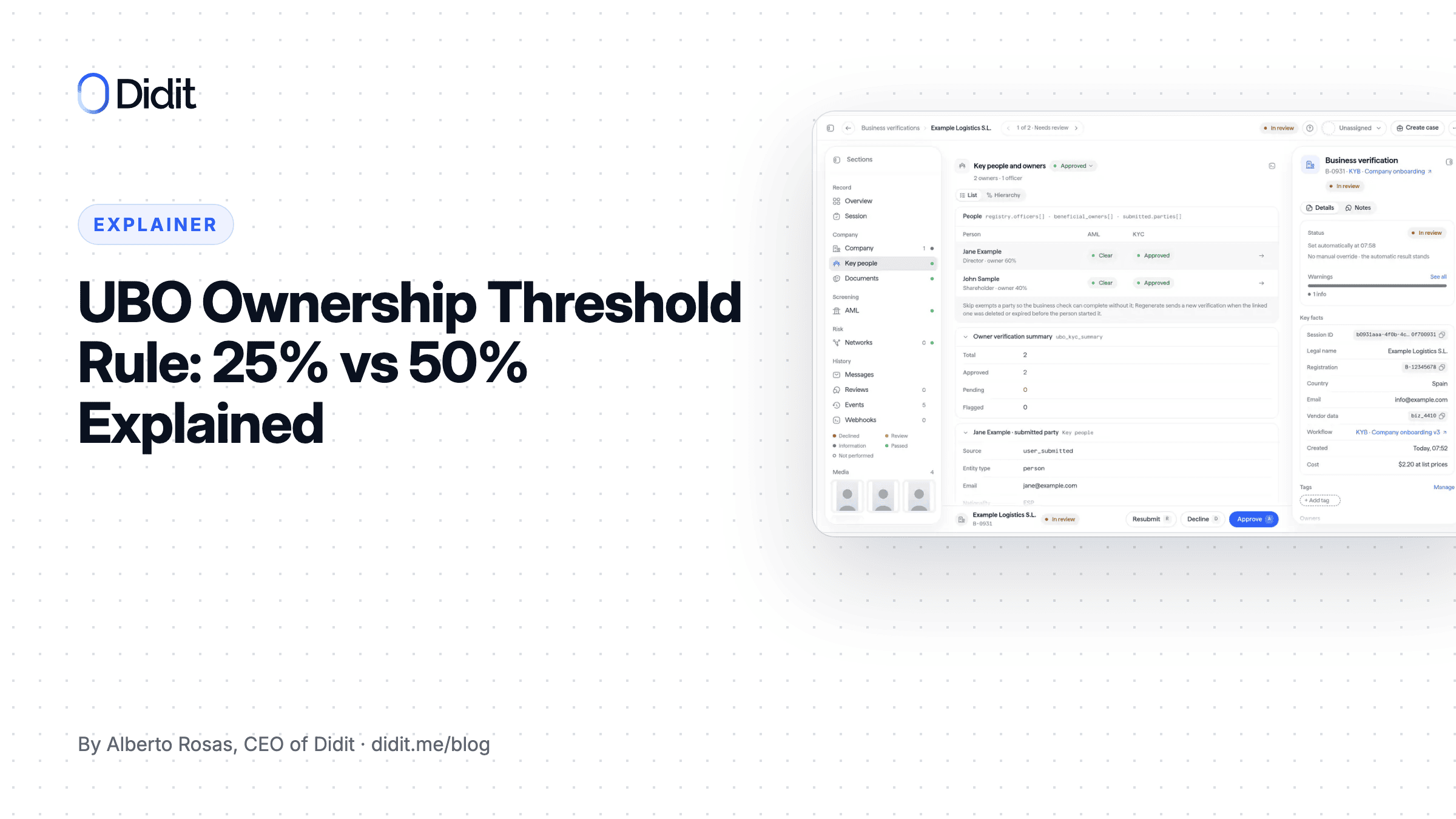
With registry prefill enabled, Key People starts with the UBOs, shareholders and officers the registry returned. The applicant can edit, add or remove parties before submitting. Registry and submitted parties both stay in the decision, so an analyst can compare them. If registry data arrives after submission, it stays in the registry evidence. The submitted parties and child-session routing stay as they were.
Developer check: compare key_people_checks[].registry.beneficial_owners[] with key_people_checks[].submitted.parties[]. If the registry shows Jane Doe at 45% and the submitted list shows her at 40%, review the shareholder register and the registry ownership report for the five point gap before approving.

What the threshold changes downstream
For UBO and shareholder roles, parties below the workflow cutoff do not require individual KYC. Eligible natural persons start child KYC when their role settings require it, subject to any allowed skip. Key People stays in Awaiting User while a required child session is pending. Corporate UBO roles can start child KYB when nested KYB is enabled. Every identified key person is screened for AML, with company and person screening reported separately.
Worked cost example
The workflow requires linked KYC for all three people, two UBOs and one director. Unit prices from the November 26, 2026 feed:
- Business Verification registry lookup: priced by country and data tier, starting at $2.00 per company.
- Company AML screening: $0.20 per check.
- Person AML, per UBO or officer: $0.20 per person.
- Linked full ID check (KYC): $0.33 per check.
- KYB document collection step: $0.20 per step.
- Key People extraction: $0.00.
For this file, one company AML check ($0.20) + three person AML checks (3 × $0.20 = $0.60) + three linked full ID checks (3 × $0.33 = $0.99) + one KYB document step ($0.20) = $1.99 at list price. Key People extraction is free. Add the published registry rate for the applicant's country and data tier to get the total.
The $2.00 figure is the published starting price for Business Verification, not a fixed registry rate for every country or tier.
Common mistakes
- Using 50% as the UBO threshold because the OFAC rule sounds similar. It is a sanctions test, not an ownership definition.
- Choosing the threshold from the subsidiary's country of incorporation alone. Identify the rule governing the onboarding or filing obligation before selecting a threshold.
- Ignoring the boundary wording, so an exactly 25% holder is either disclosed or missed by accident.
- Stopping at the multiplication and never testing control.
- Treating a nominee or a holding company as the owner instead of tracing to the natural person.
- Assuming the registry returned the whole structure. Coverage and tier depth vary by country.
- Recording a senior managing official fallback as if it were an ownership finding. It is a fallback, and it has its own file.
- Reading a below-threshold UBO result as a sanctions clearance.
Sources
- Didit docs: UBO API, beneficial ownership extraction and thresholds
- Didit docs: KYB Key People, roles and threshold routing
- Didit docs: officers and representatives in the Key People model
- Didit docs: Business Verification API overview
- Didit docs: KYB integration guide
- Didit docs: KYB registry pricing by country and tier
- Didit docs: KYB supported countries and registry tiers
- Didit pricing page
- Didit live price feed, read November 26, 2026
- Didit MCP server
- EUR-Lex: Directive (EU) 2015/849 on anti-money laundering
- FATF: Recommendations and Interpretive Note to Recommendation 10
- UK Companies Act 2006, Schedule 1A
- FinCEN Customer Due Diligence Rule
- OFAC FAQ 401: direct and indirect ownership under the 50 Percent Rule
- Singapore Companies Act 1967
Open the sandbox at business.didit.me, run a KYB session against a company with at least one holding company in its chain, and set the UBO threshold on the workflow. You will see which UBO and shareholder roles sit below the workflow cutoff, which eligible natural persons start child KYC under their role settings, and where the registry and submitted evidence land. No sales call needed.
Try it
Try this in the sandbox
Run the check this guide describes, free.
The product this post is about, taken from its topic. Run it free in the sandbox.
Author
Alejandro Rosas
Co-founder and CTO

Keep reading
Other guides in the same topic.
 What Is the Purpose of FICA in South Africa? 2026 Guide
FICA is South Africa's anti-money laundering law. It creates the Financial Intelligence Centre and requires accountable institutions to identify and verify clients, screen for PEP and sanctions risk and report suspicious.
Alberto RosasNov 26, 2026 Sixth Money Laundering Directive (6AMLD): What Changed and Which Rules Apply
6AMLD is Directive (EU) 2018/1673: Member States must criminalise laundering, widen predicate offences and set a four-year penalty floor. It adds no new due diligence duties for firms.
Alberto RosasNov 26, 2026 Automated Sanctions Screening: Canada, the Entity List and Embargoes
Automated sanctions screening matches people and companies against lists such as Canada's autonomous sanctions made under SEMA and JVCFOA and the OFAC SDN List, and returns candidate hits scored for identity confidence and.
Alberto RosasNov 26, 2026Questions
Frequently asked questions
What percentage of ownership makes someone a UBO?
There is no single global percentage. Many frameworks use 25% as a reference point for ownership or voting rights, and control can qualify a person below the ownership cutoff. For example, Singapore's Register of Registrable Controllers uses more than 25% of shares or voting power under the relevant significant-interest tests, and separate significant-control criteria also apply. Whether exactly 25% qualifies depends on the applicable rule, so confirm the wording in the law that governs your onboarding or filing.
Is the UBO threshold 25% or 50%?
Most beneficial ownership frameworks use 25% as a reference point. OFAC's 50 Percent Rule uses 50% as a sanctions blocking threshold. The rule decides whether an entity is blocked because blocked persons own 50% or more of it, directly or indirectly, individually or in aggregate. It is not a beneficial ownership definition.
Does exactly 25% ownership count?
Under a 25% or more test, yes. Under a more than 25% test, no, and the analysis moves to control rights. Record the rule and the boundary wording in the decision file so a reviewer can reproduce the decision later.
A partner holds 12% of a partnership's capital. Is that partner a UBO?
A 12% capital interest falls below a 25% test that measures capital. The applicable partnership rule can also consider profit rights, voting rights, indirect interests or control. Check the partnership deed and the governing rule before deciding whether the partner qualifies.
Does 51% ownership change anything?
A person with a 51% beneficial interest meets a 25% ownership test. Check whether the registered holder acts for someone else, assess control separately, and identify every other person whose holdings meet the applicable cutoff. Under FinCEN's CDD Rule, the control person must independently meet the control-prong criteria.
What if nobody meets the ownership threshold?
Apply the relevant control test and any fallback procedure your framework prescribes. Under the FinCEN CDD Rule, the control person is required even when ownership-based individuals have already been identified. Document the inquiries made, and keep the fallback reasoning separate from an ownership finding.
How do you calculate indirect ownership through holding companies?
To estimate proportional economic ownership, multiply the percentages along each path. A person holding 60% of a company that holds 50% of the target has 60% x 50% = 30% on those illustrative numbers. Apply the governing framework's attribution rules, such as the UK PSC majority-stake rules for indirectly held shares and voting rights, then check voting agreements, appointment rights and other arrangements the arithmetic does not capture.
Does the threshold affect who gets AML screening?
We screen every identified key person for AML and report company and person screening separately. The workflow threshold affects which UBO and shareholder roles require individual KYC, not whether the structure is screened. Eligible natural persons start child KYC when their role settings require it, subject to any allowed skip.
Compliance built in
Audited, certified and attested.
We hold the certifications and build each country's rules into your flows, so you can launch anywhere without worrying. Security and Compliance center
- Regulation encoded into your flows
Tell us what you do and where. Didit lists the rules that apply to you, with sources, and builds the checks each country needs into one workflow.
- Ready for AMLR
Every requirement of the new EU anti-money laundering rules, from checking customers to human review, is already covered by a Didit check.
- Tested in Spain's Treasury sandbox
Spain's Treasury published its supervised sandbox report on Didit's NFC plus active liveness onboarding; SEPBLAC took part and valued the added measures positively.
- Audited, not self-declared
iBeta Level 1 and Level 2. Liveness tested under ISO/IEC 30107-3.
Your obligations · 3 regions
 SOC 2 Type 2
 ISO 27001
 iBeta Level 1 and Level 2
 EU regulator attestation
 FSM youth protection
 GDPR
 EBA remote onboarding
 MiCA compatible
 FIDO Alliance member
- AMLREU AML Regulation ready
Integration · Didit MCP
Run Didit from your own AI agent
Connect Didit to Claude, Cursor, VS Code or ChatGPT and just ask in plain words. Your agent can do anything you can do in the console, with the same permissions you have.
 Add to Claude
 ChatGPT
 Cursor
- Build workflowsDescribe the checks you need. The agent creates and publishes the flow.
- Run investigationsAsk why a session was declined, review cases, search people and companies.
- Change rulesCreate payment rules, test them on past data and switch them on.
- Pull reportsAsk for numbers, exports or the audit log.
Didit Academy


