UK DVS Trust Framework: Setting Up Your Compliance Audit Trail
The UK Digital Verification Services (DVS) Trust Framework sets out standards for digital identity verification. Establishing a robust compliance audit trail is crucial for organizations to demonstrate adherence and maintain trust
 Alberto RosasCo-founder and CEO
Contents
In this guide
Jump to the part you need.
Establishing a comprehensive compliance audit trail is essential for any organization operating under the UK Digital Verification Services (DVS) Trust Framework, as it provides verifiable proof of adherence to the framework's strict standards for digital identity verification.
What is the UK DVS Trust Framework?
The UK DVS Trust Framework is a set of rules, standards, and processes designed to ensure consistent, secure, and trustworthy digital identity verification across the UK. It aims to streamline identity checks, reduce fraud, and provide a secure digital environment for individuals and organizations. The framework categorizes identity service providers (ISPs) based on the level of identity assurance they provide, and it mandates specific requirements for data protection, security, and operational resilience.
For organizations, compliance with the UK DVS Trust Framework is not just about meeting regulatory obligations; it's about building trust with users and partners. A reliable audit trail is the backbone of this compliance, offering transparency and accountability for every step of the identity verification process.
Why a Compliance Audit Trail is Critical for the UK DVS Trust Framework
An effective compliance audit trail serves several vital functions within the context of the UK DVS Trust Framework:
- Demonstrating Adherence: It provides concrete evidence that your processes align with the framework's requirements for data handling, consent, verification methods, and security protocols.
- Risk Management: By meticulously logging activities, organizations can identify potential vulnerabilities, track incidents, and demonstrate proactive risk mitigation efforts.
- Investigative Support: In the event of a security breach, data compromise, or suspicious activity, a detailed audit trail is invaluable for forensic analysis, understanding the scope of the incident, and fulfilling reporting obligations.
- Regulatory Scrutiny: During audits or reviews by regulatory bodies, a well-maintained audit trail can quickly and clearly demonstrate your compliance posture, potentially reducing the burden of inquiries.
- Operational Improvement: Analyzing audit logs can reveal inefficiencies or bottlenecks in your identity verification workflows, leading to process optimization.
Key Components of a UK DVS Trust Framework Compliance Audit Trail
To meet the demands of the UK DVS Trust Framework, your audit trail should capture specific data points. Here's a breakdown of essential components:
1. User Consent and Data Handling
- Consent Records: Document when, how, and what consent was given by the user for their identity data to be processed and shared. This includes specific purposes and third-party disclosures.
- Data Minimization: Records demonstrating that only necessary data was collected for the specified purpose, in line with the "data minimization" principle.
- Data Access Logs: Track who accessed user data, when, and for what purpose. This applies to both automated and manual access.
2. Verification Process Details
- Identity Document Verification: Log details of the document presented (type, issuer, unique identifier if available), the method of verification (e.g., NFC (near-field communication) scan, optical character recognition (OCR), manual review), and the outcome (pass/fail, reasons for failure).
- Liveness Detection: Record the method used for liveness detection, the confidence score, and the result.
- Data Source Checks: Document all external data sources queried (e.g., government databases, credit bureaus) for verification, including the data points requested and the responses received.
- Proof of Address (PoA) Verification: If applicable, log the document type, verification method, and outcome.
- Know Your Customer (KYC) / Know Your Business (KYB) Specifics: For corporate clients, record details of ultimate beneficial owner (UBO) identification, corporate registry checks, and any politically exposed person (PEP) or sanctions screening results.
3. Fraud and Risk Assessment
- Fraud Detection Scores: Log any fraud scores generated during the verification process and the factors contributing to them.
- Risk Decisioning: Record the final risk decision made (e.g., approved, referred for manual review, declined) and the rationale behind it.
- Suspicious Activity Reports (SARs): If a suspicious activity report was filed as part of Anti-Money Laundering (AML) compliance, ensure a clear record of the filing and its associated identity verification.
4. System and Security Events
- Authentication Events: Log all successful and failed authentication attempts for administrators and users accessing sensitive identity verification systems.
- Configuration Changes: Record any changes made to the identity verification system's configuration, including who made the change and when.
- Security Incidents: Document any detected security incidents, including the time of detection, nature of the incident, actions taken, and resolution.
5. Audit Trail Integrity
- Tamper-Proofing: Implement measures to ensure the audit trail itself cannot be altered or deleted without detection. This often involves cryptographic hashing or immutable ledger technologies.
- Retention Policies: Define and enforce clear data retention policies for audit logs, aligning with regulatory requirements and the UK DVS Trust Framework guidelines.
Implementing Your Audit Trail with Infrastructure for Identity and Fraud
Building out a comprehensive audit trail that meets the stringent requirements of the UK DVS Trust Framework can be complex. This is where a dedicated infrastructure for identity and fraud becomes invaluable.
Didit, as infrastructure for identity and fraud, provides a single API that integrates with over 1,000 data sources and an open marketplace of modules. It covers the entire lifecycle: Authenticate -> Verify -> Monitor. This includes User Verification (KYC), Business Verification (KYB), Transaction Monitoring, and Wallet Screening (KYT (Know Your Transaction)).
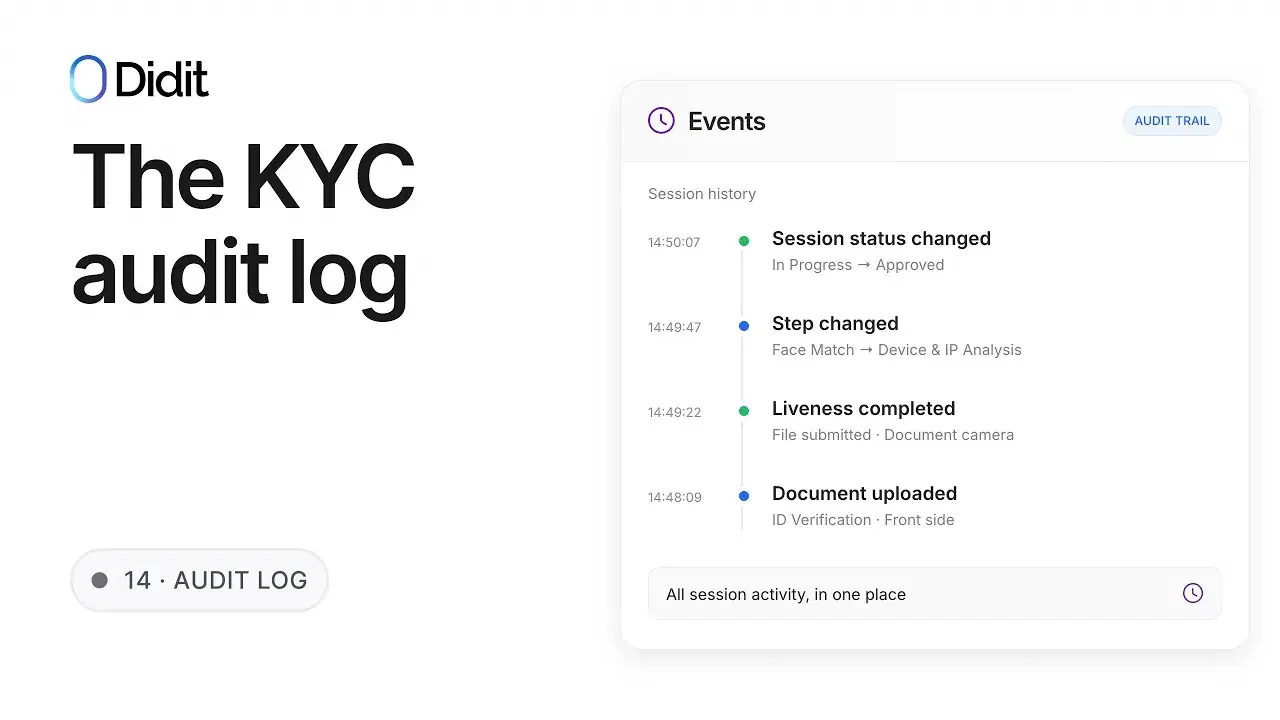
When you integrate Didit, the platform inherently generates detailed logs for every step of the verification process. For example, when performing an identity verification, Didit logs:
- The specific module used (e.g., document verification, liveness check).
- Input parameters (
document_type,country_code). - The raw response from external data sources (redacted for sensitive data as per privacy policies).
- Confidence scores and fraud indicators.
- The final verification decision and reasons.
- Timestamps for each action.
- Details of any manual review stages.
This granular logging is crucial for demonstrating compliance with the UK DVS Trust Framework. You can easily retrieve these logs via the Didit API or dashboard, providing a clear, immutable record for your compliance audit trail. For instance, a call to the GET /verifications/{verification_id} endpoint would return a comprehensive JSON object detailing the entire verification journey, including all module results and timestamps.
Didit's commitment to security and compliance, evidenced by its SOC 2 Type 2 and ISO/IEC 27001 certifications, and iBeta Level 1 and Level 2 PAD attestation, further supports your organization's ability to maintain a trusted and verifiable audit trail. The fact that a European member-state government has formally attested Didit as safer than in-person verification underscores its reliability.
Key Takeaways
- The UK DVS Trust Framework sets standards for secure and trustworthy digital identity verification.
- A reliable compliance audit trail is non-negotiable for demonstrating adherence to the framework.
- Essential audit trail components include records of user consent, detailed verification steps, fraud assessment, system security events, and audit trail integrity measures.
- Infrastructure providers like Didit automatically generate comprehensive logs that simplify the creation and maintenance of a UK DVS Trust Framework-compliant audit trail.
- These logs cover everything from document verification and liveness checks to fraud detection and final decisions, all accessible for regulatory review.
Get started with Didit
Didit is infrastructure for identity and fraud. One API and public pay-per-use pricing. Add User Verification to your flow and integrate in 5 minutes.
- User Verification: see how it works and what it costs.
- Read the documentation: API reference and integration guide.
- Start free, no credit card required.
Try it
Try this in the sandbox
Run the check this guide describes, free.
The product this post is about, taken from its topic. Run it free in the sandbox.
Author
Alberto Rosas
Co-founder and CEO

Keep reading
Other guides in the same topic.
 What Is the Purpose of FICA in South Africa? 2026 Guide
FICA is South Africa's anti-money laundering law. It creates the Financial Intelligence Centre and requires accountable institutions to identify and verify clients, screen for PEP and sanctions risk and report suspicious.
Alberto RosasNov 26, 2026 Sixth Money Laundering Directive (6AMLD): What Changed and Which Rules Apply
6AMLD is Directive (EU) 2018/1673: Member States must criminalise laundering, widen predicate offences and set a four-year penalty floor. It adds no new due diligence duties for firms.
Alberto RosasNov 26, 2026 Automated Sanctions Screening: Canada, the Entity List and Embargoes
Automated sanctions screening matches people and companies against lists such as Canada's autonomous sanctions made under SEMA and JVCFOA and the OFAC SDN List, and returns candidate hits scored for identity confidence and.
Alberto RosasNov 26, 2026Questions
Frequently Asked Questions
Q: What is the primary goal of the UK DVS Trust Framework?
A: The primary goal is to establish a secure, consistent, and trustworthy ecosystem for digital identity verification across the UK, aiming to reduce fraud and streamline identity checks for users and organizations.
Q: How does an audit trail help with UK DVS Trust Framework compliance?
A: An audit trail provides verifiable evidence of how identity verification processes were conducted, demonstrating adherence to the framework's rules on data handling, security, consent, and verification methods. It's crucial for regulatory scrutiny and risk management.
Q: What specific information should be included in an audit trail for UK DVS compliance?
A: Key information includes user consent records, details of identity document and liveness verifications, data sources queried, fraud scores, risk decisions, system access logs, and any security incidents.
Q: Is it possible to automate the creation of a compliance audit trail?
A: Yes, leveraging infrastructure for identity and fraud like Didit can significantly automate the creation of a detailed audit trail. Didit's API automatically logs every step of the verification process, making it readily available for compliance purposes.
Q: What security measures should be in place for the audit trail itself?
A: The audit trail must be tamper-proof, meaning records cannot be altered or deleted without detection. Implementing cryptographic hashing, immutable storage, and strict access controls are crucial to maintain its integrity.
Implementing infrastructure for identity and fraud like Didit allows organizations to focus on their core business while ensuring that their identity verification processes are not only efficient but also fully compliant with frameworks like the UK DVS Trust Framework. With Didit, you get comprehensive logging for every check across 220+ countries and territories, 14,000+ document types, and 54 languages. Public pay-per-use pricing means you only pay for what you use. A full identity verification starts from just $0.33.
Compliance built in
Audited, certified and attested.
We hold the certifications and build each country's rules into your flows, so you can launch anywhere without worrying. Security and Compliance center
- Regulation encoded into your flows
Tell us what you do and where. Didit lists the rules that apply to you, with sources, and builds the checks each country needs into one workflow.
- Ready for AMLR
Every requirement of the new EU anti-money laundering rules, from checking customers to human review, is already covered by a Didit check.
- Tested in Spain's Treasury sandbox
Spain's Treasury published its supervised sandbox report on Didit's NFC plus active liveness onboarding; SEPBLAC took part and valued the added measures positively.
- Audited, not self-declared
iBeta Level 1 and Level 2. Liveness tested under ISO/IEC 30107-3.
Your obligations · 3 regions
 SOC 2 Type 2
 ISO 27001
 iBeta Level 1 and Level 2
 EU regulator attestation
 FSM youth protection
 GDPR
 EBA remote onboarding
 MiCA compatible
 FIDO Alliance member
- AMLREU AML Regulation ready
Integration · Didit MCP
Run Didit from your own AI agent
Connect Didit to Claude, Cursor, VS Code or ChatGPT and just ask in plain words. Your agent can do anything you can do in the console, with the same permissions you have.
 Add to Claude
 ChatGPT
 Cursor
- Build workflowsDescribe the checks you need. The agent creates and publishes the flow.
- Run investigationsAsk why a session was declined, review cases, search people and companies.
- Change rulesCreate payment rules, test them on past data and switch them on.
- Pull reportsAsk for numbers, exports or the audit log.
Didit Academy