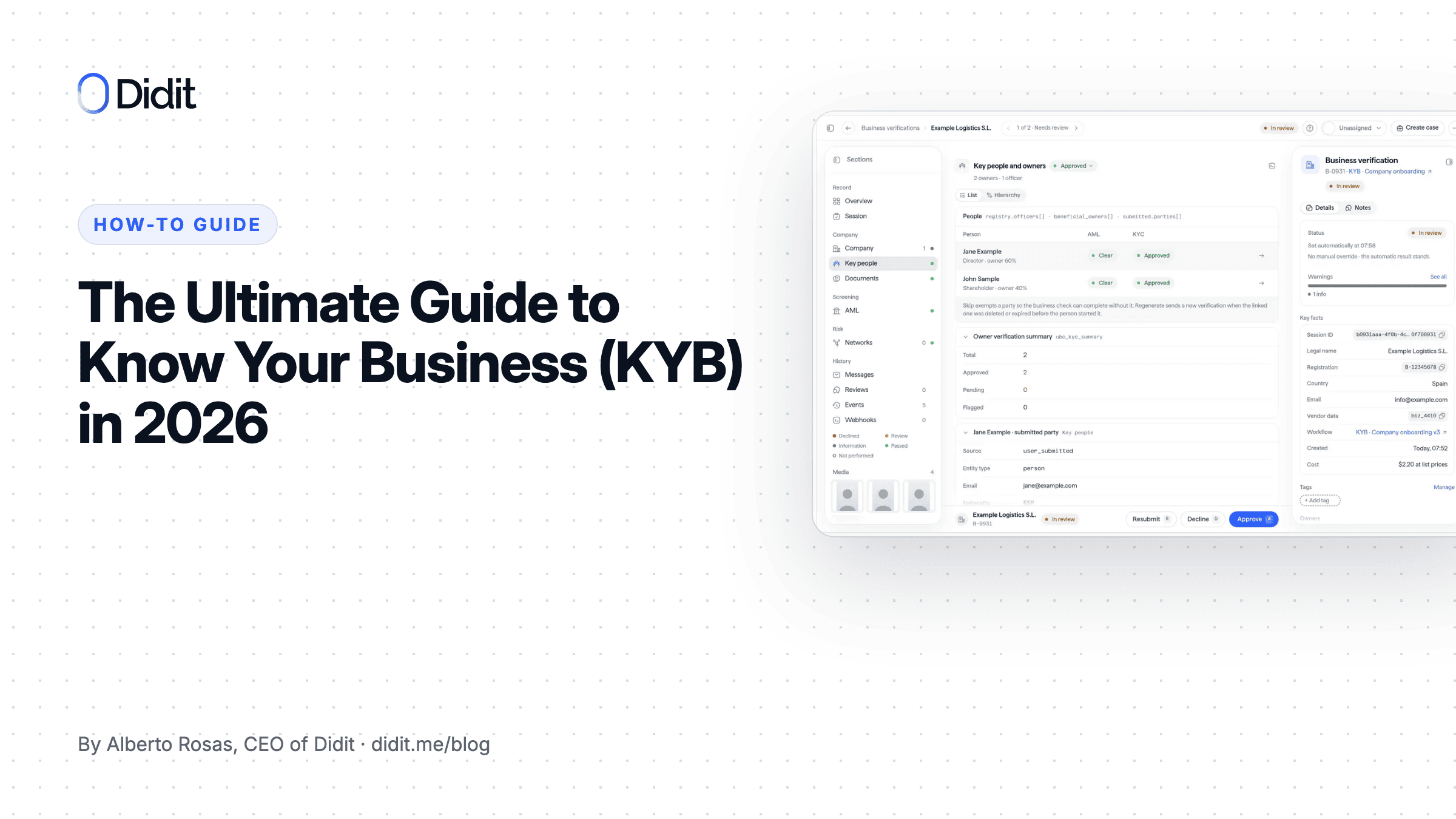
The Ultimate Guide to Know Your Business (KYB) in 2026
KYB verifies who owns and controls a company before you onboard it. Didit runs registry lookup, UBO extraction, company and person AML in the business session, with child KYC sessions for people who must verify, from $2.00 per.
 Alberto RosasCo-founder and CEO
Contents
In this guide
Jump to the part you need.
KYB (Know Your Business) checks who owns and controls a company before you onboard it. It fits banks, fintechs, marketplaces and regulated teams onboarding businesses. Didit runs registry lookup, ownership and officer extraction, company AML and person AML in the business session, with child KYC sessions for people who must verify. Pricing is by country and tier, starting at $2.00 per company. The caveat: ownership depth depends on the tier a country supports, and some sessions end in human review.
Last updated: November 26, 2026. Prices checked against the live Didit price feed on November 26, 2026.
| Item | List price (USD) | Unit |
|---|---|---|
| Registry retrieval, Lite tier (profile, status, address, officers) | From $2.00 | Company |
| Registry retrieval, Shareholders or UBOs tier | Priced by country and tier. The docs price list applies $5.00 for Shareholders and $9.00 for UBOs where ownership comes from the worldwide ownership source | Company |
| Company AML screening | $0.20 | Check |
| Person AML, per UBO or officer | $0.20 | Person |
| Linked KYC for each owner who must verify | $0.33 | Person |
| KYB documents step | $0.20 | Step |
| Key People extraction and form | Free | Person |
| Ongoing AML monitoring | $0.07 | Person per year |
Start free in the sandbox at business.didit.me with no sales call, and read the KYB quickstart in the docs. If you work with an AI assistant, connect Didit through the free MCP server at didit.me/developers/mcp. The product page is Business Verification and every unit price is on didit.me/pricing.
What a finished KYB check looks like
A finished session returns a decision object, not a folder of files. status is one of Approved, Declined, In Review, Resubmitted or Awaiting User. Approved means the configured checks in your workflow reached an Approved outcome. Declined means a rule failed and the decision carries warnings[] tags you can log. In Review means a configured rule or threshold sent the session to human review and a second webhook arrives when it resolves. Resubmitted means the business must re-upload, and the same link resumes at the resubmission step. Awaiting User means a linked Key Person KYC session is still running.
The recommended method is a webhook-driven flow. Use one workflow and create a session for each KYB run, associating runs with the business through vendor_data. That aggregates sessions into a Business entity you can re-check later. Skip webhooks and you fall back to polling the decision endpoint, the documented alternative.
Before you start
- A Didit application with Business Verification enabled. Create one at business.didit.me.
- An API key from Developer Settings, then API Keys.
- A webhook endpoint reachable from the internet, so the decision reaches you without polling.
- A decision on the data tier you need per country, because tier availability varies by registry.
Run a KYB verification in six steps
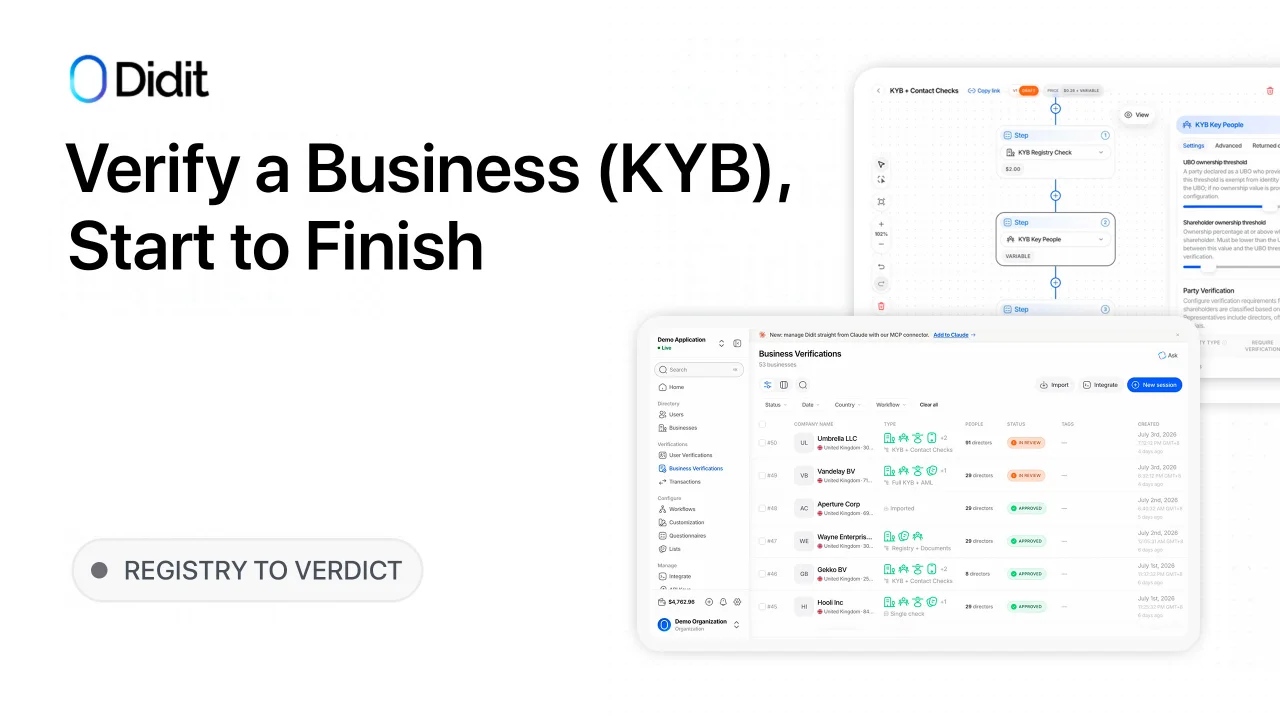
1. Create the KYB workflow
In the Business Console go to Workflows, then Create workflow, and choose Business Verification as the type. Company registry lookup is required. Company AML is recommended. Key People is required for most regulated industries. Documents is optional and lets you pick the document types you will require. Save and copy the workflow id.
2. Create a business session
KYB uses the same /v3/session/ endpoint as KYC. Passing a KYB workflow id is what makes it a business session.
curl -X POST https://verification.didit.me/v3/session/ \
  -H "x-api-key: YOUR_API_KEY" \
  -H "Content-Type: application/json" \
  -d '{
    "workflow_id": "YOUR_KYB_WORKFLOW_ID",
    "vendor_data": "biz-acme-001",
    "callback": "https://myapp.com/kyb/return",
    "metadata": {"plan": "growth", "country": "GBR"}
  }'
The response contains session_id, session_number and url. The workflow type flags the session as a business session, and its events carry session_kind set to business. If you already know the company, pass expected_details with company_name, registry_country and registration_number: the hosted flow pre-selects and locks the country, pre-fills the search and runs the asserted search so the applicant lands on their own company. Both fields stay editable.
3. Send the link to the company contact
Deliver url through your own email or chat. The administrator of the business opens it, confirms the registry match, adds directors and owners, and uploads the documents you configured. White-label branding, logo and domain are available.


4. Receive the status webhook
When the session reaches a terminal status, Didit posts a status.updated event. Filter on session_kind so business events reach your KYB handler, verify the X-Signature-V2 HMAC signature before trusting it, de-duplicate on event_id, and respond within 5 seconds.
{
  "event_id": "7f3c2c1e-6a1d-4c36-9d8e-0d3b5f4e2a10",
  "webhook_type": "status.updated",
  "session_id": "a1b2c3d4-5678-4abc-9def-1234567890ab",
  "business_session_id": "a1b2c3d4-5678-4abc-9def-1234567890ab",
  "session_kind": "business",
  "vendor_data": "biz-acme-001",
  "status": "Approved",
  "created_at": 1776515400,
  "timestamp": 1776515401,
  "decision": { "...": "full KYB decision" }
}
5. Fetch the decision if you need it later
The webhook payload already carries the full decision. Call the endpoint when you skipped webhooks, or when you want the decision again on demand.
curl https://verification.didit.me/v3/session/bs_01H.../decision/ \
  -H "x-api-key: YOUR_API_KEY"
6. Act on the decision
switch (decision.status) {
  case "Approved":      await onboardBusiness(decision); break;
  case "Declined":      await logRejection(collectWarnings(decision), decision); break;
  case "In Review":     await markPending(decision); break;
  case "Resubmitted":   await notifyBusiness(decision); break;
  case "Awaiting User": await pingChildPersonForKyc(decision); break;
}
Log the warnings[] tags from each feature array on a decline. They are the reason codes your compliance file needs.
Expected output
The decision object returns three arrays you iterate, plus the registry profile.
| Array or field | What it holds |
|---|---|
key_people_checks[] | UBOs, shareholders, directors and officers, bucketed into registry (from the lookup) and submitted (what the business confirmed), plus a ubo_kyc_summary rollup. |
document_verifications[] | One item per document node with status, node_id, items[] (signed file_url and OCR extract), groups and required_groups. |
aml_screenings[] | Company AML and per-person AML hits, each carrying a match score and a risk score. |
| Registry profile | company_name, registration_number, country_code, company_type, registry_status, incorporation_date, registered_address, tax_number, legal_entity_identifier, is_from_registry, fetch_status, verification_status. |
Registry status counts as much as the people. A company marked dissolved, struck off, in liquidation or dormant can be flagged or declined by your workflow configuration. That policy is yours to set, not a default Didit applies silently.
When a check fails, and how to recover
| Scenario | What happens and what you do |
|---|---|
Invalid workflow_id | 400 Bad Request. Re-read the id from the console. |
| A KYC workflow passed instead of a KYB workflow | The session is created but runs KYC steps. Confirm the workflow type is kyb. |
| Company not found in the registry | The applicant submits company data manually, the session continues, and is_from_registry is set to false. |
| Country outside the workflow's allowed countries | The registry check raises the KYB_COUNTRY_RESTRICTED warning. |
| Registry provider outage during the search | 502 with code kyb_registry_provider_unavailable. Not billed. The hosted flow offers manual company entry instead of a retry-only error. |
| Rate limit | 429 with a Retry-After header. |
Duplicate vendor_data | A new session is created. That is by design for a re-check. |
| A party's link expired before the person started | Reissue with POST /v3/session/{session_id}/kyb/parties/{party_uuid}/regenerate/. |
Inputs and outputs
| Field | Direction | Notes |
|---|---|---|
workflow_id | Input | Id of your KYB workflow. Required. |
vendor_data | Input | Your business id. Binds sessions to a Business entity. |
callback | Input | Where to redirect the applicant after completion. |
metadata | Input | JSON attached to the session for your own reporting. |
expected_details | Input | company_name, registry_country, registration_number. Prefills and locks the country and runs the asserted search. |
session_id | Output | Use it for the decision call and for support. |
session_number | Output | Human-readable reference. |
url | Output | The hosted verification link you deliver. |
status | Output | Approved, Declined, In Review, Resubmitted or Awaiting User. |
warnings[] | Output | Reason tags, on each feature array. |
| Three decision arrays | Output | key_people_checks[], document_verifications[], aml_screenings[]. |
What you pay for, and where a human decides
Every billable line is a completed unit, not a request.
- Registry retrieval is billed per company, by country and tier. Ask for Shareholders or UBOs in a country whose registry holds no ownership record and the check is delivered and billed at the highest tier that country can serve, usually Lite. Registry billing uses the tier actually delivered.
- Company AML is $0.20 per check. Person AML is $0.20 per UBO or officer screened.
- The documents step is $0.20 whether the applicant uploads one file or ten, and re-uploads in that step do not add another fee.
- Key People extraction and the Key People form carry no separate fee.
- Each owner who must verify takes a linked KYC at $0.33. Parties below the ownership threshold do not trigger verification even when their role would otherwise require it.
- A registry provider outage returns a 502 and is not billed.
- Ongoing AML monitoring is $0.07 per person per year. Company registry monitoring is listed at $2.00 per company a year.
Three decisions sit on the human side of the line. AML thresholds (match score threshold, approve threshold, review threshold) are set per workflow, and a risk score between the approve and review thresholds lands in In Review rather than Approved. A registry status other than active can be flagged or declined by configuration, so write your policy before you go live. And the listed-company path, where a public company declares its listing instead of naming a UBO, is off by default, is not checked against a stock exchange, and sends the session to review by default. Nested KYB for corporate UBOs is also off by default.
Worked cost example
Here is one UK company on the Lite tier with three key people who each need KYC. The arithmetic uses published unit prices and assumes the published Lite tier price of $2.00 is available for the UK in your account.
| Line | Arithmetic | USD |
|---|---|---|
| Registry retrieval, Lite | 1 x $2.00 | $2.00 |
| Company AML | 1 x $0.20 | $0.20 |
| Person AML | 3 x $0.20 | $0.60 |
| Linked KYC | 3 x $0.33 | $0.99 |
| Documents step | 1 x $0.20 | $0.20 |
| Total per company | 2.00 + 0.20 + 0.60 + 0.99 + 0.20 | $3.99 |
The same company on the UBO tier, where ownership comes from the worldwide ownership source at $9.00: 9.00 + 0.20 + 0.60 + 0.99 + 0.20 = $10.99 per company.
Plan discounts apply to Didit prices. At Scale, 10% off: 3.99 x 0.90 = $3.59. At Growth, 4% off: 3.99 x 0.96 = $3.83.
Add monitoring if you keep the relationship open: registry monitoring 1 x $2.00 per company per year plus ongoing AML at 3 x $0.07 = $0.21 per year, so $2.21 per company per year on top of onboarding.
CDD, EDD and monitoring: where KYB fits
KYB is the business side of customer due diligence. Standard due diligence confirms legal existence, ownership and activity. Enhanced due diligence applies when the company sits in a high-risk jurisdiction, is owned by a politically exposed person or shows adverse media, and it means deeper ownership tracing, source-of-funds questions and analyst review. Ongoing monitoring keeps both current after onboarding.
Most jurisdictions draw the UBO line at 25%. Didit makes the threshold a per-workflow setting, so EU, UK, US and Singapore programs can each use their own cut, and you can route to review when nobody meets it. Ownership through a corporate chain multiplies: a 60% stake in a holding company that holds 75% of the target gives 60% x 75% = 45% effective ownership, above a 25% threshold and below a 50% one. Didit records economic ownership and voting power separately, because dual-class shares make them diverge. Check the guidance that applies where you operate: the EU anti-money laundering directives as published on EUR-Lex, the UK Money Laundering Regulations on legislation.gov.uk, or your local supervisor's KYB expectations.
When a role requires identity verification, Didit opens a child KYC session for that person and the parent session reports Awaiting User until the child finishes. A child session expires on the KYC workflow's own expiration, not the KYB session's.

We support 4,000+ companies, and the registry coverage behind it spans 220+ countries and subdivisions, with tier availability varying by jurisdiction and US states addressed as US-CA, US-NY, US-DE.
Sources
- Didit docs: KYB quickstart
- Didit docs: KYB integration guide
- Didit docs: company registry API
- Didit docs: UBO API
- Didit docs: business AML screening API
- Didit docs: KYB supported countries
- Didit docs: KYB statuses, KYB webhooks, response schema
- Didit docs: KYB registry pricing by country
- Didit pricing page and live price feed, read November 26, 2026
- Didit Business Verification product page
- Didit MCP server setup
- Didit Business Console
- EUR-Lex: EU anti-money laundering directives
- legislation.gov.uk: UK Money Laundering Regulations
Run your first company through the sandbox at business.didit.me. The sandbox is free, there is no sales call, and you can wire the webhook before you spend a cent on registry checks.
Try it
Try this in the sandbox
Run the check this guide describes, free.
The product this post is about, taken from its topic. Run it free in the sandbox.
Author
Alberto Rosas
Co-founder and CEO

Keep reading
Other guides in the same topic.
 What Is the Purpose of FICA in South Africa? 2026 Guide
FICA is South Africa's anti-money laundering law. It creates the Financial Intelligence Centre and requires accountable institutions to identify and verify clients, screen for PEP and sanctions risk and report suspicious.
Alberto RosasNov 26, 2026 Sixth Money Laundering Directive (6AMLD): What Changed and Which Rules Apply
6AMLD is Directive (EU) 2018/1673: Member States must criminalise laundering, widen predicate offences and set a four-year penalty floor. It adds no new due diligence duties for firms.
Alberto RosasNov 26, 2026 Automated Sanctions Screening: Canada, the Entity List and Embargoes
Automated sanctions screening matches people and companies against lists such as Canada's autonomous sanctions made under SEMA and JVCFOA and the OFAC SDN List, and returns candidate hits scored for identity confidence and.
Alberto RosasNov 26, 2026Questions
Frequently asked questions
What is KYB in simple terms?
Know Your Business is the process of verifying a company's legal existence, ownership and risk before you onboard it as a customer, supplier or partner. It covers registry data, beneficial owners and officers, sanctions and adverse media at both company and person level, and often identity checks on the people behind the company. It exists to stop money laundering, fraud and sanctions breaches.
How much does a Didit KYB check cost?
Registry retrieval starts at $2.00 per company and is priced by country and data tier. On top of that: company AML $0.20 per check, person AML $0.20 per UBO or officer, linked KYC $0.33 per person who must verify, and $0.20 per KYB documents step. A Lite-tier company with three verified owners comes to $3.99 at list price.
How long does a KYB verification take?
Didit documents a 10-minute flow: create the workflow, create the session, send the link, receive the webhook. Registry searches run asynchronously and large registries can take a few seconds to answer. Ownership reports may land after the company profile arrives, and the applicant keeps working in the meantime.
What happens if the company is not in the registry?
The applicant submits the company data manually, the session continues, and is_from_registry is set to false. A country with no supported registry tier is not offered for registry checks at all and goes straight to manual entry. A registry provider outage returns a 502 and is not billed, and the hosted flow offers manual entry rather than a dead end.
Which countries does Didit cover for KYB?
Company registries across 220+ countries and subdivisions, with Lite, Shareholders and UBO tiers available depending on the jurisdiction. US states use the extended format such as US-CA or US-DE to select the right Secretary of State registry, and Kosovo is accepted under the user-assigned code XK.
What UBO threshold does Didit apply?
It is a per-workflow setting, and 25% ownership or control is the common line used across the EU, UK, US and Singapore. You can also flag or route to review when no UBO meets the threshold, which happens with widely held companies. Parties below the threshold do not trigger individual verification.
Does Didit verify the identity of directors and owners?
When a workflow marks a role as requiring KYC, each person gets a child KYC session using the workflow mapped to that role, and the parent session stays Awaiting User until those finish. Roles can be enabled, disabled or made skippable per workflow. A skipped party is recorded and does not block the parent session.
What does an In Review status mean in KYB?
A configured rule or threshold sent the session to human review. The session is not approved and you should not onboard on it. You receive another webhook when the analyst resolves it.
Is KYB a one-time check?
No. Ongoing AML monitoring re-screens the company and every identified person against updated watchlists at $0.07 per person per year and fires a webhook when new matches appear. The price feed also lists company registry monitoring at $2.00 per company a year, while the KYB docs still mark registry monitoring as coming soon, so confirm availability on the product page before you depend on it.
How do I start a KYB session from code?
POST to https://verification.didit.me/v3/session/ with your API key, a KYB workflow_id and your own vendor_data id. The response returns the hosted url and the session_id. The same endpoint serves KYC, so the workflow type is what makes the session a business session.
Can I drive KYB from an AI assistant?
Yes. Didit's MCP server is free, hosted at https://mcp.didit.me/mcp with OAuth sign in, and it reaches the same API. Setup instructions for every client are at didit.me/developers/mcp.
Compliance built in
Audited, certified and attested.
We hold the certifications and build each country's rules into your flows, so you can launch anywhere without worrying. Security and Compliance center
- Regulation encoded into your flows
Tell us what you do and where. Didit lists the rules that apply to you, with sources, and builds the checks each country needs into one workflow.
- Ready for AMLR
Every requirement of the new EU anti-money laundering rules, from checking customers to human review, is already covered by a Didit check.
- Tested in Spain's Treasury sandbox
Spain's Treasury published its supervised sandbox report on Didit's NFC plus active liveness onboarding; SEPBLAC took part and valued the added measures positively.
- Audited, not self-declared
iBeta Level 1 and Level 2. Liveness tested under ISO/IEC 30107-3.
Your obligations · 3 regions
 SOC 2 Type 2
 ISO 27001
 iBeta Level 1 and Level 2
 EU regulator attestation
 FSM youth protection
 GDPR
 EBA remote onboarding
 MiCA compatible
 FIDO Alliance member
- AMLREU AML Regulation ready
Integration · Didit MCP
Run Didit from your own AI agent
Connect Didit to Claude, Cursor, VS Code or ChatGPT and just ask in plain words. Your agent can do anything you can do in the console, with the same permissions you have.
 Add to Claude
 ChatGPT
 Cursor
- Build workflowsDescribe the checks you need. The agent creates and publishes the flow.
- Run investigationsAsk why a session was declined, review cases, search people and companies.
- Change rulesCreate payment rules, test them on past data and switch them on.
- Pull reportsAsk for numbers, exports or the audit log.
Didit Academy


