Bank Secrecy Act CIP Requirements and PATRIOT Act Identity Rules 2026
31 CFR 1020.220 requires banks to run a written CIP collecting name, date of birth, address and a tax ID before account opening. The rule lets a bank rely on information previously obtained for an existing customer when the.
 Alberto RosasCo-founder and CEO
Contents
In this guide
Jump to the part you need.
If your organization is a US bank or credit union, section 326 of the USA PATRIOT Act requires a written Customer Identification Program, and the operative text sits at 31 CFR 1020.220. That program is yours to write and keep current. Didit supplies the checks the rule relies on: ID document verification at $0.15, a full KYC check at $0.33, AML screening at $0.20. The caveat is simple: tooling produces evidence, not policy.
Last updated: November 26, 2026. Prices checked against the live Didit price feed on November 26, 2026.
| Instrument | Citation | Who it binds | What it requires | Status |
|---|---|---|---|---|
| Bank Secrecy Act | 12 U.S.C. 1829b and 1951-1960; 31 U.S.C. 5311-5314 and 5316-5336 | Financial institutions, banks included | Records, reports and an anti-money-laundering program | In force |
| USA PATRIOT Act, section 326 | Pub. L. 107-56, codified at 31 U.S.C. 5318(l) | Banks and other financial institutions | Verify customer identity through a written program | In force |
| CIP Rule | 31 CFR 1020.220, with parallel text at 12 CFR 21.21(c)(2) (OCC), 12 CFR 326.8(b)(2) (FDIC), 12 CFR 211.24(j)(2) (Board), 12 CFR 748.2(b)(2) (NCUA) | Banks and credit unions with an AML program requirement | Written CIP, four data points, risk-based verification, records | In force; eCFR title 31 current to November 23, 2026 |
| TIN collection request for comment | 89 FR 22231, FR Doc. 2024-06763, Docket FINCEN-2024-0009 | FinCEN with OCC, FDIC, NCUA and the Federal Reserve Board | Asked whether the TIN requirement should change | Comments closed May 28, 2024 |
| GENIUS Act CIP proposal | 91 FR 37234, FR Doc. 2026-12460, 31 CFR Part 1033, RIN 1506-AB74 | Permitted payment stablecoin issuers | Would treat them as BSA financial institutions with a CIP | Proposed June 22, 2026; comments closed August 21, 2026; not final |
Start free in the sandbox at business.didit.me with no sales call. Developers can connect Didit to an AI assistant through the MCP server at didit.me/developers/mcp. Fixed list prices in this page come from didit.me/pricing. Variable rates, such as database validation and KYB by country, are set per service in the price feed.
Who has to comply with the CIP Rule
The trigger sentence is narrow and easy to check. A bank must implement a written CIP when it is already required to have an anti-money-laundering compliance program under regulations implementing 31 U.S.C. 5318(h), 12 U.S.C. 1818(s) or 12 U.S.C. 1786(q)(1) (31 CFR 1020.220, eCFR, read November 26, 2026). Those three provisions reach institutions supervised by the OCC, the Federal Reserve Board, the FDIC and the NCUA, which is why the same CIP text appears in five parallel rulebooks.
- Depository institutions with a federal AML program duty, including credit unions under 12 U.S.C. 1786(q)(1).
- Any bank that opens an account for a customer, where the account is a formal banking relationship.
- FinCEN's Part 1020 is titled Rules for Banks and runs from section 1020.100 to 1020.670 across five subparts (eCFR Part 1020 page, read November 26, 2026).
Where the text sits
The CIP is 31 CFR 1020.220, headed 'Customer Identification Program requirements for banks,' in Title 31, Subtitle B, Chapter X, Part 1020, Subpart B. Part 1020 also carries 1020.310 for currency transaction reports, 1020.320 for suspicious transaction reports, 1020.410 for records to be made and retained, and 1020.520 for special information sharing.
The CIP must include risk-based procedures for verifying the identity of each customer to the extent reasonable and practicable, enabling the bank to form a reasonable belief that it knows the true identity of each customer (31 CFR 1020.220, eCFR, read November 26, 2026).
The obligation is a reasonable belief, not a specific document, a specific vendor or a specific score. That is the gap a verification API fills, and also the reason an API cannot sign off on your program.
From when, dated
| Date | What happened | Where it is written | Who it binds |
|---|---|---|---|
| 1970 | The Bank Secrecy Act takes effect | 12 U.S.C. 1829b and 1951-1960; 31 U.S.C. 5311-5314 and 5316-5336 | Financial institutions, banks included |
| October 26, 2001 | Section 326 of the USA PATRIOT Act adds the customer identity verification duty | Pub. L. 107-56, codified at 31 U.S.C. 5318(l) | Banks and other financial institutions |
| May 9, 2003 | The joint final rule implementing section 326 is published | 68 FR 25103, later codified at 31 CFR 1020.220 and the parallel agency rules | Banks and credit unions with an AML program requirement |
| March 29, 2024 | FinCEN opens a request for comment on the TIN collection requirement, comments close May 28, 2024 | 89 FR 22231, FR Doc. 2024-06763, Docket FINCEN-2024-0009 | Comment only, no new obligation |
| June 22, 2026 | Joint proposed rule would extend CIP duties to permitted payment stablecoin issuers, comments close August 21, 2026 | 91 FR 37234, FR Doc. 2026-12460, 31 CFR Part 1033, RIN 1506-AB74 | Proposed, not binding until final |
| November 6, 2026 | Latest amendment shown on the 31 CFR 1020.220 page; title 31 current to November 23, 2026 | eCFR, read November 26, 2026 | The CIP text as it stands today |
The four data points a CIP must collect
Before an account is opened, the CIP must obtain at minimum the customer's name, date of birth for an individual, address, and an identification number (31 CFR 1020.220, eCFR, read November 26, 2026). For a US person the identification number is a TIN: generally a Social Security number for a US individual and typically an employer identification number for a US entity. FinCEN restated the same list in 2024 while consulting on the TIN requirement, adding that for a US individual the full SSN must be collected directly from the customer (89 FR 22231, read November 26, 2026).
- Name.
- Date of birth, for an individual.
- Address.
- Identification number: a TIN for a US person, generally an SSN for a US individual and typically an EIN for a US entity, subject to the pending-TIN exception.
A TIN is defined by section 6109 of the Internal Revenue Code, 26 U.S.C. 6109, and the IRS regulations under it. The rule also carries an exception at 31 CFR 1020.220(a)(2)(i)(B) for a customer who has applied for a TIN but not yet received it.

The four data points are the floor. What makes the record defensible is showing that the check ran at opening and keeping the decision. Didit's ID Verification extracts name, date of birth, document number and address from 14,000+ document types across 220+ countries. The decision payload returns id_verifications[] with a status and a warnings array; documented warning codes include DOCUMENT_EXPIRED and INVALID_MRZ. See the ID Verification documentation for the field list.

Existing customers: what the rule actually asks for
The minimum-information list is tied to opening an account, so a new account triggers CIP review. The rule does not require a bank to start from zero every time. Under the existing-account provision at 31 CFR 1020.220(a)(3), a bank may rely on information previously obtained to verify an existing customer's identity, provided it has no reason to doubt the adequacy of that information and has a reasonable belief that it knows the customer's true identity. The exception is not automatic. Document the basis, the information relied on, and why it still supports the required reasonable belief.
For accounts that are already open, be precise about what the text does and does not say. The CIP Rule sets a risk-based standard for verifying each customer at account opening. It does not, in the text quoted on the eCFR page I read on November 26, 2026, impose a re-papering deadline for a portfolio of pre-existing accounts. Re-verification is therefore a policy decision inside your AML program, documented by your compliance team, not something a vendor can decide for you. What a vendor can do is make it cheap to run when you decide to run it.
- Reusable KYC. Reusable KYC is free in the published price list. Whether a returning customer can rely on a prior check, and what evidence you need, is your policy decision under the exception above.
- Ongoing screening. AML screening is $0.20 per check, and ongoing monitoring of a screened person is $0.07 per person per year, so a book of 30,000 customers costs $2,100 a year to keep under watch.
- Refresh on trigger. When a customer opens a second product, create a new session with the same
vendor_data. The docs describevendor_dataas your stable entity identifier, strongly recommended, and say it is used for duplicate detection across sessions.
Obligation by obligation, and what Didit does
Keep these two columns separate in your own documentation. The left column is a legal duty that stays with the institution. The right column is a paid check that produces evidence.
| Obligation under 31 CFR 1020.220 and the BSA | Didit capability and published price | Stays with the institution |
|---|---|---|
| Written CIP appropriate to the bank's size and type of business, approved by the board of directors | Workflow Orchestrator, free, builds the verification sequence; templates by industry and country | The written document, board approval and your own review cycle |
| Collect name, date of birth, address and identification number before account opening | ID Verification, $0.15 per check, extracts and authenticates the document and returns the fields; expected_details compares them with what you already hold | What you do when a field does not match |
| Risk-based procedures that support a reasonable belief in the customer's true identity | Passive liveness $0.10, face match 1:1 $0.05, face search 1:N $0.05, database validation against authoritative sources including government registries where available, non-document lookup where a country allows it | Thresholds per customer segment and the decision to accept a lower-assurance method |
| Keep the verification record | Documented decision payload with per-check status and warning codes | Retention period and the recordkeeping rule that applies to you |
| Screen for sanctions and politically exposed persons as part of the AML program | AML screening $0.20 per check against 1,300+ lists, two-score match and risk model, ongoing monitoring $0.07 per person per year | Alert adjudication, escalation and any suspicious transaction report under 31 CFR 1020.320 |

Worked example: one new account, start to finish
A customer, Dana Whitfield, opens a US consumer checking account. Her record already carries a name, an address and a Social Security number captured by the account-opening form. Your CIP needs the identity behind those fields confirmed, and the rule needs you to have done it before the account opens.
- Step 1. Your backend creates a session with the workflow for US consumer KYC, sends
vendor_dataas her stable customer ID, and passesexpected_detailswith first name, last name, date of birth and expected document types. Mismatches surface as decision warnings rather than silent passes. - Step 2. Dana photographs her driver's licence and takes a selfie. ID Verification runs document authenticity checks, passive liveness runs, and face match compares the selfie with the document portrait.
- Step 3. If the address on the document cannot be matched, the workflow adds a proof of address step at $0.20 rather than declining the account.
- Step 4. AML screening runs against sanctions and PEP lists. A clean result and a passing document set produce status Approved. A hit between the approve and review thresholds produces In Review. A hit that crosses the decline boundary can produce Declined, according to your configured rules. Didit's status is a check result. Your CIP and account-opening policy decide whether that result is enough to open the account.
- Step 5. Your webhook receives the status update, verifies the
X-Signature-V2header and de-duplicates onevent_id. The decision is fetched again fromGET /v3/session/{session_id}/decision/as the fallback if the webhook is missed.
The account opens with four data points collected, an authenticity result, a biometric comparison and a screening outcome, tied to one session ID. The institution's policy decision is recorded separately from the Didit check result.
Worked cost example: 2,500 new accounts a month
Assumptions, all from the published list. 2,500 new US consumer accounts a month, a full KYC check on each, AML screening on each, 400 of them needing proof of address, 400 phone verifications by US SMS, and a book of 30,000 customers under ongoing monitoring.
- Full KYC, $0.33 x 2,500 = $825.00. That is ID document $0.15, passive liveness $0.10, face match $0.05 and device and IP analysis $0.03.
- AML screening, $0.20 x 2,500 = $500.00.
- Combined per account, $0.33 + $0.20 = $0.53, and $0.53 x 2,500 = $1,325.00.
- Proof of address, $0.20 x 400 = $80.00.
- Phone verification, US SMS at $0.0473 per code x 400 = $18.92. That price is the carrier rate plus Didit's $0.02 fee.
- Month one at list price: $1,325.00 + $80.00 + $18.92 = $1,423.92.
- Ongoing AML monitoring for the book: $0.07 x 30,000 = $2,100.00 a year.
On the Scale plan, Didit prices carry a 10% discount. KYC becomes $0.297 and AML $0.18, so $0.297 + $0.18 = $0.477, and $0.477 x 2,500 = $1,192.50. Proof of address at $0.18 x 400 = $72.00. The phone fee falls to $0.018 with the carrier rate passing through at cost, so $0.0273 + $0.018 = $0.0453 per code, and $0.0453 x 400 = $18.12. Month one becomes $1,192.50 + $72.00 + $18.12 = $1,282.62, and monitoring becomes $0.063 x 30,000 = $1,890.00 a year. Billing is per completed check from prepaid credit; the plan fee is separate. Full terms on didit.me/pricing.
Exceptions and open questions
- TIN not yet issued. 31 CFR 1020.220(a)(2)(i)(B) allows a customer who has applied for a TIN but not received it to be handled under the CIP. That covers an individual awaiting an SSN or an entity awaiting an EIN. Your procedure for the gap is a policy decision.
- Documentary versus non-documentary methods. The rule asks for a reasonable belief, not a document. Didit's non-document lookup returns the assurance tier
data_match, meaning the data matched the named source, not that a document was authenticated. Whether that tier satisfies your program for a given customer is your call. The source queried differs by country, and on the Didit side it is recorded onid_lookup.sourcefor you and your auditors. - Re-verification of the existing book. Open question, not a settled rule: how often to re-verify pre-existing accounts and on what risk triggers. The existing-account exception above lets you rely on prior information when the standard is met; whether that is enough for a given account is your call.
- Stablecoin issuers. If you issue a permitted payment stablecoin, the June 22, 2026 joint proposal at 91 FR 37234 would put you inside the BSA with a CIP duty. It is proposed, not final, and the comment window closed on August 21, 2026.
- What no vendor can tell you. We do not give legal advice and we do not certify your program. The document you produce for an examiner has to be yours.
Implementation checklist
- Step one, write the program. Draft the CIP against 31 CFR 1020.220 and the parallel rule for your regulator, then get it approved. Nothing below substitutes for this.
- Step two, map the four fields. Decide which source holds name, date of birth, address and TIN, and which of those the customer must supply again at verification.
- Step three, build the workflow. In the console, create a workflow of type
kycwithOCR(orID_VERIFICATION), liveness, face match and AML. Start from a template or build empty, as described in the Quick Start.
curl -X POST https://verification.didit.me/v3/workflows/ -H 'x-api-key: $DIDIT_API_KEY' -H 'Content-Type: application/json' -d '{"workflow_label": "CIP - US consumer account", "workflow_type": "kyc", "features": [{"feature": "OCR"}, {"feature": "LIVENESS", "config": {"face_liveness_method": "PASSIVE"}}, {"feature": "FACE_MATCH"}, {"feature": "AML"}]}'- Step four, create the session. Send your stable customer identifier as
vendor_dataand the data you already hold asexpected_details, so a mismatch becomes a warning on the decision. The full field list is in the Create Session documentation.
curl -X POST https://verification.didit.me/v3/session/ -H 'x-api-key: $DIDIT_API_KEY' -H 'Content-Type: application/json' -d '{"workflow_id": "WORKFLOW_UUID", "vendor_data": "customer-884213", "callback": "https://app.example.com/onboarding/return", "expected_details": {"first_name": "Dana", "last_name": "Whitfield", "date_of_birth": "1989-04-02", "id_country": "USA", "expected_document_types": ["DL", "P", "ID"]}}'- Step five, wire the webhook. Register a destination for
status.updatedanddata.updated, verifyX-Signature-V2, de-duplicate onevent_idand answer within 5 seconds. Didit retries twice, at about 1 and 4 minutes, then drops the delivery. - Step six, keep the decision. Read
GET /v3/session/{session_id}/decision/and store the plural arrays:id_verifications,liveness_checks,face_matches,aml_screenings. Never assume single-object fields. - Step seven, handle the three states. Approved opens the account, In Review routes to your queue, Declined stops the flow. Surface the first terminal warning, for example
DOCUMENT_EXPIREDorMATCH_FOUND, to the reviewer rather than to the customer. - Step eight, test in the sandbox. Sandbox testing is free and unlimited, and a console sign-up with a work email starts with $10 of monthly credit. Run a declined document, a liveness failure and an AML hit before you go live.
- Step nine, document the split. Put the left column of the obligations table into your procedures, and record which check produces which evidence. If you are moving from another provider, didit.me/switch covers the migration path.
curl https://verification.didit.me/v3/session/SESSION_ID/decision/ -H 'x-api-key: $DIDIT_API_KEY'Sources
- Didit pricing and plans: didit.me/pricing and the machine-readable pricing.json, read November 26, 2026.
- Didit billing rules and standalone API prices: docs.didit.me/getting-started/pricing.
- Didit Quick Start: docs.didit.me/getting-started/quick-start.
- Didit Create Session API: docs.didit.me/sessions-api/create-session.
- Didit ID Verification: docs.didit.me/core-technology/id-verification/overview.
- Didit non-document lookup: docs.didit.me/core-technology/id-verification/non-doc-lookup.
- Didit Database Validation: docs.didit.me/core-technology/database-validation/overview.
- Didit AML Screening: docs.didit.me/core-technology/aml-screening/overview.
- Didit integration prompt: docs.didit.me/integration/integration-prompt.
- Didit MCP server: didit.me/developers/mcp.
- 31 CFR 1020.220, Customer Identification Program requirements for banks, eCFR (ecfr.gov), read November 26, 2026. eCFR describes its content as authoritative but unofficial; title 31 current to November 23, 2026, last amended November 6, 2026.
- 31 CFR Part 1020, Rules for Banks, table of contents, eCFR (ecfr.gov), read November 26, 2026.
- FinCEN with OCC, FDIC, NCUA and the Federal Reserve Board, Request for Information and Comment on the CIP Rule TIN collection requirement, 89 FR 22231, FR Doc. 2024-06763, Docket FINCEN-2024-0009, published March 29, 2024, read November 26, 2026.
- FinCEN, OCC, Federal Reserve Board, FDIC and NCUA, joint proposed rule on permitted payment stablecoin issuer customer identification programs, 91 FR 37234, FR Doc. 2026-12460, 31 CFR Part 1033, RIN 1506-AB74, published June 22, 2026, read November 26, 2026.
Next step: open the sandbox at https://business.didit.me/, build the CIP workflow above and run a session against test data. No sales call, and the free plan starts you with credit to test the checks the rule relies on.
Try it
Try this in the sandbox
Run the check this guide describes, free.
The product this post is about, taken from its topic. Run it free in the sandbox.
Author
Alberto Rosas
Co-founder and CEO

Keep reading
Other guides in the same topic.
 FATF Blacklist and Gray List: What They Mean for AML
As of October 2026 the FATF blacklist names DPRK, Iran and Myanmar: DPRK and Iran are subject to countermeasures, while Myanmar is subject to enhanced due diligence.
Alberto RosasNov 26, 2026 OFAC 50 Percent Rule Explained: Ownership and Screening
The OFAC 50 Percent Rule blocks entities owned 50 percent or more in the aggregate by blocked persons, with no SDN listing needed. Didit screens owners at $0.20 per check; your policy runs the aggregation.
Alberto RosasNov 26, 2026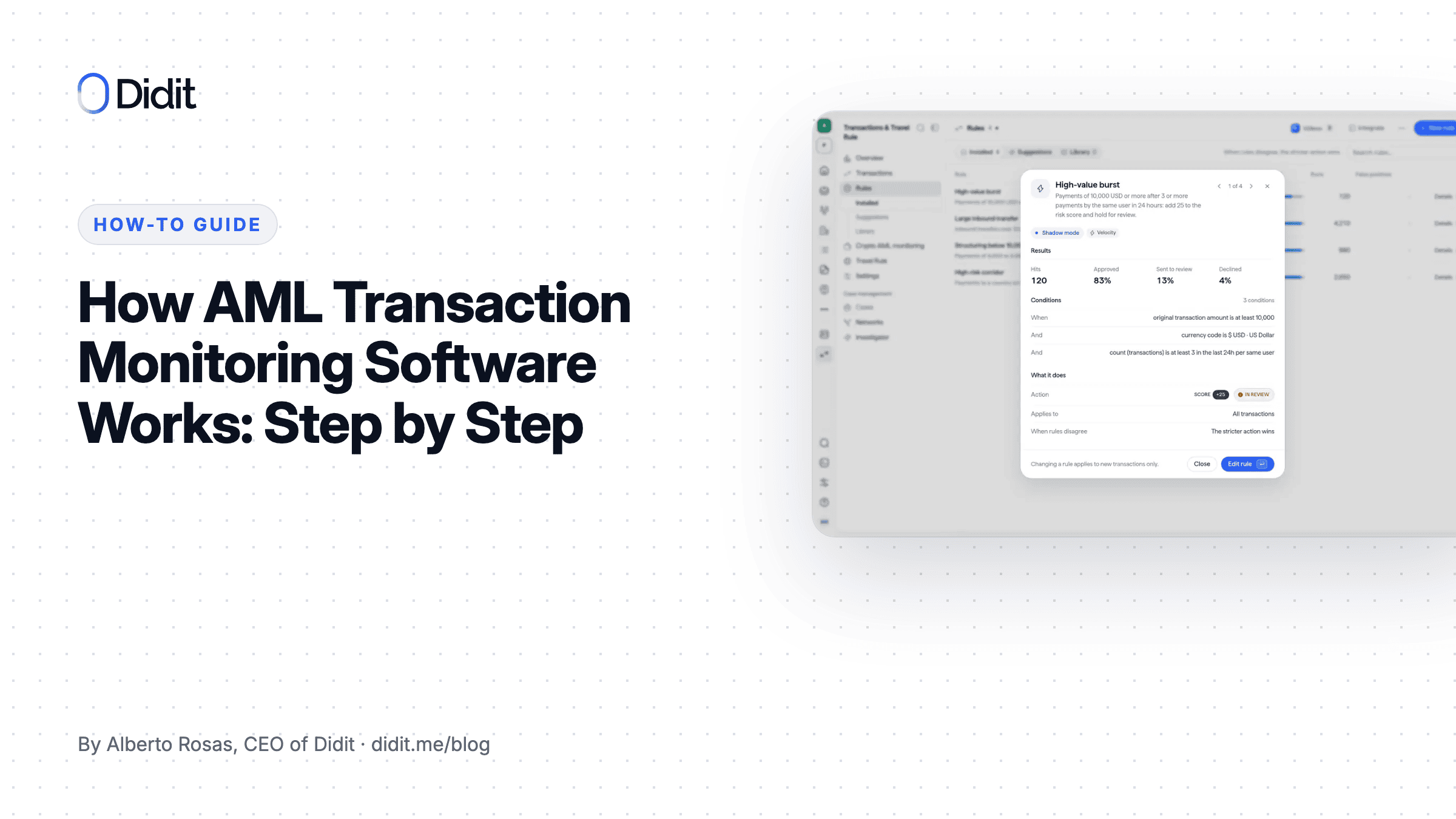 How AML Transaction Monitoring Software Works: Step by Step
AML transaction monitoring scores every transaction against rules and screening results, holds the risky ones for an analyst to triage, then moves real cases to investigation and SAR filing.
Alberto RosasNov 26, 2026Questions
Frequently asked questions
What is the difference between the Bank Secrecy Act and the USA PATRIOT Act CIP rule?
The Bank Secrecy Act is the underlying US anti-money-laundering statute, codified at 12 U.S.C. 1829b and 1951-1960 and 31 U.S.C. 5311-5314 and 5316-5336. Section 326 of the USA PATRIOT Act, Pub. L. 107-56, added the customer identity verification duty at 31 U.S.C. 5318(l). FinCEN's implementing text is 31 CFR 1020.220, usually called the CIP Rule, published as a joint final rule on May 9, 2003 at 68 FR 25103.
What four pieces of information must a CIP collect?
At minimum, the customer's name, date of birth for an individual, address and identification number, obtained before the account is opened. For a US person the identification number is a TIN: generally an SSN for a US individual and typically an EIN for a US entity, subject to the pending-TIN exception. FinCEN restated the same list in its 2024 request for comment at 89 FR 22231.
Does the CIP rule require a Social Security number?
No. A US person must provide a TIN, not necessarily an SSN. For a US individual the TIN is generally an SSN; for a US entity it is typically an EIN. The pending-TIN exception at 31 CFR 1020.220(a)(2)(i)(B) applies when a customer has applied for but not received a TIN.
Does the CIP rule apply to existing customers?
Not always in the same way. A new account triggers CIP review, but the existing-account provision at 31 CFR 1020.220(a)(3) lets a bank rely on information previously obtained to verify an existing customer's identity if it has no reason to doubt the adequacy of that information and has a reasonable belief that it knows the customer's true identity. Document that basis. For accounts already open, the text I read sets no portfolio-wide re-papering deadline; re-verification is a documented risk decision.
Can a bank verify identity without a photo ID document?
The rule states a reasonable-belief standard and names no document type, so the method is risk based. Non-document verification is one route: the customer types an identifier and a few details, and the data is checked against the authoritative source named for that country. Didit reports the assurance tier data_match for such a lookup, which proves the data matched the source, not that a document was inspected.
What does 31 CFR 1020.220 require the CIP to contain?
A written program appropriate to the bank's size and type of business, approved by the board of directors. It must include risk-based procedures for verifying each customer to the extent reasonable and practicable, the four minimum data points, identity verification before account opening, and the records the rule requires. Parallel versions sit in the OCC, FDIC, Federal Reserve Board and NCUA rulebooks.
Which banks and credit unions are covered by the CIP Rule?
Any bank required to have an AML compliance program under regulations implementing 31 U.S.C. 5318(h), 12 U.S.C. 1818(s) or 12 U.S.C. 1786(q)(1) must have a written CIP. In practice that means the federally supervised banks and credit unions bound by those three provisions. FinCEN's Part 1020 is titled Rules for Banks and carries the text at section 1020.220.
How much does a CIP-compliant identity check cost with Didit?
A full KYC check is $0.33: ID document verification $0.15, passive liveness $0.10, face match 1:1 $0.05 and device and IP analysis $0.03. Adding AML screening at $0.20 makes the compliance bundle $0.53 per account. Billing is per completed check from prepaid credit, and the Scale plan takes 10% off Didit prices.
Do payment stablecoin issuers have to run a CIP yet?
Not under a final rule. FinCEN, the OCC, the Federal Reserve Board, the FDIC and the NCUA published a joint proposed rule on June 22, 2026 at 91 FR 37234, FR Doc. 2026-12460, that would treat permitted payment stablecoin issuers as financial institutions under the Bank Secrecy Act with an effective CIP. The comment window closed on August 21, 2026 and the proposal is not final.
What does Didit not do in a CIP program?
We do not write your CIP, set your risk thresholds, file your reports or decide whether a re-verification schedule is adequate. We run the checks and return a decision with status and warning codes. Your compliance team owns the written program, the retention period and the adjudication of alerts, because the rule binds the institution, not the vendor.
How long does it take to build a CIP workflow in Didit?
Sign up, create a workflow from the KYC template, register a webhook and create your first session: the Quick Start walks that whole path in one page. Console sign-ups with a work email start with $10 of monthly credit, and sandbox testing is free and unlimited, so you can test declines and AML hits before you touch production.
Compliance built in
Audited, certified and attested.
We hold the certifications and build each country's rules into your flows, so you can launch anywhere without worrying. Security and Compliance center
- Regulation encoded into your flows
Tell us what you do and where. Didit lists the rules that apply to you, with sources, and builds the checks each country needs into one workflow.
- Ready for AMLR
Every requirement of the new EU anti-money laundering rules, from checking customers to human review, is already covered by a Didit check.
- Tested in Spain's Treasury sandbox
Spain's Treasury published its supervised sandbox report on Didit's NFC plus active liveness onboarding; SEPBLAC took part and valued the added measures positively.
- Audited, not self-declared
iBeta Level 1 and Level 2. Liveness tested under ISO/IEC 30107-3.
Your obligations · 3 regions
 SOC 2 Type 2
 ISO 27001
 iBeta Level 1 and Level 2
 EU regulator attestation
 FSM youth protection
 GDPR
 EBA remote onboarding
 MiCA compatible
 FIDO Alliance member
- AMLREU AML Regulation ready
Integration · Didit MCP
Run Didit from your own AI agent
Connect Didit to Claude, Cursor, VS Code or ChatGPT and just ask in plain words. Your agent can do anything you can do in the console, with the same permissions you have.
 Add to Claude
 ChatGPT
 Cursor
- Build workflowsDescribe the checks you need. The agent creates and publishes the flow.
- Run investigationsAsk why a session was declined, review cases, search people and companies.
- Change rulesCreate payment rules, test them on past data and switch them on.
- Pull reportsAsk for numbers, exports or the audit log.
Didit Academy


