
Vietnam e-commerce law: KYB for sellers, livestreamers and affiliates
What Vietnam's e-commerce law and Decree 320/2026 ask about sellers, livestream sellers and affiliates, the data for each seller type, company and owner checks, and an onboarding flow.
 By Alberto RosasCo-founder & CEO, DiditUpdated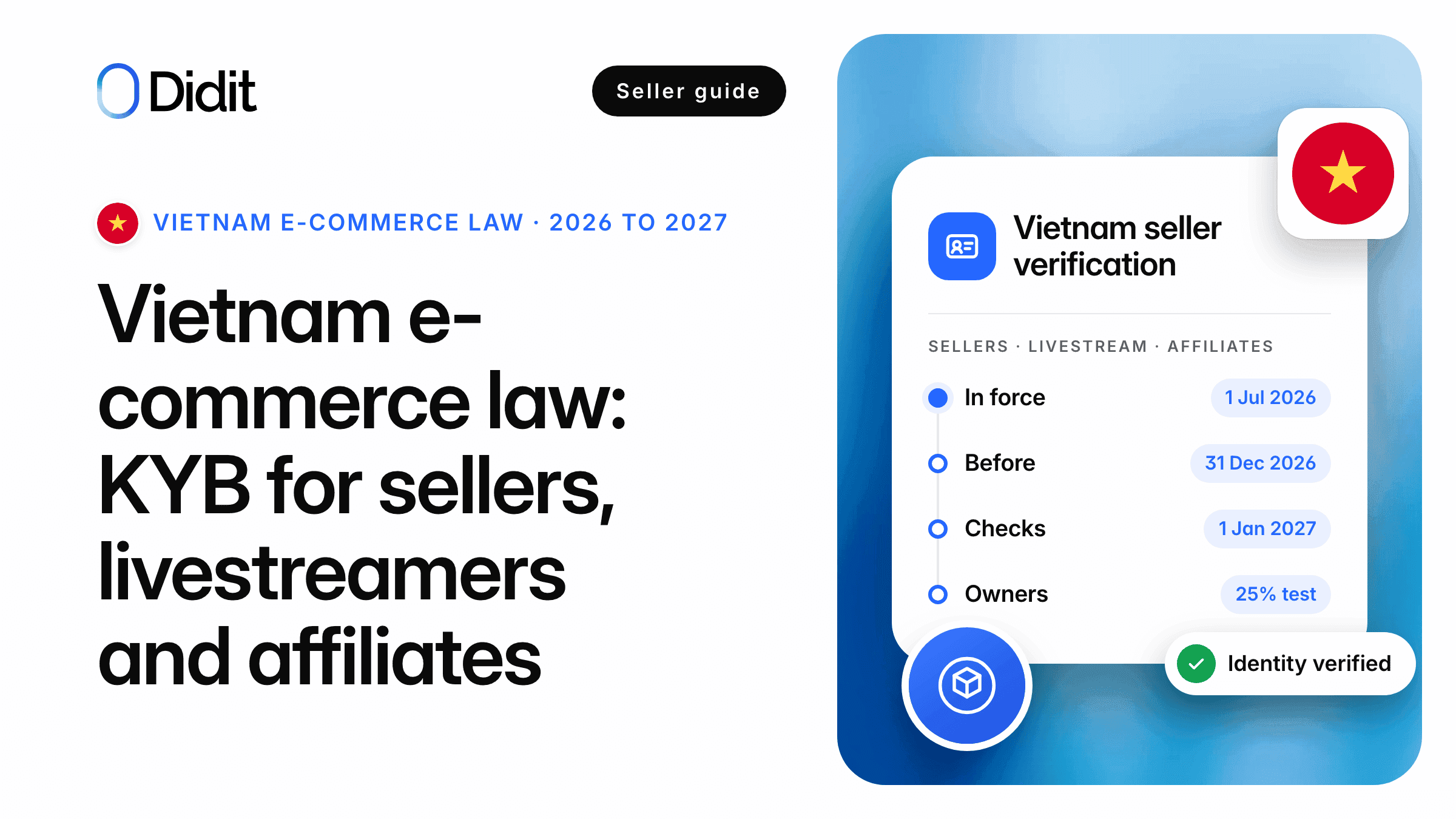
In short
Vietnam's e-commerce law (Law 122/2025/QH15, in force since 1 July 2026) makes platforms electronically verify sellers before they sell and livestream sellers before they stream, and makes affiliate marketing service providers verify affiliates before they start; foreigners are verified through lawful documents.[1]
- Decree 248/2026/ND-CP lists the data to verify and starts platform e-verification of sellers and livestream sellers on 1 January 2027.[2]
- Decree 320/2026/ND-CP requires their accounts to be linked to an electronic identification account (VNeID); accounts created before 28 September 2026, outside banking, must be linked before 31 December 2026.[3]
- For company sellers, the platform verifies the organisation and its legal representative; the Enterprise Registration Certificate and, since 2025, beneficial owner rules shape the company check.[2][7][10]
The Vietnam e-commerce law changed seller onboarding on every marketplace and social commerce app that serves Vietnamese buyers. Law 122/2025/QH15 and its implementing Decree 248/2026/ND-CP apply from 1 July 2026, and Decree 248 ended the old Decrees 52/2013 and 85/2021.[2] Decree 320/2026/ND-CP then added a second layer: seller, livestream seller and affiliate accounts must be linked to the national electronic identification system.[3]
This guide is for the product, trust and compliance teams that build seller onboarding and its know your business (KYB) and know your customer (KYC) checks: who must be verified, by whom and when, the data for each seller type, company and owner checks, and a flow with a checklist. The wider picture, including social networks and existing accounts, is in our Decree 320 and VNeID guide.
Build it with Didit
Business checks, identity checks and screening for sellers, livestreamers and affiliates in one flow: start free or talk to us about Vietnam.
Vietnam e-commerce law at a glance: the seller rules
| Rule | What it asks about sellers | In force |
|---|---|---|
| E-commerce Law 122/2025/QH15 | Identity e-verification of sellers, livestream sellers and affiliates; lawful documents for foreigners[1] | 1 July 2026[1] |
| Decree 248/2026/ND-CP | Data points per seller type (Article 18); platform e-verification (Article 52(2))[2] | 1 July 2026; Article 52(2) from 1 January 2027[2] |
| Decree 320/2026/ND-CP | Accounts must be linked to an electronic identification account (Article 19, adding Article 40(9) to Decree 69/2024)[3] | 28 September 2026[3][4] |
| Decree 147/2024/ND-CP | Social network accounts verified by Vietnamese mobile number, or personal identification number without one; commercial livestreams by personal identification number[6] | 25 December 2024[6] |
| Law 76/2025/QH15, Decree 296/2026/ND-CP | Companies keep beneficial owner information; the 25% test[9][10] | 1 July 2025; 23 July 2026[9][10] |
- 1 July 2026Law in forceE-commerce Law and Decree 248 apply.[1][2]
- 28 September 2026Decree 320The e-ID linking rule takes effect.[3]
- Before 31 December 2026Existing accountsAccounts created before 28 September 2026, banking aside, must be linked by then.[3]
- 1 January 2027Platform dutyPlatforms e-verify sellers and livestream sellers.[2]
- 30 June 2027E-commerce transitionSites and apps registered under the old e-commerce rules may run on that basis until the end of this date.[1]
Dates as written in the law. "Before 31 December 2026" renders the decree's "chậm nhất trước ngày 31 tháng 12 năm 2026", literally "at the latest before 31 December 2026".
Who must be verified: sellers, livestream sellers and affiliates
The law defines three roles. A livestream seller is "the person who appears directly on the e-commerce platform to carry out livestream selling"; an affiliate introduces goods or services through links or referral codes created by an affiliate marketing service provider (Article 3).[1] The law also covers social networks that offer messaging, online ordering or livestream selling to support sales (Article 3(5)); the seller verification duty applies to those whose messaging has contract-confirmation tools, and the account duties of Article 17(2) to those with livestream selling and online ordering (Article 18).[1]
| Role | Who verifies | When |
|---|---|---|
| Seller | The platform operator (Article 17(1)(c)), and social networks under the conditions of Article 18[1] | Before allowing sales[1] |
| Livestream seller | The platform operator (Article 22(4))[1] | Before the livestream[1] |
| Affiliate marketer | The affiliate marketing service provider, the party that creates the links or codes (Article 25(1)(a))[1] | Before affiliate marketing starts[1] |
Watch out
The affiliate duty sits with whoever issues the links or referral codes. That is often the marketplace, but an affiliate network that issues the codes carries the duty itself.[1]
What the Vietnam e-commerce law requires from platforms
The core rule is Article 17(1)(c). It binds intermediary platforms, and Article 28(1)(a) applies the Article 17 duties to foreign platforms of the same model.[1]
Article 17(1)(c)Law 122/2025/QH15 on E-commerce
"Electronically authenticate identity in accordance with this Law and the law on electronic identification and authentication before allowing sales. Where the seller is foreign, verify identity through lawful documents."
Source: Law 122/2025/QH15, Vietnamese text[1] (our translation)
Verification is one duty in a longer list, some of them only for platforms with online ordering:
- Moderate each seller's listings before they are displayed (Article 17(1)(đ)).[1]
- Suspend or terminate a seller account immediately at a competent authority's request (Article 17(2)(e))[1], within 24 hours under Decree 248 Article 18(2)(e).[2]
- Give a seller at least 5 days' notice before other restrictions for a legitimate reason, outside the authority-request case (Article 17(2)(g)).[1]
- Compensate buyers, or share liability, when a failure under Article 17 causes them damage (Article 17(2)(k)).[1]
- For large digital platforms under consumer protection law, remove unlawful listings automatically and prevent repeat violations (Article 17(3)(c); Decree 248 Article 18(3)(c)).[1][2]
Sellers must give the platform the information needed to verify them, and enterprises and household businesses their registered business name and place of business (Article 21(1)).[1] Where they use online ordering, sellers also use only their own payment account and supply licences for conditional business lines before selling (Article 21(2)).[1] Livestream platforms publish rules that explain how livestream sellers complete electronic identification, (Decree 248 Article 12)[2], and keep each stream's audio and video for at least one year (Article 22(7)).[1]
Foreign intermediary and social commerce platforms with ordering must set up a Vietnamese legal entity before offering Vietnamese as a display language or a .vn domain, or after reaching a transaction threshold, unless the law provides otherwise (Article 27(4)); where a treaty rules out that requirement, they appoint an authorised legal entity and place a deposit at a bank in Vietnam instead (Article 27(5)). They carry the same verification duties (Article 28(1)(a)).[1]
Decree 320/2026: the VNeID link for seller accounts
Decree 320/2026/ND-CP, issued on 13 August 2026 on the recommendation of the Minister of Public Security, amends Decree 69/2024/ND-CP on electronic identification and authentication.[3] Its rule for e-commerce sits in Article 19, which adds Article 40(9) to Decree 69/2024; other articles cover foreigners' accounts, account levels and how businesses connect. The clause lists several sectors; the quote below keeps the parts on e-commerce and social networks.
Article 40(9)Decree 69/2024/ND-CP, added by Article 19 of Decree 320/2026/ND-CP
"Electronic transaction accounts [...] on digital platforms serving activities in [...] e-commerce (sellers, livestream sellers and affiliate marketers under the E-commerce Law) [...] and social networks in Vietnam must be linked to and authenticated with an electronic identification account."
Source: Decree 320/2026/ND-CP, Vietnamese text[3] (our translation)
- In e-commerce it names sellers, livestream sellers and affiliates, not buyers; social network accounts are a separate item.[3]
- Accounts created before 28 September 2026, outside banking, must be linked before 31 December 2026 (Article 20(3)).[3]
- Platforms serving cross-border services link accounts only once they meet the conditions and are connected.[3]
- Businesses connect through an electronic authentication service provider, under a plan approved by the Ministry of Public Security unit that runs the system (Decree 69/2024 Article 18(5), as rewritten by Decree 320 Article 10).[3] Those providers are public units or enterprises within the People's Public Security (Decree 69/2024 Article 3(9)).[5]
- The decree has no penalty article; the Ministry of Public Security inspects that platform accounts are linked before use.[3]
Watch out
Where Article 40(9) applies, a document scan, a selfie or a phone code does not by itself link an account to an electronic identification account: the clause names the e-identification account and provides no alternative method.[3] Foreign sellers, livestreamers and affiliates are the case the E-commerce Law handles with lawful documents.[1] Decree 320 sets no separate rule for foreign users: Article 40(9) covers accounts in Vietnam without a foreigner carve-out, so the document route does not by itself settle whether linking applies to a foreign seller's account.[3]
The decree also cuts paperwork. A party that uses documents already integrated in the National Identification Application may not require the person or organisation to submit originals or copies of them (Decree 69/2024 Article 4(4), as rewritten by Article 2 of Decree 320).[3] The decree's Appendix now lists the Household Business Registration Certificate among documents issued to individuals (list 1), and the Enterprise Registration Certificate and Tax Registration Certificate among documents issued to organisations (list 2).[3] Using another person's data this way needs their consent.[3]
The data each seller type must provide
Decree 248 Article 18(1) sets the data points for four cases: domestic individuals, domestic organisations, foreign individuals and foreign organisations.[2] The decree gives household businesses no separate list; our reading is that the owner is verified as an individual, while the platform publishes the household business's registered name and place of business.[2]
| Seller type | Data the platform verifies | Where it comes from |
|---|---|---|
| Domestic individual | Full name, date of birth, personal identification number[2] | Electronic identification account[3] |
| Household business | The owner as an individual; registered name and place of business[2] | Household Business Registration Certificate[8] |
| Domestic organisation | Name, head office, identification number; legal representative's name, date of birth and personal identification number[2] | Enterprise Registration Certificate for the company[7][8]; the legal representative's own e-identification data[3] |
| Foreign individual | Name, passport number, country, on a document valid at least 6 months[2] | Passport or equivalent[2] |
| Foreign organisation | Name, head office, country; legal representative's name and passport number, valid at least 6 months[2] | Registration certificate or equivalent; passport or equivalent[2] |
Domestic sellers
Electronic identification
- E-authentication under the e-identification law[1]
- Account linked to an e-identification account[3]
- Personal identification number as the key[2]
Article 17(1)(c); Decree 248 Article 18(1)(a)
Foreign sellers
Lawful documents
- Identity verified through lawful documents[1]
- Passport or equivalent, valid 6 months[2]
- Registration document for organisations[2]
Article 17(1)(c); Decree 248 Article 18(1)(b)
Two identity routes in the E-commerce Law. They decide how identity is verified, not whether Decree 320 linking applies: that question is separate for both.[3] Foreigners who lawfully enter or reside in Vietnam can also get a VNeID account by applying in person at a provincial police immigration office with a passport, where face and fingerprints are captured.[3]
Since 1 July 2025 the personal identification number has been used in place of the personal tax code, so one number links identity and tax.[12] Citizens with a valid citizen identity card (căn cước công dân) or identity card (thẻ căn cước) can hold a level 1 or level 2 e-identification account; Article 40(9) does not say which level a platform needs.[3]
Checking the Enterprise Registration Certificate and the owners
The Enterprise Registration Certificate carries the enterprise name and code, the head office, the legal representative's details for limited liability and joint-stock companies, and the charter capital (Law on Enterprises Article 28).[7] The enterprise code is also the tax code (Decree 168/2025 Article 8(1)).[8]
The National Business Registration Portal at dangkykinhdoanh.gov.vn shows, free of charge, the name, code, head office, business lines, legal representative and legal status of a company, and the registration of household businesses (Decree 168/2025 Articles 74 and 116).[8][14]
Law 76/2025/QH15 defines the beneficial owner as an individual who in fact owns the charter capital of, or controls, the enterprise, and makes companies collect and keep that information.[9] Decree 296/2026/ND-CP sets the criteria: 25% or more of the charter capital or voting shares, held directly or indirectly, including through family or contract groups; all general partners in a partnership; control of the enterprise; and, where no one qualifies, the manager with the greatest authority.[10] Older companies add it at their next registration change.[9]
- Seller companyApplies to sell on your platform
- 60%Holding companyLook through to its owners
- 50%Owner A30% indirect, beneficial owner
- 50%Owner B30% indirect, beneficial owner
- 50%
- 40%Owner C40% direct, beneficial owner
- 60%
Example
Owners A and B each hold 50% of a holding company that owns 60% of the seller: multiplied through the chain, 30% each, above 25%. Owner C holds 40% directly. All three are beneficial owners under the Decree 296 ownership test.[10] Checking the identity of each one, as well as the legal representative, is our recommendation rather than a rule of Decree 248.
Anti-money laundering (AML) screening and tax data
A marketplace is not a reporting entity under the Law on Anti-Money Laundering (Law 14/2022/QH15) for running a platform alone: Article 4 lists financial institutions, including payment and payment intermediary services, and named non-financial businesses.[13] A group company licensed for such a service, for example an e-wallet, is covered for that activity.
Note
For most platforms, screening sellers and their owners against sanctions and politically exposed person (PEP) lists is a risk-based choice that protects buyers, payment partners and the platform, not a statutory duty.
Tax rules do add duties. Under Decree 252/2026/ND-CP, which replaced Decree 117/2025, platforms with ordering and payment functions withhold tax for household and individual sellers (Article 43).[11] Platforms must also give the tax authority, within 10 working days of a written request, a seller's tax code, personal identification number, passport number and phone number (Article 60(7)-(8)); this duty does not cover sellers the platform already withholds tax for.[11]
A seller onboarding flow for Vietnamese marketplaces
This flow is the seller route. Livestream sellers and affiliates need the same identity check without the business branch. Decree 248 writes its data list and its six-month document-validity rule for sellers, so treat those details as the seller baseline and read the law for how they apply to your livestream and affiliate accounts.
1Open a seller account
Social commerce apps show a clear seller marker.[1][2]
The seller is a domestic individual or organisation
E-identification route
Link the account to an e-identification account.[3] Individuals: name, date of birth, personal identification number. Organisations: name, head office, identification number and the legal representative's data.[2]
Lawful documents route
Seller documents: individuals a passport or equivalent valid at least 6 months from review; organisations a registration certificate or equivalent and the representative's passport or equivalent valid at least 6 months from review.[1][2] Foreign livestreamers and affiliates are verified through lawful documents.[1] Decree 320 linking is assessed separately.[3] We recommend liveness and face match on top.
2Check the business
Registry lookup by code, legal representative, beneficial owners.[8][10]
3Collect licences
Conditional business lines supply proof before the first sale.[1]
4Screen and decide
Sanctions and PEP screening, manual review of edge cases.
5Go live and monitor
Publish the registered name and place of business.[2]
The e-identification route runs through an electronic authentication service provider, under a plan approved by the Ministry of Public Security unit that runs the system.[3]
Talk to us about Vietnam
Building seller, livestream or affiliate onboarding for Vietnam: talk to us about the document, liveness, KYB and screening steps, or start free and test them on your own flow.
After onboarding: monitoring sellers and livestreams
| Trigger | What the rule says | What to build |
|---|---|---|
| Authority request | Suspend or terminate the seller account within 24 hours[2] | A suspension path with an audit trail |
| Livestream | Keep audio and video at least one year; stop the stream in listed cases[1] | Storage tied to the verified livestreamer |
| Repeat offender | Large platforms prevent repeat violations[1][2] | Duplicate face and device checks |
| Phone number changes hands | The citizen's e-identification account is locked[3] | Re-verification when the link fails |
| Company dissolved or suspended | The organisation's e-identification account is locked[3] | Periodic registry status checks |
Before each stream, the seller must give the livestreamer its business-condition documents for conditional business lines and its product quality documents, and the livestreamer must refuse to cooperate when they are missing (Articles 23(1) and 24(3)).[1]
Checklist for product and compliance teams
- Map each account type to the law's roles: seller, livestream seller, affiliate, buyer.[1]
- Decide who issues affiliate links or codes, and so who verifies affiliates.[1]
- List accounts created before 28 September 2026 that must be linked before 31 December 2026.[3]
- Plan the e-identification connection through an approved authentication service provider.[3]
- Build the lawful documents route for foreign sellers, livestreamers and affiliates.[1]
- Collect the Decree 248 data points for each seller type, plus what tax and licensing duties require, and nothing you do not need.[2]
- Look up each company and household business on the national portal.[8]
- Identify the legal representative and the beneficial owners under the Decree 296 criteria.[10]
- Record licences for conditional business lines before the first sale.[1]
- Set up the 24-hour suspension path and the one-year livestream archive.[1][2]
How Didit helps with seller verification in Vietnam
Didit's business verification checks the company behind a seller account, and its identity checks cover the people behind it. Didit does not run VNeID authentication and does not perform the Decree 320 link: the connection goes through an electronic authentication service provider under the Ministry of Public Security's approved plan, and it stays with your platform.[3][5] Talk to us about the document, liveness, KYB and screening steps that sit alongside your own VNeID connection. The document route is available now, and every foreign seller, livestreamer and affiliate needs it anyway.
- Registry checks for Vietnam at the Lite, Shareholders and ultimate beneficial owner (UBO) tiers, with ownership data where the registry supplies it, and document upload with optical character recognition (OCR).
- A linked identity check for each legal representative, director and beneficial owner.
- ID verification of the Vietnamese national ID card, passport, driver's licence or residence permit.
- On phones with near-field communication (NFC), chip reading of the Vietnamese ID card and passport, with checks that the chip data is signed and matches the printed data.
- Liveness, face match, virtual camera signals and face search, so one person behind several accounts stands out.
- AML screening against 1,300+ sanctions, PEP and watchlist databases, whose sources include a Vietnam Ministry of Public Security sanctions list and Vietnamese PEP sources, with daily monitoring.
- One-time phone codes by SMS, WhatsApp or Zalo, with SMS fallback, and verification screens in Vietnamese.
A full KYC check costs $0.33, AML screening $0.20 and ongoing monitoring $0.07 per person per year; business verification is priced on the pricing page.
Didit provides
- Company registry checks and document review
- Identity checks by document, chip, liveness and face match
- Screening and monitoring of companies and people
- The evidence of every check
Stays with you
- The VNeID connection and linking under Decree 320
- Your reading of the law and your policies
- The decision to approve, suspend or remove a seller
- Responses to the authorities
Verify sellers, livestreamers and affiliates in one flow
Combine business checks, identity checks and screening in one workflow, and pay only for completed checks.
Key takeaways
- The Vietnam e-commerce law requires identity verification of sellers, livestream sellers and affiliates before they act.
- Decree 248 starts platform e-verification of sellers and livestream sellers on 1 January 2027.
- Decree 320 requires their accounts to be linked to an e-identification account; existing ones before 31 December 2026.
- Foreigners are verified through lawful documents; for companies, the platform verifies the organisation and its legal representative, and registry and beneficial owner checks are good practice on top.
- A document check does not replace the VNeID link where Decree 320 requires it.
Frequently asked questions
What is Vietnam's new e-commerce law?
It is Law 122/2025/QH15 on E-commerce, passed on 10 December 2025 and in force since 1 July 2026.[1] Decree 248/2026/ND-CP details it and ended Decrees 52/2013 and 85/2021.[2]
Do platforms have to verify sellers before they can sell?
Yes. Article 17(1)(c) requires intermediary platforms to electronically authenticate a seller's identity before allowing sales, and to verify foreign sellers through lawful documents.[1] Decree 248 makes platforms responsible for e-verifying sellers and livestream sellers from 1 January 2027.[2]
Do livestream sellers in Vietnam have to verify their identity?
Yes. The platform must electronically authenticate the livestream seller before the livestream, and verify a foreign livestreamer through lawful documents (Article 22(4)).[1] The livestreamer must give the platform the information needed for that check (Article 24(1)).[1]
Who verifies affiliate marketers?
The affiliate marketing service provider, meaning the party that creates the links or referral codes, verifies the affiliate before affiliate marketing starts (Article 25(1)(a)).[1] That is often the platform, but not always. Foreign affiliates are verified through lawful documents.[1]
What is Decree 320/2026 and how does it affect sellers?
Decree 320/2026/ND-CP amends Decree 69/2024/ND-CP on electronic identification and authentication and took effect on 28 September 2026.[3][4] Article 40(9) of Decree 69/2024, added by Article 19 of Decree 320, requires the accounts of e-commerce sellers, livestream sellers and affiliates, among others, to be linked to and authenticated with an electronic identification account.[3]
What is the deadline for existing seller accounts?
Accounts created before 28 September 2026, outside banking, must be linked to an electronic identification account before 31 December 2026 (Decree 320 Article 20(3)).[3] Banking accounts have until before 30 June 2027, a separate deadline in the same article.[3]
Do foreign sellers need VNeID?
The E-commerce Law verifies foreign sellers, livestreamers and affiliates through lawful documents. For foreign sellers, Decree 248 adds a passport or equivalent valid for at least 6 months from review.[1][2] Foreigners who lawfully enter or reside in Vietnam can obtain a VNeID account by applying in person at a provincial police immigration office with a passport; face and fingerprints are captured. Decree 320 has no foreigner carve-out, so whether linking applies is a separate question.[3]
How do you check a Vietnamese Enterprise Registration Certificate?
Look up the enterprise code on the National Business Registration Portal, dangkykinhdoanh.gov.vn, which shows the name, code, head office, business lines, legal representative and legal status free of charge.[8][14] The enterprise code is also the company's tax code.[8]
Who is a beneficial owner in Vietnam?
An individual who in fact owns the charter capital of, or has the right to control, the enterprise.[9] Under Decree 296/2026/ND-CP that means 25% or more of the charter capital or voting shares, directly or indirectly, including through family or contract groups, all general partners in a partnership, or control; if no one qualifies, the manager with the greatest authority.[10]
What are the penalties for not verifying sellers?
The E-commerce Law provides administrative sanctions, blocking or suspension of the platform's transaction functions, and removal or termination of violating accounts (Article 39), without setting amounts.[1] Decree 320 has no penalty article.[3]
Sources
- Law 122/2025/QH15 on E-commerce, National Assembly, 10 December 2025, Vietnamese text (Thư viện Pháp luật), Articles 2, 3, 17, 18, 21 to 28, 39, 40 and 41.
- Decree 248/2026/ND-CP detailing the E-commerce Law, Government, 30 June 2026, Articles 12, 18, 19 and 52.
- Decree 320/2026/ND-CP amending Decree 69/2024/ND-CP on electronic identification and authentication, Government, 13 August 2026, Vietnamese text, Articles 1 to 20 and Appendix.
- Decree 320/2026/ND-CP, official record, Government legal documents portal (the signed PDF is linked from this page).
- Decree 69/2024/ND-CP on electronic identification and authentication, Government, 25 June 2024, Article 3.
- Decree 147/2024/ND-CP on internet services and online information, Government, 9 November 2024, Articles 23 and 27.
- Law on Enterprises 59/2020/QH14, National Assembly, 17 June 2020, Article 28.
- Decree 168/2025/ND-CP on enterprise registration, Government, 30 June 2025, Articles 8, 74, 85, 91 and 116.
- Law 76/2025/QH15 amending the Law on Enterprises, National Assembly, 17 June 2025, Articles 1 and 3.
- Decree 296/2026/ND-CP amending Decree 168/2025/ND-CP, Government, 23 July 2026, Article 3 (beneficial owners).
- Decree 252/2026/ND-CP detailing the Law on Tax Administration, Government, 30 June 2026, Articles 43, 60 and 74.
- Personal identification number used in place of the tax code from 1 July 2025, Government policy portal.
- Law on Anti-Money Laundering 14/2022/QH15, National Assembly, 15 November 2022, Article 4.
- National Business Registration Portal, official company and household business lookup.
Vietnam's seller rules reward platforms that know who is behind every shop, stream and link. See how Didit checks companies, representatives and owners on the business verification page, and read the Decree 320 guide for the VNeID migration.
Get your Vietnam seller onboarding ready
Test business checks, identity checks and screening on your own seller flow, or tell us what you need for Vietnam.
Related articles
- Decree 320/2026: VNeID account verification for platforms in Vietnam
- Vietnam ID card verification: reading the CCCD chip with NFC
- MiCA regulation in 2026: the EU crypto compliance guide to 2028
- Companies House identity verification: Insolvency Service convictions
- Privacy coin regulation after FinCEN drops its mixing rule
- OSC Argosy decisions: KYC risk tolerance and a suspended UDP