How to Bridge Web3 Wallets to Off-Chain Identity: 6 Steps
Bridge a wallet to a verified person in six steps: define the gates, configure screening, run a full ID check, screen the address on demand, prove wallet control, then exchange Travel Rule data.
 Alberto RosasCo-founder and CEO
Contents
In this guide
Jump to the part you need.
This guide is for DeFi teams that need a verified link between a wallet address and a real person without turning every swap into a KYC gate. Six steps follow: define the gates, configure the app, verify the person, screen the address, prove wallet control, record the transfer. A full ID check costs $0.33 per completed check and a wallet screening costs $0.15 per screening. The caveat: you decide where identity is required, so gate as little as possible.
Last updated: November 26, 2026. Prices checked against the live Didit price feed on November 26, 2026.
| Step | What you run | Didit module | List price |
|---|---|---|---|
| 1 | Choose the moments that need identity | Workflow Orchestrator | Free |
| 2 | Configure the application and the screening provider | Transactions settings | No published per-call price |
| 3 | Verify the person | Full ID check: document, passive liveness, face match 1:1, device and IP | $0.33 per check |
| 4 | Screen the wallet address | Wallet Screening (KYT) | $0.15 per screening |
| 5 | Prove the user controls the wallet | Wallet ownership widget | No separate published line |
| 6 | Record the transfer and exchange Travel Rule data | Transaction Monitoring, Travel Rule | $0.001 per transaction beyond the plan allowance, $0.02 per Travel Rule exchange |
Start free in the sandbox at business.didit.me, with no sales call. Developers can connect Didit to an AI assistant through the MCP server, and every price on this page is listed on the pricing page. Steps 4 to 6 use Wallet Screening inside Transaction Monitoring, the Wallet Ownership Widget, and Transaction Monitoring with Travel Rule.
What bridging on-chain and off-chain identity means
DeFi runs on pseudonymity. A wallet address carries no name, and that is the point: it gives users privacy and censorship resistance. The same property creates problems the moment real money, regulated counterparties or age-restricted products enter the flow. A protocol cannot tell whether two hundred wallets belong to one person farming an airdrop, whether a deposit address is sanctioned, or whether a borrower is a legal entity or a script.
Bridging means attaching one verifiable claim from the off-chain world to an address, and nothing more. You do not need a name on every wallet. You need to know, at specific moments, that the person behind an address passed a check, and that the fact can be proven later without keeping the passport scan. Verifiable credentials and zero-knowledge proofs are the usual vocabulary for this, but none of them is required to ship the flow: what you need is a claim issued after a real check, stored against a session reference, and read at the gate. The rest of this page is the implementation.
Prerequisites
- A Didit account and an application in the Business Console. The sandbox is free on every plan and does not ask for a sales call.
- An API key for that application. The wallet screening and transaction monitoring examples on this page authenticate with the
x-api-keyheader. Verified Identity step-up calls use the documented bearer access token instead. - A screening provider connected, either Didit's managed screening or your own provider run inside Didit. Set it in Transactions, then Settings, then Provider Preferences. Without one the wallet screening endpoint answers
409 Conflict. - A written list of the moments you will gate, and the single claim each gate needs.
- Consent language for the documents you collect, and a retention rule for the verified result.
- The network of every wallet you plan to screen. A
0xaddress on its own is not enough, and the network you send must match the address you send.
How to bridge a DeFi wallet to a verified identity in 6 steps
- Choose the gates, not the whole protocol. Write down each moment pseudonymity becomes a liability: a first fiat on-ramp, a withdrawal above your limit, an age-restricted product, a borrow above your collateral cap, a counterparty that is another VASP. For each gate record the claim you need, such as
over_18, a verified legal name, a cleared address or proof of wallet control. Everything not on the list stays open. That list is what you build in the Workflow Orchestrator, and it is what keeps the product usable. - Configure the application and the screening provider. Create the application, copy its API key, then open Transactions, Settings, Provider Preferences and connect a provider. Didit returns one result shape whether the screening runs through managed screening or through your own provider inside Didit, so your parser does not change. Nothing is billed until a check completes.
- Verify the person off-chain. Run the verification session with the modules that produce the claim from step 1. A full ID check is $0.33 and is always three parts in one check: the ID document at $0.15, biometrics at $0.15 (passive liveness $0.10 and face match 1:1 $0.05) and device and IP analysis at $0.03. For age-restricted dApps, age estimation costs $0.10. If you need claims inside a token, Authentication verified identity runs the check at sign-up or as a step-up and returns the claims you selected, such as
over_18or a verified name, never the documents or the photos. Store the session reference next to the user record. That reference is the off-chain half of the bridge.
The liveness result inside a session: the biometric half of a $0.33 full ID check. - Screen the wallet address before it touches the protocol. Pick the call that matches the moment. Both routes run the same screening and return the same result shape; only the record they leave behind is different.
The on-demand endpoint checks one address and returns the full risk result without creating a transaction.
On-demand wallet screening or transaction screening: which call to use Situation Call What you get A customer adds a withdrawal address and no transaction exists yet Wallet screening, POST /v3/wallet-screening/The risk result for that address. It writes nothing to the transactions table You are recording a deposit or withdrawal and want the screen attached to it Create Transaction with currency_kind: "crypto"Screening attached to the transaction, with rules, alerts and webhooks Compliance wants to vet an address ad hoc Wallet screening One call, one result, no transaction record
Sendcurl -X POST https://verification.didit.me/v3/wallet-screening/ \ -H "x-api-key: YOUR_API_KEY" \ -H "Content-Type: application/json" \ -d '{ "wallet_address": "0x94f1b9b64e2932f6a2db338f616844400cd58e8a", "blockchain": "ETH" }'blockchainevery time. A bare0xaddress is valid on every EVM network, so the API answers422withcandidate_chainsand screens and bills nothing until you name the network. Never sendETHfor a wallet that lives on Polygon, Base or Arbitrum: the same address can carry different activity and different risk on each chain. Coverage also depends on the route you chose. Managed screening covers a fixed list of networks, and a provider you connect can cover a different set, so check the network and the provider before you promise a chain to your users. The selected network has to match the wallet address you send, or the result is about a different chain.Wallet screening fields used in this guide Field Direction What it does wallet_addressRequest, required The address to screen. It must match the network you choose. Alias: address.blockchainRequest, optional but send it Network identifier such as ETH,BASE,SOLorTRX. Common names such asPOLYGONandTRONare accepted. Alias:currency.directionRequest, optional Context for the provider: inbound,outbound,depositorwithdrawal. It does not change the risk score.screening_typeResponse Always WALLET_SCREENING.risk_scoreResponse Integer risk score for the address. providerResponse Which screening produced the result. fallback_from_provider,fallback_reasonResponse Set only when a connected provider failed and managed screening ran instead. 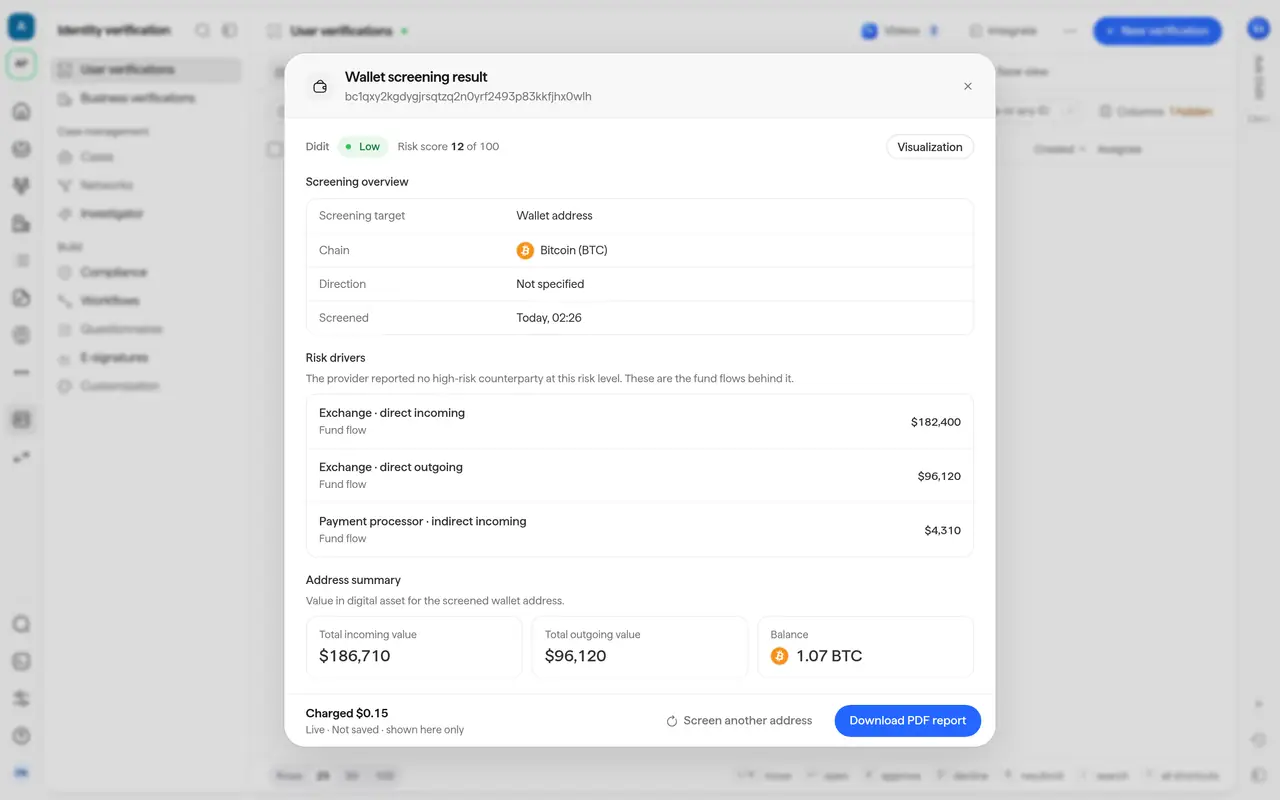
A wallet screening result in the Business Console, the same shape the API returns. - Prove the user controls the wallet. The wallet ownership widget proves that a customer controls a specific address. It supports message signing on EVM, Solana, Bitcoin and Tron wallets, a Satoshi test where the customer sends a tiny on-chain amount to a deposit address you control, a screenshot that your compliance team reviews, and, only where your jurisdiction tolerates it, self-declaration. Smart contract accounts sign too: Didit asks the account's own contract whether the signature is valid (ERC-1271), and for an account that is not deployed yet it checks the ERC-6492 signature, without deploying the account or sending a transaction. A verified proof marks the address book entry
is_ownership_verified: true, which lets a linked transfer advance out ofUNCONFIRMED_OWNERSHIP. - Record the transfer and exchange Travel Rule data. For crypto transfers, create the transaction with
currency_kindset tocrypto, the token intransaction_details.currencyand the network intransaction_details.crypto_params.crypto_chain. Screening then runs server-side during transaction creation, with no extra call from you.
When the counterparty is another VASP, submit with{ "transaction_details": { "currency": "TOKEN", "currency_kind": "crypto", "crypto_params": {"crypto_chain": "BASE"} } }transaction_category: "travelRule". Didit tries its rails in priority order, negotiates the originator and beneficiary data, and tracks the exchange through its lifecycle. Broadcast on chain only once the exchange reachesCOMPLETED, then report the transaction hash back so it closes asFINISHED. Under the EU Transfer of Funds Regulation there is no minimum amount, so every crypto transfer is in scope.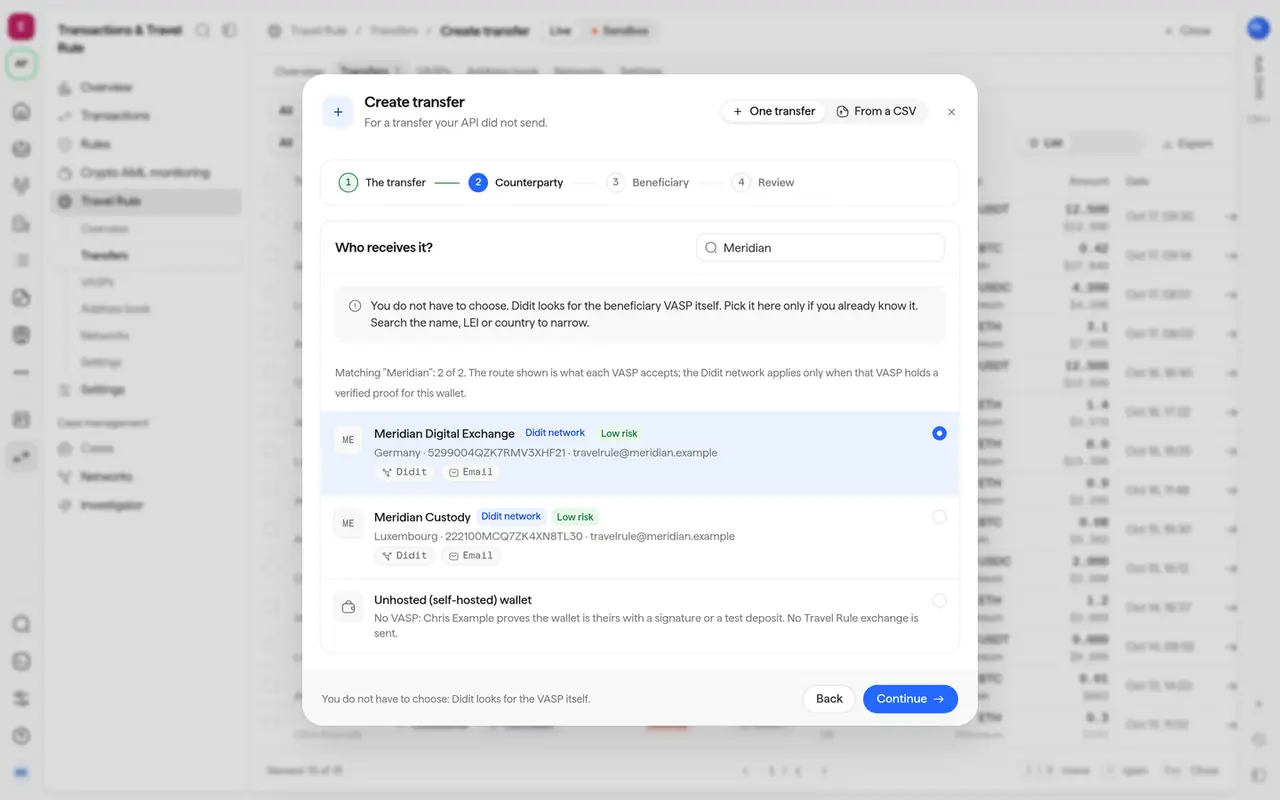
A Travel Rule transfer mid-exchange: originator and beneficiary data being negotiated before the on-chain broadcast.
Expected output
The wallet screening call returns HTTP 200 with a standardised screening result. screening_type is WALLET_SCREENING, risk_score is an integer for the address, and provider names the screening that ran. fallback_from_provider is null unless a provider you connected in the Marketplace failed and Didit's managed screening ran instead, in which case provider names the managed screening and fallback_reason says why. The response shape is identical to the WALLET_SCREENING result returned during transaction screening, so one parser handles both.
Your gate then reads three things together: the identity outcome from step 3, the risk score from step 4 and the ownership proof from step 5. Only when all three satisfy the rule you wrote in step 1 does the address become usable in your product. The verified result also lands on the person's record in the console, so a reviewer sees the identity check and the transaction activity in one place.
Failure cases and recovery
| Symptom | Cause | Recovery |
|---|---|---|
409 Conflict | No screening provider is configured for the application | Connect one in Transactions, Settings, Provider Preferences, then resend the same call |
422 with candidate_chains | A 0x address sent without blockchain | Resend with blockchain set to the wallet's real network. Nothing was screened or billed |
400 | The address format does not match any supported network, or an unsupported network was requested | Check the address, then resend with a supported identifier |
| Transaction approved but not screened | The hash was not found on any checked network, or the networks could not be checked at that moment | Read custom_values.aml_screening_status and custom_values.aml_screening_error. The transaction moves to review |
SIGNATURE_INVALID on the ownership widget | Another account or key signed, or the message changed | Ask the user to sign again. The proof stays open and the widget prompts a switch of accounts |
Step-up returns review | The check needs a human decision | Read the step-up on your backend and act only on approved. Until then the action stays blocked, because a step-up never fails open |
Paid steps and review boundaries
- Sandbox testing is free and unlimited. Billing starts only on completed checks in production, paid from prepaid credit.
- The summary table at the top of this page is the price reference for every step, at list price from the live feed.
- Plans change the unit price: Free includes $10 of monthly credit for organizations that sign up with a work email, Growth is $99 a month with 4% off Didit prices, Scale is $299 a month with 10% off, and Enterprise is a custom annual contract from $15,000 a year.
- If you already hold a contract with a screening provider, bring that provider and run it inside Didit. We do not quote a price for that route here.
Two points always need a person. A screenshot proof of wallet ownership never auto-verifies, so your compliance team approves or rejects it from the proof queue. A step-up or a verification session in review holds the action until someone decides, and a step-up never fails open. Treat those queues as part of the build, not as an afterthought.
Worked cost example
Take a perpetuals DEX onboarding 10,000 verified users a month. Each user gets a full ID check, one AML screening and one wallet screening on the deposit address.
- Per user: full ID check $0.33 + AML screening $0.20 + wallet screening $0.15 = $0.68.
- 10,000 users x $0.68 = $6,800.00 per month.
- Add 2,000 outbound Travel Rule exchanges at $0.02: 2,000 x $0.02 = $40.00.
- Total for the first month at list price: $6,800.00 + $40.00 = $6,840.00.
- Ongoing AML monitoring is billed per person per year: 10,000 x $0.07 = $700.00 a year.
- On the Scale plan the 10% discount applies to Didit prices: $0.68 x 0.90 = $0.612 per user, 10,000 x $0.612 = $6,120.00. Travel Rule becomes $0.02 x 0.90 = $0.018, and 2,000 x $0.018 = $36.00. Total $6,120.00 + $36.00 = $6,156.00, before the $299 monthly plan fee.
The free monthly credit on the Free plan is $10.00, which covers 30 full ID checks at $0.33 ($10.00 / $0.33 = 30.3). That is enough to test the whole flow end to end before you commit.
How privacy works when a wallet is verified
A verified wallet does not have to mean a doxxed user. Gate the claim, not the identity. Authentication returns selected claims inside the person's tokens, such as over_18 or a verified name, and the documents and photos never reach your app. For age-restricted dApps, age estimation costs $0.10. Reusable KYC is free and lets a person who verified once share that existing verification with another application instead of resubmitting documents.
Keep the wallet address as the identifier users see, and keep the identity result behind it. That split is what lets an anonymous Web3 identity exist for ordinary activity while the gated moments stay verifiable. 4,000+ companies use Didit for identity and fraud checks today, and the same claim model applies to a wallet gate as to a fiat account: your app receives the selected verified claim, such as over_18 or a verified name, while the documents and photos never reach your app.
Sources
- Didit docs: On-demand Wallet Screening API
- Didit docs: Crypto wallet and address screening (KYT)
- Didit docs: FATF Travel Rule API
- Didit docs: Wallet Ownership Widget
- Didit docs: Verified Identity at sign-up and step-up
- Didit docs: Reusable KYC
- Didit pricing page, price feed read November 26, 2026
- Didit docs: Pricing and billing rules
- Didit wallet screening product page
- Didit: switching from another provider
- Didit MCP server setup
- FATF, Recommendation 16 on the travel rule
- EUR-Lex, Regulation (EU) 2023/1113 on transfers of funds and certain crypto-assets
Next step: open the sandbox at business.didit.me, create an application, and run the wallet screening call above against one address before you build the rest of the gate. The sandbox is free and there is no sales call. Developers who want a coding agent to wire the API can start from the MCP server. The full price list stays on the pricing page.
Try it
Try this in the sandbox
Run the check this guide describes, free.
The product this post is about, taken from its topic. Run it free in the sandbox.
Author
Alberto Rosas
Co-founder and CEO

Keep reading
Other guides in the same topic.
 What Is the Purpose of FICA in South Africa? 2026 Guide
FICA is South Africa's anti-money laundering law. It creates the Financial Intelligence Centre and requires accountable institutions to identify and verify clients, screen for PEP and sanctions risk and report suspicious.
Alberto RosasNov 26, 2026 Sixth Money Laundering Directive (6AMLD): What Changed and Which Rules Apply
6AMLD is Directive (EU) 2018/1673: Member States must criminalise laundering, widen predicate offences and set a four-year penalty floor. It adds no new due diligence duties for firms.
Alberto RosasNov 26, 2026 Automated Sanctions Screening: Canada, the Entity List and Embargoes
Automated sanctions screening matches people and companies against lists such as Canada's autonomous sanctions made under SEMA and JVCFOA and the OFAC SDN List, and returns candidate hits scored for identity confidence and.
Alberto RosasNov 26, 2026Questions
Frequently asked questions
What is Didit wallet?
Didit provides Wallet Screening inside Transaction Monitoring and a wallet ownership widget for proving control of an address. Wallet Screening checks a wallet address or a transaction hash for AML risk. The widget proves that a customer controls a given address. You keep your own wallet, keys and custody model.
Can a user verify identity in Web3 anonymously?
Yes, at the claim level. A user proves a property such as age, and your app receives the verified claim in a token instead of the document or a photo. The wallet address stays the identifier your product uses, while the underlying identity stays with Didit and is reused rather than re-collected.
How much does it cost to verify a user and screen a wallet?
A full ID check is $0.33 and a wallet screening is $0.15, so the pair is $0.48 per user. Add AML screening at $0.20 and a verified, screened user costs $0.68. Billing is per completed check from prepaid credit, and sandbox testing is free.
Does Didit screen a wallet without a transaction?
Yes. The on-demand wallet screening endpoint checks one address and returns the full risk result without creating a transaction, which is the right call when a customer adds a withdrawal address. It writes nothing to the transactions table. Use transaction creation instead when you need rules, alerts and webhooks attached.
Which blockchains does wallet screening cover?
Managed screening covers Bitcoin, Ethereum, Litecoin, XRP, Bitcoin Cash, Dogecoin, Tron, Solana, Polygon, BNB Chain, Base, Optimism, Arbitrum One, Avalanche C-Chain, Cardano, Stellar and Hedera. Common network names such as POLYGON or BSC are accepted. Coverage varies by route, so a provider you connect may support a different set of networks, and the network you send must match the wallet address.
How do I prove a user owns a self-hosted wallet?
Use the wallet ownership widget. The default path is message signing with a Didit-issued challenge, supported for EVM, Solana, Bitcoin and Tron wallets, including smart contract accounts through ERC-1271. A Satoshi test is available when you pass a deposit address, and a screenshot proof is available only if you enable it and accept human review.
Do I have to run KYC on every wallet holder?
No. Gate only the moments you listed in step 1, such as a first fiat on-ramp or a withdrawal above your limit. A lending protocol can leave swaps open and require a verified identity only above a collateral threshold, which keeps the cost at $0.33 per gated user rather than per wallet.
What happens if no screening provider is configured?
The wallet screening endpoint answers 409 Conflict and nothing is screened or billed. Connect either Didit's managed screening or your own provider inside Didit under Transactions, Settings, Provider Preferences, then resend the same request.
Why does a 0x address return 422?
A 0x address is valid on every EVM network, so Didit cannot tell which chain you mean and answers 422 with a list of candidate_chains. Resend the call with blockchain set to the wallet's real network, for example BASE or ARB.
Can I connect Didit to an AI assistant or coding agent?
Yes. Didit runs a free hosted MCP server at https://mcp.didit.me/mcp with OAuth sign-in, and setup instructions for each client are on the MCP page. There is also an integration prompt that lets a coding agent wire the API end to end.
Compliance built in
Audited, certified and attested.
We hold the certifications and build each country's rules into your flows, so you can launch anywhere without worrying. Security and Compliance center
- Regulation encoded into your flows
Tell us what you do and where. Didit lists the rules that apply to you, with sources, and builds the checks each country needs into one workflow.
- Ready for AMLR
Every requirement of the new EU anti-money laundering rules, from checking customers to human review, is already covered by a Didit check.
- Tested in Spain's Treasury sandbox
Spain's Treasury published its supervised sandbox report on Didit's NFC plus active liveness onboarding; SEPBLAC took part and valued the added measures positively.
- Audited, not self-declared
iBeta Level 1 and Level 2. Liveness tested under ISO/IEC 30107-3.
Your obligations · 3 regions
 SOC 2 Type 2
 ISO 27001
 iBeta Level 1 and Level 2
 EU regulator attestation
 FSM youth protection
 GDPR
 EBA remote onboarding
 MiCA compatible
 FIDO Alliance member
- AMLREU AML Regulation ready
Integration · Didit MCP
Run Didit from your own AI agent
Connect Didit to Claude, Cursor, VS Code or ChatGPT and just ask in plain words. Your agent can do anything you can do in the console, with the same permissions you have.
 Add to Claude
 ChatGPT
 Cursor
- Build workflowsDescribe the checks you need. The agent creates and publishes the flow.
- Run investigationsAsk why a session was declined, review cases, search people and companies.
- Change rulesCreate payment rules, test them on past data and switch them on.
- Pull reportsAsk for numbers, exports or the audit log.
Didit Academy


