White-Label Biometric SDKs for Secure Healthcare Apps
Discover how white-label biometric SDKs enhance security and user experience in healthcare apps. This post explores the benefits of seamless, branded identity verification, crucial for patient data protection and regulatory.
 Alberto RosasCo-founder and CEO
Contents
In this guide
Jump to the part you need.
Seamless User ExperienceIntegrating white-label biometric SDKs into healthcare applications ensures a consistent brand experience, reducing user friction and increasing adoption by maintaining the app's native look and feel during critical identity verification steps.
Enhanced Data Security and ComplianceBiometric authentication, coupled with robust liveness detection, offers superior protection against identity fraud and spoofing attempts, which is vital for safeguarding sensitive patient information and adhering to strict healthcare regulations like HIPAA.
Accelerated Development and ScalabilityLeveraging pre-built, modular SDKs allows healthcare providers to quickly deploy advanced biometric verification capabilities without extensive in-house development, enabling faster time-to-market and easy scalability for growing user bases.
Didit's AI-Native AdvantageDidit provides an AI-native, modular identity platform with white-label biometric SDKs, offering Passive & Active Liveness and 1:1 Face Match, ensuring secure, customizable, and compliant identity verification solutions tailored for the unique needs of healthcare applications.
The Growing Need for Biometric Security in Healthcare
The digital transformation of healthcare has ushered in an era of unprecedented convenience, allowing patients to access medical records, schedule appointments, and consult with providers remotely. However, this accessibility comes with significant challenges, especially concerning data security and patient privacy. Healthcare applications handle highly sensitive personal health information (PHI), making them prime targets for cyberattacks and identity fraud. Traditional authentication methods, such as passwords, are often weak links, susceptible to phishing, brute-force attacks, and human error.
Biometric authentication offers a robust solution, providing a higher level of assurance that the person accessing the application is indeed the authorized user. Face recognition, fingerprint scans, and voice biometrics are increasingly being adopted to secure patient portals, telemedicine platforms, and electronic health record (EHR) systems. The unique nature of biometric data makes it far more difficult to compromise than alphanumeric credentials, significantly bolstering the security posture of healthcare applications and helping meet stringent regulatory requirements like HIPAA.
Why White-Label Biometric SDKs are a Game Changer for Healthcare Apps
While the benefits of biometrics are clear, implementing these complex technologies from scratch can be a daunting task for healthcare organizations. This is where white-label biometric SDKs (Software Development Kits) become invaluable. A white-label SDK allows healthcare app developers to integrate sophisticated biometric verification capabilities directly into their applications, all while maintaining their own branding and user interface. Instead of developing intricate liveness detection algorithms or face matching engines, developers can simply plug in a pre-built, robust solution.
The primary advantage is a seamless user experience. Patients interact with an authentication flow that looks and feels like a native part of the healthcare provider's app, not a third-party redirect or an unfamiliar interface. This consistency builds trust and reduces user abandonment rates, crucial for patient engagement. Furthermore, white-label SDKs often come with optimized camera integration, NFC capabilities (for ePassport/eID verification), and advanced anti-spoofing measures, ensuring high accuracy and fraud prevention without burdening in-house development teams. Didit's native SDKs, available for iOS, Android, React Native, and Flutter, exemplify this, providing a superior user experience by handling all the complexities of liveness detection and device capabilities.
Key Features to Look for in a Biometric SDK for Healthcare
When selecting a white-label biometric SDK for a healthcare application, several critical features must be prioritized to ensure optimal security, compliance, and user satisfaction:
- Robust Liveness Detection: This is paramount to prevent spoofing attacks using photos, videos, or 3D masks. Look for Passive & Active Liveness capabilities, which can detect sophisticated fraud attempts without requiring intrusive user actions. Didit's Liveness Detection is AI-native and highly effective against deepfakes and presentation attacks.
- High Accuracy 1:1 Face Match: The SDK should be able to accurately compare a live facial scan with a reference image (e.g., from an ID document or existing patient record) to confirm identity. Low face match scores should be configurable to trigger review or decline based on risk tolerance.
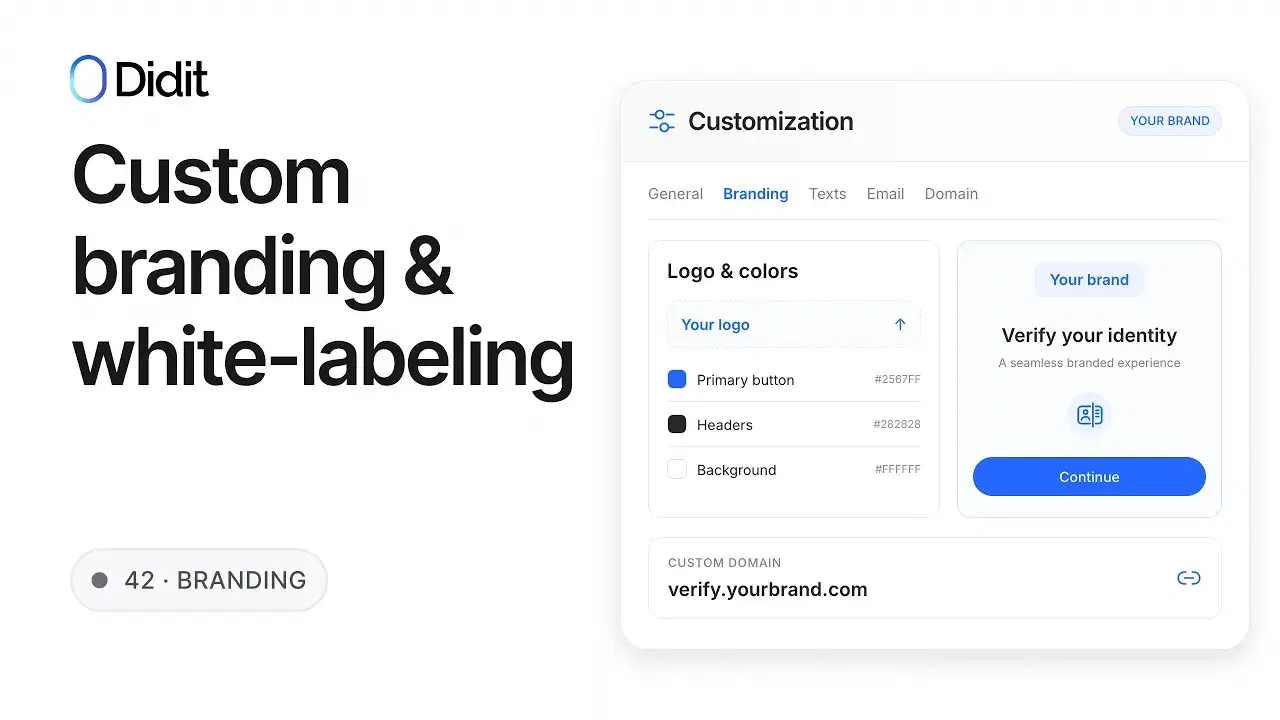
- Customization and Branding: The ability to white-label the entire verification flow—including colors, typography, logos, and even hosting on a custom domain—is essential for maintaining brand consistency and a native user experience. Didit's Business Console offers extensive customization options for every visual element.
- Compliance and Privacy: Ensure the SDK and its provider adhere to relevant data privacy regulations such as HIPAA, GDPR, and CCPA. This includes secure data handling, encryption, and clear data retention policies.
- Developer-Friendly APIs and SDKs: Easy integration is key. The provider should offer clean APIs, comprehensive documentation, and native SDKs for various platforms (iOS, Android, React Native, Flutter) to streamline development. Didit is built developer-first, with instant sandboxes and public documentation.
- Scalability and Performance: The solution must be able to handle a high volume of verification requests efficiently and scale with your user base without compromising performance.
Implementing Biometric Authentication: Best Practices
Successful implementation of biometric authentication in healthcare apps requires more than just integrating an SDK. Consider these best practices:
- User Education: Clearly communicate to users why biometrics are being used, how their data is protected, and the benefits it offers (e.g., enhanced security, faster access). Transparency builds trust.
- Multi-Factor Authentication (MFA): While biometrics are strong, combining them with another factor (e.g., a PIN or a one-time password sent to a registered device) adds an extra layer of security, especially for high-risk transactions or sensitive data access.
- Fallback Mechanisms: Always provide alternative authentication methods for users who cannot use biometrics (e.g., due to medical conditions, device issues, or personal preference). This ensures accessibility for all patients.
- Regular Audits and Updates: Continuously monitor the performance of your biometric system, review logs, and apply updates to counter emerging fraud techniques. Stay informed about the latest advancements in biometric technology and security threats.
- Ethical Considerations: Be mindful of biases in biometric systems and ensure equitable access and performance across diverse user populations.
How Didit Helps
Didit stands as the premier choice for healthcare organizations seeking to implement secure, seamless, and compliant biometric verification. Our AI-native, modular identity platform is designed for the unique demands of the healthcare sector, offering a comprehensive suite of products that can be easily integrated into any application.
With Didit's white-label Native SDKs, healthcare providers can integrate robust Passive & Active Liveness detection and highly accurate 1:1 Face Match capabilities directly into their apps. This ensures that only legitimate users gain access, effectively combating fraud and protecting sensitive patient data. Our modular architecture allows you to pick and choose the identity primitives you need, from ID Verification (OCR, MRZ, barcodes) for initial patient onboarding to NFC Verification (ePassport/eID) for high-security scenarios. The extensive white-label options in our Business Console mean your verification flows will always reflect your brand, enhancing user trust and experience.
Didit's commitment to security and compliance is unwavering, providing the tools necessary to meet stringent regulatory requirements. Furthermore, our developer-first approach, featuring clean APIs and instant sandboxes, significantly accelerates integration, while our Core KYC and no setup fees make advanced identity verification accessible to organizations of all sizes. By leveraging Didit, healthcare apps can achieve unparalleled security, efficiency, and patient satisfaction.
Ready to Get Started?
Ready to see Didit in action? Get a free demo today.
Start verifying identities for free with Didit's free tier.
Try it
Try this in the sandbox
Run the check this guide describes, free.
The product this post is about, taken from its topic. Run it free in the sandbox.
Author
Alberto Rosas
Co-founder and CEO

Keep reading
Other guides in the same topic.
 What Is the Purpose of FICA in South Africa? 2026 Guide
FICA is South Africa's anti-money laundering law. It creates the Financial Intelligence Centre and requires accountable institutions to identify and verify clients, screen for PEP and sanctions risk and report suspicious.
Alberto RosasNov 26, 2026 Sixth Money Laundering Directive (6AMLD): What Changed and Which Rules Apply
6AMLD is Directive (EU) 2018/1673: Member States must criminalise laundering, widen predicate offences and set a four-year penalty floor. It adds no new due diligence duties for firms.
Alberto RosasNov 26, 2026 Automated Sanctions Screening: Canada, the Entity List and Embargoes
Automated sanctions screening matches people and companies against lists such as Canada's autonomous sanctions made under SEMA and JVCFOA and the OFAC SDN List, and returns candidate hits scored for identity confidence and.
Alberto RosasNov 26, 2026Questions
Blog questions
Who writes the Didit blog?
Which topics does the blog cover?
Is the blog available in my language?
Where do I find product updates?
Are these posts legal advice?
How do I find posts on one topic?
Are posts dated?
Do posts link to the docs?
Is the blog the same as the docs?
Compliance built in
Audited, certified and attested.
We hold the certifications and build each country's rules into your flows, so you can launch anywhere without worrying. Security and Compliance center
- Regulation encoded into your flows
Tell us what you do and where. Didit lists the rules that apply to you, with sources, and builds the checks each country needs into one workflow.
- Ready for AMLR
Every requirement of the new EU anti-money laundering rules, from checking customers to human review, is already covered by a Didit check.
- Tested in Spain's Treasury sandbox
Spain's Treasury published its supervised sandbox report on Didit's NFC plus active liveness onboarding; SEPBLAC took part and valued the added measures positively.
- Audited, not self-declared
iBeta Level 1 and Level 2. Liveness tested under ISO/IEC 30107-3.
Your obligations · 3 regions
 SOC 2 Type 2
 ISO 27001
 iBeta Level 1 and Level 2
 EU regulator attestation
 FSM youth protection
 GDPR
 EBA remote onboarding
 MiCA compatible
 FIDO Alliance member
- AMLREU AML Regulation ready
Integration · Didit MCP
Run Didit from your own AI agent
Connect Didit to Claude, Cursor, VS Code or ChatGPT and just ask in plain words. Your agent can do anything you can do in the console, with the same permissions you have.
 Add to Claude
 ChatGPT
 Cursor
- Build workflowsDescribe the checks you need. The agent creates and publishes the flow.
- Run investigationsAsk why a session was declined, review cases, search people and companies.
- Change rulesCreate payment rules, test them on past data and switch them on.
- Pull reportsAsk for numbers, exports or the audit log.
Didit Academy