Satoshi Test vs Message Signing: Wallet Ownership Proof
Use message signing as the default wallet ownership proof for EVM, Solana, Bitcoin and Tron. The Satoshi test is the asynchronous fallback for EVM, Bitcoin and Solana, and it never appears on an auto-minted session.
 Alberto RosasCo-founder and CEO
Contents
In this guide
Jump to the part you need.
Use message signing as your default wallet ownership proof and reach for the Satoshi test only when the customer's wallet cannot sign a Didit challenge. Message signing is offered for every supported chain family: EVM, Solana, Bitcoin and Tron. The Satoshi test appears only when you pass a deposit address at mint time, so it never shows up on an auto-minted session. Travel Rule messaging is published at $0.02 per transaction.
Last updated: November 26, 2026. Prices checked against the live Didit price feed on November 26, 2026.
Message signing and the Satoshi test at a glance
Message signing is the default for supported browser wallets: the customer signs a challenge and the verdict comes back on submit. The Satoshi test is asynchronous, and it only runs when you configure it manually by passing a deposit address at mint.
| Question | MESSAGE_SIGNING | SATOSHI_TEST |
|---|---|---|
| When it is offered | Always, for supported chain families | Only when you pass satoshi_deposit_address at mint, and only on EVM, Bitcoin or Solana chains. Never on an auto-minted session |
| Chains | EVM, Solana, Bitcoin (legacy, nested SegWit, native SegWit, Taproot), Tron | EVM, Bitcoin, Solana |
| What the customer does | Signs a Didit-issued challenge string with the wallet | Sends a tiny on-chain amount from the wallet to your deposit address |
| What Didit checks | The signature against the address, with ERC-1271 and ERC-6492 handling for smart accounts | The sender, the amount, and that the deposit is confirmed on chain |
| When the answer arrives | On submit: 200 with VERIFIED, or 400 with a code | Later: 200 with a pending status, then VERIFIED, 400 rejected, or 410 expired |
| If the first attempt fails | The proof stays open, so the customer can sign again | The transaction is rejected, so the customer needs a fresh deposit inside the window |
| Session window | The workflow session expiration | expires_at extended to at least the 24-hour Satoshi window |
| Cost to the customer | No on-chain movement | A small amount of crypto sent on chain |
Start free in the sandbox at business.didit.me with no sales call. Developers can connect Didit to an AI assistant through the Didit MCP server. The method sits inside the wallet ownership widget, inside our Travel Rule flow, and every unit price is on the pricing page.
The four proof methods in the wallet ownership widget
Under the EU Transfer of Funds Regulation, a VASP has to verify ownership of a self-hosted wallet before releasing funds to or from it above the sunrise threshold. The regulation is published on EUR-Lex. The widget is how Didit collects that proof without you building signing flows yourself. A verified proof marks the matching wallet address book entry as is_ownership_verified: true, which lets a linked Travel Rule transfer advance out of UNCONFIRMED_OWNERSHIP.
| Method | How it works | When it is offered |
|---|---|---|
MESSAGE_SIGNING | The customer signs a Didit-issued challenge string with their wallet. Didit verifies the signature against the address, and signing with a different account is rejected with a switch-accounts prompt | Always, for supported chain families |
SATOSHI_TEST | The customer sends a tiny on-chain amount from the wallet to a deposit address you control. The watcher checks the sender, the amount and the on-chain confirmation | Only when you pass satoshi_deposit_address at mint and the chain is EVM, Bitcoin or Solana |
SCREENSHOT | The customer uploads a screenshot of the wallet showing the address, JPEG, PNG or WebP up to 10 MB. It never auto-verifies | Only when allow_screenshot_proof is true |
SELF_DECLARATION | The customer attests ownership without cryptographic proof | Only when allow_self_declaration is true and your ownership validation mode accepts a declaration for that transfer |
Only two of the four methods give you cryptographic proof. Screenshot and self-declaration exist for the cases where a customer cannot produce either, and both depend on your settings. A self-declaration is never accepted in FULL ownership validation mode, and in SIMPLIFIED only below your simplified_validation_threshold. Presenting one the mode does not accept answers 403.
How message signing works
We issue a challenge string, the customer signs it in their wallet, and we verify the signature against the address being verified. Signing with a different account than the one under review is rejected with a clear switch-accounts prompt, so the customer sees what went wrong instead of a dead end.
Smart contract accounts are handled properly on EVM. For an ERC-4337 smart wallet, we ask the account's own contract, on the chain the wallet is declared on, whether the signature is valid, which is ERC-1271. For an account that is not deployed yet, we check the ERC-6492 signature the wallet returns, without deploying the account and without sending any transaction. Smart contract accounts are checked on every supported EVM chain.
Wallet discovery uses EIP-6963 and Wallet Standard, so every extension installed in the customer's browser appears as its own signing option. Pairing a separate mobile wallet app, for example by QR code, is not available today. That single gap is the main operational reason to keep the Satoshi test in your flow.
Bitcoin support covers legacy, nested SegWit, native SegWit and Taproot addresses. Tron and Solana are supported too. A failed signature returns 400 and leaves the proof open, so the customer can try again immediately rather than restarting the flow.
| Code | What it means | What you do |
|---|---|---|
SIGNATURE_INVALID | The signature does not prove the wallet: another account or key signed, or the message differs. For a smart contract account, its own contract answered that the signature is not its own | Leave the proof open and prompt the customer to sign again with the right account |
SIGNATURE_UNSUPPORTED_SCHEME | The wallet signed in a format Didit does not verify, for example a Bitcoin multisig or a BIP-322 full signature | Mint manually with satoshi_deposit_address to offer the Satoshi test, or screenshot review if your settings allow it |
SIGNATURE_LOOKUP_FAILED | The lookup behind the check did not complete | The 400 leaves the proof open, so the customer can sign again |
Read the code, not the message text. That is the documented pattern in the Didit API error reference, and it is how you route SIGNATURE_UNSUPPORTED_SCHEME to the Satoshi test without guessing from a human-readable string.
const raw = await response.text();
let body = {};
try {
  body = JSON.parse(raw);
} catch {
  // A 5xx response may not be JSON: rely on response.status.
}
const code = body.code ?? null;
How the Satoshi test works
The customer sends a tiny on-chain amount from the wallet to a deposit address you control. Didit's watcher checks the sender, the amount, and that the deposit is confirmed on chain, then completes the proof. For an EVM smart contract account the sender is the account itself, including when an ERC-4337 bundler submits the transaction.
This method is asynchronous. Nothing is decided when the customer presses send. You get 200 with a pending status until the deposit confirms, then 200 with VERIFIED. A background job rechecks every five minutes, and the session expires_at is extended to at least the 24-hour Satoshi window, so a slow chain does not kill an otherwise valid proof.
| Response | Meaning |
|---|---|
200 pending | The proof is open and Didit is watching the chain for a matching deposit |
200 VERIFIED | The deposit confirmed with the right sender and amount, and the proof is complete |
400 rejected | Wrong sender, wrong amount, a stale transaction, or a transaction that was already used |
410 | The window expired before a valid deposit confirmed |
Two consequences follow. Your UI has to say that we are watching the chain, not that the wallet is verified. And the Satoshi test is only offered when you pass satoshi_deposit_address at mint time on an EVM, Bitcoin or Solana chain. Auto-minted sessions, the ones Didit creates for you when auto_wallet_verification is on, never carry a deposit address, so the Satoshi test never appears on them. To offer it, mint manually with POST /v3/travel-rule/widget-session/.
The Satoshi test costs the customer a real on-chain transfer. Keep the deposit amount tiny, and make the address you control unmistakable in the widget copy so the customer does not read it as a payment request.
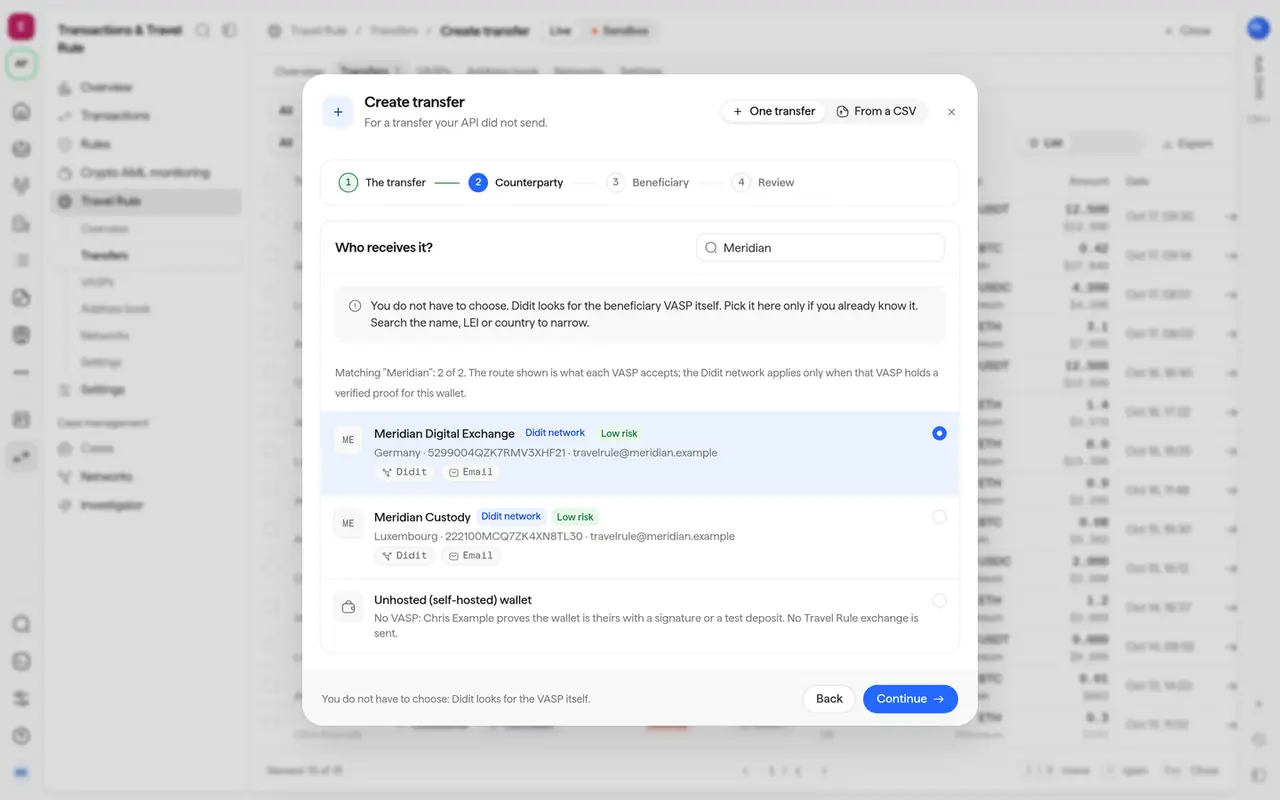
UNCONFIRMED_OWNERSHIP until the customer proves control of the counterparty wallet.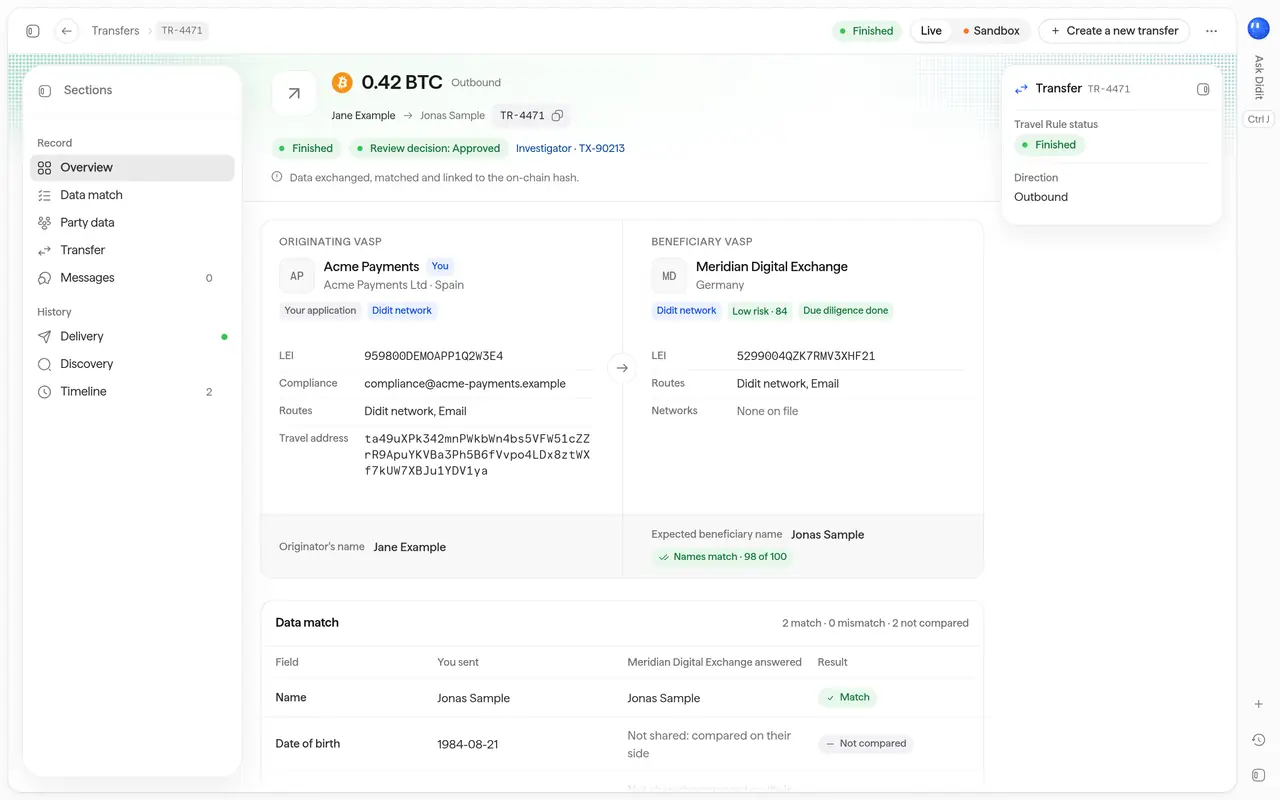
Which method to use for which wallet
- Consumer wallets in a desktop browser. Message signing. Every extension appears as its own signing option through EIP-6963 and Wallet Standard, and the answer comes back on submit.
- Bitcoin wallets that sign in an unsupported format, for example a Bitcoin multisig or a BIP-322 full signature. The Satoshi test can be a fallback when you manually mint with
satoshi_deposit_addresson an EVM, Bitcoin or Solana chain, because message signing returnsSIGNATURE_UNSUPPORTED_SCHEME. - Customers on a phone with no browser wallet. Satoshi test, because mobile wallet pairing by QR code is not available today.
- EVM smart contract accounts. Message signing. ERC-1271 handles deployed accounts and ERC-6492 handles undeployed ones, with no transaction and no deployment.
- Wallets you want pre-verified before a transfer exists. Either method, minted manually. Auto-minted sessions only exist once a transfer needs proof.
- Cases where no cryptographic proof is possible. Screenshot with review, or self-declaration where your mode accepts it. Treat both as exceptions and record why they were used.
Implementation choices to settle before you build
- Auto-mint or manual mint. With
auto_wallet_verificationon, the default, Didit mints a widget session when a transfer needs proof: the transfer is inUNCONFIRMED_OWNERSHIPbecause the counterparty wallet was declared self-hosted, or it is outbound inCOUNTERPARTY_VASP_NOT_FOUND. Inbound transfers Didit creates for you never get one, even when they land inUNCONFIRMED_OWNERSHIP, so those needPOST /v3/travel-rule/widget-session/. - How the widget reaches the customer. An auto-minted session comes back in the transaction's
action_requiredblock withtype: "wallet_ownership"and aurlto open, and the SDKs launch it automatically on client-side submission. - Which settings change the method list.
allow_screenshot_proofandallow_self_declarationdecide whether the two non-cryptographic methods appear.ownership_validation_modedecides whether a declaration is ever accepted for a transfer at all. - What your UI promises. Message signing resolves on submit, so the screen can report a result. The Satoshi test resolves later, so the screen has to say Didit is watching the chain and the proof is pending until the deposit confirms.
Scorecard: #1 Didit compared with the Satoshi Test listing
#1 Didit. Didit publishes this ranking; we explain the criteria so you can check them. One note before the scores: the public page at satoshitest.com that we could read is a domain marketplace listing, so this compares a wallet ownership proof product with a domain name for sale. Satoshi Test satoshitest.com, read November 26, 2026, states that the domain name SatoshiTest.com is for sale as a Premium, Verified Domain.
| Criterion | Didit | Why | Satoshi Test | Why |
|---|---|---|---|---|
| Published pricing | 5 | Public price book: $0.02 per Travel Rule transaction, $0.15 per wallet screening, published 4% and 10% plan discounts | 1 | No per-check price. The page lists a domain price of USD$8,888 buy now or USD$200 a month lease to own |
| Coverage | 5 | Message signing on EVM, Solana, Bitcoin including legacy, nested SegWit, native SegWit and Taproot, plus Tron, and 220+ countries for the identity checks around it | 1 | No coverage stated, because there is no verification product |
| Product breadth (KYC, KYB, AML, monitoring) | 5 | Three live product lines and 25+ composable modules, with wallet screening inside Transaction Monitoring | 1 | The page lists one item: the domain name |
| AI/MCP and developer access | 5 | Free hosted MCP server, SDKs, public OpenAPI, documented endpoints for every step | 1 | The card lists only the domain name; API, MCP and developer-documentation details were not provided |
| Time to first live check | 5 | Free unlimited sandbox on every plan, no sales call, and 4,000+ companies are active Didit customers | 1 | The listing does not describe a verification check |
| Evidence and certifications | 5 | SOC 2 Type 2, ISO/IEC 27001:2022 certified, iBeta Level 1 PAD, GDPR, DORA, MiCA, AMLD6, eIDAS 2.0 | 1 | The listing states Verified Domain, a marketplace label for the domain, not a security certification |
Verdict by use case. For wallet ownership proof before a Travel Rule transfer, Didit is the fit, and message signing is the default method inside it. For a team that wants the domain name itself, the listing is the fit at USD$8,888 buy now or USD$200 a month lease to own, Satoshi Test satoshitest.com, read November 26, 2026. There is no third case in which the listing does verification work.
Best for. Didit: VASPs and fintechs that need wallet ownership proof wired into KYC, KYB and transaction monitoring behind one API. Satoshi Test: a buyer for a domain name.
Like-for-like comparison
| Dimension | Didit | Satoshi Test |
|---|---|---|
| Features | Four proof methods: message signing, Satoshi test, screenshot with review, self-declaration. A verified proof sets is_ownership_verified: true on the wallet address book entry | None. The page lists a domain name for sale |
| Coverage | EVM, Solana, Bitcoin and Tron for message signing; EVM, Bitcoin and Solana for the Satoshi test | Not stated |
| Evidence | Signature verified against the address, ERC-1271 and ERC-6492 for smart accounts, on-chain confirmation for the Satoshi test, reviewer decision for screenshots | A Verified Domain label on the listing |
| Implementation | Hosted widget, auto-minted by default, manual mint with POST /v3/travel-rule/widget-session/, decisions by API or in the console, webhooks | None |
| Price units | Travel Rule messaging $0.02 per transaction, wallet screening $0.15 per screening, ownership proof inside the Travel Rule flow | Domain sale only: USD$8,888 buy now, USD$200 a month lease to own |
| Support | Docs, sandbox, MCP server, no sales call needed to start | The listing states free transaction support with secure payments and a support phone number, Satoshi Test satoshitest.com, read November 26, 2026 |
Matched volume cost scenarios
Ownership proofs run inside Travel Rule flows, and the published unit for that flow is $0.02 per transaction. The price book has no separate wallet-ownership line. Wallet screening, if you also screen the address, is a separate $0.15 per screening. The Satoshi test adds no Didit fee of its own. What it does add is a chain cost the customer pays directly to the network, which we do not bill and do not set.
| Volume | Didit at list price | Arithmetic | Didit on Scale | Satoshi Test |
|---|---|---|---|---|
| 1,000 checks | $20.00 | 1,000 x $0.02 | $18.00 | Not applicable: domain listing |
| 10,000 checks | $200.00 | 10,000 x $0.02 | $180.00 | Not applicable: domain listing |
| 100,000 checks | $2,000.00 | 100,000 x $0.02 | $1,800.00 | Not applicable: domain listing |
The Scale column is the same list price less the published 10% plan discount, so a transaction costs $0.018: 100,000 x $0.018 = $1,800.00. Growth takes 4% off, so a transaction costs $0.0192: 100,000 x $0.0192 = $1,920.00. Plan credit covers the first part of the bill, $115 a month on Growth and $350 a month on Scale.
Add wallet screening when the address also needs a KYT check: 100,000 screenings x $0.15 = $15,000.00 at list, or 100,000 x $0.135 = $13,500.00 on Scale.
Strengths and limitations
Message signing
- Strength: an answer on submit, with a code you can branch on and route.
- Strength: the widest chain coverage of the two methods, including Tron and Taproot, plus ERC-1271 and ERC-6492 for smart accounts.
- Strength: always offered for supported chain families, so auto-minted sessions work with no configuration.
- Limitation: a wallet that signs in an unsupported format returns
SIGNATURE_UNSUPPORTED_SCHEMEand cannot finish on that method. - Limitation: mobile wallet pairing by QR code is not available today.
Satoshi test
- Strength: a fallback you can offer by minting manually with
satoshi_deposit_addresson an EVM, Bitcoin or Solana chain, when a wallet signs in an unsupported scheme such as a Bitcoin multisig or a BIP-322 full signature. - Strength: the proof rests on the chain state, because the watcher checks the sender, the amount and the confirmation rather than a signature format.
- Limitation: asynchronous. Pending until confirmation, rechecked every five minutes.
- Limitation: never offered on auto-minted sessions, so you provide the required deposit address when minting manually.
- Limitation: a wrong sender, wrong amount, stale or already-used transaction returns
400, and an expired window returns410.
When the Satoshi Test listing is the better fit
If what you want is the domain name satoshitest.com, the listing is the right place to buy it: USD$8,888 buy now, or USD$200 a month lease to own, Satoshi Test satoshitest.com, read November 26, 2026. That is a published price for a real asset. It is not a verification service, so it cannot prove control of a wallet and buying it will not produce a VERIFIED status. If you want a Satoshi test as a proof method, that is the method inside the Didit widget described above, not a vendor of the same name.
Migration plan: moving wallets between proof methods
Moving from message signing to the Satoshi test, or the other way round, is a minting and settings change rather than a rebuild.
- Run both in parallel in the sandbox. Mint a manual widget session with
satoshi_deposit_addressfor the same wallet you verify with message signing, and confirm both reachVERIFIEDbefore you change anything in production. - Decide which wallets need a manual mint. Any wallet you want on the Satoshi test needs one, because auto-minted sessions never carry a deposit address. Keep
auto_wallet_verificationon for the wallets that can sign. - Watch the right fields. Didit sends
status.updatedanddata.updatedwebhooks with the decision inside, and the transaction'saction_requiredblock carries the widgeturl. For a Satoshi test, confirm the proof on the wallet record rather than on the first webhook you receive. - Keep the records. Store the method used, the code returned when a proof failed, the deposit transaction when one exists, and the reviewer decision for screenshots. Screenshot proofs are the ones the docs describe as reviewed from the screenshot review queue at
GET /v3/travel-rule/wallet-proofs/, with a decision atPOST .../decision/; do not assume that endpoint is the documented source for every proof record. - Check the address book. A verified proof sets
is_ownership_verified: trueon the matching entry, which is the flag that lets a linked transfer leaveUNCONFIRMED_OWNERSHIP. Confirm that flag in production before you retire the old flow.

Sources
- Didit docs: Wallet Ownership Widget, Travel Rule proof of control
- Didit docs: Travel Rule, wallet address book
- Didit docs: API errors, status codes and codes
- Didit docs: Verification statuses and session lifecycle
- Didit docs: Create Session API
- Didit docs: Retrieve Session API
- Didit pricing, checked against the live price feed on November 26, 2026
- Didit MCP server
- EUR-Lex, EU Transfer of Funds Regulation
- Satoshi Test, satoshitest.com, read November 26, 2026, domain marketplace listing, plain text per policy
Run the wallet ownership widget yourself in the sandbox at business.didit.me. Mint a session with a deposit address, run message signing against the same wallet, and compare the responses before you commit either method to production. No sales call, and the free plan includes $10 of monthly credit.
Try it
Try this in the sandbox
Run the check this guide describes, free.
The product this post is about, taken from its topic. Run it free in the sandbox.
Author
Alberto Rosas
Co-founder and CEO

Keep reading
Other guides in the same topic.
 What Is the Purpose of FICA in South Africa? 2026 Guide
FICA is South Africa's anti-money laundering law. It creates the Financial Intelligence Centre and requires accountable institutions to identify and verify clients, screen for PEP and sanctions risk and report suspicious.
Alberto RosasNov 26, 2026 Sixth Money Laundering Directive (6AMLD): What Changed and Which Rules Apply
6AMLD is Directive (EU) 2018/1673: Member States must criminalise laundering, widen predicate offences and set a four-year penalty floor. It adds no new due diligence duties for firms.
Alberto RosasNov 26, 2026 Automated Sanctions Screening: Canada, the Entity List and Embargoes
Automated sanctions screening matches people and companies against lists such as Canada's autonomous sanctions made under SEMA and JVCFOA and the OFAC SDN List, and returns candidate hits scored for identity confidence and.
Alberto RosasNov 26, 2026Questions
Frequently asked questions
What is the difference between a Satoshi test and message signing?
Message signing asks the customer to sign a Didit-issued challenge string with their wallet, and Didit checks the signature against the address on submit. The Satoshi test asks the customer to send a tiny on-chain amount to a deposit address you control, and Didit's watcher checks the sender, the amount and the confirmation on chain. Message signing answers immediately; the Satoshi test is asynchronous.
Does Didit offer the Satoshi test on auto-minted wallet ownership sessions?
No. The Satoshi test is offered only when you pass satoshi_deposit_address at mint time and the chain is EVM, Bitcoin or Solana. Auto-minted sessions cannot offer SATOSHI_TEST. Other methods depend on your settings and validation mode.
Which blockchains does Didit message signing support?
EVM chains, Solana, Bitcoin and Tron. Bitcoin support covers legacy, nested SegWit, native SegWit and Taproot addresses. On EVM, ERC-4337 smart contract accounts are verified through ERC-1271, and undeployed accounts through ERC-6492, without deploying the account or sending a transaction.
How long does a Satoshi test take to verify?
As long as the deposit needs to confirm on chain. The API returns 200 with a pending status until confirmation and 200 with VERIFIED afterwards. Didit rechecks pending proofs every five minutes and extends the session expires_at to at least the 24-hour Satoshi window.
What does SIGNATURE_UNSUPPORTED_SCHEME mean?
The wallet signed in a format Didit does not verify, for example a Bitcoin multisig or a BIP-322 full signature. The response is 400 and the proof stays open. For that wallet, you can offer the Satoshi test by minting manually with satoshi_deposit_address on an EVM, Bitcoin or Solana chain, or use screenshot review when allow_screenshot_proof is on.
Why would a Satoshi test return 400 or 410?
A 400 means the deposit did not match: wrong sender, wrong amount, a stale transaction, or one that was already used. A 410 means the window expired before a valid deposit confirmed, so you create a new session.
Does Didit charge extra for wallet ownership proof?
The price book has no separate wallet-ownership line. Ownership proofs run inside Travel Rule flows, published at $0.02 per transaction, and wallet screening is $0.15 per screening when you screen the address. The Satoshi test adds no Didit fee; the customer pays the chain network fee directly.
Is Satoshi Test at satoshitest.com a verification vendor?
No. The page at satoshitest.com is a domain marketplace listing for the domain name, with a buy now price of USD$8,888 or a lease to own price of USD$200 a month, Satoshi Test satoshitest.com, read November 26, 2026. It sells a domain name, not wallet ownership verification.
Can a Bitcoin multisig wallet prove ownership?
Not with message signing, because a Bitcoin multisig signature returns SIGNATURE_UNSUPPORTED_SCHEME. You can offer the Satoshi test for that wallet by minting manually with satoshi_deposit_address on an EVM, Bitcoin or Solana chain: the customer sends a tiny amount from it, and Didit checks the sender, the amount and the confirmation.
Which method works for a customer whose wallet is only on their phone?
The Satoshi test, in most cases. Pairing a separate mobile wallet app, for example by QR code, is not available in message signing today, and browser discovery covers extensions installed in the browser. If the customer opens the widget in a browser that holds the wallet, message signing still works.
Compliance built in
Audited, certified and attested.
We hold the certifications and build each country's rules into your flows, so you can launch anywhere without worrying. Security and Compliance center
- Regulation encoded into your flows
Tell us what you do and where. Didit lists the rules that apply to you, with sources, and builds the checks each country needs into one workflow.
- Ready for AMLR
Every requirement of the new EU anti-money laundering rules, from checking customers to human review, is already covered by a Didit check.
- Tested in Spain's Treasury sandbox
Spain's Treasury published its supervised sandbox report on Didit's NFC plus active liveness onboarding; SEPBLAC took part and valued the added measures positively.
- Audited, not self-declared
iBeta Level 1 and Level 2. Liveness tested under ISO/IEC 30107-3.
Your obligations · 3 regions
 SOC 2 Type 2
 ISO 27001
 iBeta Level 1 and Level 2
 EU regulator attestation
 FSM youth protection
 GDPR
 EBA remote onboarding
 MiCA compatible
 FIDO Alliance member
- AMLREU AML Regulation ready
Integration · Didit MCP
Run Didit from your own AI agent
Connect Didit to Claude, Cursor, VS Code or ChatGPT and just ask in plain words. Your agent can do anything you can do in the console, with the same permissions you have.
 Add to Claude
 ChatGPT
 Cursor
- Build workflowsDescribe the checks you need. The agent creates and publishes the flow.
- Run investigationsAsk why a session was declined, review cases, search people and companies.
- Change rulesCreate payment rules, test them on past data and switch them on.
- Pull reportsAsk for numbers, exports or the audit log.
Didit Academy


