South Africa ID Verification Against Government Databases 2026
Didit checks a typed South African ID number against the Department of Home Affairs register and pulls company data, officers and owners from the company registry. Lookups return a data match, not a document verdict.
 Alberto RosasCo-founder and CEO
Contents
In this guide
Jump to the part you need.
This page is for teams that need to check a South African person or company against an official record rather than a photographed document. Didit runs a typed national ID lookup against the Department of Home Affairs register and pulls company data, directors and owners from the company registry. A typed lookup returns a data match, not a document verdict. Document checks are $0.15, company registry checks start at $2.00, and non-document lookups are priced per country.
Last updated: November 26, 2026. Prices checked against the live Didit price feed on November 26, 2026.
At a glance
| Check | Source queried | Didit service | Price (USD) |
|---|---|---|---|
| Person, typed ID lookup | Department of Home Affairs, National Population Register | Non-document ID verification inside a workflow | Variable per lookup |
| Person, document | Didit document checks, 220+ countries | ID Verification | $0.15 per check |
| Person, full KYC | Didit document, biometrics and device signals | ID document, passive liveness, face match, device and IP | $0.33 per check |
| Bank account holder | The account holder's bank | Account check where the country is covered, otherwise statement upload | Priced per country on Bank Verification pricing; statement upload $0.20 |
| Company profile and officers | South African company registry; exact tier availability and price confirmed on the current KYB supported countries and pricing pages | KYB registry, Lite tier | From $2.00 per company, priced by country |
| Shareholders | Registry ownership data | KYB registry, Shareholders tier | $5.00 to $22.00 band, priced by country |
| Beneficial owners | Registry ownership chain | KYB registry, UBO tier | $9.00 to $96.00 band, priced by country |
| Company AML | 1,300+ AML, sanctions and PEP lists | Company AML screening | $0.20 per check |
Start free in the sandbox at https://business.didit.me/ (no sales call). If you build with an AI assistant, connect Didit to it through the hosted MCP server at https://didit.me/developers/mcp/. The company side is documented on the KYB Registry API page and the business verification product page, and Didit's published module prices are on https://didit.me/pricing/; country-specific KYB prices are listed in the KYB registry pricing documentation.
What South African law requires you to check
The obligation sits with your institution, not with a vendor. The Financial Intelligence Centre Act, 2001 (Act No. 38 of 2001) establishes the Financial Intelligence Centre and imposes duties on institutions and other persons who might be used for money laundering and terrorist financing, including customer due diligence measures for beneficial ownership and persons in prominent positions, on a risk-based approach (Financial Intelligence Centre Act, 2001, read November 26, 2026).
The Financial Intelligence Centre's own About page adds the operating context: the Act works alongside the Prevention of Organised Crime Act, 1998 (Act 121 of 1998) and the Protection of Constitutional Democracy Against Terrorist and Related Activities Act, 2004 (Act 33 of 2004), and the Money Laundering and Terrorist Financing Control Regulations of 20 December 2002 prescribe the manner, process and information for regulatory reports (Financial Intelligence Centre About page, read November 26, 2026). The same page records that the 2022 amendments authorise the FIC to request information from, or access to, any database held by an organ of state.
Two practical consequences for a verification build. First, you need a record of which source answered, because that provenance is what you show a reviewer. Didit keeps the source on the session payload in id_lookup.source, in the console and in exports, and the end user never sees it. Second, a name that matches a register is evidence of identity data, not a document authenticity finding, and you should not present it to a regulator as one.
The registers behind the answers
Department of Home Affairs and the National Population Register
South Africa's identity source is the Department of Home Affairs. The Department has provided its online verification system to third parties since 2013, connecting registered users to the National Population Register to check identities and other biographical information of clients against the Home Affairs database (Department of Home Affairs media statement, read November 26, 2026).
That statement matters for pricing expectations. For more than a decade banks and financial service providers paid R0.15 for real-time verifications against the NPR. Home Affairs then gazetted a new price structure: real-time verifications during peak hours at R10, with an off-peak batch transaction alternative at R1. Effective 1 July 2025 the Department began rolling out an upgraded online verification system to companies and government users, and the statement says the failure rate was reduced to below 1%.
SAnews reports the same launch with operating numbers: the upgraded service launched on 1 July 2025, the justice cluster including SASSA, SAPS and the Department of Justice and Constitutional Development was onboarded, that cluster was processing over 180,000 transactions a day with results in less than one second and an error rate well below one percent, and one private sector user had processed over one million records through the off-peak batch option (SAnews.gov.za, read November 26, 2026).
So a Home Affairs lookup carries a real upstream cost: R1 for an off-peak batch transaction and R10 for a peak-hour real-time verification. That is why Didit lists non-document verification as a variable line in the price book rather than as a flat $0.15, and why we do not publish a South Africa lookup number we would have to change. Read the exact source name for South Africa on the non-document lookup page before you enable the country, because the source column is the only statement of provenance you should rely on.
The company registry
Company records, officers and ownership come through Didit's KYB registry service, which searches company registries and then retrieves the company at the tier you need. South Africa is sold by data tier like every other jurisdiction: Lite for the company profile and officers, Shareholders for direct owners with ownership bands, UBOs for the ownership chain resolved to natural persons. Tier availability is per country in the KYB supported countries table, and what each tier returns and costs per country is on KYB registry pricing. A country whose registries hold no ownership data is delivered and billed at the highest tier it can serve, usually Lite.

The bank account holder
The account check confirms that an account belongs to the person your workflow already verified, from the details they type, with no bank sign-in. Coverage is country-specific and switches on one country at a time, and the Bank Verification pricing page is the only current statement of which countries offer it. Documented markets include Nigeria, Ghana, Kenya, Zambia, the United Kingdom, the euro area, the United Arab Emirates, Australia, the United States, India and much of Asia and Latin America (Account Check API, read November 26, 2026). That list is written as markets among which the check runs, so it does not settle any single country either way. Check the pricing page for South Africa before you rely on the fallback: a country with no priced route answers 404 with country_not_covered and is not billed.
What is documented is the ordering. Bank Verification confirms account ownership against an identity another step established, so put ID Verification, Database Validation or expected details before it, and the person never types a name for the check. The documented fallbacks are bank sign-in where the country offers it, statement upload at $0.20 per check, micro-deposits, and continuing without a bank. What is not documented is a South Africa account-check price, so read the live page rather than any copied list.
What Didit returns, by tier
A typed lookup carries the assurance tier data_match: the details the user gave matched a record the source holds. No document was inspected, so nothing about a document's authenticity is being claimed. The user picks South Africa, types the fields the country asks for, which always include the identifier and usually a name, sometimes a date of birth or an address, and gets a result: verified and moved on, asked to correct the number, retried, sent to document capture, or declined.
| What you verify | Identifier you send | What comes back | Assurance tier |
|---|---|---|---|
| Person, typed lookup | National ID number plus the fields the country asks for, usually a name | Match result, the source in id_lookup.source, and registry_portrait where the source returns a photograph | data_match |
| Person, document | Front image, plus back image on two-sided documents | Holder fields, parsed MRZ, Approved, Declined or In Review, and a warnings list | Document inspection |
| Company, Lite | Company name or registration number, with country_code ZA | Identifiers, status, legal form, incorporation date, registered address, activity, contact details, officers | Registry, Lite |
| Company, Shareholders | The same selection | Lite plus direct shareholders with ownership bands | Registry, Shareholders |
| Company, UBOs | The same selection | Shareholders plus beneficial owners resolved through the ownership chain | Registry, UBOs |
Each KYB response carries registry_tier_requested and registry_tier_delivered, so you always know what you paid for. A search itself is $0.50 per request when a paid company-data source returns candidates, regardless of how many candidates come back, and empty or failed searches are not charged.
One honest limit on the South Africa company side. The sources we can cite publish tier availability per country and price as a country-variable range, so they will not give you one South Africa Lite number from a table alone. Read South Africa's row in the KYB supported countries table for which of Lite, Shareholders and UBOs the registry serves, then read the matching row in KYB registry pricing for the per-company price. The $5.00 to $22.00 and $9.00 to $96.00 figures in the table above are global bands, not South Africa rates, and $2.00 is the global floor for a Lite retrieval.
No document, no photo, and what that means for Face Match
A lookup establishes identity from a record, and the source decides what a later Face Match step can compare against: some return the holder's photograph, some check the selfie themselves and return a verdict, and some return data only. Where a photograph comes back, the selfie, passive liveness and the face match all run inside the lookup and inside the lookup price, and the country's skip_liveness_and_face_match switch, on by default, lets the workflow skip its own biometric steps after a match. A data-only lookup leaves Face Match nothing to compare: the editor warns you before publishing and blocks publication when every path into Face Match leaves no photo, and a session that reaches it anyway reports FACE_MATCH_NOT_COMPUTED with a null score rather than declining automatically. Either allow document capture for South Africa in that path or remove the Face Match step.
Step by step in the Business Console
- Sign in to the Business Console at https://business.didit.me/ and open Workflows. The Workflow Orchestrator is free and included on every plan.
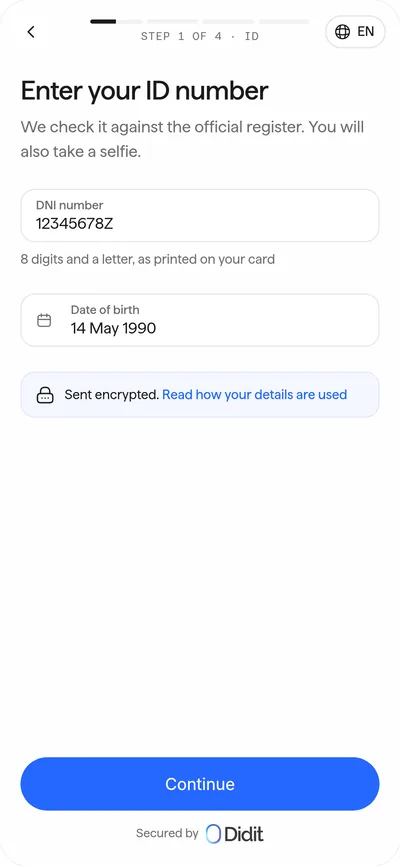
- Add an ID Verification step and open its Countries tab. Enable South Africa and pick non-document lookup, keeping document capture available as a second path for users who cannot pass a typed check.
- If a Face Match step follows, read the note beside the South African source before publishing. If the source is data only, either allow document capture for South Africa or remove Face Match from that path.
- For the company side, add a Business Verification step, choose the tier per country you want to collect, and leave the Key People form to collect directors and owners. The form has no separate fee.
- Publish the workflow, switch the environment to sandbox, and run a session with a test record. Sandbox testing is free and unlimited.
- Open the session in the console: the ID Verification detail shows the decision and the source, and the KYB screens show the company, its key people and the linked KYC status of each one.

Step by step via the API
Workflow sessions come from the standard session call, documented under workflows; the typed lookup runs inside that session, so there is no separate endpoint to wire. When a session finishes, read the decision with the documented endpoint:
GET https://verification.didit.me/v3/session/{sessionId}/decision/
x-api-key: <your key>
Listen for the status.updated webhook rather than polling. On the company side the standalone routes are search, select, shareholders and UBO, all under KYB Registry API: POST /v3/kyb/search/ returns candidates, POST /v3/kyb/select/ is the Lite profile, then POST /v3/kyb/shareholders/ and POST /v3/kyb/ubo/. The Shareholders and UBO endpoints exist on /v3/ only. Officers and representatives are not a separate concept in the Didit model: they live inside Key People, described on the officers page.
For document capture rather than a typed lookup, the standalone endpoint is POST /v3/id-verification/, which takes front_image and, for two-sided documents, back_image, and returns the extracted fields, the MRZ, a status and a warnings list. Check the live price feed for its current API rate; the same step inside a workflow is $0.15 per check. For an AI assistant, connect through the hosted MCP server documented at https://didit.me/developers/mcp/.
Worked cost example
Take a lender that onboards 1,000 people and 200 companies a month, and runs Key People checks on 300 directors and owners. All figures are published unit prices at list rate.
- 1,000 full KYC checks at $0.33 = $330.00. The bundle is the sum of its parts: ID document $0.15 plus passive liveness $0.10 plus face match $0.05 plus device and IP $0.03 = $0.33.
- 300 linked KYC checks for key people at $0.33 = $99.00.
- 200 company AML checks at $0.20 = $40.00.
- 300 person AML checks at $0.20 = $60.00.
Those four lines are the fixed part: 330.00 + 99.00 + 40.00 + 60.00 = $529.00 per month.
Company registry retrieval is a variable line. $2.00 is the published global minimum for a Lite retrieval, not a South Africa rate, so treat this step as a floor illustration rather than a South Africa quote: 200 companies x $2.00 = $400.00. At that floor the month is 529.00 + 400.00 = $929.00. Swap $2.00 for South Africa's Lite price from KYB registry pricing and the arithmetic keeps the same shape, and the real figure lands at or above the floor.
On Growth, at 4% off every Didit price, 929.00 x 0.96 = $891.84. On Scale, at 10% off, 929.00 x 0.90 = $836.10. Non-document verification is a variable line as well, so it is not in this total: we will not put a South Africa lookup number here that the price feed does not publish.
Fallbacks when the source is down or has no match
- The register has no match. The user is asked to correct the number, can retry, can be sent to document capture, or is declined. Keep document capture enabled for South Africa so a genuine user with a stale record still has a path.
- The typed source is data only. Do not put a Face Match step behind it without another source of a reference face, or the editor will not let you publish that path.
- The registry holds no ownership data. A Shareholders or UBO request is delivered and billed at the highest tier the country serves, usually Lite, and
registry_ownership_statussays why.not_heldis a coverage gap,unavailableis data that was not served, andpendingis not billed at all. Treatnot_heldandunavailableas the same Lite delivery in your branching. - The company is in no registry Didit reaches. The applicant enters the company manually and is billed at the flat manual-entry price.
- The bank cannot compare the name. The account check returns
cannot_verifyfor a blocked or closed account, and you apply your own policy, for example ask for another account. Coverage is country-specific, so confirm South Africa on Bank Verification pricing first and keep statement upload at $0.20 per check ready as the fallback.

Sources
- Didit docs: Non-Document ID Verification, Authoritative Source Lookup
- Didit docs: ID Verification API
- Didit docs: Account Check API
- Didit docs: Bank Account Check
- Didit docs: KYB Registry API
- Didit docs: KYB Supported Countries
- Didit docs: KYB Officers and Representatives
- Didit docs: KYB registry pricing
- Didit docs: Bank Verification pricing
- Didit docs: Workflows
- Didit pricing page and live price feed, read November 26, 2026
- Department of Home Affairs, media statement on National Population Register verification pricing, https://www.gov.za/news/media-statements/home-affairs-corrects-unsustainable-under-pricing-national-population, read November 26, 2026
- SAnews.gov.za, article on the upgraded Home Affairs identity verification service, https://www.sanews.gov.za/south-africa/home-affairs-makes-progress-identity-verification-service, read November 26, 2026
- Financial Intelligence Centre, About page, https://www.fic.gov.za/about/, read November 26, 2026
- Financial Intelligence Centre, Financial Intelligence Centre Act, 2001 (Act No. 38 of 2001), https://www.fic.gov.za/wp-content/uploads/2023/10/Financial-Intelligence-Centre-Act-2001-Act-38-of-2001.pdf, read November 26, 2026
Open the sandbox at https://business.didit.me/, enable South Africa on an ID Verification step, run one test session end to end, and check the source and the decision on the session before you commit to anything. Start free, no sales call.
Try it
Try this in the sandbox
Run the check this guide describes, free.
The product this post is about, taken from its topic. Run it free in the sandbox.
Author
Alberto Rosas
Co-founder and CEO

Keep reading
Other guides in the same topic.
 What Is the Purpose of FICA in South Africa? 2026 Guide
FICA is South Africa's anti-money laundering law. It creates the Financial Intelligence Centre and requires accountable institutions to identify and verify clients, screen for PEP and sanctions risk and report suspicious.
Alberto RosasNov 26, 2026 Sixth Money Laundering Directive (6AMLD): What Changed and Which Rules Apply
6AMLD is Directive (EU) 2018/1673: Member States must criminalise laundering, widen predicate offences and set a four-year penalty floor. It adds no new due diligence duties for firms.
Alberto RosasNov 26, 2026 Automated Sanctions Screening: Canada, the Entity List and Embargoes
Automated sanctions screening matches people and companies against lists such as Canada's autonomous sanctions made under SEMA and JVCFOA and the OFAC SDN List, and returns candidate hits scored for identity confidence and.
Alberto RosasNov 26, 2026Questions
Frequently asked questions
Does Didit verify South African ID numbers against Home Affairs?
Yes. Didit's non-document ID verification for South Africa queries the Department of Home Affairs, which the Didit docs name as the source for South Africa. The user types a national ID number and the few personal details the country asks for, and the result carries the assurance tier data_match. No document is photographed on that path, so nothing about a document's authenticity is claimed.
How much does a South African ID lookup cost?
Didit does not publish a flat South Africa lookup rate. Non-document verification is a variable line in the price book, priced per country, because the upstream register charges per transaction. Home Affairs gazetted a new price structure setting peak-hour real-time verifications at R10 and off-peak batch transactions at R1, after more than a decade at R0.15 (Department of Home Affairs media statement, read November 26, 2026). A document ID check is a published $0.15 instead.
Is a Home Affairs data match the same as checking an ID document?
No. A data match means the details the user typed matched a record the source holds, and nothing about a document's authenticity is claimed. A document check inspects the document itself, including MRZ check digits, expiry, screen replay, printed copies and portrait manipulation. If you need document authenticity, run ID Verification as well or require document capture.
Can Didit verify that a South African bank account belongs to the person?
Do not assume it from a copied list. The account check runs country by country, and the current coverage is stated on the Bank Verification pricing page, so check South Africa's row there before you plan on it. A country with no priced route answers 404 with country_not_covered and is not billed. The documented fallbacks are bank sign-in where offered, statement upload at $0.20 per check, and micro-deposits, and you should run ID Verification first because the bank check compares against an identity another step established.
Can I look up South African company directors, shareholders and beneficial owners?
Yes, through Didit's KYB registry service, sold in three tiers. Lite returns the company profile and its officers from $2.00 per company, Shareholders adds direct owners with ownership bands, and UBOs resolves the ownership chain to natural persons. Officers are not a separate product: they live inside Key People, and each key person takes a linked full ID check at $0.33 plus person AML at $0.20. Tier availability and price are per country, so read South Africa's rows in the supported countries table and KYB registry pricing before you quote a per-company rate.
What happens if a South African company is not in the registry results?
If the ownership source does not hold the company, Didit also asks the country's other registry sources, so the company can still be offered as a candidate instead of ending in manual entry. When no registry Didit reaches holds it, the applicant enters the company manually and is billed at the flat manual-entry price. A UBO or Shareholders request the registry cannot serve is delivered and billed as the highest tier available, usually Lite.
Does a typed lookup break Face Match in my workflow?
It can. A data-only lookup leaves Face Match nothing to compare, so the editor warns you before publishing and blocks publication when every path into Face Match leaves no photo. Fix it by allowing document capture for South Africa or by removing the Face Match step from that path. If it is reached anyway, Face Match reports FACE_MATCH_NOT_COMPUTED with a null score instead of declining automatically.
Which South African legal obligations does this support?
The Financial Intelligence Centre Act, 2001 (Act No. 38 of 2001) establishes the Financial Intelligence Centre and imposes customer due diligence duties, including beneficial ownership and persons in prominent positions, on a risk-based approach. The Money Laundering and Terrorist Financing Control Regulations of 20 December 2002 prescribe how reports are made. Your institution carries the duty, so keep the source of every match in your records.
Can an AI assistant run these checks for me?
Developers can connect an AI assistant through Didit's hosted MCP server, at https://mcp.didit.me/mcp with OAuth sign-in and documented at https://didit.me/developers/mcp/. The MCP server is free and included on every plan. There is also a one-prompt integration guide for coding agents at https://didit.me/developers/integration-prompt/.
What identifiers do I need to send?
For a person, the national ID number plus whatever else the country's source asks for, usually a name and sometimes a date of birth or an address; the step builds the form from what the country requires, so a country added later needs no change on your side. For a company, a name or registration number with country_code set to ZA. The end user never sees the source name; it appears on the session payload in id_lookup.source, in the console and in exports for you and your auditors.
Compliance built in
Audited, certified and attested.
We hold the certifications and build each country's rules into your flows, so you can launch anywhere without worrying. Security and Compliance center
- Regulation encoded into your flows
Tell us what you do and where. Didit lists the rules that apply to you, with sources, and builds the checks each country needs into one workflow.
- Ready for AMLR
Every requirement of the new EU anti-money laundering rules, from checking customers to human review, is already covered by a Didit check.
- Tested in Spain's Treasury sandbox
Spain's Treasury published its supervised sandbox report on Didit's NFC plus active liveness onboarding; SEPBLAC took part and valued the added measures positively.
- Audited, not self-declared
iBeta Level 1 and Level 2. Liveness tested under ISO/IEC 30107-3.
Your obligations · 3 regions
 SOC 2 Type 2
 ISO 27001
 iBeta Level 1 and Level 2
 EU regulator attestation
 FSM youth protection
 GDPR
 EBA remote onboarding
 MiCA compatible
 FIDO Alliance member
- AMLREU AML Regulation ready
Integration · Didit MCP
Run Didit from your own AI agent
Connect Didit to Claude, Cursor, VS Code or ChatGPT and just ask in plain words. Your agent can do anything you can do in the console, with the same permissions you have.
 Add to Claude
 ChatGPT
 Cursor
- Build workflowsDescribe the checks you need. The agent creates and publishes the flow.
- Run investigationsAsk why a session was declined, review cases, search people and companies.
- Change rulesCreate payment rules, test them on past data and switch them on.
- Pull reportsAsk for numbers, exports or the audit log.
Didit Academy


