Bank Account, SSN, Address and TIN Verification Checks Explained
Bank account, SSN, address and TIN checks each confirm one attribute against the source that owns it. None is identity proof alone. Prices: account check from $0.45, address validation $0.10, proof of address $0.20.
 Alberto RosasCo-founder and CEO
Contents
In this guide
Jump to the part you need.
Bank account, SSN, address and TIN checks look like one onboarding step and are four different proofs. This page sets out what each check establishes, which source answers it, and where the legal limits sit. It is written for teams building payout, lending and merchant onboarding flows. Bank account checks start at $0.45 per answered check, address validation at $0.10 and proof of address at $0.20. The main caveat: none of the four proves identity on its own.
Last updated: November 26, 2026. Prices checked against the live Didit price feed on November 26, 2026.
| Check | Question it answers | Source that answers it | Didit list price |
|---|---|---|---|
| Bank account check | Does this account belong to the name I already hold? | The account holder's bank | From $0.45 per answered check |
| SSN and DOB match | Do these details match a record held on this person? | The authoritative source named for the country, which may be a government register or a credit-bureau, financial-services, utility or residential-records file | Variable by country |
| Address validation | Does this postal address exist? | Postal reference data | $0.10 per validated address |
| Proof of address document | Does a document in this person's name show this address? | Utility bill, bank statement, lease or government letter | $0.20 per check |
| TIN or VAT identifier | Does the registry record carry a tax identifier I can compare? | Company registry record, where the country publishes a tax identifier | No standalone line; company registry retrieval from $2.00 per company |
| ID document and biometrics | Is this a real person holding a genuine document? | Document forensics plus passive liveness and face match | $0.33 per full ID check |
Provenance in one line: an SSN or national ID lookup names its source per country in the non-document lookup docs and returns it as id_lookup.source, while a TIN or VAT number, where a country publishes one, comes from the company registry record retrieved in business verification.
Start free in the sandbox at https://business.didit.me/, with no sales call, and run all four checks on test data before you commit. Developers who want an AI assistant to drive the integration can connect Didit through the Didit MCP server. Business and company data sit on the business verification product page, and every unit price is on the pricing page.
Where each check is used
All four appear in the same onboarding flow, and each one sits at a different moment in it.
Bank account checks, before money moves
A bank account check answers one question ahead of a payment: does the bank hold this account under the name I have already verified? Teams use it at payout setup, at withdrawal, in marketplace seller onboarding and on SEPA direct debit mandates. Didit runs it two ways. Bank sign-in has the person sign in at their bank and proves control of the account. The account check has the person type the account details and the bank confirm the holder name, with no sign-in. Read bank verification methods before you choose the order. Bank sign-in runs in 33 countries and the account check in 47, 57 in total, per the coverage page.
SSN and date of birth matching, when you have no document
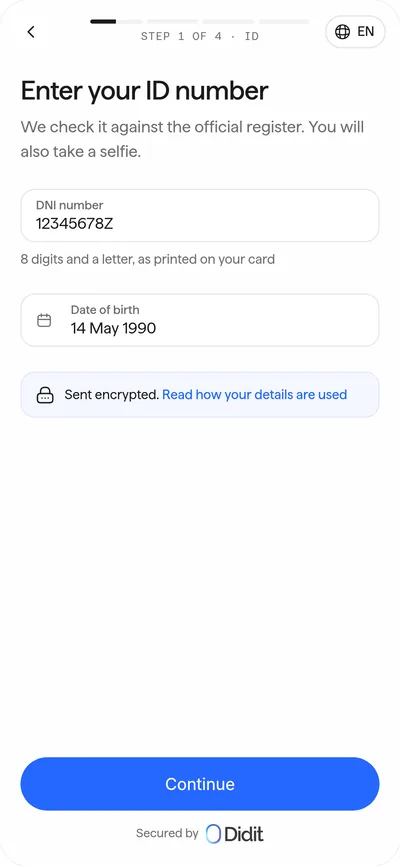
A non-document lookup takes a national identifier plus a few details and checks them against the authoritative source named for that country, and it returns the assurance tier data_match: the details matched a record. No document was inspected, so nothing about a document's authenticity is claimed. Be precise about the American case. In Canada, France, Indonesia, the Netherlands, Norway, Singapore, the United Kingdom and the United States, the authoritative record Didit can reach is a credit-bureau, financial-services, utility or residential-records file rather than a state register. The non-document ID verification docs state that this changes what the match proves, which consent regime the query runs under, and what you can tell a regulator about provenance.
Address checks, where existence and personal link are different questions
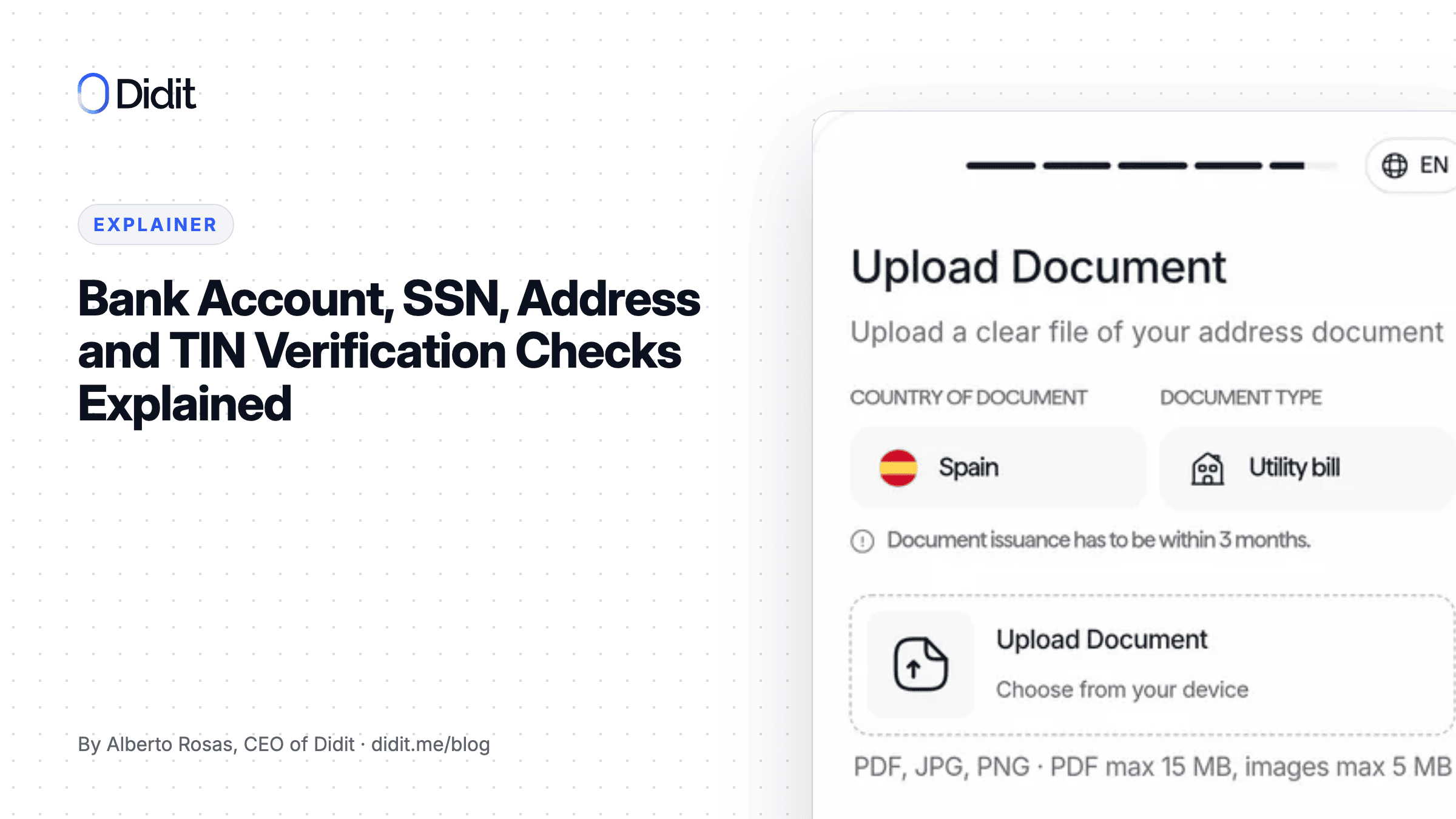
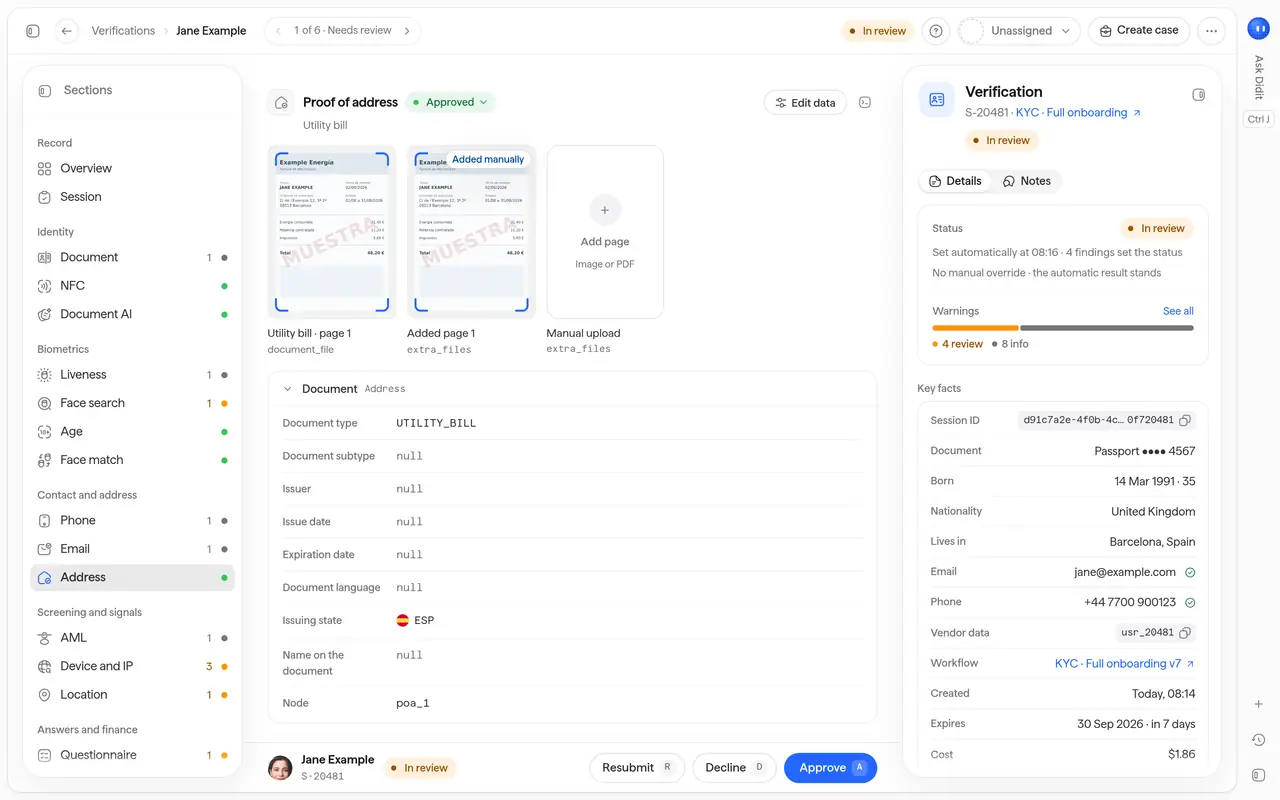
Address validation confirms that a postal address exists and returns it normalised with coordinates. It never links the address to a person, so a verified result means the place exists, not that anyone lives there. A proof of address document answers the other question: a bill, statement, lease or government letter in the person's name, read with OCR and checked for tampering. That supports a person-to-address relationship. It does not prove residence, and it does not prove property ownership. Both are documented, in address validation and proof of address.
TIN and VAT identifiers, the business field
The documented route for a country tax identifier is company registry retrieval, where that registry publishes the field. If the record includes a tax identifier, compare that returned field with the verified company record. Registry retrieval starts at $2.00 per company, priced by country and data tier, and coverage varies by country, so confirm the field per country before you depend on it. The company registry API docs describe what the retrieval returns.
The legal limits: FCRA, consent and permissible purpose
Two identical lookups can be lawful in one product and not in another, because what changes is the purpose, the consent and the disclosure, not the query. In the United States, a check that draws on a consumer report to decide eligibility runs under the Fair Credit Reporting Act. The FCRA requires a permissible purpose for the pull, and it attaches notice, dispute and adverse action duties when that report drives a denial. Your terms, your disclosure and the moment of consent therefore decide whether an SSN and date of birth lookup is available to you at all.
Two details in Didit's documentation show why provenance matters. As above, the American non-document source is a records file rather than a state register, and the docs say plainly that this changes the consent regime the query runs under. For the bank account check, some countries need the account holder's explicit consent before each check: send "consent": true, or the check is refused with a 400 and is not billed.
In the European Union the lawful basis for any of these lookups comes from GDPR Article 6, and the data you collect has to stay within what the stated purpose needs. Keep the source name for every result: Didit records it on the session payload as id_lookup.source, which is the field to quote to an auditor.
A worked example: onboarding a seller, then paying it
A marketplace onboards Northwind Trading S.L., a Spanish company, and needs to pay it.
- Business verification retrieves the registry record for the company, priced by country and data tier from $2.00. The linked ID check on the owner is a separate $0.33.
- The address on the record goes to address validation. A
verifiedstatus means the place exists down to the building;partially_verifiedmeans only the street or the locality matched. - The seller types its IBAN, and the account check compares the name the session already verified with the name the bank holds.
The request body names the holder you expect:
{
  "country": "ESP",
  "account": { "iban": "ES5500000000000000000001" },
  "holder": { "business_name": "Northwind Trading S.L." }
}
Read the result and act on it:
match: the bank holds the account under that name. Send the money.close_match: the bank holds a close name, andholder_namecarries it when the bank returned one. Compare it, or ask the seller to confirm.no_match: another name, or no such account. Do not send the money.cannot_verify: the bank answered without comparing the name, for example on a blocked or closed account. Apply your own policy.
name_match_score is the 0 to 100 similarity the result was decided on, a match from 85 and a close match from 70 to 84 by default. In a verification session those thresholds are the workflow settings bank_name_match_threshold and bank_partial_match_floor. Your threshold never changes the result, and the result stays authoritative.
For an individual seller in Nigeria the account arrives in the country's own shape: bank_code holds the 6 digit NIP code (Access Bank is 000014) and account_number holds the 10 digit NUBAN. The holder goes in full_name. A country the account check does not cover answers 404 with code: country_not_covered and is not billed.

Field names you will read in the responses
| Field | Check | What it tells you |
|---|---|---|
result | Bank account | match, close_match, no_match or cannot_verify |
holder_name | Bank account | The name the bank returned, or null where the bank only confirms whether the name matches |
name_match_score | Bank account | 0 to 100 similarity, null when no name was compared |
consent | Bank account | Required in some countries, recorded with the charge when you send it |
address_validation.status | Address validation | verified, partially_verified, not_verified or unavailable |
address_validation.verification_level | Address validation | The most precise level matched: administrative area, locality, thoroughfare, premise or delivery point |
address_validation.is_residential | Address validation | True for a residence, false for a business, null where unavailable; published for the United States, Great Britain, the Netherlands and Ireland |
poa.status and poa.warnings | Proof of address | Approved or Declined with every issue found listed |
id_lookup.source | SSN or national ID lookup | The exact source queried, for you and your auditors |
How Didit implements these checks
Each check is its own unit and its own step in the workflow orchestrator, so you run only what the flow needs.
- Bank account ownership: the account check API with no session and no sign-in, or a Bank Verification step that orders bank sign-in and the account check per country.
- Address existence: the Address Validation API, or
address_validation_enabledon the ID Verification and Proof of Address steps, where a weak result raises theADDRESS_NOT_VERIFIEDwarning. - Person-to-address evidence: the Proof of Address API or step, with OCR, PDF and EXIF forensics, a document age limit and a configurable action per warning group. It supports a person-to-address relationship; it does not prove residence or property ownership.
- SSN and identity data: a non-document ID Verification method, where the user types the identifier and the named source answers.
- Business identifiers: company registry retrieval inside business verification, where the country publishes a tax identifier on the record.
The address check is one call:
POST /v3/address-validation/
{
  "address_line_1": "Calle de Alcala 1",
  "city": "Madrid",
  "postal_code": "28014",
  "country": "ESP"
}
The documented route for a country tax identifier is company registry retrieval, where that registry publishes the field: it comes back as a returned field of the registry record retrieved in business verification, and you compare it against the company record you hold. For bank account checks, the account check API and the Bank Verification step share the same results and thresholds. If you are moving from another provider, the switch page covers migration, and AML screening is the step to add when the person or company also needs sanctions and PEP checks at $0.20 each.
Common mistakes
- Reading a verified address as proof that someone lives there. Address validation confirms the place exists and says nothing about the person.
- Reading a proof of address document as proof of residence or of property ownership. It supports a person-to-address relationship and nothing more.
- Using an account check as identity proof. It compares the bank's holder name with a name another step established, so run ID Verification or a lookup first or there is nothing to compare.
- Sending the account in the wrong country shape, for example an IBAN to the United Kingdom, which needs a sort code and account number.
- Treating
cannot_verifyas a pass. A blocked or closed account can come back with no name comparison, and a policy that reads that as a yes is a policy for paying the wrong person. - Assuming every register publishes a VAT number, when coverage and published fields vary by country.
- Expecting a stricter threshold of your own to change
result. Score your own thresholds onname_match_score, and keep the result as the decision. - Forgetting consent in a country that requires it. The check is refused with a 400 and not billed, so a retry loop without consent never resolves.
Worked cost example
Take 1,000 new sellers a month, each needing a full ID check, a bank account check and an address validation, at list price:
- Full ID check: $0.33 x 1,000 = $330.00
- Bank account check: $0.45 x 1,000 = $450.00
- Address validation: $0.10 x 1,000 = $100.00
- Total: $330.00 + $450.00 + $100.00 = $880.00 a month, or $0.88 per seller.
Suppose 50 of those sellers also upload a proof of address: 50 x $0.20 = $10.00, and the month comes to $890.00. On the Scale plan the Didit prices carry a 10% discount, so $880.00 x 0.90 = $792.00 and $10.00 x 0.90 = $9.00. Non-document verification and database validation are priced per country, so read those lines from the pricing page before you model them. Bank sign-in is from $0.45 per completed sign-in, and $0.79 in the United Kingdom and Europe, where one-time bank data reads are priced on top.
Sources
- Didit pricing page and pricing in the docs, read November 26, 2026.
- Account Check API: verify a payout bank account.
- Bank verification methods: sign-in or account check.
- Bank verification coverage and bank verification pricing.
- Bank data API overview.
- Address Validation API.
- Proof of Address API.
- Non-document ID verification: authoritative source lookup.
- Company registry API: automated KYB extraction.
- GDPR, Regulation (EU) 2016/679.
Start with a sandbox application at https://business.didit.me/: create an app, take an API key, and run a bank account check, an address validation and a proof of address against test data before you change anything in production. No sales call is needed, and the sandbox is free on every plan.
Try it
Try this in the sandbox
Run the check this guide describes, free.
The product this post is about, taken from its topic. Run it free in the sandbox.
Author
Alberto Rosas
Co-founder and CEO

Keep reading
Other guides in the same topic.
 What Is the Purpose of FICA in South Africa? 2026 Guide
FICA is South Africa's anti-money laundering law. It creates the Financial Intelligence Centre and requires accountable institutions to identify and verify clients, screen for PEP and sanctions risk and report suspicious.
Alberto RosasNov 26, 2026 Sixth Money Laundering Directive (6AMLD): What Changed and Which Rules Apply
6AMLD is Directive (EU) 2018/1673: Member States must criminalise laundering, widen predicate offences and set a four-year penalty floor. It adds no new due diligence duties for firms.
Alberto RosasNov 26, 2026 Automated Sanctions Screening: Canada, the Entity List and Embargoes
Automated sanctions screening matches people and companies against lists such as Canada's autonomous sanctions made under SEMA and JVCFOA and the OFAC SDN List, and returns candidate hits scored for identity confidence and.
Alberto RosasNov 26, 2026Questions
Frequently asked questions
What does a bank account verification check prove?
It proves that the bank holds the account under the name you sent. The account check compares the name the session already verified with the holder name at the bank and returns match, close_match, no_match or cannot_verify. It does not prove the person controls the account, because no sign-in happened. Bank sign-in is the method that proves control, and it also returns balances and transactions when you ask for them.
What does an SSN verification check actually prove?
It proves that the identifier and the details you sent matched a record at a named source, and Didit returns the assurance tier data_match plus the source name on id_lookup.source. It does not prove a document is genuine, because no document was inspected. In the United States the source Didit can reach is a credit-bureau, financial-services, utility or residential-records file, not a state register, and that changes the consent regime the query runs under.
Can you verify an address without asking for a document?
Yes, but only the existence of the address. Address validation confirms the address exists and returns it normalised with coordinates, and it never links the address to a person. If you need to know that a person is tied to the address, you need a proof of address document in their name, which is the $0.20 check rather than the $0.10 one.
What is the difference between address validation and proof of address?
Address validation is a reference data lookup at $0.10 per validated address: does this place exist, and how is it written in that country. Proof of address is a document check at $0.20: a utility bill, bank statement, lease or government letter, read with OCR, checked for age and type, and screened for tampering. One answers existence, the other answers whether a document in that name shows that address, which supports a person-to-address relationship and does not prove residence or property ownership.
What does a TIN or VAT check prove?
The documented route for a country tax identifier is company registry retrieval, where that registry publishes the field. If the record includes a tax identifier, compare that returned field with the verified company record. Coverage varies by country. Registry retrieval starts at $2.00 per company, priced by country and data tier.
Is an SSN check allowed under the FCRA?
It depends on purpose, not on the query. In the United States a check that draws on a consumer report to decide eligibility runs under the Fair Credit Reporting Act, which requires a permissible purpose and attaches notice, dispute and adverse action duties when the report drives a denial. Two identical lookups can be lawful in one product and not in another, so the terms, the disclosure and the moment of consent decide it.
How much do these four checks cost in total?
SSN and other non-document lookups are priced per country, so there is no single list price to add. A labeled example using published unit prices only: one seller needing a full ID check, a bank account check and an address validation costs $0.33 + $0.45 + $0.10 = $0.88. Add a proof of address document and the same seller costs $0.33 + $0.45 + $0.10 + $0.20 = $1.08. Address validation at $0.10 answers only whether the place exists, proof of address at $0.20 is the document check, and business registry retrieval is a separate line from $2.00 per company, priced by country and data tier.
What does cannot_verify mean on a bank account check?
The bank answered without comparing the name, for example because the account is blocked or closed, or because its holder details could not be read. name_match_score is null in that case. It is not a match and not a rejection: apply your own policy, for example ask the person for another account.
Do you need the account holder's consent for a bank account check?
In some countries, yes. Send "consent": true after asking for it in your product, or the check is refused with a 400 on the consent field and is not billed. Elsewhere consent is optional, and when you send it Didit records it with the check's charge. A sandbox key asks for consent in the same countries as a live key.
Which countries does the Didit account check cover?
The account check runs in 47 countries and bank sign-in in 33, 57 in total, among them Nigeria, Ghana, Kenya, Zambia, the United Kingdom, the euro area, the United Arab Emirates, Australia, the United States, India and much of Asia and Latin America. A country that is not covered answers 404 with code: country_not_covered and is not billed. The coverage page and the bank verification pricing page show what each country offers today.
Compliance built in
Audited, certified and attested.
We hold the certifications and build each country's rules into your flows, so you can launch anywhere without worrying. Security and Compliance center
- Regulation encoded into your flows
Tell us what you do and where. Didit lists the rules that apply to you, with sources, and builds the checks each country needs into one workflow.
- Ready for AMLR
Every requirement of the new EU anti-money laundering rules, from checking customers to human review, is already covered by a Didit check.
- Tested in Spain's Treasury sandbox
Spain's Treasury published its supervised sandbox report on Didit's NFC plus active liveness onboarding; SEPBLAC took part and valued the added measures positively.
- Audited, not self-declared
iBeta Level 1 and Level 2. Liveness tested under ISO/IEC 30107-3.
Your obligations · 3 regions
 SOC 2 Type 2
 ISO 27001
 iBeta Level 1 and Level 2
 EU regulator attestation
 FSM youth protection
 GDPR
 EBA remote onboarding
 MiCA compatible
 FIDO Alliance member
- AMLREU AML Regulation ready
Integration · Didit MCP
Run Didit from your own AI agent
Connect Didit to Claude, Cursor, VS Code or ChatGPT and just ask in plain words. Your agent can do anything you can do in the console, with the same permissions you have.
 Add to Claude
 ChatGPT
 Cursor
- Build workflowsDescribe the checks you need. The agent creates and publishes the flow.
- Run investigationsAsk why a session was declined, review cases, search people and companies.
- Change rulesCreate payment rules, test them on past data and switch them on.
- Pull reportsAsk for numbers, exports or the audit log.
Didit Academy


