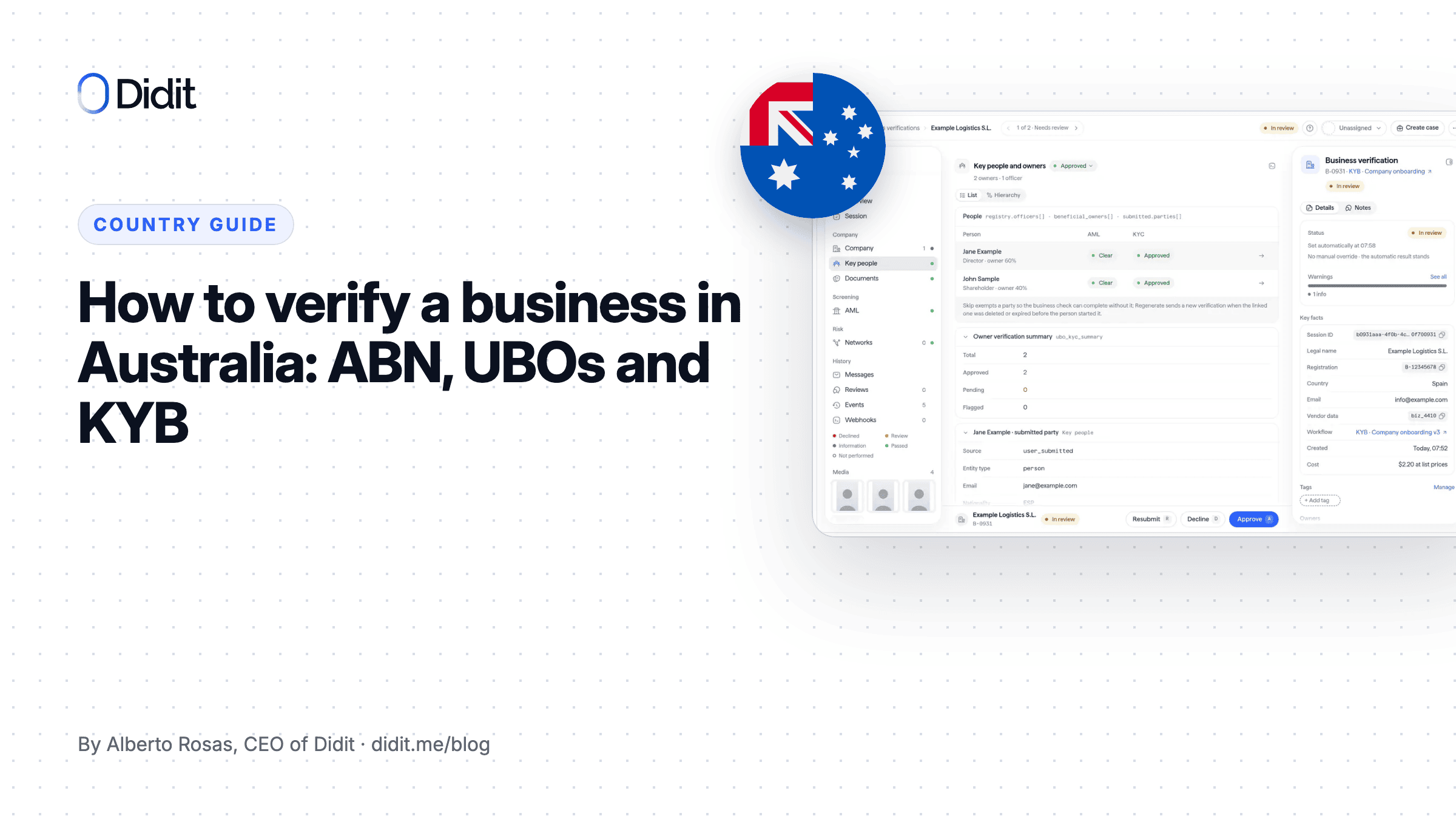
How to verify a business in Australia: ABN, UBOs and KYB
Didit verifies Australian companies in three tiers: Lite from $2.00 per company, Shareholders and UBOs. ABN Lookup is free and shows whether an ABN is active or cancelled, but it does not show who owns the company.
 Alberto RosasCo-founder and CEO
Contents
In this guide
Jump to the part you need.
If you need to verify an Australian company, Didit runs a registry check against the national register and returns Lite data from $2.00 per company, with Shareholders and UBO tiers on the same workflow. Caveats: ABN Lookup is free but shows only whether an ABN is active or cancelled, not who owns the business, and a company whose ownership record is unavailable or not held is still delivered and billed at Lite. It fits teams onboarding Australian entities.
Last updated: November 26, 2026. Prices checked against the live Didit price feed on November 26, 2026.
| Item | What applies in Australia |
|---|---|
| Country code used in KYB APIs | AU (ISO 3166-1 alpha-2 in the KYB coverage table and API country selector) |
| Data tiers available | Lite, Shareholders and UBOs are all supported for Australia as a country |
| Lite price | $2.00 per company, the Australia rate on the published price list |
| Ownership tiers | Priced per country on the same feed; no country in the catalog is priced below $5.00 Shareholders and $9.00 UBOs, and you pay for the tier delivered |
| Free public source | ABR ABN Lookup: ABN status, business type, GST status, trading names, no login |
| Add-ons per business | Company AML $0.20, person AML $0.20 per person, KYB Documents $0.20 per step, linked KYC $0.33 per person |
| Company not found | Manual entry, billed a flat $0.75 |
| Public customer base | 4,000+ companies, counted as active customers of Didit |
Start free in the sandbox at https://business.didit.me/, no sales call needed. Developers can connect Didit to an AI assistant through https://didit.me/developers/mcp/. The product page for this flow is Business Verification, and every unit price is published on https://didit.me/pricing/.
What you must verify in Australia, and why
AUSTRAC's guidance on ongoing customer due diligence states that businesses must review and, where appropriate, update customer ML/TF risk and KYC information, referring to Act sections 26F and 30 (AUSTRAC, Reviewing and updating customers' ML/TF risk and KYC information, read November 26, 2026). That page is the one to read before you design an Australian business check.
It states four things you have to do in practice:
- For a business relationship, review and, if appropriate, update your identification and assessment of the customer's ML/TF risk.
- Periodically review and, if appropriate, update and reverify the KYC information you hold on that customer.
- Review and update the risk assessment when something changes: your own ML/TF risk assessment, the type of customer, the kinds of designated services, the channels you use to deliver them, or the countries you deal in.
- Review the risk and the KYC information when the customer is involved in unusual transactions or behaviour that may give rise to a suspicious matter report.
The page also states that KYC information must be reviewed, and where appropriate updated and reverified, at a frequency appropriate to the customer's ML/TF risk. That is why an Australian check is not a one-off form: the review cadence comes from your own risk assessment, not from a fixed calendar date.
We also requested AUSTRAC's customer identification and verification easy reference guide. The URL returned a National Library of Australia Trove web-archive snapshot with no substantive AUSTRAC guidance text, so we took no requirement from it and relied on the ongoing CDD page above.
Translated into a checklist, an Australian business check has to establish: the legal entity exists and is in good standing; the ABN or ACN on file belongs to that entity; who owns and controls it; which natural persons sit behind it, each identity-checked and screened; and when you will look again.
The official registers and what they hold
The free public source is the Australian Business Register. ABN Lookup is a free public search service that returns Australian Business Number information from the ABR with no login required (Australian Business Register (ABR), ABN Lookup, read November 26, 2026). From that page you can check whether an ABN is active or cancelled, see the business type and GST status, and view the public details provided to the ABR, including historical trading names where available.
The search page lets you look up by ABN or ACN, or by name, using the box at the top of every page (Australian Business Register (ABR), ABN Lookup search, read November 26, 2026). Advanced search adds filters such as state, postcode, tax concessions and deductible gift recipient status. The same page links web services, bulk extract and ABN refresh tools, and its statistical query reports ABN counts by location, status and type. The page we read displays SearchVersion 9.9.7.
ABN Lookup provides public ABN and business details. Didit's registry and KYB checks add the company and ownership data available through their supported tiers. For ownership and officers you need the national company register, and that is where the Didit lookup differs from a free search. In Australia, a Lite check searches the national company register itself alongside the commercial registry databases and delivers the register's own record: status, incorporation date and registered address, completed with the legal form and officers where the registry databases hold them (Didit, KYB Registry Pricing by Country, read November 26, 2026). Companies incorporated in the last weeks, which commercial databases list only later, are found as soon as the register lists them. In Australia that includes companies that have an ACN but no ABN yet.
Identifiers and formats
| Identifier | What it is | How it is used |
|---|---|---|
| ABN | Australian Business Number, issued through the ABR | Searchable free in ABN Lookup; carried as registration_number in a Didit registry check or passed in expected_details |
| ACN | Australian Company Number | Searchable in ABN Lookup by number; a company with an ACN and no ABN is still found by a Didit Lite check |
| Legal name | Name as registered | Returned as company_name; name or number search, at least one is required |
| Country code | Australia | AU in the KYB coverage table and search calls; the company data schema documents country_code as ISO 3166-1 alpha-3 |
| Tax number | Tax identifier where the register publishes it | Returned as tax_number where available |
On the country code, the two references differ on purpose and you should read the field back rather than assume: the coverage table and API selector use the two-letter AU, while the retrieved company record documents country_code as three letters. Store what the response returns.
What Didit returns for an Australian company
Australia supports Lite, Shareholders and UBO requests, but a specific company can still be delivered and billed at Lite when its ownership record is unavailable or not held. The tiers are cumulative (Didit, KYB Supported Countries, read November 26, 2026):
| Tier | What you get | Price |
|---|---|---|
| Lite | Company profile, identifiers, status, registered address, activity, headcount, contact details and the officers | $2.00 per company in Australia |
| Shareholders | Lite plus the direct shareholders, natural persons and corporate entities, with ownership bands | Priced per country on the live feed: published Shareholders rates run from $5.00 to $22.00 by country. Read Australia's exact rate on the per-country price list before you quote it |
| UBOs | Shareholders plus the ultimate beneficial owners resolved through the ownership chain | Priced per country on the live feed: published UBO rates run from $9.00 to $96.00 by country. Read Australia's exact rate on the per-country price list before you quote it |
| Manual entry | Company typed in by the applicant when the register has no match | $0.75 flat |
You can read the exact ownership rate for Australia on KYB Registry Pricing by Country before you quote a price internally. The feed is the source of truth there, and it changes. What does not change is the billing rule: you pay for the tier delivered, so an ownership request on a company with no usable ownership record is billed as Lite.
The fields you get back
| Field | What it holds |
|---|---|
company_name | Legal name as registered with the authority |
registration_number | Official registration or incorporation number |
company_type | Legal entity type, for example Pty Ltd |
registry_status | Active, dissolved, struck off, in liquidation or dormant |
incorporation_date | Date the company was originally registered |
registered_address | Official registered office address |
tax_number | Tax identification number where available |
alternative_names | Trading names, former legal names, original-language names |
legal_entity_identifier | LEI, where the registry holds one |
registered_capital | Authorized or issued capital as an amount and currency object |
is_from_registry | True for a registry match, false for manual entry |
fetch_status | Pending, resolved or failed |
registry_tier_requested / registry_tier_delivered | What you asked for and what the registry actually served |
registry_ownership_status | The ownership outcome for an ownership request |
Statuses other than Active may be flagged or declined automatically depending on your workflow configuration (Didit, Company Registry API, read November 26, 2026). Treat struck off and in liquidation as separate findings, not synonyms for dissolved.
What the rest of the check costs
| Line | Price | Notes |
|---|---|---|
| Company AML screening | $0.20 per check | Sanctions, PEP and adverse media on the entity |
| Person AML (per UBO or officer) | $0.20 per person | Billed per identified party |
| KYB Documents | $0.20 per step | Per document-collection step regardless of upload count |
| Linked KYC for a key person | $0.33 per person | Full ID check: document, biometrics, device and IP |
| Key People extraction | Free | No separate fee for the form |
| Standalone search API | $0.50 per successful request | Only when paid-source results are returned |
| Registry monitoring | $2.00 per company per year | Planned; no country had monitoring enabled at the September 7, 2026 check, and a published price does not mean the feature is available |
Plan discounts apply to the whole registry price. Growth takes 4% off every Didit price, Scale takes 10%, and Enterprise follows the contract. The price of an Australian registry check is billed once per selected company, at the price of the tier delivered.
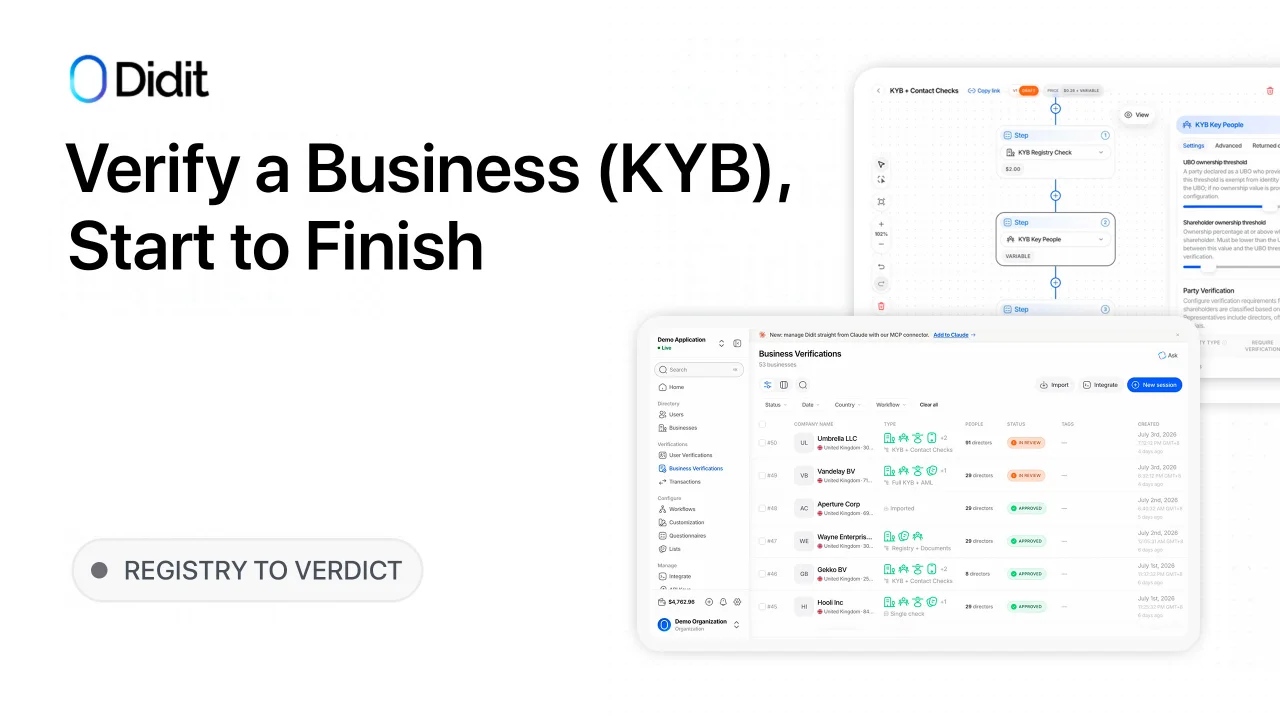
Step by step in the Business Console
- Create the application and open
Workflows, thenCreate workflow. Choose Business Verification as the workflow type. - Enable the features you need: Company registry lookup is required, Company AML is recommended, Key People is required for most regulated industries, and Documents is optional. Save and copy the
workflow_id. - Open
Workflows → KYB Registry Check → Countriesand set Australia to the tier you want. Every country starts at Lite, so a Shareholders or UBO workflow has to be set explicitly. This is also how you avoid paying for ownership data in markets where you do not need it. - Create a session. The response returns
session_id,session_numberandurl. Deliver theurlto the business contact through your own email or chat. - The applicant chooses Australia, enters the company name, the ABN or ACN, or both, and picks the correct entity from the results.
- They add key people. If your workflow requires KYC for a role, each person triggers a child KYC session automatically, and the parent key people status reads Awaiting User until those finish.
- Company AML, person AML and any documents run inside the same session. The decision lands on your webhook, or you fetch it from the API.


Step by step through the API
KYB runs through the same session endpoint as KYC. The workflow decides the session kind, and a KYB workflow produces a business session with session_kind: "business". If you already know the company, pass expected_details and the hosted flow pre-selects the country, pre-fills the search and runs it automatically.
curl -X POST https://verification.didit.me/v3/session/ \
  -H "x-api-key: YOUR_API_KEY" \
  -H "Content-Type: application/json" \
  -d '{
    "workflow_id": "YOUR_KYB_WORKFLOW_ID",
    "vendor_data": "biz-acme-001",
    "expected_details": {
      "company_name": "COMPANY LEGAL NAME",
      "registry_country": "AU",
      "registration_number": "ABN_OR_ACN"
    }
  }'
Both assertion fields stay editable, so a wrong ABN can be corrected by the applicant. Prefill is a convenience, not a check: selecting a different company than the one you asserted does not raise a warning.
curl https://verification.didit.me/v3/session/SESSION_ID/decision/ \
  -H "x-api-key: YOUR_API_KEY"
The decision carries the registry data, the key people arrays (UBOs, shareholders, directors and officers, bucketed into what came from the registry and what the business submitted), the AML hits and the document results. If you subscribe to webhooks, the status.updated event already contains the full decision and you only call the endpoint above when you did not subscribe or want it later.
For registry lookups outside a hosted flow, the standalone API sells one endpoint per tier:
| Endpoint | What it returns | Price |
|---|---|---|
POST /v3/kyb/search/ | Candidate companies: name, registration number, status, type | $0.50 per successful paid-source request |
POST /v3/kyb/select/ | Lite: profile, identifiers, status, address, activity, officers | $2.00 for Australia |
POST /v3/kyb/shareholders/ | Lite plus direct shareholders with ownership bands | Per-country Shareholders price |
POST /v3/kyb/ubo/ | Shareholders plus UBOs resolved through the chain | Per-country UBO price |
Request bodies and response schemas live on each endpoint page in the KYB Registry API reference. The ownership endpoints exist on /v3/ only.
Worked cost example
An Australian proprietary company onboarded at the Lite tier, with company AML, one document step, two key people screened and one director identity-checked:
- Registry Lite, Australia: $2.00
- Company AML screening: $0.20
- KYB Documents step: $0.20
- Person AML for two key people: 2 x $0.20 = $0.40
- Linked KYC for one director: $0.33
Total per company: 2.00 + 0.20 + 0.20 + 0.40 + 0.33 = $3.13.
At 100 Australian companies a month that is 100 x $3.13 = $313.00. On the Scale plan, with 10% off every Didit price, the same five cost lines come to 1.80 + 0.18 + 0.18 + 0.36 + 0.297 = $2.817 per company, or $281.70 for 100 companies.
The same company on the standalone API, one search plus one Lite retrieval, is 0.50 + 2.00 = $2.50 before any AML, document or KYC lines. If you request the UBO tier instead of Lite, replace the $2.00 line with the Australia UBO rate from the price list; every other line above is a flat national add-on and the arithmetic is unchanged. If that UBO request comes back with no usable ownership record, the registry line is billed as Lite instead and the total drops back to the figure above.
Fallbacks when the source is down or has no match
- Registry provider outage during a search. The integration guide documents a
502withcode: "kyb_registry_provider_unavailable", and the call is not billed. In Didit's hosted flow the business is automatically offered manual company entry instead of a retry-only error. - The company is not in the register. The applicant types the company data in manually, the session continues,
is_from_registryisfalse, and the manual entry is billed a flat $0.75. - The ownership source does not cover the company.
registry_ownership_statusreadsnot_held, meaning a coverage gap, and the Lite profile is delivered and billed.unavailableis a different finding: the data was not served, whether from an outage or a section the registry left empty. Adeliveredownership section carries neither. - The ownership section was empty or missing.
registry_data.ownership_errornames the reason.no_owners_on_recordmeans the registry answered and names no owner.ownership_section_unavailablemeans the list is missing, not empty, and says nothing about who owns the company. - A section did not come back.
registry_data.section_errorsis keyed by section (officers,shareholders,group_structure) with the status the registry answered. A delivered officers or shareholders list is always the whole list the registry holds; a partly served list is not completed on that attempt. - The country is not allowed in the workflow. The registry check raises the
KYB_COUNTRY_RESTRICTEDwarning. Add Australia to the workflow's country list before you onboard Australian entities. - Ownership still pending. Lite is charged at selection, nothing is charged for ownership until it resolves, and the later charge is only the difference to the delivered tier at the selection-time quote. The total never exceeds the quote for the tier you requested.

The Australian specific fallback worth building for is the new company. A proprietary company incorporated this month may have an ACN and no ABN yet, which is exactly the case the free ABN search cannot resolve and the Lite national register read can.
For the review cycle AUSTRAC asks for, re-run the registry check at the frequency your risk assessment sets. Registry monitoring, which pushes changes of status, officers, ownership and address and fires a data.updated webhook with trigger: "kyb_registry_change", is planned at $2.00 per company per year, but no country had monitoring enabled at the September 7, 2026 check, so today the re-run is yours to schedule.
Sources
- Didit, KYB Supported Countries: Registry Coverage, read November 26, 2026.
- Didit, KYB Registry Pricing by Country, read November 26, 2026.
- Didit, KYB Registry API: Company Search and Select, read November 26, 2026.
- Didit, KYB Quickstart: 10-Minute Business Verification, read November 26, 2026.
- Didit, KYB Integration Guide, read November 26, 2026.
- Didit, Company Registry API: Automated KYB Extraction, read November 26, 2026.
- Didit, UBO API: Beneficial Ownership Extraction, read November 26, 2026.
- Didit, pricing page and live price feed, read November 26, 2026.
- Australian Business Register (ABR), ABN Lookup, read November 26, 2026.
- Australian Business Register (ABR), ABN Lookup search, read November 26, 2026.
- AUSTRAC, Reviewing and updating customers' ML/TF risk and KYC information, read November 26, 2026.
- AUSTRAC (page delivered as a National Library of Australia Trove web-archive snapshot), customer identification and verification easy reference guide: the retrieved page contained only the archive's template shell and no substantive AUSTRAC guidance text. Details were not verifiable, and no requirement was taken from it.
The next step is a sandbox run: create a KYB workflow, set Australia to Lite, and push one real ABN through the hosted flow to see the fields and the decision shape before you wire anything up. Start at https://business.didit.me/, no sales call.
Try it
Try this in the sandbox
Run the check this guide describes, free.
The product this post is about, taken from its topic. Run it free in the sandbox.
Author
Alberto Rosas
Co-founder and CEO

Keep reading
Other guides in the same topic.
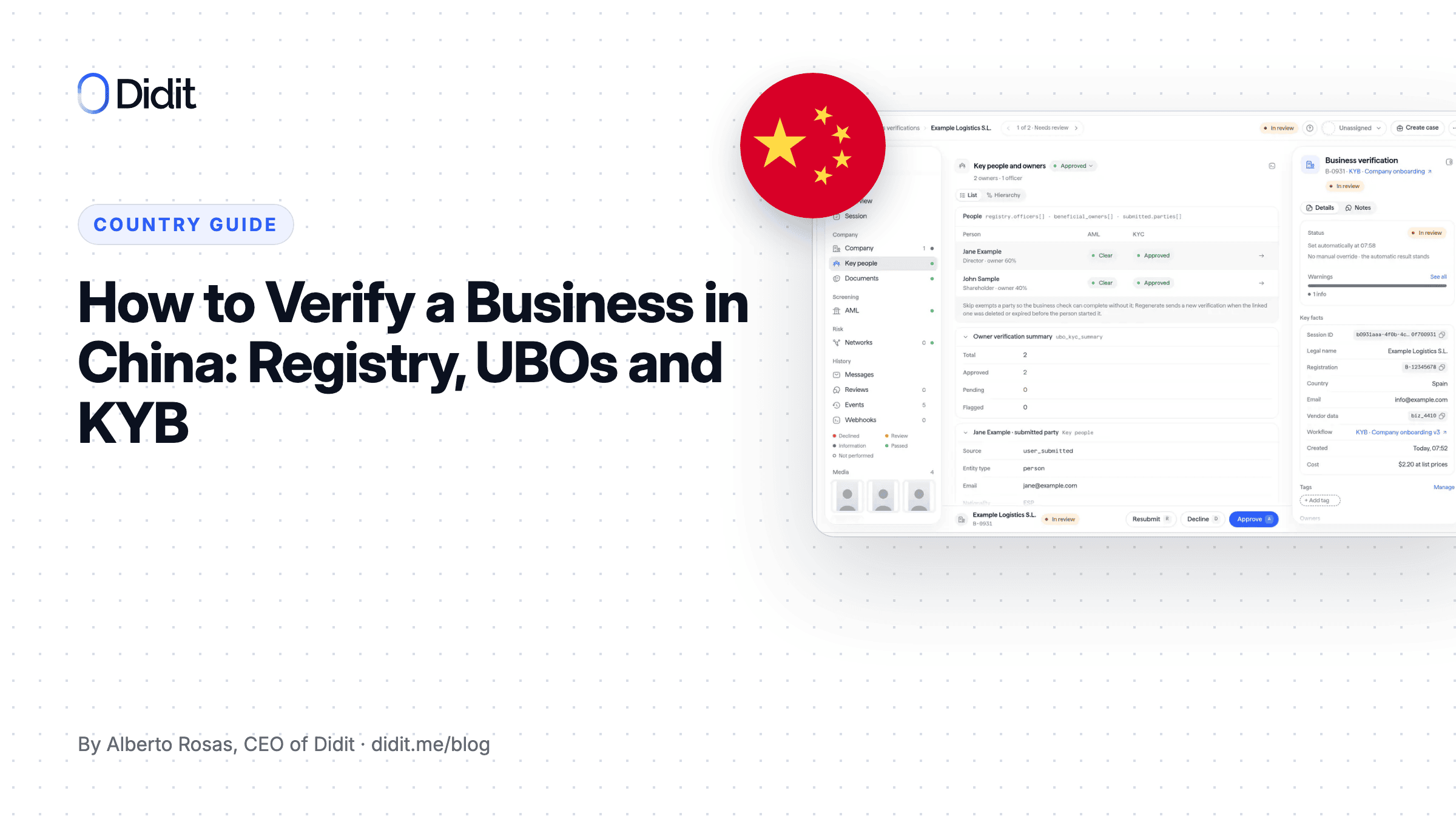 How to Verify a Business in China: Registry, UBOs and KYB
Didit checks a Chinese company against the national enterprise credit register at the Lite tier for $3.00. The cited regulation does not describe a public resolved UBO register, so ownership may require filings plus company.
Alberto RosasNov 26, 2026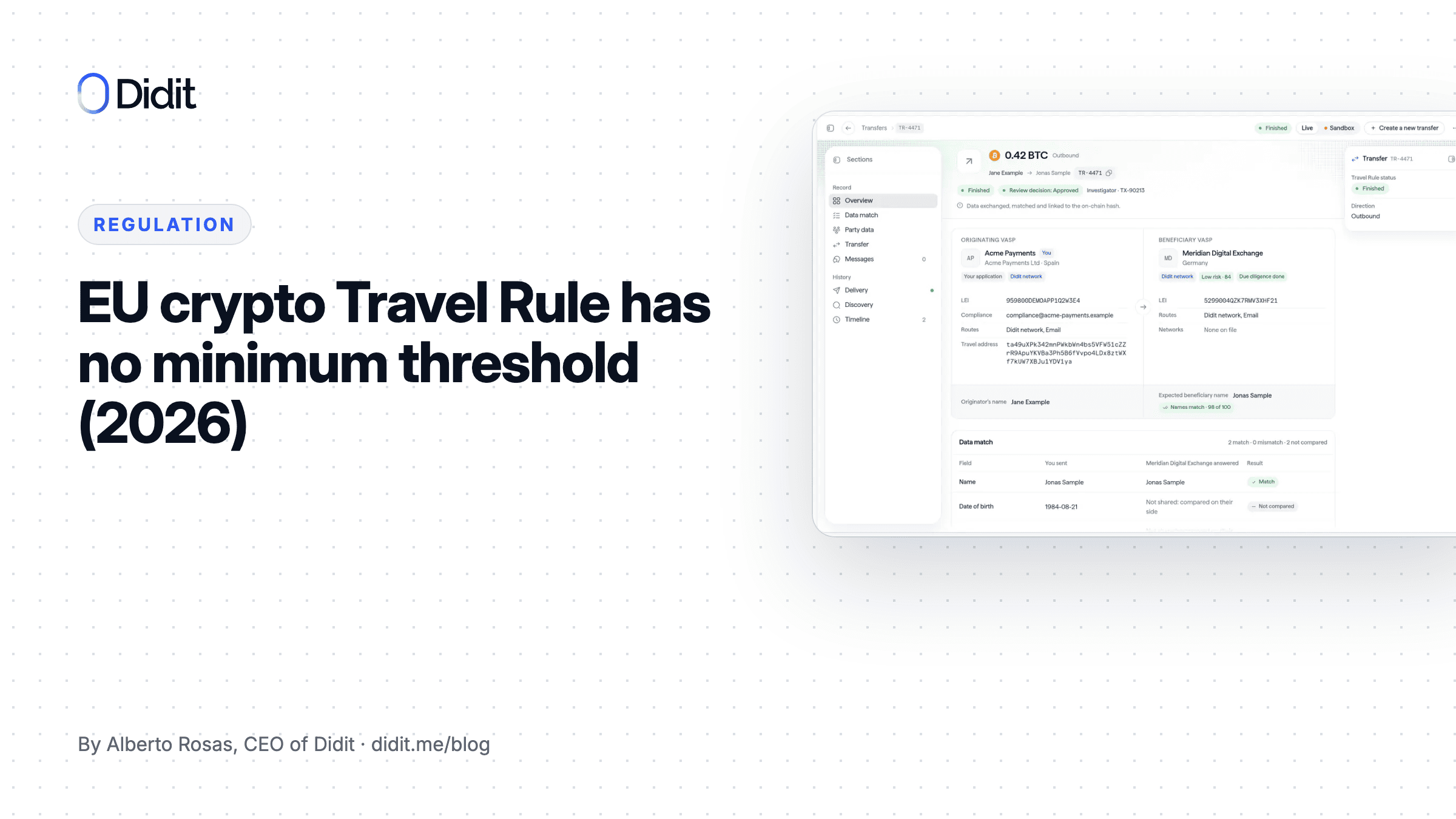 EU crypto Travel Rule has no minimum threshold (2026)
The EU Transfer of Funds Regulation has no minimum amount for crypto. Every transfer, however small, needs originator and beneficiary data sent to the counterparty CASP before settlement.
Alberto RosasNov 26, 2026 How to Verify a Business in Hong Kong: Registry, UBOs and KYB
A Hong Kong KYB check reads the Companies Registry for company data at $3.00 Lite, then adds shareholders and UBOs above that tier. The caveat: Hong Kong's significant controllers register is not filed with the Registry, so UBO.
Alberto RosasNov 26, 2026Questions
Frequently asked questions
How do I verify an Australian company's ABN or ACN with Didit?
You create a KYB workflow, set Australia to the tier you need in the workflow's country list, and start a session. The applicant enters the ABN, the ACN or the legal name, picks the company from the registry results, and Didit returns the registry record including status, incorporation date, registered address and officers. You can also pass the identifiers in expected_details so the search runs before the applicant starts.
Is ABN Lookup enough for KYB in Australia?
No. ABN Lookup is free and shows whether an ABN is active or cancelled, the business type, GST status and historical trading names, but it does not tell you who owns or controls the entity. A business check needs ownership and key people, which come from the national company register at the Shareholders or UBO tier, plus identity checks and AML screening on the individuals.
How much does an Australian KYB check cost on Didit?
The registry check is $2.00 per company at the Lite tier in Australia. Ownership tiers are priced per country on the same feed and no country in the catalog is priced below $5.00 for Shareholders or $9.00 for UBOs. Add-ons are flat: $0.20 for company AML, $0.20 per person for person AML, $0.20 per document step and $0.33 per linked KYC. You are billed for the tier delivered, not the tier requested.
Which Didit data tiers are available for Australia?
All three: Lite, Shareholders and UBOs. Australia supports all three tiers, but an individual ownership request can still be delivered and billed as Lite when the registry has no usable ownership record. Every country starts at Lite in a workflow, so a Shareholders or UBO check has to be configured per country in the console.
Can Didit verify a company that has an ACN but no ABN yet?
Yes. In Australia a Lite check searches the national company register itself alongside the commercial registry databases, so companies incorporated in the last weeks are found as soon as the register lists them, including companies that have an ACN and no ABN. A free ABN search would not find that company.
What happens if the Australian register has no ownership record for the company?
You pay for the tier delivered. An ownership request where the registry holds no ownership record is delivered and billed as Lite, and registry_ownership_status says why: not_held for a coverage gap, unavailable when the data was not served. A UBO request whose resolved chain names no natural person is delivered and billed as Shareholders.
Does Didit check the directors and shareholders as individuals?
Yes, if you enable Key People in the workflow. Each person can take a linked full ID check at $0.33 and person AML at $0.20 per person, and the decision separates people that came from the registry from people the business submitted. While any linked KYC session is in progress the parent key people status reads Awaiting User.
What does AUSTRAC require for ongoing due diligence on a business customer?
AUSTRAC ties ongoing CDD to Act sections 26F and 30: you must review and, if appropriate, update the customer's ML/TF risk assessment, and periodically review, update and reverify the KYC information, at a frequency appropriate to the customer's risk. A change in the customer type, the designated services, the delivery channels or the countries involved, or unusual behaviour that may lead to a suspicious matter report, also triggers a review.
What happens if the Australian registry is down during the check?
The API returns a 502 with code: "kyb_registry_provider_unavailable" and the call is not billed. In the hosted flow the business is offered manual company entry instead of a retry-only error, and a manually entered company is billed a flat $0.75.
Can I run Australian registry checks through the API without the hosted flow?
Yes. The standalone API sells one endpoint per tier: search, select for Lite, shareholders and ubo, all on /v3/. A successful search costs $0.50 when paid-source results are returned, and retrieval is billed separately at the country and tier price. Empty results, failed searches and results served only by other sources are not charged for the search.
Compliance built in
Audited, certified and attested.
We hold the certifications and build each country's rules into your flows, so you can launch anywhere without worrying. Security and Compliance center
- Regulation encoded into your flows
Tell us what you do and where. Didit lists the rules that apply to you, with sources, and builds the checks each country needs into one workflow.
- Ready for AMLR
Every requirement of the new EU anti-money laundering rules, from checking customers to human review, is already covered by a Didit check.
- Tested in Spain's Treasury sandbox
Spain's Treasury published its supervised sandbox report on Didit's NFC plus active liveness onboarding; SEPBLAC took part and valued the added measures positively.
- Audited, not self-declared
iBeta Level 1 and Level 2. Liveness tested under ISO/IEC 30107-3.
Your obligations · 3 regions
 SOC 2 Type 2
 ISO 27001
 iBeta Level 1 and Level 2
 EU regulator attestation
 FSM youth protection
 GDPR
 EBA remote onboarding
 MiCA compatible
 FIDO Alliance member
- AMLREU AML Regulation ready
Integration · Didit MCP
Run Didit from your own AI agent
Connect Didit to Claude, Cursor, VS Code or ChatGPT and just ask in plain words. Your agent can do anything you can do in the console, with the same permissions you have.
 Add to Claude
 ChatGPT
 Cursor
- Build workflowsDescribe the checks you need. The agent creates and publishes the flow.
- Run investigationsAsk why a session was declined, review cases, search people and companies.
- Change rulesCreate payment rules, test them on past data and switch them on.
- Pull reportsAsk for numbers, exports or the audit log.
Didit Academy


