UK Database Identity Verification: Credit Bureau and Phone Records
Didit verifies UK identities without a document by matching typed details against credit-bureau, financial-services and phone records named in its catalog, not a government register.
 Alberto RosasCo-founder and CEO
Contents
In this guide
Jump to the part you need.
Didit verifies a United Kingdom identity without a document by matching typed details against the UK records named in its catalog: a credit-bureau file, a financial-services record and a phone record. It suits UK onboarding where a data match can come before a passport. The UK source is not a government register, so the result is a data_match, and the price is not one UK number: it is set per service.
Last updated: November 26, 2026. Prices checked against the live Didit price feed on November 26, 2026.
| Item | What you get |
|---|---|
| Method | Non-document lookup. The user types an identifier plus a few personal details, with no document image |
| Source type | Credit-bureau, financial-services and phone records. Not a government register in the UK |
| Assurance tier | data_match |
| Catalog services | United Kingdom Credit Bureau, United Kingdom Financial Services, United Kingdom Phone 2 |
| Price | Variable, set per service. No single UK number is published; read the per-service Database Validation pricing table before you budget |
| Selfie | Not requested for these UK sources. Liveness and Face Match run as their own steps if you need them |
| On a no match | fallback_to_document or decline, configured per country |
| Start | Free sandbox at business.didit.me, no sales call |
Start free in the sandbox at https://business.didit.me/ and run one UK lookup before you touch production, with no sales call. If you build with an AI assistant, connect it to Didit through the MCP server at https://didit.me/developers/mcp/. Read the Database Validation overview and every module price on https://didit.me/pricing/.
Why the United Kingdom works differently
Most countries in Didit's Database Validation catalog are a government register: a civil registry, tax authority or electoral roll. The United Kingdom is an exception. Didit's Non-document lookup page says that in Canada, France, Indonesia, the Netherlands, Norway, Singapore, the United Kingdom and the United States the record Didit can reach is a credit-bureau, financial-services, utility or residential-records file rather than a state register.
That changes what the match proves, which consent regime applies and what you can tell a regulator about provenance. Do not read this page as "the UK government checks the identity for you." You are matching against commercial and public-record data, and the honest label is data_match. The end user never sees the source name; it is on the session payload in id_lookup.source, in the console and in exports, for you and your auditors.
The legal basis behind UK lookups
Callcredit Limited (trading as TransUnion), response to the ICO consultation on the Data Sharing Code of Practice, September 2018, read November 26, 2026, says financial performance data is shared with a credit reference agency by lenders and other credit providers generally in reliance on the legitimate interests legal basis. It says each credit provider gives data subjects a link to the Credit Reference Agency Information Notice explaining how CRAs use and share personal data. The same response says the CRA combines that lender data with information about bankruptcies, IVAs, court judgments and the electoral register and profiles it, also relying on legitimate interests.
Financial Conduct Authority, Credit Information Market Study Interim Report, Annex 2: Credit reference agency competition (November 2022), read November 26, 2026, adds the regulatory frame: CRAs typically sell credit information and hold a relevant regulatory permission for providing credit references, and credit information can include insolvency and County Court Judgment registers as publicly available information. The annex names SCOR and PoR as key industry arrangements, with rules prescribed by an exclusive set of market participants.
Three practical consequences follow:
- The record is a commercial file, not a state register. A match is evidence that the details you submitted line up with a file the bureau holds.
- Your lawful basis is separate from the bureau's. The bureau's reliance on legitimate interests does not decide yours. Determine and document your own lawful basis for the check with qualified counsel under the UK GDPR and the Data Protection Act 2018.
- Matching is automated. The Callcredit response describes checking algorithms for plausibility and matching algorithms. Partial matches are documented outcomes, not necessarily errors, and your
on_partial_matchaction decides what happens next.
The sources Didit queries for the United Kingdom
The service names and descriptions below come from Didit's catalog. The Callcredit and FCA documents support the external credit-information context only; they do not list Didit's services. Read the Source queried column before you enable the country.
| Service name in the catalog | Record it queries | What a match means | Rate |
|---|---|---|---|
| United Kingdom Credit Bureau | The United Kingdom Credit Bureau source named in Didit's catalog. Didit does not document what that file is built from | The details submitted line up with the record that service holds | Per-service rate on the Database Validation pricing table |
| United Kingdom Financial Services | A financial-services record reached through the same lookup call | The details submitted match the record that service holds | Same per-service table |
| United Kingdom Phone 2 | A phone record | The details submitted match the record that service holds | Same per-service table |
You do not have to run all three. Omit services and Didit runs the country's default service only. Pass the service names and it runs each one you list, and a multi-service request can produce more than one usage event because billing is per successful service hit.
What Didit returns for a UK lookup
The standalone response is a single object with request_id and database_validation. The fields you branch on:
match_type:full_match,partial_matchorno_match.validation_typeandservices_used, so you know which service answered.match_score, plus avalidations[]array with one entry per service that ran, each carryingstatus,matched_fieldsandrecord_detailswhere the source returns them.warnings[], includingDATABASE_VALIDATION_NO_MATCH,DATABASE_VALIDATION_PARTIAL_MATCHandCOULD_NOT_PERFORM_DATABASE_VALIDATION.
Inside a workflow session, the same results arrive as database_validations[] on the decision from GET /v3/session/{sessionId}/decision/. The session status is Approved, In Review or Declined according to the partial-match and no-match actions you configured.
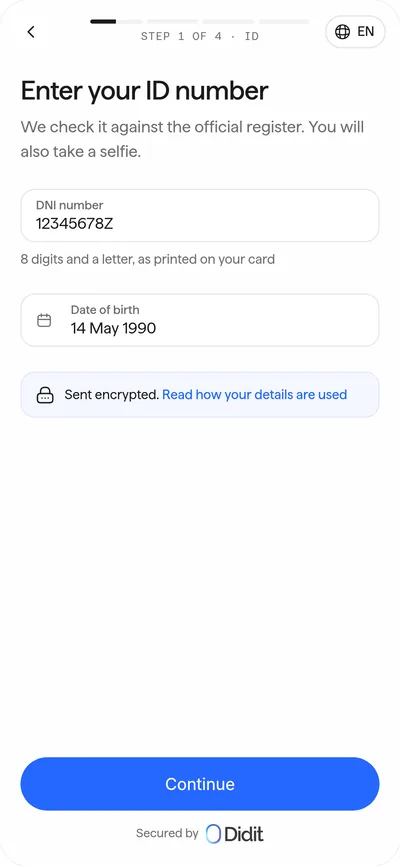
Two behaviours matter before you design the flow. The UK sources return data, not a photograph, so no selfie is taken inside the lookup and skip_liveness_and_face_match is normalised off on save. Run Liveness and Face Match as their own steps if you need biometrics. A Face Match step after a data-only UK match has nothing to compare: it reports FACE_MATCH_NOT_COMPUTED with a null score rather than declining automatically, and the workflow editor warns you before you publish.
Set up a UK lookup in the Business Console
- Create or open a workflow and add the ID Verification feature. Database Validation can also run as its own step: fields feed from the steps in front of it, and an ID Verification step is not required.
- Open the feature's Countries tab and select the United Kingdom.
- Enable the non-document lookup method for that country, and keep document capture enabled so there is somewhere to fall back to.
- Set
max_attempts, then choosefallback_to_documentordeclineforon_partial_match,on_no_matchandon_provider_error. - If a Face Match step follows, read the note beside the UK source in the Countries tab before you publish.
- Publish, create a sandbox session and read
database_validations[]on the decision.
The country key is ISO 3166-1 alpha-3, so the United Kingdom is GBR:
{
  "feature": "OCR",
  "config": {
    "methods": {
      "GBR": {
        "document": { "enabled": true },
        "id_lookup": {
          "enabled": true,
          "max_attempts": 2,
          "on_partial_match": "fallback_to_document",
          "on_no_match": "fallback_to_document",
          "on_provider_error": "fallback_to_document"
        }
      }
    }
  }
}
Run the lookup through the API
Use the standalone call when you hold the identity data and want a one-shot check, server to server.
curl -X POST 'https://verification.didit.me/v3/database-validation/' \
  -H "x-api-key: $DIDIT_API_KEY" \
  -F "issuing_state=GBR" \
  -F "identification_number=..." \
  -F "first_name=Jane" \
  -F "last_name=Doe" \
  -F "date_of_birth=1990-01-15" \
  -F "vendor_data=user-1234"
Use identification_number as the universal field. Didit maps it for issuing_state; the documented per-country request fields and format rules on the Non-document lookup page list what each UK service expects. If a service is flagged requires_consent=true, the call answers HTTP 400 until you send consent=true.
Use the session route when the lookup is a step in a hosted flow.
curl -X POST 'https://verification.didit.me/v3/session/' \
  -H "x-api-key: $DIDIT_API_KEY" \
  -H "Content-Type: application/json" \
  -d '{"workflow_id":"WORKFLOW_ID","vendor_data":"user-1234","callback":"https://app.example.com/done"}'
Open the returned session.url, then read the decision with GET https://verification.didit.me/v3/session/SESSION_ID/decision/ or subscribe to session.status.updated. Branch on session_kind first: user for KYC, business for KYB.

Worked cost example
Take 10,000 UK onboardings a month. A full ID check is $0.33 per check: 10,000 × $0.33 = $3,300.00. Document capture alone is $0.15 per check: 10,000 × $0.15 = $1,500.00. This example assumes every user receives AML screening at $0.20 per check, so that line adds the same $2,000.00 in every design and cancels out: 10,000 × $0.20 = $2,000.00.
In the lookup-first design, 7,000 users match and 3,000 fall back to document capture. The fallback leg is 3,000 × $0.15 = $450.00. The lookup leg is 7,000 × R, where R is the per-service UK rate, not a single published country number; read it from the per-service pricing table. Total before AML is 7,000 × R + $450.00.
Break-even against full KYC is ($3,300.00 - $450.00) / 7,000 = $2,850.00 / 7,000 = $0.4071, about $0.41 per lookup. If R is below $0.41, lookup-first costs less than full KYC. If R is above it, lookup-first costs more but avoids 7,000 document captures. Against document capture for everyone, lookup-first is cheaper only when 7,000 × R + $450.00 is below $1,500.00, which is R below $0.15.
If your UK service bills a no-match, add 3,000 × R for the failed attempts, because the pricing page lists which no-match lookups and retries are billable. The total becomes 10,000 × R + $450.00, and break-even against full KYC is ($3,300.00 - $450.00) / 10,000 = $0.285, about $0.29 per lookup. Phone codes are separate: a UK SMS code is $0.0783 at list price, carrier plus Didit's $0.02 fee, so 5,000 codes cost 5,000 × $0.0783 = $391.50.
When the UK source is down or returns no match
- HTTP 502 with
validation_errors[]. Every selected upstream service failed. The request is not billed and aCOULD_NOT_PERFORM_DATABASE_VALIDATIONlog is written. Retry later, or fall back to OCR-only, which is whaton_provider_error: fallback_to_documentdoes for you. - HTTP 400. The service id is not eligible for
issuing_state, a required field is missing, or a consent flag is missing on a pay-as-you-go service. Fix the request, do not retry blindly. match_type: "no_match". The response carriesDATABASE_VALIDATION_NO_MATCH. The workflow then followson_no_match, eitherfallback_to_documentordecline. Assess the result under your own risk policy; a no match is not by itself proof of synthetic identity.match_type: "partial_match". Some fields match and others do not, for example the date of birth matches and the name does not. Route to review rather than auto-declining.
In a session, if a configured database validation produced no result at all, the decision carries database_validation_not_performed_reason so your support team can explain what happened without reading logs.
Identifiers and fields for the United Kingdom
| Field | Direction | Notes |
|---|---|---|
issuing_state | You send | GBR |
identification_number | You send | The identifier the selected UK service asks for. The documented per-country request fields and format rules list the format; do not guess it |
first_name, last_name | You send | Partial matches show that some submitted fields matched while others did not |
date_of_birth | You send | ISO format, as in the documented example |
services | You send | Optional. Omit for the country default, or list the UK services to run more than one |
consent | You send | Required only where the catalog flags the service requires_consent=true |
match_type, match_score | Didit returns | Aggregated outcome across the services that ran |
matched_fields | Didit returns | Per-field match detail inside validations[] |
record_details | Didit returns | Underlying record details when the source provides them |
id_lookup.source | Didit returns | On the session payload: the exact source queried, admin-facing only |
warnings[] | Didit returns | Risk codes that explain every issue found |
What a UK data match does not prove
A UK lookup tells you the details a person gave matched a record the source holds. No document was inspected, so nothing about a document's authenticity is being claimed, and the tier stays data_match rather than documentary. If your policy or your regulator needs document authenticity, an NFC chip read or a live face comparison against a portrait, those are separate checks with their own prices. Didit runs identity and fraud checks for 4,000+ companies across 220+ countries and territories, and the honest answer on this page is that the UK route is a data match and nothing more.
Sources
- Didit documentation, Non-document ID Verification: Authoritative Source Lookup: https://docs.didit.me/core-technology/id-verification/non-doc-lookup
- Didit documentation, Database Validation API: Government-Registry KYC: https://docs.didit.me/core-technology/database-validation/overview
- Didit documentation, ID Verification Methods: Document, Lookup, Wallet: https://docs.didit.me/core-technology/id-verification/verification-methods
- Didit documentation, per-service Database Validation pricing: https://docs.didit.me/getting-started/database-validation-pricing.md
- Didit documentation, Create Session API: https://docs.didit.me/sessions-api/create-session
- Didit documentation, Retrieve Session API: https://docs.didit.me/sessions-api/retrieve-session
- Didit pricing and plans: https://didit.me/pricing/
- Callcredit Limited (trading as TransUnion), response to the ICO consultation on the Data Sharing Code of Practice, September 2018, read November 26, 2026: https://ico.org.uk/media2/migrated/2615273/ds-response-call-credit-group.pdf
- Financial Conduct Authority, Credit Information Market Study Interim Report, Annex 2: Credit reference agency competition, November 2022, read November 26, 2026: https://www.fca.org.uk/publication/market-studies/ms19-1-2-annex-2.pdf
- Data Protection Act 2018: https://www.legislation.gov.uk/ukpga/2018/12
The next step is one sandbox run: open https://business.didit.me/, add the ID Verification feature to a workflow, enable the UK lookup with document capture as the fallback, and read the database_validations[] array on the decision. No sales call.
Try it
Try this in the sandbox
Run the check this guide describes, free.
The product this post is about, taken from its topic. Run it free in the sandbox.
Author
Alberto Rosas
Co-founder and CEO

Keep reading
Other guides in the same topic.
 Australia ID Verification API: Government Database Checks
Didit checks typed identity details against the source named for a country in its live catalog. For Australia, confirm the source and availability first. A match returns data_match, not a document check.
Alberto RosasNov 26, 2026 How to verify a business in Nigeria: CAC, BOR and KYB
Verify a Nigerian company at the CAC registry, then resolve control through the PSC record. Didit returns Lite, Shareholders or UBO data where the registry supports it, from $2.00, billed at the tier the registry delivers.
Alberto RosasNov 26, 2026 How to verify a business in the UAE: registry, UBOs and KYB checks
Didit verifies UAE companies from $2.00 per company at the Lite tier, with Shareholders and UBO tiers priced per country. Ownership depth depends on what the register holds for that company.
Alberto RosasNov 26, 2026Questions
Frequently asked questions
Does the UK have a government database that Didit checks identity against?
No. For the United Kingdom, Didit's documented source is a credit-bureau, financial-services or phone file rather than a state register. The exact source for each UK service is named in the Didit catalog, and the session payload records it in id_lookup.source for you and your auditors.
What is "United Kingdom Credit Bureau" in the Didit catalog?
It is the name of a UK source in Didit's database validation catalog, and it is not a government register. Didit does not publish what that file is built from. The general description of a credit reference agency file, from Callcredit Limited (trading as TransUnion), response to the ICO consultation on the Data Sharing Code of Practice, September 2018, read November 26, 2026, is that it combines lender data with insolvency, County Court Judgment and electoral-register information. A match means the details submitted line up with the record that service holds.
What assurance tier does a UK lookup return?
A UK lookup returns data_match: the details the user typed matched a record the source holds, and no document was inspected. Assurance tiers are admin-facing; they appear on the session payload, in the console and in exports, and the end user never sees the tier, the price or the source name.
How much does a United Kingdom database validation cost?
The rate is set per service, not per country, so there is no single UK number to quote. Published Database Validation rates across all sources run from $0.05 to $7.00 per check, and each UK service's rate is on the per-service pricing table in the docs. Compare that rate with the $0.15 document-only check and the $0.33 full ID check when you decide which runs first.
Can a UK data match replace document capture?
It can replace document capture for users who match, if your policy allows a data match. Document capture stays available in the same workflow as a configured fallback for a partial or no match; the workflow may instead decline or route elsewhere. Only document capture returns the documentary tier and the document authenticity checks, so flows that need those should keep it enabled.
What is "United Kingdom Phone 2", and is it the same as phone verification?
United Kingdom Phone 2 is a source in the database validation catalog, queried through the same lookup call as the other UK services. Phone Verification is a different module that sends a one-time code and is priced per code: a UK SMS code is $0.0783 at list price, carrier plus the $0.02 Didit fee. Use the catalog service for a record match and Phone Verification to prove control of the number.
What happens if a UK lookup returns no match?
The response carries match_type: "no_match" and a DATABASE_VALIDATION_NO_MATCH warning. The workflow then follows on_no_match, either fallback_to_document or decline. Assess the result under your own risk policy; a no match is not by itself proof of synthetic identity.
What happens if the UK source is down?
The standalone call returns HTTP 502 with validation_errors[] when every selected upstream service failed, the request is not billed, and a COULD_NOT_PERFORM_DATABASE_VALIDATION log is written. Retry later or fall back to document capture, which is what on_provider_error controls in a workflow. In a session, database_validation_not_performed_reason on the decision tells you why no result was produced.
Can I test UK lookups before paying?
Yes. The sandbox is free on every plan, and sandbox_scenario can reproduce a match, a partial match or a no match on demand without touching a live source. Live lookups are billed per successful service hit from prepaid credit, and the Free plan includes $10 of monthly credit for eligible organizations.
Does Didit take a selfie for a UK lookup?
No. The UK sources return data rather than a photograph, so no selfie is taken inside the lookup and the skip_liveness_and_face_match switch is normalised off on save. Add Liveness and Face Match as their own workflow steps if you need biometrics, and be aware that a Face Match step placed only after a data-only match reports FACE_MATCH_NOT_COMPUTED with a null score.
Compliance built in
Audited, certified and attested.
We hold the certifications and build each country's rules into your flows, so you can launch anywhere without worrying. Security and Compliance center
- Regulation encoded into your flows
Tell us what you do and where. Didit lists the rules that apply to you, with sources, and builds the checks each country needs into one workflow.
- Ready for AMLR
Every requirement of the new EU anti-money laundering rules, from checking customers to human review, is already covered by a Didit check.
- Tested in Spain's Treasury sandbox
Spain's Treasury published its supervised sandbox report on Didit's NFC plus active liveness onboarding; SEPBLAC took part and valued the added measures positively.
- Audited, not self-declared
iBeta Level 1 and Level 2. Liveness tested under ISO/IEC 30107-3.
Your obligations · 3 regions
 SOC 2 Type 2
 ISO 27001
 iBeta Level 1 and Level 2
 EU regulator attestation
 FSM youth protection
 GDPR
 EBA remote onboarding
 MiCA compatible
 FIDO Alliance member
- AMLREU AML Regulation ready
Integration · Didit MCP
Run Didit from your own AI agent
Connect Didit to Claude, Cursor, VS Code or ChatGPT and just ask in plain words. Your agent can do anything you can do in the console, with the same permissions you have.
 Add to Claude
 ChatGPT
 Cursor
- Build workflowsDescribe the checks you need. The agent creates and publishes the flow.
- Run investigationsAsk why a session was declined, review cases, search people and companies.
- Change rulesCreate payment rules, test them on past data and switch them on.
- Pull reportsAsk for numbers, exports or the audit log.
Didit Academy


