BIPA, CUBI and Colorado Biometric Consent for Selfie Checks
Illinois BIPA requires written notice and a written release. Texas CUBI requires prior notice and consent for commercial capture. Colorado requires prior notice and consent for covered collection.
 Alberto RosasCo-founder and CEO
Contents
In this guide
Jump to the part you need.
Check whether Illinois BIPA, Texas CUBI or Colorado law applies to the face geometry you collect. Illinois BIPA requires written notice and a written release for covered collection. Texas CUBI requires prior notice and consent for commercial capture. For collection covered by Colorado law, give notice and obtain consent before collecting face geometry from a selfie or ID photo. A dedicated Didit screen is one way to collect consent, and we accept consent you collected earlier. A full ID check is $0.33. Have counsel review your flow.
Last updated: November 26, 2026. Prices checked against the live Didit price feed on November 26, 2026.
| Question | Answer |
|---|---|
| Which laws to check | Illinois BIPA, Texas CUBI and Colorado law. Each may require notice and consent before face geometry is collected. The legal test depends on your business and workflow. |
| When Didit shows the screen | When the workflow captures a face and your application's consent mode asks for the step. In Auto mode one of the four triggers applies. The client must support the step, and Didit does not ask again if you already submitted pre-collected consent. |
| Auto mode triggers | declared_state, ip_state, ip_unknown, document_issuer. |
| Consent modes | Auto (default), Always, Never. Set in the console under Settings, Data and privacy, Biometric consent. Each change is logged as a configuration change, not as a person's consent record. |
| Which surfaces show the step | The hosted flow, the Web SDK, a WebView, and native iOS, Android, React Native or Flutter releases that bundle native SDK 4.10.0 or later. |
| What gets recorded | The decision can record required, trigger, status, given_at and reason. When you submit pre-collected consent, send text_version with the timestamp. |
| Price | No separate price line. A full ID check is $0.33 per completed check. |
| Who owns the legal call | You do. Didit shows the step where its mode applies and keeps the answer on the session as evidence. |
Start free in the sandbox at https://business.didit.me/, with no sales call. If you build with an AI assistant, connect it to Didit through the MCP server at https://didit.me/developers/mcp/.
Who the laws cover
BIPA draws the line between a photograph, which it excludes, and a scan of hand or face geometry, which it covers. The statute defines a biometric identifier as a retina or iris scan, fingerprint, voiceprint, or scan of hand or face geometry, and it excludes writing samples, written signatures, photographs, demographic data, tattoo descriptions, physical descriptions and HIPAA health-care information (Illinois General Assembly, Biometric Information Privacy Act, 740 ILCS 14/, read November 26, 2026). A written release means informed written consent or an electronic signature, and in employment a release executed as a condition of employment. State and local government agencies, and Illinois courts, clerks and judges, sit outside the definition of private entity.
Section 15(a) of the same Act adds a standing duty: a private entity in possession of biometric identifiers or biometric information must publish a written retention schedule and destruction guidelines, and destroy the data when the initial purpose is satisfied or three years after the person's last interaction, whichever comes first.
Section 15(b) applies before collection. Before collecting or otherwise obtaining covered biometric data, a private entity must tell the person or their legally authorized representative in writing that the data is being collected or stored, state the specific purpose and length of term in writing, and obtain a written release from the person or their legally authorized representative. That is the notice-and-release sequence the Didit step is designed to sit in front of, and your counsel should confirm that your wording satisfies it.
Texas CUBI is section 503.001 of the Business and Commerce Code. For commercial capture of a biometric identifier, Texas CUBI requires notice and consent before capture. The general destruction rule is within a reasonable time and no later than one year after the collection purpose expires, subject to subsection (c-1). The identifier must be stored, transmitted and protected with reasonable care at least as protective as other confidential information. The Attorney General may bring an action, with a civil penalty of up to $25,000 for each violation (texas.public.law (Public.Law) Tex. Bus. & Com. Code § 503.001, read November 26, 2026).
For collection covered by Colorado law, give notice and obtain consent before collecting face geometry from a selfie or ID photo. Our biometric consent documentation includes Colorado among the states covered by Auto mode for face-geometry collection. This page does not state Colorado controller coverage, exceptions or the required form of consent; confirm those with counsel.
| Law | Source | Who is subject | What it asks before face geometry |
|---|---|---|---|
| Illinois BIPA | 740 ILCS 14/, P.A. 95-994, with definitions in Sec. 10 and duties in Sec. 15 | Private entities. State and local government agencies and Illinois courts, clerks and judges are excluded from private entity | Written notice of collection or storage, the specific purpose and length of term, and a written release before collection. A public written retention and destruction policy under Sec. 15(a) |
| Texas CUBI | Tex. Bus. & Com. Code § 503.001 | A person capturing a biometric identifier for a commercial purpose | Inform the individual before capturing and receive consent. Reasonable care in storage. The general destruction rule is within a reasonable time and no later than one year after the collection purpose expires, subject to subsection (c-1). Civil penalty up to $25,000 per violation |
| Colorado | Colorado statutes: confirm the text with counsel | Confirm controller coverage with counsel. This page does not state it | For collection covered by Colorado law, give notice and obtain consent before collecting face geometry from a selfie or ID photo. Confirm the exceptions and the required form of consent with counsel |
What the laws ask you to do, next to what Didit does
You keep the legal standard, the wording of your notice and your retention choices. We provide a mechanism and an evidence trail.
| Obligation | Where it comes from | Didit capability | Stays with you |
|---|---|---|---|
| Give notice before collecting face geometry | 740 ILCS 14/15; Tex. Bus. & Com. Code § 503.001; Colorado: confirm with counsel | Shows a consent step before the first face capture when a trigger applies, on the hosted flow, the Web SDK, a WebView and native SDK 4.10.0 or later | The notice wording, and whether it fits each state's standard |
| Obtain an explicit release or consent | Same statutes, subject to your counsel's reading | Records the answer on the session: required, trigger, status, given_at. An Always-mode session records trigger: "forced" | Whether the collected text is a valid release for a given state |
| Publish a written retention and destruction policy | 740 ILCS 14/15(a) | The decision carries biometric_retention with jurisdictions and deletes_at for the session's live biometric data | Writing and publishing the policy |
| Destroy on schedule | 740 ILCS 14/15(a); Texas destruction by the first anniversary of the purpose expiring, subject to subsection (c-1) | The decision reports biometric_retention.deletes_at, the scheduled deletion date for the session's live biometric data | Choosing the schedule and defending it |
| Consent you collect yourself | Where your journey sits outside Didit's step | Never mode does not display Didit's step. If you submit previously collected consent through biometric_consent, the decision records it as given with trigger: "customer_collected" | Running that collection, and keeping the signed record |
When the explicit consent screen actually appears
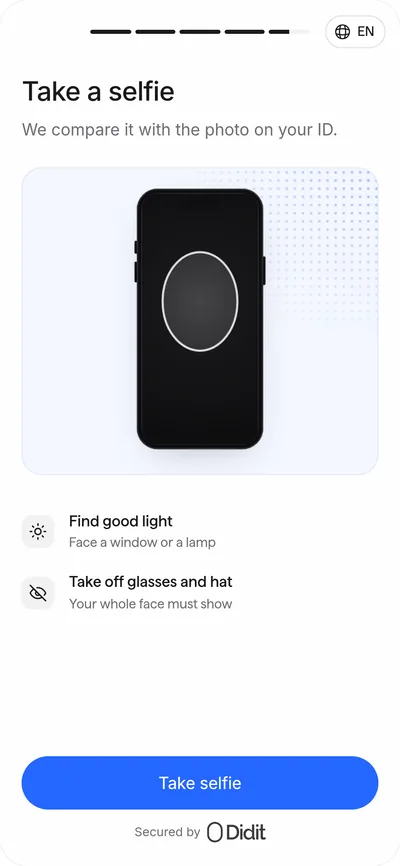
A session shows the step when both of these are true. First, the workflow captures a face: a Liveness step, a Face Match step, an Age Estimation step, the front-camera selfie the ID Verification step takes unless you turned it off, or full-session video recording. Second, the application's consent mode asks for it. In Auto mode that means one of the four triggers applies, on a supported client, unless you already submitted pre-collected consent. In Always mode, every session that captures a face on a supported client asks, unless you already submitted pre-collected consent.
The step appears before the first face capture. When only the ID document shows a covered state, it appears right after the ID capture and before the selfie, and no face geometry is computed from the ID capture images until the person agrees. Didit checks the requirement when the person opens the flow and again at each step until it applies, and once a session requires consent it keeps requiring it.
| Mode | What happens | When to pick it |
|---|---|---|
| Auto (default) | Shows the step only where a trigger applies, on a supported client, unless you already submitted pre-collected consent. Everyone else sees the standard one-line notice | Most applications. It asks where the evidence points to a covered state |
| Always | Every session that captures a face on a supported client asks, unless you already submitted pre-collected consent. The decision records trigger: "forced" | You cannot tell where people are, or your users travel and you want one journey |
| Never | Didit does not display the explicit consent step. Where consent is required, collect and retain it before capture. If you submit previously collected consent through biometric_consent, the decision records it as given with trigger: "customer_collected" | You already run a consent journey and want Didit to record it rather than ask |
Trigger recorded in biometric_consent.trigger | When it applies |
|---|---|
declared_state | You declared a covered state when creating the session: user_state, or a US address in expected_details |
ip_state | The person's IP is located in Illinois, Texas or Colorado |
ip_unknown | The IP resolves to the US without a state, or the IP cannot be located and the supplied details or ID place the person in the US |
document_issuer | The identity document read at ID capture was issued by a covered state |
Didit checks these rules in order and records the first one that applies. Two further values describe how consent was settled rather than why it was asked: forced when the mode is Always, and customer_collected when you sent consent you had already gathered.

Which surfaces can show the step, and the SDK floor
The step needs an app that can display it, and Didit decides that on every request the app makes. The hosted verification flow in a browser, the Web SDK and a WebView all show it. Native iOS, Android, React Native and Flutter show it in a release that bundles native SDK 4.10.0 or later. A native SDK below 4.10.0, or one that does not report its version, cannot show it. The SDK versions and the upgrade paths are in the native SDK documentation.
That last case is the one that catches teams out. The verification still runs and the selfie is still processed, but Didit never records consent that was not given. For a session that required consent, the decision reports required: true, status: "pending" and reason BIOMETRIC_CONSENT_UNSUPPORTED_SDK. A verification decision alone does not establish that consent was given. For flows that require prior consent, upgrade to native SDK 4.10.0 or later, use the supported hosted flow, or collect consent before capture and send it with Create Session. Treat the pending decision as evidence that consent has not been established.
Telling Didit what you already know
The Create Session API takes two optional fields that change what the person sees. user_state is where the person lives, as an ISO 3166-2 subdivision code such as US-IL, or a US state code or name such as IL or Illinois. In Auto mode, for a workflow that captures a face on a supported client, a covered user_state triggers declared_state unless you already submitted consent. An unrecognized value returns 400.
biometric_consent is consent you already collected, as given_at in ISO 8601 and a text_version that identifies your consent text. text_version is capped at 64 characters. The flow does not ask again and the decision records status: "given" with trigger: "customer_collected". A given_at in the future is rejected.
| Who collects consent | Fields to send on Create Session | What the decision records |
|---|---|---|
| Didit collects in the flow | Send user_state if you know the person's state. Do not send biometric_consent. | The step appears when Auto mode or Always mode applies on a supported client. The answer is recorded on the session. |
| You collected before the session | Send biometric_consent with given_at and text_version. text_version is capped at 64 characters. | status: "given" and trigger: "customer_collected". |
{
  "workflow_id": "YOUR_WORKFLOW_ID",
  "vendor_data": "user-42",
  "user_state": "US-IL",
  "biometric_consent": {
    "given_at": "2026-10-13T09:12:00Z",
    "text_version": "consent-v3"
  }
}
Reading the answer on the decision
The Retrieve Session API returns the decision from GET /v3/session/{session_id}/decision/, and the consent object sits inside it alongside the feature arrays. The session decision records the person's consent response in biometric_consent. Read status and given_at to check whether and when consent was recorded. Branch on status rather than on trigger alone: a session can require consent and still be pending. The older-SDK case is the one to handle. A verification decision alone does not establish that consent was given. The same object arrives inside the decision envelope on the status.updated and data.updated webhooks. Here is an excerpt of the biometric_consent object from a decision:
"biometric_consent": {
  "required": true,
  "trigger": "ip_state",
  "status": "pending",
  "given_at": null,
  "reason": "BIOMETRIC_CONSENT_UNSUPPORTED_SDK"
}
Retention of live biometric data is part of the same decision. Read the scheduled deletion date for the session's live biometric data in biometric_retention.deletes_at, and the jurisdictions that applied in biometric_retention.jurisdictions. Keep the consent evidence required by your own retention policy.
Worked example: 10,000 completed checks, with 1,800 consent prompts in Auto
Take a consumer app that runs 10,000 full ID checks in a month. Assume that Auto mode shows the consent step to 1,800 of them, on Auto signals such as a covered declared state, a covered IP or a covered document issuer. That 1,800 is an assumption about prompts, not a count of where people live.
| Line | Arithmetic | Amount |
|---|---|---|
| One full ID check, list | $0.15 ID document + $0.10 passive liveness + $0.05 face match + $0.03 device and IP | $0.33 |
| Month at list | 10,000 x $0.33 | $3,300.00 |
| Scale per-check price | $0.33 x 0.90 | $0.297 |
| Usage on Scale | 10,000 x $0.297 | $2,970.00 |
| Usage after the monthly plan credit | $2,970.00 - $350.00 | $2,620.00 |
| Monthly plan fee plus usage above included credit | $2,620.00 + $299.00 | $2,919.00 |
The price feed lists no separate consent-screen line, and the example assumes 10,000 completed checks in either mode. Billing still depends on completed checks, which can change with the flow. The credit applied above expires at the end of the plan month, so it cannot be banked for a heavy month. The plan terms and the per-check discount are on https://didit.me/pricing/, and the checks in this flow are part of User Verification.
One worked decision trace
Here is the order Didit uses for one session. You create the session with user_state set to US-IL. At the start, Auto mode sees a declared covered state and records declared_state as the trigger. If you had not sent user_state, an IP in Texas would record ip_state; an unresolved US session would record ip_unknown; and a document issued by Illinois, seen only at ID capture, would record document_issuer after that capture. The first rule that applies is the one recorded. When the trigger is document_issuer and the ID is the only signal, the prompt comes after ID capture and before the selfie, and no face geometry is computed from the ID images until the person agrees. Then the selfie runs.
Exceptions and open questions
- VPNs, proxies and hosting networks do not ask on their own. Didit still checks declared state, IP location, whether available signals place the session in the US without a resolvable state, and document issuer. A VPN can change the IP location Didit sees. Use Always mode or send
user_stateif you need to cover that case. ip_unknownis a signal, not a legal test. Auto can ask when the documented IP and US signals leave the state unresolved. Its triggers determine when Didit displays the step. Always can display the step on supported face-capture flows regardless of location.- You remain responsible for applicable biometric duties in every mode. In Never mode, Didit does not display the explicit consent step, so collect and retain consent yourself before capture where required. You can send previously collected consent with the session through
biometric_consent. - Auto mode looks at Illinois, Texas and Colorado. Always mode can display the step on supported face-capture flows wherever the person is. Your own notice duties elsewhere sit in your own consent journey.
Implementation checklist
- Pick the consent mode per application in the console, under Settings, Data and privacy, Biometric consent. Leave it on Auto unless you have a reason.
- Send
user_stateon Create Session whenever you already know where the person lives. In Auto mode, it establishes the declared-state trigger for supported face-capture sessions. - If you collect consent yourself, send
biometric_consentwithgiven_atand atext_versionof up to 64 characters that matches the text the person actually saw. - Check your native SDK version. You need 4.10.0 or later, and React Native or Flutter need a release that pins native 4.10.0 or later. See the SDK overview for current releases.
- Read
biometric_consent.statuson the decision and handlependingwith reasonBIOMETRIC_CONSENT_UNSUPPORTED_SDKas its own case. For flows that require prior consent, upgrade to native SDK 4.10.0 or later, use the supported hosted flow, or collect consent before capture and send it with Create Session. Treat the pending decision as evidence that consent has not been established. - Publish your BIPA retention and destruction policy. Keep the consent evidence required by your own policy, and read
biometric_retention.deletes_aton the decision for the scheduled deletion date. - Confirm that your consent-mode change appears in the audit log.
- In the sandbox, create a session with
user_stateset toUS-ILand confirm the prompt and decision on a supported client. Verify the issuer and unknown-IP branches if you can supply those inputs. Sandbox testing is free and unlimited.
Sources
- Didit documentation: Biometric consent for BIPA, CUBI and Colorado
- Didit documentation: Create Session API
- Didit documentation: Retrieve Session API
- Didit documentation: Data Models
- Didit documentation: Native mobile KYC SDKs
- Didit documentation: Data Retention and Deletion
- Didit documentation: Audit logs
- Didit documentation: Workflow Builder
- Didit pricing page and live price feed
- Didit User Verification product page
- Illinois General Assembly, Biometric Information Privacy Act, 740 ILCS 14/, source P.A. 95-994, effective October 3, 2008, with the written-release definition from P.A. 103-769, effective August 2, 2024, read November 26, 2026
- texas.public.law (Public.Law) Tex. Bus. & Com. Code § 503.001, read November 26, 2026
Next step: open the sandbox at https://business.didit.me/, build a workflow with Liveness or Face Match, set the consent mode, and run a session with user_state set to US-IL. No sales call is involved, and the Free plan gives $10 of monthly credit to eligible organizations.
Try it
Try this in the sandbox
Run the check this guide describes, free.
The product this post is about, taken from its topic. Run it free in the sandbox.
Author
Alberto Rosas
Co-founder and CEO

Keep reading
Other guides in the same topic.
 SEPBLAC Remote Onboarding in Spain: NFC + Liveness Validation
After a year-long test, Spain validated our NFC and active liveness flow as at least as secure as in-person verification. Each check costs $0.15. NFC requires a compatible document and device.
Alberto RosasNov 26, 2026 AMLR Article 19 Due Diligence Thresholds in Code
Article 19 sets CDD triggers at EUR 10,000 occasional, EUR 1,000 transfers of funds and CASPs, EUR 3,000 cash, EUR 2,000 gambling. Below EUR 1,000 a CASP must at least identify and verify the customer.
Alberto RosasNov 26, 2026 How to Geofence Identity Verification by Country or Region
Turn on the Didit geofence switch, list allowed countries, regions, circles or polygons, and read the result: outside, undetermined near a border, or in a blocked area.
Alberto RosasNov 26, 2026Questions
Frequently asked questions
Do I need an explicit consent screen before a selfie in Illinois?
For collection covered by Illinois BIPA, give written notice and obtain a written release before collecting the face-geometry scan. A dedicated screen is one way to obtain that release. Didit can also accept consent you collected before the session.
Does Texas CUBI require consent before a selfie check?
For commercial capture of a biometric identifier, Texas CUBI requires notice and consent before capture. The general destruction rule is within a reasonable time and no later than one year after the collection purpose expires, subject to subsection (c-1). Didit can show and record a consent step in supported flows; your counsel decides whether your capture is covered.
When does Didit show the biometric consent step in Auto mode?
When the workflow captures a face and one of four triggers applies on a supported client. The workflow captures a face if it runs Liveness, Face Match, Age Estimation, the ID Verification front-camera selfie, or full-session video. The four triggers are declared_state for a covered state you declared, ip_state for an IP located in a covered state, ip_unknown when the IP resolves to the US without a state or cannot be located and supplied details or the ID place the person in the US, and document_issuer for an ID issued by a covered state. Didit does not ask again if you already submitted pre-collected consent.
What does Didit's Auto mode do for Colorado?
For collection covered by Colorado law, give notice and obtain consent before collecting face geometry from a selfie or ID photo. In Auto mode, Colorado counts for declared state, IP location and document issuer. Didit shows the step when the workflow captures a face on a supported client and an Auto trigger applies, unless you already submitted consent. The unresolved-IP fallback also applies when the IP resolves to the US without a state, or when the IP cannot be located and supplied details or the ID place the person in the US. Confirm controller coverage, exceptions and the required form of consent with counsel.
What is the difference between Auto, Always and Never consent modes?
Auto shows the step only where a trigger applies, and everyone else sees the standard one-line notice. Always shows it to every session that captures a face on a supported client, unless you already submitted pre-collected consent, and records trigger: "forced". In Never mode, Didit does not display the step, so collect and retain consent yourself before capture where required. You can send consent you already collected with Create Session.
What happens if my native app uses an SDK older than 4.10.0?
The verification runs as before and the face captures are accepted. For sessions that required consent, the app cannot display the step, so the decision reports required: true, status: "pending" and reason BIOMETRIC_CONSENT_UNSUPPORTED_SDK. Didit never records consent that was not given, so upgrade to 4.10.0 or later.
Can I pass consent I already collected to Didit?
Yes. Create Session accepts a biometric_consent object with given_at in ISO 8601 and a text_version of up to 64 characters identifying your consent text. The flow does not ask again, and the decision records status: "given" with trigger: "customer_collected". A given_at in the future is rejected.
Does the Didit biometric consent step cost extra?
The price feed lists no separate consent-screen line. You pay the normal per-check prices: a full ID check is $0.33 per completed check, made of $0.15 ID document verification, $0.10 passive liveness, $0.05 face match and $0.03 device and IP analysis.
Where do I find the consent answer in the Didit decision?
It is the biometric_consent object in the session decision from GET /v3/session/{session_id}/decision/, with required, trigger, status, given_at and, when relevant, reason. The same object arrives inside the decision envelope on the status.updated and data.updated webhooks. A verification decision alone does not establish that consent was given; a required session can still be pending.
Does a VPN stop the consent screen from appearing?
A VPN can change the IP location Didit sees in Auto mode. Didit still checks declared state, IP location, whether available signals place the session in the US without a resolvable state, and document issuer. Send user_state when you know the person's state, or use Always mode if you need to ask across locations.
Does an ID photo count as face geometry under BIPA?
BIPA excludes photographs from its definition of a biometric identifier, but a scan of face geometry is explicitly included. Didit handles this by treating the ID capture as a face source: when only the document shows a covered state, the step appears right after ID capture and before the selfie, and no face geometry is computed from the ID images until the person agrees.
Where can I see when Didit will delete live biometric data?
The session decision's biometric_retention object lists the applicable jurisdictions and the scheduled deletion date for live biometric data. Keep the consent evidence required by your retention policy.
Compliance built in
Audited, certified and attested.
We hold the certifications and build each country's rules into your flows, so you can launch anywhere without worrying. Security and Compliance center
- Regulation encoded into your flows
Tell us what you do and where. Didit lists the rules that apply to you, with sources, and builds the checks each country needs into one workflow.
- Ready for AMLR
Every requirement of the new EU anti-money laundering rules, from checking customers to human review, is already covered by a Didit check.
- Tested in Spain's Treasury sandbox
Spain's Treasury published its supervised sandbox report on Didit's NFC plus active liveness onboarding; SEPBLAC took part and valued the added measures positively.
- Audited, not self-declared
iBeta Level 1 and Level 2. Liveness tested under ISO/IEC 30107-3.
Your obligations · 3 regions
 SOC 2 Type 2
 ISO 27001
 iBeta Level 1 and Level 2
 EU regulator attestation
 FSM youth protection
 GDPR
 EBA remote onboarding
 MiCA compatible
 FIDO Alliance member
- AMLREU AML Regulation ready
Integration · Didit MCP
Run Didit from your own AI agent
Connect Didit to Claude, Cursor, VS Code or ChatGPT and just ask in plain words. Your agent can do anything you can do in the console, with the same permissions you have.
 Add to Claude
 ChatGPT
 Cursor
- Build workflowsDescribe the checks you need. The agent creates and publishes the flow.
- Run investigationsAsk why a session was declined, review cases, search people and companies.
- Change rulesCreate payment rules, test them on past data and switch them on.
- Pull reportsAsk for numbers, exports or the audit log.
Didit Academy


