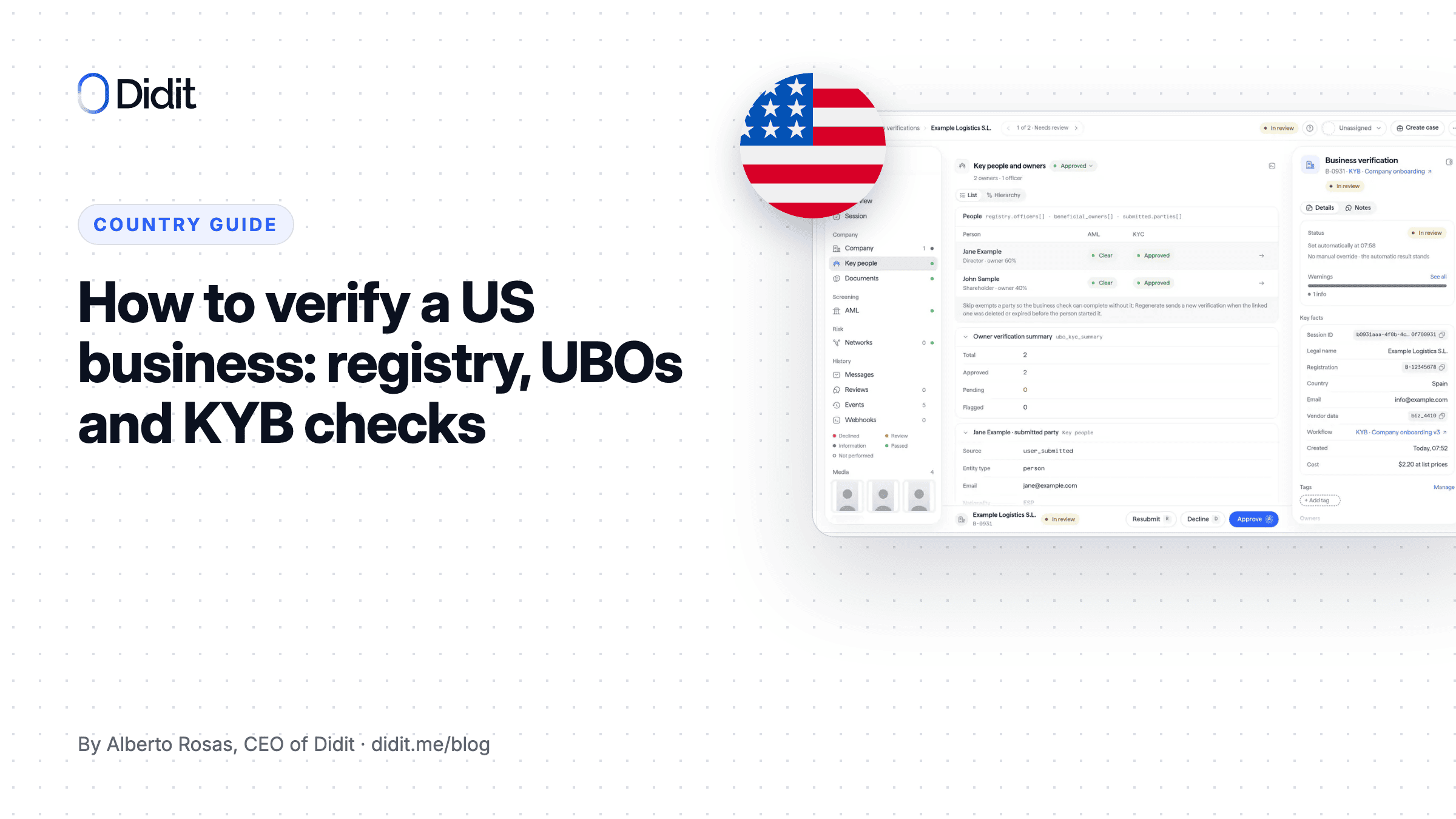
How to verify a US business: registry, UBOs and KYB checks
Verify a U.S. company at the state business registry, then collect UBOs, officers, AML results and documents. Didit KYB starts at $2.00 for Lite; US-DE and US-CA select the state registry.
 Alberto RosasCo-founder and CEO
Contents
In this guide
Jump to the part you need.
This guide is for compliance and onboarding teams that verify a U.S. company before onboarding, payment or contracting. Didit Business Verification (KYB) checks state registries from $2.00 for the Lite tier, then collects key people, UBOs, AML results and documents in one session. The caveat: the U.S. has no single federal company register, and after FinCEN's August 11, 2026 final rule domestic companies no longer file beneficial ownership reports, so ownership usually comes from the company.
Last updated: November 26, 2026. Prices checked against the live Didit price feed on November 26, 2026.
| What you verify | Official source | Identifier | What Didit returns |
|---|---|---|---|
| Legal existence and status | State business registry, for example Kentucky Secretary of State or New York Department of State | State file number or exact legal name | Lite fields: legal name, registration number, status, incorporation date, registered address |
| Ownership and control | State registry where ownership is published, plus the Key People form | Shareholder and UBO names, ownership %, voting % | Shareholders or UBO tier when available; otherwise Key People submissions |
| Officers and representatives | State registry and company submission | Officer names and role tags | Key People with roles |
| Sanctions, PEP and adverse media | Didit AML lists | Company and person names | Company AML $0.20; Person AML $0.20 per person |
| Supporting documents | Company uploads | Certificate, articles, register, proof of address | KYB Documents $0.20 per step |
Start free in the sandbox at https://business.didit.me/ (no sales call). Developers can connect Didit to an AI assistant through the MCP server. The matching product page is Business Verification and all list prices are on didit.me/pricing.
What you must verify in the United States, and why
The Corporate Transparency Act created the federal BOI reporting regime described in FinCEN's materials. FinCEN BOI FAQ, read November 26, 2026, states that Congress enacted the Act in 2021 and that it required certain U.S. and foreign entities to report beneficial owner information to FinCEN. That regime changed. FinCEN BOI reference materials, read November 26, 2026, states that a final rule issued on August 11, 2026 changed the requirements: U.S. companies are exempt from BOI reporting and no longer file BOI reports. Only certain foreign companies registered to do business in the U.S. must report, and they do not report U.S. person beneficial owners or U.S. person company applicants. The same page says U.S. persons with a FinCEN ID do not need to update or correct previously submitted information.
For a U.S. company, this means there is no federal beneficial ownership database you can query to find the owner. You verify formation and status at the state level, then collect ownership and control from the company and its documents. That is the gap Didit KYB fills: a state registry lookup, a Key People form for UBOs and officers, AML screening on the company and each person, and document collection in the same business session.
"U.S. companies are exempt from BOI reporting requirements and are no longer required to file BOI reports." FinCEN BOI reference materials, read November 26, 2026.
The state registers, identifiers and what they expose
Company law is state law. A U.S. company is formed in one state and files with that state's business office, usually the Secretary of State. The registers differ in search fields, documents and how much ownership they publish. Two official examples show the range.
The Kentucky Secretary of State online services page, read November 26, 2026, lets you search for an organization by name or identification number. It also supports name availability checks and searches by current officer name, founding officer or initial director name, and registered agent name. Online filings include annual reports, renewal of assumed names, and statements of change of registered agent or principal office. Corporate documents filed on or after September 15, 2004 are available as scanned images, and earlier documents are added as they are scanned.
The New York State Department of State, Division of Corporations public inquiry page, read November 26, 2026, searches the Corporation and Business Entity Database. That database includes business and not-for-profit corporations, limited partnerships, limited liability companies, limited liability partnerships and other miscellaneous businesses, plus assumed name filings for corporations, LLCs and limited partnerships. New York states that the system should not be used to determine the acceptability of an entity name and that completeness or accuracy cannot be guaranteed because the Department relies on information provided to it. Treat the registry as evidence of filing, not as a guarantee of the company's current facts.
Didit uses state codes in the extended US-<state> format to pick the correct registry. US-DE selects Delaware, US-CA selects California, and US-NY selects New York. The supported-countries documentation says this format is how U.S. states are selected for the registry check. A country list built from the table should use those codes, not a single US code, when the workflow collects a U.S. entity.
| Identifier or field | Where it comes from | Format or note | Didit output |
|---|---|---|---|
| State entity file number | State registry, such as a Kentucky identification number or New York DOS number | Registry-specific, often numeric or alphanumeric | registration_number |
| Legal name | State registry | Exact registered name | company_name, alternative_names |
| Entity type | State registry | LLC, corporation, LP, LLP, and so on | company_type |
| Status | State registry | Active, dissolved, struck off, in liquidation, dormant | registry_status |
| Incorporation date | State registry | Date of formation | incorporation_date |
| Registered address | State registry | Registered office or principal office | registered_address, addresses[] |
| Registered agent | State registry where exposed | Agent name and address | Registry field where available |
| Officers and directors | State registry and company submission | Names and roles, coverage varies by state | Key People with role tags |
| Tax number | Registry or company documents | EIN or state tax number where available | tax_number |
| LEI | Registry or company | LEI where present | legal_entity_identifier |
| Ownership percentage | Registry where published, or Key People form | Economic and voting percentages | ownership_percent, voting_percent |
| UBO threshold | Workflow setting | Didit's ownership documentation lists the U.S. CTA threshold as 25% ownership or substantial control | Set in the KYB workflow under Risk |
What Didit returns for a U.S. company
Didit sells registry data in three tiers: Lite, Shareholders and UBOs. Tier availability varies by country and state registry. Lite returns the company profile: legal name, registration and tax numbers, legal form, status, incorporation date, registered address, activity, headcount and contact details, plus officers. Shareholders adds direct shareholders with ownership bands. UBOs adds the ultimate beneficial owners resolved through the ownership chain. Prices are per selected company, by country and tier, from $2.00.
State coverage and ownership-tier availability are state-specific: confirm the selected state is supported and whether its registry can serve Shareholders or UBOs before you promise an ownership result.
U.S. state registries are not uniform on ownership. The supported-countries documentation says that a Shareholders or UBO request in a country whose registry holds no ownership record is delivered and billed at the highest tier the country's registries can serve, usually Lite. The same rule protects you from paying for ownership data the registry cannot supply. When ownership is unavailable, Didit still collects it through Key People: UBOs, shareholders, directors, representatives, secretaries and authorized signatories, each with role tags, ownership percentages and voting percentages. Corporate shareholders are recorded with company name, registration number, ownership percentage and country of incorporation. Nested KYB can run a child business session for a corporate UBO when the workflow enables it.
AML runs on both levels. Company AML screens the entity against sanctions, adverse media and regulatory enforcement lists for $0.20 per check. Person AML screens each key person for $0.20 per person. Linked KYC for each person is a full ID check at $0.33. Document collection costs $0.20 per KYB document step, regardless of how many files are uploaded in that step. Key People extraction has no separate fee.
The decision returns status as Approved, In Review or Declined. Registry fields include fetch_status (pending, resolved or failed), verification_status (verified, failed or unknown) and is_from_registry (true for registry data, false for manual entry). Companies with a status other than Active may be flagged or declined depending on your workflow configuration.
Step by step in the Business Console
- Create a KYB workflow. In the Business Console go to Workflows, Create workflow and choose Business Verification. Enable Company registry lookup, Company AML, Key People and any Documents you require. Save and copy the
workflow_id. - Set the country and state. In the workflow's KYB Registry Check settings choose United States and the state code, for example
US-DEorUS-CA. The pricing documentation says hosted workflows pick the tier per country in the console and every country starts at Lite. - Start a business session. Create a session from the console or API. The KYB workflow flags the session as a business session automatically.
- Search the registry. The applicant selects the state and enters the company name, the registration number, or both. At least one is required. The registry search runs asynchronously and returns matches. The applicant picks the correct company.
- Confirm company data. The applicant confirms or corrects the registry fields. If the registry holds an ownership report, it arrives in the background; the Key People form is not blocked.
- Add key people and documents. The applicant adds UBOs, shareholders, directors and representatives, then uploads the configured documents. Each role can require KYC, use a specific KYC workflow, or be skippable, per the workflow settings.
- Review and decide. The analyst reviews the decision in the Business Console, can request more documents, and approves or declines. The session reaches a terminal status: Approved means all checks passed, In Review waits for an analyst decision, and Declined means a critical check failed.


Step by step through the API
The API uses the same workflow. Create a session with the KYB workflow_id and your own vendor_data reference:
curl -X POST https://verification.didit.me/v3/session/ -H 'x-api-key: YOUR_API_KEY' -H 'Content-Type: application/json' -d '{"workflow_id": "YOUR_KYB_WORKFLOW_ID", "vendor_data": "biz-acme-001"}'The response contains session_id, session_number and url. Send the url to the company contact. If you already know the company, add expected_details with company_name, registry_country and registration_number. The hosted flow pre-selects and locks the country and, for state-level registries such as US-CA, the state, then runs the asserted search. Both fields remain editable so the applicant can correct a wrong assertion.
When processing reaches a terminal status, Didit posts a status.updated event. Business sessions carry session_kind set to business. Filter on that field, verify the X-Signature-V2 HMAC signature, then read the decision. The webhook payload already contains the full decision; call the decision endpoint only if you did not subscribe or need it later.
curl https://verification.didit.me/v3/session/bs_01H.../decision/ -H 'x-api-key: YOUR_API_KEY'The decision includes registry data, key people, AML hits, documents and per-feature results. Use Approved to onboard, Declined to reject and log the warnings[] tags, and In Review to wait for the analyst decision.
What each charge covers before you price a U.S. check
Registry verification is the state lookup and the company profile it returns. Company AML is a separate check on the legal entity. Person AML screens each key person separately, and linked KYC is a full ID check for that person. They are separate lines because one can pass while another needs review, and because a person who is not a UBO or officer does not need a linked KYC. Price the parts you actually run, not a bundle you assume.
State coverage and ownership-tier availability must be confirmed for the selected U.S. state. The tier is set per country in the workflow and every country starts at Lite. A state registry that holds no ownership record is delivered and billed at the highest tier it can serve, usually Lite.
Worked cost example for a Delaware LLC
Assume a Delaware LLC verified at Lite, one company AML check, two key people who each take a full KYC and person AML, and one document step. All prices are list prices from the live price feed on November 26, 2026.
| Line | Unit price | Quantity | Cost |
|---|---|---|---|
| Registry check, Lite | $2.00 | 1 company | $2.00 |
| Company AML | $0.20 | 1 check | $0.20 |
| Linked KYC for key people | $0.33 | 2 people | $0.66 |
| Person AML | $0.20 | 2 people | $0.40 |
| KYB document step | $0.20 | 1 step | $0.20 |
| Total | $3.46 |
Arithmetic: 2.00 + 0.20 + 0.66 + 0.40 + 0.20 = 3.46. This example stays at the verified Lite scenario for Delaware. If a higher ownership tier is available, use the quoted tier price shown for that state and recalculate the total. If the registry holds no ownership record, the request is delivered and billed at Lite, so the $3.46 example applies. A manual-entry company that cannot be found is billed a flat $0.75 for the registry line. Plan discounts apply to Didit prices: 4% on Growth and 10% on Scale.
Fallbacks when a registry is down or has no match
State registries go down and some companies are too new or use a name that does not match the register. Didit exposes the lookup state through fetch_status. If the lookup fails, the session can continue with manual company data: the applicant submits the company details, is_from_registry is set to false, and the registry line is billed at the flat $0.75 manual-entry price. A company that cannot be found is not a dead end, but it is also not registry-verified, so treat the manual data as an assertion to check against documents.
If the registry has no ownership record, a Shareholders or UBO request is delivered and billed at the highest tier the registry can serve, usually Lite. If ownership is pending at selection, Lite is charged at selection and only the difference to the delivered ownership tier is charged later, using the selection-time quote. No additional ownership charge applies when ownership is unavailable, and the total never exceeds the requested tier's quote. If the registry returns a status other than Active, the workflow can flag or decline the company. New York's own disclaimer is a reminder that registry data is not guaranteed accurate, so cross-check the certificate of incorporation, articles, shareholder register and proof of address when the decision matters.
Standalone API searches can incur a $0.50 fee per successful request; hosted workflow searches have no separate search fee. That matters if you build a search-and-select screen outside a hosted session.
Sources
- Didit docs: Business Verification API (KYB), registry and UBO, read November 26, 2026.
- Didit docs: KYB supported countries and registry coverage, read November 26, 2026.
- Didit docs: KYB registry pricing by country, read November 26, 2026.
- Didit docs: KYB quickstart, read November 26, 2026.
- Didit docs: company registry API, read November 26, 2026.
- Didit docs: UBO API and ownership, read November 26, 2026.
- Didit pricing and live price feed, read November 26, 2026.
- Financial Crimes Enforcement Network (FinCEN), U.S. Department of the Treasury, BOI reference materials, read November 26, 2026.
- Financial Crimes Enforcement Network (FinCEN), U.S. Department of the Treasury, BOI FAQ, read November 26, 2026.
- Kentucky Secretary of State, online business filings and records, read November 26, 2026.
- New York State Department of State, Division of Corporations, public inquiry, read November 26, 2026.
Next step: open the sandbox at https://business.didit.me/, create a KYB workflow with a U.S. state code, and run one test company. No sales call. Didit serves 4,000+ companies, and the list price for a Lite U.S. registry check starts at $2.00.
Try it
Try this in the sandbox
Run the check this guide describes, free.
The product this post is about, taken from its topic. Run it free in the sandbox.
Author
Alberto Rosas
Co-founder and CEO

Keep reading
Other guides in the same topic.
 Phone Verification API Pricing: Carrier Cost Plus $0.02
Phone verification API pricing is the carrier price for the country and channel plus a $0.02 fee per code. No contract on Free, Growth and Scale, paid per code from prepaid credit; Growth pays $0.0192 and Scale $0.018.
Alberto RosasNov 26, 2026 How to Verify a Supplier IBAN and Company Name Before a Payout
Call Didit's account check with the country, the account in that country's format and the registered company name. It returns <code>match</code>, <code>close_match</code>, <code>no_match</code> or <code>cannot_verify</code>.
Alberto RosasNov 26, 2026 Google Wallet ID Verification API: US, UK, Brazil, Singapore and Taiwan
We verify Google Wallet IDs for $0.10 per completed check in the US, UK, Brazil, Singapore and Taiwan. Use the Digital ID wallet API for your own interface or the Sessions API for our hosted journey.
Alberto RosasNov 26, 2026Questions
Frequently asked questions
How do I verify a company in the United States?
Start with the state where the company is formed. Search the state business registry by legal name or state file number, confirm the entity is Active, and collect its registered address and officers. Then collect UBOs and directors through a Key People form, screen the company and each person for AML, and check the certificate of incorporation and ownership documents. Didit does this in one KYB session using state codes such as US-DE and US-CA.
Does the United States have a federal company registry?
No. Companies are formed under state law, so the official register is the state business office, usually the Secretary of State. FinCEN BOI reference materials, read November 26, 2026, say U.S. companies are exempt from BOI reporting under the August 11, 2026 final rule, so there is no federal beneficial ownership report for a domestic company. Only certain foreign companies registered to do business in the U.S. must report BOI.
What does US-DE or US-CA mean in Didit KYB?
US-DE and US-CA are Didit's extended state codes. The country part is US and the suffix selects the state registry, so US-DE routes to Delaware and US-CA routes to California. Didit's supported-countries documentation says U.S. states use the US-<state> format to select the correct Secretary of State registry. Use these codes instead of a single US code when the entity is a U.S. company.
Can Didit find UBOs for a U.S. company?
Only where the relevant state registry publishes ownership data. Many U.S. state registries do not publish shareholders or UBOs. Didit's rule is to deliver and bill the highest tier the registry can serve, usually Lite, and then collect ownership through the Key People form. The decision shows registry-derived beneficial owners when available and user-submitted parties otherwise, with ownership and voting percentages and role tags.
How much does a U.S. KYB check cost?
The Lite registry check is $2.00 per company. Company AML is $0.20, person AML is $0.20 per person, linked KYC is $0.33 per person, and a KYB document step is $0.20. A Delaware LLC with two key people, company AML, person AML and one document step costs 2.00 + 0.20 + 0.66 + 0.40 + 0.20 = $3.46 at list price. Plan discounts are 4% on Growth and 10% on Scale.
Is BOI reporting still required for U.S. companies in 2026?
For domestic U.S. companies, no. FinCEN BOI reference materials, read November 26, 2026, states that the final rule issued on August 11, 2026 exempts U.S. companies from BOI reporting and that they no longer file BOI reports. Only certain foreign companies registered to do business in the U.S. must report, and they do not report U.S. person beneficial owners or U.S. person company applicants. FinCEN also says U.S. persons with a FinCEN ID do not need to update or correct previously submitted information.
What happens if a state registry is down or has no match?
The session continues with manual company data. Didit sets is_from_registry to false and bills the registry line at the flat $0.75 manual-entry price. You still get Key People, AML and documents in the same session, but the company data is an assertion rather than a registry-verified record, so check it against the formation documents. If the registry lookup is pending, Lite is charged at selection and any ownership difference is charged later.
What documents should I collect for a U.S. company?
At minimum, collect the certificate of incorporation or formation, the articles or operating agreement, and a shareholder or membership register. Add proof of address for the registered office, tax registration, and financial statements when the risk is higher. Didit's document step is $0.20 per step, regardless of how many files are uploaded in that step. Analysts can request more documents during review.
How do I know when a U.S. business verification is complete?
Didit posts a status.updated webhook when the business session reaches a terminal status. Business events carry session_kind set to business. The payload contains the full decision, including registry data, key people, AML hits and documents. If you do not subscribe to webhooks, call GET /v3/session/{session_id}/decision/ with your API key.
Can I verify a company in more than one U.S. state?
Yes, if you run one session per entity and set the state code for each. A company can be formed in Delaware and registered to do business in California, so the registry of record and the state registration can differ. Use the state of incorporation for the registry check and collect foreign qualification or registration documents for the other states where the company operates.
Compliance built in
Audited, certified and attested.
We hold the certifications and build each country's rules into your flows, so you can launch anywhere without worrying. Security and Compliance center
- Regulation encoded into your flows
Tell us what you do and where. Didit lists the rules that apply to you, with sources, and builds the checks each country needs into one workflow.
- Ready for AMLR
Every requirement of the new EU anti-money laundering rules, from checking customers to human review, is already covered by a Didit check.
- Tested in Spain's Treasury sandbox
Spain's Treasury published its supervised sandbox report on Didit's NFC plus active liveness onboarding; SEPBLAC took part and valued the added measures positively.
- Audited, not self-declared
iBeta Level 1 and Level 2. Liveness tested under ISO/IEC 30107-3.
Your obligations · 3 regions
 SOC 2 Type 2
 ISO 27001
 iBeta Level 1 and Level 2
 EU regulator attestation
 FSM youth protection
 GDPR
 EBA remote onboarding
 MiCA compatible
 FIDO Alliance member
- AMLREU AML Regulation ready
Integration · Didit MCP
Run Didit from your own AI agent
Connect Didit to Claude, Cursor, VS Code or ChatGPT and just ask in plain words. Your agent can do anything you can do in the console, with the same permissions you have.
 Add to Claude
 ChatGPT
 Cursor
- Build workflowsDescribe the checks you need. The agent creates and publishes the flow.
- Run investigationsAsk why a session was declined, review cases, search people and companies.
- Change rulesCreate payment rules, test them on past data and switch them on.
- Pull reportsAsk for numbers, exports or the audit log.
Didit Academy


