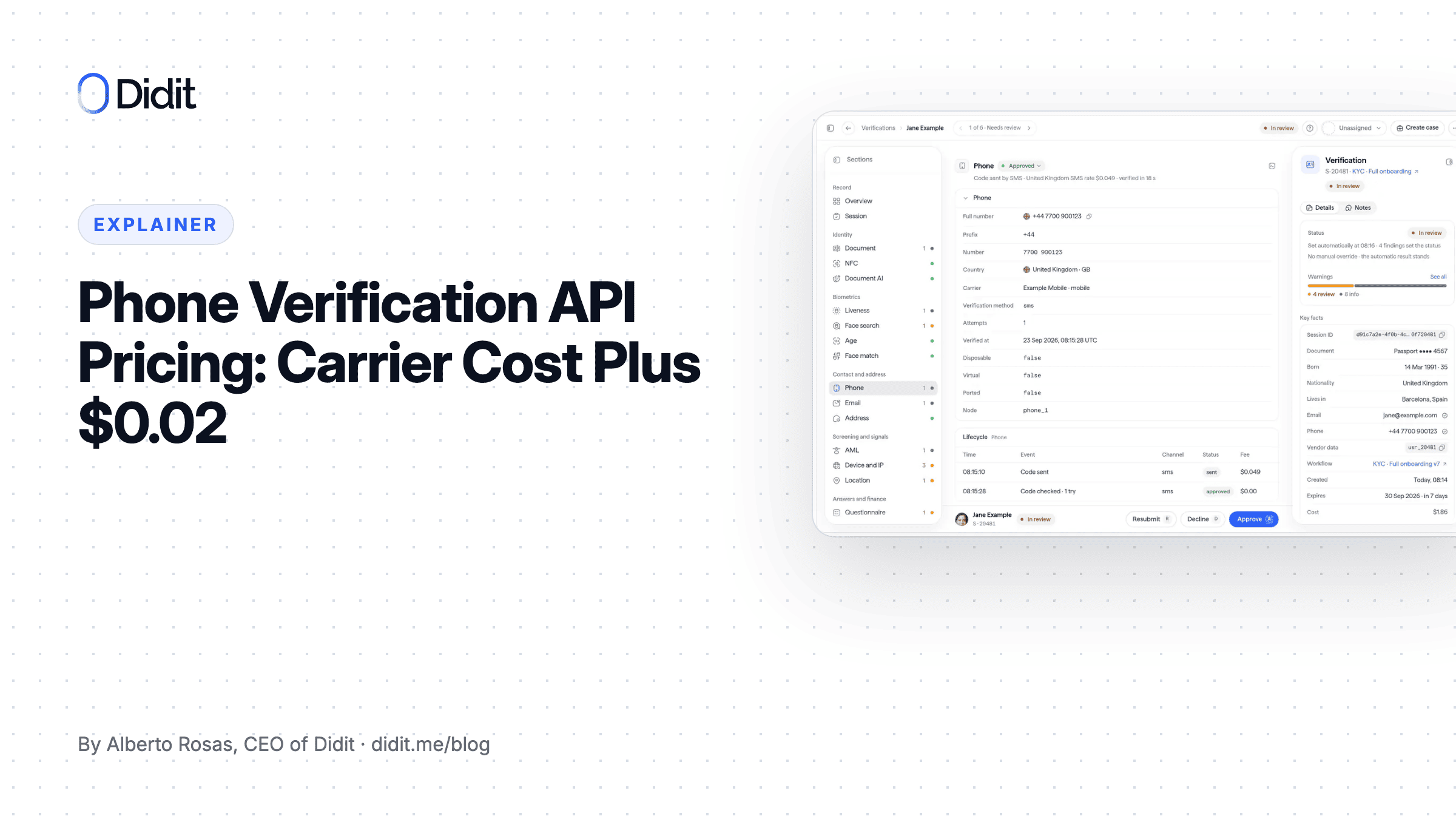
Phone Verification API Pricing: Carrier Cost Plus $0.02
Phone verification API pricing is the carrier price for the country and channel plus a $0.02 fee per code. No contract on Free, Growth and Scale, paid per code from prepaid credit; Growth pays $0.0192 and Scale $0.018.
 Alberto RosasCo-founder and CEO
Contents
In this guide
Jump to the part you need.
Phone verification API pricing fits teams that send one-time codes at signup and want the carrier cost and the vendor fee on separate lines. We charge the carrier's price for the country and channel plus $0.02 per code, with no contract on Free, Growth and Scale. The caveat is that the carrier part moves with the destination and the channel, so a Nigerian SMS code costs about five times a US one.
Last updated: November 26, 2026. Prices checked against the live Didit price feed on November 26, 2026.
What phone verification API pricing means
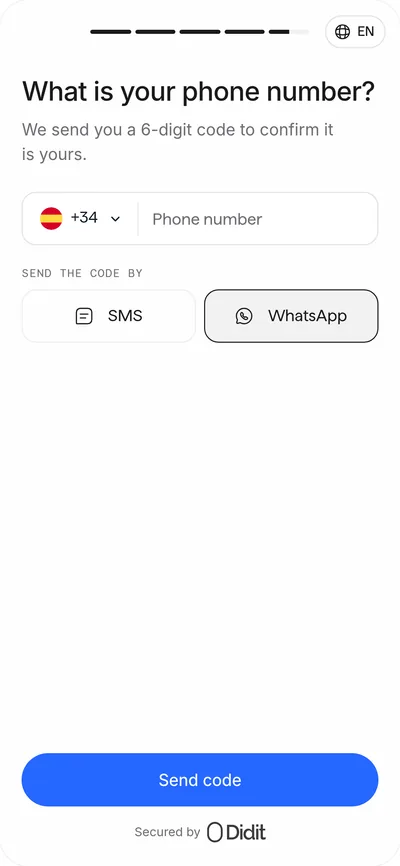
Phone verification API pricing is what a provider bills for one phone number check, split into the carrier's price for delivering the code and the provider's own fee, billed per code rather than per month or per seat. The term covers the send, the check of the code the user typed, and the phone risk data that comes back with the result.
Buyers meet it in two places: procurement, where someone asks what a million signups cost, and engineering, where someone asks which countries break the budget and whether a retry is billed twice. Both answers come from the same split. The carrier is paid for the message. We are paid a flat fee for the verification around it.
| Item | Price (USD) | Notes |
|---|---|---|
| Didit fee per code | $0.02 | Added to the carrier price |
| Didit fee per code, Growth | $0.0192 | 4% off the fee only |
| Didit fee per code, Scale | $0.018 | 10% off the fee only |
| Carrier price | At cost | Passes through, never discounted |
| United States, SMS | $0.0473 | Total per code: carrier $0.0273 + $0.02 |
| United Kingdom, SMS | $0.0783 | Total per code |
| Germany, SMS | $0.1145 | Total per code |
| India, SMS | $0.0948 | Total per code |
| Nigeria, SMS | $0.2597 | Total per code |
| United States, WhatsApp | $0.0431 | Total per code |
Phone risk API, POST /v3/phone/risk/ | Listed on the pricing page | Scores carrier, line type, porting and fraud risk without sending a code |
| Plan fees | Growth $99 a month, Scale $299 a month | Separate from phone usage, which is billed per code from credit |
| Contract | None on Free, Growth and Scale | Enterprise is an annual contract from $15,000 a year |
Start free in the sandbox at business.didit.me, no sales call. Developers can connect Didit to an AI assistant through didit.me/developers/mcp. Per-country code prices sit on the phone price list, and the rest of the price book is on the pricing page.
Where the term shows up
Phone verification pricing appears wherever a code leaves your system and a bill comes back. In practice:
- Signup and login flows that send an OTP before the account exists, where cost is per attempt and the fraud rate sets the volume.
- Full identity checks that include the PHONE feature in a workflow, where phone cost sits next to the ID check, liveness and face match on the same invoice.
- Fraud teams that score numbers without sending anything, using the risk endpoint instead of a code.
- Finance and procurement, who compare a per-code price against a monthly minimum and ask what a contract locks in.
The two parts of one code
The carrier price
The carrier price is what the route charges to deliver the message to that number, in that country, on that channel. It passes through at cost. We add no margin on it, and the plan discount does not touch it.
The Didit fee
Our side is a flat $0.02 per code at list price. It does not change with the destination or the channel. On Growth the fee is $0.0192 and on Scale $0.018, because the plan discount applies to our prices. The same US SMS code that totals $0.0473 at list price is $0.0465 on Growth: the carrier still gets $0.0273 and only our fee drops.
Retries, fallbacks and blocked sends
- A fixed line takes no SMS. An eligible new send requested by SMS to a fixed line may be read out in a call instead and is then priced as a voice code. That fallback never applies to a repeat, a reused pending code, a destination without voice or a sandbox send.
- A send blocked by anti-abuse, with reason spam, sends no code and is not charged.
- Nothing is charged for a check that never finishes with a result. We bill a check when it completes, the rule that covers every Didit product.
A same-window retry preserves the five-minute deadline. The broader pricing feed says some retries can be billable, while the phone page does not break retries out, so confirm phone retry billing against the current route-specific pricing before modeling volume.
Why the price moves so much by country and channel
The same six-digit code costs between $0.0408 and $0.3061 depending on where it lands and how it travels. Sample totals at list price, carrier plus $0.02:
| Country | SMS | Telegram | |
|---|---|---|---|
| United States | $0.0473 | $0.0431 | $0.05 |
| Brazil | $0.052 | $0.0461 | $0.05 |
| United Kingdom | $0.0783 | $0.0599 | $0.05 |
| India | $0.0948 | $0.0413 | $0.05 |
| Germany | $0.1145 | $0.0899 | $0.05 |
| Saudi Arabia | $0.1502 | $0.0496 | $0.05 |
| Nigeria | $0.2597 | $0.0461 | $0.05 |
| Indonesia | $0.3061 | $0.0628 | $0.05 |
Two patterns matter. First, the channel can beat the country. A WhatsApp code to Saudi Arabia totals $0.0496 against $0.1502 by SMS, and to Nigeria $0.0461 against $0.2597. Second, the spread lives in the destination: Nigeria and Indonesia were five to six times a US SMS in this table, while Telegram was $0.05 in every row shown.
One billing rule to plan around: billing uses the higher of the listed carrier price and the price the route reports.
The full per-country table is on the Didit phone price list, and the same numbers are published programmatically at the phone pricing endpoint. Read price_usd for one country and channel, then add $0.02 for the list price per code.
SMS segments versus one verification code
This is the question that confuses budgets most, because two products price two different things.
Verification codes are priced per code. A completed verification code is billed once per code, whatever the message length, because the message is a code and nothing else. A send blocked by anti-abuse sends no code and is not charged.
The Messages product, for transactional SMS, WhatsApp and email you write yourself, is priced per segment. An SMS segment is 160 characters, or 70 characters when the text uses characters outside the basic SMS alphabet such as emoji. Each segment costs the carrier price plus our $0.02 fee. WhatsApp costs Meta's price plus $0.004 a message, and $0.004 alone when you send from your own WhatsApp Business account. Emails you send cost $0.02 each, and the emails Didit sends during a verification are free.
So a long notification SMS can cost three or four segments. A six-digit OTP costs one code, and the sender name on it is free on every send.
If you are budgeting verification, count codes. If you are budgeting notifications, count segments and characters. Mixing the two is the most common pricing error we see in support tickets.
Worked example: 1,000 US signups by SMS
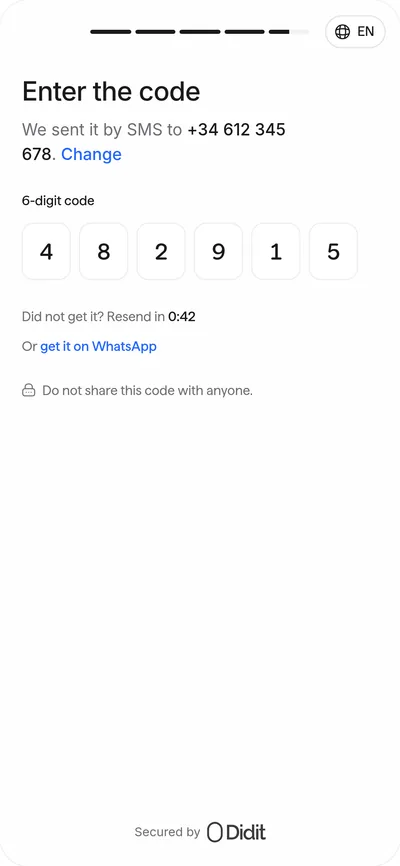
One thousand completed phone verifications to US mobile numbers over SMS, at list price:
- Carrier: 1,000 x $0.0273 = $27.30
- Didit fee: 1,000 x $0.02 = $20.00
- Total: 1,000 x $0.0473 = $47.30
The same volume on a paid plan, where only the fee changes:
| Plan | Fee per code | Total per code | 1,000 codes |
|---|---|---|---|
| List price | $0.02 | $0.0473 | $47.30 |
| Growth | $0.0192 | $0.0465 | $46.50 |
| Scale | $0.018 | $0.0453 | $45.30 |
Now a mixed month, still 1,000 codes: 500 to the United States, 300 to Germany, 200 to Nigeria, all by SMS at list price.
- US: 500 x $0.0473 = $23.65
- Germany: 300 x $0.1145 = $34.35
- Nigeria: 200 x $0.2597 = $51.94
- Total: $23.65 + $34.35 + $51.94 = $109.94
Same code count, more than twice the US bill, because 200 Nigerian codes cost more than 500 German ones. The fee part stays at 1,000 x $0.02 = $20.00 and the carrier part is $89.94. On Growth, $115 of monthly credit covers about 2,470 US SMS codes at $0.0465. On the mixed month above, where the average code costs $0.10994, the same credit covers about 1,046 codes.
Fields and terms you will see on the bill
| Term or field | What it means |
|---|---|
price_usd | Carrier price for one country and channel from the phone pricing endpoint. Add $0.02 for the list price per code. |
available | Whether that channel exists for that country. False means the route is not offered there. |
preferred_channel | sms, whatsapp, telegram, voice or viber. Delivery falls back to SMS if the preferred channel is unavailable. |
code_size | Digits in the code. Six in our examples. It does not change the price. |
verification_id | The id returned by Send Phone Code, passed to Check Phone Code so the check applies to that verification. |
status | Not Started, In Progress, Approved, Declined, Failed, Expired or Not Found, Abandoned, Kyc Expired. |
max_attempts | Wrong code entries allowed on a standalone verification. Defaults to 5. |
is_disposable, is_virtual, carrier.type | Risk signals returned with the check: throwaway number, VoIP number, and mobile, landline or voip. |
balance | Organization credit in USD, a fixed-point decimal string. Parse it with a decimal type, not a float. |
auto_refill_amount | What auto top-up adds, $50 to $20,000, at face value. |
How Didit implements phone verification pricing
We bill phone codes as carrier plus fee, per code, from prepaid credit. Growth and Scale also carry a monthly plan fee, $99 and $299, and phone usage itself is billed per code from the credit that fee buys. Free, Growth and Scale are self-serve with no contract; Enterprise is the only annual contract, from $15,000 a year. We run this for 4,000+ companies across 220+ countries.
- Credit order: this month's plan credit first, then your oldest top-up. Top-ups run from $50 to $20,000 at face value and last 12 months.
- The Free plan's monthly credit does not cover phone codes. Sending verification codes needs a paid Growth or Scale plan or your organization's first top-up.
- Growth and Scale credit pays for phone codes in full. Risk lookups skip the first-top-up requirement but still need credit to cover them.
- Sandbox testing is free and unlimited on every plan: anything you run there is not charged.
- Usage in the console breaks phone spend down by country, because the price depends on it.
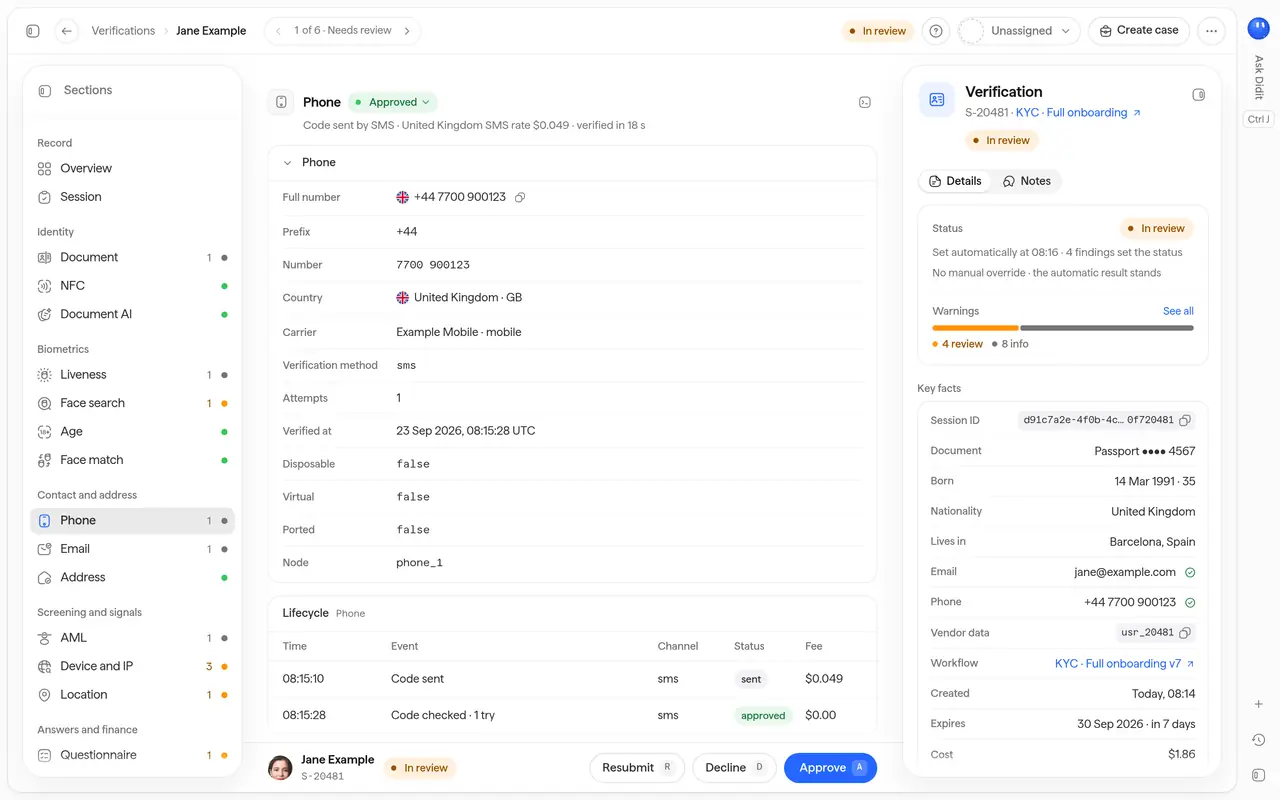
Read the list price per code for every country before you build the flow:
# List price per code for every country with SMS: carrier price + 0.02
curl -s https://verification.didit.me/v3/organization/phone-verification-pricing/ \
  | jq -r 'to_entries[] | select(.value.channels.sms.available) | "\(.key) \(.value.name) \((.value.channels.sms.price_usd | tonumber) + 0.02)"'
Then send the code:
curl -X POST 'https://verification.didit.me/v3/phone/send/' \
  -H "x-api-key: $DIDIT_API_KEY" \
  -H "Content-Type: application/json" \
  -d '{
    "phone_number": "+14155552671",
    "options": {"code_size": 6, "preferred_channel": "sms", "locale": "en-US"},
    "vendor_data": "user-1234"
  }'
Check the code with the same number and the verification_id from the send. The response carries carrier, line type, disposable and voip flags, and porting data. A wrong code returns Failed with attempts remaining, exhausting the limit returns Declined, and a code outside the 5-minute window returns Expired or Not Found, so you start again.
Balance and auto top-up are one call away:
curl -X GET 'https://verification.didit.me/v3/billing/balance/' \
  -H 'x-api-key: YOUR_API_KEY'
# {"balance": "1234.5600", "auto_refill_enabled": true, "auto_refill_amount": "500.00", ...}
Product reference: Phone Verification, the Phone Verification API, pricing in the docs, Billing in the console, and Didit pricing for the full price book.

Common mistakes
- Treating $0.02 as the price of a verification. It is our fee. In the published table the carrier part is the larger of the two numbers in every row, including the cheapest, Türkiye on WhatsApp at $0.0408, where $0.0208 is carrier and $0.02 is our fee.
- Expecting the plan discount to shrink the carrier price. Growth and Scale discount our prices; carrier and Meta charges pass through at cost.
- Budgeting segments on an OTP. A verification code is billed per code. The per-segment rule belongs to the Messages product.
- Forgetting the voice fallback. A fixed line that takes no SMS may have the code read out in a call, and that send is priced as a voice code.
- Assuming one code per user. The window is 5 minutes and a standalone verification allows 5 wrong entries, so retries and restarts belong in the model. The broader pricing feed says some retries can be billable, and the phone page does not break them out, so confirm phone retry billing against the current route-specific pricing before you commit to a number.
- Planning against the printed list alone. Billing uses the higher of the listed price and the price the route reports.
- Assuming free credit covers phone. It does not: phone codes sit outside the Free plan's monthly credit.
- Shipping the API key in a browser or app bundle. It is a server-side secret on the
x-api-keyheader.
Sources
- Didit docs: Phone Verification API, SMS OTP and risk signals
- Didit docs: Phone Verification overview (OTP, SMS and WhatsApp)
- Didit docs: Identity Verification Pricing
- Didit docs: Billing and plan in the console
- Didit docs: Get credit balance API
- Didit docs: List phone verifications
- Didit pricing page, read November 26, 2026
- Didit phone price list, read November 26, 2026
- Didit pricing as JSON, read November 26, 2026
Next step: open the sandbox at https://business.didit.me/ with no sales call, send one code to your own number, and check your country's price on the phone price list before you size the flow.
Try it
Try this in the sandbox
Run the check this guide describes, free.
The product this post is about, taken from its topic. Run it free in the sandbox.
Author
Alberto Rosas
Co-founder and CEO

Keep reading
Other guides in the same topic.
 Which Blockchains Does Didit Wallet Screening Support? (2026)
Didit wallet screening accepts 23 network values. Managed screening runs 17 of them as networks. USDT and USDC are accepted values but only legacy aliases for Ethereum, not additional networks.
Alberto RosasNov 26, 2026 iGaming Fraud Rules: Bonus Abuse, Chip Dumping, Opposite Betting
Didit ships an iGaming fraud bundle of preset rules for event-native bonus abuse, opposite betting, affiliate fraud, chat rain farming, chip dumping and account takeover.
Alberto RosasNov 26, 2026 Test KYT Rules Before Deploy: Test Mode vs Active Mode
Didit rules run as Active, Test or Disabled. Test mode evaluates a rule and records rule-run results without changing the transaction, so you can back-test a structuring rule before you set it Active.
Alberto RosasNov 26, 2026Questions
Frequently asked questions
How much does one phone verification cost on Didit?
The carrier price for the destination and channel plus a $0.02 Didit fee at list price. On November 26, 2026 a US SMS code totaled $0.0473 and a German SMS code $0.1145. Growth charges a fee of $0.0192 and Scale $0.018, with the carrier part unchanged.
Is the $0.02 fee the whole price?
No. It is only our part. The carrier price for the country and channel is added on top and passes through at cost, so published totals per code run from $0.0408 to $0.3061 in the table we checked. Always add the two numbers before you model volume.
Do plan discounts apply to the carrier fee?
No. Growth takes 4% off Didit prices and Scale 10%, and the phone fee follows: $0.0192 and $0.018. Carrier and Meta charges pass through at cost and are never discounted.
Why does SMS verification cost so much more in some countries?
Because the carrier price is set by the destination network and the channel, and the published totals differ by more than six times between the cheapest and the most expensive rows. On November 26, 2026 a Nigerian SMS code totaled $0.2597 against $0.0473 in the United States, and Indonesia was $0.3061. Changing channel often lowers it: WhatsApp to Nigeria was $0.0461.
Is a verification code billed per SMS segment?
No. Verification codes are billed per code, one charge per send. The per-segment rule applies to the Messages product, where an SMS segment is 160 characters, or 70 with characters outside the basic alphabet such as emoji, and each segment costs the carrier price plus $0.02.
Does the Free plan credit pay for phone codes?
No. Phone codes sit outside the Free plan's monthly credit. Sending verification codes needs a paid Growth or Scale plan or your organization's first top-up, and the cost comes from that credit or top-up balance.
What happens if the code never arrives?
You can retry the code in the same window, and a retry preserves the five-minute deadline. If the destination is a fixed line that takes no SMS, an eligible new send may be read out in a call and is then priced as a voice code. The broader pricing feed says some retries can be billable, and the phone page does not break retries out, so confirm phone retry billing against the current route-specific pricing before modeling volume. A send blocked by anti-abuse sends no code and is not charged.
Can I price a phone number without sending a code?
Yes. A call to POST /v3/phone/risk/ scores carrier, line type, porting and fraud risk without an OTP, so you can judge a number before you pay for a message. It sits on its own line of the price book, and the current figure is on the Didit pricing page.
How do I get the carrier price for a country before I commit?
Call the phone pricing endpoint and read price_usd for the channel you plan to use, then add $0.02 for the list price per code. The same totals are published per country on the Didit phone price list.
Do I need a contract or a sales call?
No contract on Free, Growth and Scale. They are self-serve, billed per code from prepaid credit, and the sandbox is free on every plan. Enterprise is the only annual contract and starts at $15,000 a year.
Compliance built in
Audited, certified and attested.
We hold the certifications and build each country's rules into your flows, so you can launch anywhere without worrying. Security and Compliance center
- Regulation encoded into your flows
Tell us what you do and where. Didit lists the rules that apply to you, with sources, and builds the checks each country needs into one workflow.
- Ready for AMLR
Every requirement of the new EU anti-money laundering rules, from checking customers to human review, is already covered by a Didit check.
- Tested in Spain's Treasury sandbox
Spain's Treasury published its supervised sandbox report on Didit's NFC plus active liveness onboarding; SEPBLAC took part and valued the added measures positively.
- Audited, not self-declared
iBeta Level 1 and Level 2. Liveness tested under ISO/IEC 30107-3.
Your obligations · 3 regions
 SOC 2 Type 2
 ISO 27001
 iBeta Level 1 and Level 2
 EU regulator attestation
 FSM youth protection
 GDPR
 EBA remote onboarding
 MiCA compatible
 FIDO Alliance member
- AMLREU AML Regulation ready
Integration · Didit MCP
Run Didit from your own AI agent
Connect Didit to Claude, Cursor, VS Code or ChatGPT and just ask in plain words. Your agent can do anything you can do in the console, with the same permissions you have.
 Add to Claude
 ChatGPT
 Cursor
- Build workflowsDescribe the checks you need. The agent creates and publishes the flow.
- Run investigationsAsk why a session was declined, review cases, search people and companies.
- Change rulesCreate payment rules, test them on past data and switch them on.
- Pull reportsAsk for numbers, exports or the audit log.
Didit Academy


