DAO Fraud Detection: Identity, Governance, and Risk Mitigation in Web3
DAO fraud detection works when identity checks are tiered by role, governance wallets are screened before they touch the treasury, wallet control is proven separately from wallet screening, and treasury transfers run through.
 Alberto RosasCo-founder and CEO
Contents
In this guide
Jump to the part you need.
This guide is for DAO operators, governance leads and Web3 compliance teams who need to stop Sybil voting, malicious proposals and treasury drains. The method combines tiered identity checks with wallet screening and treasury monitoring, priced per completed result: KYC $0.33, AML screening $0.20, wallet screening $0.15, monitoring $0.001 per transaction beyond the plan allowance. The caveat: identity checks prove who a member is, not that a proposal is safe. Time-locks, multisigs and audits still carry weight.
Last updated: November 26, 2026. Prices checked against the live Didit price feed on November 26, 2026.
| Layer | What it stops | Didit step | List price |
|---|---|---|---|
| Human identity | One person holding many voting wallets | User Verification session, plus Face Search 1:N | $0.33 per full KYC, $0.05 per face search |
| Person risk | Sanctioned or PEP-backed members voting on treasury spend | AML Screening | $0.20 per check |
| Wallet risk | Governance or treasury wallets tied to illicit funds | Wallet Screening (KYT) | $0.15 per screening |
| Wallet control | Proposals signed by a wallet the member does not actually control | Wallet ownership widget inside Travel Rule, message signing | Travel Rule messaging is $0.02 per outbound exchange; the price feed lists no separate widget line |
| Treasury flow | Velocity abuse, structuring, high-risk counterparties | Transaction Monitoring with rules | $0.001 per transaction beyond the monthly allowance |
| Business counterparties | Shell companies receiving grants | Business Verification (KYB) | From $2.00 per company |
Start free in the sandbox at business.didit.me (no sales call), and read every line price on the Didit pricing page. If your team builds with an AI assistant, connect the Didit MCP server and run the same checks from a prompt.
What a DAO fraud detection programme has to cover
DAOs lose money in four ways, and each one needs a different control.
- Sybil voting. One actor buys or generates many wallets, spreads governance tokens across them, and votes as if it were a crowd.
- Malicious proposals. A proposal that looks routine passes and moves treasury funds to an address the proposer controls, or grants an allowance that can be drawn later.
- Treasury drains and exit attempts. Founders or council members use legitimate access to move community funds.
- Contract exploits. A bug in the treasury or governance contract is used to mint, transfer or bypass a vote.
Pseudo-anonymity makes the first two cheap. On-chain records show what a wallet did, not who is behind it, so a member can be ten wallets at once. The absence of a central authority makes recovery slow: reversing a passed proposal usually needs another proposal, and that proposal is exposed to the same manipulation. Identity checks close part of that gap, governance design closes the rest.
Prerequisites
- A Didit organisation and an application. The sandbox is free and unlimited on every plan.
- An API key, sent in the
x-api-keyheader. - Transaction Monitoring configured with a screening provider in Transactions, Settings, Provider Preferences in the Business Console. Without it, the on-demand wallet screening endpoint answers 409 Conflict. You can use our managed screening, or bring your own screening provider and run it inside Didit.
- A written policy stating which DAO roles need which check, and who reviews an alert. The reviewer must not be the person who proposed the spend.
- The list of chains your treasury actually uses. Managed screening covers Base, Optimism and Arbitrum One for both wallet and transaction-hash screening, and accepts BTC, ETH, LTC, XRP, BCH, DOGE, TRX, SOL, MATIC, BNB, AVAX, ADA, XLM and HBAR; a provider you connect may cover different chains.
Step-by-step: how to set up DAO fraud detection
Step 1: Rank roles by what they can do to the treasury
Do not verify everyone at the same level. Sort roles by blast radius. Voting on general forum posts is low risk. Proposing a treasury transfer, signing on a multisig, holding an admin key and receiving a grant are high risk. Write the tiers down, because the tier decides the check and the check decides the price. A workable default is three tiers: open participation with an email or wallet check, delegate and council voting with a full identity check, and proposer, signer or grantee with a full identity check plus AML and wallet screening.
Step 2: Verify the human, not the wallet
A full Didit identity session checks the ID document, passive liveness and face match, plus device and IP analysis, at $0.33 per completed check. Run it once per member, when they claim a tier, not on every vote. Then run Face Search 1:N at $0.05 per search. It compares a submitted face against your own approved identity verification sessions and returns the duplicates, so the same face arriving under a second name and a second wallet shows up as a hit. That answers the question a wallet list cannot: how many real people are behind the addresses. Face Search compares the submitted face against approved identity sessions in your own account.
Step 3: Screen each verified person for sanctions, PEPs and adverse media
AML Screening costs $0.20 per check and covers 1,300+ sanctions, PEP and watchlist sources. You can add it as a step inside the verification workflow, or call it standalone when you already hold the member data. The standalone call is one request:
curl -X POST 'https://verification.didit.me/v3/aml/' \
  -H "x-api-key: YOUR_API_KEY" \
  -H "Content-Type: application/json" \
  -d '{
    "full_name": "Javier Ejemplo Modelo",
    "entity_type": "person",
    "date_of_birth": "1974-01-01",
    "nationality": "ES",
    "include_adverse_media": true,
    "vendor_data": "user-1234"
  }'
Two scoring rules decide the outcome. The match score says whether the hit is the same person; the risk score says how risky that entity is if it is. Keep the three weights (aml_name_weight, aml_dob_weight, aml_country_weight) summing to exactly 100, or the request is rejected with HTTP 400. Set include_adverse_media to true and plan for a client timeout of at least 45 seconds, because that call can take about 25 seconds.

Step 4: Screen the wallet before it touches governance or the treasury
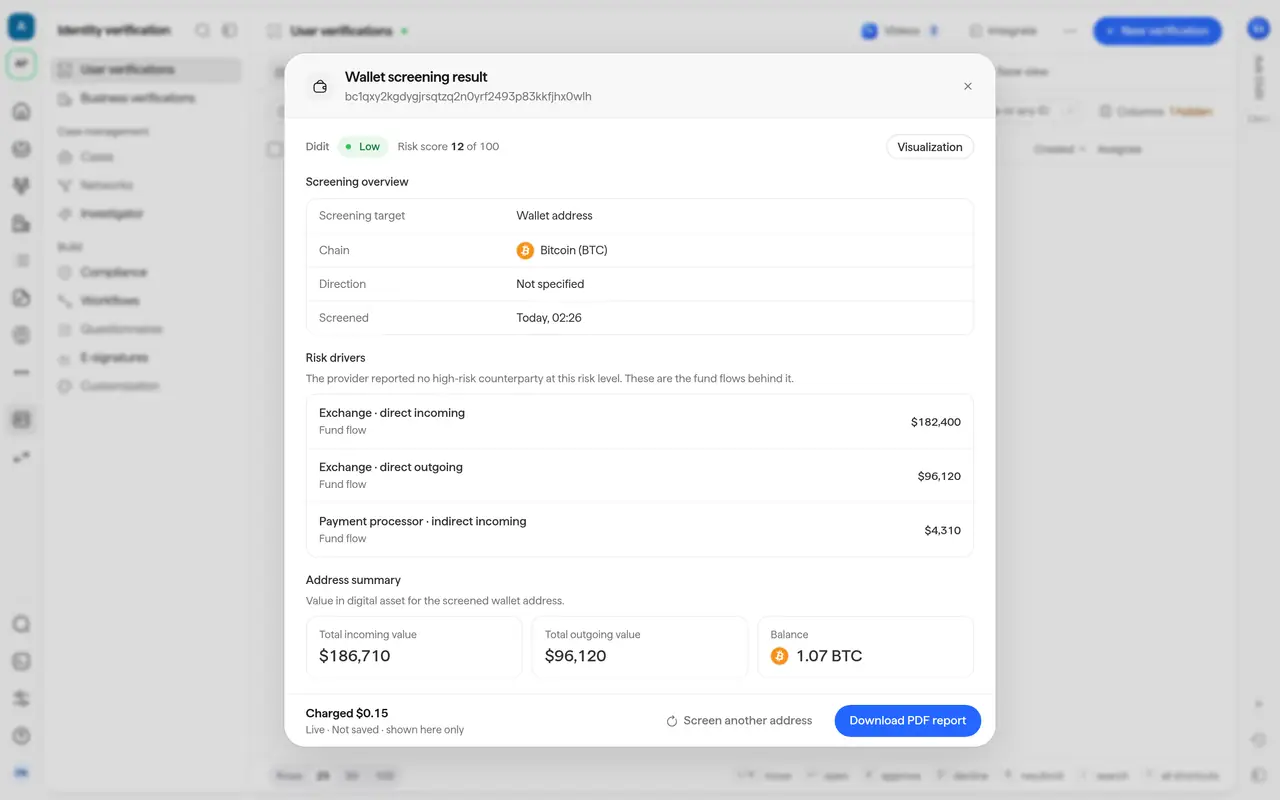
Wallet Screening (KYT) costs $0.15 per screening and returns the AML risk of an address with no transaction required. Use the on-demand endpoint when a member adds a voting or payout address, when a multisig signer changes, or when a grant recipient supplies a new address. The Wallet Screening product page lists what the result covers. One call:
curl -X POST https://verification.didit.me/v3/wallet-screening/ \
  -H "x-api-key: YOUR_API_KEY" \
  -H "Content-Type: application/json" \
  -d '{
    "wallet_address": "0x94f1b9b64e2932f6a2db338f616844400cd58e8a",
    "blockchain": "ETH"
  }'
Always send blockchain for an EVM address. A 0x address is valid on every EVM chain, so without the network the API answers 422 with candidate_chains, screens nothing and bills nothing. Never substitute ETH for the real network: the same address can carry different activity and risk on Base, Optimism or Arbitrum One.
Step 5: Prove the wallet belongs to the member
A screening result and a proof of control answer two different questions, and the gap between them is where DAOs get hurt. Screening checks the address for AML risk, sanctions exposure and source-of-funds risk. It does not tell you the member holds the key. The wallet-ownership widget, part of our Travel Rule module, proves control by message signing: the member signs a Didit challenge with the wallet, and Didit verifies the signature against the address. It supports EVM, Solana, Bitcoin and Tron wallets, including EVM smart-contract accounts. A verified proof marks the matching address book entry as ownership verified, which lets a linked Travel Rule transfer advance out of unconfirmed ownership. Require it for wallets that propose or sign, so the signer's control of the address is verified at that point in time. On pricing: Travel Rule messaging is $0.02 per outbound exchange, billed once per exchange regardless of later status changes, and the price feed lists no separate wallet-widget line. Didit mints a widget session automatically when a transfer needs proof of wallet control and auto_wallet_verification is on.
Step 6: Push treasury movements through transaction monitoring
Wallet screening checks an address. Transaction monitoring checks behaviour. Submit treasury inflows and outflows through POST /v3/transactions/ so rules run on every one of them. Set the asset and the network as separate fields:
{
  "transaction_details": {
    "currency": "TOKEN",
    "currency_kind": "crypto",
    "crypto_params": {"crypto_chain": "BASE"}
  }
}
The plan includes 1,000 monitored transactions a month on Free, 10,000 on Growth and 100,000 on Scale; beyond the allowance each transaction costs $0.001. For a DAO, monitoring inbound deposits to the treasury and outbound grants and payroll is usually enough, and it costs cents.
Step 7: Install rules in Test mode, then make them Active
Didit ships preset rule bundles for the typologies DAOs hit: high velocity inbound and outbound, dormant account reactivation, cumulative volume limits, high-risk jurisdiction exposure, mixer exposure, high-risk source-of-funds exposure above a share, and multi-accounting through a shared device fingerprint. Install the bundles you want, run each rule in Test mode for a few weeks so you can see what it would have flagged, then switch it to Active. A rule has a scope, conditions, an optional velocity window and actions: add score, change status, add tags, add a note, add to a list, open a case. Custom rules let you set your own threshold, for example a single outbound transfer above a fixed amount, or a velocity window on cumulative outbound volume over 24 hours.

Step 8: Review alerts, decide, and keep the record
Every matched rule writes into the transaction's rule_runs[], and the cumulative score decides whether the transaction crosses the review or decline threshold. Route review to a named person who is not the proposer. Record the decision and the evidence in the case, and keep the audit log long enough for your policy: 30 days on Free, one year on Growth, three years with export on Scale. This record matters when a vote is challenged later, and it is the part most DAOs skip.
Expected output
A successful wallet screening call returns HTTP 200 with a standardised screening result: screening_type set to WALLET_SCREENING, a risk_score and a severity band, plus the source-of-funds and counterparty exposure behind the score. The same shape comes back when screening runs automatically inside a recorded crypto transaction, so one parser covers both paths. Remember what that result is not: it is a risk read on an address, not evidence that the member controls it. Ownership comes from the widget in Step 5.
The AML call returns request_id and an aml object with a status, a screening id, a list of hits and a list of warnings. The documented statuses are Not Started, In Progress, Approved, In Review, Declined, Abandoned, Kyc Expired, and those are the states we see in practice. A result is Declined when at least one hit reaches the review threshold and crosses the configured decline boundary. A risk score between the approve and review thresholds returns In Review and belongs in a manual queue.
Failure cases and recovery
| Response | What it means | Recovery |
|---|---|---|
| 409 Conflict | No screening provider is configured for the application | Set one in Transactions, Settings, Provider Preferences, then resend |
422 with candidate_chains | A 0x address sent without a network | Resend with blockchain set to the real chain; nothing was screened or billed |
| 400 | Address format not recognised, or the chain is not covered by your provider | Check the address against the network and use a chain your provider supports |
| 403 | Out of credit | Top up, or turn on auto top-up so live checks do not stop when the balance runs low |
fallback_from_provider is set | A provider you connected rejected or failed the screening, and the fallback setting is on | Read fallback_reason, fix the provider account, then re-screen if you need that provider's result |
| AML returns without adverse-media hits | The adverse-media source was slow | Use the sanctions and PEP result, which is still actionable, and re-run adverse media later |
Inputs and outputs for the wallet screening call
| Field | Direction | What it does |
|---|---|---|
wallet_address (alias address) | Input, required | The address to screen. It must match the network you send. |
blockchain (alias currency) | Input, optional | Network identifier such as ETH, BTC, SOL, BASE, OP, ARB. Without it Didit reads the network from the address format; a 0x address needs it. |
direction | Input, optional | inbound, outbound, deposit or withdrawal, as context. It does not change the score or the severity. |
screening_type | Output | Always WALLET_SCREENING. |
risk_score | Output | Integer risk score for the address. |
severity | Output | Risk band for the result. |
fallback_from_provider, fallback_reason | Output | Set only when a connected provider failed and the screening ran on our managed screening instead. |
Which steps cost money and where a human must review
Several steps bill, and we charge only when a check finishes with a result: the identity session at $0.33, AML screening at $0.20, wallet screening at $0.15 and monitored transactions at $0.001 beyond the monthly allowance. Face Search 1:N costs $0.05 per search. KYB starts at $2.00 per company, with $0.20 per company AML check, $0.20 per person AML check for each owner or officer, and a linked identity check at $0.33 per person. Travel Rule messaging is $0.02 per outbound exchange. Workflow orchestration, reusable KYC and the MCP server carry no separate fee. A failed or unscreened request, such as the 422 on a 0x address without a network, is not billed.
Three decisions stay human. First, any AML result in In Review status. Second, any transaction whose cumulative rule score lands between the review and decline thresholds. Third, any screenshot wallet proof, which never auto-verifies and sits in a review queue until someone approves or rejects it. Put those three behind one named owner and a written turnaround time, and record the decision in the case.
Worked cost example
A DAO with 25 council members and proposers, 40 governance and payout wallets, and 2,000 monitored treasury transactions a month, on list prices:
- 25 full identity checks at $0.33 = $8.25
- 25 AML screenings at $0.20 = $5.00
- 40 wallet screenings at $0.15 = $6.00
- 2,000 monitored transactions, minus the 1,000 included on the Free plan, leaves 1,000 at $0.001 = $1.00
- Total for the month: $8.25 + $5.00 + $6.00 + $1.00 = $20.25
On Growth the same lines carry a 4% discount: 25 x $0.3168 = $7.92, 25 x $0.192 = $4.80 and 40 x $0.144 = $5.76. All 2,000 monitored transactions fit within the 10,000 included on Growth, so the total is $7.92 + $4.80 + $5.76 = $18.48 before the monthly fee and credit. The identity part is a one-off per member; the wallet and monitoring lines are the recurring cost. Those are the only unit prices we quote here. For the live figures, the yearly fees, the credit and the volume discounts, check the pricing page and the pricing documentation, which we keep in step with the price feed.
Anonymous Web3 identity: pseudonymous to the community, accountable to the DAO
Members often ask for anonymous Web3 identity, meaning they want to vote without publishing a legal name on-chain or in a forum. That is compatible with fraud control, as long as you separate two things: what the community sees, and what the DAO records. The community keeps seeing a wallet and a pseudonym. The DAO keeps a verification result bound to that wallet in its own system, produced by a full identity check at $0.33 and, for high-risk roles, an AML screening at $0.20. Nothing about the person is written on-chain. The wallet-ownership widget adds the missing link: a signature from the member's own wallet proves the address belongs to the verified person, without revealing who that person is to anyone else.
This is also the honest answer to the trade-off. Pure anonymity and Sybil resistance pull against each other, because a wallet costs nothing to create. A verified but unpublished identity is the practical middle: one person, one voting weight, no public doxxing. Say so in your governance docs before you enforce it, and keep the retention window in line with your plan's data retention setting.
Sources
- Didit pricing page and pricing documentation, read November 26, 2026
- Didit docs: on-demand wallet screening API, read November 26, 2026
- Didit docs: crypto wallet and address screening (KYT), read November 26, 2026
- Didit docs: AML screening overview, read November 26, 2026
- Didit docs: KYT rules and scoring, read November 26, 2026
- Didit docs: wallet ownership widget, read November 26, 2026
- Didit docs: Travel Rule, read November 26, 2026
- Didit docs: Face Search 1:N, read November 26, 2026
- Didit Wallet Screening product page and Transaction Monitoring product page, read November 26, 2026
- Didit MCP setup for every client, read November 26, 2026
- FATF for travel rule and virtual asset guidance, read November 26, 2026
Next step: open the sandbox at business.didit.me, run one identity check and one wallet screening against test data, then wire the same calls into your governance flow. No sales call.
Try it
Try this in the sandbox
Run the check this guide describes, free.
The product this post is about, taken from its topic. Run it free in the sandbox.
Author
Alberto Rosas
Co-founder and CEO

Keep reading
Other guides in the same topic.
 What Is the Purpose of FICA in South Africa? 2026 Guide
FICA is South Africa's anti-money laundering law. It creates the Financial Intelligence Centre and requires accountable institutions to identify and verify clients, screen for PEP and sanctions risk and report suspicious.
Alberto RosasNov 26, 2026 Sixth Money Laundering Directive (6AMLD): What Changed and Which Rules Apply
6AMLD is Directive (EU) 2018/1673: Member States must criminalise laundering, widen predicate offences and set a four-year penalty floor. It adds no new due diligence duties for firms.
Alberto RosasNov 26, 2026 Automated Sanctions Screening: Canada, the Entity List and Embargoes
Automated sanctions screening matches people and companies against lists such as Canada's autonomous sanctions made under SEMA and JVCFOA and the OFAC SDN List, and returns candidate hits scored for identity confidence and.
Alberto RosasNov 26, 2026Questions
Frequently asked questions
How do you detect a Sybil attack in a DAO?
You detect it by verifying each member once, proving they control the wallet they vote with, and watching behaviour. Run one full identity check per member when they claim a voting tier, then use Face Search 1:N to find the same face under a second name, and let transaction rules flag multi-accounting through a shared device fingerprint and high-velocity wallet creation. Each signal answers a different question: the identity check and Face Search help detect duplicate people, wallet screening flags exposure to illicit funds, and device fingerprint rules catch many wallets run from one device. Read them together, because no single one holds on its own.
Can a DAO stop fraud without doxxing its members?
Yes, if you separate what the community sees from what the DAO records. The member stays pseudonymous in forums and on-chain, while the DAO holds a verification result bound to their wallet in its own systems. Wallet ownership proof by message signing then confirms the member controls the address without revealing their legal identity.
What does a wallet screening check return?
Didit returns a standardised screening result for the address: a risk score, a severity band, and the source-of-funds and counterparty exposure behind them, plus any sanctions hit. The same result shape comes back whether you screen an address on demand or let screening run inside a recorded crypto transaction. The check costs $0.15 per screening.
Is a wallet screening result the same as proof that the member owns the wallet?
No, and they are worth keeping separate. A screening result is an AML risk read on an address, which you get for $0.15 per screening. A wallet-control proof is a signature from the member's own key, checked by Didit, that the address belongs to them. Use screening before you accept an address and the ownership widget before you give that address voting or signing weight.
How much does DAO fraud detection cost?
List prices are $0.33 per full identity check, $0.20 per AML screening, $0.15 per wallet screening, $0.05 per face search and $0.001 per monitored transaction beyond the monthly allowance. A DAO verifying 25 high-risk members, screening 40 wallets and monitoring 2,000 treasury transactions pays about $20 a month on those lines. Plans start at Free with $10 of monthly credit, Growth at $99 and Scale at $299.
Do we need full KYC for every DAO member?
No. Tier the checks by what a role can do. Email or wallet checks are enough for open discussion, a full identity check fits delegates and council voters, and proposers, multisig signers and grant recipients should also pass AML and wallet screening. Tiering keeps the cost proportional to the risk and is easier to defend to members.
Should we screen wallets before or after a treasury transfer?
Before, whenever you can. The on-demand wallet screening endpoint screens an address with no transaction required, so you can vet a payout or voting address before it is whitelisted or funded. Screening after the transfer is still useful for the record and for rules, but the funds have already left by then.
What happens when a wallet screening cannot be completed?
The API tells you why instead of returning a silent pass. A missing provider answers 409, a 0x address without a network answers 422 with candidate chains, an uncovered chain answers 400, and none of those are screened or billed. When a provider you connected fails and the fallback setting is on, the result names the failed provider and the reason in fallback_reason.
Can we use our own wallet screening provider?
Yes. You can bring your own screening provider and run it inside Didit, and our managed screening covers the networks the docs list if you prefer not to connect one. Managed screening accepts BTC, ETH, LTC, XRP, BCH, DOGE, TRX, SOL, MATIC, BNB, BASE, OP, ARB, AVAX, ADA, XLM and HBAR, with Base, Optimism and Arbitrum One covered for both wallet and transaction-hash screening. Celo, Mode and Plume are not covered by managed screening, so a provider you connect may be needed for them. Set the choice in the Business Console under Transactions, Settings, Provider Preferences.
Are smart contract audits enough to stop DAO fraud?
No. An audit finds bugs in code; it does not stop a legitimate-looking proposal written by a real member with a real wallet. Audits, time-locks and multisigs cover the contract and execution side, while identity checks, wallet screening and transaction rules cover the people and the money side. You need both.
Can identity checks be run from an AI assistant?
Yes. The Didit MCP server at https://mcp.didit.me/mcp exposes the same checks and rule management to an AI assistant, and it carries no separate fee. Teams typically create rules and tune thresholds from the assistant, and keep the console for the human review of alerts.
Compliance built in
Audited, certified and attested.
We hold the certifications and build each country's rules into your flows, so you can launch anywhere without worrying. Security and Compliance center
- Regulation encoded into your flows
Tell us what you do and where. Didit lists the rules that apply to you, with sources, and builds the checks each country needs into one workflow.
- Ready for AMLR
Every requirement of the new EU anti-money laundering rules, from checking customers to human review, is already covered by a Didit check.
- Tested in Spain's Treasury sandbox
Spain's Treasury published its supervised sandbox report on Didit's NFC plus active liveness onboarding; SEPBLAC took part and valued the added measures positively.
- Audited, not self-declared
iBeta Level 1 and Level 2. Liveness tested under ISO/IEC 30107-3.
Your obligations · 3 regions
 SOC 2 Type 2
 ISO 27001
 iBeta Level 1 and Level 2
 EU regulator attestation
 FSM youth protection
 GDPR
 EBA remote onboarding
 MiCA compatible
 FIDO Alliance member
- AMLREU AML Regulation ready
Integration · Didit MCP
Run Didit from your own AI agent
Connect Didit to Claude, Cursor, VS Code or ChatGPT and just ask in plain words. Your agent can do anything you can do in the console, with the same permissions you have.
 Add to Claude
 ChatGPT
 Cursor
- Build workflowsDescribe the checks you need. The agent creates and publishes the flow.
- Run investigationsAsk why a session was declined, review cases, search people and companies.
- Change rulesCreate payment rules, test them on past data and switch them on.
- Pull reportsAsk for numbers, exports or the audit log.
Didit Academy


