
AI labs are buying human data. Fraud rings are selling it.
AI labs pay for human data, and fraud rings sell fake and rented contributor accounts into it. How the rings work, why it is hard, and how Didit verifies every contributor at signup, every session and every payout.
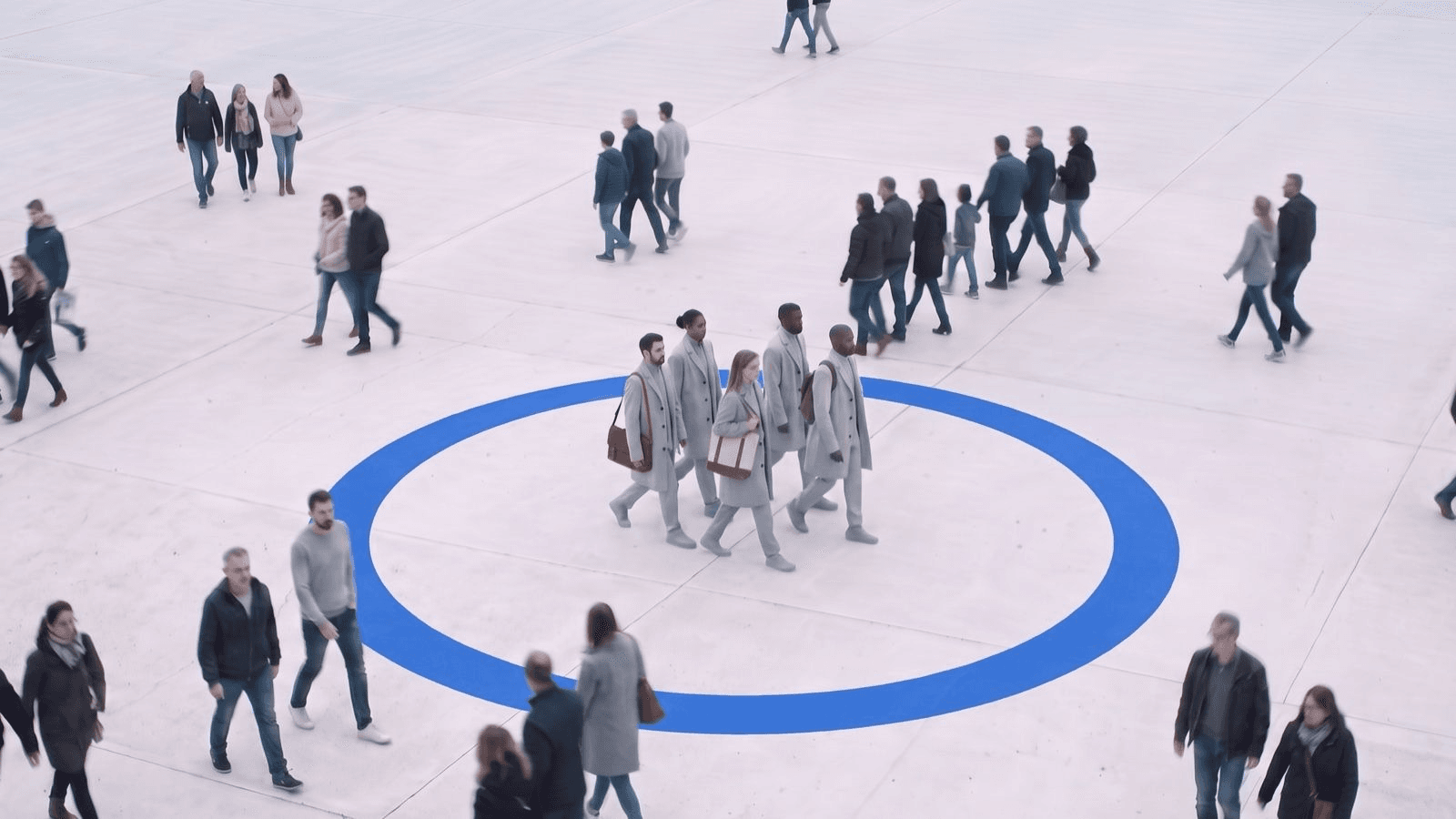
Frontier labs like OpenAI, Anthropic and Google DeepMind need data the public web can't give them: fresh human data, people recording how they cook, fold laundry or fix a sink so robots can learn it. Voices in hundreds of languages. Experts ranking model answers. The spend is real: Reuters reported that Google alone planned to pay one data supplier about $200 million in a single year for human-labeled training data [1].
That money flows to a new kind of company: data suppliers that pay thousands of people around the world to collect it. Data suppliers are one of the fastest-growing groups of companies building on Didit (YC W26) right now. And almost every one of them learns the same lesson shortly after launch: the moment you pay people for data, fraud rings show up to get paid too.
This is how those rings work, why it is a hard problem, and how we stop them, step by step, so a lab can trust where every hour of data came from.
How the rings work
It's rarely one guy with a fake ID. It's organized, it behaves like a business, and it adapts to whatever check you put in front of it.
The simplest version is one person running dozens of accounts: same face, different names, sometimes documents bought online, sometimes synthetic identities stitched together from a real document number and invented details. Each account records the same task and gets paid every time.
Then come the account markets. Rings recruit real people, often for a small fee, to pass verification once, then take the account over, use it or sell it. Journalists have found "verified" accounts for AI-training platforms for sale on Facebook, WhatsApp and Telegram, some rented out for an upfront fee or a share of future earnings [2], and one seller told AlgorithmWatch he gets ten false accounts a day ready to task [3].
Around that you get VPNs and emulators to look like you are in a country that pays more, recordings replayed or lightly edited and uploaded again, AI-generated voices and faces passed off as real, scripts that keep a verified account working long after the human left, and payouts landing with someone who never recorded anything.
Why the lab should care
Losing money on payouts hurts the data company. Bad data hurts the lab.
A lab buying ten thousand hours of real-world recordings is paying for thousands of different people: different homes, different hands, different accents. If a few hundred people sit behind thousands of accounts, the dataset is duplicated and skewed in ways nobody sees on a dashboard, and you usually find out after the model has trained on it. A 2022 study by Lee et al. found that models trained on duplicated data memorize more of it and need more training to reach the same quality [4], and when machine-generated data feeds back into training, the rare cases are the first to go [5].
So the real question for a lab is provenance. Not only "is this data good?", but "was it made by a real, unique person who is who they say they are?". That question can only be answered at the source, by the company collecting the data.
Why it is hard
Rings coordinate. They share devices and networks and reuse the same face across accounts with different documents. Look at one account and everything is clean. You only see the ring when you look across all of them, over time.
The incentive is cash. Tell me the incentives and I'll tell you how the system behaves: wherever a platform pays people it has never met, someone will try to get paid more than once. For a ring, every fake account has a clear return, AI has made fake faces, documents and voices very cheap to produce, and the attacks keep getting more experimental as the money grows.
Friction kills supply. Contributors are gig workers on their phones. A ten-minute flow loses the honest people and barely slows the professionals, so the flow has to be invisible for the first and very hard for the second.
And it is global by design. Contributors sign up from dozens of countries in the same week. Every country has different documents, different security features, different government registries (or none), different privacy rules and different fraud patterns. Most companies end up stitching one vendor per region together, and the gaps between those vendors are exactly where the rings live.
That last one is why we built Didit global from day one. My brother Alejandro and I knew from the start that a company verifying people only in a few countries would always leave a door open. So we do the hard part: we read IDs from every country we support, we connect to government registries country by country, we keep up with each new fraud technique, and we keep testing which flow converts best in each market. Our customers don't see any of that. They build one workflow, and the right method runs in each country.
Step 1: signup, one real and unique person
The first moment is when someone joins. On the contributor's phone it takes about a minute: open the link, take one selfie, get the result. Behind it, Didit is doing a lot more.
Device and IP analysis starts the moment the link opens. We read the network (VPN, Tor, hosting providers and data centers), where the IP really is, and a device signal that still recognises the phone after the history is cleared or the app is reinstalled, so one handset can't quietly open dozens of accounts. Country rules let you block the countries you don't serve, before anyone records a minute.
The selfie runs passive liveness, so a printed photo or a screen replay doesn't pass, with no gestures for honest users. Then face search compares that face against every account you already have and against your face blocklist. A new, unique person is approved. A face that matches another account goes to review, and a phone or device already seen on other accounts shows up in Networks as a signal for review, not an automatic ban. A blocklisted face or a blocked country is declined.
Step 2: every session, still the same person
Verifying once is not enough. An account verified on Monday can be sold on Tuesday, and a script can keep it running for weeks.
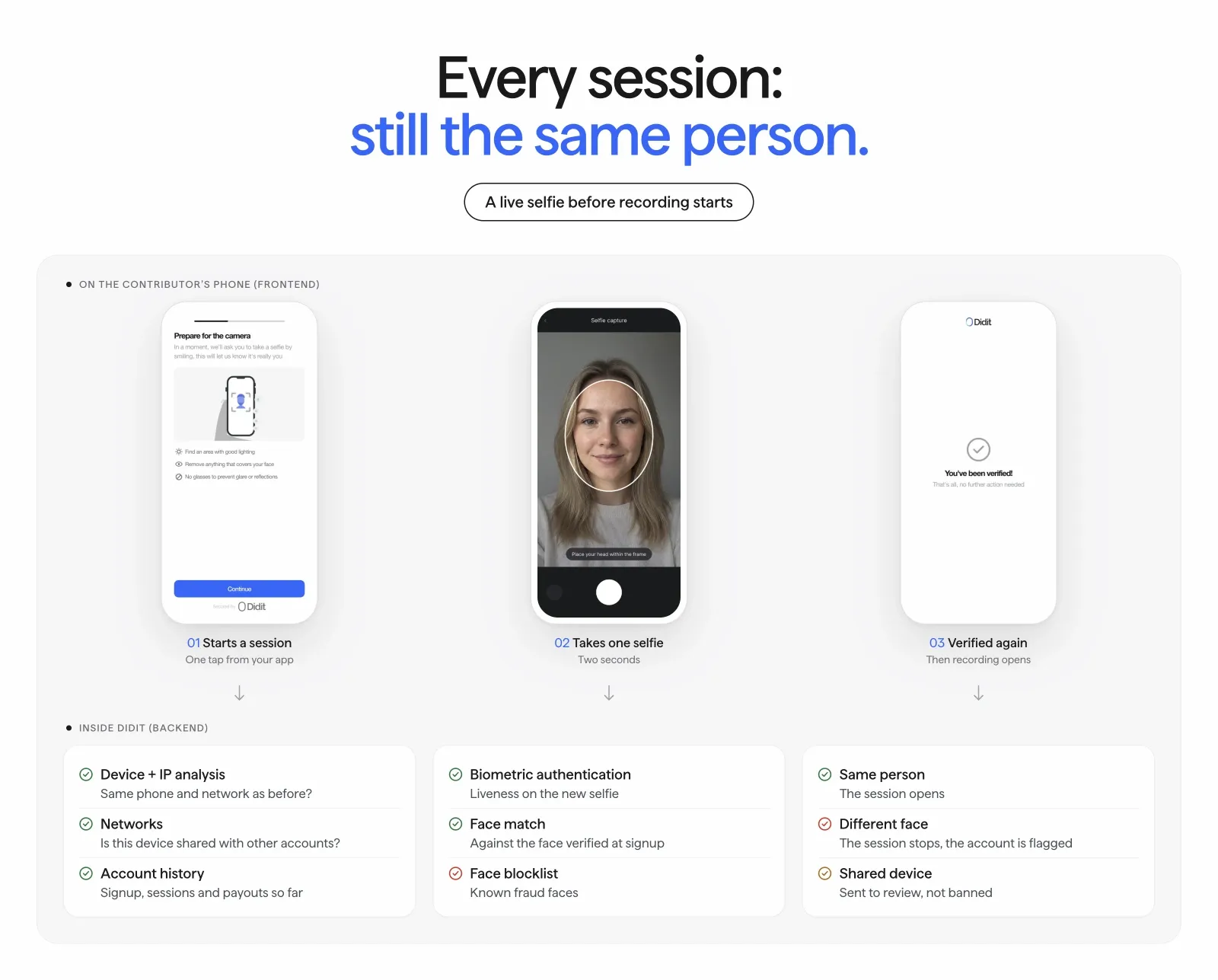
Biometric authentication asks for a quick selfie when a session starts. Didit runs liveness again, can match the face to the one verified at signup, checks it against the face blocklist, and compares the device and network with what we saw before. A bought account is worth very little when the buyer can't get past that selfie. A ring can still try to rent the real person for every session, which is why the selfie is read together with the device, the network and the history of the account, never on its own.
Step 3: every payout, the person you verified
Before money moves, you confirm who you are paying. This is where the identity gets checked at its strongest.
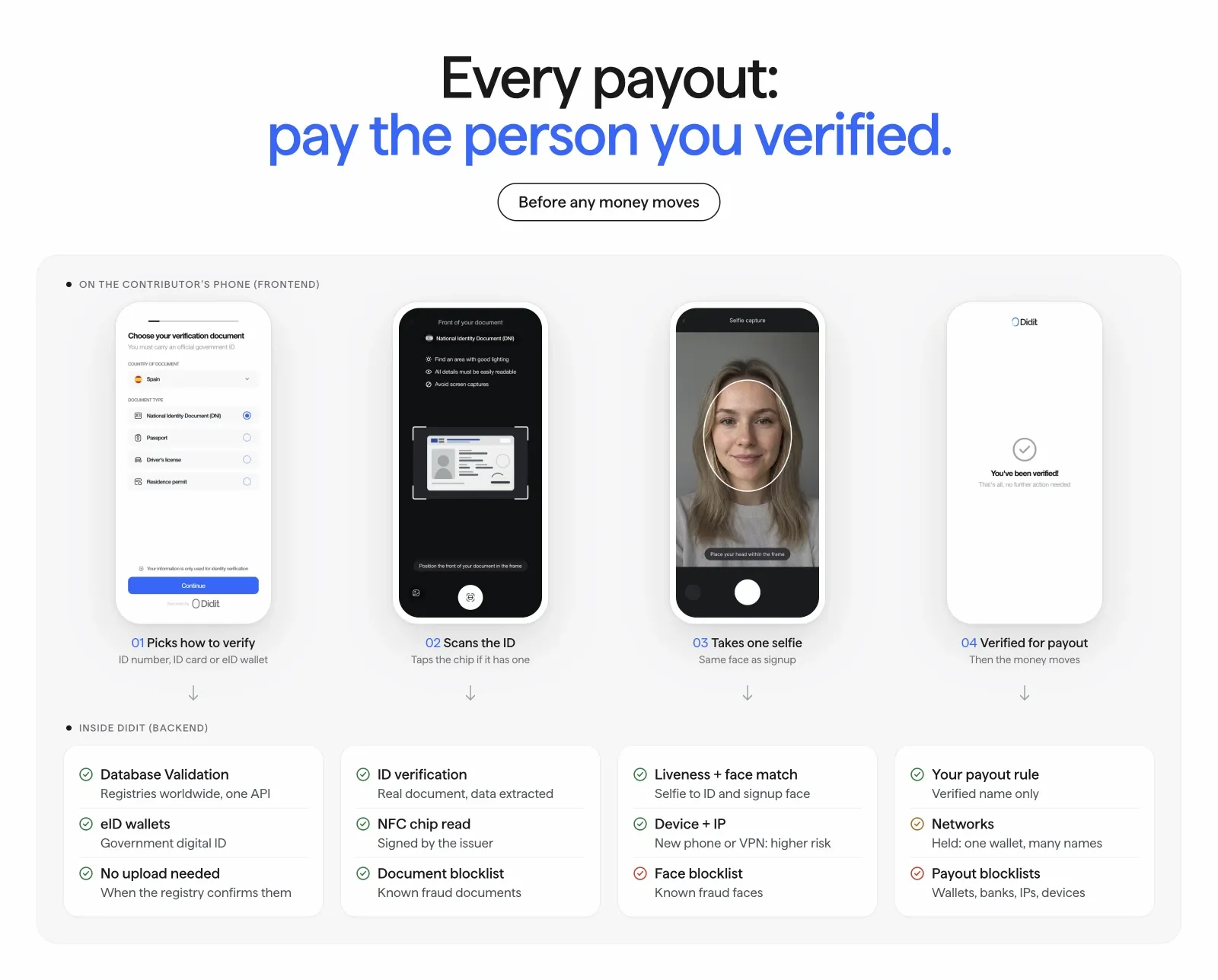
Where the country has an official registry, Database Validation checks the person directly against it. We have connected government sources around the world into one API, so a synthetic identity that a document photo alone would let through gets caught, and in many cases the contributor doesn't even need to upload a document. Where the country offers it, contributors can share a government eID wallet instead. Where there is no registry, the workflow captures the ID, reads the NFC chip on passports and eIDs that have one (the chip data is signed by the issuing government, so it isn't typed in by whoever holds the phone), and matches the face on the ID to the live selfie and to the face from signup.
Then the payout itself. Your rule is simple: money only goes to an account in the verified person's name. Didit's transaction monitoring checks the payout too, against blocklists of wallets, bank accounts, IPs and devices, because one bank account or wallet collecting for twenty verified names is a ring, whatever the names say.
Across every step: Networks and blocklists
Every check above runs inside one system, so the signals add up instead of sitting in five different tools.
Networks groups accounts that share a device fingerprint, an IP, a face, a selfie background, a document number, an address, a phone or an email into one network your team can act on [6]. Each network comes with a map of where its members are and an activity timeline of when each account signed up and what it did, so twenty signups from one IP range in one hour read as one pattern, not twenty flags. A ring surfaces as one investigation instead of dozens of unrelated alerts.
When you confirm a ring, its faces, documents, phones and emails go on your blocklists, and its wallets and bank accounts on your payout lists. They are checked at signup, at every session and at every payout. Block a face once and the next account that shows that face is declined, whatever name it uses. One more thing that matters here: sharing a phone is normal in many of the countries this data comes from, so a shared device is a signal for review, not an automatic ban. Block the ring, keep the honest contributor.
No system makes fraud impossible. What this does is make it expensive enough that rings stop being worth it and move somewhere softer, while honest contributors get through in about a minute.
Where our experience comes from
None of this was new to us. We spent years working with crypto, iGaming and fintech operators on deposit abuse, bonus abuse, multi-accounting, money mules and account takeovers. The gig economy is now going through the same thing: delivery and ride-hailing apps, freelance marketplaces, and AI data platforms, anywhere a platform pays people it has never met. The fraud looks the same (rented accounts, shared devices, payouts to the wrong person), and so does the flow that stops it.
Where this is going
To be clear about what this solves: data quality has many parts, and we cover the one where a human is involved. We verify that each contributor is not an automated farm, that they are a real human, that they are unique, and that they are who they say they are, and we surface the rings that try to fake all four. That removes one big part of the data quality problem at the source.
My bet is that within a couple of years the serious AI labs will ask every data supplier to prove that each hour of data came from a real, unique, verified person. Verified human data will be the premium tier, and data that can't prove where it came from will be worth a lot less. Identity answers who recorded something; checking that every upload is a new, real take is a second layer, and identity is where it has to start.
The companies collecting data today are building the supply chain for AI. Identity and fraud is the part of that supply chain nobody sees until it breaks.
If you are paying people for data, verify who you pay before you pay them. If you want to see how this is set up on Didit, send me a DM or start at business.didit.me.
Sources
- Reuters, "Google, Scale AI's largest customer, plans split after Meta deal", 13 Jun 2025. www.reuters.com
- Business Insider, "AI training is booming, and scammers are taking advantage", 1 Dec 2025. www.businessinsider.com
- AlgorithmWatch, "Scams and Shadow Workers: A Black Market is Selling European Accounts for AI Training", 22 May 2025. algorithmwatch.org
- Lee et al., "Deduplicating Training Data Makes Language Models Better", ACL 2022. arxiv.org
- Shumailov et al., "AI models collapse when trained on recursively generated data", Nature, 2024. www.nature.com
- Didit docs, Networks. docs.didit.me