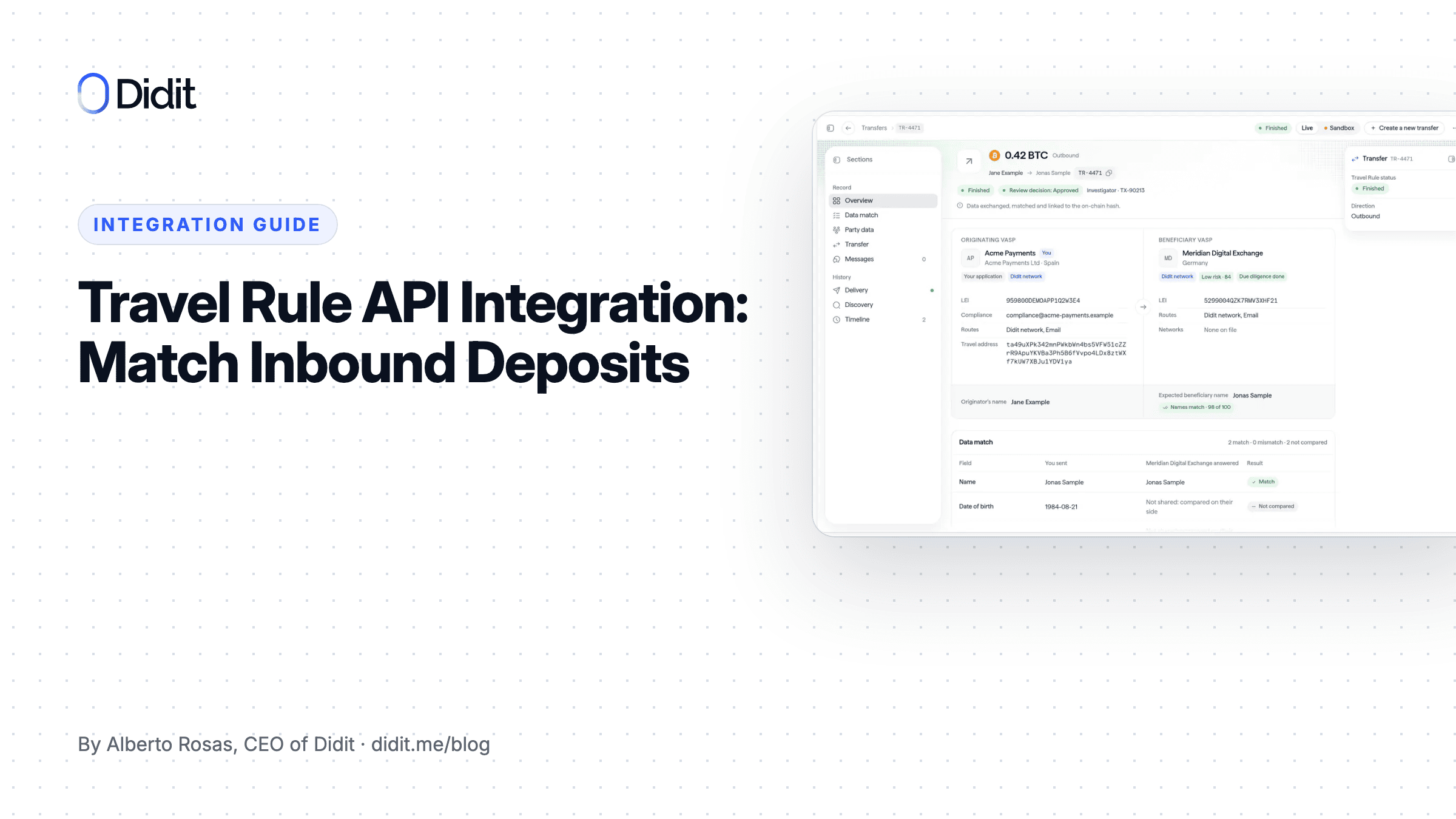
Travel Rule API Integration: Match Inbound Deposits
The unmatched deposits endpoint shares filters with the transfers list: direction, status, rail (INTERNAL, TRP, GTR, TRUST, VERIFYVASP, SYGNA, EMAIL, TEST_VASP), kind, currency, dates and counterparty UUID.
 Alberto RosasCo-founder and CEO
Contents
In this guide
Jump to the part you need.
This guide is for compliance engineers at a VASP or PSP that already sends Travel Rule data through Didit and now needs inbound deposit matching wired up. Travel Rule costs $0.02 per outbound exchange on the public price list. The caveat comes first: the network rails (GTR, TRUST, VerifyVASP, Sygna) route only through your own connected membership, because Didit holds no platform membership on any of them today.
Last updated: November 26, 2026. Prices checked against the live Didit price feed on November 26, 2026.
Add Didit to Claude · Open Didit in ChatGPT · MCP setup for every client
Inbound deposit matching at a glance
| Item | Detail |
|---|---|
| Endpoint | GET https://verification.didit.me/v3/travel-rule/unmatched/ |
| Authentication | x-api-key header. A scoped key needs the transactions privilege. |
| Which deposits it returns | Inbound transfers in AWAITING_COUNTERPARTY, NOT_ENOUGH_COUNTERPARTY_DATA or COUNTERPARTY_VASP_NOT_FOUND, with no received Travel Rule message paired and nobody matched by hand. |
| Filters | The same filters as GET /v3/travel-rule/transfers/, plus limit (default 50) and offset. |
| Pairing call | POST /v3/travel-rule/unmatched/{transaction_uuid}/match/, using the row's transaction_id. |
| Price | $0.02 per outbound exchange. Sandbox testing is free and unlimited. |
| Failure modes | 400 on an invalid filter value, 401 on a bad key, 403 when the key lacks the transactions privilege. |
Start free in the sandbox at https://business.didit.me/, no sales call. Developers who want an assistant to draft and check the calls can connect Didit to an AI assistant through https://didit.me/developers/mcp/. The product page is Travel Rule and every unit price sits on https://didit.me/pricing/.
How inbound matching works on a Didit Travel Rule setup
Didit runs the originator and beneficiary exchange as a managed process. When you create a transfer with transaction_category: "travelRule", Didit tries the rails in a strict priority order and uses the first one that can reach the counterparty: INTERNAL, then TRP, GTR, TRUST, VERIFYVASP, SYGNA, and EMAIL last. For outbound transfers, the documented release condition is to broadcast on-chain only once the exchange reaches COMPLETED, and then you report the transaction hash back so the exchange closes as FINISHED.
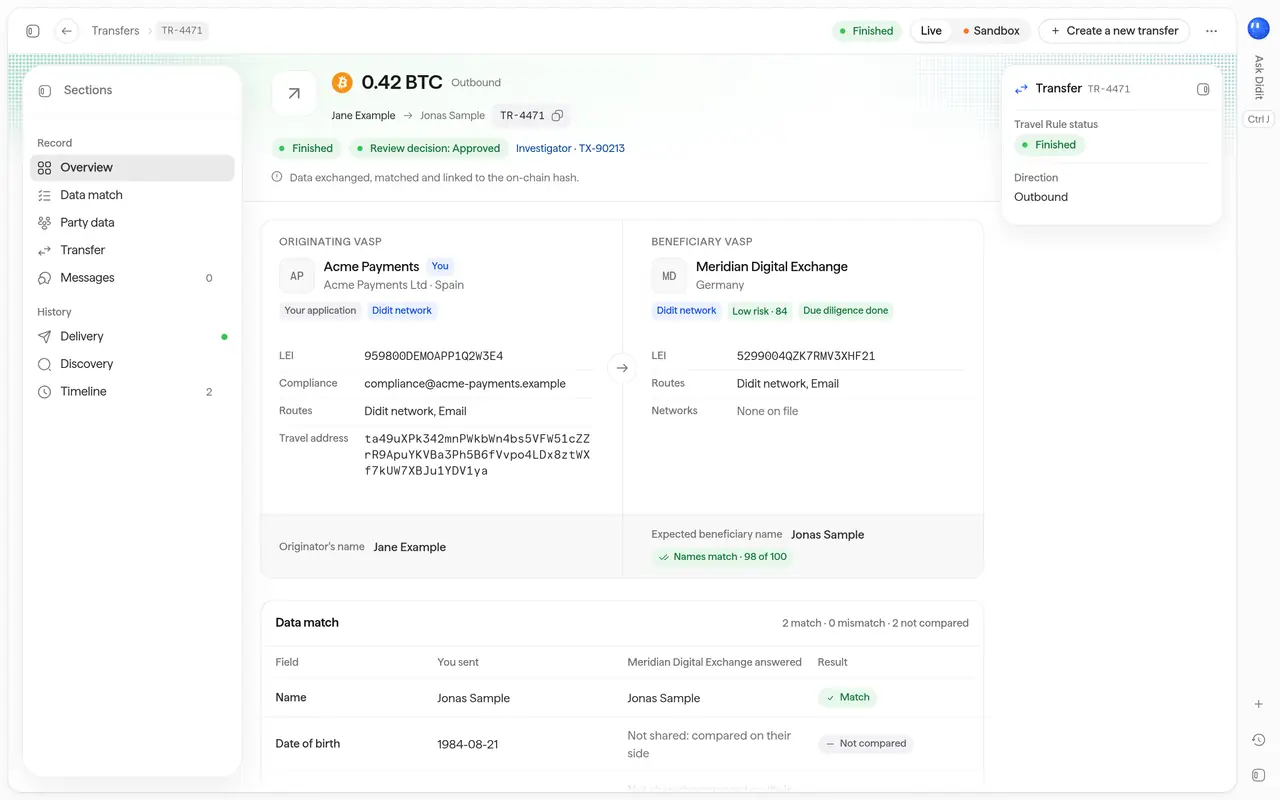
Inbound is the mirror image. A deposit can land in your wallet, or a counterparty can start a transfer toward you, before the matching Travel Rule data reaches your application. Until a received message is paired with that deposit, the deposit waits in one of three statuses: AWAITING_COUNTERPARTY, NOT_ENOUGH_COUNTERPARTY_DATA or COUNTERPARTY_VASP_NOT_FOUND. The unmatched endpoint lists exactly those rows, newest first. A deposit leaves the list when a received message is paired with it, when you match it by hand, or when its status moves on.
Two settings shape the queue before you write any code. inbound_auto_accept defaults to true, and confirmation_timeout_hours pairs with timeout_outcome (HOLD, REJECT or PROCEED). sunrise_jurisdictions currently reads CO, KH and VN, and the sunrise policy applies first, then the non responsive policy, then timeout_outcome.
Prerequisites
| Requirement | What it needs to be | Where it comes from |
|---|---|---|
| Plan | Any plan. Sandbox testing is free and unlimited, and the Free plan carries $10 of monthly credit for a work email signup. | Didit pricing |
| Travel Rule | is_enabled is true on the settings object | GET /v3/travel-rule/settings/ |
| API key | Sent in the x-api-key header. A scoped key needs the transactions privilege, and the match call needs write access to transactions. | Didit Business Console |
| Client | Any HTTPS client that can set a header. Every example on this page is curl. | None |
| Counterparty entry | The directory entry's id (a UUID), if you want to filter by counterparty | /v3/travel-rule/vasps/ |
| Pagination | limit defaults to 50, offset walks the pages | query parameters |
The unmatched endpoint itself needs no network membership, no contract and no call with sales. The four network rails are different: GTR, TRUST, VerifyVASP and Sygna route only through your own connected membership, and no network membership is included by default.
Step by step
- Read the settings for the application. This tells you whether the managed exchange runs, which networks can route, and what the travel address is. Share
travel_addresswith counterparties so they can reach you machine to machine.
Readcurl "https://verification.didit.me/v3/travel-rule/settings/" \ -H "x-api-key: YOUR_API_KEY"is_enabled,inbound_auto_accept,confirmation_timeout_hoursand thenetworksobject. Each network reportsown,didit,offorunavailable. Until Didit finishes onboarding as a network provider, no production application reportsdidit. - Create the API key the matching job will use. In the Didit Business Console, create a key with the transactions privilege, or use a full access key. A scoped key without that privilege is refused with 403 when it reaches the unmatched endpoint. Store the key server side and send it only in the
x-api-keyheader. - Call the unmatched endpoint with the filters you actually need. Every filter is optional, and they are the same filters as
GET /v3/travel-rule/transfers/. Direction values are case sensitive, and status values are uppercase.
Dates arecurl "https://verification.didit.me/v3/travel-rule/unmatched/?direction=INBOUND&status=AWAITING_COUNTERPARTY,NOT_ENOUGH_COUNTERPARTY_DATA,COUNTERPARTY_VASP_NOT_FOUND&rail=TRP,GTR,VERIFYVASP,SYGNA,EMAIL&kind=deposit&start_date=2026-11-01&end_date=2026-11-26&limit=50&offset=0" \ -H "x-api-key: YOUR_API_KEY"YYYY-MM-DDin UTC. Request fewer rails than the full enum when you are debugging one channel, and page withoffsetinstead of raisinglimitpast what you need. - Resolve the counterparty UUID from the VASP directory. The
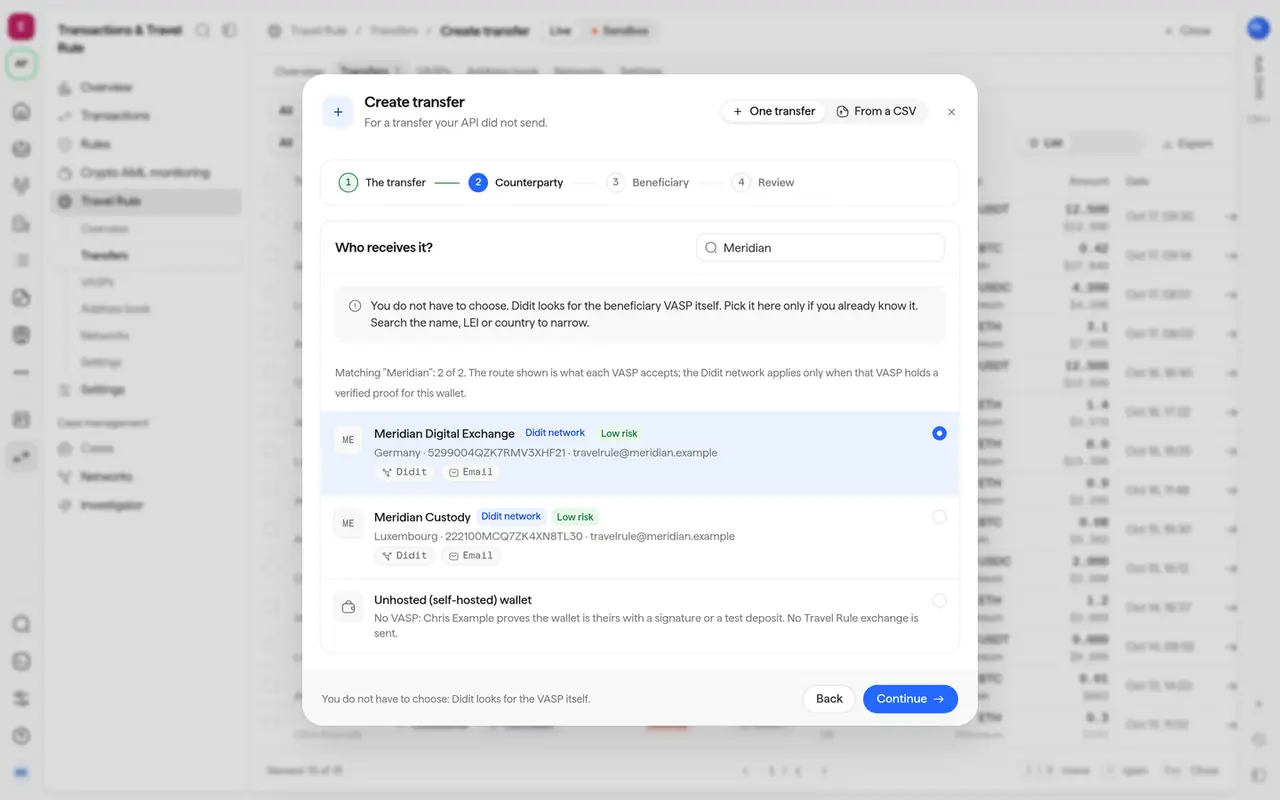
counterpartyfilter takes the directory entry's id. Read the directory to find it; use the search endpoint to locate an entry and its available routes.
If the counterparty is missing entirely, add it privately and it comes back withcurl "https://verification.didit.me/v3/travel-rule/vasps/" \ -H "x-api-key: YOUR_API_KEY"source: added_by_you. A matching visible name or LEI answers 409 with the existingvasp_id, so select that entry instead of creating a duplicate.curl -X POST 'https://verification.didit.me/v3/travel-rule/vasps/' \ -H 'x-api-key: YOUR_API_KEY' -H 'Content-Type: application/json' \ -d '{"name": "Example VASP", "email": "compliance@example.com", "jurisdiction": "DE", "invite": false}' - Work the rows, not the whole list. Each row carries
originator_vasp,beneficiary_vasp,counterparty_jurisdiction,wallets,memosanddeadline_at. Prioritize rows bydeadline_atso you can review them before expiry while you are chasing a counterparty.counterparty_jurisdictionis the counterparty VASP's recorded jurisdiction, and the row'smatched_transaction_idis empty while the deposit is still waiting. - Pair the deposit with the message the originating VASP sent. Pass the row's
transaction_idas{transaction_uuid}toPOST /v3/travel-rule/unmatched/{transaction_uuid}/match/. The Match an unmatched deposit page documents the request that call takes. - Confirm the row left the list. Call the unmatched endpoint again with the same filters, or read the transfer directly from
GET /v3/travel-rule/transfers/.
As an implementation check, comparecurl "https://verification.didit.me/v3/travel-rule/transfers/?direction=INBOUND&limit=20" \ -H "x-api-key: YOUR_API_KEY"status,review_statusandmatched_transaction_idon the row before and after the call. The documentation describes the match as the pairing step and nothing beyond it, so read the row rather than assume a second outcome.
Filter mapping
| Parameter | Accepted values | What it does in your matching logic |
|---|---|---|
direction | INBOUND, OUTBOUND, or both comma separated. Case sensitive. | Keep INBOUND for deposit matching. Anything else pulls in your own outbound traffic. |
status | One or more transfer statuses, comma separated | The three waiting statuses are the natural default. A lowercase value answers 400. |
rail | INTERNAL, TRP, GTR, TRUST, VERIFYVASP, SYGNA, EMAIL, TEST_VASP | Isolates the channel that carried, or will carry, the message. Useful when one network is lagging. |
kind | withdrawal, deposit, message, comma separated | deposit for funds arriving on your side. message rows are data only. |
currency | A currency | Narrows the list to one currency when you reconcile per book. |
start_date / end_date | YYYY-MM-DD, UTC | A date window over the deposits, for daily reconciliation runs. |
counterparty | A UUID from /v3/travel-rule/vasps/ | One counterparty VASP, for when a single sender is causing the backlog. |
limit / offset | limit defaults to 50 | Paging over the same ordering, newest first. |
Field mapping
| Field | What it tells you |
|---|---|
transaction_id | The deposit id. Pass it as {transaction_uuid} to the match call. |
txn_id | The transfer's own identifier, for cross reference with the network or email thread. |
originator_vasp / beneficiary_vasp | Which side each VASP sits on, so you know who still owes you data. |
counterparty_jurisdiction | The counterparty VASP's recorded jurisdiction. It is the application's own jurisdiction setting that decides which data fields the exchange must share. |
wallets | The addresses involved. Compare against your deposit address to confirm the row is yours. |
memos | The memos value returned on the transfer row. |
deadline_at | When the exchange expires. After that, timeout_outcome or the sunrise policy decides what happens to the transaction. |
matched_transaction_id | Empty while the deposit waits. Populated once a received message is paired or a match lands. |
status / review_status | The exchange state and your own review state, kept apart on purpose. |
Test with sandbox data
Sandbox testing is free and unlimited, and sandbox applications never convert the amount, so the threshold applies only when a request sends amount_in_default_currency. The rail filter accepts TEST_VASP as one of its documented values.
Expected success: a 200 with rows, newest first. An application with no Travel Rule transfers returns an empty list rather than an error, so an empty response on a fresh sandbox application is the correct result, not a broken key.
| Status | What you see | Fix |
|---|---|---|
| 400 | {"status": ["Unknown value(s): awaiting."]} | Filter values are case sensitive. Send AWAITING_COUNTERPARTY, not awaiting. Re-read the rail and kind enums the same way. |
| 401 | Authentication credentials were not provided or are invalid. | The key is wrong, malformed, revoked or expired. Check the x-api-key header and rotate the key in the console. |
| 403 | This API key has no access to this endpoint. | The scoped key lacks the transactions privilege. Add it, or use a full access key. |
| 403 | {"detail": "...", "code": "insufficient_credits"} | Travel Rule calls report a low balance this way. Top up at https://business.didit.me and retry. |
Disconnect. Revoke the API key in the Didit Business Console so the job can no longer read deposits. If you are winding the whole integration down, send a partial update to PUT /v3/travel-rule/settings/ with is_enabled set to false, so the managed exchange stops running for outbound travelRule transactions. The unmatched list itself is generated from transfer state and is empty for applications without Travel Rule transfers.
Cost of both ends
On your side, the price feed has one Travel Rule line: $0.02 per transaction, billed once per outbound exchange regardless of later status transitions. Transaction monitoring is $0.001 per transaction beyond the plan allowance (1,000 on Free, 10,000 on Growth, 100,000 on Scale, which resets monthly and does not roll over), and wallet screening is $0.15 per screening. The unmatched list itself is not a priced line in the price book.
Worked example, at list price for a VASP that settles 3,000 outbound exchanges a month and reviews every inbound deposit:
- Travel Rule: 3,000 exchanges x $0.02 = $60.00
- Wallet screening on the 3,000 deposit addresses: 3,000 x $0.15 = $450.00
- Transaction monitoring on 60,000 transactions with the Growth allowance of 10,000: 50,000 x $0.001 = $50.00
- Total: $60.00 + $450.00 + $50.00 = $560.00
On Scale the same month costs $54.00 for exchanges (3,000 x $0.018), $405.00 for screening (3,000 x $0.135) and $50.00 for monitoring, which is $509.00 of usage. Scale costs $299 a month and adds $350 of credit a month, so the first $350.00 is covered by plan credit and $159.00 comes from top ups.
On the other side, the counterparty VASP needs no Didit account, API key or commercial relationship. The interoperability documentation says a VASP exchanging with a Didit customer needs only HTTPS and JSON. Over the EMAIL rail the counterparty needs nothing but its own compliance inbox and the one time pickup link.
You can bring your own screening provider and run it inside Didit, with that provider's terms handled directly.
Sources
- Didit docs: List Unmatched Travel Rule Deposits API
- Didit docs: Match an unmatched deposit
- Didit docs: List Travel Rule transfers
- Didit docs: Get Travel Rule Settings API
- Didit docs: Create a private Travel Rule VASP entry
- Didit docs: Search the VASP directory
- Didit docs: FATF Travel Rule API and VASP compliance
- Didit docs: Travel Rule interoperability, reach a Didit VASP
- Didit docs: Travel Rule networks
- Didit docs: API errors, status codes and fixes
- Didit docs: API authentication
- Didit docs: pricing and billing rules
- Didit pricing page and live price feed, read November 26, 2026
- Didit Travel Rule product page
- Didit MCP server setup
- FATF, Recommendation 16 and the Travel Rule
- EUR-Lex, Transfer of Funds Regulation text
Next step: open a free sandbox at https://business.didit.me/, enable Travel Rule on a sandbox application, and call the unmatched endpoint there before any real deposit reaches your wallets. No sales call.
Try it
Try this in the sandbox
Run the check this guide describes, free.
The product this post is about, taken from its topic. Run it free in the sandbox.
Author
Alberto Rosas
Co-founder and CEO

Keep reading
Other guides in the same topic.
 Address Validation API: Structured Fields vs One Line
Send an address to <code>POST /v3/address-validation/</code> on one line or as structured fields, never both, with the country in ISO 3166-1. Results show the match level and cost $0.10 per validated address.
Alberto RosasNov 26, 2026 Didit sandbox vs live mode: what is mocked and what is billed
Didit sandbox is free, mocks providers, stores real captures, and allows 500 session creates per app every 24 hours. Live mode calls real providers. A completed full KYC check lists at $0.33.
Alberto RosasNov 26, 2026 How to AML Screen UBOs and Company Officers With an API
Screen each identified UBO and officer for sanctions, PEP, criminal records, adverse media and fitness and probity at $0.20 per person. The session's AML status reflects the highest-risk result across the company and all.
Alberto RosasNov 26, 2026Questions
Frequently asked questions
What does the Didit Travel Rule unmatched deposits endpoint return?
It returns inbound transfers that are AWAITING_COUNTERPARTY, NOT_ENOUGH_COUNTERPARTY_DATA or COUNTERPARTY_VASP_NOT_FOUND, with no received Travel Rule message paired to them and nobody matched by hand. Rows are the same as a row of GET /v3/travel-rule/transfers/, newest first.
Which filters does GET /v3/travel-rule/unmatched/ accept?
All of them are optional: direction, status, rail, kind, currency, start_date, end_date and counterparty, plus limit (default 50) and offset. They are the same filters the transfers list takes, so one query builder covers both endpoints.
Why does my rail filter return nothing for GTR or SYGNA?
The filter accepts the value, but the network can only route when a membership is connected for your application. Didit holds no platform membership on GTR, TRUST, VerifyVASP or Sygna today and is onboarding as a provider, so those rails work only through your own membership connected in the console Marketplace. Read the networks object on GET /v3/travel-rule/settings/ to see whether a network reports own, off or unavailable.
How do I pair an unmatched deposit with the message the counterparty sent?
Post to /v3/travel-rule/unmatched/{transaction_uuid}/match/, using the row's transaction_id as {transaction_uuid}. The body supplies the received message that belongs to that deposit. After the pair lands, the deposit leaves the unmatched list and the row's matched_transaction_id is filled.
Why does the unmatched endpoint return 403 instead of 401?
A 401 means the key itself is wrong, malformed, revoked or expired. A 403 with This API key has no access to this endpoint. means the key is valid but scoped without the transactions privilege. A 403 with code: insufficient_credits means the balance cannot cover the call.
Where does the counterparty UUID in the filter come from?
From the VASP directory at /v3/travel-rule/vasps/. Use the search endpoint to find the entry, read its id, and pass that UUID as counterparty. If the counterparty is missing, add it privately with POST /v3/travel-rule/vasps/ using a name and a compliance email.
What is deadline_at on a deposit row?
It is the moment the exchange expires. When a deadline passes, sunrise_policy applies first for counterparties in a sunrise jurisdiction (currently CO, KH and VN), then non_responsive_policy for directories marked unresponsive, then timeout_outcome, which is HOLD, REJECT or PROCEED. Sorting your queue by deadline_at keeps you ahead of it.
How much does inbound deposit matching cost?
The price feed lists Travel Rule at $0.02 per transaction, billed once per outbound exchange regardless of later status transitions, and the unmatched list has no separate price line. Growth takes 4% off every Didit price and Scale takes 10%, and Scale costs $299 a month with $350 of monthly credit.
Does the counterparty VASP need a Didit account to match with us?
No. A counterparty that exchanges Travel Rule data with a Didit customer needs no Didit account, API key or commercial relationship. Over TRP it answers a JSON inquiry, and over EMAIL it uses a one time pickup link from its compliance inbox.
Can I set this up with an AI assistant instead of writing it by hand?
Yes. Didit runs a hosted MCP server at https://mcp.didit.me/mcp with OAuth sign-in, and the MCP server is free on every plan. Add it as a custom connector in Claude or open the Didit plugin in ChatGPT, and the assistant can call the documented endpoints. The documentation index at https://docs.didit.me/llms.txt lists every page you can point the assistant at.
How do I test inbound matching without real traffic?
Use a sandbox application, where testing is free and unlimited. The rail filter accepts TEST_VASP as one of its documented values, and a sandbox application with no transfers returns an empty list rather than an error. Sandbox applications never convert amounts, so a threshold applies only when the request sends amount_in_default_currency.
Compliance built in
Audited, certified and attested.
We hold the certifications and build each country's rules into your flows, so you can launch anywhere without worrying. Security and Compliance center
- Regulation encoded into your flows
Tell us what you do and where. Didit lists the rules that apply to you, with sources, and builds the checks each country needs into one workflow.
- Ready for AMLR
Every requirement of the new EU anti-money laundering rules, from checking customers to human review, is already covered by a Didit check.
- Tested in Spain's Treasury sandbox
Spain's Treasury published its supervised sandbox report on Didit's NFC plus active liveness onboarding; SEPBLAC took part and valued the added measures positively.
- Audited, not self-declared
iBeta Level 1 and Level 2. Liveness tested under ISO/IEC 30107-3.
Your obligations · 3 regions
 SOC 2 Type 2
 ISO 27001
 iBeta Level 1 and Level 2
 EU regulator attestation
 FSM youth protection
 GDPR
 EBA remote onboarding
 MiCA compatible
 FIDO Alliance member
- AMLREU AML Regulation ready
Integration · Didit MCP
Run Didit from your own AI agent
Connect Didit to Claude, Cursor, VS Code or ChatGPT and just ask in plain words. Your agent can do anything you can do in the console, with the same permissions you have.
 Add to Claude
 ChatGPT
 Cursor
- Build workflowsDescribe the checks you need. The agent creates and publishes the flow.
- Run investigationsAsk why a session was declined, review cases, search people and companies.
- Change rulesCreate payment rules, test them on past data and switch them on.
- Pull reportsAsk for numbers, exports or the audit log.
Didit Academy


