Transaction Monitoring Pricing 2026: 6 Vendors Ranked
Didit includes 1,000 monitored transactions monthly, then charges $0.001 each. Calls include rule scoring, counterparty AML and adverse-media screening, IP enrichment and webhooks. Monthly allowance resets.
 Alberto RosasCo-founder and CEO
Contents
In this guide
Jump to the part you need.
Didit Transaction Monitoring fits teams that want a per-transaction price on a public page. Our Free plan includes 1,000 monitored transactions a month; after that each one costs $0.001. One call covers rule scoring, counterparty AML and adverse media screening, IP enrichment and webhooks. Didit bills monitored transactions at the published rate, and its docs describe alerts as held transactions with no separate alert endpoint. The caveat: the allowance resets monthly and does not roll over.
Last updated: November 26, 2026. Prices checked against the live Didit price feed on November 26, 2026.
| Vendor | Price basis | Cost for 1,000 transactions a month | Best for |
|---|---|---|---|
| Didit | 1,000 monitored transactions a month included, then $0.001 each | $0 on the Free plan | Teams that want a published per-transaction rate with screening and alerts inside it |
| SEON (SEON homepage, read November 26, 2026) | Starter $699 a month with 2,500 fraud checks | No per-transaction rate published; $699 is the entry plan | Fraud teams that want a rule builder over 1,100+ data signals |
| Sumsub (Sumsub homepage, read November 26, 2026) | $1.35 per verification (Basic) or $1.85 (Compliance), with $149 or $299 minimums | No per-transaction rate published | Teams seeking identity checks and monitoring described on one platform |
| ComplyAdvantage (ComplyAdvantage homepage, read November 26, 2026) | Starter from $99 a month for 100 to 2,000 entities; Enterprise on request | No per-transaction rate published | Screening-led programmes that prefer to budget by entity count |
| Flagright (Flagright homepage, read November 26, 2026) | Not published, quote required | Quote required | Teams that need SAR filing to FinCEN and 70+ GoAML countries |
| Unit21 (Unit21 homepage, read November 26, 2026) | Not published, quote required | Quote required | Fintech fraud and AML operations built around AI agents |
Start free in the sandbox at business.didit.me, no sales call. The sandbox is free on every plan and unlimited. Developers who want to drive Didit from an AI assistant can connect it through the Didit MCP server. The product page is Transaction Monitoring and every line price is on Didit pricing.
Verdict
Didit is the only vendor in this comparison that publishes a per-transaction monitoring price, and it is $0.001 after the 1,000 transactions included each month. That single number settles the question behind this page: 1,000 monitored transactions a month costs $0 on the Free plan, and 2,500 costs $1.50, paid from the monthly credit. The same call runs rule scoring, counterparty AML and sanctions screening with adverse media, IP enrichment with country, ASN and VPN or Tor flags, and webhooks back to your systems.
Three of the other five publish an entry price, in units that are not monitored transactions: SEON at $699 a month for 2,500 fraud checks (SEON homepage, read November 26, 2026), Sumsub at $1.35 per verification with a $149 monthly minimum (Sumsub homepage, read November 26, 2026), and ComplyAdvantage from $99 a month for 100 to 2,000 entities (ComplyAdvantage homepage, read November 26, 2026). If your finance team needs a number before a call, that difference matters more than a feature list. If automated regulatory filing is the first requirement, Flagright publishes SAR filing to FinCEN and 70+ GoAML countries (Flagright homepage, read November 26, 2026), and we cover that in its section.
How we picked
We ranked vendors that sell transaction monitoring as a named product and that a compliance or engineering team can buy in 2026. Every fact comes from the vendor's own page, read on November 26, 2026, or from Didit's Transaction Monitoring documentation. We scored six criteria, each from 1 to 5, and each score below carries the evidence we used.
- Published transaction price. A 5 means the vendor publishes a rate per monitored transaction. A 1 means pricing is not published at all.
- Cost at 1,000 transactions a month. A 5 means $0 at that volume. A 1 means you cannot know without a quote.
- What one call includes. Rule scoring, counterparty AML and sanctions screening, adverse media, IP enrichment and webhooks count. A 5 means all of it sits inside the transaction price.
- Rules and scoring depth. Single-transaction thresholds, velocity windows, behavioural patterns, score contributions and back-testing.
- Alert and case workflow. Held transactions, analyst assignment, cases, audit trail and report preparation.
- Time to test. A free sandbox or trial that lets you see a rule fire before you sign.
Didit publishes this ranking; we explain the criteria so you can check them. We did not run head-to-head tests on competitor systems, so no score claims a measured result. Scores reflect what each vendor publishes.
| Vendor | Published price | Cost at 1,000 a month | What one call includes | Rules and scoring | Alerts and cases | Time to test |
|---|---|---|---|---|---|---|
| Didit | 5: $0.001 per transaction published | 5: $0 on the Free plan | 5: rule score, counterparty AML, adverse media, IP enrichment, webhooks | 4: velocity windows, back-testing, score thresholds | 4: held transactions, cases, SAR preparation | 5: free sandbox on every plan, unlimited |
| SEON (SEON homepage, read November 26, 2026) | 4: $699 a month published with a 2,500 check allowance | 3: $699 is the entry plan | 3: 1,100+ data signals, per-call contents not itemised | 3: 50 custom rules on Starter, unlimited on Premium | 3: case management and AML compliance on Premium only | 3: no free trial stated on the page |
| Sumsub (Sumsub homepage, read November 26, 2026) | 3: $1.35 or $1.85 per verification, no per-transaction rate | 3: $149 monthly minimum on Basic | 2: transaction monitoring is listed, its contents are not priced | 3: rules and scoring not itemised on the page | 3: case data named, pricing not published | 4: 14-day trial with 50 free checks |
| ComplyAdvantage (ComplyAdvantage homepage, read November 26, 2026) | 2: from $99 a month, priced per entity rather than per transaction | 3: $99 covers up to 1,000 entities on Starter | 3: customer screening listed, per-call breakdown not published | 3: agentic workflows resolve up to 85% of routine alerts | 3: risk applications named, no seat or case pricing published | 3: ComplyLaunch gives early-stage start-ups free access |
| Flagright (Flagright homepage, read November 26, 2026) | 1: not published | 1: quote required | 3: transaction monitoring and dynamic risk scoring listed | 4: AI Forensics turns SOPs into agents in 20 minutes, per the page | 4: regulatory filing to FinCEN and 70+ GoAML countries | 3: AI Forensics is described as self-serve |
| Unit21 (Unit21 homepage, read November 26, 2026) | 1: not published | 1: quote required | 3: real-time monitoring and sanction screening listed | 4: every AI decision is traceable and mapped to policies | 4: case management is a named product | 2: no trial stated on the page |
Shortlist
| Rank | Vendor | Best for | Price basis | Key capabilities | Main trade-off |
|---|---|---|---|---|---|
| 1 | Didit | A published per-transaction price with alerts represented as held transactions | 1,000 a month included, then $0.001 | Rule scoring, counterparty AML and adverse media, IP enrichment, webhooks, cases, travel rule | Allowance does not roll over, and wallet screening is priced separately at $0.15 per screening |
| 2 | SEON (SEON homepage, read November 26, 2026) | Fraud rules over many data signals | Starter $699 a month, 2,500 fraud checks | 1,100+ data signals, 50 custom rules, managed risk services | Case management and AML compliance only on the custom Premium plan |
| 3 | Sumsub (Sumsub homepage, read November 26, 2026) | Identity checks and monitoring described on one platform | $1.35 or $1.85 per verification, $149 or $299 minimums | ID and business verification, AML screening, transaction monitoring, fraud prevention | No per-transaction monitoring rate published |
| 4 | ComplyAdvantage (ComplyAdvantage homepage, read November 26, 2026) | Entity-count budgeting for screening | From $99 a month for 100 to 2,000 entities | Mesh risk intelligence, agentic alert resolution, customer screening | The plan is priced in entities, not transactions |
| 5 | Flagright (Flagright homepage, read November 26, 2026) | Regulatory filing at volume | Not published, quote required | Dynamic risk scoring, AI agents, case management, SAR filing to 70+ GoAML countries | No published price to budget from |
| 6 | Unit21 (Unit21 homepage, read November 26, 2026) | Agent-led investigations with a full audit trail | Not published, quote required | Real-time monitoring, AML transaction monitoring, sanction screening, case management | No published price and no trial stated |
What 1,000 transactions a month actually costs
One thousand monitored transactions a month costs $0 on the Didit Free plan: the plan fee is $0 and the first 1,000 sit inside the included allowance, so no usage charge applies. Usage beyond the allowance is paid from the monthly credit when applicable. The Free plan includes 1,000 monitored transactions each month, so the first 1,000 never reach the $0.001 rate and never draw on the $10 monthly credit. Three billing components stay separate: the plan fee, the monthly credit that pays for usage, and the per-transaction charge that starts at transaction 1,001. Plan credit is added on the first day of each plan month and expires at the end of it, and the transaction allowance resets on the 1st of the month without rolling over.

| Transactions a month | Plan | Included in the allowance | Charge beyond the allowance | Paid from plan credit | Plan fee |
|---|---|---|---|---|---|
| 1,000 | Free | 1,000 | 0 x $0.001 = $0.00 | $0.00 of the $10 credit | $0.00 |
| 2,500 | Free | 1,000 | 1,500 x $0.001 = $1.50 | $1.50 of the $10 credit | $0.00 |
| 10,000 | Growth | 10,000 | 0 x $0.001 = $0.00 | $0.00 of the $115 credit | $99.00 |
| 15,000 | Growth | 10,000 | 5,000 x $0.001 = $5.00 | $5.00 of the $115 credit | $99.00 |
| 100,000 | Scale | 100,000 | 0 x $0.001 = $0.00 | $0.00 of the $350 credit | $299.00 |
| 250,000 | Scale | 100,000 | 150,000 x $0.001 = $150.00 | $150.00 of the $350 credit | $299.00 |
The arithmetic is the whole story. 1,500 transactions above the Free allowance is 1,500 x $0.001 = $1.50, and that $1.50 comes out of the $10 monthly credit, so the cash outlay is still $0. At 250,000 transactions on Scale, 250,000 minus 100,000 is 150,000, and 150,000 x $0.001 = $150.00, which the $350 monthly credit covers, so the cash outlay stays at the $299 plan fee. When the credit runs out, usage is paid from a top-up balance; top-ups are added at face value and last 12 months. On Enterprise, usage beyond the contracted credit is invoiced as overage instead.
If the same users also need identity checks, add those on top, because the transaction allowance does not cover them. A full ID check is $0.33 at list price, $0.3168 on Growth and $0.297 on Scale, so 500 checks on Growth is 500 x $0.3168 = $158.40, paid from the same credit. Wallet screening for crypto is its own line at $0.15 per screening. You can also bring your own screening provider and run it inside Didit; we do not publish a price for that route, so ask us before you build a budget around it.
For contrast, here is the same arithmetic on the published competitor numbers. SEON Starter is $699 a month for 2,500 fraud checks, so $699 divided by 2,500 = $0.2796 per fraud check (SEON homepage, read November 26, 2026). ComplyAdvantage Starter from $99 a month for 1,000 entities is $99 divided by 1,000 = $0.099 per entity per month (ComplyAdvantage homepage, read November 26, 2026). Sumsub Compliance at $1.85 per verification for 1,000 verifications is 1,000 x $1.85 = $1,850, against a $299 monthly minimum (Sumsub homepage, read November 26, 2026). Those are fraud-check, entity and verification units, not monitored transactions, so read the figures as a pricing-model contrast and not as a like-for-like quote.
1. Didit: 1,000 transactions included, then $0.001 each
Verdict. The only published per-transaction rate in this comparison, and it is a rate you can read before you talk to anyone. The price includes the documented monitoring and screening capabilities described below. If your volume is around 1,000 transactions a month, the number on the invoice is $0.
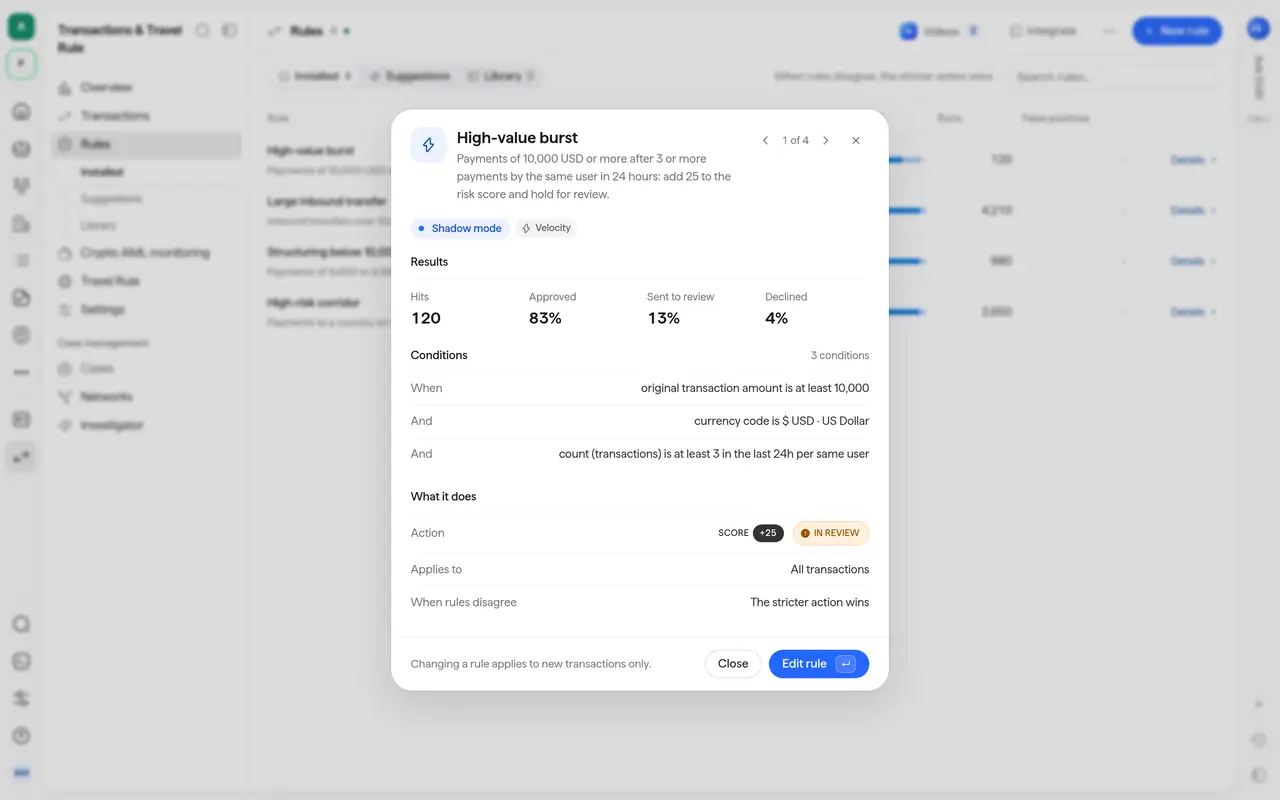
Features. Every transaction is submitted to POST /v3/transactions/ with a subject, an optional counterparty, amount, currency and direction. The rules engine then evaluates single-transaction thresholds, velocity windows such as more than $10,000 in 24 hours, behavioural patterns including structuring, counterparty AML screening against sanctions and watchlists, and wallet risk for crypto. Each matched rule adds its score_delta, and the total sets the status: APPROVED, IN_REVIEW, DECLINED or AWAITING_USER. When a transaction needs the customer to do something, Didit creates a linked remediation session and returns a verification URL. Didit runs identity and fraud checks for 4,000+ companies on one open API.
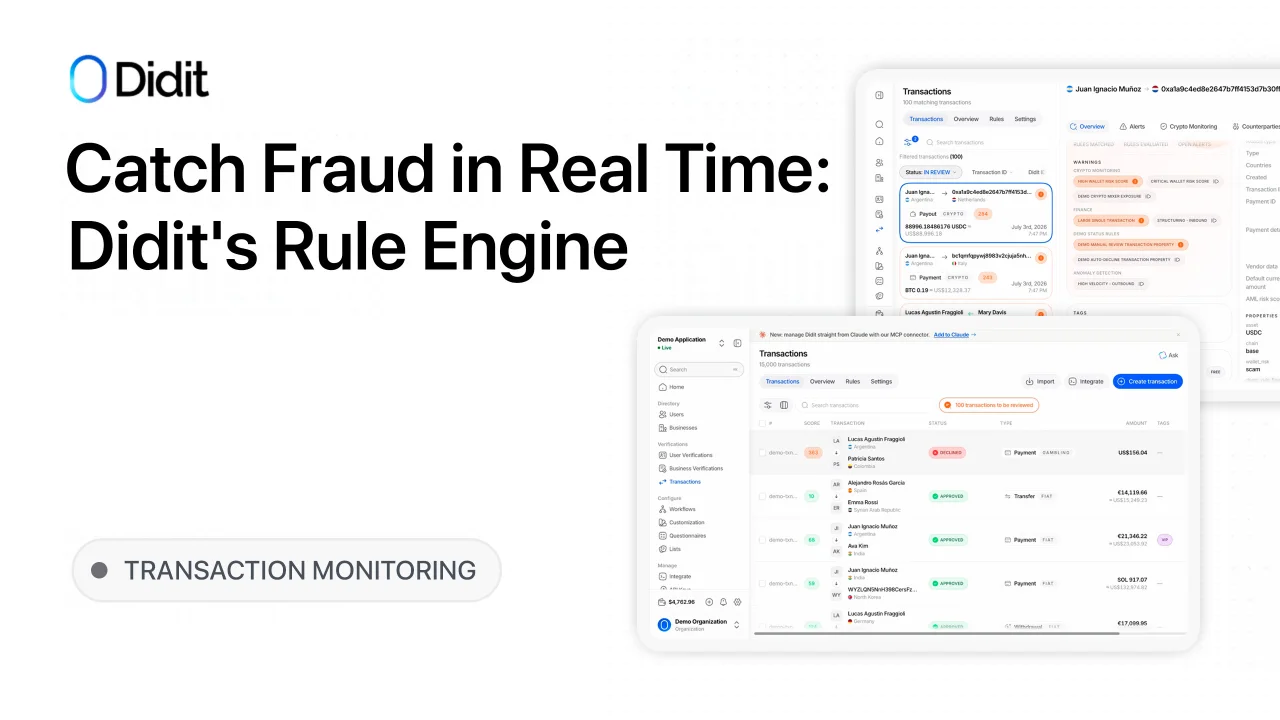
Pricing. Free is $0 a month with 1,000 monitored transactions included. Eligible organizations that sign up with a work email receive $10 of monthly credit. Growth is $99 a month with 10,000 included and $115 of credit. Scale is $299 a month with 100,000 included and $350 of credit. Enterprise starts at $15,000 a year and carries the allowance its contract sets, or 100,000 when it sets none. Beyond the allowance every transaction is $0.001 on every plan. Wallet screening is $0.15 per screening, and travel rule is $0.02 per transaction. All of it is on Didit pricing.
Pros
- The per-transaction price is public, so you can size the bill before you talk to anyone.
- Rule scoring, counterparty AML and sanctions screening with adverse media, IP enrichment with country, ASN and VPN or Tor flags, and webhooks all run inside the same call.
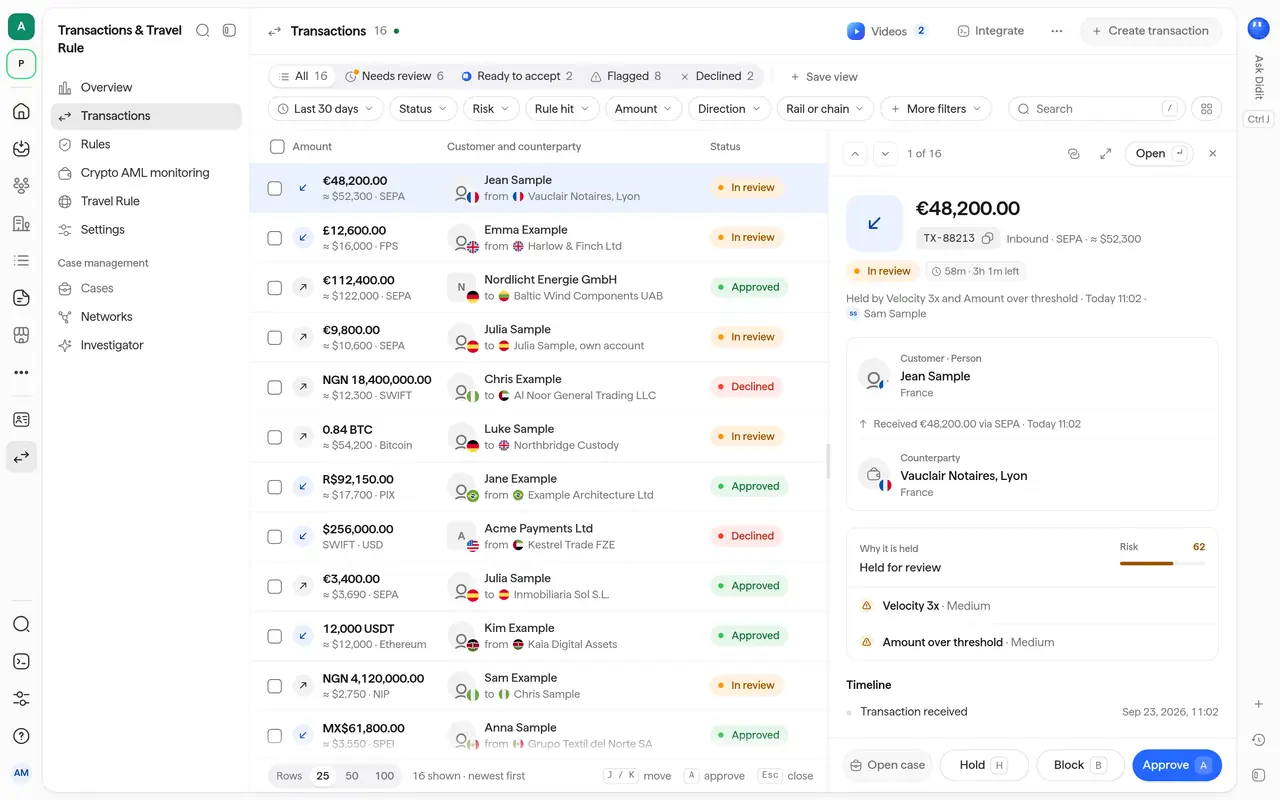
- Alerts are held transactions, and the docs describe no separate alert record or endpoint.
- The sandbox is free on every plan and unlimited, and the MCP server is free.
Cons
- The monthly allowance does not roll over, so a quiet month does not bank capacity for a busy one.
- Crypto wallet screening is priced per screening, not per transaction.
- The
alertsarray on a transaction detail is always empty today, so integrations readstatusinstead. - You configure the rules. Presets and back-testing help, but nobody tunes your thresholds for you.
Best for: teams monitoring around 1,000 transactions a month that want a published rate, screening inside the per-transaction price and a free sandbox to prove the rules before signing.
2. SEON: $699 a month for 2,500 fraud checks
All SEON facts in this section come from SEON homepage, read November 26, 2026.
Verdict. SEON publishes both an entry price and an included volume, so you can work out a per-check figure before a call: $699 divided by 2,500 fraud checks is $0.2796 per check.
Features. SEON's page describes an AI command center for fraud prevention and AML compliance that connects 1,100+ first-party data signals so users can enrich data, understand context and act from one place. Named products are fraud prevention, AML compliance, identity verification and managed risk services. Starter includes 10 users and 50 custom rules. Premium adds case management and AML compliance, unlimited API calls, unlimited users and unlimited custom rules, and the page states an average of 14 days from implementation to impact.
Pricing. Starter is $699 per month with 2,500 fraud checks a month. Premium is custom pricing for your needs. There is no published rate per monitored transaction, so the check allowance is the only published volume unit to work from (SEON homepage, read November 26, 2026).
Pros
- Entry price and included volume are both published (SEON homepage, read November 26, 2026).
- 1,100+ data signals give rule authors a wide input set (SEON homepage, read November 26, 2026).
- The page states an average of 14 days from implementation to impact (SEON homepage, read November 26, 2026).
Cons
- The page lists Starter at $699 per month and Premium at custom pricing (SEON homepage, read November 26, 2026).
- Case management and AML compliance sit on the custom Premium plan, so the $699 tier is not a full compliance stack (SEON homepage, read November 26, 2026).
Best for: fraud teams that want a large signal set and a rule builder, and can start at $699 a month.
3. Sumsub: $1.35 or $1.85 per verification
All Sumsub facts in this section come from Sumsub homepage, read November 26, 2026.
Verdict. Sumsub may fit teams seeking identity checks and monitoring described on one platform. It publishes per-verification prices and minimums, so the floor of the commitment is visible.
Features. Sumsub's page describes AI-powered trust infrastructure that connects identity verification, AML, transaction, fraud and case data into one platform. Products listed are ID verification, business verification, AML screening, AML transaction monitoring and fraud prevention. The page states that setup can be done through coding agents, and that a 14-day trial with 50 free checks is available.
Pricing. Basic is $1.35 per verification with a $149 minimum monthly commitment. Compliance is $1.85 per verification with a $299 minimum. Custom plans are by contact. Add-ons on the page include email verification at +$0.04 per applicant, phone verification at +$0.04 plus SMS fees, SMS notification from +$0.10 to +$0.63 depending on tier, proof of address at +$1.35 per check and automated data extraction at +$0.06 (Sumsub homepage, read November 26, 2026).
Pros
- Per-verification prices and minimums are published, so the floor of the contract is visible (Sumsub homepage, read November 26, 2026).
- A 14-day trial with 50 free checks, and no charge when an applicant does not complete verification (Sumsub homepage, read November 26, 2026).
- Identity checks and monitoring are described on one platform (Sumsub homepage, read November 26, 2026).
Cons
- No published per-transaction monitoring rate, so you cannot price 1,000 transactions from the page (Sumsub homepage, read November 26, 2026).
- Add-ons stack on top of the base verification price (Sumsub homepage, read November 26, 2026).
Best for: teams that already verify identities with Sumsub and want monitoring from the same vendor.
4. ComplyAdvantage: from $99 a month for up to 2,000 entities
All ComplyAdvantage facts in this section come from ComplyAdvantage homepage, read November 26, 2026.
Verdict. ComplyAdvantage publishes an entry price of $99 a month, but it is priced per entity on a screening plan, so it does not answer the question of what a monitored transaction costs.
Features. ComplyAdvantage's page describes an AI-native financial crime platform with embedded agents that automate compliance work, delivered through the Mesh risk intelligence platform. Named capabilities include financial crime risk applications, risk intelligence, agentic workflows and customer screening. The page states that agentic workflows can resolve up to 85% of routine alerts autonomously. ComplyLaunch gives early-stage start-ups free access to the platform.
Pricing. The Starter Plan starts from $99 per month for 100, 250, 500, 750, 1,000, 1,500 or 2,000 entities. Enterprise pricing is by proposal. ComplyLaunch is free for early-stage start-ups (ComplyAdvantage homepage, read November 26, 2026). No per-transaction monitoring rate is published on that page.
Pros
- A published entry price with a clear entity ladder (ComplyAdvantage homepage, read November 26, 2026).
- Agentic alert handling is quantified on the page at up to 85% of routine alerts (ComplyAdvantage homepage, read November 26, 2026).
- A free route for early-stage start-ups through ComplyLaunch (ComplyAdvantage homepage, read November 26, 2026).
Cons
- Enterprise pricing requires a proposal (ComplyAdvantage homepage, read November 26, 2026).
- Per-call contents for transaction monitoring are not itemised on the page (ComplyAdvantage homepage, read November 26, 2026).
Best for: screening-led programmes that budget by the number of entities they monitor and want agentic alert handling.
5. Flagright: quote required
All Flagright facts in this section come from Flagright homepage, read November 26, 2026.
Verdict. Flagright publishes regulatory filing to FinCEN and 70+ GoAML countries. Its pricing is not published, so a 1,000-transaction budget starts with a quote.
Features. Flagright's page describes an AI operating system for financial crime compliance, with transaction monitoring, dynamic risk scoring, AI agents under the AI Forensics name, regulatory filing and case management. AI Forensics is described as turning SOPs into production-ready agents in 20 minutes, self-serve and auditable. Regulatory filing automates SAR filing to FinCEN and 70+ GoAML countries. Rules run in real time or post-transaction at claimed volumes of millions of transactions a day.
Pricing. Not published on the page, so quote required (Flagright homepage, read November 26, 2026).
Pros
- SAR filing to FinCEN and 70+ GoAML countries is a named, specific capability (Flagright homepage, read November 26, 2026).
- AI Forensics is described as self-serve, auditable and tested before deployment (Flagright homepage, read November 26, 2026).
- Rules run on real-time or post-transaction paths at high volume (Flagright homepage, read November 26, 2026).
Cons
- No published price, so you cannot estimate 1,000 transactions without a quote (Flagright homepage, read November 26, 2026).
- No public check allowance to compare against the 1,000 transactions Didit includes (Flagright homepage, read November 26, 2026).
- Buyers must go through a quote before they can see a number (Flagright homepage, read November 26, 2026).
Best for: teams whose first requirement is automated SAR filing across many jurisdictions and who accept a quote-only contract.
6. Unit21: quote required
All Unit21 facts in this section come from Unit21 homepage, read November 26, 2026.
Verdict. Unit21 does not publish a price, so a budget for 1,000 transactions starts with a quote. The investigation workflow and the audit trail are the named products, and the page lists named customers including Brex, Chime, Crypto.com, FIS, Intuit, Rippling, Sallie Mae and Sunrise Banks.
Features. Unit21's page describes AI risk infrastructure for fraud and AML, with configurable AI agents that detect risk in real time, run investigations end to end and produce regulator-ready outcomes with an audit trail. Products listed are AI agents, real-time monitoring, AML transaction monitoring, sanction screening and case management. Every AI decision is described as traceable, mapped to policies and backed by documented reasoning.
Pricing. Not published on the page, so quote required (Unit21 homepage, read November 26, 2026).
Pros
- Investigation workflow is the core product, not an add-on (Unit21 homepage, read November 26, 2026).
- Traceability of AI decisions is described as a first-class feature, which matters in an exam (Unit21 homepage, read November 26, 2026).
- Named customers on the page include Brex, Chime, Crypto.com, FIS, Intuit, Rippling, Sallie Mae and Sunrise Banks (Unit21 homepage, read November 26, 2026).
Cons
- No published price and no published check allowance (Unit21 homepage, read November 26, 2026).
- No trial is stated on the page (Unit21 homepage, read November 26, 2026).
- You cannot compare its cost per transaction against $0.001 without a quote (Unit21 homepage, read November 26, 2026).
Best for: fintechs and banks that want AI agents to carry investigations with a documented audit trail, and that plan a procurement cycle.
Which one to pick
You process about 1,000 transactions a month
Pick Didit. The Free plan includes 1,000 monitored transactions and costs $0, with counterparty AML, adverse media, IP enrichment and webhooks inside the call. You only need a paid plan when you want the Growth or Scale features, more credit, or a larger allowance.
You need a number for a board paper before any call
Pick Didit. It is the only vendor here that publishes a per-transaction rate, and the plan allowances are published too, so the estimate is 1,000 transactions at $0 and anything above at $0.001. The other five require a quote or publish a unit that is not a monitored transaction.
You want fraud rules over a very wide signal set
Look at SEON. Its Starter plan is $699 a month for 2,500 fraud checks with 50 custom rules over 1,100+ data signals, and case management arrives on the Premium plan (SEON homepage, read November 26, 2026).
You want identity checks and monitoring from the same vendor
Look at Sumsub. Basic is $1.35 per verification with a $149 monthly minimum and Compliance is $1.85 with a $299 minimum, and the 14-day trial with 50 free checks lets you test the flow (Sumsub homepage, read November 26, 2026).
You budget by entity, not by transaction
Look at ComplyAdvantage. Starter from $99 a month covers 100 to 2,000 entities, and agentic workflows are stated to resolve up to 85% of routine alerts (ComplyAdvantage homepage, read November 26, 2026).
You must file SARs in many jurisdictions
Look at Flagright. It publishes SAR filing to FinCEN and 70+ GoAML countries, then asks for a quote. Budget time for the quote (Flagright homepage, read November 26, 2026).
You want AI agents to run investigations
Look at Unit21. The investigation loop and the audit trail are the product, and pricing is by quote (Unit21 homepage, read November 26, 2026).
Sources
- Didit Transaction Monitoring overview
- Didit Transaction Monitoring quickstart
- Didit KYT alerts documentation
- Didit transaction risk scoring documentation
- Didit Transaction Monitoring integration guide
- Didit submit transactions API reference
- Didit pricing documentation
- Didit pricing page and pricing as JSON, read November 26, 2026
- Didit Transaction Monitoring product page
- Didit MCP server
- SEON homepage, seon.io, read November 26, 2026
- Sumsub homepage, sumsub.com, read November 26, 2026
- ComplyAdvantage homepage, complyadvantage.com, read November 26, 2026
- Flagright homepage, flagright.com, read November 26, 2026
- Unit21 homepage, unit21.ai, read November 26, 2026
Next step: create a free account at business.didit.me, submit a test transaction, enable the structuring preset and watch the webhook land. No sales call, the sandbox is free on every plan and unlimited, and the 1,000 monitored transactions included each month start on the Free plan.
Try it
Try this in the sandbox
Run the check this guide describes, free.
The product this post is about, taken from its topic. Run it free in the sandbox.
Author
Alberto Rosas
Co-founder and CEO

Keep reading
Other guides in the same topic.
 What Is the Purpose of FICA in South Africa? 2026 Guide
FICA is South Africa's anti-money laundering law. It creates the Financial Intelligence Centre and requires accountable institutions to identify and verify clients, screen for PEP and sanctions risk and report suspicious.
Alberto RosasNov 26, 2026 Sixth Money Laundering Directive (6AMLD): What Changed and Which Rules Apply
6AMLD is Directive (EU) 2018/1673: Member States must criminalise laundering, widen predicate offences and set a four-year penalty floor. It adds no new due diligence duties for firms.
Alberto RosasNov 26, 2026 Automated Sanctions Screening: Canada, the Entity List and Embargoes
Automated sanctions screening matches people and companies against lists such as Canada's autonomous sanctions made under SEMA and JVCFOA and the OFAC SDN List, and returns candidate hits scored for identity confidence and.
Alberto RosasNov 26, 2026Questions
Frequently asked questions
How much does Didit charge per monitored transaction?
Didit charges $0.001 per monitored transaction beyond the allowance included in your plan. The Free plan includes 1,000 monitored transactions a month, Growth includes 10,000 and Scale includes 100,000. The $0.001 rate is the same on every plan.
What does the 1,000 transactions a month include?
Each included call covers real-time rule scoring, automatic counterparty AML and sanctions screening with adverse media, IP enrichment with country, ASN and VPN or Tor flags, and webhooks. You submit the transaction once to POST /v3/transactions/ and get a score, matched rules and a status back. Nothing extra is charged for the screening inside that call.
How much does a Didit transaction monitoring alert cost?
Didit bills monitored transactions at the published rate. An alert is a transaction held in IN_REVIEW or AWAITING_USER, and the price list has no separate alert line. You pay the per-transaction rate once whether the transaction is approved or held for review.
What happens after 1,000 transactions in a month on the Free plan?
Every transaction after the 1,000th costs $0.001 and is paid from your $10 monthly credit or your top-up balance. At 2,500 transactions a month that is 1,500 extra transactions, so 1,500 x $0.001 = $1.50, covered by the credit. If credit runs out and auto top-up is off, live checks stop until you top up, while the sandbox keeps working.
Do unused monitored transactions roll over to the next month?
No. The allowance resets on the 1st of each month and does not roll over, and monthly plan credit expires at the end of the plan month. Top-ups are different: they last 12 months from the day you add them.
Is AML screening billed separately from transaction monitoring in Didit?
Inside transaction monitoring, counterparty AML and sanctions screening with adverse media runs automatically as part of the transaction evaluation. Standalone AML screening for a person is a separate line at $0.20 per check, and ongoing AML monitoring is $0.07 per person a year.
How do I test Didit Transaction Monitoring before paying?
Use the sandbox at business.didit.me. The sandbox is free on every plan and unlimited. The quickstart walks you through submitting a transaction, enabling the structuring preset and confirming the webhook in about 10 minutes.
Does Didit have a free plan for transaction monitoring?
Yes. The Free plan costs $0 a month, includes 1,000 monitored transactions a month and gives eligible organizations $10 of credit. The credit applies to organizations that sign up with a work email in the console, and the sandbox is free on every plan and unlimited.
How does Didit compare with SEON or ComplyAdvantage on price?
Didit publishes $0.001 per monitored transaction after 1,000 included each month. SEON publishes $699 a month for 2,500 fraud checks, which is $0.2796 per check (SEON homepage, read November 26, 2026), and ComplyAdvantage publishes from $99 a month for up to 2,000 entities, which is $0.099 per entity per month (ComplyAdvantage homepage, read November 26, 2026).
Can I bring my own wallet screening provider into Didit?
Yes. You can bring your own screening provider and run it inside Didit. Didit's own wallet screening is a separate line at $0.15 per screening, and we do not publish a price for the bring-your-own route, so ask us before you budget for it.
What is the transaction allowance on the Enterprise plan?
Enterprise sets the monthly transaction allowance in its contract, and the allowance is 100,000 when the contract sets none. Enterprise contracts start at $15,000 a year, and usage beyond the credit is invoiced as overage rather than paid from top-ups.
Is the $0.001 charge included in the plan fee?
No. The plan fee is the subscription, and the monthly credit is a separate prepaid balance that pays for usage, including transactions beyond the allowance at $0.001 each. A Free organization with 2,500 transactions pays $1.50 from its $10 credit and no plan fee; a Growth organization pays the $99 plan fee and its $5.00 of overage comes out of the $115 credit.
Compliance built in
Audited, certified and attested.
We hold the certifications and build each country's rules into your flows, so you can launch anywhere without worrying. Security and Compliance center
- Regulation encoded into your flows
Tell us what you do and where. Didit lists the rules that apply to you, with sources, and builds the checks each country needs into one workflow.
- Ready for AMLR
Every requirement of the new EU anti-money laundering rules, from checking customers to human review, is already covered by a Didit check.
- Tested in Spain's Treasury sandbox
Spain's Treasury published its supervised sandbox report on Didit's NFC plus active liveness onboarding; SEPBLAC took part and valued the added measures positively.
- Audited, not self-declared
iBeta Level 1 and Level 2. Liveness tested under ISO/IEC 30107-3.
Your obligations · 3 regions
 SOC 2 Type 2
 ISO 27001
 iBeta Level 1 and Level 2
 EU regulator attestation
 FSM youth protection
 GDPR
 EBA remote onboarding
 MiCA compatible
 FIDO Alliance member
- AMLREU AML Regulation ready
Integration · Didit MCP
Run Didit from your own AI agent
Connect Didit to Claude, Cursor, VS Code or ChatGPT and just ask in plain words. Your agent can do anything you can do in the console, with the same permissions you have.
 Add to Claude
 ChatGPT
 Cursor
- Build workflowsDescribe the checks you need. The agent creates and publishes the flow.
- Run investigationsAsk why a session was declined, review cases, search people and companies.
- Change rulesCreate payment rules, test them on past data and switch them on.
- Pull reportsAsk for numbers, exports or the audit log.
Didit Academy


