
Swiss AML and KYC requirements: AMLA, FINMA and SRO rules
The Swiss AML and KYC rules after the 1 October 2026 reform: who is in scope, FINMA or an SRO, remote onboarding under Circular 2016/7, beneficial owners, PEPs, MROS reports, SECO screening and a checklist.
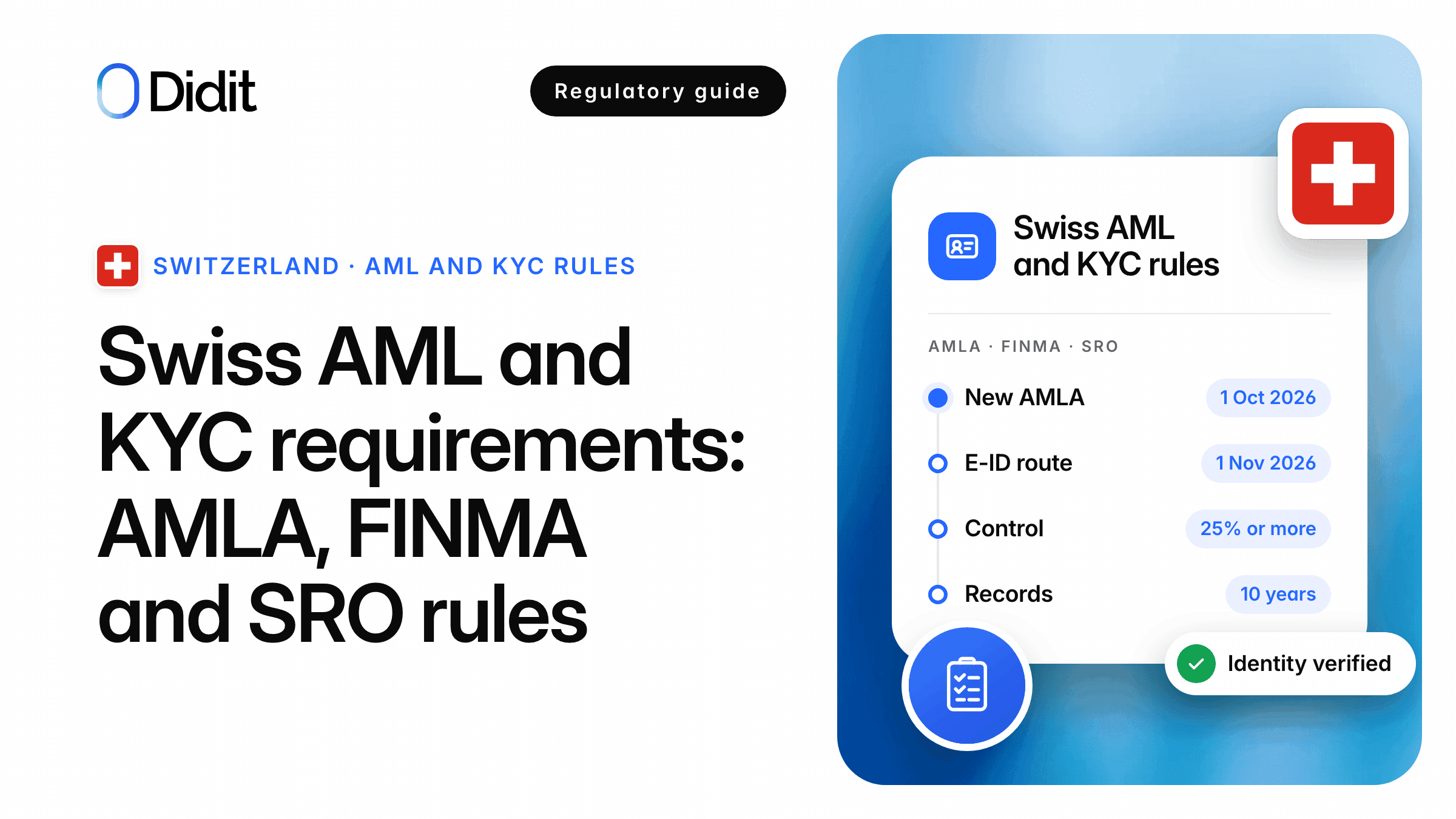
At a glance
Swiss AML and KYC requirements come from the Anti-Money Laundering Act (AMLA, SR 955.0) and its ordinances: identify the customer, establish the beneficial owner, monitor the relationship, report suspicion to the Money Laundering Reporting Office Switzerland (MROS) and keep records for ten years.[1][3] The revised AMLA, in force since 1 October 2026, also makes sanctions compliance an organisational duty.[1][4]
- Supervision: the Swiss Financial Market Supervisory Authority (FINMA) for licensed institutions, one of 10 self-regulatory organisations (SROs) for other financial intermediaries.[1][9]
- Remote onboarding: FINMA Circular 2016/7, with a Swiss E-ID route from 1 November 2026.[5]
- Does Didit screen SECO? Yes: both lists of the State Secretariat for Economic Affairs (SECO), "State Secretariat for Economic Affairs, Switzerland - List of Sanctioned Individuals, Entities and Organizations" and "State Secretariat for Economic Affairs, Switzerland - Sanctions List", among 1,300+ watchlists, at onboarding and in ongoing monitoring.[18][19]
Swiss AML and KYC requirements changed on 1 October 2026. The revised Anti-Money Laundering Act (in German Geldwäschereigesetz, GwG; in French loi sur le blanchiment d'argent, LBA) and the new Act on the Transparency of Legal Persons came into force that day, after Parliament adopted both on 26 September 2025.[4] It brings certain advisers into scope and ties sanctions screening into the anti-money laundering (AML) duties of financial intermediaries.[1]
This guide covers, with article numbers, who is in scope, which know your customer (KYC) checks apply, remote onboarding under FINMA's rules, where the SECO sanctions list fits, and what to report and keep.
Swiss AML timeline: what changed and what is next
- 1 September 2023New FADPThe revised Federal Act on Data Protection applies to identity data.[15]
- 26 September 2025Parliament votesRevised AMLA and the Transparency Act adopted.[4]
- 1 October 2026In forceAdvisers in scope, sanctions duty in Art. 8, transparency register.[1][4]
- 1 November 2026E-ID routeRevised Circular 2016/7 adds online identification with the Swiss E-ID.[5]
- 1 January 2027PlannedFINMA's partial revision of AMLO-FINMA, consulted in May and June 2026.[10]
1 January 2027 is FINMA's planned date for a revision not yet adopted on 22 October 2026.
The revised AMLA adds advisers, extends Article 8 so that a financial intermediary's organisational measures also prevent "violations of compulsory measures taken in accordance with the EmbA", the Embargo Act (in German Embargogesetz, EmbG; in French loi sur les embargos, LEmb), and sets a CHF 15,000 cash threshold for dealers in precious metals and stones.[1]
Screen SECO from day one
Yes, Didit screens against the SECO sanctions lists: both SECO lists are part of its AML screening, with daily re-screening of approved users and a webhook on new hits and status changes.[18][19] Start free, or Talk to us about your Swiss onboarding.
Who must comply: financial intermediaries, dealers and advisers
The AMLA applies to financial intermediaries, dealers who accept cash and, since 1 October 2026, advisers.[1] Article 2 para. 2 names financial intermediaries by type, from banks to trading facilities for distributed ledger technology (DLT) securities; Article 2 para. 3 adds anyone who "on a professional basis" accepts, holds or helps invest or transfer assets belonging to others, such as payment, credit and trading businesses.[1]
| Who | Legal basis | Supervised for AML by |
|---|---|---|
| Banks, securities firms, fund managers, portfolio managers, trustees, DLT trading facilities | Art. 2 para. 2 AMLA | FINMA (Art. 12 lit. a)[1] |
| Payment services, credit, trading for others, crypto transfer services | Art. 2 para. 3 AMLA, Art. 4 AMLO | A recognised SRO (Art. 12 lit. c, Art. 14)[1][2] |
| Advisers: real estate deals, forming non-operating entities, domicile providers | Art. 2 paras 3bis and 3ter AMLA | A recognised SRO (Art. 12 lit. d, Art. 14)[1] |
| Dealers accepting more than CHF 100,000 in cash | Art. 8a AMLA | No SRO; they must appoint an audit firm (Art. 15)[1] |
"Professional basis" has numbers. Under Article 7 of the Anti-Money Laundering Ordinance (AMLO, GwV in German, OBA in French, SR 955.01), it means, per calendar year, gross proceeds above CHF 50,000, more than 20 new customers in relationships that are not one-off (or at least 20 such relationships maintained), transactions above CHF 2 million, or power of disposal over more than CHF 5 million at any time.[2] Money or value transfer is always professional, unless it is done for a related person and earns gross proceeds of no more than CHF 50,000 a year.[2]
On 21 October 2026, FINMA's list showed 10 recognised SROs, among them VQF, PolyReg, ARIF and SO-FIT.[9] Their members are supervised by the SRO, not by FINMA, which approves each SRO's regulations.[9]
Swiss AML and KYC requirements, step by step
The AMLA duties follow the life of a customer relationship.
1Verify the customer's identity
A document of evidentiary value (Art. 3 AMLA).[1]
2Establish the beneficial owner
Identify and verify who owns or controls, with a declaration (Art. 4 AMLA).[1]
3Understand nature and purpose
Checks and approvals follow the risk (Art. 6 para. 1 AMLA).[1]
Is the relationship unusual or higher risk
Clarify the background
Economic background and purpose, decided at the level the risk requires (Art. 6 AMLA).[1]
Standard due diligence
Onboard and set the review cycle by risk.[1]
4Screen and monitor
Sanctions, PEPs and transactions (Art. 8 AMLA, Art. 20 AMLO-FINMA).[1][3]
5Report, freeze, keep records
MROS on suspicion, no tipping off, ten-year records (Art. 7, 9, 10a AMLA).[1]
The AMLA sequence for a financial intermediary.
For FINMA-supervised institutions, the FINMA Anti-Money Laundering Ordinance (AMLO-FINMA, GwV-FINMA in German, OBA-FINMA in French, SR 955.033.0) sets thresholds, data fields and risk criteria.[3] Banks also follow the Swiss Bankers Association's code, CDB 20 (VSB 20 in German), in force since 1 January 2020.[7] SRO members follow their SRO's regulations.[9]
Screen against SECO with Didit
Yes, Didit screens applicants against both SECO lists named in its docs, with UN, EU, OFAC and HM Treasury lists, and re-screens approved users daily with a webhook on new sanctions hits and status changes.[18][19] Your firm keeps every decision and report. See AML screening and the Switzerland page.
Identifying the customer: data, thresholds and documents
Article 3 AMLA asks for a "document of evidentiary value" when a relationship starts.[1] Which detailed rules apply depends on the firm: banks and securities firms follow CDB 20 (Art. 35 AMLO-FINMA), SRO members follow their SRO's regulations, and the rules below (Art. 43a to 52 AMLO-FINMA) apply to fintech-licence holders under Article 1b of the Banking Act and to portfolio managers, trustees and DLT trading facilities (Art. 2 para. 2 lit. abis and dquater AMLA).[3][7][9] Those rules list what to collect: for a natural person, surname, first name, date of birth, residential address and nationality; for a legal entity, company name and domicile address (Art. 44).[3] Any identification document with a photograph issued by a Swiss or foreign authority is admissible (Art. 45 para. 3).[3]
For those firms, occasional business has thresholds; linked transactions count together, and suspicion triggers identification at any amount.[1][3]
| Transaction | Identify the customer when | Rule |
|---|---|---|
| Money exchange | CHF 5,000 or more, linked transactions included[3] | Art. 51 para. 1 lit. a AMLO-FINMA |
| Other cash transactions | CHF 15,000 or more[3] | Art. 51 para. 1 lit. b AMLO-FINMA |
| Virtual currency transactions without a lasting relationship | CHF 1,000 or more (not for money transfers); for cash or anonymous payment, technical measures against splitting within 30 days[3] | Art. 51a AMLO-FINMA |
| Money or value transfer abroad | Always[3] | Art. 52 para. 1 AMLO-FINMA |
| Money or value transfer into Switzerland | Above CHF 1,000 for the payee[3] | Art. 52 para. 2 AMLO-FINMA |
Without a face-to-face meeting, the firm must also check the residential address, by post or an equivalent way, and keep a certified copy of the identification document (Art. 45 para. 2 AMLO-FINMA); Article 49 lists who may certify it.[3] FINMA's circular sets out when a digital process counts as that copy.
Video and online identification under FINMA Circular 2016/7
FINMA Circular 2016/7 "Video and online identification" applies directly to the financial intermediaries FINMA supervises under Article 2 para. 2 lit. a to dquater AMLA, and CDB 20 refers to it.[5] The version adopted on 23 September 2026 applies from 1 November 2026: it admits the E-ID, treats documents with a QR code like those with a machine-readable zone (MRZ), and adds liveness detection, which FINMA links to risks from artificial intelligence.[5][6]
| Route | What the customer does | What the firm checks | Address proof | Margin nos. |
|---|---|---|---|---|
| Video identification | Live audio-visual interview | MRZ or QR code read, one optically variable and one random security feature, photos, audio recording[5] | Counts as in person[5] | 5 to 22 |
| Online, document copy | Photos of the document and a live photo | Face match, MRZ or QR code, at least two random security features, liveness; bank transfer or chip read[5] | Required[5] | 32 to 37.1 |
| Online, qualified electronic signature | Sends an ID copy authenticated with a qualified electronic signature | Data against the signature profile, liveness (one-year transition, margin no. 54)[5] | Required[5] | 38 to 39 |
| Online, Swiss E-ID | Presents an E-ID issued under the e-ID Act | E-ID issued to this person and valid, liveness[5] | Required[5] | 44.1 to 44.4 |
The document-copy route normally needs a payment from the customer's own account at a bank in Switzerland, Liechtenstein or a qualifying Financial Action Task Force (FATF) country, unless the firm reads the document's chip:[5]
Margin no. 33.1FINMA Circular 2016/7
"The financial intermediary may dispense with a bank transfer as set out in margin no. 33 if they read the chip embedded in biometric identification documents using adequate technical equipment and if the data, having undergone authenticity and integrity checks, match the information provided and the photograph taken of the contracting party."
Source: FINMA, Circular 2016/7 Video and online identification[5]
The address check accepts a bill, postal delivery, a register or trustworthy database, or an equivalent digital process (margin nos. 34 to 37.1).[5] The beneficial owner declaration can be signed with a qualified electronic signature or confirmed with a TAN or similar method (margin nos. 47 and 48).[5] See also video ident vs eID and our swiyu guide.
Beneficial owners: the 25% rule, Form A and Form K
Article 4 AMLA asks for the beneficial owner to be identified "with the due diligence required in the circumstances" and verified.[1] For an operating legal entity, that means the natural persons holding at least 25% of capital or votes, directly or indirectly, or controlling it otherwise; failing that, the most senior member of the executive body (Art. 2a para. 3 AMLA).[1]
- Alpine Pay AGThe customer, unlisted operating company
- 60%Holding GmbHIntermediate company
- 100%Person AControls the 60% through Holding GmbH
- 100%
- 40%Person B40% held directly
- 60%
Example
Person A owns all of Holding GmbH, which holds 60% of the customer; Person B holds 40% directly. Both pass 25% and go on Form K.[1][7]
Under CDB 20, Form K records the controlling persons of an unlisted operating company (Art. 20 and 21), and Form A the beneficial owner of the assets, for example for domiciliary companies or accounts opened by correspondence (Art. 27 and 28); Forms S, T and I cover foundations, trusts and certain insurance policies (Art. 40 to 42).[7] Since 1 October 2026, the declaration may be written "or another form of declaration that may be evidenced in text".[1] A revised CDB is not expected before 1 January 2027, the Swiss Bankers Association says.[8]
The federal transparency register for beneficial owners started on 1 October 2026, which opens the transition periods for legal entities to register.[4] The Federal Department of Justice and Police keeps it, and it is open to certain authorities and to those subject to the AMLA.[14]
PEPs and higher-risk relationships
Politically exposed persons (PEPs) are defined in Article 2a AMLA;[1] AMLO-FINMA adds risk criteria such as a high-risk country or no personal contact.[3]
| Group | Who | Higher risk | After leaving office |
|---|---|---|---|
| Foreign PEPs | Prominent public functions abroad[1] | Always (Art. 6 para. 3 AMLA)[1] | No time limit in the AMLA |
| Domestic PEPs | Prominent national functions in Switzerland[1] | With one or more further risk criteria (Art. 6 para. 4)[1] | No longer PEPs after 18 months (Art. 2a para. 4)[1] |
| PEPs in international organisations | Intergovernmental bodies, sports federations[1] | With one or more further risk criteria (Art. 6 para. 4)[1] | No time limit in the AMLA |
| Family and close associates | Close for family, social or work reasons[1] | As the PEP they are close to[1] | As the PEP |
A higher-risk relationship needs its background clarified (Art. 6 AMLA), and for video and online onboarding FINMA's circular says such a client is onboarded only once a supervisor, a superior or the management board has approved it under Article 18 AMLO-FINMA.[1][5] Banks and securities firms must run an IT-based transaction monitoring system (Art. 20 para. 2 AMLO-FINMA).[3]
Sanctions screening inside the AML framework
Sanctions are a separate regime. The Embargo Act (EmbA, SR 946.231) lets the Federal Council adopt sanctions as ordinances; SECO enforces and monitors them, and every private person and company in Switzerland must comply, as our pillar guide to the SECO sanctions list explains.[16][17]
Anti-money laundering
AMLA
- Supervised by FINMA or an SRO[1]
- Trigger: reasonable suspicion[1]
- Report to MROS[1]
Art. 9 and 12 AMLA
Sanctions
Embargo Act
- Enforced by SECO[17]
- Trigger: funds owned or controlled by a listed person or entity[17]
- Report those funds to SECO[17]
Art. 2 EmbA and the ordinances
Since 1 October 2026, Article 8 AMLA links the two: financial intermediaries must take organisational measures, including staff training and checks, to prevent violations of Embargo Act measures.[1] FINMA is not the sanctions authority: SECO is.[17] List differences and what to do on a true hit are in our sanctions screening guide for Switzerland.
Reporting to MROS, freezing and tipping off
MROS is run by the Federal Office of Police (fedpol) and receives reports through its information system.[1] Article 9 AMLA requires a report "immediately" on knowledge or reasonable grounds to suspect money laundering, criminal origin, control by a criminal or terrorist organisation, or terrorist financing.[1] MROS received 21,087 suspicious activity reports in 2025, 39% more than in 2024, according to fedpol.[13]
1Clarify under Art. 6
Reasonable grounds: specific evidence or several indications that checks cannot dispel (Art. 9 para. 1quinquies).[1]
2Report to MROS
Without telling the customer (Art. 10a).[1]
3Keep executing orders
During the analysis, leaving a paper trail for significant assets (Art. 9a).[1]
MROS says it is passing the report to a prosecutor
Freeze the assets
From that notice until a prosecutor's ruling, at most five working days (Art. 10).[1]
No notice in 40 working days
The firm may terminate the relationship (Art. 9b).[1]
The MROS path under Art. 9 para. 1 lit. a AMLA. Sanctions hits go to SECO.
Article 9b para. 1AMLA, SR 955.0
"Teilt die Meldestelle nach einer Meldung nach Artikel 9 Absatz 1 Buchstabe a dieses Gesetzes oder nach Artikel 305ter Absatz 2 StGB dem Finanzintermediär nicht innert 40 Arbeitstagen mit, dass sie die gemeldeten Informationen einer Strafverfolgungsbehörde übermittelt, so kann der Finanzintermediär die Geschäftsbeziehung abbrechen."
In English (summary): if MROS does not inform the financial intermediary within 40 working days that it is passing the report to a prosecution authority, the intermediary may terminate the business relationship. Source: fedlex, AMLA[1]
Wilfully failing to report can bring a fine of up to CHF 500,000, negligence up to CHF 150,000 (Art. 37).[1]
Records, data protection and the revised FADP
Records must let FINMA, a supervisory organisation or an auditor judge compliance within a reasonable time (Art. 22 AMLO-FINMA), and must be updated by risk and kept at least ten years (Art. 7 AMLA).[1][3]
Under the revised Federal Act on Data Protection (FADP, DSG in German, LPD in French, SR 235.1), in force since 1 September 2023, biometric data that uniquely identifies a person is sensitive personal data (Art. 5 lit. c no. 4), which matters for liveness and face matching.[15] Large-scale processing of sensitive data typically needs a data protection impact assessment (Art. 22); a high-risk breach goes to the Federal Data Protection and Information Commissioner (FDPIC) "as quickly as possible" (Art. 24); and data sent abroad needs an adequacy decision or safeguards (Art. 16).[15]
Crypto firms and payment transfers
Crypto businesses meet the same Swiss AML and KYC requirements. Helping transfer virtual currencies to a third party is a payment service under Article 4 AMLO when the firm has a lasting relationship with the customer or power of disposal over the coins, and does not serve only supervised financial intermediaries; which duties apply depends on the business model.[1][2] For firms under AMLO-FINMA Title 5, virtual currency transactions without a lasting relationship (and not money transfers) need identification from CHF 1,000; when paid in cash or by other anonymous means, technical measures must stop splitting within 30 days (Art. 51a).[3] Payment orders carry the originator's name, account number and address and the beneficiary's name and account number (Art. 10 AMLO-FINMA).[3]
Watch out
FINMA Guidance 02/2019 "Payments on the blockchain" notes that, unlike the FATF standards, Article 10 AMLO-FINMA has no exception for payments involving unregulated wallet providers. Until a FINMA-supervised institution can exchange that information, it transfers only to and from external wallets of its own customers, whose ownership "must be proven using suitable technical means", or of third parties it has first identified, with their beneficial owner established and wallet ownership proven.[11]
Didit's transaction monitoring includes wallet screening and a wallet-ownership check.[24]
Onboarding checklist for a Swiss fintech, crypto firm or SRO member
- Decide whether you are a financial intermediary under Art. 2 AMLA and Art. 7 AMLO.[1][2]
- Join a recognised SRO or confirm FINMA supervision before you onboard customers.[1]
- Write the money laundering risk analysis; FINMA supplemented its guidance on it on 4 June 2026.[12]
- Pick an identification route your rules allow (FINMA, CDB 20 or SRO) and document each session.[5]
- Get the beneficial owner declaration on Form A, Form K or your SRO's equivalent.[1][7]
- Screen customers and beneficial owners against both SECO lists and PEP lists.[1][18]
- Re-screen customers when the SECO list changes.[17]
- Route possible matches to a trained reviewer and escalate higher-risk clients for approval.[1][5]
- Train staff on MROS reporting and the tipping-off ban.[1]
- Keep records for ten years after the relationship ends.[1]
- Run a data protection impact assessment where biometric processing is likely to be high risk.[15]
How Didit helps with Swiss AML and KYC requirements
Didit puts identity checks, AML screening and monitoring in one flow (see the Switzerland page). Didit is not FINMA-licensed, an SRO or an audit firm, and Swiss authorities do not approve or certify screening vendors: your firm keeps its programme, risk assessment and reporting.
- SECO screening: yes, both SECO lists, among 1,300+ sanctions, PEP and watchlist sources updated daily, with Swiss Federal Assembly PEP lists.[18]
- Ongoing monitoring: daily re-screening, a webhook on new sanctions hits and status changes, and an exportable history.[19]
- Identity: Swiss ID cards, passports and residence permits on the supported-document list, NFC chip reading for Swiss passports and residence permits, liveness and face match.[20][21]
- Business verification: the KYB table lists Switzerland; tier availability varies by country.[22]
- Data: retention from 1 month to 10 years, EU storage by default.[23]
Didit provides
- Document, chip, liveness and face checks
- SECO and PEP screening, re-run daily
- The evidence of every check
Stays with you
- SRO membership or FINMA licence
- The risk analysis and every decision
- Reports to MROS and SECO
Screen Swiss customers against SECO from the first sign-up
Verify the person, screen both SECO lists and keep watching.
Key takeaways
- The revised AMLA applies since 1 October 2026, with Embargo Act compliance in Art. 8.[1]
- Non-licensed financial intermediaries and advisers join one of 10 SROs.[1][9]
- Controlling persons of an operating company start at 25% (Form K); Form A covers the beneficial owner of the assets.[1][7]
- Circular 2016/7 adds the Swiss E-ID route from 1 November 2026.[5]
- Report suspicion to MROS immediately and keep records for ten years.[1]
Frequently asked questions
What are the Swiss AML and KYC requirements?
Under the Anti-Money Laundering Act (AMLA, SR 955.0), financial intermediaries verify the customer's identity, establish the beneficial owner, clarify unusual or higher-risk cases, report suspicion to MROS and keep records for at least ten years.[1] AMLO-FINMA, CDB 20 and SRO regulations add the detail.[3][7]
Do I have to join a self-regulatory organisation (SRO)?
Yes, if you are a financial intermediary under Article 2 para. 3 AMLA or an adviser (Art. 14 AMLA).[1] FINMA recognised 10 SROs on 21 October 2026, and they, not FINMA, supervise their members.[9]
Is FINMA the sanctions authority in Switzerland?
No. SECO enforces and monitors sanctions under the Embargo Act.[17] Since 1 October 2026, Article 8 AMLA requires financial intermediaries to take organisational measures against violations of Embargo Act measures.[1]
What does FINMA Circular 2016/7 require for online identification?
From 1 November 2026, the document-copy route needs a face match, a read of the MRZ or QR code, at least two random security features, liveness detection, an address check, and a payment from an own-name bank account or a chip read (margin nos. 32 to 37.1).[5]
Can the Swiss E-ID be used for KYC?
Yes, from 1 November 2026 (margin nos. 44.1 to 44.4 of Circular 2016/7). The firm checks that the E-ID was issued to the customer and is valid, verifies the address and runs liveness detection.[5]
What are Form A and Form K?
CDB 20 forms for banks: Form K records the controlling persons of an unlisted operating company, those with 25% or more of capital or votes or control by other means, failing which the most senior executive; Form A records the beneficial owner of the assets.[1][7]
How are PEPs treated under Swiss AML law?
Foreign PEPs are always higher risk; domestic PEPs and PEPs in international organisations are higher risk with a further risk criterion (Art. 6 AMLA). Domestic PEPs stop being PEPs 18 months after leaving office (Art. 2a para. 4).[1]
When must a financial intermediary report to MROS?
Immediately, on knowledge or reasonable grounds to suspect money laundering, criminal origin or terrorist financing (Art. 9 AMLA). It must not tell the customer (Art. 10a).[1]
Does Didit screen against the SECO sanctions list?
Yes. Didit's AML screening includes both SECO lists, "State Secretariat for Economic Affairs, Switzerland - List of Sanctioned Individuals, Entities and Organizations" and "State Secretariat for Economic Affairs, Switzerland - Sanctions List".[18] Approved users are re-screened daily; your firm keeps the decisions and any report.[19]
Sources
- Anti-Money Laundering Act (AMLA), SR 955.0, fedlex, version of 1 October 2026 (German original; official English for information), Articles 1 to 15, 23 to 25 and 37.
- Anti-Money Laundering Ordinance (AMLO, GwV), SR 955.01, fedlex, version of 1 October 2026, Articles 4, 7 and 9.
- FINMA Anti-Money Laundering Ordinance (AMLO-FINMA, GwV-FINMA), SR 955.033.0, fedlex, version of 1 January 2023, Articles 10, 13, 14, 20, 22, 44, 45, 49, 51, 51a and 52.
- Federal Council brings new anti-money laundering rules into force, Federal Council press release, 12 June 2026.
- FINMA Circular 2016/7 Video and online identification, FINMA, last amendment adopted 23 September 2026, in force 1 November 2026, margin nos. 2 to 54.
- FINMA adopts partially revised Circular 2016/7 Video and online identification, FINMA, 8 October 2026.
- Agreement on the Swiss banks' code of conduct with regard to the exercise of due diligence (CDB 20), Swiss Bankers Association, in force 1 January 2020, Articles 20, 27 to 42 and 69.
- Combating money laundering, Swiss Bankers Association, retrieved 22 October 2026.
- Self-regulatory organisations (SROs) and the list of SROs recognised by FINMA, FINMA, list of 21 October 2026.
- FINMA consultation on the partially revised AMLO-FINMA, FINMA, 12 May 2026, with its key points paper.
- FINMA Guidance 02/2019 Payments on the blockchain, FINMA, 26 August 2019.
- Supplement to Guidance 05/2023 on the money laundering risk analysis, FINMA, 4 June 2026; and FINMA news of 24 August 2023.
- Money laundering: number of reports rises by more than a third, fedpol Report 2025.
- Anti-Money Laundering Act (AMLA), State Secretariat for International Finance (SIF), retrieved 22 October 2026.
- Federal Act on Data Protection (FADP), SR 235.1, fedlex, version of 7 July 2025, Articles 5, 16, 22, 24 and 74.
- Embargo Act (EmbA), SR 946.231, fedlex, version of 1 July 2023.
- FAQ Sanktionen der Schweiz, SECO, retrieved 22 October 2026.
- AML watchlist coverage, Didit documentation.
- Continuous AML monitoring, Didit documentation.
- Supported documents, Didit documentation.
- NFC-supported documents, Didit documentation.
- KYB supported countries, Didit documentation.
- Data retention, Didit documentation.
- Wallet ownership widget, Didit documentation.
See AML screening, Didit in Switzerland and pricing.
Build a Swiss onboarding flow your reviewers can trust
Identity, SECO and PEP checks and monitoring in one workflow.
Artigos relacionados
- Lista de sanções do SECO: como funciona a lista de sanções suíça (2026)
- Sanctions screening in Switzerland: SECO vs EU, UN and OFAC lists
- Lei do comércio eletrónico do Vietname: KYB para vendedores, livestreamers e afiliados
- Decree 320/2026: verificação de contas VNeID para plataformas no Vietname
- Verificação do cartão de identidade do Vietname: leitura do chip CCCD por NFC
- Regulamento MiCA em 2026: guia de conformidade cripto na UE até 2028