
FINTRAC identity verification in 2026: methods, rules, C-12
FINTRAC identity verification explained from the official texts: the five methods, remote photo ID in two steps, agents since October 2025, beneficial owners, PEPs, records, Bill C-12 penalties and a 30-day plan.
In short
FINTRAC identity verification means using one of the methods in FINTRAC's guidance to confirm that a document or other source matches what the client told you.[1] For a person there are five methods: government-issued photo ID, credit file, dual-process, affiliate or member, and reliance, and an agent or mandatary may run the first three for you.[1]
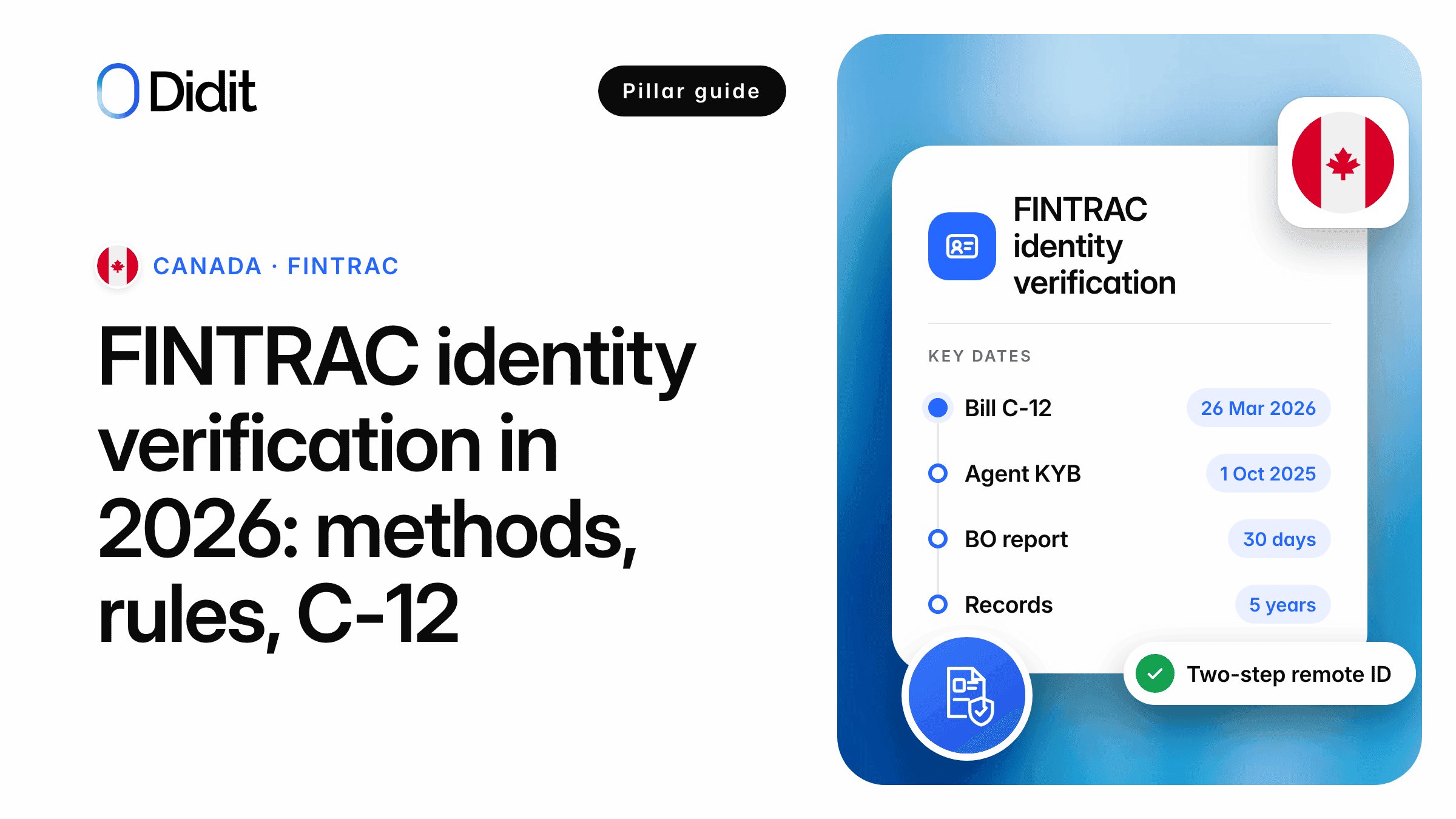
- Since 1 October 2025 an agent may also verify corporations and other entities, and high-risk federal corporations bring a 30-day discrepancy report.[5][8]
- Bill C-12, in force since 26 March 2026, raised maximum penalties up to 40 times and made compliance agreements mandatory for prescribed violations.[6][7]
FINTRAC identity verification is the part of Canada's anti-money laundering regime that most onboarding teams touch every day. The Proceeds of Crime (Money Laundering) and Terrorist Financing Act (PCMLTFA) and its Regulations (PCMLTFR) say who must verify, which methods count and what to record, and FINTRAC (the Financial Transactions and Reports Analysis Centre of Canada, CANAFE in French) explains them in its guidance.[1][3][4]
Building remote onboarding for Canada
Didit checks the document, runs liveness and a 1:1 face match, and keeps the evidence of each check in one workflow. Start free or talk to us about your Canadian flow, and see our identity verification in Canada page.
FINTRAC identity verification in 2026 at a glance
| Question | Short answer |
|---|---|
| Legal basis | PCMLTFA s. 5; PCMLTFR ss. 105 to 112.1, 138, 148[3][4] |
| Methods for a person | Photo ID, credit file, dual-process, affiliate or member, reliance[1] |
| Remote photo ID | Allowed in two steps: authenticate the document, then match the person[1] |
| Agent or mandatary | Written agreement first; entities since 1 October 2025[1][5] |
| Beneficial owners | 25% or more; reasonable measures to confirm, different from those used to obtain[3][8] |
| Politically exposed persons (PEP) | Account-based sectors: reasonable measures at opening; follow-up within 30 days[9] |
| Records | At least five years; producible within 30 days of a request[3] |
| Penalties | Bill C-12: up to 40 times the previous maximums for violations after 26 March 2026[6] |
- 11 October 2024Mortgage sectorMortgage administrators, brokers and lenders covered.
- 1 April 2025New sectorsFactors, cheque cashers, financing and leasing entities.
- 1 October 2025Agents for entitiesAgents for entities, title insurers, ownership discrepancy reports.
- 26 March 2026Bill C-12Royal assent; new penalty framework applies.
- Not yet setUniversal enrolmentWaits for regulations in the Canada Gazette.
Dates from FINTRAC's sector pages, its changes page and LEGISinfo.[5][7][10][11][12]
Who must verify identity under the PCMLTFA
Section 5 of the PCMLTFA lists the reporting entities: banks, credit unions and caisses populaires, life insurers, trust and loan companies, securities dealers, money services businesses (MSBs) in Canada and foreign MSBs serving people in Canada, prescribed businesses and professions, and provincial casinos.[4]
| Sector | Covered from | Source |
|---|---|---|
| Armoured cars | 1 July 2024 | FINTRAC sector page[13] |
| Mortgage administrators, brokers and lenders | 11 October 2024 | FINTRAC sector page[10] |
| Factors, cheque cashers, financing or leasing entities | 1 April 2025 | FINTRAC changes page[5][11] |
| Title insurers; acquirers of private automated banking machines | 1 October 2025 | FINTRAC changes page[5][12] |
| Stablecoin issuers (as MSBs dealing in virtual currency) | When regulations are published | FINTRAC changes page[5] |
Universal enrolment with FINTRAC waits for "Regulations to be developed and published in the Canada Gazette, Part II", like stablecoin issuer registration.[5]
For virtual currency thresholds and the Travel Rule, read our guide on KYC for MSBs, crypto and payment providers in Canada.
FINTRAC identity verification: the five methods for a person
FINTRAC's guide is direct: "You can use any of the 5 methods described below to identify a person".[1]
| Method | What must be true | Regulation | What you record |
|---|---|---|---|
| Government-issued photo ID | Authentic, valid and current; federal, provincial, territorial or equivalent foreign government; name, photo, unique number; matches the person | 105(1)(a) | Name, date, document type, number, jurisdiction and country, expiry date if available[1] |
| Credit file | Canadian credit bureau; file at least three years old; more than one tradeline; name, address and date of birth match; searched at the time | 105(1)(c) | Name, date of search, bureau or vendor, file number[1] |
| Dual-process | Two of: name and address, name and date of birth, name and a deposit, prepaid, credit card or loan account with a financial entity; two different reliable sources | 105(1)(d) | Name, date, the two sources, the type of information, account or reference number[1] |
| Affiliate or member | An affiliate that is a reporting entity under s. 5(a) to (g), a foreign affiliate with similar activities, or a member of your cooperative or credit union central verified the person with one of the first three methods; name, address and date of birth match | 105(1)(e) | Name, date, the affiliate or member, the method it used and all information it recorded for that method[1] |
| Reliance | Another reporting entity or an affiliated foreign entity verified the person; obtain the confirmed information as soon as feasible, check it is valid and current, and hold a written agreement giving you all underlying information on request; for a foreign affiliate, first weigh its country's risk, equivalent policies and supervision | 107 | Name, the agreement, the information relied on[1][3] |
1Collect name, address and date of birth
Match what your chosen method requires.
The client can show a government-issued photo ID
Photo ID method
In person, or remote: authenticate the document, then match the live person and the name.
Credit file or dual-process
Credit file of three years or more; otherwise two different reliable sources.
Another reporting entity or affiliate already verified the client
Affiliate, member or reliance
Confirm the match and hold the written agreement where reliance requires it.
Verify yourself or through an agent
An agent may use photo ID, credit file or dual-process for you.
2Record the method and its fields
Simplified. Your written policies set the order and fallbacks.[1]
The affiliate or member method and the reliance method both need the earlier verification to have used photo ID, credit file or dual-process, or before 1 June 2021 the methods then in force; reliance also needs "a written agreement or arrangement" that gets you all the underlying information on request.[1][3] A person verified with a valid method, with the record kept, needs no new check later unless you have doubts.[1]
The government-issued photo ID method, in person and remote
In person, you inspect the original document in the client's presence.[1] Remote verification is allowed in two distinct steps: authenticate the document, then confirm that the name and photo belong to the person.[1]
Guide 11, s. 2.1FINTRAC, Methods to verify the identity of persons and entities
"You may use the government-issued photo identification method if a person is not physically present, but you must have a process in place to authenticate the government-issued photo identification document. For instance, you could assess a document by using a technology capable of determining the document's authenticity."
Source: FINTRAC Guide 11[1]
Step 1
Authenticate the document
- The client scans the ID with a phone or device camera
- Technology compares known characteristics, security features and markers
- Confirm the document is valid and current
PCMLTFR 105(1)(a), 105(5)
Step 2
Match the live person
- Selfie compared to the ID photo with facial recognition
- Or a live video chat comparing face and name
- Compare the ID name with the name the client gave
FINTRAC Guide 11, s. 2.1
FINTRAC's examples include holograms, barcodes, watermarks and embedded electronic chips.[1]
Watch out
"It is not enough to only view a person and their government-issued photo identification document through a video conference or another type of virtual application."[1] The French text says such a view "n'est pas suffisant en soi".[2]
The two steps "do not need to happen at the same time", but you must complete both, and your written policies must describe how you do each.[1]
Credit file and dual-process: the three-year and six-month rules
| Rule | Credit file method | Dual-process method |
|---|---|---|
| Age of the credit file | At least three years[1] | At least six months, if one source is a credit file[1][3] |
| Sources | A Canadian credit bureau, or a vendor it authorizes; more than one tradeline[1] | Two different reliable sources; two independent tradelines can qualify if each confirms a different category and neither is your own[1] |
| What must match | Name, address and date of birth[1] | Two of: name and address, name and date of birth, name and a deposit, prepaid, credit card or loan account with a financial entity[1] |
| Timing | Searched at the time; no copies, no earlier pulls[1] | Valid and current information[1] |
| Not accepted | Foreign credit bureaus[1] | Social media; truncated or redacted numbers; the client or you as a source[1] |
A scan of a government photo ID can be one dual-process source.[1]
Example
A newcomer's seven-month-old credit file fails the credit file method (three years) but works as one dual-process source (six months) for name and date of birth, paired with a different source for name and address, such as a municipal property tax assessment.[1]
Using an agent or mandatary, including for entities since 1 October 2025
An agent or mandatary verifies identity on your behalf. For a person, the agent must use the photo ID, credit file or dual-process method; for a corporation or other entity, the confirmation of existence method.[1] The entity part applies since 1 October 2025.[5]
Verifies with a permitted method
Checks it is valid and current
FINTRAC's three conditions: agreement first, all information as soon as feasible, and satisfaction that the method was followed.[1]
FINTRAC's examples: an agent's 2019 photo ID check stays usable after the licence expires if name and appearance are unchanged, but not after a name change, nor if the licence had expired when checked.[1]
Watch out
"As a reporting entity it is your responsibility to meet your client identification requirements under the Act and associated Regulations, even when you use an agent or mandatary".[1]
When to verify: timing rules
PCMLTFR s. 105(7) sets the timing.[3]
| Situation | Verify identity | PCMLTFR |
|---|---|---|
| Listed transactions (for example large cash or large virtual currency) | At the time of the transaction | 105(7)(a)[3] |
| Accounts under ss. 86(a)(i)-(ii) and 94(a) | Before the first transaction other than an initial deposit | 105(7)(b)[3] |
| Prepaid payment product account | Before it is activated | 105(7)(e)[3] |
| Group plan accounts | When a contribution for a member is made (overrides (b) and (h)) | 105(7)(j)[3] |
| Credit card account | Before any card is activated | 105(7)(d)[3] |
| Cases tied to an information record under s. 92(a) | Within 30 days after the record is created | 105(7)(h)[3] |
| Suspicious transaction cases under s. 85 | Reasonable measures before the report is filed, unless they would tip off the client | 85, 105(7)(c)[3] |
Under 12, verify a parent, guardian or tutor; ages 12 to 15 may use any method or, if information is lacking, a dual-process variant.[1][3]
Verifying corporations and beneficial owners
For a corporation, confirmation of existence uses a certificate of incorporation, an annual securities filing or the latest record with name, address and directors, for example from the Corporations Canada database; other entities use a partnership agreement, articles of association or a similar record.[1] At the same time, for a corporation, obtain the names of all directors and the names and addresses of everyone who owns or controls, directly or indirectly, 25% or more of the shares, plus ownership, control and structure; trusts and other entities have their own lists (PCMLTFR s. 138).[3]
Then take reasonable measures to confirm its accuracy, which "cannot be the same as the measures you used to obtain the information".[8]
- Client Corp.The client, a CBCA corporation
- 60%Holdco Ltd.Intermediate company
- 50%Person A30% indirect, beneficial owner
- 50%Person B30% indirect, beneficial owner
- 50%
- 40%Fund LPLook through to its owners
- 60%
Example
Person A owns 50% of Holdco, which owns 60% of the client: 50% of 60% is 30%, above the 25% line, so Person A is a beneficial owner. Record the chain, then take reasonable measures to confirm it.[3][8]
Since 1 October 2025, for corporations under the Canada Business Corporations Act (CBCA) that you assess as high risk, you must consult Corporations Canada's database and report a material discrepancy within 30 days, then keep the notice of acknowledgement.[8] A discrepancy resolved within 30 days need not be reported.[8] If you cannot obtain or confirm beneficial ownership, take reasonable measures to verify the chief executive officer's identity and apply the special measures for high-risk clients.[8]
PEP and HIO determinations and follow-up deadlines
Account-based reporting entities (financial entities, securities dealers, casinos) must take reasonable measures to determine whether a client is a politically exposed person (PEP), a head of an international organization (HIO), or a family member or close associate.[9]
| Rule | What FINTRAC requires |
|---|---|
| When | Account opening, periodic monitoring, and when you detect a fact; financial entities and casinos also on some transactions of CAD 100,000 or more[9] |
| Deadline | Follow-up measures within 30 days after opening the account or detecting the fact; for transactions, 30 days after the transaction[9] |
| Foreign PEP | Source of funds and wealth, senior management approval, enhanced measures[9] |
| Domestic PEP or HIO | The same measures when your risk assessment finds high risk[9] |
| Records | At least five years after the account closes[9] |
Record keeping: five years, and 30 days to produce
PCMLTFR s. 148(1) sets the floor: at least five years after the account closes for account records, after the last business transaction for information records and entity existence records, and after creation for all other records.[3] Section 149 adds that records must be producible to FINTRAC within 30 days after a request.[3][20]
- Store the applicable photo ID fields for every person verified by that method.[1]
- Keep the agent agreement next to each agent-made verification.[1]
- Keep the beneficial ownership record and the confirmation measure used.[3]
- Test that you can export any client file within 30 days.[3]
Keep the evidence with the check
Didit sends verification updates and AML status-change alerts by webhook, screening history is exportable, and retention runs from one month to ten years.[36][28][31] See ID verification or talk to us.
What Bill C-12 changed on 26 March 2026
Bill C-12, the Strengthening Canada's Immigration System and Borders Act, was introduced on 8 October 2025 and received royal assent on 26 March 2026 (S.C. 2026, c. 4).[7] Bill C-2, the Strong Borders Act, is separate: as of 31 October 2026 LEGISinfo shows it at second reading in the House of Commons, so it is not law.[21]
New penalty frameworkFINTRAC, Administrative monetary penalties: changes
"Reporting entities that commit prescribed violations after March 26, 2026, will be required to enter into mandatory compliance agreements and may be subject to compliance orders."
Source: FINTRAC, pen/3-eng[6]
| Change | Status on 31 October 2026 |
|---|---|
| Maximum penalties up to 40 times the previous limits; ability to pay as a criterion | In force for violations after 26 March 2026[6] |
| Compliance agreements whenever a penalty is imposed; compliance orders; breach of an order as a new violation | In force[5][6] |
| Some compliance program violations moved from serious to very serious | In force[5] |
| Compliance programs "reasonably designed, risk-based and effective"; definition of anonymous client | In force; FINTRAC guidance to follow[5] |
| Universal enrolment | Enacted, waiting for regulations[5] |
Violations entirely before 26 March 2026 keep the old policy and amounts, and each examination is scoped to one framework.[6] FINTRAC's page states the increase only as "up to 40 times current limits" while it updates its penalty policy and guidance.[6]
Enforcement lessons from FINTRAC's published penalties
FINTRAC publishes its penalties.[14] These were imposed under the previous framework; the findings are FINTRAC's, as published.
| Entity, as named by FINTRAC | Penalty | Imposed | Finding FINTRAC published |
|---|---|---|---|
| The Toronto-Dominion Bank | CAD 9,185,000 | 9 April 2024 | 85 clients without special measures; a foreign PEP transacted for more than two years without source of funds or wealth[15] |
| 13010431 Canada Inc. (Necosmart) | CAD 693,742.50 | 27 March 2026 | Enhanced measures documented but not done, including three-month proof of address and wallet scans[19] |
| Canaccord Genuity Corp. | CAD 544,500 | 14 May 2025 | High-risk files lacked updates of beneficial ownership and client information[18] |
| Synergy Credit Union | CAD 214,500 | 26 September 2025 | Beneficial ownership documents missing for 4 clients, entity verification documents for 2; an entity with unknown owners rated below high risk[16] |
| Primary Capital Inc. | CAD 93,390 | 15 May 2025 | PEP and HIO determination focused only on foreign PEPs and their families[17] |
The pattern: written controls not applied, and evidence missing when examiners asked. After 26 March 2026 such findings face higher maximums.[6]
A 30-day plan for your compliance team
Week 1: map methods and policies
- List every onboarding channel and the FINTRAC method each one uses.[1]
- Rewrite the remote photo ID policy to name both steps: document authentication and the name and face match.[1]
- Remove any flow that relies on a video call view alone.[1]
Week 2: agents and fallbacks
- Sign or update a written agent or mandatary agreement before the next verification by a provider.[1]
- Add a dual-process fallback for clients whose credit file is under three years old.[1]
Week 3: entities, owners and PEPs
- Collect directors and 25% owners at onboarding, with the structure chart.[3]
- Confirm ownership with reasonable measures at onboarding and during ongoing monitoring.[3][8]
- Check high-risk CBCA clients against Corporations Canada and diarize the 30-day discrepancy window.[8]
- Screen for domestic PEPs, HIOs, family members and close associates, not only foreign PEPs.[9][17]
Week 4: evidence and C-12 readiness
- Sample 20 files against FINTRAC's record fields.[1]
- Prove that enhanced measures written in policy appear in the files.[19]
- Run a 30-day production drill on a random client file.[3]
How Didit helps with FINTRAC identity verification
Didit's ID verification authenticates government-issued documents across 220+ countries and 14,000+ document types, checking for tampering and fraud.[22] With liveness and a 1:1 selfie-to-portrait face match, the flow maps to FINTRAC's government-issued photo ID method for a person who is not present, as FINTRAC describes it.[23][24][1] Near-field communication (NFC) chip reading is available for passports and ID cards with a chip.[25]
For Canada, Didit's database validation includes a credit-bureau service that, in the docs' words, "Verifies input data against Credit Header data obtained from a Credit Bureau in Canada and responds with data sufficient to meet FINTRAC requirements"; an agency application is required.[26] Anti-money laundering (AML) screening covers 1,300+ sanctions, PEP and watchlist sources, with daily rescreening of approved users and webhook alerts.[27][28] Registry sources listed for Canada include Corporations Canada and provincial registries such as Ontario, British Columbia, Alberta and Quebec, with availability varying by company.[29] Transaction monitoring adds real-time rules and cases.[30]
Retention runs from one month to ten years, with deletion on demand; data is processed and stored in the EU by default, and Enterprise customers can request in-country processing subject to availability and contract.[31][32] Didit holds SOC 2 Type 1 and Type 2, ISO/IEC 27001:2022 and iBeta Level 1, offers a hosted flow or API with SDKs and signed webhooks, and verifies in French among other languages.[33][34][36][35]
Didit provides
- Document authentication, liveness and face match
- Canadian credit-bureau data validation, as documented
- AML and PEP screening with daily rescreening
- The evidence of every check, with your retention setting
Stays with you
- Your compliance program, policies and risk assessment
- The written agent agreement and method choice
- Beneficial ownership confirmation and discrepancy reports
- Reporting to FINTRAC and the onboarding decision
Put a two-step remote ID check in your Canadian onboarding
Document authentication, liveness and face match in one hosted flow, with the evidence kept for your examiners.
Key takeaways
- FINTRAC lists five methods for a person; an agent may run the first three for you.
- Remote photo ID needs two steps: authenticate the document, then match the live person and the name.
- Credit files: three years, or six months as one dual-process source.
- Since 1 October 2025: agents for entity checks and 30-day beneficial ownership discrepancy reports.
- Since 26 March 2026: Bill C-12 penalties up to 40 times higher and mandatory compliance agreements.
Frequently asked questions
What are FINTRAC's KYC requirements for identity verification?
For a person: government-issued photo ID, credit file, dual-process, affiliate or member, and reliance. An agent or mandatary may use the first three for you.[1]
Does FINTRAC allow remote or online identity verification?
Yes. Authenticate the government-issued photo ID with a process such as technology, then confirm the name and photo are the person's, for example by selfie and facial recognition plus a name check.[1]
Is a video call enough to verify identity for FINTRAC?
No. Only viewing a person and their ID through a video conference is not enough. A live video chat can serve for the face and name match once the document is authenticated.[1]
What is the dual-process method?
Confirming two of: name and address, name and date of birth, or name and a deposit, prepaid, credit card or loan account with a financial entity, from two different reliable sources. A scan of a government photo ID can be one source; social media cannot.[1]
How old must a credit file be for FINTRAC identity verification?
At least three years for the credit file method, from a Canadian bureau and searched at the time. As one dual-process source, at least six months.[1][3]
Can an identity verification provider act as a FINTRAC agent or mandatary?
Yes, with a written agreement before use, all the information it referred to and confirmed as soon as feasible, and a permitted method. Since 1 October 2025 that includes entity checks. You stay responsible.[1][5]
What did Bill C-12 change for FINTRAC reporting entities?
Royal assent came on 26 March 2026. For later violations, maximum penalties rise up to 40 times, compliance agreements become mandatory for prescribed violations and FINTRAC can issue compliance orders.[6][7]
What are FINTRAC's beneficial ownership requirements?
For a corporation, obtain directors' names and the names and addresses of every owner of 25% or more, plus the structure; trusts and other entities have their own lists. Take reasonable measures to confirm accuracy, different from those used to obtain it. Since 1 October 2025, report material discrepancies on high-risk CBCA corporations within 30 days.[3][8]
When must a PEP determination be made?
For financial entities, securities dealers and casinos: reasonable measures at account opening, during periodic monitoring and when you detect a fact. Follow-up measures are due within 30 days of opening the account or detecting the fact.[9]
How long must FINTRAC identity records be kept?
At least five years, counted from account closure, the last business transaction or creation depending on the record, and producible within 30 days of a request.[3]
Sources
- Methods to verify the identity of persons and entities, FINTRAC compliance guidance, modified 3 December 2024.
- Méthodes pour vérifier l'identité de personnes et d'entités, CANAFE, modified 15 September 2025.
- Proceeds of Crime (Money Laundering) and Terrorist Financing Regulations, SOR/2002-184, Justice Laws Website.
- Proceeds of Crime (Money Laundering) and Terrorist Financing Act, S.C. 2000, c. 17, s. 5, Justice Laws Website.
- Modernization and upcoming changes impacting reporting entities, FINTRAC, modified 13 April 2026.
- Administrative monetary penalties: changes following legislative amendments, FINTRAC, modified 6 May 2026.
- Bill C-12, Strengthening Canada's Immigration System and Borders Act, LEGISinfo, Parliament of Canada.
- Beneficial ownership requirements, FINTRAC compliance guidance, modified 30 July 2026.
- Politically exposed persons and heads of international organizations requirements for account-based reporting entities, FINTRAC.
- Mortgage administrators, brokers and lenders: FINTRAC's requirements, FINTRAC.
- Financing or leasing entities: FINTRAC's requirements, FINTRAC.
- Title insurers: FINTRAC's requirements, FINTRAC.
- Armoured cars: FINTRAC's requirements, FINTRAC.
- Public notice of administrative monetary penalties, FINTRAC, modified 9 July 2026.
- Administrative monetary penalty imposed on The Toronto-Dominion Bank, FINTRAC, 2 May 2024.
- Administrative monetary penalty imposed on Synergy Credit Union, FINTRAC, 27 November 2025.
- Administrative monetary penalty imposed on Primary Capital Inc., FINTRAC, 18 September 2025.
- Administrative monetary penalty imposed on Canaccord Genuity Corp., FINTRAC, 3 July 2025.
- Administrative monetary penalty imposed on 13010431 Canada Inc., FINTRAC, 14 May 2026.
- Record keeping requirements for financial entities, FINTRAC.
- Bill C-2, Strong Borders Act, LEGISinfo, Parliament of Canada.
- ID verification overview, Didit documentation.
- Liveness overview, Didit documentation.
- Face match overview, Didit documentation.
- NFC verification overview, Didit documentation.
- Canada Credit Bureau (FINTRAC) verification, Didit documentation.
- AML screening overview, Didit documentation.
- Continuous AML monitoring, Didit documentation.
- Company registry sources by country, Didit documentation.
- Transaction monitoring overview, Didit documentation.
- Data retention and deletion, Didit documentation.
- Security and compliance, Didit documentation.
- Certifications, Didit documentation.
- SDKs and integrations, Didit documentation.
- Supported languages, Didit documentation.
- Webhooks, Didit documentation.
See the ID verification page, read about identity verification in Canada, or check pricing. If you handle biometrics in Quebec, read our guide to Quebec Law 25 and biometrics; for adult or gaming platforms, our guide to age verification in Canada.
Keep your Canadian onboarding evidence in one place
Remote ID, screening and records in one workflow.
Похожие статьи
- Age verification in Canada: S-209, C-34 and what to do now
- Quebec Law 25 and biometrics: identity verification guide (2026)
- FINTRAC MSB KYC requirements for crypto and payment firms (2026)
- The Binance breach shows the gap: a key proves a device, not a person
- AI labs are buying human data. Fraud rings are selling it.
- Didit vs Unit21: KYC, KYB, AML и мониторинг в одной записи