Privacy-Preserving Identity Verification: A 2026 Implementation Guide
Privacy-preserving identity verification means running only the checks your risk model needs, keeping data for a set window, capturing biometric consent where law requires it, and deleting on request.
 Alberto RosasCo-founder and CEO
Contents
In this guide
Jump to the part you need.
Privacy-preserving identity verification fits teams that must run KYC or AML checks but do not want to warehouse personal data. On Didit a full ID check costs $0.33 per completed check, and you set the retention window, the biometric consent step and the deletion call yourself. The caveat is governance: we are the processor, you are the controller, and a privacy setting only protects you if your notice and instructions cover it.
Last updated: November 26, 2026. Prices checked against the live Didit price feed on November 26, 2026.
| Control | Where you set it | What it does | Price effect |
|---|---|---|---|
| Data minimisation | Workflow Orchestrator: pick the modules | Runs only the checks your risk model names | Each module billed per completed check |
| Retention window | Business Console, App Settings, Data retention | Deletes sessions from 1 month to 10 years after capture | No line item in the public price book |
| Biometric template policy | Data retention, plus PATCH /v3/webhook/ | Deletes the face embedding with the session, or keeps an image-free template to a finite expiry | No line item in the public price book |
| Biometric consent step | Settings, Data and privacy, Biometric consent | Notice and explicit release before the first face capture for Illinois, Texas and Colorado | No line item in the public price book |
| Erasure | Console Delete button, or DELETE /v3/session/{session_id}/delete/ | Removes the session, its files and its results; privacy_erasure also purges every retained template for that person | No line item in the public price book |
| Reusable KYC | POST /v3/session/{sessionId}/share/ and POST /v3/session/import-shared/ | A finished session is shared once instead of re-run | Listed as Free, Included |
| Ongoing AML monitoring | AML Screening module | Keeps re-screening a person after onboarding | $0.07 per person per year |
Start free in the sandbox at https://business.didit.me/, with no sales call. Developers who want an AI assistant to drive the same configuration can connect Didit through the MCP server at https://didit.me/developers/mcp/. Unit prices are on https://didit.me/pricing/ and in the pricing docs.
The outcome this process delivers
A privacy-preserving verifier can answer five questions for any session: what personal data was collected, why it was needed, where it was processed, how long it was kept, and what was destroyed when the person asked. GDPR sets the frame, with its data minimisation and storage limitation principles (Regulation (EU) 2016/679), and FATF Recommendation 10 still requires you to identify and verify customers (fatf-gafi.org). Nothing in the privacy work removes the identity work. Both run in one flow.
Start from the workflow, not from the full bundle. A returning customer who only needs a selfie login runs Biometric Authentication at $0.10 instead of a full $0.33 ID check, and an account in a lower risk tier that needs only contact checks runs email and phone modules without touching a document at all. Full copies of identity documents plus a selfie video make an attractive target, because a single breach can produce reusable identity theft. The pattern below inverts that default: collect the smallest set, keep it for the shortest defensible window, and make deletion a call rather than a project. 4,000+ companies verify on Didit, and each application sets its own workflow, retention window and consent mode.
Techniques that reduce exposure, and what we actually ship
Zero-knowledge proofs let someone prove an attribute, such as being over 18, without revealing the underlying date of birth. Decentralized identifiers and verifiable credentials move the record to a wallet the person controls. Both are real and both are still emerging for everyday onboarding. What you can configure today on Didit is less glamorous and more useful: module-level minimisation, a retention window you choose, a consent step that records its own evidence, and an erasure endpoint that reports what happened to the biometric data.
Capture occurs in the hosted flow, Web SDK, WebView, or native SDK. The document and the selfie are captured there, and the question that matters for privacy is what the server keeps afterwards. That is the retention setting, not the capture.
Prerequisites
- A Didit application. Data location is chosen when the application is created: the European Union (Ireland) by default, with Australia (Sydney), Mexico, the United Arab Emirates and the United States (N. Virginia) coming soon. Enterprise accounts can enable in-country processing, subject to availability and contract.
- An application API key. Deletion calls need the
delete:sessionsprivilege. - A workflow that names only the modules your risk model requires. ID document, passive liveness, face match, device and IP analysis, and AML screening are separate modules with separate prices.
- Your controller instructions and privacy notice. If you retain biometric templates, those documents must cover it. Ask for the DPA and TOMs at privacy@didit.me.
- Counsel review where biometric law applies. Didit shows the consent step and records the answer; it does not decide whether your journey meets the Illinois, Texas or Colorado rules.
Step-by-step: configure privacy-preserving verification
- Cut the module list to what the risk model names. A full ID check is three parts in one check: ID document verification at $0.15, biometrics at $0.15 (passive liveness $0.10 plus face match 1:1 $0.05) and device and IP analysis at $0.03, so $0.33. AML screening is separate at $0.20 per check. If your risk model does not require AML on every user, do not run it on every user.
- Confirm the processing region. Check the application's data location before you send live traffic. Changing region is not a retention setting, it is an application choice.
- Set the retention window. Go to Business Console, App Settings, Data retention. Choose a window from 1 month to 10 years and save. A new application starts at the longest window its plan includes: 1 year on Free, 5 years on Growth, 10 years on Scale, unlimited on Enterprise. The policy applies to future and existing sessions, and at expiry the session is deleted exactly as by Delete Session. Full detail is in the data retention docs.
- Decide the biometric template policy. The default is
delete_with_session: the face embedding that powers duplicate detection and Face Search 1:N goes with the session. If you need duplicate detection to survive deletion, turn on Retain biometric template, select Retain until scheduled expiry or earlier deletion, and enter a finite period between 1 and 3650 days. The setting cannot be saved without that period. Set the same policy programmatically:
curl -X PATCH https://verification.didit.me/v3/webhook/ \
  -H "x-api-key: YOUR_API_KEY" \
  -H "Content-Type: application/json" \
  -d '{"face_retention_policy": "retain_until_user_deleted", "face_retention_days": 365}'
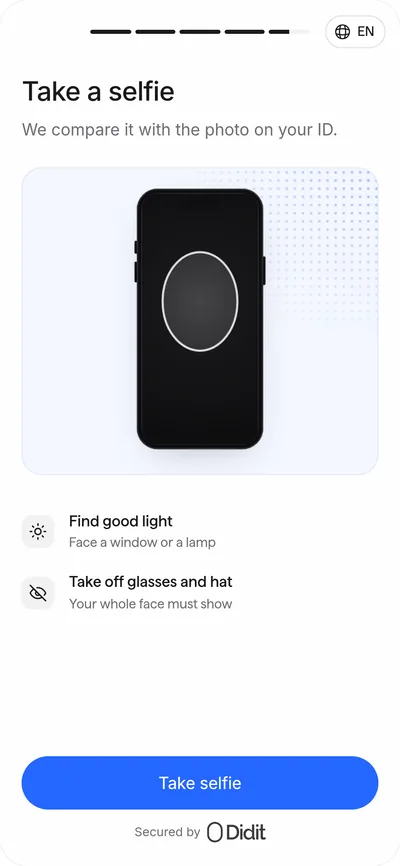
- Turn on the biometric consent step where it applies. Go to the application's Settings, Data and privacy, Biometric consent, and choose Auto, Always or Never. Auto shows the step only where a trigger applies: a covered state you declared, an IP in Illinois, Texas or Colorado, a US location whose state cannot be told, or an ID issued by a covered state. Always shows it to everyone whose face is captured. For native apps, use native SDK 4.10.0 or later. The hosted flow, Web SDK, and WebView can also display the step. The biometric consent docs list the decision fields.
- Record consent you collected yourself. If your own journey already captured consent, send it on Create Session so the flow does not ask twice. The decision then records
trigger: "customer_collected":
{
  "workflow_id": "YOUR_WORKFLOW_ID",
  "vendor_data": "user-42",
  "user_state": "US-IL",
  "biometric_consent": {
    "given_at": "2026-10-13T09:12:00Z",
    "text_version": "consent-v3"
  }
}
- Delete on request with the privacy erasure instruction. A routine deletion follows the application policy. A data subject erasure request uses
deletion_instruction: "privacy_erasure", which purges every retained template for that person and never retains a new one. Send your own ticket id ininstruction_idso the audit trail matches your records:
curl -X DELETE https://verification.didit.me/v3/session/<SESSION_ID>/delete/ \
-H "x-api-key: <API_KEY>" \
-H "Content-Type: application/json" \
-d '{"deletion_instruction": "privacy_erasure", "instruction_id": "dsar-2026-0142"}'
- Check what remains, then purge deliberately. List retained templates with
GET /v3/biometric-templates/, count them withGET /v3/biometric-templates/count/, and purge one withDELETE /v3/biometric-templates/{uuid}/or many withPOST /v3/biometric-templates/delete/. The same templates appear in the console under Lists, Biometric templates. The Biometric Templates API returns the retention reason, the acting principal and the expiry for each one.
Expected output
The deletion call returns 200 OK with a body that reports what happened to the biometric data:
{
  "session_id": "<uuid>",
  "session_number": 1024,
  "face_retention_outcome": "deleted",
  "biometric_template_uuid": null,
  "biometric_template_expires_at": null,
  "deleted_child_verifications": 0
}deleted: the session and its face embedding are gone. This is the default.retained_with_user: the session is gone and an image-free template with the returnedbiometric_template_uuidstays anchored to the User untilbiometric_template_expires_at, User deletion, a privacy erasure request or an explicit purge.none: the session had no face embedding, for example a KYB session or a document-only KYC session.ineligible_no_vendor_user: retention was requested but the session has no linked User, so nothing could anchor the template and everything was deleted.deleted_child_verifications: for a KYB session, how many key-people and owner verifications were deleted with it. Always 0 for a KYC session.
The deletion also drops webhooks still queued for that session, stops AML and registry monitoring started by it, and removes the files, results, reviews and activity log. Blocklist entries created from the session are not removed, and the parent User is not deleted.
Failure cases and recovery
| Failure | What you see | Recovery |
|---|---|---|
| Erasure combined with retention | 400: privacy_erasure with retain_face_embeddings: true is rejected | Remove the retain flag. An erasure request never keeps a template. |
| Session already deleted or unknown id | 404 Not Found | The endpoint is idempotent. Treat it as done and log the ticket id. |
| Console user token on a template endpoint | 403: You do not have permission to perform this action. | Authenticate with an application API key, not a console session. |
| External store unavailable during a purge | 503, template status purge_failed | The template is already excluded from matching. Repeat the purge. |
| Bulk purge with no selector | 400: template_uuids is required unless delete_all is true | Send a list of template ids, or delete_all plus filters. |
| Native SDK older than 4.10.0 when consent was required | Decision shows BIOMETRIC_CONSENT_UNSUPPORTED_SDK with status: pending | Upgrade the SDK, or collect consent in your own journey and send it on Create Session. |
Unknown user_state value | 400 on Create Session | Send an ISO 3166-2 subdivision such as US-IL, or a state code or name. |
| Share token expired or addressed to another app | 400 Share token has expired. or This token is not valid for this application. | Mint a new token. The TTL runs from 60 to 86400 seconds and a token cannot be revoked, only expired. |
Inputs and outputs
| Input | Sent where | Example | Output it changes |
|---|---|---|---|
workflow_id | Create Session | application workflow UUID | Which modules run, therefore which data exists at all |
user_state | Create Session | US-IL | Whether the consent step is shown, with trigger: declared_state |
biometric_consent | Create Session | given_at plus text_version | status: given and trigger: customer_collected on the decision |
| Retention window | Console, App Settings, Data retention | 1 year | Deletion date for every session in the application |
face_retention_policy | PATCH /v3/webhook/ | retain_until_user_deleted | What happens to the embedding at deletion time |
face_retention_days | PATCH /v3/webhook/ | 365 | The template expiry returned in biometric_template_expires_at |
deletion_instruction | Delete Session | privacy_erasure | Purges every retained template for the person |
instruction_id | Delete Session | dsar-2026-0142 | Your reference on the audit trail and on retained templates |
trust_review | Import Shared Session | false | Whether a shared session is cloned as Approved or forced to In Review |
Paid steps and review boundaries
Privacy controls are configuration. The charges come from the checks themselves: ID document verification $0.15, passive liveness $0.10, face match 1:1 $0.05, device and IP analysis $0.03, AML screening $0.20, proof of address $0.20, email verification $0.02, wallet screening $0.15 per screening, Face Search 1:N $0.05 per search, business verification from $2.00 per company. Phone codes carry the carrier price for the country and channel plus our $0.02 fee, so for example a US SMS code is $0.0473 on the live feed. Deletion, retention settings, consent and the orchestrator have no line in the price book, and Reusable KYC is listed as Free. Every number in this section is read from the public list on didit.me/pricing.
Two boundaries to write into your runbook. First, credits already consumed by a verification are not refunded when you delete the session, so deletion is a compliance action, not a billing one. Second, deletion does not rewrite everything: blocklist entries created from the session stay in your lists, and the parent User or Business record stays until you call POST /v3/users/delete/ or POST /v3/businesses/delete/. Human review has its own boundary too. When a shared session arrives with trust_review: false, your reviewers must decide again, even if the source application approved it.
Controller checklist: owner and evidence for each decision
Each of these decisions needs one named owner and one artifact you can show a regulator or an enterprise customer. This is the minimum set that holds up in an audit file.
| Decision | Owner | Evidence record |
|---|---|---|
| Modules run per risk tier | Head of financial crime or risk | The workflow configuration, plus the risk assessment that names each module |
| Retention window | Data protection officer | The saved policy in Business Console, App Settings, Data retention, and the retention schedule it implements |
| Biometric template retention | Data protection officer with fraud | The saved policy with a finite face_retention_days, and the privacy notice clause that covers it |
| Biometric consent mode | Legal counsel with product | The mode set in Settings, Data and privacy, Biometric consent, and the biometric_consent object returned on each decision |
| Erasure execution | Privacy operations | The Delete Session response with face_retention_outcome, matched to your instruction_id and the request ticket |
Worked cost example
Take 10,000 new users a month, each running a full ID check plus AML screening. The arithmetic below uses list prices before Growth's 4% discount and before any monthly plan credit is applied, so it is the ceiling on both Free and Growth:
- ID document: $0.15 x 10,000 = $1,500
- Passive liveness: $0.10 x 10,000 = $1,000
- Face match 1:1: $0.05 x 10,000 = $500
- Device and IP analysis: $0.03 x 10,000 = $300
- KYC subtotal: $3,300, which is $0.33 x 10,000
- AML screening: $0.20 x 10,000 = $2,000
- Total per month: $5,300, or $0.53 per user
- Ongoing AML monitoring, if you keep re-screening them: $0.07 x 10,000 = $700 per year
Deletion calls for the users who exercise their rights add nothing to the bill.
On Scale every Didit price is 10% lower, so the same month is $0.297 x 10,000 = $2,970 for KYC plus $0.18 x 10,000 = $1,800 for AML, a total of $4,770, against the $299 monthly fee and its $350 of monthly credit.
Reusable KYC carries no separate price line (Reusable KYC docs), so if 2,000 of those users are verified once and shared into a second application, the second application pays no verification line for them.
Sources
- Didit docs: Data Retention and Deletion, GDPR privacy controls
- Didit docs: Delete Session API
- Didit docs: Biometric Templates API
- Didit docs: Biometric consent for BIPA, CUBI and Colorado
- Didit docs: Security and compliance
- Didit docs: Reusable KYC, verify once and share across apps
- Didit docs: Data models for every report object
- Didit docs: Pricing and billing terms
- Didit pricing page and live price feed, read November 26, 2026, and didit.me/llms-full.txt
- Regulation (EU) 2016/679 (GDPR): eur-lex.europa.eu
- FATF Recommendations, customer due diligence: fatf-gafi.org
This page is a configuration guide for Didit and makes no third-party product claims, so no competitor pages are cited here. Start in the sandbox at https://business.didit.me/, with no sales call. Build one workflow, set the shortest retention window your record-keeping duties allow, and run one erasure call before you send live traffic.
Try it
Try this in the sandbox
Run the check this guide describes, free.
The product this post is about, taken from its topic. Run it free in the sandbox.
Author
Alberto Rosas
Co-founder and CEO

Keep reading
Other guides in the same topic.
 What Is the Purpose of FICA in South Africa? 2026 Guide
FICA is South Africa's anti-money laundering law. It creates the Financial Intelligence Centre and requires accountable institutions to identify and verify clients, screen for PEP and sanctions risk and report suspicious.
Alberto RosasNov 26, 2026 Sixth Money Laundering Directive (6AMLD): What Changed and Which Rules Apply
6AMLD is Directive (EU) 2018/1673: Member States must criminalise laundering, widen predicate offences and set a four-year penalty floor. It adds no new due diligence duties for firms.
Alberto RosasNov 26, 2026 Automated Sanctions Screening: Canada, the Entity List and Embargoes
Automated sanctions screening matches people and companies against lists such as Canada's autonomous sanctions made under SEMA and JVCFOA and the OFAC SDN List, and returns candidate hits scored for identity confidence and.
Alberto RosasNov 26, 2026Questions
Frequently asked questions
What does privacy-preserving identity verification mean?
It means confirming a person's identity for a legal or risk purpose while collecting, keeping and sharing the least personal data that purpose allows. In practice it is four settings: which checks run, how long results are stored, whether biometric consent was captured, and how deletion is executed and evidenced.
How long does Didit store verification data?
You choose a window from 1 month to 10 years in Business Console under App Settings, Data retention. A new application starts at the longest window its plan includes: 1 year on Free, 5 years on Growth, 10 years on Scale and unlimited on Enterprise. At the end of the window the session is deleted exactly as by the Delete Session call.
Can I delete a verification session through the API?
Yes. Send DELETE https://verification.didit.me/v3/session/{session_id}/delete/ with your API key and the delete:sessions privilege. It returns 200 OK with a body that reports the outcome for the face biometric data, and it is idempotent, so a repeated call is safe.
Does deleting a session delete the face biometric data?
By default, yes. The face embedding that powers duplicate detection and Face Search 1:N is deleted with the session, and the response shows face_retention_outcome: deleted. Applications that opted in to biometric template retention get retained_with_user with an expiry instead.
What is a retained biometric template and when should I enable it?
It is one image-free face template, anchored to the User, that survives an operational session deletion so duplicate detection keeps working. It contains no face image, video, document data or extracted fields, but it is still biometric data with a finite expiry. Enable it only when your controller instruction and privacy notice cover it, and pick the shortest period between 1 and 3650 days that your fraud case needs.
When do I need a biometric consent step?
Illinois, Texas and Colorado require a notice and explicit release before a business collects face geometry, whether from a selfie or from the photo on an ID. Didit can show that step before the first face capture and store the answer on the session as evidence. It needs the hosted flow, a Web SDK or WebView, or native SDK 4.10.0 or later.
Is Didit the data controller or the data processor?
Didit acts as a data processor and you remain the data controller. That is why the retention window, the template policy and the erasure instruction are yours to set. You can request the DPA and the TOMs at privacy@didit.me.
Where is Didit data processed?
Each application's data location is chosen when the application is created, with the European Union (Ireland) as the default. Australia (Sydney), Mexico, the United Arab Emirates and the United States (N. Virginia) are coming soon, and Enterprise accounts can enable in-country processing subject to availability and contract.
Does deleting a session refund the credits?
No. Credits already consumed by the verification are not refunded when you delete the session, because the check was performed. Treat deletion as a compliance action and budget the verification normally.
Can a user reuse one verification instead of verifying twice?
Yes, with Reusable KYC. The source application mints a share token with POST /v3/session/{sessionId}/share/ and the receiving application redeems it with POST /v3/session/import-shared/. The token lives from 60 to 86400 seconds, can be redeemed once per application, and the cloned session records shared_from_session for audit.
How much does a privacy-preserving KYC check cost?
A full ID check is $0.33 per completed check: ID document verification $0.15, passive liveness $0.10, face match 1:1 $0.05 and device and IP analysis $0.03. AML screening adds $0.20, ongoing AML monitoring is $0.07 per person per year, and retention, consent and deletion carry no line in the price book.
Which certifications support the privacy claims?
Didit holds SOC 2 Type 2, ISO/IEC 27001:2022 certification, iBeta Level 1 and Level 2 under ISO 30107-3, GDPR compliance, FSM youth-protection certification and an EU AI Act ready posture, with an independent legal opinion confirming EBA remote onboarding and MiCA compatibility. Data is encrypted in transit with TLS 1.3 and at rest with AES-256, and every action is written to an audit log whose readable history depends on your plan.
Compliance built in
Audited, certified and attested.
We hold the certifications and build each country's rules into your flows, so you can launch anywhere without worrying. Security and Compliance center
- Regulation encoded into your flows
Tell us what you do and where. Didit lists the rules that apply to you, with sources, and builds the checks each country needs into one workflow.
- Ready for AMLR
Every requirement of the new EU anti-money laundering rules, from checking customers to human review, is already covered by a Didit check.
- Tested in Spain's Treasury sandbox
Spain's Treasury published its supervised sandbox report on Didit's NFC plus active liveness onboarding; SEPBLAC took part and valued the added measures positively.
- Audited, not self-declared
iBeta Level 1 and Level 2. Liveness tested under ISO/IEC 30107-3.
Your obligations · 3 regions
 SOC 2 Type 2
 ISO 27001
 iBeta Level 1 and Level 2
 EU regulator attestation
 FSM youth protection
 GDPR
 EBA remote onboarding
 MiCA compatible
 FIDO Alliance member
- AMLREU AML Regulation ready
Integration · Didit MCP
Run Didit from your own AI agent
Connect Didit to Claude, Cursor, VS Code or ChatGPT and just ask in plain words. Your agent can do anything you can do in the console, with the same permissions you have.
 Add to Claude
 ChatGPT
 Cursor
- Build workflowsDescribe the checks you need. The agent creates and publishes the flow.
- Run investigationsAsk why a session was declined, review cases, search people and companies.
- Change rulesCreate payment rules, test them on past data and switch them on.
- Pull reportsAsk for numbers, exports or the audit log.
Didit Academy


