Can KYB Verify a Company Incorporated Last Week?
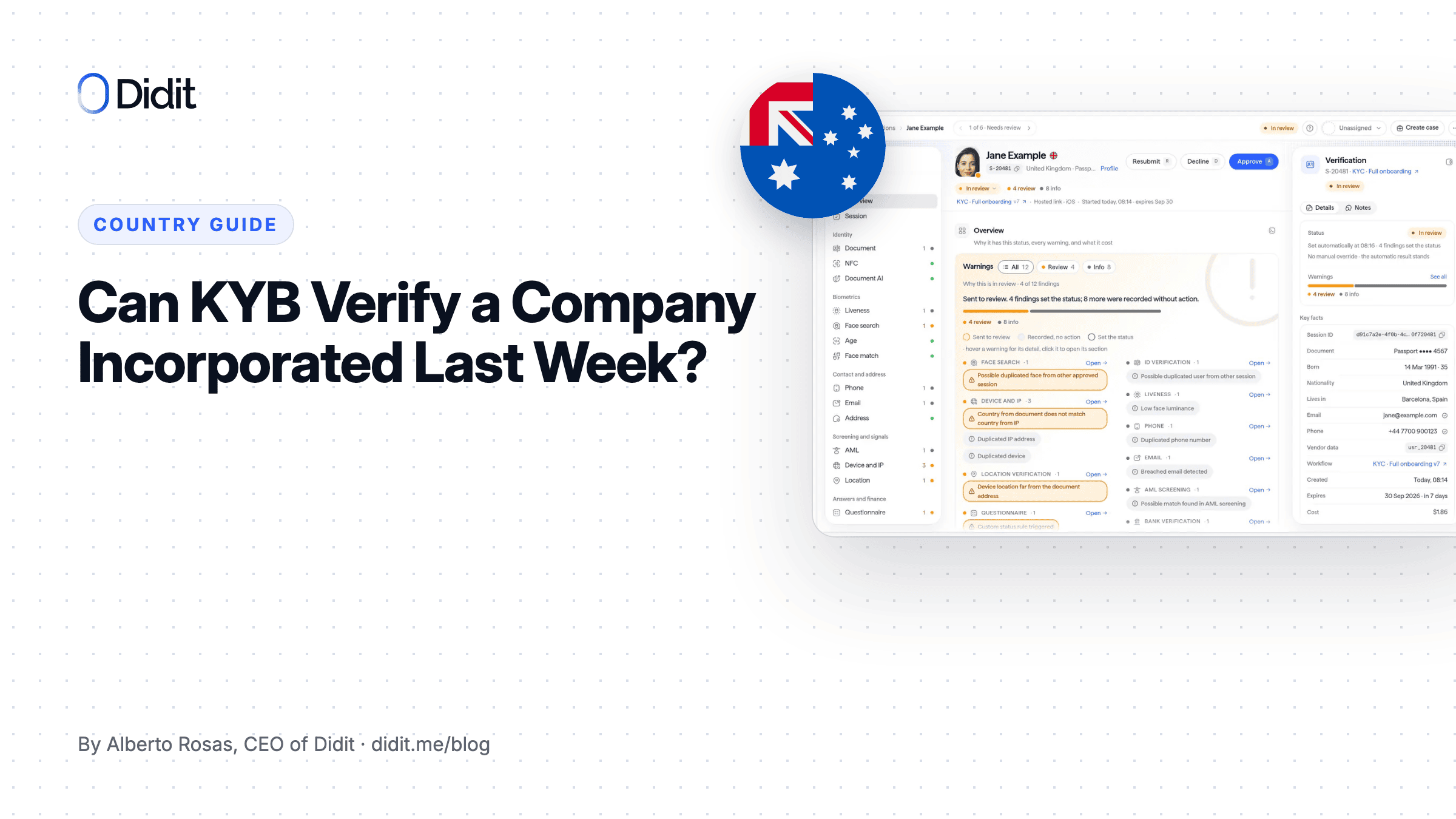
Yes. Lite registry checks read the national register and find companies as soon as the national register lists them, including Australian companies with an ACN but no ABN yet.
 Alberto RosasCo-founder and CEO
Contents
In this guide
Jump to the part you need.
Yes. If you onboard companies in Australia, Singapore, Hong Kong or Japan and the applicant was incorporated last week, a Lite registry check finds it as soon as the national register lists it. Lite costs $2.00 per company in Australia and $3.00 in Singapore, Hong Kong and Japan. The caveat is registry data: a newly incorporated company often has no shareholder or UBO record filed yet, so confirm ownership from documents and Key People.
Last updated: November 26, 2026. Prices checked against the live Didit price feed on November 26, 2026.
| Market | What the Lite check reads | Lite price | Catch for a company registered last week |
|---|---|---|---|
| Australia | National company register (ASIC) | $2.00 | The ACN exists from registration day; an ABN may not be available yet and does not block the match |
| Singapore | National company register (ACRA) | $3.00 | Status and registered address are the first fields to check; shareholder and officer detail depends on what the register holds |
| Hong Kong | National company register | $3.00 | Legal form and incorporation date return; ownership tier depends on what the register holds |
| Japan | National company register | $3.00 | Same as Hong Kong; officer data only where the register publishes it |
Start free in the sandbox at business.didit.me, with no sales call. Developers can connect Didit to an AI assistant through the MCP server. The product page is Business Verification, and every list price sits on didit.me/pricing.
Register coverage and what you must verify, market by market
Newly incorporated is not a category in the rules. The job is the same as for any business customer: identify the legal entity, confirm it exists and is active, identify the people who own or control it, and screen everyone. Four jurisdictions, four evidence trails. We run these checks for 4,000+ companies.
Australia: the ACN exists before the ABN
ASIC issues the Australian Company Number, a unique 9-digit number, to a company once it is registered under the Corporations Act 2001 (ASIC, Register a company, read November 26, 2026). The ACN is issued at registration. An Australian company can have an ACN while its ABN is not yet available, and the registry lookup can run on the name, the registration number, or both combined. That is the practical answer to the ACN-without-ABN question.
ASIC's free search returns company or organisation name, type, ABN/ACN/ARBN/ARSN, registration date, next review date, registered office suburb, state and postcode, and the list of documents lodged (ASIC, Company and organisation registers, read November 26, 2026). You can search by company or organisation name, a business name held by the organisation, an ACN, ARBN or ARSN. Note that the free view shows the registered office at suburb level, not the full street address. ASIC can identify foreign companies operating in Australia with an ARBN. Registration currently costs $524 or $636 for most companies, and a name reservation on Form 410 is $65 for up to two months (ASIC, Register a company, read November 26, 2026). Those are ASIC's fees, paid to ASIC.
Singapore: status and registered address first
ACRA's own guidance is direct: the free entity search on Bizfile can be used to check that a business has a live status in ACRA's register and a valid registered address (ACRA, Basic risk assessment, read November 26, 2026; the page was last updated January 30, 2026). Paid Bizfile profiles add depth: a Business Profile costs $5.50, and a People Profile costs $33 and shows businesses registered to a person, current and past appointments, and shareholding amounts. BizQuery on OneMap, provided by ACRA and the Singapore Land Authority, is another route to find businesses. Those prices belong to ACRA, not to us.
Hong Kong and Japan
For both markets, Lite queries the national company register and returns the fields the register publishes: legal name, registration number, status, legal form, incorporation date and registered address. Officer data is returned only where the relevant register publishes it. Incorporation date is what proves the company is one week old, and the status field is what tells you it is still active. Our source cards cover Australia and Singapore only, so we describe what the registry check returns here and leave the local legal analysis to your counsel.
What Didit returns: identifiers and fields
We sell registry data in three tiers, priced by country and tier: Lite, Shareholders and UBOs (KYB supported countries). Lite is the entry tier and the one that answers the existence question.
| Field | What it settles | Why it matters at week one |
|---|---|---|
company_name | Legal name as registered | Match it against the name on the contract |
registration_number | Official registration or incorporation number | The ACN in Australia, the registry number elsewhere |
registry_status | Active, dissolved, struck off, in liquidation, dormant | A new company should read active |
incorporation_date | Date the company was registered | Proves the company really is one week old |
company_type | Legal entity type: Ltd, LLC, PLC, SA, GmbH | Settles legal form before you contract |
registered_address | Official registered office | Compare with the address on the documents |
tax_number | Tax identification number where available | Often missing for a brand-new entity |
is_from_registry | True for a registry match, false for manual entry | Tells you whether the register confirmed anything |
Two status fields track the lookup itself. fetch_status is pending, resolved or failed, and verification_status is verified, failed or unknown (Company registry API).
Finding the entity versus proving ownership
Lite answers whether the legal entity exists and is active. Proving ownership is separate: Shareholders returns direct shareholders where the register holds them, UBOs resolves the ownership chain, documents collect the certificate of incorporation and shareholder register, and Key People records each person with role tags. For a company registered last week, start with Lite, then build ownership from documents and Key People when the register has no filed ownership record.
Why a company registered last week usually settles at Lite
Ownership tiers need ownership records. A newly formed company often has no shareholder register or annual return on file yet. Our docs state it plainly: a Shareholders or UBOs request in a country whose registry holds no ownership record is still delivered. The request is billed at the highest tier the country's registries can serve, usually Lite, even when the register has no ownership record (KYB supported countries). You also do not get shareholders you cannot see, so for a week-old company plan to build the ownership picture from documents and key people.
Officer data is returned only where the relevant register publishes it. Key people records cover directors, secretaries, representatives, authorized signatories, shareholders and UBOs, and one person can carry several roles at once; a founder who is also a director and a UBO holds three tags on one record (KYB officers and representatives). Key people extraction has no separate fee. The paid registry tier supplies the ownership data, and linked KYC and person AML are billed per person.
Step by step in the Business Console
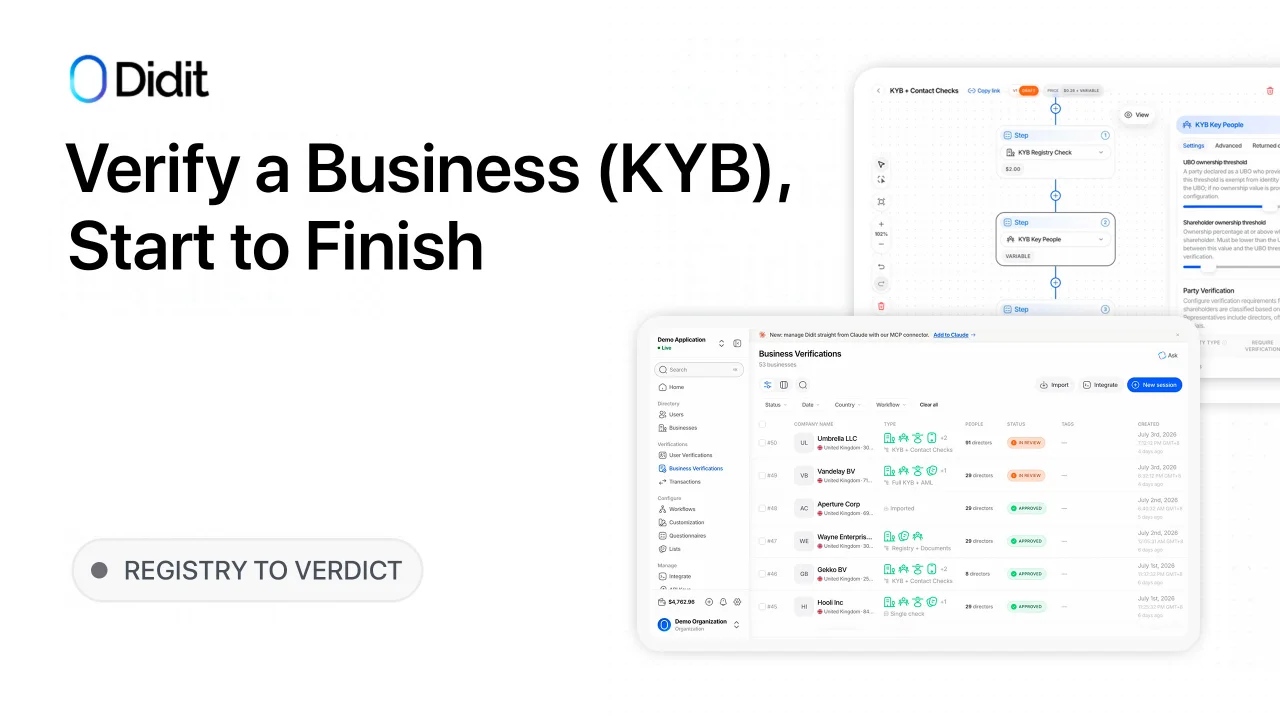
- Create the workflow: Workflows, then Create workflow, then choose Business Verification. Enable Company registry lookup, Company AML, Key People and any documents you require. Save and copy the workflow ID.
- Optionally prefill the search. Pass
expected_detailswithcompany_name,registry_countryandregistration_number; the hosted flow pre-selects and locks the country, prefills the fields and runs the asserted search, so the applicant lands on their own company. Both fields stay editable. - Let the applicant confirm. They can search exact or contains, review the candidates and select the match. Didit links the selected company and populates every field the register returns. They confirm or correct the details.
- Add key people. Registry officers appear where available, and the applicant can enter directors, shareholders and UBOs manually; the registry people show up as the ownership report arrives.
- Collect documents. For a company registered last week the certificate of incorporation is the obvious one, with proof of the registered address, articles of association and a shareholder register if one exists.
- Decide with the console. The session reads Approved, In Review or Declined, analysts can request more documents and leave comments, and warnings surface per feature.

Step by step via the API
The session endpoint is the same one KYC uses. A KYB workflow marks the session as a business session automatically (KYB quickstart).
curl -X POST https://verification.didit.me/v3/session/ -H "x-api-key: YOUR_API_KEY" -H "Content-Type: application/json" -d '{"workflow_id": "YOUR_KYB_WORKFLOW_ID", "vendor_data": "biz-au-newco-001", "expected_details": {"company_name": "Example Pty Ltd", "registry_country": "AU", "registration_number": "123456789"}}'The response carries session_id, session_number and url. Send the url to the company contact. When processing reaches a terminal status, Didit posts a status.updated event with session_kind set to business; verify the X-Signature-V2 HMAC before trusting it and de-dupe on event_id. To fetch the decision on demand:
curl https://verification.didit.me/v3/session/{session_id}/decision/ -H "x-api-key: YOUR_API_KEY"The decision contains registry data, key people bucketed into registry and submitted, AML screenings and document verifications. Branch on Approved, Declined, In Review or Resubmitted, and on Awaiting User while a child KYC session for a director is still pending (KYB integration guide).

Fallbacks when the register is down or has no match
- Provider outage: the search returns a
502with codekyb_registry_provider_unavailable, the call is not billed, and the hosted flow offers manual company entry instead of a retry-only error. - No match: the applicant submits company data manually and
is_from_registryis set to false. The session continues on the submitted data, so a register that has not listed the company yet does not block onboarding, it changes what you can prove. - Lookup still running:
fetch_statusstays pending andverification_statusstays unknown. A pending ownership report does not count as a completed registry check, and billing uses the tier actually delivered. - Country not enabled: the registry check raises the
KYB_COUNTRY_RESTRICTEDwarning. Add the country to the workflow before the session runs. - Register lists the company but holds no ownership record: the request bills at the highest tier the register can serve, usually Lite, and ownership comes from documents and key people.
- Registry changes later: registry monitoring costs $2.00 per company a year, and a registry-reported change triggers a
data.updatedevent on the linked business session.
Worked cost example
One Australian company incorporated in the previous week, two directors who are also the only shareholders, and one document step.
- Lite registry check, Australia: $2.00
- Company AML screening: $0.20
- Person AML, two people at $0.20: $0.40
- Linked full ID check, two people at $0.33: $0.66
- KYB documents, one step: $0.20
Total: 2.00 + 0.20 + 0.40 + 0.66 + 0.20 = $3.46 per company.
The same case in Singapore starts at Lite $3.00: 3.00 + 0.20 + 0.40 + 0.66 + 0.20 = $4.46. Ten Singapore companies a month is $44.60 at list price. Re-uploads inside the document step do not add another $0.20, and key people extraction carries no fee of its own. Plan discounts of 4% on Growth and 10% on Scale apply to Didit prices and are read from didit.me/pricing before you quote.
If you only need to know whether the company exists before opening a full session, the standalone company search costs $0.50 per successful paid-source search, and empty results, failed searches and results served only by other sources are not charged; a later profile retrieval is billed separately (KYB registry API).

Sources
- Didit docs: Business Verification API (KYB) overview
- Didit docs: Company registry API
- Didit docs: KYB supported countries
- Didit docs: KYB officers and representatives
- Didit docs: KYB quickstart
- Didit docs: KYB integration guide
- Didit docs: KYB registry API
- Didit docs: KYB registry pricing
- Didit pricing, price feed read November 26, 2026
- ASIC, Company and organisation registers, read November 26, 2026
- ASIC, Register a company, read November 26, 2026
- ACRA, Basic risk assessment, read November 26, 2026
Open the sandbox and run one check against a company you already know, then the same check against a company registered last week: business.didit.me. No sales call, no contract, and the free plan includes $10 of monthly credit for organizations that sign up with a work email.
Try it
Try this in the sandbox
Run the check this guide describes, free.
The product this post is about, taken from its topic. Run it free in the sandbox.
Author
Alberto Rosas
Co-founder and CEO

Keep reading
Other guides in the same topic.
 What Is the Purpose of FICA in South Africa? 2026 Guide
FICA is South Africa's anti-money laundering law. It creates the Financial Intelligence Centre and requires accountable institutions to identify and verify clients, screen for PEP and sanctions risk and report suspicious.
Alberto RosasNov 26, 2026 Sixth Money Laundering Directive (6AMLD): What Changed and Which Rules Apply
6AMLD is Directive (EU) 2018/1673: Member States must criminalise laundering, widen predicate offences and set a four-year penalty floor. It adds no new due diligence duties for firms.
Alberto RosasNov 26, 2026 Automated Sanctions Screening: Canada, the Entity List and Embargoes
Automated sanctions screening matches people and companies against lists such as Canada's autonomous sanctions made under SEMA and JVCFOA and the OFAC SDN List, and returns candidate hits scored for identity confidence and.
Alberto RosasNov 26, 2026Questions
Frequently asked questions
Can KYB verify a company that was incorporated last week?
Yes, if the national register already lists it. Didit's Lite check queries the national company register in Australia, Singapore, Hong Kong and Japan and returns the company as soon as the register carries it. What you cannot assume is ownership data: shareholders and UBOs often appear only after the first filings.
How soon after incorporation does a company appear in a registry check?
In these four markets, a company can appear as soon as the register lists it. The Australian ACN is issued at registration, so the register match can exist from day one. The lookup runs against the official register; availability still depends on that register listing the company.
Does an Australian company with an ACN but no ABN yet pass a KYB check?
Yes. The ACN is a unique 9-digit number issued to a company once it is registered with ASIC under the Corporations Act 2001, and the registry lookup runs on the name, the registration number, or both combined. An ABN is a separate tax identifier, and an Australian company can have an ACN while its ABN is not yet available. ASIC's free search shows whichever identifiers the record holds.
What does a Lite check return for a newly incorporated company?
Company name, registration number, country, status, legal form, incorporation date, registered address and tax number where available. Officers are included where the register publishes them. Lite costs $2.00 in Australia and $3.00 in Singapore, Hong Kong and Japan.
Why was my one-week-old company not found?
The usual reasons are that the register has not listed it yet, the identifier was typed differently from the register, or the country is not enabled in your workflow. Registration numbers are normalised where a register requires it, and when both a name and a number are supplied the lookup combines them. With no match, the applicant can submit company data manually and the session continues with is_from_registry set to false.
Can I verify shareholders and UBOs of a company registered last week?
Only to the extent the register holds a record. A Shareholders or UBOs request in a country whose registry has no ownership record is delivered and billed at the highest tier the registries can serve, usually Lite. For a brand-new company, capture ownership through documents and Key People instead of waiting for a filing.
What happens if the registry provider is down?
The search returns a 502 with code kyb_registry_provider_unavailable and the call is not billed. In the hosted flow the business is offered manual company entry rather than a retry-only error.
How much does it cost to verify a company incorporated last week?
In Australia, $3.46 for a two-director company with company AML, person AML, linked KYC and one document step: $2.00 Lite plus $0.20 plus $0.40 plus $0.66 plus $0.20. In Singapore the same case is $4.46 because Lite is $3.00. Prices are per completed check, billed from prepaid credit.
Does a new company have less AML history?
AML screening on a newly incorporated company reflects the sanctions, adverse-media and enforcement data available at the time of screening. A clean result means no match in that data at that time, not that the company has a trading history.
Can I keep monitoring the company after onboarding?
Yes. Registry monitoring costs $2.00 per company a year and ongoing AML monitoring costs $0.07 per person a year. When the register reports a change, Didit sends a data.updated event on the linked business session.
Compliance built in
Audited, certified and attested.
We hold the certifications and build each country's rules into your flows, so you can launch anywhere without worrying. Security and Compliance center
- Regulation encoded into your flows
Tell us what you do and where. Didit lists the rules that apply to you, with sources, and builds the checks each country needs into one workflow.
- Ready for AMLR
Every requirement of the new EU anti-money laundering rules, from checking customers to human review, is already covered by a Didit check.
- Tested in Spain's Treasury sandbox
Spain's Treasury published its supervised sandbox report on Didit's NFC plus active liveness onboarding; SEPBLAC took part and valued the added measures positively.
- Audited, not self-declared
iBeta Level 1 and Level 2. Liveness tested under ISO/IEC 30107-3.
Your obligations · 3 regions
 SOC 2 Type 2
 ISO 27001
 iBeta Level 1 and Level 2
 EU regulator attestation
 FSM youth protection
 GDPR
 EBA remote onboarding
 MiCA compatible
 FIDO Alliance member
- AMLREU AML Regulation ready
Integration · Didit MCP
Run Didit from your own AI agent
Connect Didit to Claude, Cursor, VS Code or ChatGPT and just ask in plain words. Your agent can do anything you can do in the console, with the same permissions you have.
 Add to Claude
 ChatGPT
 Cursor
- Build workflowsDescribe the checks you need. The agent creates and publishes the flow.
- Run investigationsAsk why a session was declined, review cases, search people and companies.
- Change rulesCreate payment rules, test them on past data and switch them on.
- Pull reportsAsk for numbers, exports or the audit log.
Didit Academy


