
App Store Accountability Acts: Texas, Utah, Louisiana, Alabama
The four App Store Accountability Acts in one developer table: dates that count today, who verifies age, your duties, which age wins when yours differs, penalties, and what Google Play and Apple say per state.
In short
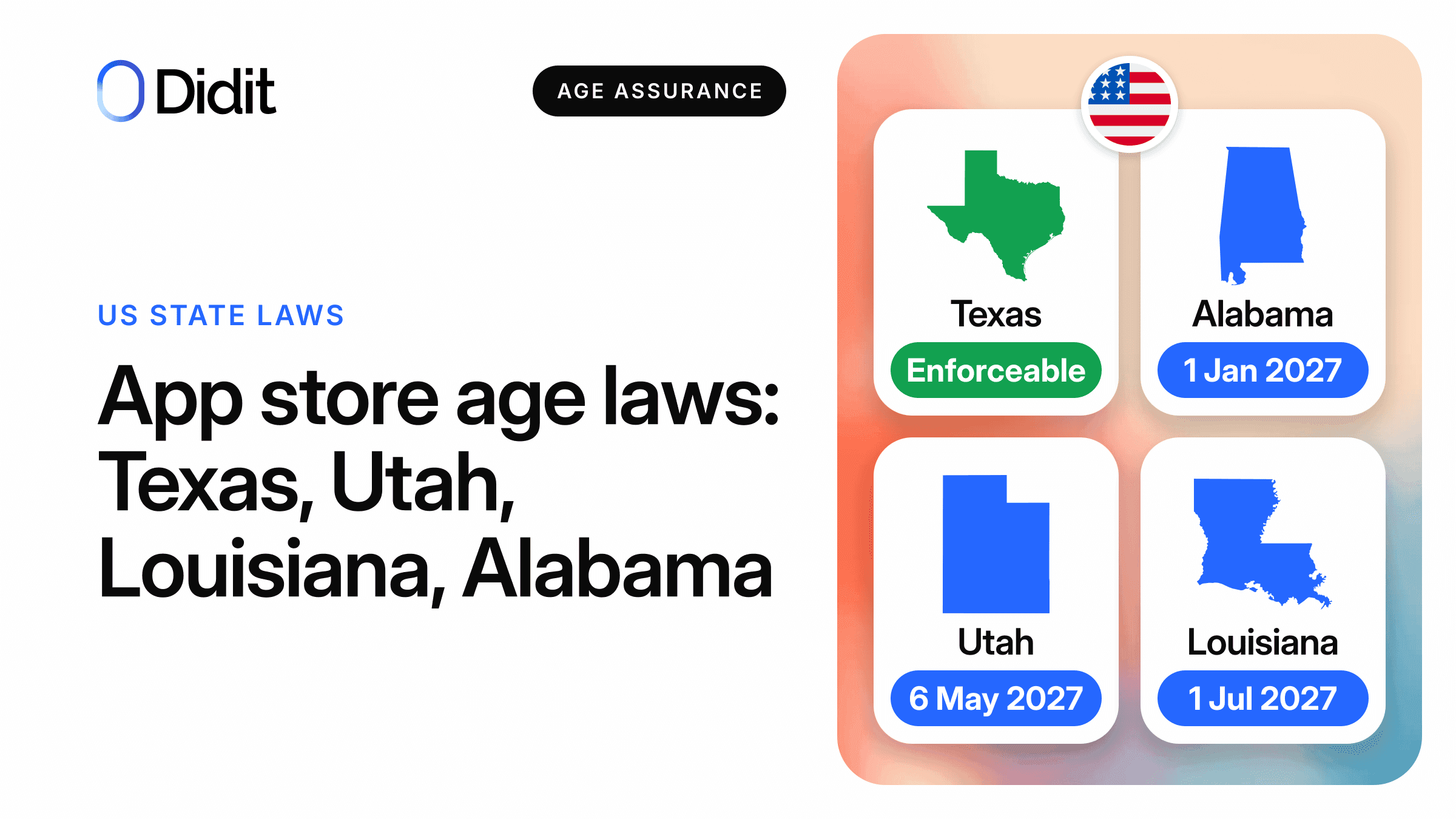
An App Store Accountability Act makes the app store verify a user's age category, get a parent's consent for minors and pass both facts to your app. Four states have one: Texas (enforceable now, appeal pending), Alabama (1 January 2027), Utah (6 May 2027) and Louisiana (1 July 2027).[1][2][6][9][10]
- Your core duty is to ask the store, use the answer, report significant changes and not pass the data on.[1][6][9][10]
- None of the four tells every developer to verify age itself. If you already do, the conflict rule differs by state.[1][6][9][10]
- Alabama's court case is reported paused while rules are written. The date in the Act has not moved.[10][14]
This App Store Accountability Act guide is for developers, founders and counsel deciding what the app does in each state. Every status is as of 22 November 2026.
If you came here from Google's November email, start with what changes in the Play Age Signals API in January 2027. This page covers the law behind the signal, outside California.
The short version
- 4 June 2026TexasFifth Circuit stays the injunction; SB 2420 enforceable[2]
- 1 January 2027AlabamaHB 161 takes effect[10]
- 6 May 2027UtahDeveloper duties begin[6]
- 1 July 2027LouisianaAct 185 takes effect[9]
- 2028CO and ILDeclared-age laws begin[25][26]
Two dates are often wrong. Utah's developer duties begin on 6 May 2027, not in May 2026.[5][6] Louisiana's first law, Act 481 of 2025, "shall not become effective"; Act 185 replaces it from 1 July 2027.[9]
Two models: the store verifies, or the device declares
Texas, Utah, Louisiana, Alabama
The app store verifies
- The store verifies an age category when an account is created
- A minor's account is linked to a parent's, and the store gets the consent
- You check category and consent through the store
- You tell the store about significant changes
SB 2420, SB 142 and HB 498, Act 185, HB 161
California, Colorado, Illinois
The account holder declares
- A birth date or age is declared at device or account setup
- These signal laws ask no parent for consent to a download
- You request a signal and use it
- No significant-change notice
AB 1043 and AB 1856, SB 26-051, Public Act 104-0664
All four store-verification Acts use the same categories: under 13, 13 to 15, 16 to 17, and 18 or over.[1][5][9][10] California has its own page: read AB 1043 and AB 1856 for the signal and the four California rules for 2027 for what plugs into it.
The comparison table: law, date, duty, conflict rule, penalty
| Law | In force | Who establishes age | Developer duty | If your own age differs | Own check | Penalty and enforcer | Google Play today | Apple today |
|---|---|---|---|---|---|---|---|---|
| Texas SB 2420[1] | Enforceable since the Fifth Circuit lifted the injunction (28 May and 4 June 2026); appeal pending[2][13] | Store, commercially reasonable method, at account creation | Rate app and each in-app purchase; notify significant change; verify category and consent with store data; delete it after | No conflict rule; a separate good-faith reliance defense | Not required, not mentioned; social platforms keep duties under other law | Deceptive trade practice; up to $10,000 per violation, Attorney General[1][4] | Verifies eligible users; returns age range and significant-change status[15] | Accounts created on or after 4 June 2026; range always shared, cannot be turned off[19] |
| Alabama HB 161[10] | 1 January 2027; lawsuit reported paused, no injunction found[14] | Store, commercially available method or a system under Attorney General rules | Verify category and consent via store; notify significant change; limited use; no sharing | Lowest category, for your restrictions, safety features and defaults | Contemplated, not required | Up to $7,500 per knowing or reckless violation, Attorney General only | "Details coming soon."[15] | No Apple page found |
| Utah SB 142, HB 498[5][6] | 6 May 2027; stores have 12 months for existing accounts | Store, commercially available methods, parent attestation for minors | Verify category and consent via store; notify significant change; limited use; no sharing | Lowest category, when first setting safety features and defaults | Contemplated, not required | Minor or parent may sue: actual damages or $1,000 per violation[7] | No row[15] | February note said 6 May 2026, before HB 498; not in October list[21][22] |
| Louisiana Act 185[9] | 1 July 2027 | Store, commercially available methods, at account creation | Verify category and consent via store; notify significant change; use the signal for minimum ages, law and defaults; no selling | Store signal, unless you actually know yours is more accurate: then yours, or the lower | Required for R.S. 9:2800.29 publishers; otherwise proof of age contemplated | Up to $10,000 per violation, Attorney General, 45-day cure | No row[15] | February note said 1 July 2026, before Act 185; not in October list[21][22] |
| California AB 1043, AB 1856[24] | 1 January 2027 | Account holder declares | Request the signal; treat it as primary indicator; no sharing | Internal clear and convincing information wins | Not required | $2,500 or $7,500 per affected child, Attorney General | Age range on a mandatory basis from January 2027[15] | No Apple page found |
Status on 22 November 2026. Unless a cell cites another source, the facts in a row come from the law cited in its first cell.
Google writes that it "doesn't mandate the use of these features" and that it is your responsibility to determine whether and how the laws apply to your app.[16] The duty comes from the state, not from Google. The two signals differ too: see Play Age Signals and Declared Age Range.
Map your app to these states
Get a demo of age estimation in your app: where the store answer is enough, and where your own check fits.
Texas SB 2420: enforceable now, appeal pending
SB 2420 was due on 1 January 2026.[1] A federal judge enjoined it on 23 December 2025.[13] The Fifth Circuit lifted that injunction in two steps, an administrative stay on 28 May and a full stay on 4 June 2026.[2][13] On 6 July the Supreme Court declined to vacate the stay, which is not a merits ruling.[3] The appeal was argued on 4 August; a November law-firm review lists it as pending, and we found no decision on 22 November 2026.[13]
Texas asks developers for the most of the four:
- Assign an age rating to the app and to each purchase that can be made in it, and give every store the rating and the reasons (121.052).[1]
- Notify every store before a significant change to the terms or privacy policy (121.053).[1]
- Build a system that uses the store's information to verify each user's category and, for a minor, the consent (121.054).[1]
- Delete the personal data the store gave you once that verification is complete (121.055).[1]
- Do not share or disclose it, and do not enforce terms against a minor without consent (121.056).[1]
The store's duty attaches "when an individual in this state creates an account", so do not expect an answer for every Texan.[1] Google says it returns signals for eligible Texas users who created accounts after 28 May 2026.[18] Apple applies its Texas rules to accounts created on or after 4 June 2026 and tells developers to request age categories through Declared Age Range.[19][20] If Play returns VERIFICATION_REQUIRED, Google says to ask the user to visit the Play Store; do not reuse that in California, where AB 1856 bars prompting a user to change age information.[24][33]
Utah: 6 May 2027, with a private lawsuit
Utah's act is SB 142 of 2025, rewritten by HB 498. The developer duties in section 13-76-202 begin on 6 May 2027.[6] You verify category and consent through the store's data sharing methods, and request the data when someone downloads or buys the app, first launches a pre-installed app, or when you make a significant change. After that, a routine accuracy check is allowed once in 12 months.[6]
Watch out
Some summaries say Utah developers cannot be sued. The Utah Code lets a harmed minor or a parent sue a developer for enforcing terms against a minor without verified consent, knowingly misrepresenting the consent disclosure, or sharing age category data. The award is the greater of actual damages or $1,000 for each violation, plus fees and costs.[6][7]
Utah's safe harbor protects a developer who relied in good faith on the store's data and met 13-76-202.[8] You may also ask a store to block minor accounts from your app.[6]
Louisiana Act 185: 1 July 2027, beyond phones
Act 185 covers apps on smartphones, tablets, computers, gaming consoles and virtual reality devices, which is wider than the other three.[1][5][9][10] Developers must use the verified signal to enforce legal minimum ages, comply with law and set age-appropriate defaults. Selling age category data is banned.[9]
R.S. 51:1773(C)(2)Louisiana Act 185 of 2026
"If the developer has actual knowledge that its internal signal is more accurate, such as if the user provided proof of age to the developer, the developer shall use its internal signal or the lower of the two signals."
Source: Louisiana Legislature, Act 185[9]
Publishers that R.S. 9:2800.29 already makes verify age in the app keep that job. Other developers with a legal duty to verify at app level "may utilize the age signal" from the store to meet it.[9]
Alabama HB 161: 1 January 2027, rules not written
HB 161 is Act 2026-59, and section 15 sets the date: 1 January 2027.[10] Stores verify existing accounts before 1 October 2027; the enrolled act and the official code print different cut-off dates for what counts as existing.[10][11]
The trade group CCIA sued on 28 October 2026 and moved for a preliminary injunction the same day.[12] On 17 November CCIA said it had agreed with the Attorney General's office to delay further proceedings until the state approves verification rules, with litigation likely to restart around summer 2027.[14] We have not seen the filing, and the report does not say whether enforcement waits too. Plan on the statute and ask counsel.
On 19 November the Attorney General opened a request for information for those rules, with responses due by 8 January 2027, after the Act starts. They cover how stores verify.[10][23]
Open point
Section 9(a)(4) tells developers to request "age category data or verifiable parental consent".[10] Squire Patton Boggs notes it is unclear whether a developer might need its own consent screen or whether the store's flow is enough.[13]
Next: Colorado, Illinois and Congress
| Measure | Status | What it means for an app |
|---|---|---|
| Colorado SB 26-051 | 1 July 2028; older devices and apps by 1 January 2029[25] | Declared age. No developer must acquire age data other than the signal; clear and convincing information prevails[25] |
| Illinois Public Act 104-0664 | Device, system and store side by 1 January 2028; operators by 1 July 2028[26] | Social platforms only. They may rely on the signal and need not verify age independently[26] |
| H.R. 3149, federal App Store Accountability Act | Not law: ordered reported 26 to 23 in March 2026[27] | No duty yet |
| H.R. 7757, KIDS Act | Not law: passed the House in June 2026[28] | The passed text does not mention app stores[28] |
We verified seven states, not all 50 legislatures. Website and adult-content laws are a different family: see age verification laws in 2026. Other countries put stores in the chain too, such as Singapore and Mexico.
Significant change and in-app purchase ratings
This duty fires on ordinary product decisions. The base is a change to the terms or privacy policy; the triggers:
| Trigger | Texas | Alabama | Utah | Louisiana |
|---|---|---|---|---|
| Data categories | Yes | Yes | Yes | Yes |
| Age rating or content description | Yes | Yes | Yes | Yes |
| Monetization | New purchases or ads, even if you had some | Only where none were previously present | First in-app purchases or first ads | New monetization features |
| Functionality or user experience | Yes | No | No | Yes |
| Age rating for each in-app purchase | Yes | No explicit duty | Rating system expressly not required | No explicit duty |
Sources: SB 2420, HB 161, HB 498 and Act 185.[1][5][9][10]
The store asks the parent again, but the gate is yours. Google says it "will not revoke app access or disable the app based on significant change approvals", and that you are responsible for restricting the changed content based on the status the API returns.[16][17] Parents read your description word for word.[17] The in-app purchase rating is separate from the content rating of the app on Play.[16]
Which age wins when yours differs
If you already hold a birth date or a check, the four Acts treat it differently.
Your own age data and the store category differ
Use the lowest category
Your data can tighten the experience, never loosen it.[6][10]
Store signal, with an exception
If you actually know yours is more accurate, use yours or the lower one.[9]
No rule in the Act
Verify with store data. Ask counsel before acting on a conflict.[1]
| Example | Alabama and Utah | Louisiana | Texas |
|---|---|---|---|
| Store 18+, your check 16 to 17 | Apply 16 to 17 to the defaults covered | You may keep 18+; with actual knowledge, 16 to 17 | No conflict rule |
| Store 13 to 15, your check 18+ | Stay at 13 to 15 for the defaults covered | 13 to 15; with actual knowledge, yours or the lower | No conflict rule; verification runs on store data |
Utah's rule applies "when initially implementing" safety features or defaults; a parent may be allowed to adjust them later. Alabama's also covers restrictions.[6][10] In Louisiana the text's example is proof of age. An age estimate is a probability, and we found no authority saying it amounts to actual knowledge.
Checklist for an app with users in these states
- List each store and state where you offer the app, with consoles and computers for Louisiana.[9]
- Request the store category at the moments each Act lists, not at every login.[6][10]
- Store the category for the allowed uses only, and delete Texas data after verification.[1]
- Keep the signal out of analytics, ads and vendors; Google's policy bars transfer to third parties except as strictly required by law.[29]
- Rate the app and each in-app purchase for Texas.[1]
- Gate changed features until the parent's approval status allows them.[17]
- Code one conflict function per state.
- Design an age-appropriate default for users with no signal.
- Recheck Texas, Alabama and Google's Alabama row before January.
What this means if you already run an age check
When the store answer is enough
If your only reason to know the age is one of these Acts and the store returned a category you have no data against, stop there. Alabama does not require a developer to collect information beyond what verifying store data needs and its ordinary business involves; Louisiana has a similar limit.[9][10] A second check on every user is hard to square with data minimization.
A check of your own earns its place in four cases: another law asks for it, as Louisiana and Alabama expressly preserve;[9][10] the signal is missing, for example an older Texas account or a sideloaded app; you also serve the web; or your own risk needs more than a category. See what to do when the signal is missing.
Start the check without the store's data, because Texas, Alabama and Utah restrict disclosing it and Google's policy does too.[1][6][10][29] Use the result only in the direction the state allows. Federally, the FTC said in February 2026 it will not bring COPPA actions against general-audience and mixed-audience operators that collect data solely to determine age, if conditions on purpose, security, deletion, notice and accuracy are met.[30]
How Didit helps after the store signal
Didit does not provide or read the store signal. It is the age verification step your app runs when you decide one is needed. Your app passes its own minimum age, never Google's or Apple's answer.
The Adaptive Age Verification workflow starts with a selfie and age estimation with liveness, then asks for an ID document only inside the borderline band you set. The estimate is not legal proof of age and does not say who the person is.[31] Age Estimation is $0.10, and a triggered document step adds ID Verification at $0.15 (pricing). A workflow declared under ISO/IEC 27566-1 returns a yes or no answer about age and no personal data, with 13 as the lowest minimum age.[31]
In Texas, Illinois and Colorado a selfie also needs a biometric notice and an explicit release. Didit shows that step and records the answer; use native SDK 4.10.0 or later, offer another way to verify, and confirm your flow with counsel.[32] Age limits in Didit's document step follow the document's issuing country or state, not where the user is, so the state logic stays in your app.[31]
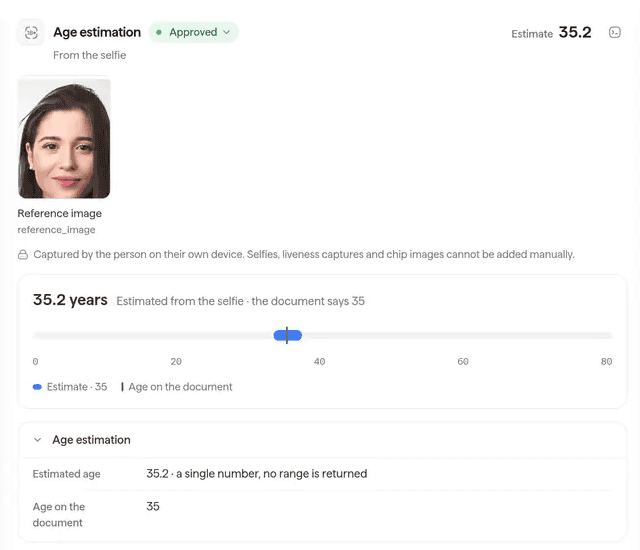
The age estimation result in the Didit console (sample data): the estimate from the selfie next to the age on the document.
Didit provides
- A selfie age estimate with liveness
- A document step for the borderline band
- A biometric consent step for Texas, Illinois and Colorado
- The result by API and signed webhook
Stays with you
- Requesting and using the store's category
- Significant-change notices and gating
- The conflict rule of each state
- Legal review and the decision per user
See the check that follows the signal
Show us your age gate and the states you serve, and we will show you where a selfie estimate or a document fits.
Key takeaways
- Texas is enforceable while its appeal is pending; Alabama starts on 1 January, Utah on 6 May and Louisiana on 1 July 2027.
- The store verifies and collects consent; you check through it, report significant changes and gate features.
- Your own data can only tighten in Alabama and Utah, can win with actual knowledge in Louisiana, and has no rule in Texas.
- When the store answer covers your duty and nothing contradicts it, stop there.
Frequently asked questions
How does the App Store Accountability Act work?
The app store verifies each user's age category, links a minor's account to a parent's and gets the parent's consent for downloads and purchases. It then shares category and consent status with developers, who must check them through the store.[1][5][9][10]
Which states have an App Store Accountability Act?
Texas, Utah, Louisiana and Alabama have the store-verifies model. California, Colorado and Illinois enacted declared-age signal laws instead.[1][5][9][10][24][25][26]
Is Texas SB 2420 in force?
It is enforceable as of 22 November 2026. The Fifth Circuit stayed the injunction (28 May and 4 June 2026), the Supreme Court declined to vacate the stay, and the appeal is pending.[2][3][13]
When do Utah and Louisiana start?
Utah's developer duties begin on 6 May 2027 and Louisiana's Act 185 on 1 July 2027.[6][9]
Is Alabama's law blocked in court?
We found no injunction as of 22 November 2026. The plaintiff says it agreed with the Attorney General's office to delay proceedings until verification rules are approved, and the Act still says 1 January 2027.[10][14]
Does it apply if my app is not for children?
Yes, it can. The Acts cover developers whose apps are offered through an app store to users in the state. Being aimed at children is not the test.[1][5][9][10]
Do I collect parental consent myself?
In these four Acts the store collects consent and you verify its status. Alabama's wording is less clear, so confirm it with counsel.[1][6][9][10][13]
What is a significant change?
A change to the terms or privacy policy that alters data categories, the rating or content description, or monetization. Texas and Louisiana add a material change in functionality or user experience.[1][5][9][10]
Do I need my own age verification?
Not because of these Acts alone, for most apps. Another law, a missing signal, a website or your own risk may justify it. In Alabama and Utah it can only tighten the settings that rule covers.[6][9][10]
What are the penalties?
Texas: up to $10,000 per violation under its deceptive trade practices law. Alabama: up to $7,500 per knowing or reckless violation. Louisiana: up to $10,000 per violation after a 45-day cure period. Utah: a private claim for actual damages or $1,000 per violation, whichever is greater.[1][4][7][9][10]
Sources
- Texas SB 2420, enrolled text, Texas Legislature, Business and Commerce Code chapter 121.
- Order granting a stay pending appeal, No. 25-51073, US Court of Appeals for the Fifth Circuit, 4 June 2026.
- Docket 25A1389, Supreme Court of the United States, application denied 6 July 2026.
- Texas Business and Commerce Code, section 17.47(c), Texas Legislature.
- Utah HB 498 (2026), Utah Legislature.
- Utah Code 13-76-202, developer requirements, Utah Legislature.
- Utah Code 13-76-401, enforcement, Utah Legislature.
- Utah Code 13-76-402, safe harbor, Utah Legislature.
- Louisiana Act 185 of 2026 (HB 977), R.S. 51:1771 to 1775, Louisiana Legislature.
- Alabama HB 161, enrolled (Act 2026-59), Alabama Legislature.
- Code of Alabama 8-19K-2, Alabama Legislature.
- Docket 2:26-cv-00897, CCIA v. Marshall, M.D. Ala., Justia copy retrieved 28 October 2026.
- App store age verification laws: your questions, answered, Squire Patton Boggs, November 2026 (secondary).
- Lawsuit challenges Alabama's app store verification law, WSFA, 17 November 2026 (secondary, quotes the plaintiff).
- Regional age-related protections on Play, Google, updated 18 November 2026.
- Changes to Google Play for upcoming app store bills, Google Play Console Help.
- Notify Google Play of significant changes, Google.
- Play Age Signals API overview, previous version, Google.
- Age requirements for managing an Apple Account in the United States (Texas), Apple, 4 June 2026.
- Update for apps distributed in Texas, Apple Developer, 3 June 2026.
- Age requirements for apps distributed in Brazil, Australia, Singapore, Utah and Louisiana, Apple Developer, 24 February 2026.
- Region-specific rules for managing an Apple Account, Apple, 26 October 2026.
- Request for information on age verification rules, Alabama Attorney General, 19 November 2026.
- California AB 1856, chapter 184, Statutes of 2026, California Legislature.
- Colorado SB 26-051, chapter 343, Colorado General Assembly.
- Illinois Public Act 104-0664, Illinois General Assembly.
- Full committee markup recap, House Energy and Commerce Committee, March 2026.
- H.R. 7757, KIDS Act, Congress.gov.
- Play Age Signals requirements in Google Play policy, Google Play Console Help.
- COPPA age verification enforcement policy statement, Federal Trade Commission, 25 February 2026.
- Age estimation overview, Didit documentation.
- Biometric consent, Didit documentation.
- Request age signals, Google.
Start with the store's answer and add a check only where the law or your risk needs more. Then see how age verification with Didit works.
Plan your age checks state by state
Get a demo of age estimation in your app and see which users need a check of your own.