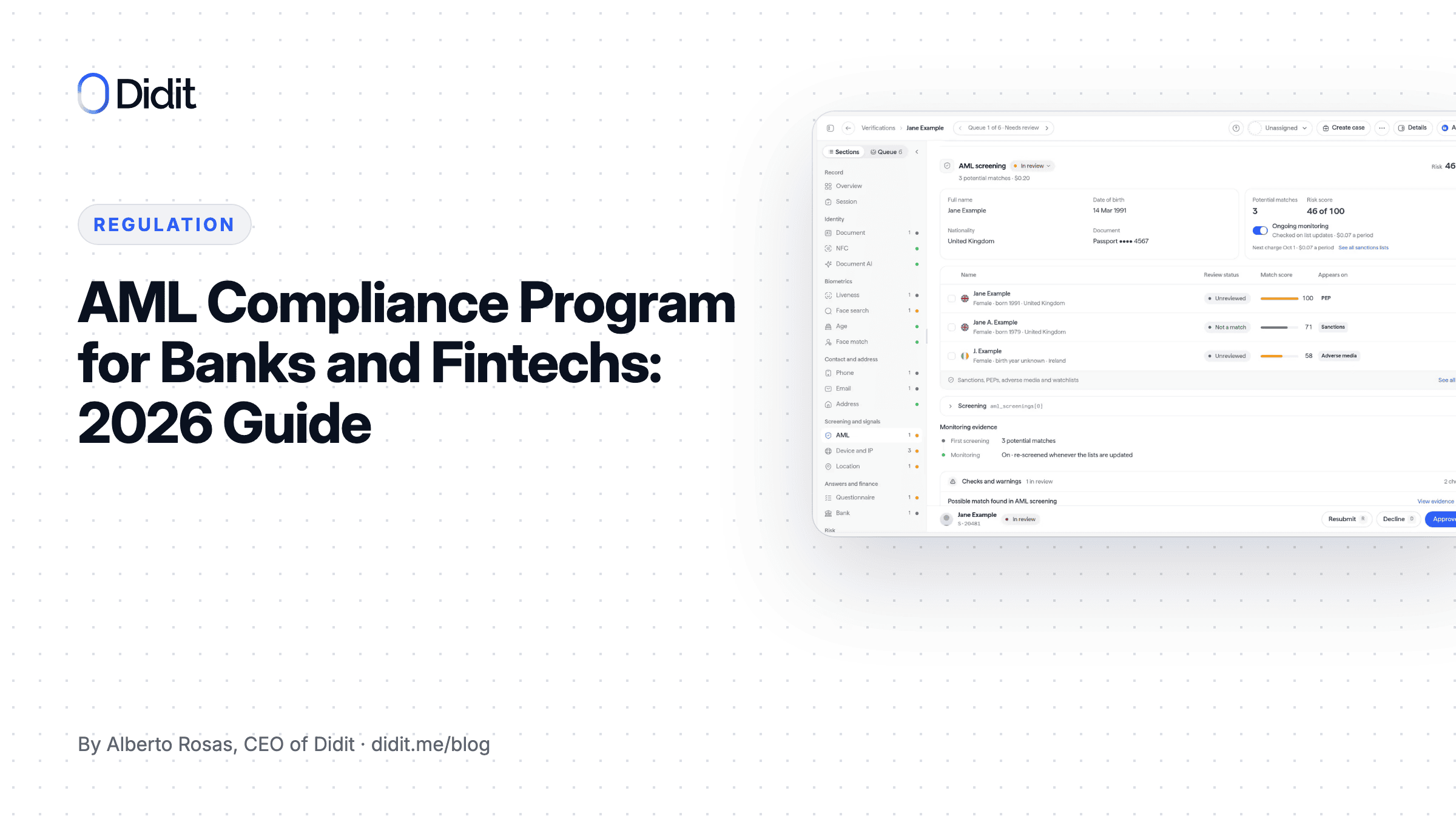
AML Compliance Program for Banks and Fintechs: 2026 Guide
Banks must keep an AML program under 31 CFR 1020.210, and a fintech's duties follow from the licence it holds. Didit supplies the checks from $0.33 and you keep every decision.
 Alberto RosasCo-founder and CEO
Contents
In this guide
Jump to the part you need.
Banks and covered financial institutions need a risk-based AML and customer due diligence program: a named owner, a documented risk assessment, training, independent testing, and due diligence depth that follows the risk. The scope depends on your charter, your regulator and the trigger. Didit supplies the checks: a full ID check at $0.33, AML screening at $0.20 and transaction monitoring at $0.001 per transaction beyond the plan allowance. We supply checks and evidence. You keep the decision.
Last updated: November 26, 2026. Prices checked against the live Didit price feed on November 26, 2026.
| Requirement | Primary source | Didit capability and list price |
|---|---|---|
| An AML program that meets the bank's Federal functional regulator | 31 CFR 1020.210 | Workflow Orchestrator, free on every plan |
| Customer identification program | 31 CFR 1020.220 | Full ID check, $0.33 |
| Beneficial ownership and customer due diligence | FinCEN CDD Rule | Business verification, from $2.00 per company, with pricing varying by country and data tier. Person AML $0.20, linked KYC $0.33 |
| Sanctions and PEP screening | FinCEN CDD Rule; EU AMLR Art. 20(1)(d) and (g), Art. 42 | AML Screening $0.20 per check, ongoing monitoring $0.07 per entity a year |
| Transaction monitoring and case work | EU AMLR Art. 26(1) and Art. 69 | Transaction monitoring $0.001 per transaction beyond the plan allowance, cases and FIU report templates |
| Records and human review of automated decisions | EU AMLR Art. 77 and Art. 76(5) | Retention by plan, manual review with PATCH /v3/session/{sessionId}/update-status/ |
Start free in the sandbox at business.didit.me with no sales call and run the checks below on test data. Builders can connect Didit to an AI assistant through the Didit MCP server. The product pages behind this guide are AML Screening, Business Verification and Transaction Monitoring, and every number is on didit.me/pricing.
One caveat applies to everything below. The obligations are not identical for every institution. A bank supervised by a Federal functional regulator, a broker-dealer, a crypto-asset service provider in the EU and a fintech that only builds software for a bank each land under a different rule, a different supervisor and a different set of triggers. Outsourcing a check does not outsource the obligation: under Article 18 you remain fully liable for any task you outsource, as summarised in Didit's AMLR compliance guide. Didit provides the checks and the evidence. You remain the obliged entity, and the onboarding decision stays with your team. Read this as a map, then confirm your own regime with your regulator and your counsel.
Who has to run an AML program
Banks in the United States: 31 CFR 1020.210
The rule is titled Anti-money laundering program requirements for banks. It sits at 31 CFR 1020.210, in Title 31, Part 1020, Subpart B, issued by the Financial Crimes Enforcement Network, Department of the Treasury (eCFR, 31 CFR Part 1020 Subpart B, read November 26, 2026). Subpart B contains three sections: 1020.200 General, 1020.210 for AML programs and 1020.220 for customer identification programs.
The operative sentence matters for anyone running a bank. A bank regulated by a Federal functional regulator, including banks, savings associations and credit unions, is deemed to satisfy 31 U.S.C. 5318(h)(1) if it implements and maintains an AML program that complies with sections 1010.610 and 1010.620 and with its Federal functional regulator's own regulation (eCFR, 31 CFR 1020.210, read November 26, 2026). In practice you build one program and answer to your primary supervisor: the OCC, the Federal Reserve, the FDIC or the NCUA. The eCFR page states that Title 31 was last amended on 11/06/2026 and was up to date as of 11/24/2026, and it warns that its text is authoritative but unofficial (eCFR, 31 CFR 1020.210, read November 26, 2026). Check the printed CFR before you file anything.
Fintechs: the licence decides, not the word fintech
The CDD Rule reaches covered financial institutions: U.S. banks, mutual funds, brokers or dealers in securities, futures commission merchants and introducing brokers in commodities (FinCEN, CDD Final Rule page, read November 26, 2026). Whether a particular fintech sits inside one of those categories, or under a different regime entirely, is a licensing question rather than a marketing one.
Europe: Regulation (EU) 2024/1624
The EU Anti-Money Laundering Regulation puts customer due diligence into one directly applicable text. It binds credit and financial institutions, including crypto-asset service providers, providers of gambling services and the other obliged entities listed in Article 3. It entered into force on 9 July 2024 and applies from 10 July 2027. Until then the national laws that transpose the current directive continue to apply (Didit, AMLR compliance guide, last reviewed 2 October 2026).
The article map is worth memorising because it is the checklist your supervisor will use: Art. 19 for when due diligence is triggered, Art. 20(1)(a) and Art. 22 for identifying and verifying the customer, Art. 20(1)(b) and Arts. 51 to 53 for beneficial owners, Art. 20(1)(d) and (g) with Art. 42 for sanctions and PEPs, Art. 25 for purpose and source of funds, Art. 26 for monitoring and keeping data current, Art. 69 for reporting suspicions, Art. 76(5) for a human in automated decisions and Art. 77 for five year retention followed by deletion.
Where it applies and from when
| Regime | Applies to | Instrument | Status and date |
|---|---|---|---|
| US bank AML program | Banks, savings associations and credit unions supervised by a Federal functional regulator | 31 CFR 1020.210 | In force. Title 31 up to date as of 11/24/2026 and last amended 11/06/2026 (eCFR, 31 CFR 1020.210, read November 26, 2026) |
| US customer identification | Banks | 31 CFR 1020.220 | In force (eCFR, 31 CFR Part 1020 Subpart B, read November 26, 2026) |
| US customer due diligence and beneficial ownership | Banks, mutual funds, brokers or dealers in securities, futures commission merchants, introducing brokers in commodities | FinCEN CDD Rule | In force, with FinCEN Ruling FIN-2026-R001 granting exceptive relief from identifying and verifying beneficial owners at each account opening (FinCEN, CDD Final Rule page, read November 26, 2026) |
| EU AML Regulation | Credit and financial institutions, crypto-asset service providers, gambling providers and the other Article 3 obliged entities | Regulation (EU) 2024/1624 | In force 9 July 2024, applies from 10 July 2027 (Didit, AMLR compliance guide, last reviewed 2 October 2026) |
| International standard | National regimes worldwide | FATF Recommendations | The standard national rules implement, published at fatf-gafi.org |
The program elements supervisors ask about
Four classic pillars: internal controls written down as policies and procedures, a designated compliance officer, ongoing employee training and independent testing. Customer due diligence is examined alongside them, with four core requirements from the CDD Rule: identify and verify customer identity, identify and verify beneficial owners, understand the nature and purpose of the customer relationship so you can set a risk profile, and conduct ongoing monitoring (FinCEN, CDD Final Rule page, read November 26, 2026).
Each pillar needs evidence, not a narrative. In our experience the questions are practical: can you produce the risk assessment on request, does the training log carry dates, and did the independent test come from someone other than the person who wrote the procedures. Map every pillar to a named owner, a document and a system of record before you look at tooling.
KYC and CDD integration
The customer identification program is 31 CFR 1020.220 in the United States. It collects identity data, verifies it against documents or databases, keeps records and checks government lists. Didit runs that as a full ID check at $0.33, made of four priced lines: ID document verification at $0.15, passive liveness at $0.10, face match 1:1 at $0.05 and device and IP analysis at $0.03. The live price feed describes the full check as three parts in one: the ID document, biometrics (passive liveness and face match) and device and IP analysis.
For legal entities the CDD Rule requires identifying and verifying any individual who owns 25 percent or more of the entity, plus one individual who controls it (FinCEN, CDD Final Rule page, read November 26, 2026). Didit Business Verification pulls the registry record from official sources, extracts the key people for free and screens each one. $2.00 per company is a minimum registry-retrieval example, not a fixed price: actual pricing varies by country and data tier (Lite, Shareholders, UBOs), so treat $2.00 as the floor rather than the bill. The workflow keys that set the line are kyb_ubo_ownership_threshold and kyb_shareholder_ownership_threshold, and kyb_reject_if_ubo_rejected declines the company when a UBO is declined.

Purpose and source of funds are the part teams skip. Article 25 of the EU regulation expects you to understand why the relationship exists, and Article 19 sets the triggers: a business relationship, an occasional transaction of at least EUR 10,000 in one operation or in linked transactions, suspicion whatever the amount, or doubt about data you already hold. Lower triggers apply in some sectors, EUR 1,000 for occasional transfers of funds and for crypto-asset service providers, EUR 3,000 for occasional cash transactions and EUR 2,000 in gambling (Didit, AMLR compliance guide, last reviewed 2 October 2026). Didit does not decide whether a trigger applies. Your code routes by transaction type and amount, then starts the session for that trigger with POST /v3/session/ and the matching workflow_id. Custom questionnaires, at $0.10 per check, are the usual vehicle for purpose and source of funds questions.
Screening for sanctions and PEPs
Didit AML Screening checks a person or a company against 1,300+ global sanctions, PEP and watchlist sources plus adverse media, and returns every potential match with two scores. The match score asks whether the match is the same person. The risk score asks how risky that listed entity is. Hits below the match threshold, default 93, are tagged False Positive and ignored for risk. The highest remaining risk score becomes the score that drives the status: above the review threshold of 100 it is Declined, above the approve threshold of 80 it is In Review, otherwise Approved. The three weighting keys aml_name_weight, aml_dob_weight and aml_country_weight must sum to exactly 100 or the request is rejected with HTTP 400.

Calling it directly, without a hosted flow, is one request:
curl -X POST 'https://verification.didit.me/v3/aml/' \
  -H "x-api-key: $DIDIT_API_KEY" \
  -H "Content-Type: application/json" \
  -d '{"full_name": "Javier Ejemplo Modelo", "entity_type": "person", "date_of_birth": "1974-01-01", "include_adverse_media": true}'
Two operational notes. With include_adverse_media set to true the call waits for adverse media enrichment, so set a client timeout of at least 60 seconds, and if the upstream provider is slow the result returns without adverse media hits and is still actionable. Ongoing monitoring keeps the entity under provider-driven re-screening, dated every day, at $0.07 per screened entity a year; it requires save_api_request=true and is switched off from the console. The full reference is in the AML Screening API documentation.
Ongoing monitoring is what turns screening into an Article 26 control. A customer who was clean at onboarding and appears on a list a year later must be found by the system, not by an annual manual sweep.
Transaction monitoring
Rules score every transaction in real time against amount thresholds, high-risk countries, blocklists, velocity windows, structuring patterns and counterparty screening. Each transaction lands as Approved, In Review, Declined or Awaiting User, and when it lands in Awaiting User Didit creates a linked remediation session and returns a verification URL so the customer can be re-verified before the transaction settles (Didit, Transaction Monitoring overview). Every plan includes a monthly allowance, 1,000 transactions on Free, 10,000 on Growth and 100,000 on Scale, and each transaction beyond it costs $0.001, the same on every plan.
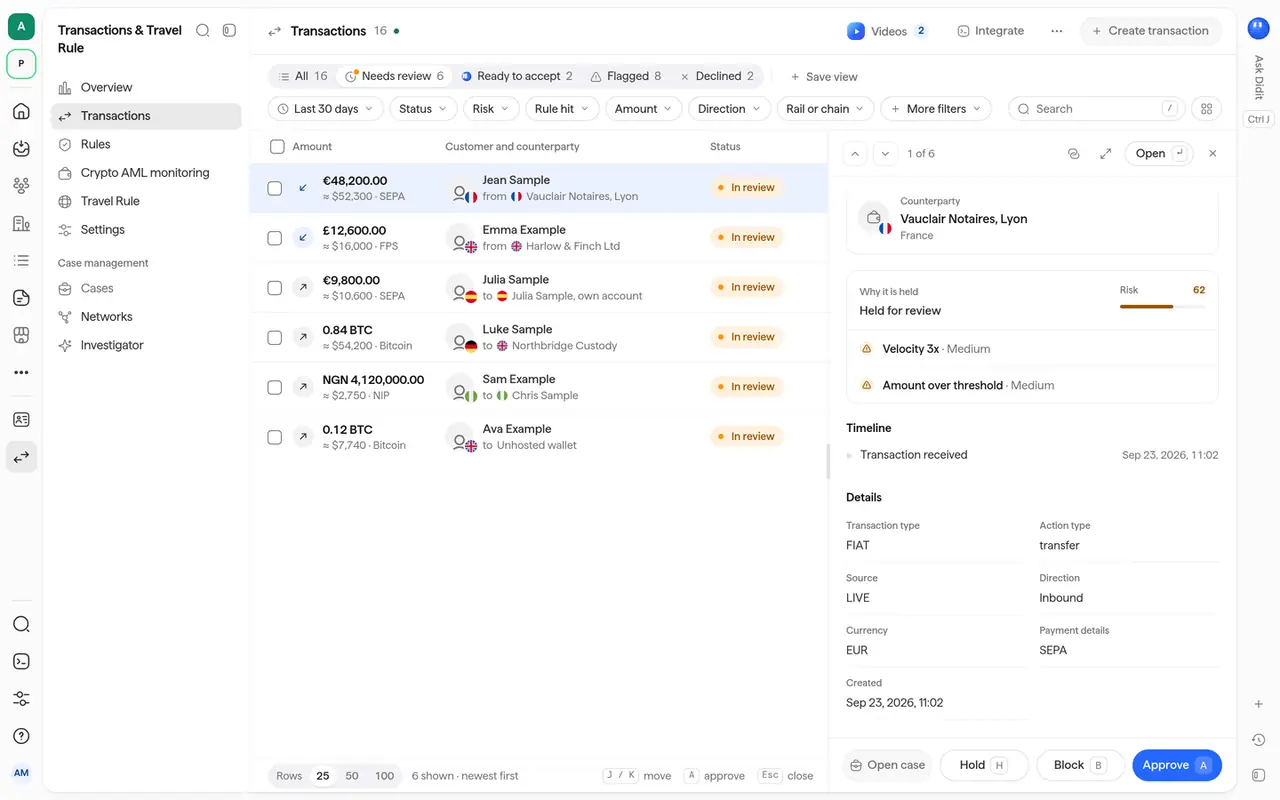
curl -X POST https://verification.didit.me/v3/transactions/ \
  -H "x-api-key: YOUR_API_KEY" \
  -H "Content-Type: application/json" \
  -d '{"transaction_id": "finance0001", "transaction_category": "finance", "transaction_details": {"direction": "outbound", "amount": "1200.00", "currency": "EUR"}, "subject": {"entity_type": "person", "vendor_data": "user-123", "full_name": "John Doe"}, "counterparty": {"entity_type": "person", "full_name": "Jane Doe"}}'
For crypto transactions Didit screens wallet addresses and transaction hashes server-side during transaction creation, and you can also bring your own screening provider and run it inside Didit. Wallet screening on our own coverage is $0.15 per screening. Results feed the same rules engine, so a sanctions match on a counterparty fires like any other rule.
Risk assessment: how a decision is actually produced
There is no single composite score for business verification. Each feature finishes with its own status, Approved, In Review or Declined, raises warning tags when something is off, and your workflow assigns an action to each warning, so the same warning can approve, review or decline depending on your policy. The decision explains itself through warnings[] and decision_trace (Didit, KYB risk assessment). That trace is the artefact your independent tester will ask for, because it shows the rule that produced the outcome rather than a black box verdict.
Build the customer risk assessment separately. Jurisdiction, product, channel, entity type, ownership complexity, expected volume and adverse media combine into a rating that sets your due diligence depth and refresh cycle. Use those factors to set your customer risk rating and due diligence depth. Didit supplies verification and screening results that your team can use in that assessment.
Case management and reporting
Alerts and hits become cases. Every case, whether it started from a transaction rule, an AML hit, a workflow or a manual click, moves through one lifecycle of Open, Awaiting user and Resolved, closing with a resolution of False positive or Valid threat, with blueprints controlling assignment, escalation and four-eyes review (Didit, Cases and SAR investigations). Add the Create case effect to a transaction rule and cases open automatically, grouped by applicant or by rule and applicant, with the matched transaction attached.
Filing comes from the resolved investigation. Didit generates SAR, STR, CTR and other filings from templates and keeps a printable record. Under the EU regulation this is Article 69 territory and the record retention that supports it is Article 77: five years, then deletion of personal data. Plan retention lines up with that, one year on Free, five years on Growth, up to ten years on Scale.
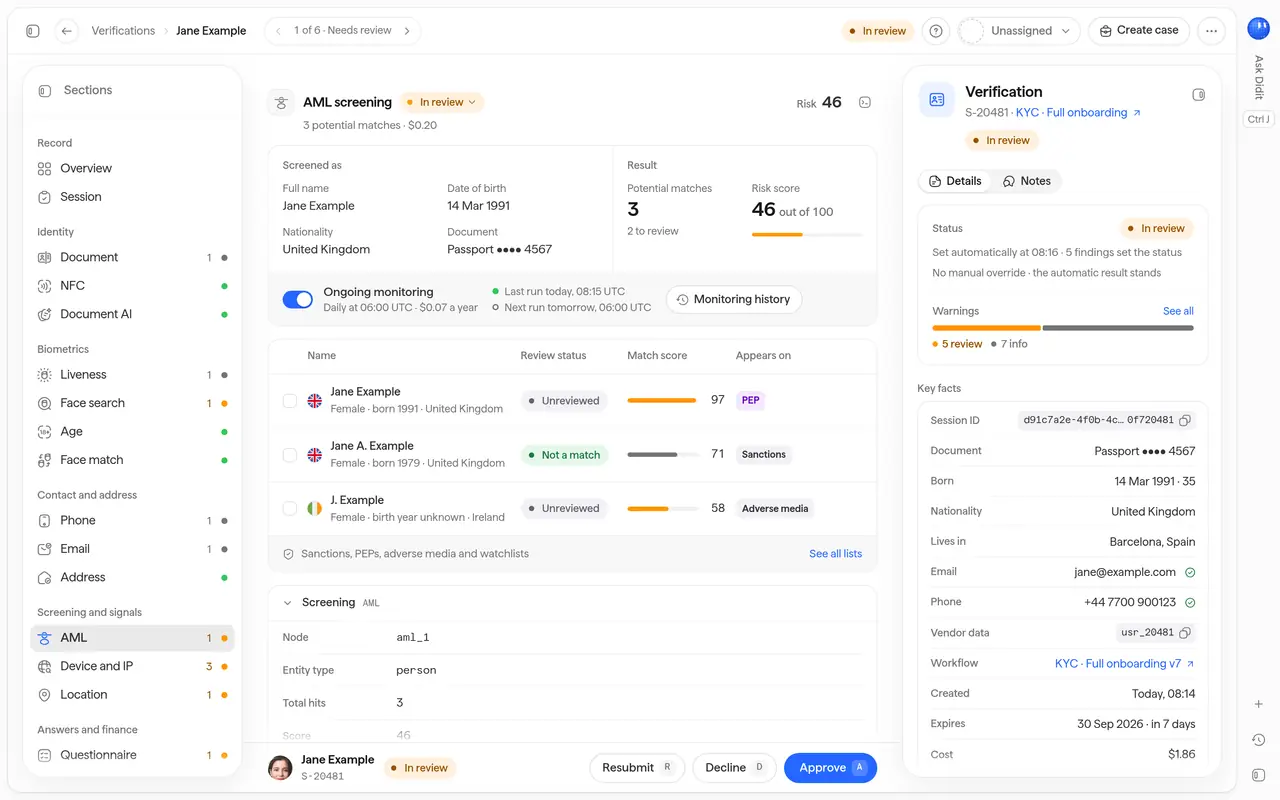
Obligations and Didit capability, side by side
| Obligation | What stays with you | Didit capability | List price |
|---|---|---|---|
| Maintain an AML program with a compliance officer, training and independent testing | Policies, officer appointment, training records, testing scope and remediation | Workflow Orchestrator, audit trail and console roles to run the checks the program depends on | Orchestrator free. Self-serve plans are $0, $99, or $299 per month. Enterprise contracts start at $15,000 per year |
| Identify and verify each customer (31 CFR 1020.220, AMLR Art. 22) | Which data you collect and what you do when verification fails | ID document verification, passive liveness, face match, device and IP analysis | $0.33 per full ID check |
| Identify beneficial owners (FinCEN CDD Rule, AMLR Arts. 51 to 53) | The ownership threshold you adopt and how you resolve contradictions | Registry retrieval, free key people extraction, person AML and linked KYC per person | Business verification, from $2.00 per company, with pricing varying by country and data tier. Person AML $0.20, linked KYC $0.33 |
| Screen sanctions and PEPs (AMLR Art. 20(1)(d) and (g), Art. 42) | Thresholds you set and the disposition of every hit | 1,300+ lists with match and risk scores, plus ongoing monitoring | $0.20 per check, $0.07 per entity a year |
| Monitor transactions and report suspicions (AMLR Art. 26(1), Art. 69) | The rule set, the escalation path and the filing decision | Rule engine, alerts, cases, FIU report templates | $0.001 per transaction beyond the allowance |
| Keep a human in automated decisions (AMLR Art. 76(5)) | Who reviews, with what authority | Manual review queue and status override via the API | Included |
| Retain records then delete (AMLR Art. 77) | Your retention schedule and deletion evidence | Retention by plan, exports and on-demand deletion | Included in the plan |
Worked example: a fintech onboarding 2,000 customers a month
Assume 2,000 new customers a month, 300 of them businesses with two beneficial owners each, and 400,000 transactions a month. Only published unit prices are used, at list price before any plan discount. The $2.00 registry line is a minimum illustrative price: real registry retrieval is priced by country and data tier, so the business verification line can only go up from here.
- KYC: 2,000 x $0.33 = $660.00
- AML screening at onboarding: 2,000 x $0.20 = $400.00
- Business verification registry retrieval at the $2.00 minimum: 300 x $2.00 = $600.00
- Company AML screening: 300 x $0.20 = $60.00
- Person AML for 600 beneficial owners: 600 x $0.20 = $120.00
- Linked KYC for those 600 people: 600 x $0.33 = $198.00
- Transaction monitoring on 400,000 transactions with a 100,000 monthly allowance on Scale: 300,000 x $0.001 = $300.00
The onboarding lines total $660.00 + $400.00 + $600.00 + $60.00 + $120.00 + $198.00 = $2,038.00 at list price. Transaction monitoring overage is $0.001 on every plan, so the plan discount does not touch it and that line stays at $300.00.
On Scale the 10 percent discount applies to the Didit list prices in the onboarding lines: $2,038.00 x 0.10 = $203.80 off, leaving $1,834.20. Add the $300.00 of monitoring overage and the discounted usage is $2,134.20. The plan fee is $299.00 a month and brings $350.00 of credit, so the bill is $299.00 + ($2,134.20 minus $350.00) = $299.00 + $1,784.20 = $2,083.20 for that month. On Growth the discount is 4 percent, applied to the same $2,038.00 of onboarding lines: $2,038.00 x 0.04 = $81.52 off, with $115.00 of included credit and the $300.00 monitoring overage unchanged.
Ongoing AML monitoring adds 2,000 x $0.07 = $140.00 per year at list price, on top of the monthly figures.
The point of the arithmetic is not the total. It is that the program cost scales with customers and transactions, while the fixed part of compliance, the officer, the training and the independent test, does not.
Exceptions and open questions
- Beneficial ownership at each account opening. FinCEN Ruling FIN-2026-R001 grants exceptive relief from the requirement to identify and verify beneficial owners at each account opening (FinCEN, CDD Final Rule page, read November 26, 2026). Read the ruling text before you change your onboarding flow, because relief is not a repeal.
- The unofficial text problem. The eCFR states its content is authoritative but unofficial. Quote the printed CFR or the Federal Register source it cites when you file.
- One FinCEN source could not be verified. FinCEN, details were not verifiable on November 26, 2026, so no facts on this page come from that source. Use the CDD Final Rule page instead.
- Adverse media is not deterministic. If the upstream provider is slow, the result returns without adverse media hits. Treat that as a partial result to re-run, not a clean result.
- Sandbox output is not evidence. Sandbox keys skip screening and billing and return a mocked Approved with zero hits unless you pass
sandbox_scenario. Never let a sandbox result into a customer file. - Do you know which regime binds you? Whether a particular fintech is a bank, a broker-dealer or a money services business is a licensing question for your counsel and your supervisor.
- The EU date is not today. Regulation (EU) 2024/1624 applies from 10 July 2027. Until then the national transposition laws apply, so a build that only maps the AMLR articles can still fail a 2026 examination.
Implementation checklist
- Write the program document and name the compliance officer, with a deputy who has the same authority.
- Complete the institution-wide risk assessment before choosing tools, then set due diligence depth per risk band.
- Decide your beneficial ownership threshold and record the decision, since the rule sets a floor and lets you go lower.
- Create the onboarding workflow in the console or with
POST /v3/workflows/, including ID verification, AML screening and, for entities, business verification. - Set
aml_match_score_threshold,aml_score_approve_thresholdandaml_score_review_threshold, then write down why those values match your risk appetite. - Create the session with
POST /v3/session/usingworkflow_id,vendor_dataandcallback, and subscribe tostatus.updatedwebhooks. - Pull the decision with
GET /v3/session/{sessionId}/decision/and storeaml_screenings[]with its warnings. - Route In Review outcomes to a named analyst and log every manual outcome with
PATCH /v3/session/{sessionId}/update-status/. - Turn on ongoing monitoring for higher risk customers at $0.07 per entity a year, with
save_api_request=true. - Ship transaction rules with the Create case effect, and test one case end to end through to a generated SAR or STR.
- Book the independent test, give the tester API and console read access, and keep the decision traces.
- Set the retention period per plan and document the deletion process that follows it.
If you are moving off another provider, the switching guide covers parallel running and data export. Didit serves 4,000+ active companies.
Sources
- Didit, AML Screening API overview
- Didit, AML Screening standalone API reference
- Didit, AMLR compliance guide, last reviewed 2 October 2026
- Didit, Real-time transaction monitoring overview
- Didit, KYT cases and SAR investigations
- Didit, KYB risk assessment
- Didit, pricing documentation and the pricing page, read November 26, 2026
- eCFR, 31 CFR 1020.210, read November 26, 2026, https://www.ecfr.gov/current/title-31/subtitle-B/chapter-X/part-1020/subpart-B/section-1020.210
- eCFR, 31 CFR Part 1020 Subpart B, read November 26, 2026, https://www.ecfr.gov/current/title-31/subtitle-B/chapter-X/part-1020/subpart-B
- FinCEN, CDD Final Rule page, read November 26, 2026, https://www.fincen.gov/resources/statutes-and-regulations/cdd-final-rule
- FinCEN, details were not verifiable on November 26, 2026; no facts here are taken from that source.
- FATF, the international standard that national AML rules implement.
Open the sandbox at business.didit.me and run one KYC, one AML screening and one business verification on test data before you talk to anyone. No sales call, and the pricing page has every number in this guide.
Try it
Try this in the sandbox
Run the check this guide describes, free.
The product this post is about, taken from its topic. Run it free in the sandbox.
Author
Alberto Rosas
Co-founder and CEO

Keep reading
Other guides in the same topic.
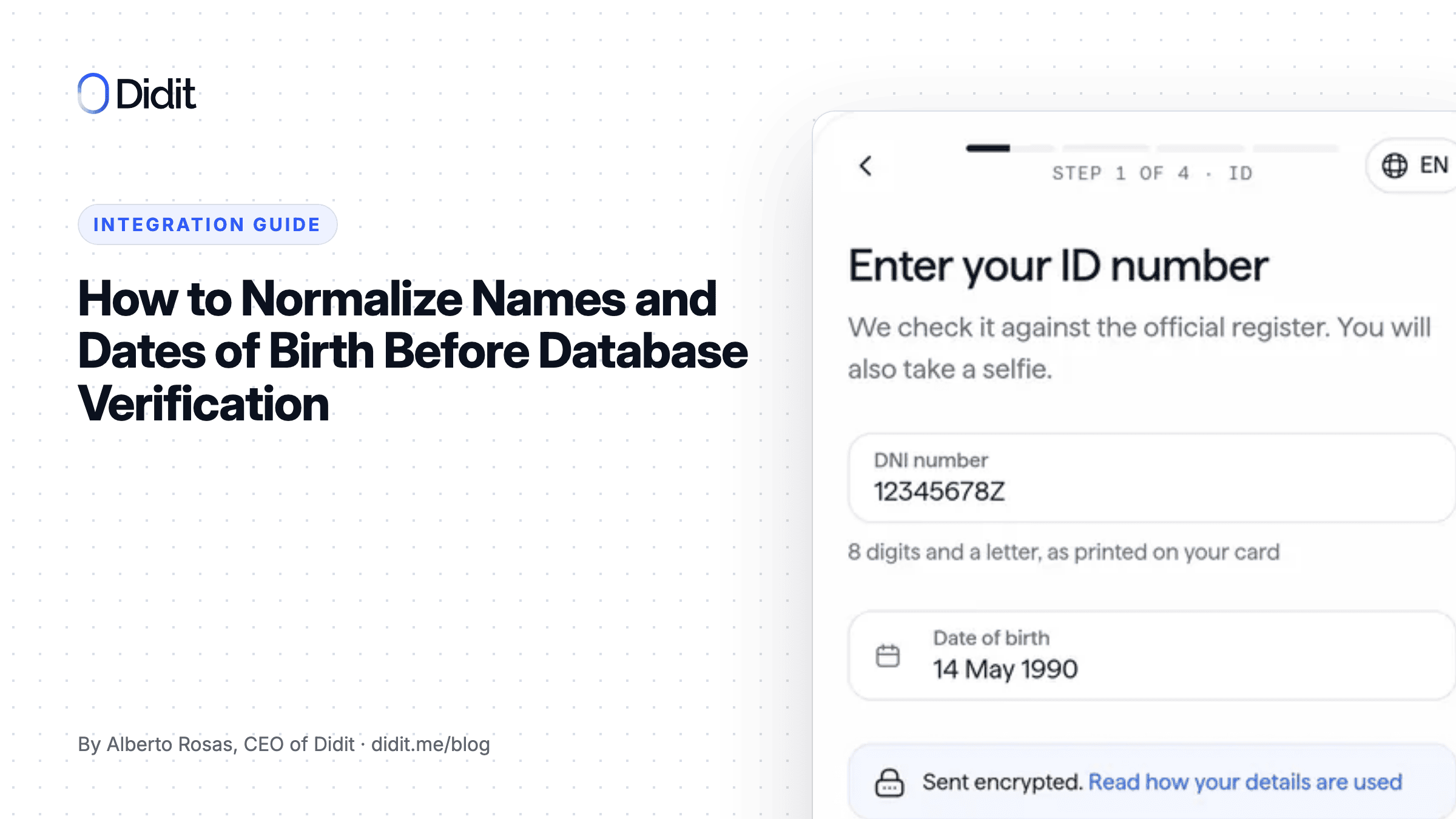 How to Normalize Names and Dates of Birth Before Database Verification
Normalize names to the spelling the registry holds and send date of birth as ISO 8601 before a Didit Database Validation call. Pricing varies by service; $0.05 per check is the lowest published example.
Alberto RosasNov 26, 2026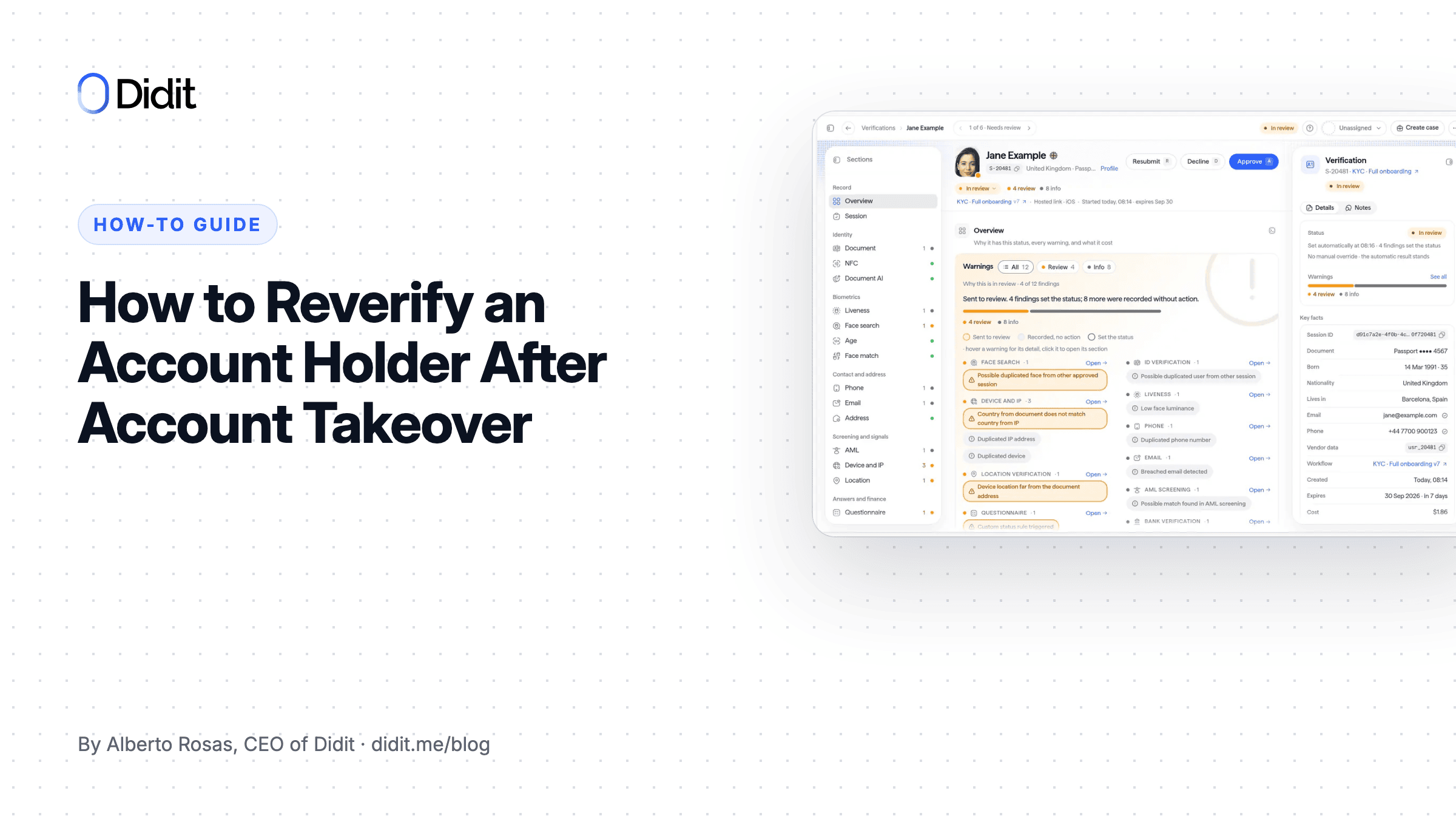 How to Reverify an Account Holder After Account Takeover
Reverify with a fresh full KYC session ($0.33) bound to the original account ID, compare the new face to the enrolled identity with Face Search ($0.05), and make the hand-back a human decision.
Alberto RosasNov 26, 2026Passkey Account Recovery After a Lost Phone (2026)Passkey account recovery after a lost phone depends on whether the platform synced the passkey. If it did not, the person signs in with another enabled method, such as an email code, then enrolls a new passkey.
Alberto RosasNov 26, 2026Questions
Frequently asked questions
What are the AML compliance program requirements for banks and fintechs?
In the United States a bank must implement and maintain an AML program that complies with 31 CFR 1010.610, 31 CFR 1010.620 and its Federal functional regulator's regulation, which is how it satisfies 31 U.S.C. 5318(h)(1) under 31 CFR 1020.210. In practice that means internal controls, a designated compliance officer, training, independent testing and customer due diligence. A fintech takes on the same duties when it holds a charter or falls inside the CDD Rule's covered institutions; otherwise its obligation follows from the licence it holds.
What does BSA mean in banking?
BSA is the Bank Secrecy Act, the United States anti-money-laundering statute in Title 31 of the U.S. Code, and 31 U.S.C. 5318(h)(1) is the provision that requires financial institutions to have an AML program. 31 CFR 1020.210 is the FinCEN rule that tells banks how that program is deemed satisfied. BSA compliance is the everyday shorthand for the program, the reporting and the record keeping that follow from it.
How many pillars does an AML program have?
Supervisors work with four classic pillars: internal controls, a designated compliance officer, ongoing training and independent testing. The FinCEN CDD Rule added customer due diligence as a further examined element, with four core requirements: identify and verify the customer, identify and verify beneficial owners, understand the purpose of the relationship, and monitor it on an ongoing basis. Build all five, and keep a document that proves each one.
What is the beneficial ownership threshold in the US CDD Rule?
Financial institutions must identify and verify any individual who owns 25 percent or more of a legal entity, plus one individual who controls the entity (FinCEN, CDD Final Rule page, read November 26, 2026). You may adopt a stricter policy or a lower threshold. FinCEN Ruling FIN-2026-R001 grants exceptive relief from identifying and verifying beneficial owners at each account opening, so read the ruling before redesigning onboarding.
When does the EU AML Regulation apply, and to whom?
Regulation (EU) 2024/1624 entered into force on 9 July 2024 and applies from 10 July 2027. It binds credit and financial institutions, including crypto-asset service providers, providers of gambling services and the other obliged entities listed in Article 3. Until that date the national laws that transpose the current directive continue to apply.
How much does AML screening cost?
Didit AML Screening is $0.20 per check against 1,300+ sanctions, PEP and watchlist sources with adverse media. Ongoing monitoring is $0.07 per screened entity per year. On Growth the prices are discounted 4 percent and on Scale 10 percent, and the sandbox is free on every plan.
Can Didit make my company compliant?
No. Didit provides the checks and the evidence, and you remain the obliged entity: you decide the customer's risk profile, you decide whether to onboard, and under Article 18 of the EU regulation you remain fully liable for any task you outsource. Using Didit does not by itself make a company compliant with the AMLR or the BSA.
What happens when an AML hit scores below the match threshold?
Hits below aml_match_score_threshold, default 93, are tagged False Positive and excluded from the risk calculation. The highest risk score among the remaining hits becomes the screening score, and the final status follows your review and approve thresholds.
How long do I keep AML records?
Article 77 of the EU AML Regulation requires five years, after which personal data is deleted. On Didit, data retention follows the plan: one year on Free, five years on Growth and up to ten years on Scale, with exports and on-demand deletion available. Confirm the retention period against your own national law as well.
Does the sandbox give real AML screening results?
No. Sandbox keys skip screening and billing and return a mocked Approved result with zero hits unless you pass sandbox_scenario. A saved sandbox screening is still retrievable through the decision endpoint, but use live keys for anything you intend to rely on as evidence.
Compliance built in
Audited, certified and attested.
We hold the certifications and build each country's rules into your flows, so you can launch anywhere without worrying. Security and Compliance center
- Regulation encoded into your flows
Tell us what you do and where. Didit lists the rules that apply to you, with sources, and builds the checks each country needs into one workflow.
- Ready for AMLR
Every requirement of the new EU anti-money laundering rules, from checking customers to human review, is already covered by a Didit check.
- Tested in Spain's Treasury sandbox
Spain's Treasury published its supervised sandbox report on Didit's NFC plus active liveness onboarding; SEPBLAC took part and valued the added measures positively.
- Audited, not self-declared
iBeta Level 1 and Level 2. Liveness tested under ISO/IEC 30107-3.
Your obligations · 3 regions
 SOC 2 Type 2
 ISO 27001
 iBeta Level 1 and Level 2
 EU regulator attestation
 FSM youth protection
 GDPR
 EBA remote onboarding
 MiCA compatible
 FIDO Alliance member
- AMLREU AML Regulation ready
Integration · Didit MCP
Run Didit from your own AI agent
Connect Didit to Claude, Cursor, VS Code or ChatGPT and just ask in plain words. Your agent can do anything you can do in the console, with the same permissions you have.
 Add to Claude
 ChatGPT
 Cursor
- Build workflowsDescribe the checks you need. The agent creates and publishes the flow.
- Run investigationsAsk why a session was declined, review cases, search people and companies.
- Change rulesCreate payment rules, test them on past data and switch them on.
- Pull reportsAsk for numbers, exports or the audit log.
Didit Academy


