Blog
Blog archive
Every post on the Didit blog, newest first. Pick a category or search to find the subject you need.
All posts
Every post, newest first
Pick a category to filter.
Farmed accounts are cheap at the account layer and expensive at the physical layer. The device and network warning codes that expose emulators, automation, tampered clients and recovered devices — $0.03 per check.
Alejandro RosasAug 4, 2026The Access-Layer Playbook Against Model Extraction
The assembled playbook: what each of the three defense layers owns, the four primitives that build the access layer, the trigger and enforcement design, the cost model, and the honest limits of what identity can do.
Alejandro RosasAug 4, 2026UK Age Assurance & VPN Use: Navigating Compliance
Navigating UK age assurance requirements, especially with VPN usage, is crucial for businesses. This post clarifies the regulatory landscape, practical implementation challenges, and how to effectively manage compliance while.
Alejandro RosasAug 3, 2026How to Self-Host the Didit MCP Server
Deploy the open-source Didit MCP server with Docker or Node, configure OAuth or headless stdio, and run a stateless service behind your own load balancer.
Alejandro RosasAug 3, 2026Claude or ChatGPT for Identity Workflows: What Actually Differs
A practical comparison of Claude and ChatGPT for identity workflows, including Didit's 115-tool hosted catalogue and restricted 101-tool OpenAI app surface.
Alejandro RosasAug 3, 2026Crypto Exchange Onboarding with Claude: An Operator Decision Sequence
Coordinate KYC, AML, wallet screening, transaction submission, and explicit case actions from Claude without inventing automation or payload fields.
Alberto RosasAug 3, 2026Age Verification with Claude: Hosted Sessions vs Local Files
Use hosted Didit sessions for real-user age checks in Claude, and reserve absolute image-path tools for local or self-hosted MCP servers.
Alberto RosasAug 3, 2026Building a Compliance Copilot in Claude with Didit
A governance-first blueprint for a durable Claude assistant: least-privilege Didit tools, role scoping, risk-policy instructions, triage prompts, and human approval boundaries.
Alberto RosasAug 3, 2026The identity verification MCP server for Claude
A security checklist for evaluating Didit’s hosted MCP server for Claude: typed tools, OAuth, role scoping, redaction, and precise action boundaries.
Alejandro RosasAug 3, 2026How to Verify a User's Identity with Claude
Verify a user from inside Claude with natural-language prompts: create the hosted link, run ID, passive liveness, face match, and IP analysis, then read the decision. No code required.
Alberto RosasAug 3, 2026KYC with Claude: Running Know Your Customer checks in chat
How compliance analysts use Didit's MCP server in Claude to review KYC sessions, correct extracted data, approve or decline verifications, and manage the review queue — all from chat.
Alberto RosasAug 3, 2026Verifying a Business with Claude: KYB and Beneficial Owners Through the Didit MCP
Use Claude to create one parent KYB session, follow the hosted Key People flow, read registry and child KYC evidence, and keep policy decisions human-owned. From $2.00 per business.
Alejandro RosasAug 3, 2026Didit MCP Server Guide Hub — Every Identity & Fraud Guide in One Place
Your index to every Didit MCP guide. 115 tools for identity verification, fraud detection, and compliance — integrated into Claude, Cursor, ChatGPT, or any AI agent.
Alejandro RosasAug 3, 2026Which Identity Vendors Have an MCP Server? 2026 Comparison
An evidence-backed map of official MCP support across 17 identity, fraud, and compliance vendors, with a practical checklist for developers comparing integrations.
Alejandro RosasAug 3, 2026Know Your Agent: How to Bind a Human to an AI Agent
A technical guide to binding AI agent actions to an accountable human through OAuth 2.1, PKCE, Dynamic Client Registration, scoped tokens, role-aware authorization, and audit trails.
Alberto RosasAug 3, 2026Agentic Fraud Patterns and How to Control Them
Six concrete fraud patterns that emerge when AI agents transact, plus the identity, biometric, transaction, wallet, and operational controls that contain them.
Alberto RosasAug 3, 2026Agentic commerce needs an identity layer: Visa TAP, Google AP2, and Mastercard Agent Pay
A neutral technical comparison of Visa TAP, Google AP2, and Mastercard Agent Pay—and the identity, authorization, fraud, and compliance controls developers still need.
Alberto RosasAug 3, 2026KYC Through an MCP Server: The Practical Guide
How to run a complete Know Your Customer (KYC) verification through an MCP server — discover your org, pick a workflow, create a hosted session, and read the decision, all from natural-language prompts. Full KYC bundle at $0.33 per check.
Alejandro RosasAug 3, 2026AML Screening via MCP Server — Run Sanctions, PEP, and Adverse Media Checks from Any AI Agent
Run AML screening against 1,300+ sanctions, PEP, and adverse-media watchlists from any MCP-compatible AI client. One tool call, $0.20 per screen. No API key needed.
Alejandro RosasAug 3, 2026The FCC wants phone companies to run bank-style KYC.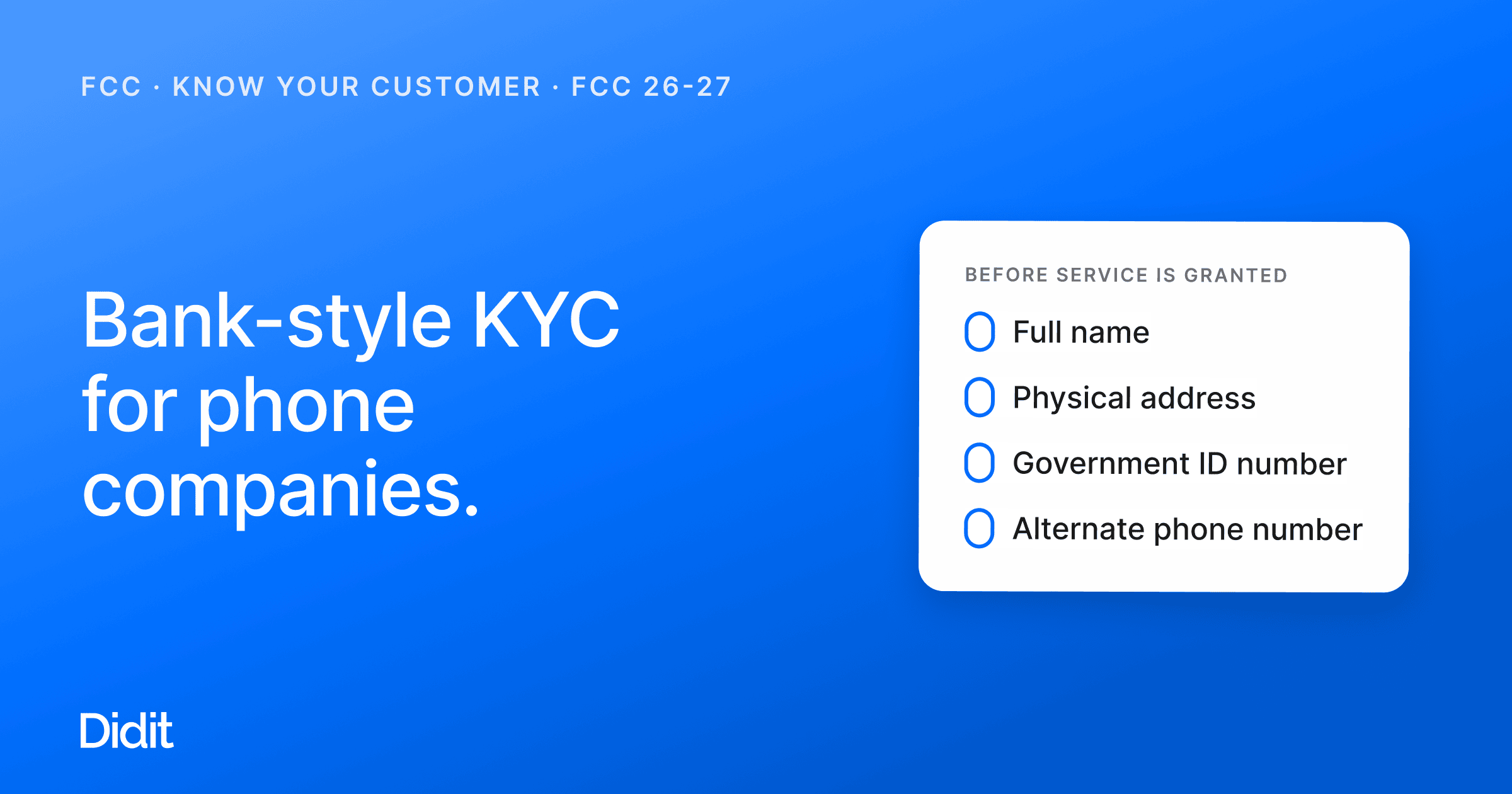
The FCC sought comment on making phone companies collect and verify government ID before granting service. What FCC 26-27 asks, and what it proposes.
Alberto RosasAug 1, 2026Asia is moving the cost of weak identity checks onto banks and platforms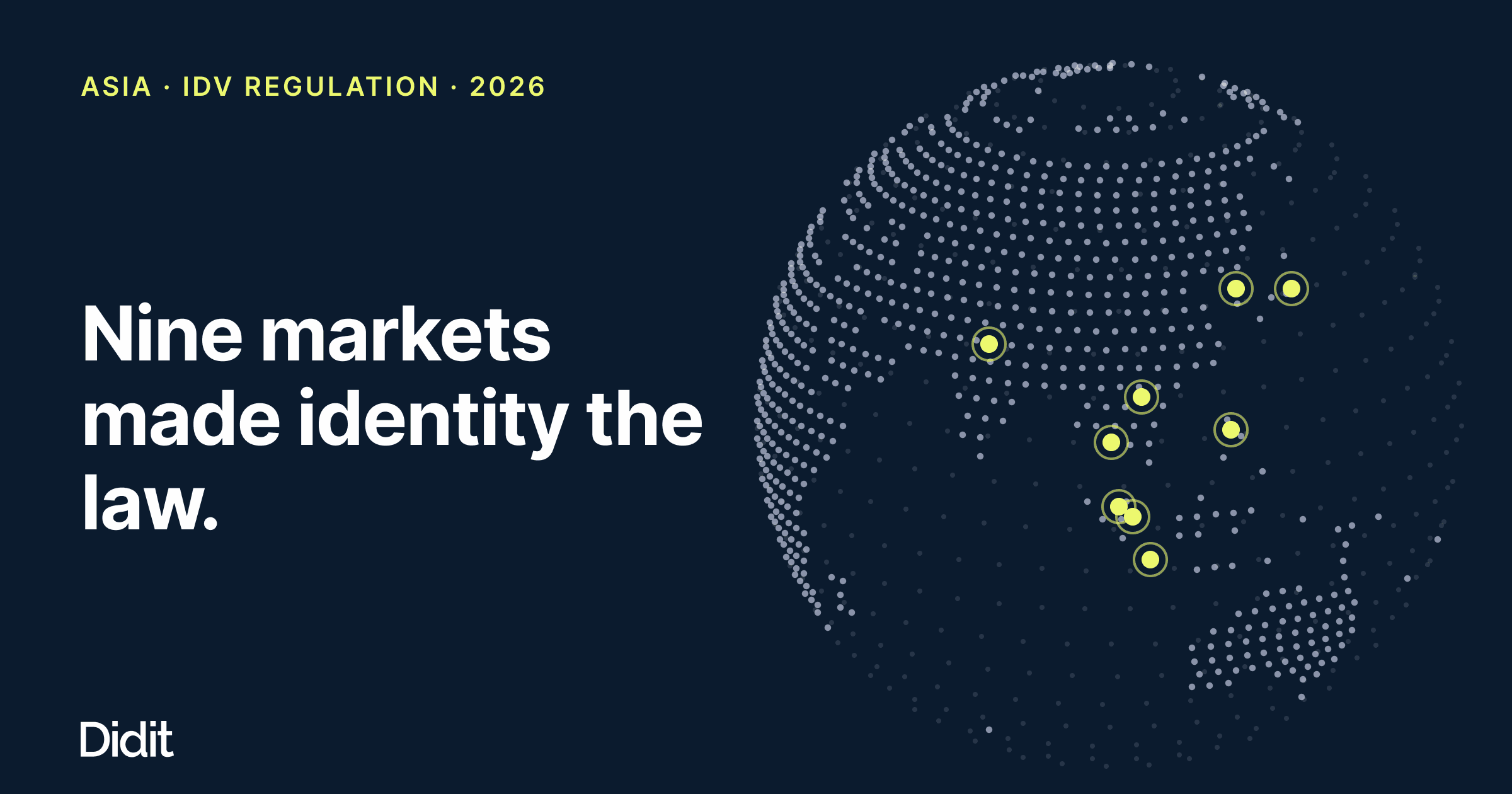
Nine Asian markets rewrote their identity rules between December 2024 and January 2026. Singapore and Thailand now make institutions pay for scam losses.
Alberto RosasAug 1, 2026Six Latin American economies rewrote their identity rules in 21 months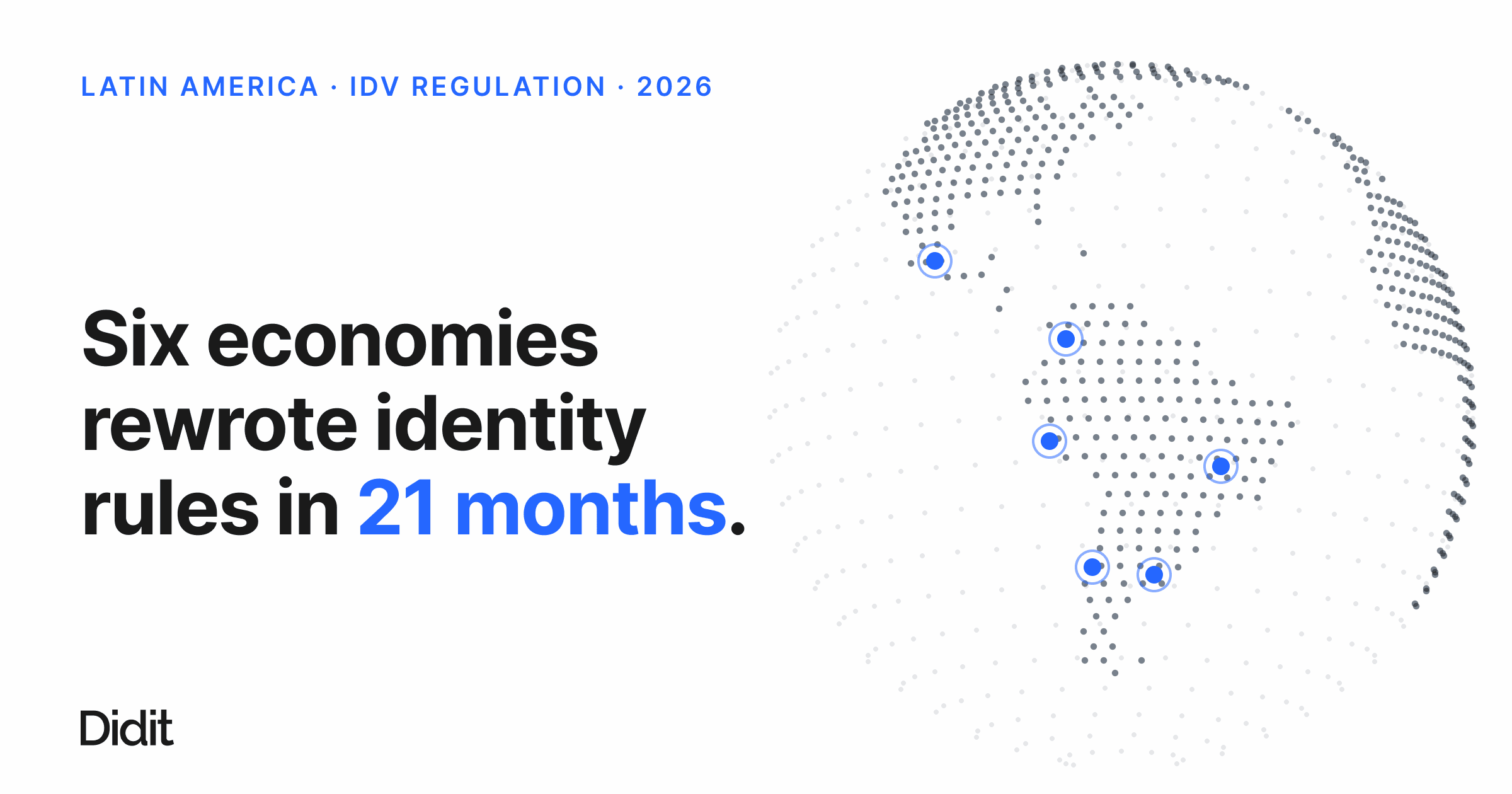
Six of Latin America's seven largest economies rewrote their identity rules between March 2025 and December 2026. Chile's regime binds 1 December.
Alberto RosasAug 1, 2026EU law lets five years pass before you recheck who owns a customer.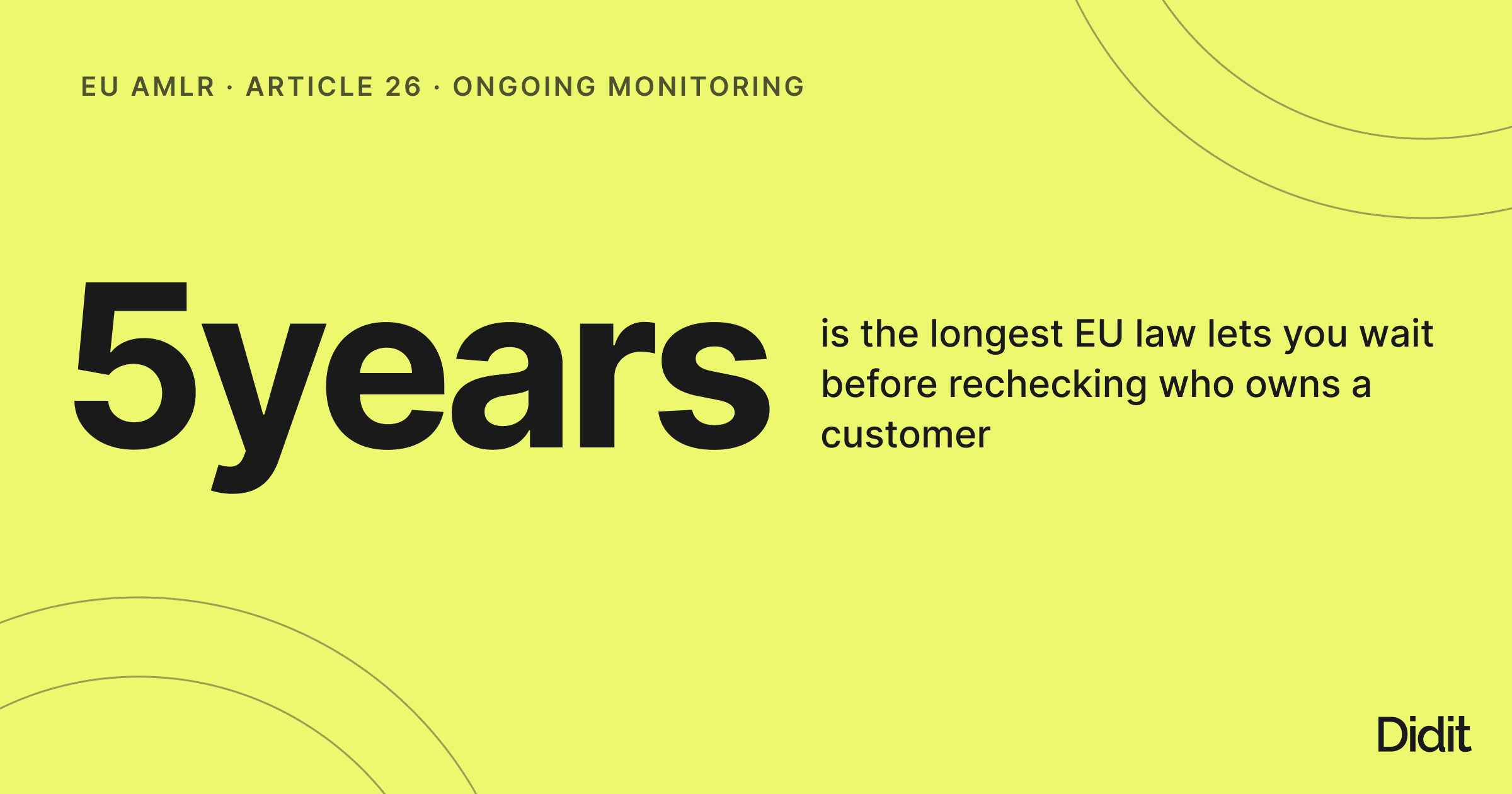
EU law caps the gap between customer information updates at five years, or one for higher risk. AMLA’s operational guidelines are still in draft.
Alberto RosasAug 1, 2026The firms reporting the most risk to the FCA report the widest control gaps.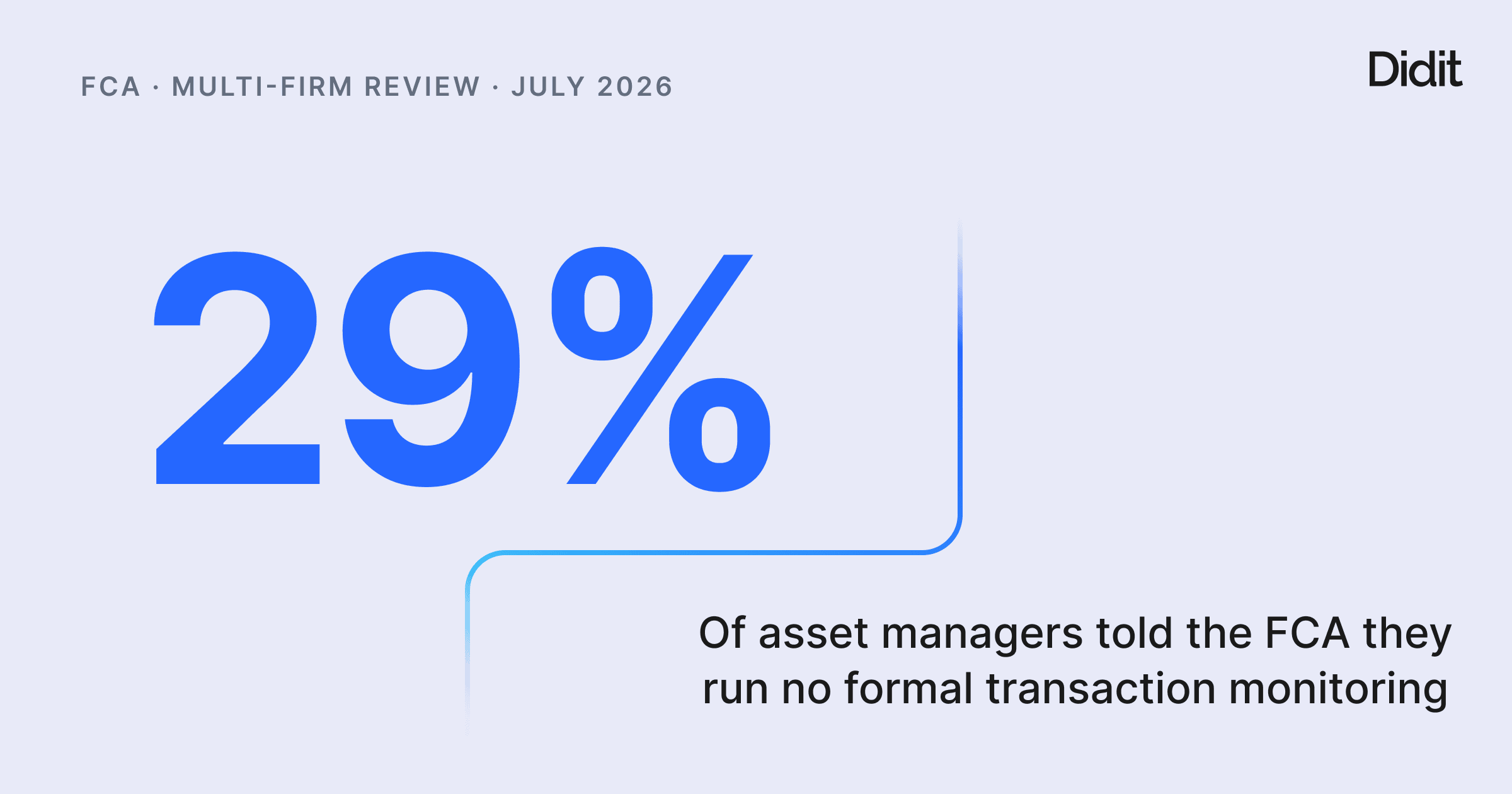
The FCA asked 242 asset management firms about financial crime controls. Private-markets firms report the most risk and several of the widest control gaps.
Alberto RosasAug 1, 2026A risk assessment that did not work cost one operator £4.75 million.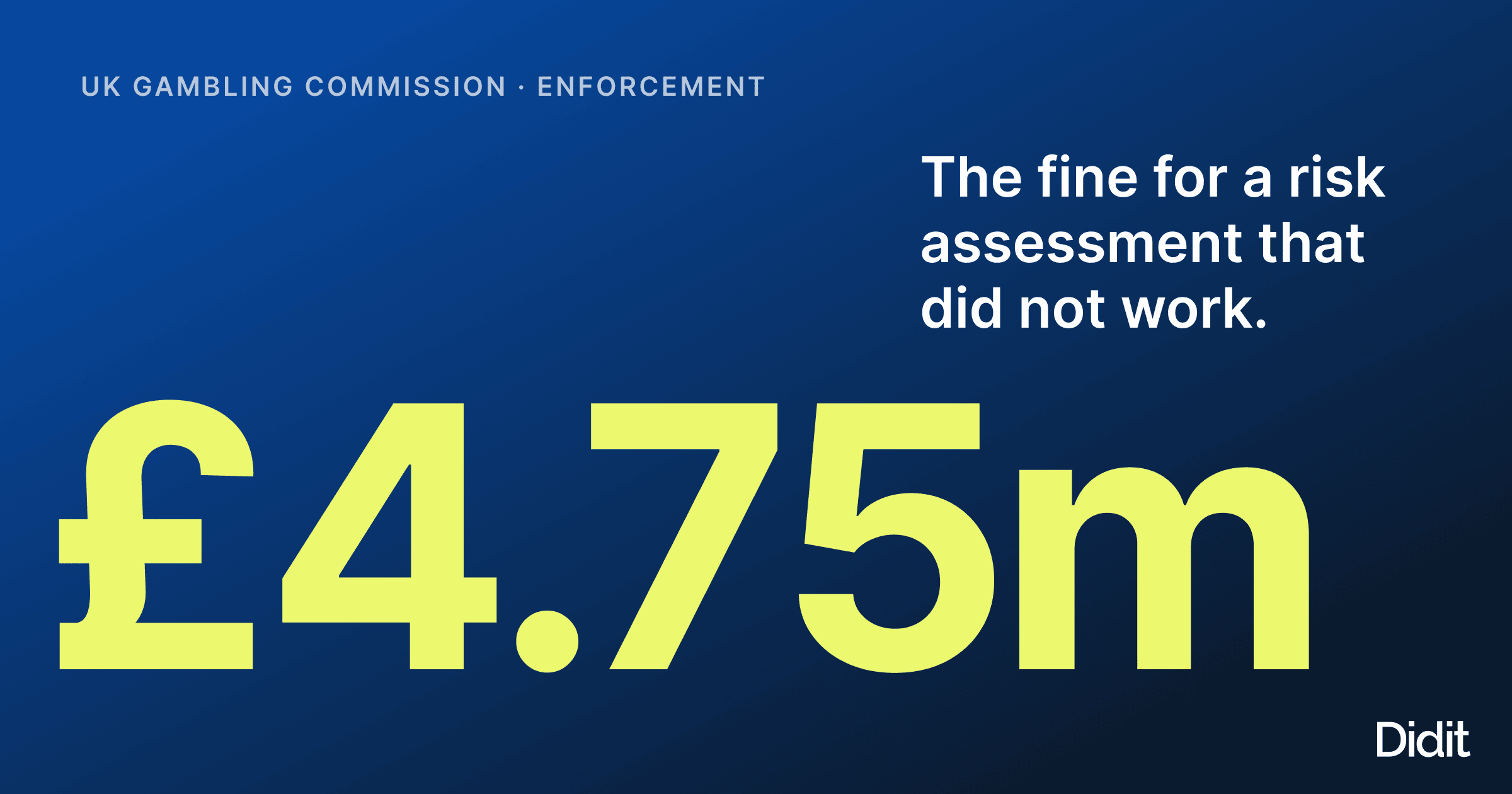
Evolution Malta will pay £4.75m after the Gambling Commission found its money laundering risk assessment did not flag two unlicensed partners.
Alberto RosasAug 1, 2026Regulators are asking prediction markets about identity, not trading.
A congressional committee and two European regulators examined prediction markets in 2026. All three landed on identity, not on trading rules.
Alberto RosasAug 1, 2026Identity Verification API Latency: Benchmarks for Fintech CTOs
Achieving sub-second identity verification API latency is critical for fintechs to optimize user experience and conversion rates. This post explores the technical factors influencing latency, provides benchmarks for key.
Alejandro RosasJul 31, 2026PEP Screening: Definitions, Scope, and Monitoring
An operational guide to politically exposed person screening: FATF definitions, foreign and domestic PEPs, family and close associates, tiering, match resolution, enhanced due diligence, ongoing monitoring, and governance.
Alberto RosasJul 28, 2026Enhanced Due Diligence (EDD): Compliance Guide
A risk-based guide to enhanced due diligence: triggers beyond standard CDD, source of funds and wealth, approvals, ongoing monitoring, evidence, review, and governance.
Alberto RosasJul 28, 2026MRZ Explained: Machine Readable Zone Technical Guide
A technical guide to the Machine Readable Zone: ICAO 9303 TD1, TD2, and TD3 layouts, check digits, parsing pitfalls, and its relationship to NFC chips.
Alejandro RosasJul 28, 2026Age Verification Software: Buyer's Guide
A buyer-focused guide to age verification software: estimation, documents, reusable proof, regulatory drivers, accuracy, bias, privacy, testing, and procurement.
Alberto RosasJul 28, 2026Flutter SDK: Add Identity Verification to Your App
A developer guide to adding identity verification to a Flutter app with the Didit SDK: native setup, backend-created sessions, Dart result handling, typed errors, webhooks, testing, security, and release operations.
Alejandro RosasJul 28, 2026W3C Decentralized Identifiers (DIDs) Specification
A technical explanation of the W3C DID Core specification: identifier and DID URL syntax, subjects, controllers, DID documents, methods, resolution, verification relationships, services, privacy, and Verifiable Credentials.
Alberto RosasJul 28, 2026Adverse Media Screening: Process, Tuning, and Risks
An operational guide to adverse media screening: regulatory context, source quality, matching, triage, false positives, tuning, ongoing monitoring, testing, and governance.
Alberto RosasJul 28, 2026KYC Software Buyer's Guide and Evaluation Criteria
Evaluate KYC software against your customer, evidence, risk, integration, review, security, accessibility, and cost requirements with practical procurement criteria.
Alberto RosasJul 28, 2026FIDO2 Explained: WebAuthn, Passkeys, and SecurityA technical guide to FIDO2: WebAuthn and CTAP roles, registration and authentication ceremonies, passkeys, phishing resistance, attestation, recovery, and deployment pitfalls.
Alberto RosasJul 28, 2026AML Compliance: KYC, CDD, Screening, and Monitoring
An AML operations guide to customer due diligence, beneficial ownership, KYC inputs, screening, risk rating, enhanced checks, transaction monitoring, investigations, and governance.
Alberto RosasJul 28, 2026ID Verification API: Integration and Evaluation Guide
A developer-focused guide to identity verification APIs: workflow architecture, states, webhooks, evidence, security, testing, procurement criteria, and integration mistakes.
Alejandro RosasJul 28, 2026Remote eKYC: Methods, Risks, and Compliance
A definition-first guide to electronic KYC: remote identity evidence, digital onboarding, fraud controls, regulatory expectations, evaluation criteria, and implementation pitfalls.
Alberto RosasJul 28, 2026VPN and Proxy Detection: Signals, Limits, and Policy
A practical guide to VPN and proxy detection: network types, IP and device signals, residential proxies, measurement, false positives, implementation, and risk-based policy.
Alejandro RosasJul 28, 2026Liveness Detection: Methods, Metrics, and Testing
A technical guide to biometric liveness detection: active and passive methods, presentation and injection attacks, PAD metrics, testing, deployment, and common evaluation mistakes.
Alejandro RosasJul 28, 2026Deepfakes Explained: Types, Detection, and Defense
A practical guide to deepfake images, video, and audio: how they are made, how identity attacks use them, how layered detection works, and how to evaluate defenses.
Alberto RosasJul 28, 20267 KYC Verification Steps and Requirements
Follow 7 KYC verification steps, from collecting identity evidence to reviewing risk, and learn how to connect checks, decisions, and records through an API.
Alejandro RosasJul 28, 2026Japan FSA's Revised AML/CFT Guidelines (March 2026): The Risk-Based Era
Japan's FSA AML/CFT guideline revisions took effect 31 March 2026: risk-based approach, STR analytics, board accountability — and what compliance teams must do.
Alberto RosasJul 23, 2026Japan Crypto & EPISP Compliance: Travel Rule, KYC and the 2025–2027 Timeline
Japan's crypto AML timeline: EPISP Travel Rule scope (Aug 2025), FSA's revised guidelines (Mar 2026) and the April 2027 IC-chip mandate for onboarding.
Alberto RosasJul 23, 2026NFC Chip Reading vs Photo Uploads: Why Identity Verification Is Going Chip-First
Why ID verification is going chip-first: what NFC chip reading verifies, why photo uploads fail, and Japan's April 2027 IC-chip mandate.
Alejandro RosasJul 23, 2026JPKI and the My Number Card: How Japan's Public-Key Identity Verification Works
What JPKI is, how My Number card chip certificates verify identity remotely, Japan's January 2026 expansion, and the April 2027 IC-chip eKYC mandate.
Alberto RosasJul 23, 2026Japan's April 2027 IC-Chip Verification Mandate: What Changes for Remote Onboarding
From April 2027, Japan outlaws photo-based ID checks for remote account opening. What the IC-chip mandate requires, who must comply, and how to prepare.
Alejandro RosasJul 23, 2026Japan's eKYC Overhaul (2026–2027): JPKI, IC-Chip Mandates and the End of Photo-Based Account Opening
Japan is ending photo-based identity checks: the JPKI expansion since January 2026, the April 2027 IC-chip mandate, FSA AML rules, and how to prepare.
Alberto RosasJul 23, 2026NFC Passport Verification Reliability
NFC passport verification offers high reliability for Know Your Customer (KYC) processes by cryptographically validating identity data directly from the e-passport chip.
Alejandro RosasJul 22, 2026Preparing AUSTRAC Online for the New TTR & SMR Forms: A Practical Checklist
A readiness checklist for the new AUSTRAC TTR and SMR forms from 1 July 2026: gap analysis, system updates, staff training, and transition date.
Alberto RosasJul 21, 2026The New AUSTRAC SMR Form (2026): Expanded Reportable Details
AUSTRAC's new 2026 Suspicious Matter Report form explained: SMR triggers, the 3-day and 24-hour deadlines, expanded details, and how to prepare.
Alberto RosasJul 21, 2026AUSTRAC Tranche 2 for Lawyers & Conveyancers (2026)
From 1 July 2026, lawyers and conveyancers enter Australia's AML/CTF regime. A plain-English guide to designated services, CDD, reporting and deadlines.
Alberto RosasJul 21, 2026The New AUSTRAC TTR Form (2026): What's Changing and How to Prepare
A plain-English guide to AUSTRAC's new TTR form from 1 July 2026: the AUD 10,000 threshold, the 10-day deadline, and how to prepare.
Alberto RosasJul 21, 2026AUSTRAC New Forms Transition Timeline (2026–2029): What To Do By When
A quarter-by-quarter guide to AUSTRAC's new TTR and SMR forms: the 30 March 2026 cut-off, the 1 July 2026 start, and the 30 March 2029 deadline.
Alberto RosasJul 21, 2026AUSTRAC Tranche 2 for Dealers in Precious Metals & Stones (2026)
A 2026 AML/CTF guide for bullion, jewellery and precious-stone dealers: the AUD 10,000 TTR trigger, SMRs, enrolment, and KYC at point of sale.
Alberto RosasJul 21, 2026AUSTRAC Tranche 2 for Trust & Company Service Providers (2026)
What AUSTRAC's Tranche 2 reforms mean for trust and company service providers from 1 July 2026: enrolment, KYB, UBO verification, and reporting.
Alberto RosasJul 21, 2026AUSTRAC Tranche 2 for Real Estate Agencies: The 2026 Compliance Guide
From 1 July 2026, real estate agencies are captured by AUSTRAC. Learn which services are covered, enrolment, AML programs, CDD, TTRs and SMRs.
Alberto RosasJul 20, 2026UK Social Media Age Verification: New ID or Face Scan Requirements
New UK regulations, including the Online Safety Act, are pushing social media platforms towards stricter age verification. This will likely involve advanced methods like ID document checks and biometric face scans to protect.
Alberto RosasJul 17, 2026AUSTRAC Transaction Reporting Changes from 1 July 2026: New TTR and SMR Forms Explained
AUSTRAC releases new threshold transaction report (TTR) and suspicious matter report (SMR) forms on 1 July 2026 — the same day tranche 2 businesses come under AML/CTF regulation. Here is who is affected, the deadlines that matter,
Alberto RosasJul 16, 2026Composable Identity Verification: Future-Proofing Compliance
Building a composable identity verification architecture allows organizations to adapt quickly to evolving regulatory landscapes and incorporate new technologies without a complete system overhaul. This approach enhances complianc
Alberto RosasJul 16, 2026Non-Profit KYC: Ensuring Transparency and Preventing Abuse
Non-profit organizations face unique challenges in adhering to Know Your Customer (KYC) regulations while maintaining their mission. This article explores how robust KYC practices can safeguard non-profits from financial crime and
Alberto RosasJul 16, 2026Healthcare Identity Verification: Protecting Patients and Preventing Fraud
Healthcare identity verification is crucial for safeguarding patient data, ensuring accurate care delivery, and combating medical fraud. Implementing robust verification processes helps providers meet regulatory compliance and mai
Alberto RosasJul 16, 2026Enhancing Trust with Government Digital Identity Verification
Robust government digital identity verification is crucial for securing public services, preventing fraud, and ensuring equitable access. This article explores how advanced identity infrastructure can meet these challenges.
Alberto RosasJul 16, 2026Reverse Imaging for Identity Verification Fraud Detection: Techniques and Limitations
Explore how reverse imaging fraud detection enhances identity verification security by identifying manipulated or re-used identity documents, and understand its current capabilities and inherent limitations.
Alberto RosasJul 16, 2026Remote Work Identity Verification: Securing Collaboration
Remote work identity verification is crucial for safeguarding collaboration tools against impersonation, unauthorized access, and data breaches. Implementing robust identity checks ensures that only legitimate users access sensiti
Alberto RosasJul 16, 2026Secure Data Access Identity Verification: Protecting Sensitive Information
Implementing robust secure data access identity verification is crucial for protecting sensitive information from unauthorized access and maintaining compliance in today's digital landscape. This article explores how modern identi
Alberto RosasJul 16, 2026KYC for P2P Trading Platforms: Mitigating Fraud and Ensuring Compliance
P2P trading platforms face unique challenges in balancing user privacy with regulatory compliance and fraud prevention. Implementing effective Know Your Customer (KYC) measures is crucial for safeguarding users and the platform's
Alberto RosasJul 16, 2026Real-Time Identity Verification for Instant Payments: Speed and Security
Instant payments demand instant trust. This article explores how real-time identity verification payments solutions enable financial institutions to balance the need for speed with robust security and compliance in a rapidly evolv
Alberto RosasJul 16, 2026Streamlining Employee Identity Verification for Modern Workforces
Efficient employee identity verification is crucial for secure and compliant onboarding. This guide explores best practices and technological solutions to streamline the process for modern organizations.
Alberto RosasJul 16, 2026UK/EU Age Assurance in 2026: Choosing the Right Method for Your Business
As 2026 approaches, businesses operating in the UK and EU must navigate evolving age assurance regulations. This article explores the various verification methods available and helps you choose the right approach for your digital
Alberto RosasJul 16, 2026LATAM KYB Automation: Setting Verification Thresholds
Effectively implementing Know Your Business (KYB) automation in Latin America requires careful consideration of local regulations, data availability, and risk profiles. This guide explores how to set appropriate verification thres
Alberto RosasJul 16, 2026UK DVS Trust Framework: Setting Up Your Compliance Audit Trail
The UK Digital Verification Services (DVS) Trust Framework sets out standards for digital identity verification. Establishing a robust compliance audit trail is crucial for organizations to demonstrate adherence and maintain trust
Alberto RosasJul 16, 2026EBA MiCA Fines Framework: Calculating Your VASP's Exposure Threshold
Understanding the European Banking Authority's (EBA) MiCA Fines Framework is critical for Virtual Asset Service Providers (VASPs). This article details how to calculate your exposure threshold to navigate compliance and mitigate f
Alberto RosasJul 16, 2026Deepfake Document Attacks: Benchmarking the 2026 39X Surge and Adapting Your Defenses
Deepfake document attacks are projected to increase dramatically by 2026, posing significant threats to identity verification processes. Understanding this surge and implementing robust defenses is critical for businesses.
Alberto RosasJul 16, 2026Benchmarking KYC Conversion Rates: Identifying Friction Points and Optimizing Onboarding Flow
Understanding and improving KYC conversion rates is crucial for digital businesses. This article explores how to benchmark your performance, identify common friction points, and implement strategies to optimize your onboarding flo
Alberto RosasJul 16, 2026AMLA AML Enforcement: Setting Internal Response Deadlines
The new Anti-Money Laundering Authority (AMLA) will harmonize AML enforcement across the EU, introducing strict internal response deadlines for financial institutions. Understanding and preparing for these timelines is crucial for
Alberto RosasJul 16, 2026Reducing AML False Positives with Dynamic Thresholds
Effectively managing Anti-Money Laundering (AML) compliance requires sophisticated strategies to reduce false positives, which drain resources and delay legitimate transactions. Implementing dynamic thresholds and workflow automat
Alberto RosasJul 16, 2026Australia AML/CTF: Non-Individual Onboarding 2026 Thresholds & Documents
Australia's updated AML/CTF (Anti-Money Laundering/Counter-Terrorism Financing) regulations, effective July 1, 2026, introduce significant changes for non-individual entities. This article details the new thresholds, document requ
Alberto RosasJul 16, 2026Know Your Stablecoin Customer: FinCEN's Proposed CIP Rules Explained
FinCEN's proposed rule extends traditional Customer Identification Program (CIP) requirements to stablecoin transactions, impacting entities involved in the issuance, redemption, and exchange of these digital assets.
Alejandro RosasJul 16, 2026EBA MiCA Fines Framework: How Crypto Compliance Teams Can Prepare Now
The European Banking Authority (EBA) is developing a fines framework for the Markets in Crypto-Assets (MiCA) regulation. Crypto compliance teams need to understand these upcoming penalties and proactively adjust their strategies t
Alberto RosasJul 16, 2026Preparing for an Identity Verification Compliance Audit
Effectively preparing for an identity verification compliance audit involves understanding regulatory requirements, documenting your processes, and ensuring data integrity. This proactive approach minimizes risks and demonstrates
Alberto RosasJul 13, 2026Stopping Subscription Fraud: The Role of Identity Verification
Subscription fraud costs businesses billions annually. Effective identity verification is crucial to prevent this pervasive threat, protecting revenue and maintaining trust in your services.
Alberto RosasJul 13, 2026Privacy-Preserving Identity Verification: Balancing Compliance and User Data
Achieving compliance with identity verification regulations while safeguarding user data is a critical challenge. This article explores strategies and technologies for privacy-preserving identity verification, ensuring regulatory
Alberto RosasJul 13, 2026Securing Webhooks with Signature Verification for Identity Workflows
Learn how webhook signature verification is crucial for securing identity workflows, preventing data tampering, and ensuring the integrity of real-time notifications from identity verification providers.
Alberto RosasJul 13, 2026PSD3 SCA Identity Verification: Boosting Payment Security
The upcoming PSD3 (Revised Payment Services Directive) will reinforce the need for robust Strong Customer Authentication (SCA) in payments. Identity verification is crucial for meeting these evolving regulatory demands and enhanci
Alberto RosasJul 13, 2026DeSci Identity Verification: Ensuring Trust and Preventing Fraud
Decentralized Science (DeSci) promises a new era of open, transparent research, but it faces unique challenges in identity verification and fraud prevention. This article explores how robust identity solutions are crucial for main
Alberto RosasJul 13, 2026CDD vs EDD: When and Why to Apply Enhanced Due Diligence
Understanding the differences between Customer Due Diligence (CDD) and Enhanced Due Diligence (EDD) is crucial for effective risk management in financial services. This guide explains when and why to apply each level of scrutiny.
Alberto RosasJul 13, 2026Navigating Global Remote Work: Identity Verification for Compliance
Remote work presents unique challenges for identity verification and compliance. This article explores how to meet regulatory obligations and prevent fraud in a distributed workforce environment.
Alberto RosasJul 13, 2026Explainable AI in Transaction Monitoring: Building Trust and Auditability
Explainable AI (XAI) addresses the "black box" problem in AI-driven transaction monitoring, providing transparency into decision-making processes. This is crucial for regulatory compliance, auditability, and fostering trust in aut
Alberto RosasJul 13, 2026Streamlining B2B Marketplace KYC/KYB for Global Supply Chains
Effectively managing B2B marketplace KYC (Know Your Customer) and KYB (Know Your Business) is crucial for mitigating fraud and ensuring compliance in complex global supply chains. This article explores strategies and infrastructur
Alberto RosasJul 13, 2026AI Chatbot Identity Verification: Securing Automated Customer Service
AI chatbots are transforming customer service, but verifying user identity within these automated interactions presents unique security challenges. This article explores how to implement robust identity verification to safeguard s
Alberto RosasJul 10, 2026Quantum Computing Identity Verification: Preparing for the Post-Quantum Era
As quantum computing advances, the cryptographic foundations of current identity verification systems face an existential threat. This article explores the implications of quantum computing for identity verification and outlines s
Alberto RosasJul 10, 2026DAO Identity Verification: Bringing Trust to Web3 Governance
Decentralized Autonomous Organizations (DAOs) promise a new paradigm of governance, but anonymity can lead to Sybil attacks and regulatory challenges. Implementing robust DAO identity verification and Know Your Customer (KYC) proc
Alberto RosasJul 10, 2026Identity Verification for Account Aggregation: Securing Open Banking
Identity verification is crucial for securing account aggregation in open banking, ensuring that only authorized users access consolidated financial data and mitigating fraud risks. This article explores how robust identity checks
Alberto RosasJul 10, 2026Navigating High-Risk: Identity Verification Challenges in Cannabis and iGaming
Operating in regulated industries like cannabis and iGaming presents unique identity verification challenges. This article explores the complexities of ensuring compliance and preventing fraud in these high-risk sectors.
Alberto RosasJul 10, 2026Understanding the Fraudster's Mind: Applying Behavioral Economics to Identity Verification
This article explores how behavioral economics sheds light on the decision-making processes of fraudsters and how these insights can be applied to strengthen identity verification systems, enhancing fraud detection and prevention.
Alberto RosasJul 10, 2026Securing Supply Chain Finance: The Role of KYB in Mitigating Risk
Supply chain finance relies on robust trust. Implementing comprehensive Know Your Business (KYB) processes is crucial for mitigating risks like fraud, money laundering, and non-compliance across complex supply networks.
Alberto RosasJul 10, 2026Beyond Spoofing: Advanced Evasion Techniques in Identity Verification and How to Stop Them
Explore sophisticated identity verification evasion techniques beyond simple spoofing and learn how modern infrastructure can detect and prevent them, safeguarding against fraud.
Alberto RosasJul 10, 2026Onboarding Global Remote Talent: Secure Identity Verification for Distributed Teams
Effectively onboarding a global remote workforce requires robust identity verification to mitigate fraud and ensure compliance. This guide explores the challenges and solutions for secure identity verification for remote teams.
Alberto RosasJul 10, 2026Questions
Blog questions
Who writes the Didit blog?
Which topics does the blog cover?
Is the blog available in my language?
Where do I find product updates?
Are these posts legal advice?
How do I find posts on one topic?
Are posts dated?
Do posts link to the docs?
Is the blog the same as the docs?
Compliance built in
Audited, certified and attested.
We hold the certifications and build each country's rules into your flows, so you can launch anywhere without worrying. Security and Compliance center
- Regulation encoded into your flows
Tell us what you do and where. Didit lists the rules that apply to you, with sources, and builds the checks each country needs into one workflow.
- Ready for AMLR
Every requirement of the new EU anti-money laundering rules, from checking customers to human review, is already covered by a Didit check.
- Tested in Spain's Treasury sandbox
Spain's Treasury published its supervised sandbox report on Didit's NFC plus active liveness onboarding; SEPBLAC took part and valued the added measures positively.
- Audited, not self-declared
iBeta Level 1 and Level 2. Liveness tested under ISO/IEC 30107-3.
Your obligations · 3 regions
 SOC 2 Type 2
 ISO 27001
 iBeta Level 1 and Level 2
 EU regulator attestation
 FSM youth protection
 GDPR
 EBA remote onboarding
 MiCA compatible
 FIDO Alliance member
- AMLREU AML Regulation ready
Integration · Didit MCP
Run Didit from your own AI agent
Connect Didit to Claude, Cursor, VS Code or ChatGPT and just ask in plain words. Your agent can do anything you can do in the console, with the same permissions you have.
 Add to Claude
 ChatGPT
 Cursor
- Build workflowsDescribe the checks you need. The agent creates and publishes the flow.
- Run investigationsAsk why a session was declined, review cases, search people and companies.
- Change rulesCreate payment rules, test them on past data and switch them on.
- Pull reportsAsk for numbers, exports or the audit log.
Didit Academy


