Didit Bank Connection Lifecycle: Refresh vs Renew vs Revoke vs Delete
Refresh pulls new data into the same connection and never extends consent. Renew extends consent and keeps connection and account ids. Revoke stops access; delete erases the connection.
 Alberto RosasCo-founder and CEO
Contents
In this guide
Jump to the part you need.
This guide is for teams that already have Didit bank connections and need to keep them healthy: refresh data on demand, renew consent before it lapses, revoke access, or delete a connection and its data. Those are four separate calls with different consequences. A one-time read in the UK or Europe bills $0.79 for the bank sign-in plus $0.35 for balances and $1.30 for transactions. Ongoing access with real banks is not open yet for live applications.
Last updated: November 26, 2026. Prices checked against the live Didit price feed on November 26, 2026.
Refresh, renew, revoke and delete at a glance
| Operation | Endpoint | What it changes | Status afterwards | Billing |
|---|---|---|---|---|
| Refresh | POST /v3/bank/connections/{id}/refresh/ | Asks the bank for a sync now, inside the consent you already hold. Same connection, same account ids | Check the connection and sync-run result; status depends on the sync outcome | Covered by the monthly price of the active connection |
| Renew | POST /v3/bank/connections/{id}/renew/ | Extends the consent and sends the person to their bank once. Keeps the connection id and every account id | active again after the person signs in | Same connection, same monthly price |
| Revoke | POST /v3/bank/connections/{id}/revoke/ | Stops access. Data stays readable until consent.retain_until | revoked | No separate price line |
| Delete | DELETE /v3/bank/connections/{id}/ | Removes the connection and its data, immediately and irreversibly, when the call returns | deleted | No separate price line |
| List sync runs | GET /v3/bank/connections/{id}/sync-runs/ | Nothing. It is the audit trail of sync attempts | Unchanged | Reads never bill |
| Get one sync run | GET /v3/bank/connections/{id}/sync-runs/{sync_id}/ | Nothing. One attempt in detail | Unchanged | Reads never bill |
Start free in the sandbox at business.didit.me, with no sales call. For the product itself, read the Bank data overview and the pricing page. Developers who work from an AI assistant can connect Didit through the MCP server.
How a Didit bank connection lives
A completed Bank Link creates a connection: one person's or company's permission for your application to read one bank. The connection carries the consent dates, the sync state and the accounts. Every call in this guide acts on that object, and the status tells you which call is legal right now. The model is one line: a link creates a connection, a connection has accounts, and an account has balances and transactions.
| Status | Meaning | Data readable | Syncs |
|---|---|---|---|
pending | The link completed and the first sync is running | Not yet | Running |
active | Consent is valid and syncing is healthy or retrying | Yes | Yes |
renewal_required | The consent ended, or the bank asks the person to sign in again. status_reason says which | As last synced | No |
paused | The current month could not be paid, so syncing stops. It resumes by itself once your balance covers the month | As last synced | No |
revoked | Access was stopped by the person, the bank or you, or the read completed, or the coming month was not paid | Until consent.retain_until | No |
deleted | The connection and its data were deleted | No | No |
failed | The first read did not complete and cannot be resumed | No | No |
The status_reason field names the cause, and it is the field you branch on in code: collection_complete, consent_expired, consent_lapsed, bank_requires_sign_in, revoked_by_end_user, revoked_by_bank, revoked_by_customer, insufficient_balance, paused_by_customer (reserved, no endpoint sets it today), first_sync_failed and unpaid. A connection in failed is never read again and cannot be resumed, so the only route is a new link for the person. A connection in paused comes back on its own: when a credit reaches your wallet, or at the daily check at 05:30 UTC.

Refresh and renew solve two different problems
Refresh asks the bank for fresh data inside the consent you already hold. Renew asks the person to extend that consent. A refresh cannot move consent.expires_at by a single day, and a renewal is not how you get a transaction that landed ten minutes ago.
- Refresh when the connection is
activeand you need the last hours of movements now, instead of at the next automatic sync. Didit already syncs an active ongoing connection between one and four times a day depending on the bank, plus live syncs on demand, so a refresh closes the gap. - Renew when
consent.renew_byis close, or when the connection has already moved torenewal_requiredwithstatus_reasonconsent_expired,consent_lapsedorbank_requires_sign_in. - Do neither on a connection that has ended for good. After
consent.renewable_untilhas passed, or once the status isrevokedordeleted, the route forward is a new link, and a new connection gets new account ids.
| Connection state | Call to make | Why |
|---|---|---|
active | Refresh if you need the last hours of movements now; otherwise let the automatic sync run | The consent is valid. A refresh never extends it |
Consent close to consent.renew_by, or renewal_required | Renew | Renewal keeps the connection id and every account id. It answers 409 renewal_not_needed while more than 30 days remain |
revoked | Keep the data until consent.retain_until and erase after it, or delete now | Access has stopped. The data stays readable until the retention date, and a delete ends that |
failed | Create a new link | A failed connection is never read again and cannot be resumed |
paused | Top up the wallet | Syncing resumes by itself once the balance covers the month, or at the daily 05:30 UTC check |
Prerequisites
- An API key for your application. A full-access key reads Bank data, and so does the application's primary secret. A key with custom access reads Bank data only when its scopes name Bank data: Read for the reads, Write for refresh, renew, revoke and delete.
- The connection id, taken from the
bank.link.completedwebhook rather than from a browser, or from theconnection_idin a link you created. - The base URL
https://verification.didit.me/v3/and thex-api-keyheader, as for every Didit standalone API. - For a renewal, a way to reach the person and, ideally, a
redirect_urlon the originating link so they come back to your site. - A sandbox application with the Didit Test Bank for ongoing access. With real banks, one-time reads are open to live applications in the countries on the coverage page; ongoing access with real banks opens country by country.
Refresh a connection and prove that it worked
Read the connection before you poke it, send the refresh, then audit the attempt with the sync runs endpoints. The refresh endpoint is documented in the Bank data API reference, and the on-demand pattern is written up in refresh bank data on demand.
- Read
GET /v3/bank/connections/{id}/and checkstatus. If it is notactive, a refresh is the wrong call: go to the renewal steps below, or create a new link. - Read
consent.renew_byandconsent.expires_at. If the consent end is close, renew first, because a refresh does not buy you time. - Call
POST /v3/bank/connections/{id}/refresh/with anIdempotency-Key, so a network retry does not ask for the same sync twice. - Wait for the
bank.data.updatedwebhook, or read the connection again and followsync.next_sync_at. - Call
GET /v3/bank/connections/{id}/sync-runs/to list the attempts on that connection, thenGET /v3/bank/connections/{id}/sync-runs/{sync_id}/to open one of them. - Read the change feed from your stored cursor, so you apply only what changed. Reads never bill, so one read per webhook is enough.
export DIDIT_API_KEY="your-sandbox-key"
export CONNECTION_ID="0b9c4f1e-6a2d-4e8b-9f31-7c5d2e1a8b40"

# 1. What does the connection say right now
curl https://verification.didit.me/v3/bank/connections/$CONNECTION_ID/ \
  -H "x-api-key: $DIDIT_API_KEY"

# 3. Ask the bank for a sync now
curl -X POST https://verification.didit.me/v3/bank/connections/$CONNECTION_ID/refresh/ \
  -H "x-api-key: $DIDIT_API_KEY" \
  -H "Idempotency-Key: refresh-client-7731-20261126"

# 5. Audit it: list the sync attempts, then open one
curl "https://verification.didit.me/v3/bank/connections/$CONNECTION_ID/sync-runs/?limit=5" \
  -H "x-api-key: $DIDIT_API_KEY"
curl https://verification.didit.me/v3/bank/connections/$CONNECTION_ID/sync-runs/$SYNC_ID/ \
  -H "x-api-key: $DIDIT_API_KEY"
Expected output. The connection read returns status active, consent.renew_by in the future, and sync.next_sync_at set, because a connection with valid consent keeps its schedule. The sync runs list returns the attempts recorded for that connection, and the single sync run read returns one attempt in detail. If the list does not show the expected attempt, check the status and error fields of the sync runs it does list first, and use the connection's status and status_reason as context before you draw a conclusion about the refresh.
Renew consent before it expires
Renewal keeps the same connection id and every account id, and history continues without duplicates. That is why you renew rather than start over whenever the bank still allows it.
- Subscribe to
bank.connection.consent_expiring. Didit sends it 14, 7 and 1 day before the consent end, so you have three chances to act before anything stops. - Read the real dates on the connection:
consent.expires_at,consent.renew_byandconsent.renewable_until. The bank sets the end, up to theconsent_daysyou asked for, so never hardcode a window. - Treat a non-null
consent.renewable_untilas the test for renewability. It is null while access has not ended and whenever the connection cannot be renewed. - Call
POST /v3/bank/connections/{id}/renew/with anIdempotency-Key. - On
201, take the renew link'surland send it to the person. They see what continues to be shared and until when, sign in at their bank once, and return to yourredirect_url. - Confirm with a connection read:
statusisactiveagain,renewed_counthas increased,versionhas moved, andscopes_grantedandaccounts_grantedshow what the person agreed to this time.
curl -X POST https://verification.didit.me/v3/bank/connections/$CONNECTION_ID/renew/ \
  -H "x-api-key: $DIDIT_API_KEY" \
  -H "Idempotency-Key: renew-client-7731-20261126"
Expected output. A renewal inside the window answers 201 with a renew link. Shortened to the field you use:
{
  "url": "https://verify.didit.me/bank/link/..."
}
409 renewal_not_needed
The renewal endpoint answers 409 renewal_not_needed while more than 30 days are left on the consent. Nothing is wrong and nothing needs fixing: the connection is fine, the window has not opened, and your consent_expiring webhook will arrive later. Log it, keep the connection, and try again inside the window. Do not respond to this code by creating a new link, because that would throw away stable account ids for no reason.
409 renewal_window_expired
After consent.renewable_until, the same connection can no longer be renewed with its renewal link, and the call answers 409 renewal_window_expired. This is the one case where the lifecycle really restarts: create a new link with POST /v3/bank/links/, the person connects the bank again, and you get a new connection with new account ids. Plan against consent_expiring to reduce the chance of reaching this state on a paying client.
Revoke access without deleting the data
Revoking stops future reading and keeps what you already have, until consent.retain_until. Use it when a client leaves, when the person asks you to stop reading their bank but an audit trail or an open dispute still needs the history, or when you want the end to be attributable.
- Decide who is ending access, because
consent.ended_byrecords it, and an auditor reads that field. - Call
POST /v3/bank/connections/{id}/revoke/with anIdempotency-Key. - Confirm the connection reads
statusrevoked, and noteconsent.retain_until, the date after which the data is no longer readable through the same endpoints. - Handle the documented
bank.connection.revokedevent when it applies, and confirm the connection status isrevoked. Stop any scheduled read of that connection in your own code.
Delete a connection and its data
Deletion is immediate and irreversible: when the call returns, the connection and its data are deleted. Use it for erasure requests and for cleanup, and export anything you are contractually required to keep before you send the call, not after.
- Check that you are not merely stopping access. If the history must survive for a retention period, revoke instead of delete.
- Call
DELETE /v3/bank/connections/{id}/. - Treat a successful
DELETEresponse as the completion signal. When the call returns, the connection and its data are gone, so there is nothing to read afterwards: no accounts, no balances, no transactions, no sync runs. Do not plan a follow-up read of the deleted connection.
# Stop access, keep the data until consent.retain_until
curl -X POST https://verification.didit.me/v3/bank/connections/$CONNECTION_ID/revoke/ \
  -H "x-api-key: $DIDIT_API_KEY" \
  -H "Idempotency-Key: revoke-client-7731-20261126"

# Remove the connection and its data, immediately and irreversibly
curl -X DELETE https://verification.didit.me/v3/bank/connections/$CONNECTION_ID/ \
  -H "x-api-key: $DIDIT_API_KEY"
Inputs and outputs
| Operation | You send | You get back | Read after the call |
|---|---|---|---|
| Refresh | POST /v3/bank/connections/{id}/refresh/, your key, an Idempotency-Key | An accepted sync request | sync-runs/, then sync-runs/{sync_id}/ |
| Renew | POST /v3/bank/connections/{id}/renew/ | 201 with a renew link, or 409 renewal_not_needed, or 409 renewal_window_expired | consent.renewable_until, renewed_count, version, status |
| Revoke | POST /v3/bank/connections/{id}/revoke/ | Access stopped | status revoked, consent.ended_by, consent.retain_until |
| Delete | DELETE /v3/bank/connections/{id}/ | The connection and its data removed when the call returns. That response is the completion signal | Nothing. The connection and its data are gone |
Failure cases and recovery
| Response | What it means | What to do |
|---|---|---|
409 one_time_connection | You refreshed or renewed a one-time connection. It ended itself when its read completed, with status_reason collection_complete | Create a new link to read the bank again. The old data stays readable until consent.retain_until |
409 renewal_not_needed | More than 30 days of consent remain | Do nothing. Renew when bank.connection.consent_expiring arrives |
409 renewal_window_expired | consent.renewable_until has passed | Create a new link. The new connection gets new account ids |
401 | The key is wrong, malformed, revoked or expired | Check the key on your server, or create a new one |
403 | The key lacks the Bank data scope for that action, or the balance cannot cover the call | Add Bank data Write to the key, or top up |
404 | The connection id does not exist for that key, or is outside the key's limits | Use the connection_id from the webhook, not an id from a browser |
429 | Too many requests | Wait for the retry_after value in the body |
status failed | The first read never completed and cannot be resumed | Create a new link. A failed connection is never read again |
status paused | The current month could not be paid | Top up. Syncing resumes by itself once the balance covers the month, or at the 05:30 UTC check |
The error body carries code, message, request_id, field, next_action and retry_after. Branch on code, never on the message text, as the API errors page explains.
Paid steps and review boundaries
Reads never bill, so every connection read and sync run read above is free. A refresh on an active ongoing connection sits inside the price of that connection, which is per active connection per month, published with live access. Revoke and delete have no separate published price line. What does bill is the connect: bank sign-in starts at $0.45 per completed sign-in, while UK and Europe one-time data is priced on top of the $0.79 sign-in price, with balances at $0.35 and transactions at $1.30 as separate lines. A link nobody completes is free, and nothing is charged in sandbox. Every number is on the pricing page and in the bank verification pricing docs.

paused when a month cannot be paid and return to syncing once the balance covers it.Two review boundaries belong to your side of the contract, not to the API. First, revoke and delete are not the same decision, and delete cannot be undone, so make the retention call before the call. Second, consent is the record an auditor reads: scopes_granted, accounts_granted, ended_by, renewed_count and retain_until describe what the person agreed to and when it stopped, so keep them reproducible in your own system rather than reading them only when a question arrives. Didit publishes SOC 2 Type 2 and ISO/IEC 27001:2022 certification, and runs these checks on one API key with identity, business verification and AML screening for 4,000+ companies.
Worked cost example
Take one Spanish client on a one-time read, which is the live path with real banks today.
- Sign-in: $0.79. Balances: $0.35. Transactions: $1.30. One completed read is 0.79 + 0.35 + 1.30 = $2.44.
- The connection then reads
revokedwithstatus_reasoncollection_complete. A refresh answers409 one_time_connection, and a renewal answers the same, so fresh data means a new link: another $2.44. Two reads in the month are 2 x 2.44 = $4.88. - On the Scale plan, every Didit price is 10% lower: 2.44 x 0.90 = $2.196 per read, and 2 x 2.196 = $4.392 for the two reads.
- The same client on ongoing access in sandbox: $0 is charged. On live ongoing access the unit is the active connection per month, and those monthly prices are published with live access. In that model a refresh adds no line of its own, so five on-demand syncs in a day cost the same as one.
Sources
- Didit docs: Bank Connections, ongoing access, consent and renewal
- Didit docs: Bank Data API reference, every connection endpoint
- Didit docs: Refresh a connection
- Didit docs: Renew a connection
- Didit docs: Revoke a connection
- Didit docs: Delete a connection
- Didit docs: List sync runs and get a sync run
- Didit docs: Bank data quickstart
- Didit docs: Bank Data API overview
- Didit docs: Bank data overview, availability and coverage
- Didit docs: Bank webhooks
- Didit docs: Data, consent and deletion
- Didit docs: Bank data coverage
- Didit docs: API errors, status codes and fixes
- Didit docs: Refresh bank data on demand
- Didit docs: Bank verification pricing
- Didit pricing page, read November 26, 2026
- Didit MCP server
Next step: open the sandbox at business.didit.me, create an application and a key, and run the refresh, renew, revoke and delete calls on a Didit Test Bank connection. No sales call, and nothing is charged in sandbox.
Try it
Try this in the sandbox
Run the check this guide describes, free.
The product this post is about, taken from its topic. Run it free in the sandbox.
Author
Alberto Rosas
Co-founder and CEO

Keep reading
Other guides in the same topic.
 Didit Signed PDF Download API for KYC and KYB E-Signatures
The signed PDF is one GET on the Sessions API, using the signature step ID and the document ID that the decision already carries. It needs read:sessions, and it answers 409 when the stored file no longer matches the signed hash.
Alberto RosasNov 26, 2026 How to Monitor Didit Webhook Destination Failures (2026)
The Didit Destination Activity API returns webhook failure alerts newest first with occurrence timestamps and failure counts. Page with limit and offset, follow next until null, and alert on each destination's health status.
Alberto RosasNov 26, 2026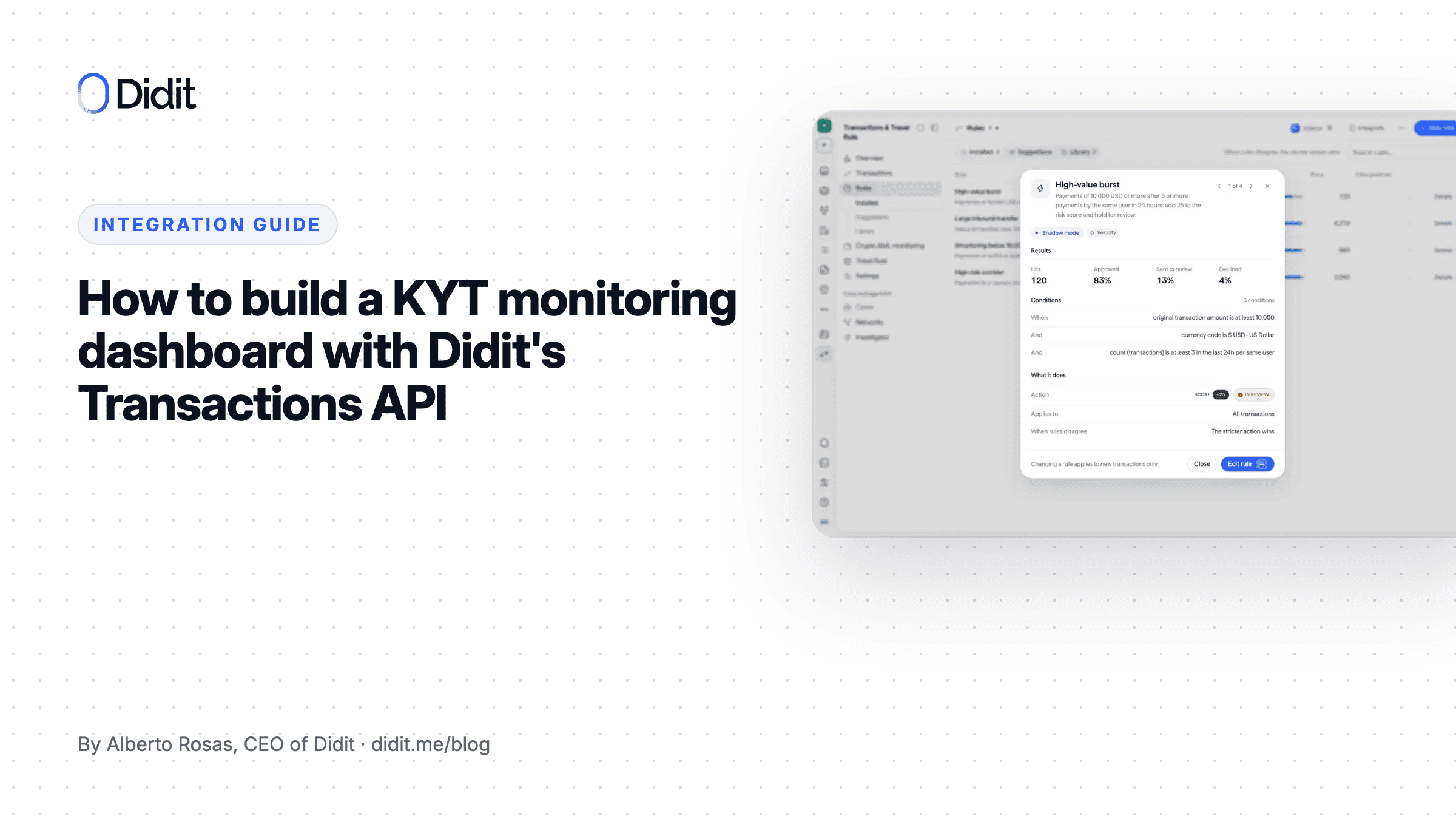 How to build a KYT monitoring dashboard with Didit's Transactions API
Didit's Transactions API lists monitored transactions newest first with score, status, parties, tags and Travel Rule state. Page with limit and offset, and take the true row count from the dedicated total field rather than the.
Alberto RosasNov 26, 2026Questions
Frequently asked questions
What is the difference between refreshing and renewing a Didit bank connection?
Refresh, POST /v3/bank/connections/{id}/refresh/, asks the bank for new data inside the consent you already hold, and keeps the same connection and account ids. Renew, POST /v3/bank/connections/{id}/renew/, extends the consent by sending the person to their bank once, and also keeps the connection and account ids. Refresh changes the data. Renew changes the date the data stops.
A connection shows renewal_required. Can I refresh it instead of renewing?
No. renewal_required means the consent ended or the bank wants the person to sign in again, and syncs have stopped, so refreshing cannot bring data back. Read consent.renewable_until: if it is not null, renew and the same connection returns to active. If it is null, create a new link.
Why does the renew endpoint return 409 renewal_not_needed?
Didit answers 409 renewal_not_needed while more than 30 days of consent remain, because a renewal then would be wasted effort and a pointless sign-in for the person. Nothing is broken. Wait for the bank.connection.consent_expiring webhook, which arrives 14, 7 and 1 day before the end, and renew inside that window.
How early should I renew an open banking consent?
Didit sends bank.connection.consent_expiring 14, 7 and 1 day before the consent ends, so you get three notifications. Act inside your own renewal process rather than treating the first one as a fixed deadline: the hard limit is consent.renew_by, and the same connection can still be renewed until consent.renewable_until. Renewing before the end means no gap in data.
What does renewal_window_expired mean and what do I do about it?
It is the 409 that comes back once consent.renewable_until has passed. The connection can no longer be renewed with its renewal link, so create a new link with POST /v3/bank/links/ and let the person connect the bank again. The replacement is a new connection with new account ids, so treat it as a fresh start in your data model.
How do I check that a refresh actually worked?
Read GET /v3/bank/connections/{id}/sync-runs/ and see whether the expected attempt is listed, then open one with GET /v3/bank/connections/{id}/sync-runs/{sync_id}/. The connection read tells you the current state through status, status_reason and sync.next_sync_at. That pair of reads is the audit, and neither of them bills.
Does renewing create a new connection id or new account ids?
No. A renewal keeps the connection id and every account id, and history continues without duplicates, which is the whole reason to renew instead of asking the person to connect again. Only a new link creates a new connection, and only then do the account ids change.
What is the difference between revoking and deleting a bank connection?
Revoke, POST /v3/bank/connections/{id}/revoke/, stops access and leaves the data readable until consent.retain_until, with consent.ended_by recording who ended it. Delete, DELETE /v3/bank/connections/{id}/, removes the connection and its data immediately and irreversibly, and the successful response is the completion signal. Revoke when you may still need the history. Delete when you must not keep it.
Can I refresh or renew a one-time connection?
No, both answer 409 one_time_connection. A one-time read ends itself when its read completes, reading revoked with status_reason collection_complete and sync.next_sync_at null. The data stays readable until consent.retain_until, and new data needs a new link.
Is a refresh or a renewal billed separately?
There is no separate price line for either call. An ongoing connection is billed per active connection per month, and that monthly unit covers automatic syncs plus live syncs on demand. Reads never bill, so the sync runs audit costs nothing. Sandbox is free, and a link nobody completes is free.
Does Didit support ongoing bank access with real banks today?
Not yet for live applications. Ongoing access with real banks is available for sandbox applications with the Didit Test Bank and opens country by country. One-time reads of real banks are open to live applications in the countries on the coverage page, and bank sign-in runs in 33 countries with the account check in 47, 57 in total.
If you work from an AI assistant, you can add Didit as a connector and keep the endpoint names above at hand:
Add Didit to Claude · Open Didit in ChatGPT · MCP setup for every client
Compliance built in
Audited, certified and attested.
We hold the certifications and build each country's rules into your flows, so you can launch anywhere without worrying. Security and Compliance center
- Regulation encoded into your flows
Tell us what you do and where. Didit lists the rules that apply to you, with sources, and builds the checks each country needs into one workflow.
- Ready for AMLR
Every requirement of the new EU anti-money laundering rules, from checking customers to human review, is already covered by a Didit check.
- Tested in Spain's Treasury sandbox
Spain's Treasury published its supervised sandbox report on Didit's NFC plus active liveness onboarding; SEPBLAC took part and valued the added measures positively.
- Audited, not self-declared
iBeta Level 1 and Level 2. Liveness tested under ISO/IEC 30107-3.
Your obligations · 3 regions
 SOC 2 Type 2
 ISO 27001
 iBeta Level 1 and Level 2
 EU regulator attestation
 FSM youth protection
 GDPR
 EBA remote onboarding
 MiCA compatible
 FIDO Alliance member
- AMLREU AML Regulation ready
Integration · Didit MCP
Run Didit from your own AI agent
Connect Didit to Claude, Cursor, VS Code or ChatGPT and just ask in plain words. Your agent can do anything you can do in the console, with the same permissions you have.
 Add to Claude
 ChatGPT
 Cursor
- Build workflowsDescribe the checks you need. The agent creates and publishes the flow.
- Run investigationsAsk why a session was declined, review cases, search people and companies.
- Change rulesCreate payment rules, test them on past data and switch them on.
- Pull reportsAsk for numbers, exports or the audit log.
Didit Academy


