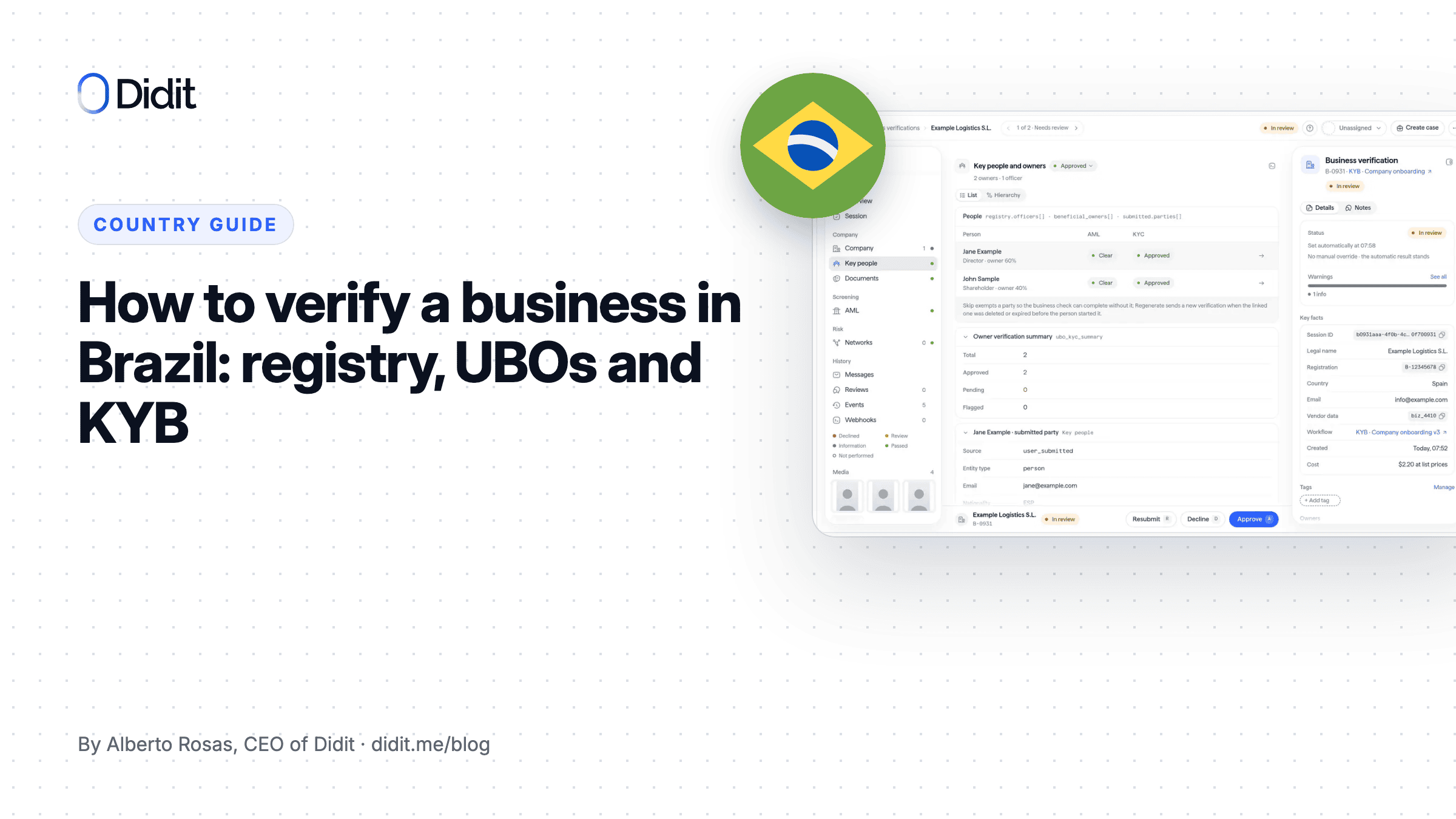
How to verify a business in Brazil: registry, UBOs and KYB
Brazilian KYB matches the company record and the CNPJ, then identifies and verifies the owners. Applicants should compare registry and CNPJ details with the relevant official records; we query the supported company registries.
 Alberto RosasCo-founder and CEO
Contents
In this guide
Jump to the part you need.
Brazil KYB comes down to two identifiers: the company's registration record and the CNPJ, which is generated only after the MAT tax-regime step. Applicants should compare registry and CNPJ information with the relevant official records. We query the supported company registries, then identify and verify the owners. Registry data starts at $2.00 per company; the caveat is ownership, so read Brazil's row in the coverage table before you promise a UBO report.
Last updated: November 26, 2026. Prices checked against the live Didit price feed on November 26, 2026.
| Question | Answer |
|---|---|
| Country code in the API | BR (ISO 3166-1 alpha-2), passed as registry_country. The returned country_code field is documented as ISO 3166-1 alpha-3, so normalize before you store or join it |
| Registers involved | Public records for comparison: the company registration file and the CNPJ generated after the MAT tax-regime step. We query the supported company registries |
| Data tiers | Lite, Shareholders, UBOs. Tier availability is listed per country in the coverage table and set per country in the workflow |
| Registry price | From $2.00 per company. Ownership tiers are priced per country, and no country in the catalog is priced below $5.00 Shareholders and $9.00 UBOs |
| People and AML | Company AML $0.20, person AML $0.20 per UBO or officer, linked full ID check $0.33 per person |
| Documents and manual entry | KYB document step $0.20; manual entry $0.75 flat when the company is not found |
| Monitoring | Configured rate $2.00 per company per year. The feature is coming soon and no country had it enabled at the September 7, 2026 check |
Start free in the sandbox at business.didit.me, with no sales call. Developers who want an assistant to run the flow can connect Didit through the MCP server. The product page is Business Verification, and every line price is on didit.me/pricing.
What has to be verified in Brazil, and the legal basis
A Brazil onboarding file is built from the integrated registration events the Redesim portals list: opening a company, alteration, closure, merger, split and incorporation, transformation or change of legal nature, and MEI (Redesim RN portal, read November 26, 2026). The Junta Comercial do Estado da Para\u00edba (JUCEP) / RedeSIM Para\u00edba portal lists the same event set and adds the Junta Comercial services a compliance team ends up asking for: certid\u00f5es, livro digital, ata and estatuto, balan\u00e7o, armaz\u00e9m geral, procura\u00e7\u00e3o and protection of the company name (JUCEP / RedeSIM Para\u00edba, read November 26, 2026). Those are the documented portal facts, and they are what a registry check can be matched against.
Two portal rules change what a Brazilian file looks like. From 01/12/2025 the CNPJ can no longer be used as the raz\u00e3o social when a company is constituted, and after the process is authenticated the legal responsible or the accountant must access MAT and choose the tax regime before the CNPJ is generated (communicados published by both portals, read November 26, 2026). For historical context, both portals also announced that the MEI, Inova Simples and Redesim systems would be closed from 21:00 on 28/11/2025 to 07:00 on 01/12/2025. That window has passed and is not current scheduled downtime. One possible consequence of the documented MAT sequence is a filing that exists before its CNPJ is generated, which is the case where a registry lookup returns nothing and manual entry carries the session.
Ownership data matters because of a reporting duty. The Manual e-Financeira Anexo VII, Orienta\u00e7\u00f5es CRS, published by the Receita Federal do Brasil (read November 26, 2026) and written as comments on IN RFB 1680/2016, specifies the information declaring financial institutions report for reportable entity accounts. Under its art. 4, where an entity account has one or more controlling persons who are reportable persons, the institution reports the entity's name, address, residence jurisdiction and NIF, plus each controlling person's name, address, residence jurisdiction, NIF, date and place of birth, and the roles that make that person a controlling person. That is a duty on the declaring institution, not a universal requirement on every KYB file, and ownership data is what lets the institution meet it.
For crypto service providers, the Secretaria Especial da Receita Federal do Brasil published a draft normative instruction and a public consultation (read November 26, 2026) proposing the Declara\u00e7\u00e3o de Criptoativos (DeCripto), which would update IN RFB 1.888/2019 and align with the OECD CARF model. In the draft, reporting is mandatory for crypto service providers domiciled in Brazil for tax purposes and for individuals or entities resident or domiciled in Brazil transacting through foreign providers, decentralized platforms or without a provider when monthly operations exceed R$ 30.000,00. DeCripto is to be filed through the Coletor Nacional system in the Centro Virtual de Atendimento (e-CAC), and the draft requires a valid ICP-Brasil digital certificate whenever e-CAC requires a signature. The draft cites art. 350, III of the Regimento Interno (Portaria ME n\u00ba 284/2020), art. 113 of Lei n\u00ba 5.172/1966, art. 16 of Lei n\u00ba 9.779/1999, art. 57 of MP n\u00ba 2.158-35/2001 and Decreto n\u00ba 8.842/2016. If your Brazilian counterparty is a VASP, its e-CAC identity and that certificate are items that sit next to the registry record, for the DeCripto filing specifically.
The registers, identifiers and what they give you
- Official records for comparison. Applicants should compare the registry and CNPJ information with the relevant official records. We query the supported company registries.
- CNPJ. The company number a Brazilian counterparty quotes. Both Redesim portals state it is generated only after the MAT tax-regime step, so a filing may exist before a CNPJ is generated.
- e-CAC and ICP-Brasil. Under the DeCripto draft, filing runs through the Coletor Nacional system in e-CAC and a valid ICP-Brasil certificate is required where e-CAC asks for a signature. These are DeCripto and e-CAC conditions, not conditions of a CNPJ lookup or of CNPJ verification in general.
- NIF. The tax residence number the CRS guidance reports for the entity and for each controlling person.
When you search in Didit, the applicant picks the country of incorporation and enters the company name, the registration number, or both, and at least one is required. Registration numbers are normalized where a registry requires it, and when both identifiers are provided the lookup combines them (Didit Company Registry API). The searched_by field on the response reports how results were matched: name, registration_number or registration_number_and_name. For a Brazilian applicant, pass the CNPJ as the registration number alongside the legal name; when both identifiers are provided the lookup combines them.
What we return for a Brazilian company
We sell the registry lookup in three tiers. Tier availability is a property of the country, not of your plan, and the coverage table lists it per jurisdiction (KYB supported countries).
| Tier | What you get |
|---|---|
| Lite | Company profile: legal name, registration and VAT numbers, legal form, status, incorporation date, registered address, activity, headcount and contact details, plus the officers |
| Shareholders | Lite plus the direct shareholders (natural persons and corporate entities) with their ownership bands |
| UBOs | Shareholders plus the ultimate beneficial owners resolved through the ownership chain |
You pay for the tier delivered. A Shareholders or UBO request in a country whose registry holds no ownership record is delivered and billed at the highest tier the country's registries can serve, usually Lite. Where the resolved chain names no natural person as a beneficial owner, because it ends in corporate entities the registry cannot trace to a person, a UBO check is delivered and billed as Shareholders (KYB registry pricing). Read Brazil's row before you write a UBO deliverable into a contract.
The registry fields come back on the decision: company_name, registration_number, country_code, company_type, registry_status, incorporation_date, registered_address, tax_number, alternative_names, legal_entity_identifier, nature_of_business, registered_capital, location_of_registration, control_scheme, contact details, addresses[], industries[], filing dates and financial_summary where the registry publishes them. Registry status is one of Active, Dissolved, Struck off, In liquidation or Dormant, and a status other than Active may be automatically flagged or declined depending on your workflow configuration.
Owners and officers land under key_people_checks[].registry.beneficial_owners[] when the registry supplies them and key_people_checks[].submitted.parties[] when the applicant confirms or adds them. Each person carries a role, and the roles you mark as requiring verification start a child full ID check automatically. The UBO threshold is a workflow setting under Risk (UBO API, Officers and representatives).

Step by step in the Business Console
- Open Workflows, create a workflow and choose Business Verification as the type. Enable company registry lookup (required), company AML, Key People and documents.
- Open the KYB Registry Check settings, Countries tab. Every country starts at Lite. Keep Brazil enabled and raise the tier only where you will act on ownership data, because you pay for the tier delivered.
- Open Key People in the same workflow and set which roles require a full ID check, which are skippable, and which KYC workflow each role maps to. Set the UBO threshold under Risk.
- Create the session and send the hosted link to the company admin.
- The admin selects Brazil, enters the legal name and the CNPJ, and confirms the company from the results.
- They confirm or add key people. Each person whose role requires verification gets a child session, and the parent sits at Awaiting User until those complete.
- Read the decision and branch on it: Approved, Declined, In Review or Resubmitted.

Step by step through the API
KYB runs on the same session endpoint as KYC. Pass a KYB workflow id and the session is flagged as a business session automatically. If you already know the company, send expected_details and the hosted flow pre-selects and locks the country, pre-fills the matching fields and runs the asserted search.
curl -X POST https://verification.didit.me/v3/session/ -H "x-api-key: YOUR_API_KEY" -H "Content-Type: application/json" -d '{"workflow_id":"YOUR_KYB_WORKFLOW_ID","vendor_data":"biz-br-0001","expected_details":{"company_name":"Example Comercio Ltda","registry_country":"BR","registration_number":"00000000000000"}}'The response carries session_id, session_number and url. Deliver the url to the business contact. When the session reaches a terminal status we post a status.updated event with session_kind: "business" in data; filter on that, verify the X-Signature-V2 HMAC, and then fetch the decision if you did not subscribe to webhooks.
curl https://verification.didit.me/v3/session/SESSION_ID/decision/ -H "x-api-key: YOUR_API_KEY"If you only want the registry record and no hosted flow, the standalone endpoints are sold one per tier: select for Lite, shareholders and ubo. Standalone API searches can incur a $0.50 fee per successful request. The full integration paths are in the KYB quickstart and the integration guide.
Worked cost example
This is a generic $2.00 minimum-price illustration, not a Brazil-specific quote. Take a company onboarded through a hosted workflow with Lite registry data, company AML on, two key people who each need a linked full ID check and person AML, and one document step.
- Registry, Lite at the published $2.00 minimum price: $2.00
- Company AML: $0.20
- Person AML for two people: 2 x $0.20 = $0.40
- Linked full ID check for two people: 2 x $0.33 = $0.66
- KYB documents, one step: $0.20
- Total: 2.00 + 0.20 + 0.40 + 0.66 + 0.20 = $3.46 per company
At 100 companies a month that is 100 x $3.46 = $346.00. On Scale the 10% plan discount applies to each price: $3.46 x 0.90 = $3.114, so $3.11 per company.
If the workflow asks for UBOs and Brazil delivers that tier, only the registry line changes. The $9.00 below is the generic published worldwide UBO tier price, not a Brazil-specific quote, so read Brazil's live row in the price feed before you put a number in a contract. At that published price, with the same two people verified: 9.00 + 0.20 + 0.40 + 0.66 + 0.20 = $10.46. If the company is not found and is typed in manually at the flat $0.75: 0.75 + 0.20 + 0.40 + 0.66 + 0.20 = $2.21. The delivery rule, not the request, sets the bill.
When the registry is down or has no match
A registry provider outage during company search returns 502 with code: "kyb_registry_provider_unavailable", and that attempt is not billed. In the hosted flow the business is automatically offered manual company entry instead of a retry-only error.
When the company is not found at all, the applicant submits the data manually, the session continues, and is_from_registry is set to false, billed at the flat $0.75. Ownership that is still pending does not count as a completed registry check or as an automatic approval, and the registry prefill does not block the Key People form: people can be entered manually while the ownership report finishes, and the applicant's corrections are preserved when it arrives.
Two Brazil-specific causes of a missing match are worth staging for. First, the 2025 systems closure both Redesim portals announced explains older entities with an odd paper trail: filings created around that window existed before a CNPJ was generated. Second, the MAT step: a company whose process is authenticated but whose tax regime has not been chosen may have no CNPJ yet, so a CNPJ search may not return it. Add a document request for the ato constitutivo or the certid\u00e3o in those cases.

Identifiers and fields
| Identifier or field | What it is | Where it comes from |
|---|---|---|
| CNPJ | The company number counterparties quote. Both Redesim portals state it is generated only after the MAT tax-regime step, and it can no longer be used as the raz\u00e3o social at constitution from 01/12/2025 | Applicant, checked against the portal rules |
| Registry filing | The opening, alteration or closure event recorded in the official company records | Official records, for comparison |
registration_number | Official company registration or incorporation number as the registry holds it | Registry lookup |
tax_number | Tax identification number where the registry exposes it | Registry lookup |
company_name | Legal name as registered | Registry lookup |
country_code | Country of incorporation, documented as ISO 3166-1 alpha-3 | Registry lookup |
registry_status | active, dissolved, struck off, in liquidation, dormant | Registry lookup |
incorporation_date, registered_address, company_type | Registration date, registered office, legal form as the registry reports it | Registry lookup |
legal_entity_identifier | LEI, for financial institutions and listed entities | Registry lookup |
key_people_checks[].registry.beneficial_owners[] | Owners and officers taken from the registry report | Registry report |
key_people_checks[].submitted.parties[] | People the applicant confirmed or added | Hosted flow |
| NIF | Tax residence number reported for the entity and each controlling person | Applicant, matched to the file |
| ICP-Brasil certificate | Digital certificate the DeCripto draft requires where e-CAC asks for a signature | Applicant |
One format detail is worth wiring correctly. Pass registry_country as BR, the ISO 3166-1 alpha-2 code, because that is what the coverage table and the registry check use. The returned country_code field is documented as ISO 3166-1 alpha-3. Normalize on your side before you join the two, or a stored BR will not match a returned BRA.
Sources
- Didit docs: KYB supported countries and registry coverage
- Didit docs: KYB registry pricing by country and tier
- Didit docs: Company Registry API
- Didit docs: UBO API
- Didit docs: Officers and representatives
- Didit docs: KYB quickstart
- Didit docs: KYB integration guide
- Didit pricing page
- Redesim RN portal, read November 26, 2026
- Junta Comercial do Estado da Para\u00edba (JUCEP) / RedeSIM Para\u00edba portal, read November 26, 2026
- Secretaria Especial da Receita Federal do Brasil, draft normative instruction and public consultation on DeCripto, read November 26, 2026
- Receita Federal do Brasil, Manual e-Financeira Anexo VII, Orienta\u00e7\u00f5es CRS, read November 26, 2026
Next step: open the sandbox at business.didit.me, create a Business Verification workflow with Brazil enabled, and run one company through it. There is no sales call. 4,000+ companies run on Didit, and you can add any other market to the same workflow when you need it.
Try it
Try this in the sandbox
Run the check this guide describes, free.
The product this post is about, taken from its topic. Run it free in the sandbox.
Author
Alberto Rosas
Co-founder and CEO

Keep reading
Other guides in the same topic.
 Identity Verification Methods: Documents, Biometrics, Databases, NFC
Identity verification methods are the evidence a check collects: a captured document, a biometric, an authoritative database record, an NFC chip read or a digital ID wallet sign-in.
Alberto RosasNov 26, 2026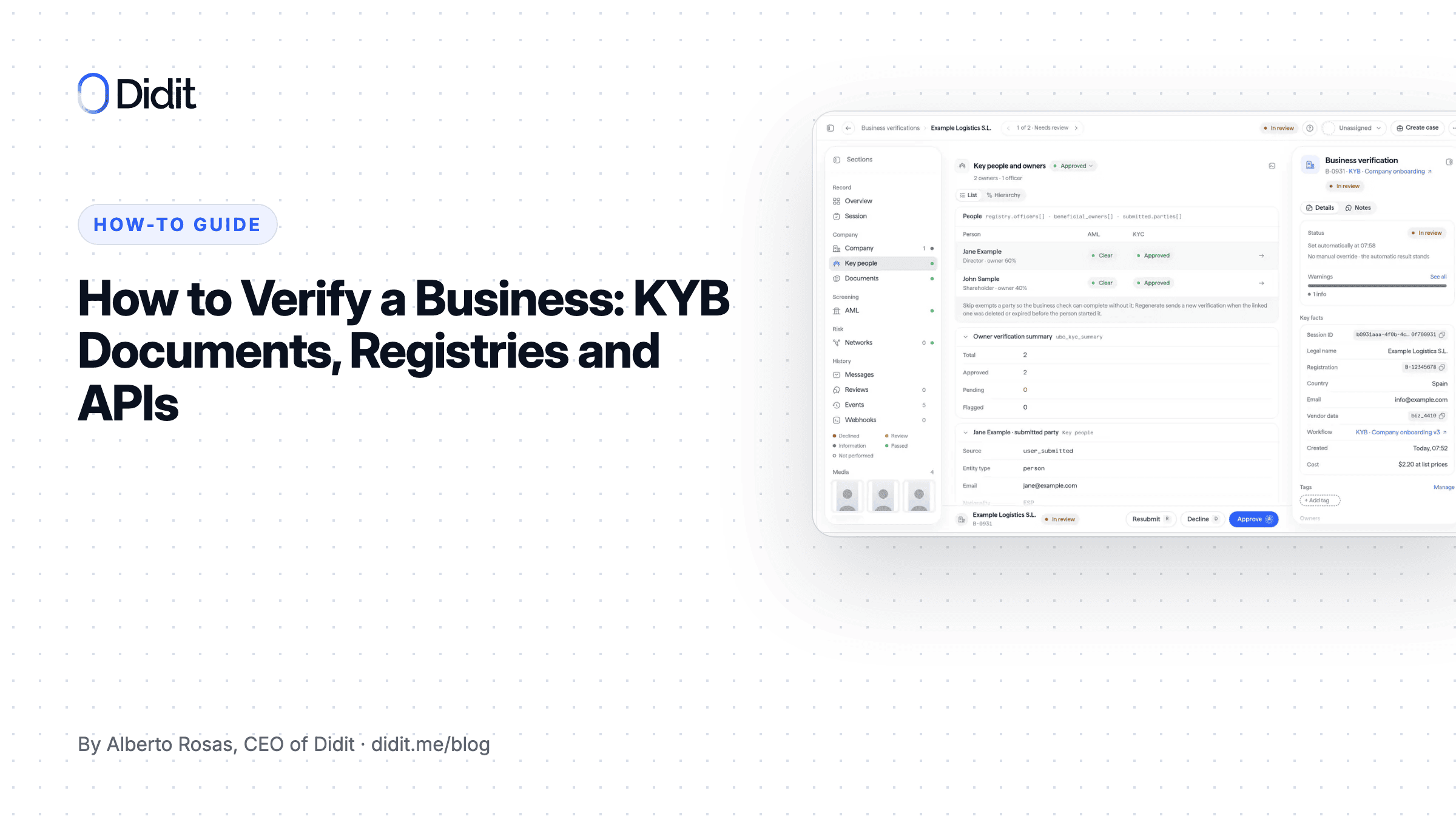 How to Verify a Business: KYB Documents, Registries and APIs
Verify a business by joining a company registry lookup, UBO and officer extraction, corporate document cross-checks and company plus person AML on one session, then acting on that session's status.
Alberto RosasNov 26, 2026 Automated KYC Checks in 8 Steps: Cut Manual Review (2026)
Automated KYC runs document capture, liveness, face match, device and IP analysis and watchlist screening, then sends only sessions that breach your rules to a human queue.
Alberto RosasNov 26, 2026Questions
Frequently asked questions
How do I verify a business in Brazil?
Match the company at the registry of record, then identify and verify the people behind it. With Didit the applicant selects Brazil, enters the legal name and the CNPJ, and confirms the company from the registry results; ownership and officers come from the registry report, and each person whose role requires it runs a child full ID check. The decision carries the registry data, the people, AML hits and per-feature statuses.
What is a CNPJ and does Didit check it?
The CNPJ is the company number Brazilian counterparties quote, and both Redesim portals state it is generated only after the MAT tax-regime step. We search on the registration number, the company name, or both combined, and normalize the number where a registry requires it. The registry record also returns tax_number where the registry exposes a tax identifier.
Does Didit support UBO checks for Brazilian companies?
Tier availability is a property of the country, so read Brazil's row in the KYB supported countries table before you commit to a UBO deliverable. If the registry holds no ownership record, a Shareholders or UBO request is delivered and billed at the highest tier the country can serve, usually Lite. If the resolved chain ends in corporate entities with no natural person, a UBO check is delivered and billed as Shareholders.
How much does a Brazil business verification cost?
Registry data starts at $2.00 per company, and ownership tiers are priced per country with no country priced below $5.00 Shareholders and $9.00 UBOs. On top of the registry line you pay $0.20 for company AML, $0.20 per person for person AML, $0.33 per linked full ID check and $0.20 per document step. Manual entry when a company is not found is a flat $0.75, and the $9.00 UBO figure is the generic published tier price, so confirm Brazil's live row before quoting it.
What happens if the Brazilian registry is unavailable?
A provider outage returns HTTP 502 with the code kyb_registry_provider_unavailable, and that attempt is not billed. In the hosted flow the business is offered manual company entry rather than a dead end. Portal downtime also matters in Brazil: both Redesim portals announced a closure of the MEI, Inova Simples and Redesim systems from 21:00 on 28/11/2025 to 07:00 on 01/12/2025, which is historical context rather than a current schedule.
Can an applicant type a Brazilian company in manually?
Yes. If the company is not found in the registry, the applicant submits the company data manually, the session continues, and is_from_registry is set to false. Manual entry is billed at the flat $0.75, and the Key People step still runs, so the people are identified and verified even without a registry record.
Which country code does Didit use for Brazil?
Pass BR, the ISO 3166-1 alpha-2 code, as registry_country on the session or inside expected_details. That code is also used on the registry check and on business entity fields. The returned country_code field is documented as ISO 3166-1 alpha-3, so normalize between the two formats before you store or compare them.
Is registry monitoring available for Brazil?
Not yet. Registry monitoring is coming soon, and at the September 7, 2026 check no country in the KYB price list had it enabled. The configured rate is $2.00 per company per year. When it ships it applies to companies verified at the Shareholders or UBO tier, is enabled per workflow, and a change sends the session back to review with a data.updated webhook carrying trigger: "kyb_registry_change".
Does Didit screen a Brazilian company and its owners for sanctions and PEPs?
Yes, as separate priced lines. Company AML screening is $0.20 per check against 1,300+ lists, and person AML is $0.20 per UBO or officer. Results arrive in the aml_screenings[] array of the decision next to the registry data, so an analyst reviews the company record and the screening hits together.
What if the Brazilian company status is not active?
registry_status returns Active, Dissolved, Struck off, In liquidation or Dormant. A status other than Active may be automatically flagged or declined, depending on how your workflow is configured. For Brazil, compare the returned registry status with the relevant official records.
Compliance built in
Audited, certified and attested.
We hold the certifications and build each country's rules into your flows, so you can launch anywhere without worrying. Security and Compliance center
- Regulation encoded into your flows
Tell us what you do and where. Didit lists the rules that apply to you, with sources, and builds the checks each country needs into one workflow.
- Ready for AMLR
Every requirement of the new EU anti-money laundering rules, from checking customers to human review, is already covered by a Didit check.
- Tested in Spain's Treasury sandbox
Spain's Treasury published its supervised sandbox report on Didit's NFC plus active liveness onboarding; SEPBLAC took part and valued the added measures positively.
- Audited, not self-declared
iBeta Level 1 and Level 2. Liveness tested under ISO/IEC 30107-3.
Your obligations · 3 regions
 SOC 2 Type 2
 ISO 27001
 iBeta Level 1 and Level 2
 EU regulator attestation
 FSM youth protection
 GDPR
 EBA remote onboarding
 MiCA compatible
 FIDO Alliance member
- AMLREU AML Regulation ready
Integration · Didit MCP
Run Didit from your own AI agent
Connect Didit to Claude, Cursor, VS Code or ChatGPT and just ask in plain words. Your agent can do anything you can do in the console, with the same permissions you have.
 Add to Claude
 ChatGPT
 Cursor
- Build workflowsDescribe the checks you need. The agent creates and publishes the flow.
- Run investigationsAsk why a session was declined, review cases, search people and companies.
- Change rulesCreate payment rules, test them on past data and switch them on.
- Pull reportsAsk for numbers, exports or the audit log.
Didit Academy


