Didit vs AU10TIX: liveness, KYC and pricing compared
Choose Didit for fintech, crypto and gaming KYC: $0.33 published bundle, per-module prices, KYB, AML, monitoring and agents. AU10TIX plans are quote-based, with a $500 monthly minimum on two tiers.
 Alberto RosasCo-founder and CEO
Contents
In this guide
Jump to the part you need.
Verdict for regulated online platforms
Choose Didit if you run a fintech, crypto, gaming or marketplace product and want identity, AML and monitoring checks priced per use before you talk to anyone. One account and one record take a user from onboarding to monitoring, and every module carries a published price.
- Category price: the full KYC bundle is $0.33 per completed check (ID $0.15, passive liveness $0.10, face match $0.05, device and IP $0.03). That is $330 per 1,000 checks.[4]
- Operational breadth: government database checks in 45 countries plus a Global group, six live national digital IDs, device, IP, email and phone signals, free 1:N face search, AML with ongoing monitoring, transaction monitoring, wallet screening, Travel Rule, KYB with a linked KYC for every owner, and an Investigator agent.[4]
- Public trust: Didit is the only provider formally attested by an EU member-state government (Spain's Tesoro / Banco de España / SEPBLAC) as safer than in-person verification. It also holds SOC 2 Type 1 & 2 and ISO/IEC 27001, and serves 4,000+ production companies.[11]
Price per check and monthly budget
Didit charges per successful completed check at published unit prices. The $0.33 bundle covers ID verification at $0.15, passive liveness at $0.10, 1:1 face match at $0.05 and device and IP analysis at $0.03.[4] You can calculate your bill from the table below without asking for a quote.
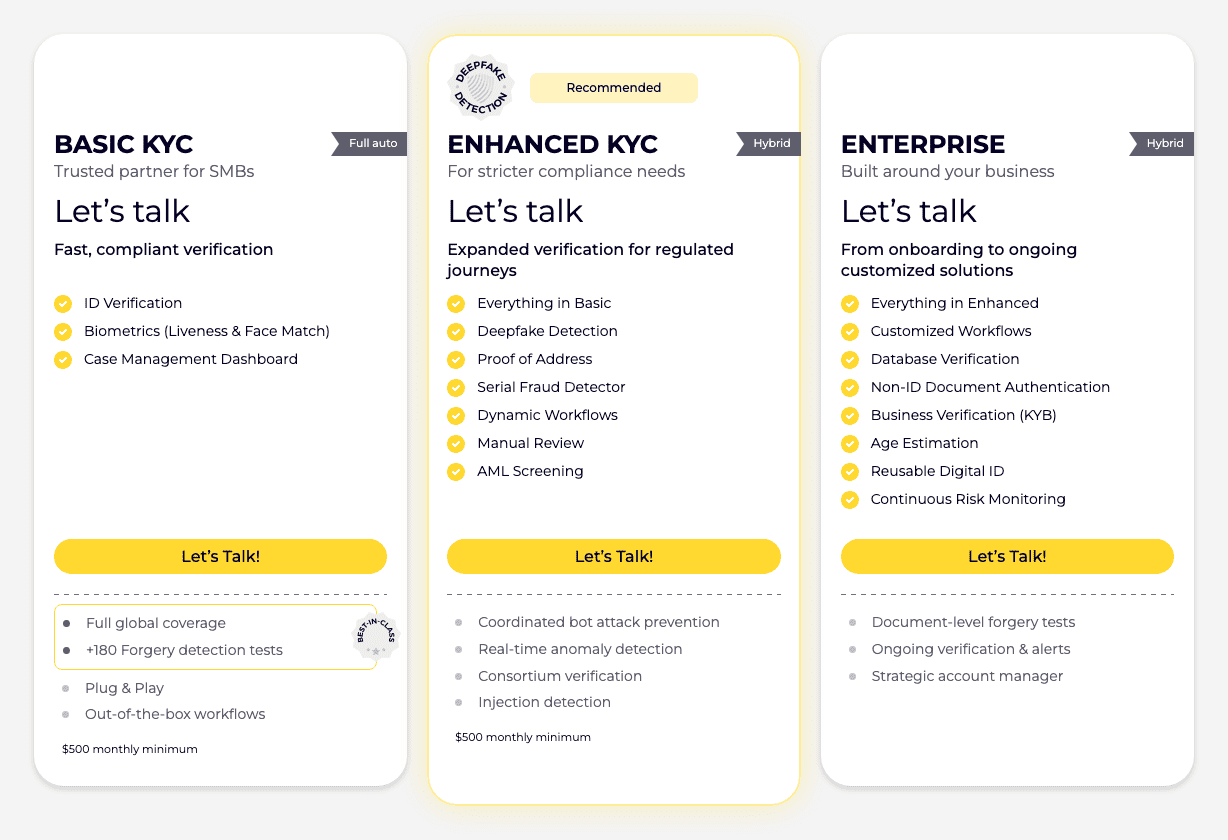
AU10TIX's pricing page, accessed 27 October 2026: “Let’s talk” on each plan and a “$500 monthly minimum” on Basic KYC and Enhanced KYC.[1]
| Monthly completed full KYC bundles | Didit total ($0.33) | Made up of (ID + liveness + face match + device & IP) | AU10TIX published pricing, accessed 27 October 2026 |
|---|---|---|---|
| 1,000 | $330 | $150 + $100 + $50 + $30 | Quote-based (“Let’s talk”) on Basic KYC, Enhanced KYC and Enterprise. A $500 monthly minimum applies to Basic KYC and Enhanced KYC; it is a floor, not a total. No per-check price is published.[1] |
| 10,000 | $3,300 | $1,500 + $1,000 + $500 + $300 | |
| 50,000 | $16,500 | $7,500 + $5,000 + $2,500 + $1,500 |
Didit figures are undiscounted USD list prices for completed bundles.[4] A 1,000, 10,000 or 50,000 AU10TIX figure comes from a written quote; ask which checks the quoted rate covers so both quotes price the same basket.
Comparable capabilities side by side
| Area | Didit | AU10TIX, as published |
|---|---|---|
| Document, liveness, face match | ID verification $0.15, passive liveness $0.10 and face match $0.05, bundled with device and IP analysis at $0.33.[4] | Basic KYC lists ID Verification and Biometrics (Liveness & Face Match), with a Case Management Dashboard (27 October 2026).[1] |
| Workflow builder | No-code builder that combines any module, branches by risk and shows each step's price while you build. | Dynamic Workflow Orchestrator (25 October 2026);[3] Dynamic Workflows listed in Enhanced KYC (27 October 2026).[1] |
| Integration | SDKs for Web, iOS, Android, React Native and Flutter, REST API and an import API for historical verifications.[10] | APIs and SDKs for web and mobile, plus white-label options (25 October 2026).[2] |
| Pricing | A published price for every module, plus a Free plan with $10 of credit every month from 1 November 2026.[13] | Plans marked “Let’s talk”; $500 monthly minimum on Basic KYC and Enhanced KYC (27 October 2026).[1] |
| Packaging of AML, KYB, monitoring | Each module priced on its own: AML $0.20, transaction monitoring $0.02 per transaction, KYB registry search free and business selection from $2.00.[4] | AML Screening listed from Enhanced KYC; Database Verification, Business Verification (KYB) and Continuous Risk Monitoring listed in Enterprise (27 October 2026).[1] |
What Didit includes, module by module
| Capability | Published price and scope | Docs |
|---|---|---|
| Full KYC bundle | $0.33: ID, passive liveness, face match, device and IP. 14,000+ document types in more than 220 countries and territories. | ID verification |
| NFC chip verification | $0.15 for e-passports and eIDs. | ID verification |
| Government database validation | 45 countries plus a Global group, run as an extra check on top of document, liveness and face match. | Database validation |
| National digital IDs | Six live schemes: MitID (Denmark), BankID Sweden (Sweden), iDIN (Netherlands), Finnish Trust Network (Finland), Smart-ID (Estonia, Latvia, Lithuania, Belgium), Mobile-ID (Estonia, Lithuania). | National digital IDs |
| Device, IP, email, phone | Device fingerprint, IP risk and VPN/proxy/Tor detection are collected during the session ($0.03 unit, included in the bundle). Email $0.03; phone $0.04 plus carrier fees. | IP · Email · Phone |
| Face search 1:N | Free, against your own users and blocklists, to catch multi-accounting and repeat fraudsters. | Face search |
| AML | $0.20 per screening (sanctions, PEP, adverse media, 1,300+ lists); ongoing monitoring $0.07 per user per year. | Pricing |
| Transaction monitoring | $0.02 per transaction, 150+ preset rules, alerts linked to the verified user. | Transaction monitoring |
| Wallet screening, Travel Rule | Wallet screening $0.15 per check; Travel Rule with IVMS 101 messaging, VASP directory and counterparty due diligence. | Pricing |
| KYB | Free registry search; selecting a business from $2.00; a linked KYC for every owner. | Business verification |
| Cases and Investigator | Four-eyes case review with every check's evidence on one record; Investigator $0.20 per reviewed item. | Investigator |
| Copilot and MCP | Copilot builds workflows, questionnaires and database validation in the console; hosted MCP server with OAuth 2.1 for your own agents. | MCP |
| Import API and SDKs | Historical verification import; Web, iOS, Android, React Native and Flutter SDKs. | Import |
Government databases and national eIDs
Didit connects national government databases directly in 45 countries plus a Global group and runs them as an extra check on top of document, liveness and face match.[6] Six national digital ID schemes are live today: MitID (Denmark), BankID Sweden (Sweden), iDIN (Netherlands), Finnish Trust Network (Finland), Smart-ID (Estonia, Latvia, Lithuania, Belgium) and Mobile-ID (Estonia, Lithuania).[7] Document capture, a national ID lookup and an eID can sit in the same flow, so each user can take the route that fits their country.
KYB with linked owner KYC
Didit's business verification covers registry data, ownership and UBOs, officers, key people, business AML, documents and risk assessment. Each owner gets a linked KYC on the same account, so a company and the people behind it are reviewed in one place.[9] Registry search is free, and selecting a business starts at $2.00.
Watch: Verify a Business (KYB), Start to Finish (Didit Academy)
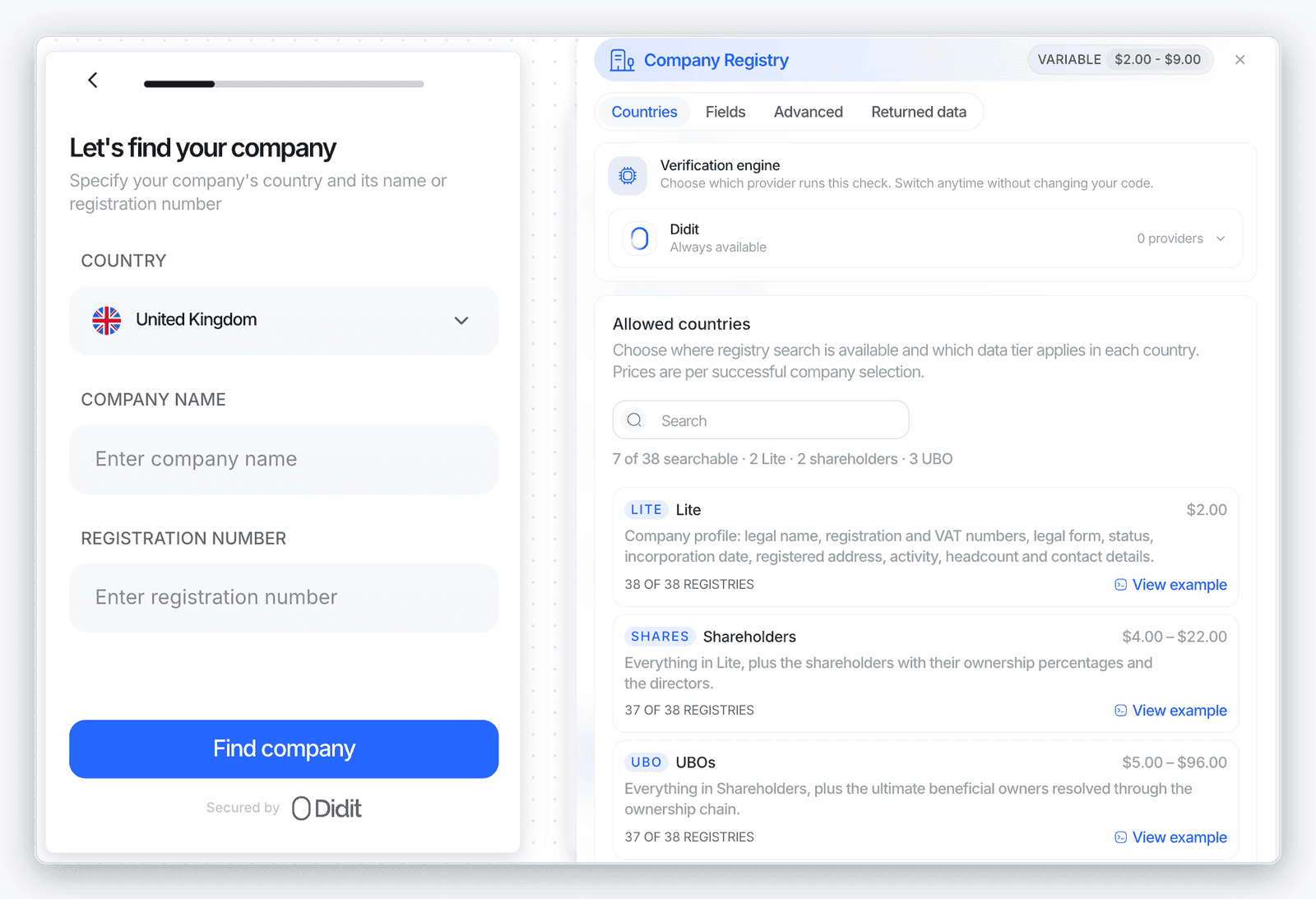
Didit's company registry configuration in the console.[9]
From onboarding to monitoring: a worked connected workflow
Real platforms do more than verify a document. They screen the person, monitor transactions and review alerts. This basket prices that chain on one record, using explicit hypothetical monthly counts.
| Scenario | Full KYC bundles ($0.33) | Initial AML screens ($0.20) | Monitored transactions ($0.02) | Investigator reviews ($0.20) | Monthly total |
|---|---|---|---|---|---|
| 1,000 new users | $330 | $200 | 10,000 → $200 | 100 → $20 | $750 |
| 10,000 new users | $3,300 | $2,000 | 100,000 → $2,000 | 1,000 → $200 | $7,500 |
| 50,000 new users | $16,500 | $10,000 | 500,000 → $10,000 | 5,000 → $1,000 | $37,500 |
Counts are hypothetical, not measured usage or predicted outcomes. Optional wallet screening adds $0.15 per wallet check.[4]
Public proof
Didit's certification page lists SOC 2 Type 1, SOC 2 Type 2 and ISO/IEC 27001, alongside the EU member-state attestation above.[11] More than 4,000 production companies use Didit, which is a separate figure from its coverage of 14,000+ document types in more than 220 countries and territories.
In AhoraCrypto's published customer story, the company reports more than 20% savings per user compared with its previous verification provider and a reduction of over 50% in time spent on manual user reviews.[12] These figures describe that customer's own experience.
Agents, Copilot and MCP
- Investigator, $0.20 per reviewed item: reads verifications, alerts and cases and writes a cited report with a recommendation. It decides alone only inside your policy and autonomy level.[14]
- Copilot: builds workflows, questionnaires and database validation in the console.
- Hosted MCP server with OAuth 2.1: lets your own agents work with Didit.[15]
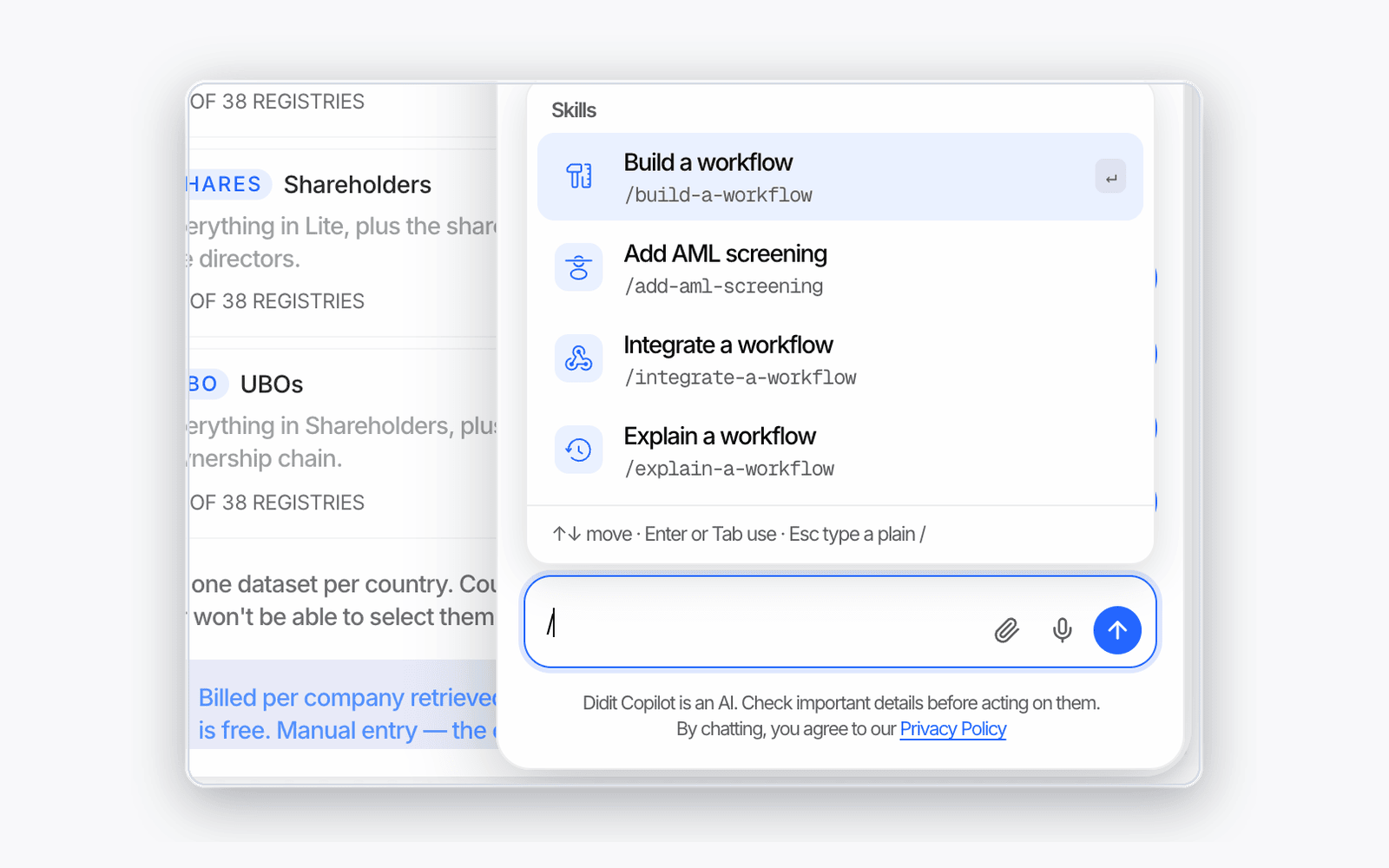
Copilot building a workflow in the Didit console.
Workflow builder and evidence
AU10TIX documents a Dynamic Workflow Orchestrator.[3] Didit's no-code builder combines any module, from document, liveness and face match to database checks, eIDs, AML and KYB. It branches by risk and shows each step's price while you build, so the monthly cost is visible before launch.
Watch: Build Your First Verification Flow (Didit Academy)
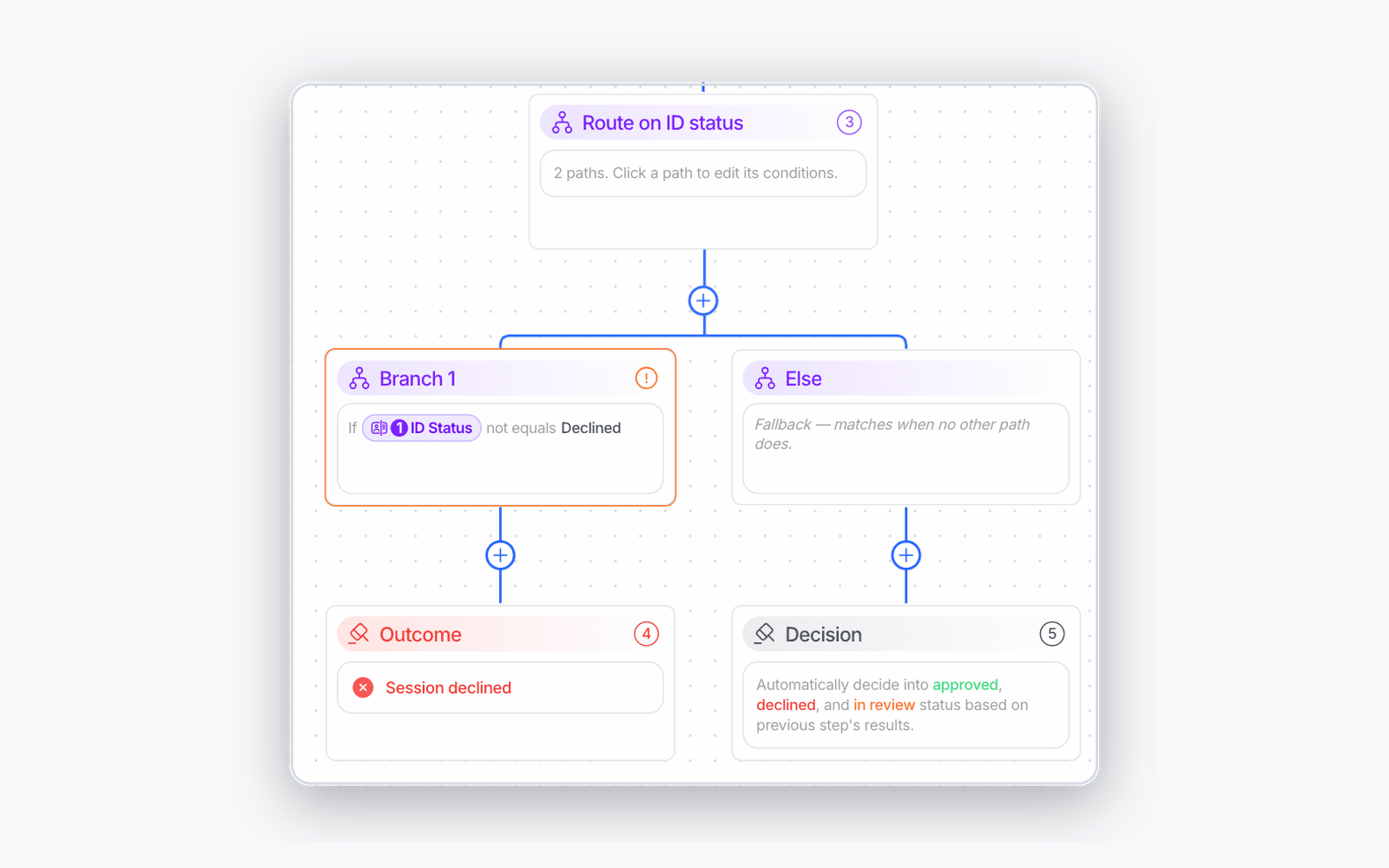
Didit's workflow builder shows the price of each step while you configure the flow.[4]
For every session, one API response returns each check's result, extracted fields, images and warnings. Compliance PDF reports and webhooks are available too.[16]
Migrating from AU10TIX
- Pilot a traffic share: send part of live traffic to Didit while your current setup serves the rest.
- Map your configuration: list your current workflows, statuses, rules, cases and webhooks, and recreate each in the Didit console, with Copilot to help build flows. This configuration is separate from importing history.
- Dry-run the history import: use the import API (
POST /v3/session/imports/) withworkflow_id,status_mappinganddry_run.[10] - Check the terminal status: a
PENDINGresponse means the import was accepted, not completed. Wait for the job to reach a terminal status. - Reconcile: compare the created, updated, skipped and failed counts with your own records.
Judge the pilot on concrete criteria:
- Completion rate and drop-off by country and device on your own users.
- Agreement between Didit decisions and your reviewers on a labelled sample.
- Manual-review volume and handling time per item.
- Cost per approved user, using the basket in your own workflow.
- Webhook and status reconciliation against your records.
- Time to configure the workflow and rules in the console.
Conclusion
For a fintech, crypto, gaming or marketplace team, Didit gives you one account and one record from onboarding to monitoring. You get KYC at $0.33, AML, transaction monitoring, wallet screening, KYB with linked owner KYC and cases, plus Investigator at $0.20 per reviewed item, Copilot and a hosted MCP server with OAuth 2.1. Open the console and start building without a sales call. A Free plan with $10 of credit every month starts on 1 November 2026, as described in the pricing announcement.[13]
Scope: the $0.33 bundle excludes NFC ($0.15), database validation, national eID checks, other modules, taxes, credits and discounts. A signed eID result does not by itself include a selfie match. Selecting a business in KYB starts at $2.00, which is not every KYB check.
Price your own volume
Build a workflow, see each step's price and test it in the sandbox.
Sources
- Pricing, AU10TIX, accessed 27 October 2026.
- KYC AI, AU10TIX, accessed 25 October 2026.
- Workflow Orchestrator, AU10TIX, accessed 25 October 2026.
- Pricing, Didit documentation, accessed 27 October 2026.
- ID verification, Didit documentation.
- Database validation, Didit documentation.
- National digital IDs, Didit documentation, verified 27 October 2026.
- Transaction monitoring, Didit documentation.
- Business verification, Didit documentation.
- Import verifications, Didit documentation.
- Certifications, Didit documentation.
- AhoraCrypto success story, Didit blog.
- New pricing from 1 November 2026, Didit blog.
- Investigator agent, Didit documentation.
- MCP server overview, Didit documentation.
- Retrieve session, Didit documentation.
AU10TIX and its trademarks belong to their respective owner; references here are nominative, provided for comparative evaluation only, and imply no endorsement or affiliation.
Try it
Try this in the sandbox
Run the check this guide describes, free.
The product this post is about, taken from its topic. Run it free in the sandbox.
Author
Alberto Rosas
Co-founder and CEO

Keep reading
Other guides in the same topic.
 Play Age Signals vs Apple Declared Age Range: full comparison
Google Play Age Signals and Apple's Declared Age Range API side by side: ranges, tiers, nulls, automatic sharing and terms, plus one age state for your backend and when to add your own check.
Alberto RosasNov 22, 2026 Play Age Signals API integration guide: v0.0.6 for Android apps
The three calls of Play Age Signals 0.0.6 in Kotlin, a decision table for every status, tier and bound, errors, migration from 0.0.3 and 0.0.4, testing, and how to start your own age check.
Alberto RosasNov 22, 2026 Age verification API: which one works on apps, web and stores
Five kinds of age verification API and where each one answers: Play apps, App Store apps, sideloads, web and desktop. With the selfie call, the hosted session, webhook checks, cost and data.
Alberto RosasNov 22, 2026Questions
Blog questions
Who writes the Didit blog?
Which topics does the blog cover?
Is the blog available in my language?
Where do I find product updates?
Are these posts legal advice?
How do I find posts on one topic?
Are posts dated?
Do posts link to the docs?
Is the blog the same as the docs?
Compliance built in
Audited, certified and attested.
We hold the certifications and build each country's rules into your flows, so you can launch anywhere without worrying. Security and Compliance center
- Regulation encoded into your flows
Tell us what you do and where. Didit lists the rules that apply to you, with sources, and builds the checks each country needs into one workflow.
- Ready for AMLR
Every requirement of the new EU anti-money laundering rules, from checking customers to human review, is already covered by a Didit check.
- Tested in Spain's Treasury sandbox
Spain's Treasury published its supervised sandbox report on Didit's NFC plus active liveness onboarding; SEPBLAC took part and valued the added measures positively.
- Audited, not self-declared
iBeta Level 1 and Level 2. Liveness tested under ISO/IEC 30107-3.
Your obligations · 3 regions
 SOC 2 Type 2
 ISO 27001
 iBeta Level 1 and Level 2
 EU regulator attestation
 FSM youth protection
 GDPR
 EBA remote onboarding
 MiCA compatible
 FIDO Alliance member
- AMLREU AML Regulation ready
Integration · Didit MCP
Run Didit from your own AI agent
Connect Didit to Claude, Cursor, VS Code or ChatGPT and just ask in plain words. Your agent can do anything you can do in the console, with the same permissions you have.
 Add to Claude
 ChatGPT
 Cursor
- Build workflowsDescribe the checks you need. The agent creates and publishes the flow.
- Run investigationsAsk why a session was declined, review cases, search people and companies.
- Change rulesCreate payment rules, test them on past data and switch them on.
- Pull reportsAsk for numbers, exports or the audit log.
Didit Academy


