
Didit vs Aware: hosted KYC API vs a biometrics platform
Didit vs Aware: hosted KYC API with transparent $0.33 bundle pricing and unified fraud signals versus Aware's quote-based multimodal biometrics and orchestration platform.
Choose Didit when biometric checks need an operational review workflow.
For teams evaluating Aware, Didit brings document verification, liveness, face matching and device/IP signals together for $0.33, with the result evidence, review cases and follow-on monitoring in one console.
- Budget from published unit prices. The $0.33 KYC bundle includes ID verification ($0.15), passive liveness ($0.10), face match ($0.05) and device/IP analysis ($0.03). Additional modules are priced separately. Didit pricing.
- Keep evidence available to reviewers. Results, extracted fields, images and warnings are available through the API, with case management and an Investigator agent at $0.20 per reviewed item. Investigator documentation.
- Evaluate documented trust controls. Didit has SOC 2 Type 1 and Type 2 reports and ISO/IEC 27001 certification. Public certification details.
Choosing between Didit and Aware depends on whether your organization needs an end-to-end hosted compliance flow or low-level biometric capture and orchestration. Aware, Inc. (NASDAQ: AWRE) provides biometric software and multi-vendor decision orchestration (Aware Decision Orchestration, checked 25 October 2026). Full compliance solutions such as AML screening, transaction monitoring, and business verification (KYB) are not documented on the Aware pages reviewed (Aware Platform, checked 25 October 2026).
Didit provides ready-to-run infrastructure for identity and fraud behind a single API and console. This guide examines how the two approaches compare on commercial predictability, technical scope, evidence handling, and migration.
Price comparison at scale
Budget predictability is often the deciding factor between hosted KYC services and proprietary biometric platforms. Didit publishes standard per-check list prices for every module, billing only for successful completed checks.
The standard Didit KYC bundle combines document verification ($0.15), passive liveness detection ($0.10), 1:1 face match ($0.05), and session-level device and IP analysis ($0.03), totaling $0.33 per completed verification. Additional modules—such as AML watchlist screening ($0.20), government database validation, national digital identity schemes, or transaction monitoring ($0.02)—are billed separately per use.
Aware states in its biometrics-as-a-service documentation that pricing may follow consumption-based or subscription models, but does not publish specific rates or tier schedules (Aware BaaS, checked 25 October 2026). aware.com (checked 25 October 2026) lists no prices and routes pricing questions to a demo request.
| Monthly verification volume | Didit list price ($0.33 bundle) | Aware pricing |
|---|---|---|
| 1,000 successful verifications | $330 | Quote-based; no public per-check price |
| 10,000 successful verifications | $3,300 | Quote-based; no public per-check price |
| 50,000 successful verifications | $16,500 | Quote-based; no public per-check price |
Budgets in USD based on published list prices for completed KYC bundles (document verification, passive liveness, face match, device & IP analysis). Taxes, credits, volume discounts, and add-on modules (such as AML screening or database checks) excluded. Aware status verified on aware.com, 25 October 2026.
Direct feature comparison
The table below compares capabilities where both platforms provide public, documented features. Where Aware does not document a capability on its public website, that row is omitted from the direct table and addressed in Didit's platform scope below.
| Capability | Didit (hosted API & console) | Aware (Awareness Platform & SDKs) |
|---|---|---|
| Document verification | Covers 14,000+ document types across more than 220 countries and territories using AI OCR and fraud checks ($0.15). (Didit Docs) | Document checking combines OCR, data validation, and fraud detection for passports, driver's licences, and national IDs. (Aware Document, checked 25 October 2026) |
| Biometric liveness | Passive liveness ($0.10 workflow / $0.05 API), plus active options ($0.15) (Didit Docs). Didit passive liveness is iBeta Level 1 and Level 2 certified for presentation attack detection (ISO/IEC 30107-3). | Intelligent Liveness offers passive presentation and injection attack detection on-device or server with sub-second response. (Aware Liveness, checked 25 October 2026) |
| Face matching & search | 1:1 face match ($0.05); free 1:N face search across prior sessions and custom blocklists to prevent repeat fraud. (Didit Docs) | Knomi mobile framework and server modules provide 1:1 verification and 1:N biometric identification. (Aware Knomi, checked 25 October 2026) |
| Workflow orchestration | Visual no-code workflow builder showing per-step pricing, dynamic branching, and risk thresholds. (Didit Docs) | Awareness Platform and Decision Orchestration manage cross-vendor biometric workflows and benchmarking. (Aware Orchestration, checked 25 October 2026) |
| Deployment model | Turnkey hosted cloud API, hosted verification links, embedded iframes, and mobile SDKs. (Didit Docs) | Available via SaaS and self-hosted server deployments, alongside client SDKs for iOS, Android, and web. (Aware Platform, checked 25 October 2026) |
| Result data & storage | Unified session response with liveness scores, facial crops, inspection images, and warning codes stored for review. (Didit Docs) | Stateless REST biometric services return computational match and liveness scores without data storage. (Aware BaaS, checked 25 October 2026) |
| Commercial model | Published per-check rates; self-serve sign-up with immediate sandbox access in the console. (Didit Docs) | aware.com (checked 25 October 2026) lists no prices and routes pricing questions to a demo request. (Aware Demo, checked 25 October 2026) |
Didit platform breadth: beyond biometric matching
Biometric matching answers whether a presenter matches a reference image. Regulated compliance and fraud defense require corroborating identity data against authoritative ledgers, monitoring watchlists, and checking device reputation. Didit integrates these layers directly on the same record:
- Authoritative government database validation: Didit links directly to official registry databases across 45 countries plus a Global group (Database Validation). Teams can validate citizen ID numbers against official sources as a standalone check or as an extra layer over document verification.
- Six live national digital identity schemes: Users can verify via sovereign digital identity methods: MitID (Denmark), BankID Sweden (Sweden), iDIN (Netherlands), Finnish Trust Network (Finland), Smart-ID (Estonia, Latvia, Lithuania, Belgium), and Mobile-ID (Estonia, Lithuania). (Digital Identity Methods)
- NFC chip verification: Direct cryptographic reading of biometric chips in e-passports and identity cards ($0.15) validates the chip's cryptographic signature, adding strong evidence against physical document forgery.
- Device, IP, and contact risk signals: Session-level device fingerprinting, proxy/VPN/Tor detection, and geolocation consistency ($0.03 unit, included in the $0.33 bundle), combined with standalone email risk ($0.03) and phone verification ($0.04 + carrier).
- Continuous compliance & KYT: AML screening against 1,300+ sanctions, PEP, and adverse media sources ($0.20), ongoing monitoring ($0.07/user/year), and real-time transaction monitoring with 150+ rules ($0.02/transaction). (Transaction Monitoring)
- Crypto wallet screening & Travel Rule: On-chain risk screening at $0.15 per check in Didit, paired with IVMS 101 messaging, VASP directory lookups, and counterparty verification. (Wallet Screening)
- Corporate verification (KYB): Automated company registry lookups starting from $2.00 per business, with free company search and linked owner KYC workflows. (KYB Docs)
Addressing buyer trade-offs: data storage and biometric breadth
For regulated onboarding and online platforms, compliance teams require structured evidence and review tooling alongside automated biometric scoring. Didit captures complete session evidence—liveness confidence scores, captured selfies, inspection video frames, extracted identity fields, and device signals—accessible via API or the Business Console.
Watch: How to Read a Verification Result (Didit Academy)
Aware provides stateless REST biometric services that return computational match and liveness scores without data storage (Aware BaaS, checked 25 October 2026). However, end-to-end compliance management, transaction monitoring, and case review tooling are not documented on the Aware pages reviewed (Aware Platform, checked 25 October 2026).
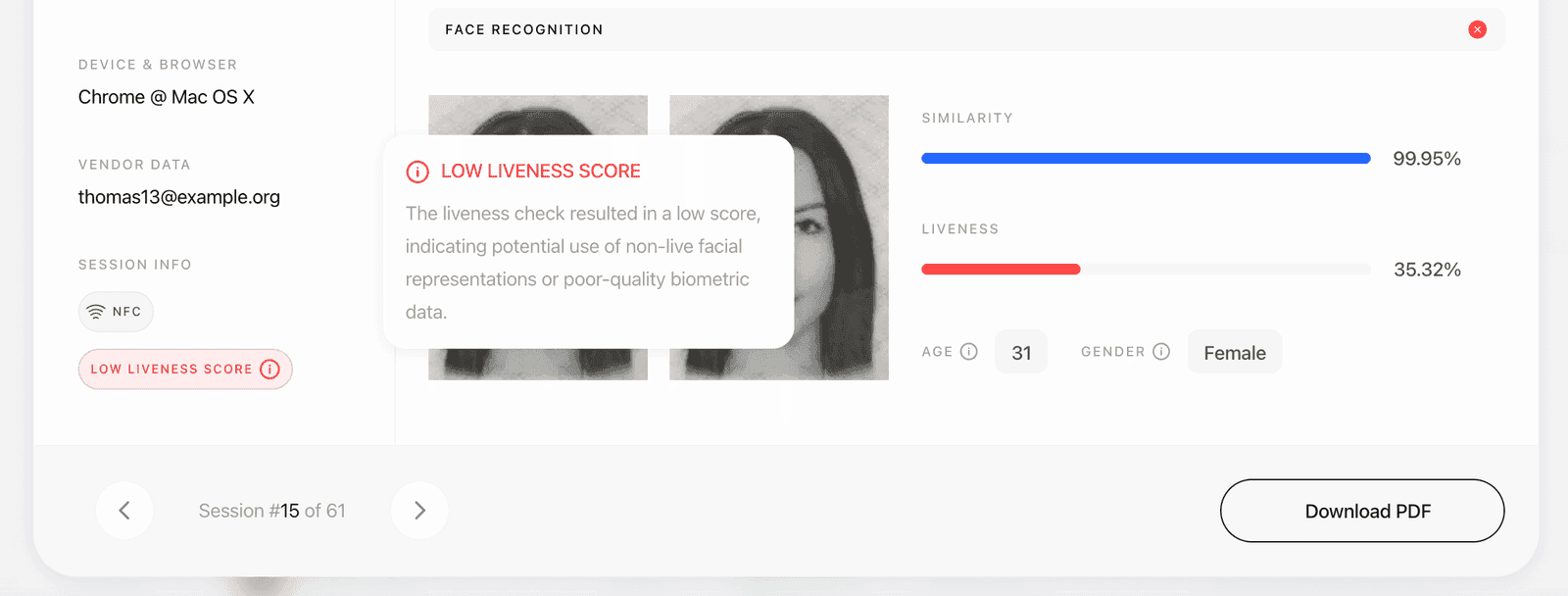
A Didit session flagged for review: liveness score, face match similarity, estimated age, and device signals presented in a single compliance view.
Furthermore, Didit runs 1:N face search across your user base inside every liveness check without added integration. If an applicant attempts to open multiple accounts or reappears on your internal blocklist, the engine flags the duplicate in the same flow.
Watch: Duplicate Account Detection (Didit Academy)
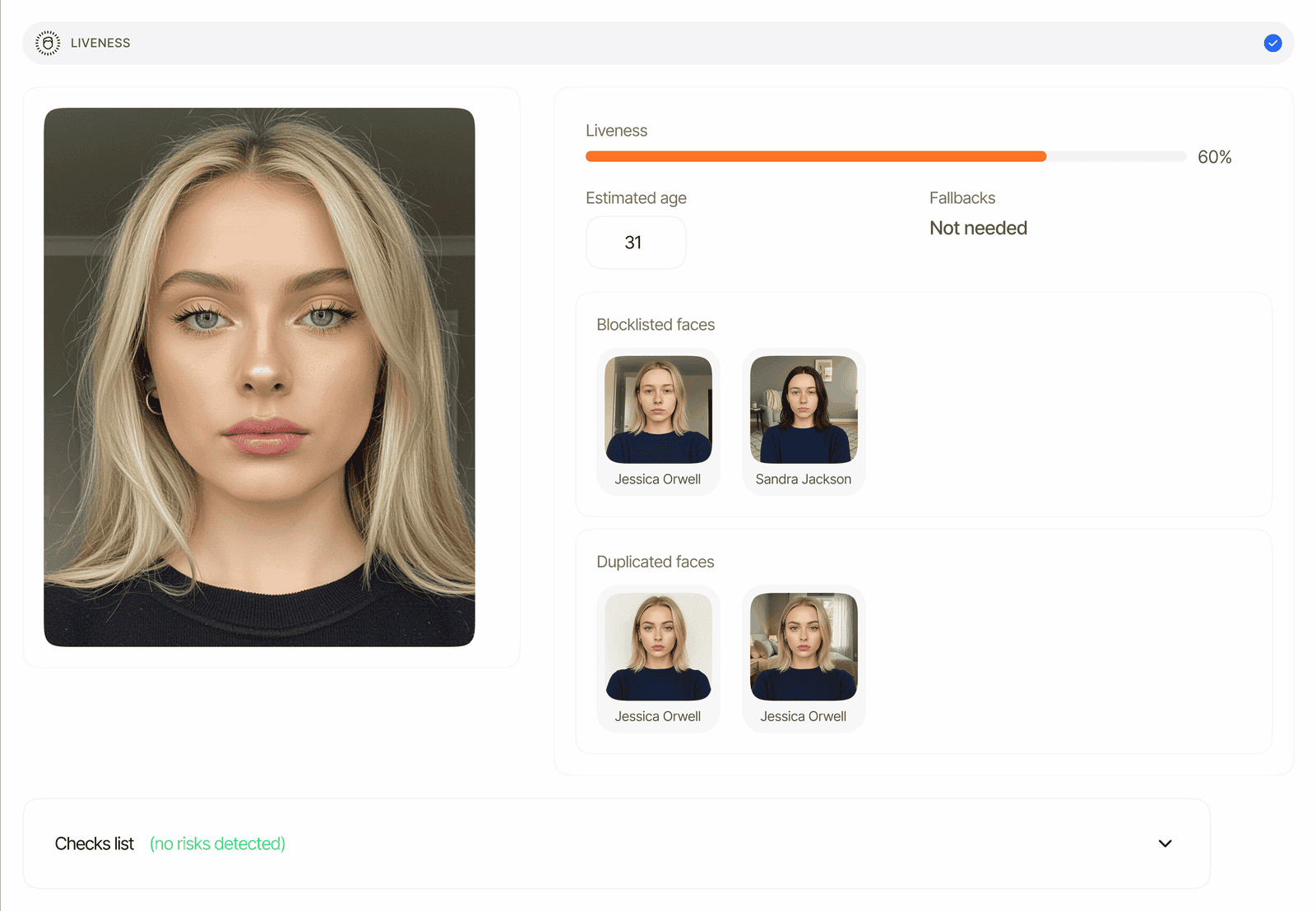
A liveness result in the Didit console highlighting matched duplicate sessions and blocklisted facial identities.
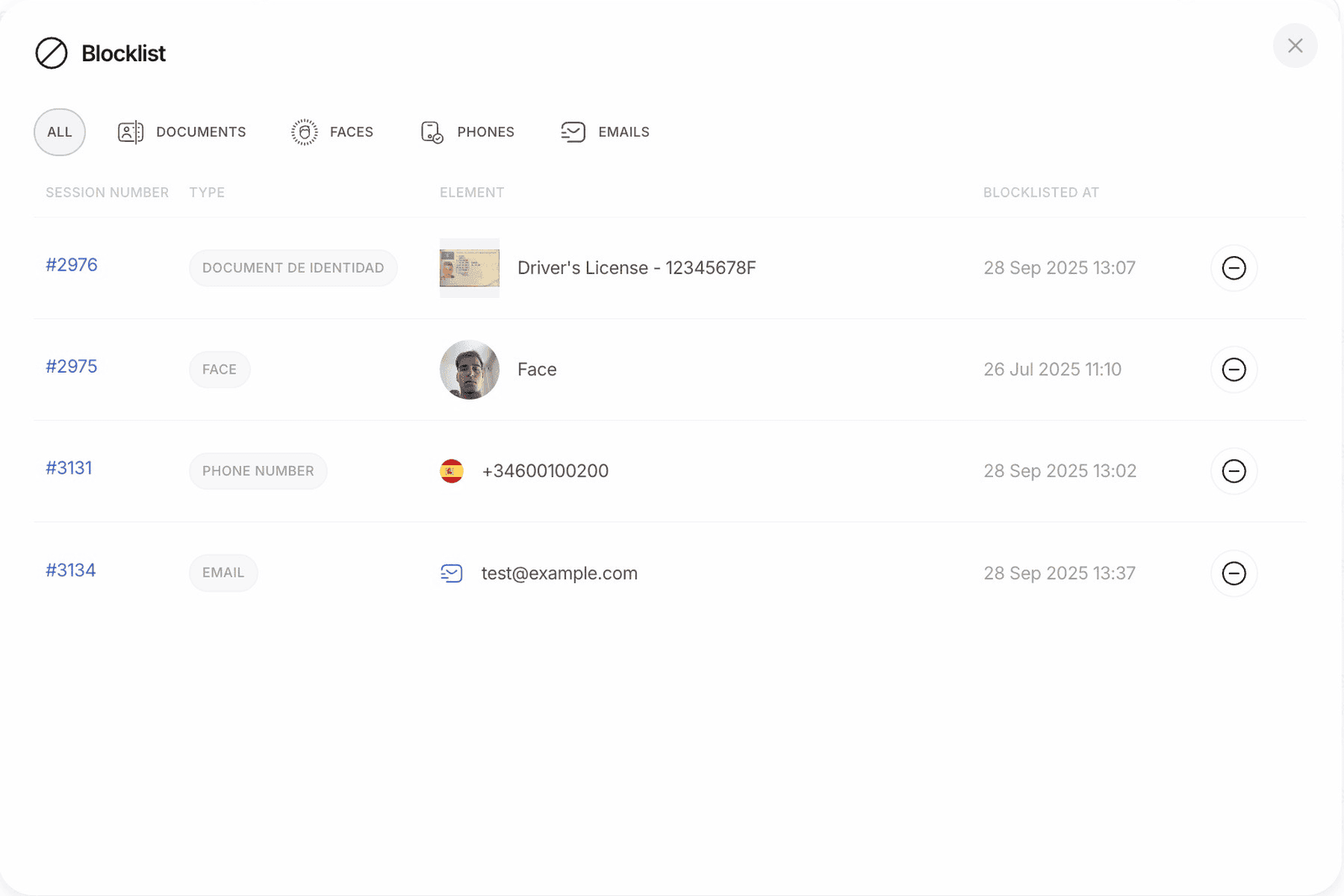
Custom lists within Didit linking blocklisted identity cards, faces, emails, and phone numbers back to original sessions.
Verified compliance and enterprise proof
Didit provides enterprise-grade regulatory attestations and operational security:
- EU member-state supervisory assessment: Spain's Treasury published the Didit sandbox conclusions (Informe de Conclusiones, accessed 27 October 2026); the supervisor records that SEPBLAC positively assessed the added safeguards for remote identification.
- Security certifications: Audited under SOC 2 Type 1 and Type 2 standards, and certified under ISO/IEC 27001 (Certifications).
- Global scale: Trusted by 3,000+ companies; covers more than 220 countries and territories across 14,000+ document types.
- Measured operational impact: In its published customer case study, digital asset platform AhoraCrypto reported achieving more than 20% savings per user compared with its previous verification provider, alongside a reduction of over 50% in time spent on manual user reviews.
Technical migration from Aware
Transitioning from an Aware integration to Didit does not require a risky cutover. Engineering teams can run a staged migration while reconciling historic records.
- Step 1Concept mappingMap Aware biometric workflows and decision logic to Didit workflows, automated rules, and webhook subscriptions.
- Step 2Parallel traffic splitDeploy Didit SDKs or hosted redirect links across a pilot percentage of onboarding sessions to validate completion rates.
- Step 3Historical verification importMigrate historic user verification records via the import API to maintain identity continuity.
- Step 4Full cutoverRoute all traffic to Didit once verification metrics and reconciliation counts align.
Concept mapping reference
| Aware component | Didit counterpart | Implementation notes |
|---|---|---|
| Awareness Platform workflow | Didit Workflow Orchestrator | Visual no-code flows configure check sequencing, document fallbacks, and risk thresholds. |
| Knomi capture SDK | Didit Web & Mobile SDKs | Drop-in native libraries (iOS, Android, React Native, Flutter) and web SDK or hosted redirects. |
| Decision Orchestration rules | Didit Rule Engine & Actions | Define automatic approval, rejection, or manual review routing based on warning codes. |
| External data store | Didit Cases & Audit Logs | Evidence, raw images, and warnings stored on the unified record; reviewable in the Business Console. |
Migrating historic verifications via API
Teams holding historic verification records can migrate them using the import verifications API (POST /v3/session/imports/). Historical verification records are imported with workflow_id and status_mapping after a dry run.
Setting dry_run: true validates file formatting and schema matching before writing data. The endpoint returns a PENDING response indicating acceptance; your backend then polls the import job until it reaches a terminal state. Reconcile the returned created, updated, skipped, and failed record counters before switching traffic. Workflows, business rules, and cases are configured directly within Didit.
Unified operations with AI agents
Didit eliminates fragmented vendor stacks by linking the complete customer lifecycle from onboarding to ongoing monitoring on one account. When edge cases arise, compliance operations scale without headcount bottlenecks:
- Investigator AI agent: For $0.20 per reviewed item, the Investigator agent evaluates complex flags across documents, biometric checks, and watchlist alerts, compiling a cited audit narrative with a recommendation based on your risk policies (Investigator Docs).
- Console Copilot: An AI assistant embedded in the Business Console to help risk teams construct custom verification workflows, configure questionnaires, and deploy database rules.
- Hosted MCP server: A Model Context Protocol server secured via OAuth 2.1 that connects external autonomous agents to Didit's identity and monitoring data.
- Self-serve activation: Teams can configure workflows and begin testing immediately in the Business Console with transparent pay-per-check pricing. As announced in Didit's public pricing update, from 1 November 2026 the Free plan includes $10 of credit each month (pricing details).
Start building with transparent per-check pricing
Create an account in minutes, explore workflows in the sandbox, and inspect full biometric and document evidence directly in the console.
Related articles
- Didit vs ID R&D: IDLive Face liveness or a hosted KYC API
- Didit vs TECH5: a hosted KYC API vs biometrics for ID programmes
- Didit vs Trust Stamp: published prices vs a quote-led KYC suite
- Didit vs FaceTec: Hosted Liveness, Full Evidence, Published Prices
- Didit vs Nametag: customer KYC API vs workforce identity checks
- Didit vs Keyless: verifying new users vs biometric login